Showing posts with label Rwanda. Show all posts

On February 3

On this day in ...
... 2006, the International Court of Justice issued a judgment concluding by a vote of 15 to 2 that it had no jurisdiction to consider an application that the Democratic Republic of Congo had lodged 4 years earlier, in which it alleged that Rwanda, one of its neighbors to the east (map credit), had committed
'massive, serious and flagrant violations of human rights and of international humanitarian law' resulting 'from acts of armed aggression perpetrated by Rwanda on the territory of the Democratic Republic of the Congo in flagrant violation of the sovereignty and territorial integrity of the Democratic Republic of the Congo, as guaranteed by the United Nations and OAU Charters'.
The ICJ's judgment in Armed Activities on the Territory of the Congo (New Application : 2002) (Democratic Republic of the Congo v. Rwanda), the court declined to exercise jurisdiction based on a laundry list of treaties. It held inapplicable, for instance: the 1984 Convention Against Torture, for the reason that Rwanda was not a state party; and the 1948 Convention Against Genocide, for the reason that Rwanda had attached a pertinent reservation to its ratification of the latter treaty. Nor did it agree with the DRC that Rwanda had waived its right to object to jurisdiction.


(Prior February 3 posts are here, here, and here.)

On January 16

On this day in ...
... 2001 (10 years ago today), President Laurent Kabila was assassinated by a bodyguard at his mansion in Kinshasha, Democratic Republic of Congo. The killing occurred against the backdrop of violence in the country, fueled at at times by neighbors Rwanda and Uganda. Having come to power when rebels deposed dictator Mobutu Sese Seko in 1997, Kabila would be succeeded by his son, Joseph Kabila, still President in a country that, as we've posted, is still plagued by conflict.

(Prior January 16 posts are here, here, and here.)

"Benevolent" Dictator Kagame?

Paul Kagame (left) has been newly re-elected President of Rwanda with 93% of the vote.
Despite that suspiciously high number, government electoral officials reported that the process functioned properly, without irregularities.
It is hard to cry foul -- except that no one else was allowed to compete.
Leading up to the election, all signs pointed to serious political repression. Opposition candidates and supporters were arrested for holding what was deemed an illegal rally. Moreover, the suspension of newspapers, the removal of a human rights researcher from the country, and the restructuring of military leadership all pointed to a regime consolidating power before the election. Some recent incidents of violence -- the attempted killing of an exiled Rwandan general, killing of the vice president of the Democratic Green Party, and the killing of a journalist -- have been attributed to Kagame's government. (Recall too the subject of a recent guest post, the arrest and detention of a U.S. attorney who was helping a would-be Kagame electoral opponent.)
Yesterday, in an interview with National Public Radio, Kagame denied allegations of impropriety. The interview was a troubling window into Kagame's administration, one in which nearly anything can be done with impunity, a lesson that U.N. Human Rights Committee member Ruth Wedgood, in an EJIL Talk! commentary posted on Sunday, has argued was learned as a result of
the West's failure to address Tutsi violations of the laws of war.
Responding in the NPR interview to criticism over the lack of opposition participation in the election, Kagame implied that there had been no opposition at all, or perhaps that the participation of Rwandan citizens in the electoral process did away with the need for organized political opposition. He said:

Well we've had a lot of criticisms indeed, most of which is just very unfair and have no basis. What we've done wouldn't have been successful if there had not been participation of Rwandans.
Kagame also diminished the responsibility of a ruling party to allow for opposition:
If other leaders are weak or there is no track record or, this is not something that we should be held responsible for. We should be held responsible for what we are doing or what we are not doing.
Most troublingly, Kagame stated:

What Rwanda suffers most is that it's a poor country, and when a country is poor, when a country is developing, there is that tendency for it to be described as undemocratic . . . I don't accept that. We don't accept that. So our future is about unity, stability, development, prosperity for our people, good governance, and so on and so forth.

Despite Kagame's total denial of the label "undemocratic," democracy notably fails to make the list of Kagame's major goals. The rhetoric that democracy is a luxury only available to the developed world, coded in unassailable terms of anti-imperialism, does not bode well. While Kagame has presided over a transition from horrific conflict to relative stability, it begs the question at what cost.
When asked to respond to other labels sometimes ascribed to him -- such as "authoritarian leader with a vision," or "benevolent dictator" -- Kagame replied ominously:

I think this is said by few, but very loudmouthed, people.
The NPR interview doesn't provide much hope that such dissenters will have a space to voice their opinions, let alone form opposition groups, during the next Kagame term. As Wedgwood wrote, and Opinio Juris blogger Kevin Jon Heller agreed, the United States needs to reevaluate its relationship to Rwanda.
In short, the international community needs to pressure Kagame to move away from a platform of unity and towards one that emphasizes civil liberties.

Gender Crimes and Canada's Genocide Prosecutions

(Delighted to welcome guest Heather Goodman, who contributes this post in tandem with IntLawGrrl Valerie Oosterveld)

On Friday, Jacques Mungwarere, an Ontario resident who immigrated several years after the 1994 genocide in his native Rwanda, appeared in a Canadian court in connection with 4 counts, arising out of events in the Kibuye region, levied against him in June: 2 charges of genocide (intentional murder and causing serious bodily or mental harm to Tutsis); and 2 charges of crimes against humanity (intentional murder and sexual violence). Mungwarere, who appeared before the Ontario Superior Court in Ottawa (logo at left), is the 2d person to be charged under Canada’s Crimes Against Humanity and War Crimes Act. Passed in 2000, the Act permits the national prosecution of genocide, crimes against humanity, and war crimes under the doctrine of universal jurisdiction. (The website of the Canadian Centre for International Justice provides more details on the case.)
The first person to have been charged is Désiré Munyaneza (below right), a Rwandan who had been living in Toronto before his arrest on October 19, 2005. (photo credit) Authorities charged him, under the 2000 Canadian Act, with 7 seven counts stemming from events in the Butare region of Rwanda: 2 counts of genocide (intentional murder and causing serious bodily or mental harm to Tutsis); 2 counts of crimes against humanity (intentional murder and sexual violence); and 3 counts of war crimes (intentional murder, sexual violence and pillaging).
Munyaneza’s trial officially began on March 27, 2007, in Montreal, though it had been preceded by a rogatory commission in Kigali, Rwanda, during which Justice André Denis of Quebec Superior Court heard the first 14 prosecution witnesses -- witnesses unable to travel to Canada. At trial proceedings in Montreal, the prosecution called an additional 16 prosecution witnesses, for a total of 30. The accused called 36 witnesses in total. A dozen were heard by the court in Montreal; the remainder, by rogatory commission: 3 in Paris, 7 in Kigali, and 14 in Dar es Salaam, Tanzania.
On May 22, 2009, as then posted, Justice Denis issued a judgment of conviction on all counts. That same year, on October 29, Munyaneza was sentenced to life in prison, with no chance of parole for 25 years. His case is currently on appeal.
The Munyaneza judgment is important for the overall development of Canadian law under the Crimes Against Humanity and War Crimes Act. More specifically, we believe that it is also significant as an example of a gender-sensitive domestic universal jurisdiction prosecution.
Throughout the Munyaneza judgment, countless examples of gender-based crimes are evident:
► For example, expert witness Dr. Rony Zachariah told the court about his pregnant colleague, a Hutu woman. She was killed because her husband was Tutsi, and therefore, “the child she was carrying … would be Tutsi” (para. 456).
► Several witnesses recounted a difference in treatment between male and female victims. Witness C-19 stated that “Minister Pauline gave instructions to kill the men and rape the women,” and that Munyaneza was particularly zealous in following these instructions, making the men undress before taking them away to be killed (para. 687). Witnesses C-16, C-17, and C-24 observed that the men were taken away and never seen again, while the women were raped (paras. 636, 655 and 834). Witnesses C-15, C-19 and C-23 recalled the treatment of Tutsi women as though they were property (paras. 620, 689 and 801). Witness C-22 stated that members of the Interahamwe militia “raped a girl on the prefecture grounds in front of everyone” (para. 768). Witness C-15 stated that about ten men raped her, and that “they wanted to see whether Tutsi women were better than others” (para. 617).
► Witnesses also recited instances of sexual captivity. Witness C-15, who was 17 years old in 1994, recounts how she and two other Tutsi girls were kept in sexual captivity for three days, where they were repeatedly raped (paras. 615, 619). Witness C-20 observed that women would be taken away by soldiers and the Interahamwe to be raped, and some did not return for two days (para. 704). Witness C-23 provided similar testimony, stressing that Interahamwe especially liked to take away very young girls for an evening or for days, and that Munyaneza took part in this violence (para. 800).
A militia member took witness C-21 to the house of Munyaneza’s father, Isaac Munyagasheke. Witness C-21 testified that Munyagasheke paid 20,000 Rwandan francs for her life, and she stayed at his house until the RPF took the city. She also told the court that, while at the house, she was raped five times by Munyaneza, who was armed and threatened to hand her over to the Interahamwe, who would kill her. C-21 felt unable to leave because she had nowhere safe to go (paras. 727-741). At one point, Munyaneza told C-21 that “he had kept her alive to show what a beautiful Tutsi was like, since she was the last” (para. 736).
In his May 22 judgment, Justice Denis defined the prohibited genocidal act of causing serious bodily or mental harm to include “rape, sexual violence, mutilation and interrogation accompanied by blows or threats” as well as “[s]ubjecting a person to intense fear, terror, intimidation or threats” (paras. 88-89). He relied in particular on the judgment of the International Criminal Tribunal for Rwanda in Prosecutor v. Akayesu in the course of defining the term “sexual violence” as any act of a sexual nature which is committed on a person under circumstances which are coercive (para. 95). Denis provided examples of such sexual violence: forcing a person to undress in public; sexual penetration; rape; and sexual molestation (para. 96). He adopted the same approach with regard to the crimes against humanity and war crimes counts (paras. 121 and 142). When considering the war crimes charges, Denis also held that an act of sexual violence is part of “inhumane acts”, “outrages upon personal dignity”, and “serious bodily or mental harm” as regards the victim (para. 141).
In an article entitled "Canada’s Crimes against Humanity and War Crimes Act on Trial: An Analysis of the Munyaneza Case", published this year in the Journal of International Criminal Justice, Professor Fannie Lafontaine (left), of the Faculty of Law at the University of Laval in Quebec, noted that Justice Denis' judgment did not define the term “rape”, despite the fact that his factual findings often referred to rape. In Canadian law, the crime of rape was replaced by the broader term “sexual assault” in 1983. As Lafontaine points out, since the Crimes Against Humanity and War Crimes Act defines Canadian law by reference to international criminal law, and since international criminal law does recognize the specific crime of rape, the crime of rape is again part of Canadian law, at least for the purposes of this statute. She argued that Justice Denis should therefore have defined the term “rape”.
For us, LaFontaine’s observation raises the very interesting question of how the Crimes Against Humanity and War Crimes Act should address such differences between international criminal law and Canadian criminal law -- especially differences that, many would argue, put Canadian law in a more progressive stance than international criminal law.

Practicing Cessation

The UN Convention Relating to the Status of Refugees and the OAU Convention Governing the Specific Aspects of Refugee Problems in Africa contain identical cessation clauses -- provisions that determine when a host state can withdraw refugee protection. A recently issued report demonstrates the risks inherent in applying the cessation clauses, specifically the changed circumstances provision, in practice.
The changed circumstances provision allows for the cessation of refugee status when a refugee
can no longer, because the circumstances in connection with which [s]he was recognized as a refugee have ceased to exist, continue to refuse to avail h[er]self of the protection of the country of h[er] nationality
In principle, this seems a reasonable provision, but its application in practice can give short shrift to the determination of individual levels of risk within the country of nationality. In the words of an excellent working paper issued last month by the International Refugee Rights Initiative, the Refugee Law Project, and the Social Science Research Council,
[A]n end to hostilities has typically been used as a key indicator that repatriation can take place and that particular groups should go home. This approach, however, often fails to recognise that war and violence may profoundly reshape a polity and, in the process, create new threats to particular individuals who may continue to require protection as refugees.
The paper, A Dangerous Impasse: Rwandan Refugees in Uganda, criticizes efforts by the Governments of Rwanda and Uganda and the UN High Commissioner for Refugees to ensure that all Rwandan refugees in Uganda "voluntarily" repatriate by the end of this calendar year. In the event that some refuse to return of their own accord, the Ugandan government has stated that it will invoke the cessation clause to terminate the status of all Rwandan refugees by the end of 2010. The most recent tripartite communique from the Rwandan and Ugandan governments and UNHCR, in May of this year, stated that a mechanism would be created to address claims by Rwandans with compelling claims for continued protection in Uganda, but this process has yet to be established. This lapse is particularly concerning given that Rwandan refugees in Uganda were to be returned to Rwanda through "bilateral mechanisms" by the end of June, and that many Rwandans continue to seek asylum in Uganda.
The researchers interviewed over 100 refugees and stakeholders, and found that Rwandan refugees in Uganda had numerous reasons to fear return. First, the largely Hutu refugee population feared the gacaca courts, which they viewed as biased because they try only Hutus and because they can be easily manipulated for personal gain or revenge. Second, Hutus worried about the social imposition of collective guilt; one refugee, who was 10 years old at the time of the genocide, feared she would be blamed for the crimes of her parents. Last but certainly not least, the ongoing political repression in Rwanda led many politically active refugees to fear mistreatment upon their return.
The politics of the return of Rwandan refugees are far too complex for a short blog post (though the report takes an admirable stab at explaining them); suffice to say that the Rwandan government's motives for pushing voluntary repatriation are likely less than noble. Refugee populations are an indicator of democratic failures, and the Rwandan government controls its image rather tightly. The Ugandan government, in turn, is eager to move the refugees off its land, and seems to care little for their welfare in Rwanda. UNHCR's role is rather puzzling; perhaps the solution would be worse without its involvement, but it appears to be lending legitimacy to a rather dubious repatriation agreement. To be fair, UNHCR is short on sticks so must be generous with its carrots; one can only hope that it will be able to ensure a fair cessation process for Rwandan refugees in Uganda.

'Nuff said

(Taking context-optional note of thought-provoking quotes)

We have witnessed with shame the horrible events that occurred in Rwanda, Sierra Leone, Somalia and even here in Kenya. Thousands of Africans have been killed and displaced, women raped and forced to live as sex slaves, property destroyed and communities displaced.
As a Kenyan, and as an African woman, I can affirm that whether it is here in Kenya or in Darfur, in the Democratic Republic of Congo, in the Central African Republic or in Uganda, the need for justice is universal. The ICC is bringing us hope that we can finally see the fulfilment of the right of the victims to learn the truth, to see the perpetrators of these crimes tried, and to receive reparation. The only reason we might fear ICC is if we are guilty.

-- The 2004 Nobel Peace Prizewinner, Dr. Wangari Maathai (above left), in an op-ed, which she published yesterday in the Nairobi-based Daily Nation, reflecting on the work of the Kampala International Criminal Court Conference. (credit for photo by Martin Rowe)

Rwanda arrest & ICTR defence counsel

(I am very grateful to IntLawGrrls for the invitation to guest-post on this issue.)

It is now 15 days that Peter Erlinder (left), a colleague in the international defence bar, has been imprisoned in Rwanda. (photo credit)
Erlinder, Professor of Law at William Mitchell College of Law in St. Paul, Minnesota, is Lead Counsel for Major Aloys Ntabakuze, an accused in the Military I case who is in the process of appealing his December 2008 conviction by the International Criminal Tribunal for Rwanda. Erlinder was arrested in Rwanda on 28 May 2010, and this week his application for bail was denied.
Although no indictment has been issued, the bail decision indicates that Erlinder will be charged with ‘genocide denial and downplaying the genocide, in addition to spreading rumours capable of endangering the security of the Rwandan people’ -- a crime punishable in Rwanda by up to 20 years' imprisonment.
Erlinder was in the Rwandan capital, Kigali, to assist Victoire Ingabire (right), chairperson of the United Democratic Forces political party. Ingabire, who is seeking to run against Rwandan President Paul Kagame in the 9 August presidential elections, herself has been charged with propagating genocide ideology and ethnic divisionism. (photo credit)
Opposition to Erlinder's arrest has been swift and widespread, with multiple national bar associations calling for his release, the US State Department urging for his release on ‘compassionate grounds’, and legislation being introduced in the U.S. House of Representatives requesting his immediate return to the United States. Many of the public letters of opposition cite to Principle 16 of the UN Basic Principles on the Role of Lawyers, which states that

governments shall ensure that lawyers are able to perform all of their professional functions without intimidation, hindrance, harassment or improper interference.
The response from the Tanzania-based ICTR itself, however, has been inconsistent.
In the face of filings from defence teams requesting varied forms of relief, such as the suspension of proceedings and the withdrawal of counsel due to external pressures, the ICTR announced through its official spokesman that given that Peter was not in Rwanda on official mission in his role as counsel, the ICTR did not have the ‘power or vocation for giving lawyers any immunity in cases that are not related to the ICTR’s mandate’.
The ICTR’s hands-off approach subsequently became more difficult, however, on account of the Decision on Provisional Incarceration and Release rendered by the High Court of Gasabo, Rwanda, on 7 June. In two paragraphs of this decision summarising the Prosecution’s submissions, the Court refers to the link made by the Prosecutor between the alleged genocide denial and Erlinder’s pleadings as a Defence counsel in the Military I case. This is a critical link. It is one which it appears the ICTR could no longer ignore, as evidenced by decisions of recent days.
Trial Chamber III, for example, rendered on 9 June a decision the motion of another accused, Ildephonse Nizeyamana, for suspension of the proceedings, noting that
it appears from the available information that the charges against Peter Erlinder are partly related to his submissions before the Tribunal during the Military I case. The issue whether as to bring the matter before the Security Council with reference to Articles 28 and 29 of the Statute is presently being considered by the President of the Tribunal.
Significantly, Article 28 of the ICTR Statute requires states to cooperate with the Tribunal, albeit in ‘the investigation and prosecution of persons accused of committing serious violations of international humanitarian law.’
So what is the impact of this situation on the ICTR’s Defence Counsel? Particularly those who have upcoming missions or site visits to Rwanda which are necessary in the defence of clients?
Certainly the most immediate impact was felt by Peter Robinson (left), Lead Counsel for another accused, Joseph Nzirorera. (photo credit) Following Erlinder’s arrest, Robinson had filed a request for withdrawal on the grounds that continued representation of his own client would cause him to be in violation of the ICTR's Code of Professional Conduct for Defence Counsel, Article 5 of which requires:
In providing representation to a client, Counsel must ... [n]ever permit their independence, integrity and standards be compromised by external pressures.
Having filed this request, Robinson was unwilling to proceed with a witness examination before receiving a decision from the ICTR Registrar. After issuing a warning, Trial Chamber III then initiated contempt proceedings, and Robinson now faces a maximum penalty of 5 years imprisonment or a fine not exceeding US$10,000. Considering the acts for which contempt proceedings are normally reserved at the ad hoc tribunals, this decision of the Chamber to initiate contempt proceedings was surprising to many.
While reports that the ICTR has ‘ground to a halt’ are misplaced, the mood is certainly tense among Defence lawyers. While the link remains between Erlinder’s work as a Counsel on the Military I trial and his alleged genocide denial, the position for Defence teams at the ICTR seems uncertain. This concern, of course, is secondary to the anxiety felt for the well-being of our colleague, and his family.

Do We Need a Reservation?

On Tuesday, India's upper house of parliament passed the Women's Reservation Bill, which would amend the constitution in order to set aside a 33% quota for women in India's federal and state assemblies. This contentious bill, which was first introduced nearly fifteen years ago, still needs to pass the lower house of parliament and pass through 15 of 28 state assemblies in order to take effect.
Grumbles abound; some fear that these reserved positions will be allocated only to already privileged women, arguing that Muslim, Dalit, and otherwise disadvantaged women should have particular guarantees of representation. Supporters of the bill say that it will work to protect these disadvantaged groups, and in any case, moving beyond the current 11% representation of women in the lower house of parliament seems a great step forward. (In the U.S., women make up 16.8% of the House of Representatives, 17% of the Senate, and 24.4% of state legislatures.) Others express the concern that, added to the 22.5% of parliament that's already reserved for disadvantaged castes and tribes, this would leave 55% of the seats in India's legislature subject to quotas.
Some argue that the reservations simply won't advance women, as powerful men will just get their wives and daughters elected as proxies. This claim is belied by the 33% reservations for women that already exist at the panchayat, or local council level, to which a million women are elected every five years -- the largest participation of women in government in the world (in raw numbers, of course, not percentages; Rwanda, as we've posted, wins the latter prize, with women making up 56.3% of the lower house of parliament and 34.6% of the upper house). The Economist makes a more compelling argument against the bill's effectiveness, noting that it will cover a different tranche of seats in three successive parliamentary terms and will then expire. This fractured application and short lifespan will make it difficult for women and men alike to get re-elected, thereby eliminating incentives to work hard on behalf of their constituencies.
Despite the bill's flaws, we know that women will not get a seat at the table without a reservation. And in India, where women face harms ranging from sex-selective abortion to dowry death, the need for representation is urgent and vital. The maintenance of India's vibrant democracy demands no less. In the words of Sonia Gandhi as she faced down one of the bill's opponents, “Your wife has been chief minister. You have seven daughters. What’s their view on the bill?” 'Nuff said.

Rosamond Carr, foremother

(Thanks to guest blogger Alice Edwards for her guest post and this tribute to IntLawGrrls' newest foremother)

Rosamond Carr, with whom I'm pictured a right, was a wonderful feminist in her own way, a real humanitarian, mother of Rwanda’s orphans, and a good friend to me.
Having started out life in New York as a fashion design hopeful, New Jersey-born Rosamond moved to the Belgian Congo after having married British “big game hunter and filmmaker” Kenneth Carr. He was 24 years her senior -- although she shared with me that she had not known that he was so much older than her when they married. A few years into the marriage, it foundered.
But by then, it seems, Rosamond had fallen in love with Africa, and instead of fleeing back to the States, she bought a farm in Rwanda, growing flowers for hotels, businesses and embassies in Kigali and living modestly. It was at this time that she started raising money to send young Rwandans to school and university, many of them the children of her farm workers. She never married again, nor had any children of her own.
Rosamund's life became intertwined with another amazing woman -- and IntLawGrrls foremother --the zoologist Dian Fossey. Rosamond always spoke fondly and vividly about Fossey if you’d ask her. Identified in the Fossey film biography Gorillas in the Mist (1988) as "Roz Carr," Rosamond is portrayed by actress Julie Harris.
Rosamund refused to leave her home and her staff during the April 1994 genocide in Rwanda. Her farm was in the foothills of the Virunga mountains, close to some of the worst slaughter and fighting in the country. Eventually she was evacuated and many of her staff and friends were killed, but she returned in August the same year to turn her own pyrethrum-drying plant into the Imbabazi Orphanage for children who had lost their parents in the genocide. She was still running the orphanage when I met her in 2000-2001, when we became neighbours in the lakeside village of Gisenyi, on the Congo border. I was there working for the U.N. High Commissioner for Refugees.
Though she turned 90 during that time, Rosamond incredibly active for her age. She was generous to a fault, and her beautiful garden was a real sanctuary from what was still difficult Rwandan politics at that time. We corresponded by old-fashioned letter until she died in 2006, aged 94. Her life is portrayed her memoir, Land of a Thousand Hills: My Life in Rwanda (1999), co-authored with her niece, Ann Howard Halsey.
Rosamond's selflessness inspires me to this day.

Justice Administration in Meheba Refugee Settlement: Refugee Perceptions, Preferences, and Strategic Decisions

(Many thanks to IntLawGrrls for the opportunity to contribute this guest post!)

Though access to justice is enshrined in international refugee and human rights law instruments, including Article 16 of the 1951 Convention Relating to the Status of Refugees, many refugees do not have access to, or do not choose to utilize, the host state justice system. Camps and settlements are often characterized by a plurality of legal institutions, operated by the host state, the United Nations' High Commissioner for Refugees (UNHCR), nongovernmental organizations, and refugee actors. Many of these institutions do not comply with international or host state laws, thus leaving refugees without adequate legal protection.
The UNHCR has long recognized that the lack of functioning law and order systems in refugee camps and settlements has serious consequences for violence and human rights. Yet as a senior official recently told me in an interview, UNHCR is still “a little bit at a loss about what is really needed in the field.” This is in part because the existing body of academic and practitioner literature on justice administration in refugee camps and settlements is very small and focused on procedural and legalistic questions. (As one example, see this report.) Almost no attention has been paid to the perceptions, preferences, and strategic decisions and behavior of refugees themselves with regard to justice administration.
The aim of my research was to go beyond rules-based analysis, toward a socio-legal study that engaged with justice systems as dynamic social institutions heavily influenced by popular perceptions and actions. To this end, from July to September of 2008 I conducted fieldwork among three communities in Meheba Refugee Settlement in Zambia, which hosts 14,181 refugees primarily from Angola, the Democratic Republic of Congo, and Rwanda. Through focus groups, individual interviews, and participant observation, I sought to understand the types of crimes and conflicts that refugees thought to be most common and of greatest concern in their communities; their opinions on the advantages and disadvantages of the various justice institutions available; how they decide whether to take a case to a justice institution and, if so, how they decide which one to go to first; and what they believe the objective(s) of pursuing justice are. Working in three different administrative areas of the settlement, I found significant variation in the way groups of refugees perceived and used various justice institutions.
I argue that four factors help to explain these variations:
  • Population composition and heterogeneity, in terms of gender, age, and country of origin
  • Physical location in the settlement and proximity to authorities (e.g. UNHCR, Zambian Ministries, police) and social services (e.g. schools, clinics, Mobile Court)
  • Socio-cultural characteristics, namely witchcraft beliefs, employment backgrounds, and attitudes towards the rule of law
  • Long-term durable solution (i.e. resettlement, repatriation, or local integration) preferences.
More generally, what emerged is that, to the refugees in Meheba, justice is often about more than simply seeking a resolution to a single crime or conflict. Personal reputation, community image, monetary costs, pride, fear, shame, manipulation, and the pursuit of a particular durable solution or long-term goal all affect refugees’ strategic decision-making processes about whether and where to pursue justice. With such variation in the perceptions of and preferences for different justice institutions among refugees in the same settlement, it is clear that one-size-fits-all policies and programs to improve access to justice will be ineffective.

(This post is based on my dissertation for the Master of Philosophy in Development Studies at the University of Oxford. It is available in full here.)


An end to universal jurisdiction?

(Thanks to IntLawGrrls for giving me this opportunity to contribute another guest post.)

El Congreso de los Disputados (left), Spain's lower house of Parliament, has passed a bill that would limit the reach of universal jurisdiction and profoundly restrict Spain's ability to prosecute serious human rights crimes. (The legislative push was mentioned in this prior IntLawGrrls post.) The bill, available in English translation here, will go before the Spanish Senate for a final vote in the fall.
As is well known, the Spanish universal jurisdiction law was used to pursue former Chilean dictator Augusto Pinochet in 1998. Since then, the law has allowed Spanish courts to stand as a last resort for victims who cannot find justice at home:
► Using this law, Spanish courts have issued warrants for top Rwandan leaders and convicted an Argentine official for "dirty war" killings.
► The law also forms the basis for the Guatemala Genocide Case and the 1989 Jesuits Massacre Case in El Salvador, both now being litigated by the Center for Justice & Accountability, the San Francisco-based nongovernmental organization for which I am Executive Director.
As detailed here, the bill is flawed, yet there may well be constructive means by which the Spanish legislature can clarify the application of the universal jurisdiction law. For instance, the proposed bill correctly adds crimes against humanity to the list of admissible crimes. But the amendment will do nothing to streamline the legal process or to weed out spurious claims from the many legitimate human rights cases that have been brought. Worse still, this amendment may close the doors of Spanish justice to thousands of survivors of human rights abuses. This bill should not become law.
We'll continue to work with the Asociación Pro Derechos Humanos de España, and other partners around the world, to oppose this legislation as it stands and to seek reforms that will protect this powerful tool for human rights.

On June 15

On this day in ...
... 1945, Miriam Defensor Santiago (left), a Senator in the Philippines, was born in Iloilo in that country. As a child, she excelled in school, finishing college on time despite suffering a severe illness. She went on to graduate from the University of the Philippines College of Law in 1969. She continued taking courses, and at the age of 50 completed a master's degree in religious studies at the Maryhill School of Theology. For her work as a crusader against corruption in the Philippines she received a Ramon Magsaysay Award, known colloquially as the Asian Nobel Prize, in 1988. Her resume also includes employment as a lecturer, professor, Quezon City regional trial judge, and Legal Officer to the U.N. High Commissioner for Refugees. In 1992, Santiago campaigned to be President of the Philippines, on the slate of the People's Reform Party, which she founded. She lost, claiming "electoral irregularities." She ran for president again in 1998, and again lost. Having served as a Senator from 1995 to 2001, she was re-elected in 2004. In 2008, Santiago was the Philippines' nominee for the International Court of Justice. She won in the United Nations' General Assembly but not in its Security Council.
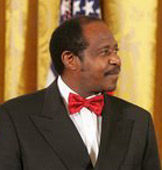
... 1954 (55 years ago today), Paul Rusesabagina (below left) was born in Gitarama, Rwanda. He was a hotel manager at the Hôtel des Mille Collines during the 1994 Rwandan genocide. As a result of his efforts, 1,268 refugees survived under his protection at the hotel. The movie Hotel Rwanda (2004) was inspired by his actions. In his memoir, An Ordinary Man (2007), and in interviews, he's said:

I was a hotel manager. I just kept on being a hotel manager. If to be a hero is to remain who you are, everyone would be a hero.

Rusesabagina began the Hotel Rwanda Rusesabagina Foundation to aid victims of the genocide by giving direct aid to orphans and by encouraging a "Truth, Justice, and Reconciliation Commission." Today, he lives in Belgium with his wife, Tatiana, and their 6 children. (photo credit)

(Prior June 15 posts are here and here.)

On May 29

On this day in ...
... 1990, Canada's House of Commons (right) passed Bill C-43, new abortion legislation, by a vote of 140 to 131. (photo credit) The bill, which continued the criminal proscription of abortion but allowed exceptions from that prohibition " as long as a doctor believes the physical or mental health of the woman is endangered," was sent to Canada's Senate for debate. There it would fail by a tie vote in 1991.
... 1999 (10 years ago today), Olusegun Obasanjo (left) was sworn in as President of Nigeria following his election, bringing an end to 15 "years of adventurism and brigandage under military rule," as The Nation put it. (photo credit) The 8-year tenure of Obasanjo, who himself had been a military ruler of Nigeria from 1976 to 1979, was marred by charges of corruption and repression. Last December Obasanjo was appointed the U.N. Special Envoy on the Great Lakes Region, tasked to aid "dialogue between the leaders of Democratic Republic of Congo and Rwanda," by Secretary-General Ban Ki-moon.

(Prior May 29 posts are here and here.)

Québec court finds Rwandan Désiré Munyaneza guilty

In the first-ever application of Canada's Crimes Against Humanity and War Crimes Act (2000), the Cour supérieure of Québec found Désiré Munyaneza (left, credit) guilty of all 7 counts pending against him since 2005: genocide (intentional murder and serious bodily or mental harm), crimes against humanity (intentional murder and sexual violence) and war crimes (intentional murder, sexual violence and pillage). The charges stem from acts committed between 06 April and 04 July 1994 in Rwanda. The Crimes Against Humanity and War Crimes Act implements the Rome Statute establishing the International Criminal Court and the Québec court's decision, delivered by Judge André Denis, addresses an international audience, abundantly citing case law from the international criminal tribunals for Rwanda and the former Yugoslavia.
Commentators are saying this may be just the beginning of further such trials. Indeed, one of the major obstacles in transnational trials was overcome here: almost all the witnesses hailed from beyond Canada and spoke a foreign language (Kinyarwanda). The judge's "unshakable faith" in their testimony apparently surprised the defense, which has has already made its intention to appeal known.The decision is available here.

When Is Prosecution Persecution?

This, of course, is a central question in refugee and asylum law -- when does prosecution by a state cross the line from legitimate investigation into persecution, thus rendering the accused eligible for refugee status? We've recently seen an abundance of examples of this phenomenon, which illustrates the complex relationship between refugee law and global politics.
In some cases, the prosecuting state's motives are obviously illegitimate, seeking to punish dissidents for engaging in activities protected by international law.
So, we saw yesterday, in Burma, Aung San Suu Kyi was arrested and charged with "violating the rules of her house arrest" after an American man entered her home; under Burmese law, she could face five years in prison for this infraction. Not only is the underlying house arrest an attempt to silence a political critic, but the charges seek to punish Suu Kyi for exercising her right to freedom of association.
The same day, in Zimbabwe, human rights lawyer Alec Muchadehama was arrested outside Harare's Magistrates Court for "obstruction of justice"; his "crime" was speaking to the court clerk in an attempt to free three political prisoners.
These examples illustrate one end of the prosecution/ persecution spectrum, with obviously politically motivated charges in countries that lack any pretense of the rule of law, and make for relatively straightforward refugee claims.
Determining the existence of persecutory prosecution can be significantly more complicated, however, as illustrated by Monday's spat between Bolivia and Peru. Bolivian President Evo Morales, who seeks extradition of three former government officials accused of genocide, was angered by Peru's grant of asylum to one of these officials (and review of asylum claims by the other two). Morales has charged these and other officials, as well as the former Bolivian president, with genocide for their role in soldiers' killing of 63 anti-government demonstrators in 2003. The officials argue that the charges are a "political witch hunt" and that they can't get a fair hearing. Presumably on similar grounds, the former president, Gonzalo Sanchez de Lozada, was granted asylum in the United States in 2007. So are these criminal charges persecution? The other side would argue that the former government's security forces violently gunned down indigenous protesters demanding political representation, and should be held accountable for their crimes.
A similarly complex story unfolded in England last month, when the High Court held that four accused génocidaires from Rwandans could not be extradited because they would not receive a fair trial in Rwanda. The decision relies on extensive evidence, including expert testimony from Filip Reyntjens and Philippe Sands on behalf of the accused and William Schabas on behalf of the Rwandan government, to analyze whether the accused would face an independent and impartial tribunal and whether there would be adequate protection for their witnesses in Rwanda. Is the lack of procedural safeguards in Rwandan courts so dire that trials before them would constitute persecution? This was not, of course the precise question before the court, which was, rather, deciding whether or not to extradite. But its opinion amply illustrates the heavily politically contested nature of this point. In such situations, where assertions of fact are diametrically opposed and an offer of asylum can itself be viewed as a politically aggressive act, is there any hope that refugee determination processes can remain apolitical, impartial, and fair?

On April 6

On this day in ...
... 1994 (15 years ago today), Juvenal Habyarimana and Cyprian Ntayamira, respectively the Presidents of Rwanda and Burundi, were killed in a plane crash that some said was the result of rocket fire from the ground. The crash occurred just outside of Kigali, Rwanda's capital, to which the 2 were flying after having taken part in a discussion among African leaders meeting in Tanzania on how "to end the ethnic violence in Burundi and Rwanda." The incident would have the opposite consequence, touching off massacres in Rwanda. Earlier last month the Chief of Protocol for Rwandan President Paul Kagame, Rose Kabuyé (prior post), submitted to interviews by a French investigating judge in connection with charges, levied against Kagame in France, relating to the 1994 deaths. Yesterday Uganda's Daily Monitor reported that she has returned to Rwanda on grant of "'extra-territorial bail.'" The paper quoted Kabuyé as stating upon her arrival back in Kigali "to continue with her duties" as protocol chief:
'After two days of interrogation with judges, I was requested to come back to Kigali. I was granted permission and was also informed that my arrest warrant has been suspended.
'I can continue with my job and travel anywhere in the world unlike before when I had to only travel in Rwanda and France. I am set to go back in the first week of May.'

... 1968, "[d]ozens of major cities in the United States have been rocked by an escalation in the race riots which began two days ago ... provoked by the assassination of black civil rights leader Martin Luther King" Jr., the BBC reported. More than 100 cities would be affected in days of rioting, which resulted in deaths, injuries, arrests, arson, looting and shootings. (credit for photo of riot-damaged store in Washington, D.C.)

(Prior April 6 posts are here and here.)

Genocide 60 years after the Convention

Perhaps* worth checking out:

A CNN documentary analyzing global response -- or lack thereof -- to genocide. The broadcast, set for 9 p.m. Eastern time tomorrow, December 4, is meant to mark the adoption of the Convention on the Prevention and Punishment of the Crime of Genocide on December 9, 1948. That's 60 years ago next Tuesday.
In the 2-hour documentary, CNN reporter Christiane Amanpour (above left) (photo credit) will present interviews not only with world leaders, but also with persons personally affected by atrocities in, for example, 1970s Cambodia, 1980s Iraq, 1990s Bosnia and Rwanda, and 2003 Darfur. According to a CNN release, the documentary concludes

that instead of using a U.N. treaty outlawing genocide as a springboard to action, political leaders have invoked reason after reason to make intervention seem unnecessary, pointless and even counter-productive.
The conclusion dovetails with the one that Samantha Power reached respecting the United States in her Pulitzer Prizewinning book A Problem from Hell (2003) -- itself worth a reread at this anniversary time.


* Why "perhaps," one might ask? Surely CNN deserves much credit for devoting resources to this important issue. Yet this prospective viewer remains wary on account of the title chosen: Scream Bloody Murder. Let's hope the documentary itself is far less sensationalist.

New to the Ranks of Female Defendants

We've blogged before (here and here and here) on the female defendants indicted by international, and hybrid, criminal tribunals. European states have also indicted several Rwandan women for genocide and crimes against humanity; for example, two nuns were accused in a Belgian indictment of complicity in genocide.
In the newest chapter of this story, German officials detained Rose Kabuye (above), Chief of Protocol for Paul Kagame, Rwanda's President. She was seized at the Frankfurt airport upon a French arrest warrant. Kabuye was a guerrilla within the Rwandan Patriotic Army (RPA), the military wing of the Tutsi-led Rwandan Patriotic Front, and as such is considered a national heroïne. (photo credit)
Apparently, the charges against her stem from the shooting down on April 6, 1994 of Juvenal Habyarimana's plane, which ignited the genocide in Rwanda. (The plane was shot down as President Habyarimana and Burundian President Cyprien Ntaryamira were returning from a meeting in Tanzania on the implementation of the Arusha Peace Accords. The identity and the precise motive of the assassins remain unknown. Many have long speculated that Hutu nationalists, angered that President Habyarimana had capitulated during the peace process, were responsible.)
It appears that Kabuye was visiting Germany in her private capacity, which opened the way for her arrest. News accounts indicate that Kabuye had been warned that she risked arrest when travelling in Europe.
Rwandan Minister of Information Louise Mushikiwabo (right, center) has stated that Kabuye’s arrest is a “misuse of international jurisdiction” and “a perversion of the principle of universal jurisdiction." The African Union (AU) has also said arrest warrants would not be recognised in AU countries.
Mushikiwabo’s statements are intriguing.
If I am not mistaken, Mushikiwabo was a plaintiff in a suit under the Alien Tort Statute against Jean-Bosco Barayagwiza, a leader in the Hutu-nationalist Coalition pour la Défense de la République party and a co-owner of the vitriolic Radio Télévision Libre des Milles Collines. (See here and here for profiles on Mushikiwabo). With others, she sued Barayagwiza in New York in 1994 and obtained a $35 million judgment against him in default (see 1996 WL 164496 (S.D.N.Y. Apr. 9, 1994). In an exercise of what many have deemed a form of civil universal jurisdiction, Mushikiwabo obtained “tag” personal jurisdiction over the defendant by serving him with process while he was in New York attending meetings at the United Nations and he strayed outside the U.N. headquarters zone.
Apparently, what is good for the gander is not so good for the goose? Kabuye has been flown to France to face the charges. Stay tuned!

Sexual Violence Before the ICTR: An Object Lesson for the ICC

We’ve blogged before (e.g., here, here, here, here, and here) on the mixed track record for the prosecution of sexual violence in international criminal law.

The experience of the International Criminal Tribunal for Rwanda (ICTR) (above) provides a forceful object lesson for the International Criminal Court (ICC) and other international criminal law tribunals into the ways in which crimes of sexual violence can be poorly- or under-prosecuted and thus rendered invisible. Although gender violence in Rwanda did not receive the levels of media attention focused on similar crimes committed in the former Yugoslavia, the Rwandan statistics—inherently approximate—are stunning. Estimates range from 250,000 to 500,000 rapes during the short period of the genocide (April-June 1994), promoting the Special Rapporteur of the Commission on Human Rights to observe that
Rape was the rule and its absence the exception.
Rape in Rwanda was also accompanied by sexual mutilation and torture, and women and girls were often literally raped to death by perpetrators wielding machetes, sharpened sticks, broken bottles, and other implements. By some accounts, all female survivors—including very young girls—in Rwanda were raped or sexually assaulted during the 100 days of the genocide. See Human Rights Watch, Shattered Lives: Sexual Violence during the Rwandan Genocide and its Aftermath (1996).
Yet, the results of the cases before the ICTR do not reflect the high levels of gender violence in Rwanda during the genocide. In fact, the systemic lack of gender violence charges and high numbers of acquittals for what charges were brought generates the opposite impression. This disconnect reflects the many ways in which gender justice can be neglected or sidelined in international criminal law where gender violence is not central to a prosecutorial strategy.
A recent chapter in this saga has occurred in the Muvunyi (left) case. (Relevant decisions available here). A few weeks prior the start of trial, the prosecution sought to withdraw the rape charges altogether on the grounds that witnesses could not be traced and others refused to testify. The prosecution’s decision caused an uproar in Rwanda; even Rwanda’s representative to the ICTR criticized the decision.
The Trial Chamber denied the prosecutor’s request to withdraw the rape charge on the grounds that
  • the Prosecution had not provided sufficient grounds upon which to reconsider the confirmation of the original indictment and
  • the Defense had already expended time and resources preparing to defend the charges.
The Trial Chamber also rejected other proposed amendments amounting to new charges as prejudicial where the prosecution could not justify the delay in seeking the changes. The Trial Chamber instructed the prosecution that it need not amend the indictment; rather, it could simply present no evidence at trial and take an acquittal.
At trial, however, the prosecution managed to locate and present the testimony of three rape victims, whose harrowing testimony was deemed reliable by the Trial Chamber. None of the witnesses, however, was raped by the specific group of subordinates alleged in the indictments. Accordingly, the defendant was acquitted on these counts.
Both sides appealed, with the prosecution alleging error in the rape acquittals. In August 2008, the Appeals Chamber, in an as-yet unpublished decision, quashed the original convictions and ruled that the defendant should be partially retried on the incitement to genocide count pursuant to Rule 118(C), because the Trial Chamber did not adequately state the reasons for his conviction. Once again, rapes of Rwandan women are un-redressed.
Although it is largely too late for the women of Rwanda, the ICC—whose constitutive statute contains groundbreaking structural, procedural, and substantive provisions to ensure gender justice—must generate better results for women victims elsewhere. Fortunately, in several pending indictments, the Office of the Prosecutor has demonstrated an early commitment to ensuring gender justice, suggesting that the missteps, carelessness, and neglect characterizing gender justice before the ICTR may not be repeated before the ICC.

'Nuff said

(Occasional item taking context-optional note of thought-provoking quotes)


'The fact that we are so many has made it possible for men to listen to our views. Now that we're a majority, we can do even more.'

-- Espérance Mwiza (right), a Member of the Parliament of Rwanda, which is now 56 percent women.

Mwiza's quoted in Women Run the Show In a Recovering Rwanda, an article in which the Washington Post's Stephanie McCrummen tells of the transformation in gender roles since the 1994 genocide in the African country. "'Women can contribute a lot in ideas,'"a man says, and McCrummen indicates that ideas about governance are as varied as the country's needs:


In the recent parliament session, lawmakers asked the finance minister about the impact of the financial crisis on Rwanda's budget, the gap between exports and imports and the soundness of Rwanda's booming mortgage market. Just one question -- about funding for maternal and child health -- was gender-specific.

Great. But, um, since when is the health of a country's children a "gender-specific" concern?


Bloggers Team