Showing posts with label Philippines. Show all posts

On April 3

On this day in ...
... 2001 (10 years ago today), in consolidated cases captioned Estrada v. Desierto and Estrada v. Macapagal-Arroyo, the Supreme Court of the Philippines (right) (photo credit) stripped a former President of immunity from suit on charges of corruption, and further recognized the legitimacy of respondent Gloria Macapagal-Arroyo (prior IntLawGrrls posts), who had succeeded the former President, Joseph Estrada, in office the previous January. Macagapal-Arroyo would serve until mid-2010.

(Prior April 3 posts are here, here, here, and here.)

Beyond Libya's Borders

With the news media focused on the estimated 180,000 migrants who have fled Libya in the past 10 days, it's a good moment to think about the impact of the crisis on migrants beyond Libya's borders.
To start, the unrest has cut off a World Food Programme supply chain used to feed tens of thousands of Darfurian refugees and displaced persons in Chad. Food supplies that had for many years been discharged at Benghazi port in Libya have been re-routed to Port Sudan, at great expense and with questionable outcomes, as aid convoys now must traverse Darfur to reach their intended recipients. The consequences for these refugees are sure to be dire.
The instability in Egypt may also obstruct efforts to protect migrants in that country against human rights abuses. Haaretz reports that the number of African migrants entering Israel through Egypt has dropped precipitously in the wake of the crisis. The concern here, given credible and frequent reports of abuse of African migrants by smugglers in the Sinai, is that many Africans are being held for ransom in the desert. Though the Egyptian government's efforts to crack down on organized crime in the Sinai were insufficient at the best of times, the current political situation has likely resulted in even less attention being paid to the situation of these migrants.
On the development side of the ledger, the loss of migrant worker jobs throughout North Africa will have global repercussions. The widely reported repatriation of many foreign workers in Libya will result in the loss of millions of dollars of remittances. Not only current but also future jobs are at stake; the Philippines and Indonesia have suspended the sending of their national workers to Bahrain, Egypt, Libya, and Yemen. Though this decision is to be applauded, it will come at great cost to families in need of remittance funds.
While there's much to celebrate in North Africa, and much assistance needed for migrants escaping the unrest in Libya, the impact of the crisis on migrants and their families will be felt far beyond Libya's borders.


On February 22

On this day in ...

... 1986 (25 years ago today), what soon would come to be called the "People Power" movement began in the Philippines. (It's an anniversary with special resonance this year of "North African People Power.") Precipitating events was a Presidential election after which longtime dictator Ferdinand Marcos (prior posts) refused to step down despite contentions that his opponent, Corazon Aquino, had won. On this day couple "senior members" of his government called for Marcos to step down. Soon "hundreds of thousands of civilians responded to calls for an uprising" -- one that would force the autocrat and his wife, Imelda Marcos, to flee (leaving behind her 2,700 pairs of shoes). (photo credit) He died in Hawaii in 1989; Aquino in Manila in 2009. Imelda Marcos opened a museum filled with her shoes in 2001; she remains mired in corruption lawsuits to this day.


(Prior February 22 posts are here, here, here, and here.)

Impact of Resolution 1325 on peace accords

(Our thanks to IntLawGrrls for the opportunity to contribute this guest post)

With last October's tenth anniversary of UN Security Council Resolution 1325 on Women, Peace and Security (2000), the resolution’s effectiveness is coming under intense scrutiny. (image credit) In our recent research on the impact of the resolution on the text of peace agreements, we make some significant findings about the impact of 1325 on peace agreement drafting.
(Our research dataset is available in full here. Our methodology, coding decisions, findings and our fuller analysis may be found in ‘Peace Agreements or ‘Pieces of Paper’? The Impact of UNSC Resolution 1325 on Peace Processes and their Agreements’, our article published in the October 2010 edition of International & Comparative Law Quarterly.)
Peace agreements can play a crucial role in setting post-conflict priorities and shaping the internal constitutional order. Women often attempt to influence agreement texts in pursuit of gender equality, in an effort to influence the key roadmap to the political and legal future that will shape their lives. For these reasons Resolution 1325 specifically targeted peace negotiations and agreements in paragraph 8, which calls on all actors involved, when negotiating and implementing peace agreements, to adopt a gender perspective, with particular reference to post-conflict needs. The aim of this perspective is to support local women’s peace initiatives as well as the human rights of women with relation to constitutional reform. (Prior IntLawGrrls posts on this resolution may be found here.)
In our research project, we were interested in whether the texts of peace agreements post-1325 showed evidence of the resolution’s impact. Did peace agreements signed after the resolution contain more references to women and gender equality than those signed before the resolution? If so, what was the nature of these provisions? What difference did involvement of the United Nations in the negotiation of the agreement make regarding, firstly, the number, and secondly, the nature, of peace agreement references to women and gender? Were peace agreements more likely to address the specific issues for women and girls identified in paragraph 8?
In summary we found:
► Only 16% of peace agreements contain references to women. But references to women have increased significantly since the passing of Resolution 1325, from 11% to 27% of agreements.
► This rise is more dramatic for agreements in which the UN had a third-party role (from 4% to 12%) than it is for agreements which did not involve the UN in such a role (from 7% to 14%).
► However, both before and after Resolution 1325 women are more likely to be referenced in agreements in which the UN is not named as a third party. The more marked increase in references to women in ‘UN’ agreements must therefore be understood in a context where such agreements were less likely to reference women prior to Resolution 1325.
► Peace agreement references to women are qualitatively often poor. They constitute scattered references to women, some of which contravene provisions of the Convention on the Elimination of All Forms of Discrimination against Women. Only on rare occasions do these references illustrate good practice.

Our data
Our study involved 585 peace agreements signed since between 1 January 1990 and 1 May 2010. We began by identifying provisions making explicit reference to ‘women’, ‘gender’, ‘widows’ or ‘girls’ and to ‘sexual violence’, or named forms of sexual violence such as ‘rape’.
We separately coded whether the UN was involved as some type of third party to the peace agreement. This enabled us to question the extent to which the UN has played a role in implementing its own normative standards. UN third party involvement was defined using the agreement text and documenting whether the UN, a UN agency, or a UN representative was party or signatory, mediator or facilitator, observer, witness or negotiator to the agreement.
In addition we undertook a qualitiative analysis of the reference to women.

Our Analysis
The overall finding that only 16% of peace agreements make any sort of reference to women is disappointing.
Even the higher figure for post-Resolution 1325 references to women of 27% (up from 11%) indicates a long way to go before peace agreements systematically include references to women. However, it does seem that the 2000 Security Council measure is having some effect, and particularly where the UN is involved.
Our qualitative review of the nature of the peace agreement references indicates that many of these references are unsubstantial.
There is little evidence of systematic inclusion of women in peace agreement texts, or systematic treatment of issues across peace agreements within conflicts. Moreover, some of the references in our database are, at best, ambiguous in terms of feminist gains, for example: the use of quotas which not only encourage but limit the participation of women (Bangladesh/Chittagong); references to ensuring women’s ‘moral integrity’ (Philippines); references to women as mothers to be targeted for early prisoner release (Nicaragua). Some strong textual provisions do however exist, often in countries that also have actions plans (see for example, Uganda).

Our conclusions
We suggest that further thought must be given to the strategies and barriers to effective implementation of Resolution 1325. Our findings regarding the resolution’s effectiveness with respect to peace negotiations and peace agreement texts suggest the need for further thinking on:
► What constitutes a ‘gender perspective’ in a peace agreement.
► How Resolution 1325 is being taken forward by organizations other than the UN is required, particularly as their role is increasing.
► Whether a ‘gender justice v peace’ dilemma exists where gender-specific concerns of women are left off the table, not due to oversight, lack of expertise, or lack of commitment, but because of concerns that inclusion would make it more difficult for the parties to reach agreement on other matters or destabilize any agreement reached.
► What constitutes good practice in terms of inserting ‘a gender perspective’ in peace agreement texts.
► How to retain space for women to re-envision peace processes in a transformative way, while influencing texts as they arise within the processes in which women are engaged.

We would encourage people to look at and use the research, and to contact us (c.bell@ulster.ac.uk, cf.orourke@ulster.ac.uk) with any response they may have.

On November 22

On this day in ...
... 1913, Cecilia Muñoz-Palma (right) was born in Bauan, Batangas, the Philippines.
She was valedictorian at St. Scholastica's College and earned a bachelor of laws degree from the University of the Philippines in 1937 -- the same year that she placed 1st on her country's bar examination. She founded the Woman Lawyers’ Association of the Philippines (WLAP) Free Legal Aid Clinic. In 1954, she earned a master of laws degree at Yale. That same year she became a local judge in the Philippines. In 1968 she served as President of the Philippines' Constitutional Commission, which drafted the 1987 Constitution, and also was elevated to the country's Court of Appeals. She served as an Associate Justice of the Supreme Court of the Philippines -- the 1st woman on that high court -- from 1973 until her 65th birthday, on this day in 1978. Among her publications is a 2001 collection of speeches, entitled Mirror of My Soul. Justice Muñoz-Palma died in 2006.


(Prior November 22 posts are here, here, and here.)

3d woman on "15-man" bench

The newest member of the Philippines' highest court is a woman, though you'd never know it from the Philippine Star news lead announcing that President Benigno Aquino this week administered
the oath of office of his first appointee to the 15-man Supreme Court ...
The newest Justice is Maria Lourdes Aranal-Sereno (left), Executive Director of a thinktank, the Asian Institute of Management Policy Center. (photo credit) Aranal-Sereno served as co-counsel in 2 transnational matters resolved in favor of her client, the Philippines: Fraport, before the International Centre for the Settlement of Investment Disputes in Washington, D.C., and PIATCO, before the International Chamber of Commerce-International Court of Arbitration in Singapore. She earned her law degree cum laude from the University of the Philippines, followed by an LL.M. from the University of Michigan Law School. Aranal-Sereno won appointment over 5 other nominees, all men.
With the arrival of Aranal-Sereno, 3 out of 15 Justices are now women; the other 2 women are Justices Conchita Carpio-Morales (far right) and Teresita J. Leonardo-De Castro (near right).

Gender equality & the G-20bis

This year's official photo from the G-20 summit, held this past weekend in Toronto, Canada, looks pretty much like last year's from London, England: there's German Chancellor Angela Merkel in orange, Argentinian President Cristina Fernández de Kirchner in white, and standing 2 rows behind her, Gloria Macapagal-Arroyo, till tomorrow the President of the Philippines. Et alia. Another G-20 country now also has a woman leader, but Julia Gillard, Prime Minister only since Friday, sent Australia's Treasurer, Wayne Swan (top middle).

In passing: Corazon Aquino

(In passing marks the memory of a person featured in IntLawGrrls) In Manila yesterday, Corazon Aquino died from cancer at age 76. Noting her role in a milestone event on February 25, 1986, we posted a while back:

Corazon Aquino (left) was sworn in as the 1st woman President of the Philippines. The move culminated what was called the People Power Revolution, which sent into Hawaiian exile longtime dictator Ferdinand Marcos. He'd threatened to stage a ceremony swearing himself back into power; he changed course, however, after the United States withdrew its support of him. Aquino, who had entered politics after the 1983 killing of her husband Benigno, a dissident leader, held office until 1992.
The tenure of Asia's 1st woman President was difficult, as detailed in her obituary -- not in the least because of the 6 coup attempts she withstood in as many years. Nonetheless, the person who posted this video clip of her swearing-in called it among "proudest moments in Philippine history." Also worth a look: this video clip of her calling for Marcos' resignation. For her role in returning democracy to the Philippines -- a country that had been subjected to Marcos' dictatorial rule for 2 decades -- she will not soon be forgotten.

On June 15

On this day in ...
... 1945, Miriam Defensor Santiago (left), a Senator in the Philippines, was born in Iloilo in that country. As a child, she excelled in school, finishing college on time despite suffering a severe illness. She went on to graduate from the University of the Philippines College of Law in 1969. She continued taking courses, and at the age of 50 completed a master's degree in religious studies at the Maryhill School of Theology. For her work as a crusader against corruption in the Philippines she received a Ramon Magsaysay Award, known colloquially as the Asian Nobel Prize, in 1988. Her resume also includes employment as a lecturer, professor, Quezon City regional trial judge, and Legal Officer to the U.N. High Commissioner for Refugees. In 1992, Santiago campaigned to be President of the Philippines, on the slate of the People's Reform Party, which she founded. She lost, claiming "electoral irregularities." She ran for president again in 1998, and again lost. Having served as a Senator from 1995 to 2001, she was re-elected in 2004. In 2008, Santiago was the Philippines' nominee for the International Court of Justice. She won in the United Nations' General Assembly but not in its Security Council.
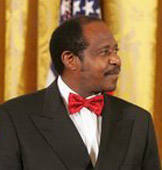
... 1954 (55 years ago today), Paul Rusesabagina (below left) was born in Gitarama, Rwanda. He was a hotel manager at the Hôtel des Mille Collines during the 1994 Rwandan genocide. As a result of his efforts, 1,268 refugees survived under his protection at the hotel. The movie Hotel Rwanda (2004) was inspired by his actions. In his memoir, An Ordinary Man (2007), and in interviews, he's said:

I was a hotel manager. I just kept on being a hotel manager. If to be a hero is to remain who you are, everyone would be a hero.

Rusesabagina began the Hotel Rwanda Rusesabagina Foundation to aid victims of the genocide by giving direct aid to orphans and by encouraging a "Truth, Justice, and Reconciliation Commission." Today, he lives in Belgium with his wife, Tatiana, and their 6 children. (photo credit)

(Prior June 15 posts are here and here.)

Regulating the Domestic Sphere: The Role of States

Given the potential for abuse and widespread lack of regulation, working conditions in the domestic sphere are particularly perilous. Add temporary or nonexistent immigration status to the mix, and the situation becomes even more dire. Though the examples in this post focus on the situation of migrant domestic laborers, largely Asian and female, who work in the Middle East, such abuse has been amply documented in the United States and presumably occurs with regularity around the globe. Stories abound of exploitation ranging from unpaid wages to rape; while awareness of these issues has been raised in recent years, legal frameworks for protection in states that receive such workers are often non-existent or underenforced. Moreover, labor-sending states should be playing a larger role in establishing and enforcing the rights of migrant domestic laborers.
Receiving states are an obvious starting point for protection frameworks, but domestic workers are often excluded from labor law protections. In Lebanon, for example, which hosts over 200,000 migrant domestic workers, mainly Filipina and Sri Lankan women, the United Nations High Commissioner for Human Rights and the International Labor Organization have only just succeeded in creating a common set of standards, in the form of a unified contract, to protect migrant domestic workers. The contract includes basic rights to adequate food and clothing and a private place to sleep, limits workdays to 10 hours per day and 6 days per week, and requires employers to provide monthly paychecks as well as health insurance for domestic employees. Yet the employer still has the right to hold workers' passports, may terminate employment at will, and most importantly faces no enforcement mechanism for violations of the contract. While uniform standards are preferable to the void that existed previously, rights of domestic migrant workers must be given enforceable legal status before they will be taken seriously by employers.
Sending states can also play a role in protecting their workers abroad. Given the financial benefits migrant worker-exporting states reap in the form of remittances -- for example, in 2007, Bangladeshis working in Saudi Arabia and the UAE and Filipinos working in the Arab States each sent home over $2 billion while Sri Lankans remitted $3 billion -- they should recognize the importance of protecting the physical and psychological well-being of these workers. I've blogged here about the Philippines' creative program to protect migrant workers abroad, which offers support to laborers prior to departure, during their work stint, and for repatriation. At the other end of the spectrum, some nations ban their citizens from working in countries notorious for abusing their workers or ban women from participating in migrant labor flows -- a dangerous step likely to push migrant workers underground and eliminate access to protective services. Given the failure of the UN Convention on the Protection of the Rights of All Migrant Workers to attract signatories from migrant-receiving states, sending states might negotiate bilateral treaties protecting the rights of migrant workers, ensuring that those working in the domestic sphere are covered by labor laws. Short of a such a serious commitment, states could ameliorate the situation of their workers abroad through relatively simple programs such as pre-departure rights presentations to migrants and effective outreach and support programs within embassies and consulates.

On January 13

On this day in ...

... 1993, a criminal court in Berlin announced its abandonment of the trial of former East German leader Erich Honecker, who was 80 years old an suffering from terminal liver cancer. Honecker had been charged with "manslaughter over the deaths of defectors fleeing by way of the Berlin wall," which separated the city during the Cold War. Soon after the trial was aborted, Honecker flew to Chile, where he died a year and a half later. (credit for 1986 photo of Berlin Wall)

... 1933, President Herbert Hoover vetoed a bill to give the Philippines independence from the United States. Within hours the House of Representatives overrode the veto; however, the Senate did not so act, and so the bill failed. In his veto message, the New York Times reported, Hoover (right) suggested "that a plebiscite for freedom be deferred for fifteen or twenty years" in the Philippines, lest "'economic and social chaos'" ensue.

On August 12

On this day in ...

... 1833 (175 years ago today), Chicago was founded. About 350 people lived in the town, which spanned a 3/8-square-mile area that still is at the heart of the city's Loop. Its name is a Native American word, but its meaning is uncertain -- some say it meant "wild onion" or "skunk"; others, "strong" or "great." Today Chicago (flag above right) -- the 3d largest U.S. city, with a population of 2.8 million living in a 237-square-mile area -- is vying with other cities in the world to host the 2016 Olympic Games.

... 1898 (110 years ago today), at 4:23 p.m., representatives of Spain and the United States signed an armistice ending the Spanish-American War. As part of the agreement, Spain gave up its claim to Cuba, agreed to U.S. occupation of the Philippines, and ceded Puerto Rico and other colonial holdings to the United States. (map credit)

On July 4

On this day in ...
... 1976, a contingent of about 200 Israeli commandoes rescued 100 hostages at Entebbe airport in Uganda and then flew them to Israel (at right; photo credit). The commandoes waged a gunfight for more than half an hour; 20 Ugandan soldiers, 7 hijackers, the commandoes' leader, and 3 hostages were killed. The operation ended a crisis that began when an Air France flight, bound from Paris to Israel via Athens, was hijacked on June 27.
... 1946, the United States granted independence to the Philippines (flag below left). But because the U.S. grant came with strings attached, Filipinos were not happy with celebrating on that date, and thus in 1962 Independence Day was switched to June 12, the date that revolutionaries in 1898 proclaimed independence from Spain.

On this day

On February 25, ...
... 1986, in Manila, Corazon Aquino (left) was sworn in as the 1st woman President of the Philippines. The move culminated what was called the People Power Revolution, which sent into Hawaiian exile longtime dictator Ferdinand Marcos. He'd threatened to stage a ceremony swearing himself back into power; he changed course, however, after the United States withdrew its support of him. Aquino, who had entered politics after the 1983 killing of her husband Benigno, a dissident leader, held office until 1992. Litigation stemming from human rights violations during the Marcos regime continues; indeed, as we've posted, the U.S. Supreme Court will hear 1 such case. Argument in Republic of Philippines v. Pimentel is set for March 17, 2008.
... 1956, in an effort to dispel "the 'Stalin cult' that has held Soviet citizens in its thrall for 30 years," Soviet leader Nikita Khrushchev "denounced Joseph Stalin as a brutal despot" in a speech before the 20th Congress of the Communist Party.

Rehabilitation’s just a (dance) step away

It has now become yet another terrifying experiment in seeing just how far a state can go in treating prisoners as subhuman. In her latest Boston Review essay, our colleague Colin Dayan describes how the Supreme Court of one of the world’s oldest and largest democracies, in a case called Beard v. Banks (2006), upheld prison regulations providing that certain prisoners could be

isolated 23 hours a day in their cells, denied radio and television broadcasts, and prevented from earning a GED (General Education Diploma) or taking special education classes. They ate alone and could not make telephone calls except in emergencies or when related to legal representation. Unable to speak or socialize directly with other inmates, they stared at the unpainted, concrete, and windowless walls onto which nothing could be posted. Except for the occasional touch of an officer’s hand as they were handcuffed and chained to leave their cells, they had no contact with other human beings. Although prisoners could “graduate” out of [this special unit], the duration of their stay—beyond the minimum requirement of ninety days—was at the discretion of prison administrators, and most did not graduate. In this already severely restricted environment, the new [] policy categorically prohibited access to magazines, newspapers, or books, except paperbacks from the prison library—called “leisure books” in “[the unit’s] Rules and Regulations”—and books of a legal or religious nature.

Prison officials offered two reasons for this sweeping restriction of prisoners’ First Amendment rights. Newspapers, they said, could be wound up, turned into projectiles, used as night sticks, and deployed to make fires and hide contraband. Moreover, these officials argued, the deprivation of personal photographs and secular periodicals serves the goal of rehabilitation. Prisoners like to read about current events and look at photographs of their loved ones. Take these things away, the theory went, and recalcitrant prisoners, those “who have few other privileges to lose,” would behave.

Meanwhile, across an ocean, in a former dictatorship where “[p]risoners sleep on hard pallets more than a dozen to a cell and are held to a strict schedule of work and other activities from dawn to light-out[,]” inmates are learning that “they can be productive, that they aren’t useless scum of society”. In the prison where rehabilitation through dance began, gangs have been broken up, “weekly outbreaks of violence have subsided, inmates’ health has improved and recidivism rates are down dramatically”. This country? The Philippines, where the dance craze has spread to other prisons, thanks, in part, to this YouTube video, in which 1500 prisoners groove together.

Back in the United States, as Dayan's essay reminds us, on one day in 2006 some members of the Supreme Court expressed extreme dismay over Salim Hamdan’s being denied the right to be present at his trial before a military commission. That was just one day after members of the Court -- including some who'd expressed concern in Hamdan -- handed down the retrograde judgment upholding the denial of anything that might show certain prisoners that they are still present as human beings in society.

Transnational docket grows: Supreme Court to sort out contest over Marcos assets

Even as it heard argument in a 3d round of Guantánamo litigation -- litigation that took on new wrinkles (here and here) in light of revelations that the CIA destroyed videotapes of interrogations of certain high-value detainees, documents no doubt relevant in detainee cases -- twice last week the U.S. Supreme Court expanded the transnational character of its OT '07 docket.
The 1st of 2 transnational cases the Court's agreed to hear next spring is Philippines v. Pimentel, a dispute over the assets of the onetime dictator of the island state, Ferdinand E. Marcos, who died in 1989 in Hawaii, having fled his country in 1986. (Marcos is pictured above with his wife, Imelda.) At issue, according to SCOTUSblog: "about $35 million held in a Merrill Lynch account for a Panamanian corporation, Arelma S.A." In a 2006 panel decision written by Judge John T. Noonan, the U.S. Court of Appeals affirmed the trial court's award of funds to plaintiffs who'd won an Alien Tort Statute class action against the Marcos estate; in so doing, the courts turned back a bid by the Republic of the Philippines to be treated as a party to the litigation. Among the issues at play in the case, in which the United States has entered as amicus in support of the Philippines, is application of the Foreign Sovereign Immunities Act.
Details on the 2d just-granted case tomorrow.

On December 7, ...

... 1917 (90 years ago today), at 5:03 p.m. Eastern time, the United States went to war against Austria-Hungary when President Woodrow Wilson signed a joint resolution of Congress authorizing the action. The United States had entered World War I in April, when it declared war against Imperial Germany.
... 1941, at 7:48 a.m. Hawaii time, Japanese bombers startled the U.S. Pacific fleet at Pearl Harbor with an early morning attack, prompting the United States' northern neighbor, Canada to declare war against Japan at once. The United States followed the next day, when President Franklin D. Roosevelt, in a speech to Congress that can be heard here, condemned December 7, 1941, "a date which will live in infamy."
... 1945, a U.S. military commission convicted and sentenced to death Japanese General Tomoyuki Yamashita, who had surrendered after Japan-controlled Philippines fell to the U.S. military. On a theory of command responsibility Yamashita (pictured at right returning to his cell after a day of trial) was held responsible for war crimes committed by his troops. In fewer than 2 months the U.S. Supreme Court rejected his habeas petition by a vote of 7-2, and Yamashita was hanged soon after. In time the opinions of dissenting Justices Frank Murphy and Wiley B. Rutledge, Jr. won over many legal commentators; indeed, they were discussed favorably in the Court's invalidation in Hamdan v. Rumsfeld of President George W. Bush's post-9/11 military commissions.
... 1952 (55 years ago today), U.S. Sen. Susan M. Collins (R-Me.), was born in Caribou, Maine.

Resurrecting State Protection: Migrant Workers Abroad

In the age of human rights, the conventional wisdom is that we should be skeptical of the role of states in protecting the rights of their citizens abroad. Our cherished human rights treaties focus on individually-enforceable rights, fearing that states will be ineffective at rights protection, especially when it comes to migrants. However, an interesting example from the Philippines illustrates the promise of state involvement in protection of migrant workers abroad. Dovelyn Rannveig Agunias of the Migration Policy Institute reports here on the creative steps that the Philippines is taking to protect its migrant workers. As of 12/06, almost 25% of the Filipino labor force and 9% of the total population worked abroad, the majority as temporary workers. Remittances from Filipino workers abroad are likely to approach US$15 billion this year. As far back as 1982, the government created the Philippine Overseas Employment Administration (POEA), which regulates the recruitment of Filipino workers and warns them about private agencies that have cheated workers in the past. The Overseas Workers Welfare Administration (OWWA) protects Filipinos while abroad, including providing immediate repatriation of distressed and physically ill workers, life and disability insurance, loans, and scholarships and training. Another agency provides legal services to Filipino workers abroad. These agencies, empowered by outrage on the part of domestic political constituencies at the treatment of Filipinos abroad (ranging from unfair trials to "mysterious" deaths), are funded in part through contributions from foreign employers and workers abroad. While the programs are not yet perfected, they seem to be more effective than, say, the International Convention on the Protection of the Rights of All Migrant Workers, which has yet to be ratified by any developed nation. For developing countries with a high percentage of workers abroad, this model presents an innovative avenue to protect migrant workers.

On September 23, ...

... 1972 (35 years ago today), Ferdinand Marcos, who 3 years earlier had become his country's 1st President to be elected to a 2d term, made a public announcement, carried on radio and television, of his decision to declare martial law in the Philippines. He would flee the country in 1986; his exile was followed a decade later by Hilao v. Estate of Marcos, litigation brought in the United States pursuant to the Alien Tort Statute.
... 1869, Mary Mallon was born in Ireland. She immigrated to the United States at around age 15, and soon became a cook for wealthy families in Massachusetts and New York. In the early 1900s she was determined to be an asymptomatic carrier of typhoid fever, and was believed to have spread the disease to dozens of people for whom she worked. Dubbed "Typhoid Mary," "the most dangerous woman in America," Mallon was quarantined by health officials; that's her in the 1st hospital bed at left. In a letter pleading for release, she wrote:
I have been in fact a peep show for everybody. Even the interns had to come to see me and ask about the facts already known to the whole wide world. The tuberculosis men would say 'There she is, the kidnapped woman.' Dr. Park has had me illustrated in Chicago. I wonder how the said Dr. William H. Park would like to be insulted and put in the Journal and call him or his wife Typhoid William Park.

Questions persist about the fairness of her treatment and the degree to which class or ethnic prejudice motivated officials in her case.

Asian Enigma answered

Answer to Asian Enigma above:
c) Philippines
Gloria Macapagal-Arroyo (below) has served as President since 2001. She is not is not the 1st woman to serve as President of the Philippines, however; Corazon Aquino held the post from 1986 to 1992. Notably, women have governed in 3 of the other Asian countries on this list:
a) Sri Lanka: Sirimavo Banaranaike was Prime Minister 1960-65, 1970-1977, and 1991-2000; her daughter, Chandrika Kumaratunga, Prime Minister in 1994 and then President from 1994 to 2005.
d) Bangladesh: Hasina Wajed, Prime Minister from 1996-2001, and her rival, Khaleda Zia, from 1991-1996 and 2001-2006.
f) South Korea: Han Myeong-Sook served as Prime Minister from April 2006 to March 2007.
 
Bloggers Team