Showing posts with label International Court of Justice. Show all posts

On April 9

On this day in ...
... 1949, the International Court of Justice decided its 1st case. Its judgment on the merits in Corfu Channel (United Kingdom of Great Britain and Northern Ireland v. Albania) held by a vote of 11 to 5 that Albania was responsible for destruction and loss of life stemming from the 1946 incidents in which British destroyers hit mines while traveling in Albanian waters. (map credit) By a vote of 14 to 2, the ICJ further declared that Britain's entry had not violated Albanian sovereignty. The ICJ ruled unanimously that its finding of responsibility constituted satisfaction, and so declined to award damages.

(Prior April 9 posts are here, here, here, and here.)

CERD shoehorn fails to fit

Shoehorning the conflict between the Republic of Georgia and the Russian Federation into a race discrimination claim always seemed a bit of a stretch.
Not to say there's no ethnic animus amid the tension that heated into armed conflict a while back. (Prior IntLawGrrls posts available here.) Just that there seemed to be a lot more going on. Still, Georgia's CERD shoehorn -- its effort for secure International Court of Justice review on the basis of the Convention on the Elimination of All Forms of Racial Discrimination -- was creative lawyering. The kind of thing that just might work.
In the end, however, not enough judges were persuaded.
The ICJ has ruled against Georgia in the case known as Application of the Convention on the Elimination of All Forms of Racial Discrimination (Georgia v. Russian Federation). Of initial note in the judgment, available here, is the division among judges on the issues presented:
► On Russia's claim that no dispute under CERD Article 22 existed, the vote was 12 judges in favor of the objection, 4 against (among the latter, new Judge Xue Hanqin, of China).
► On Russia's claim that Georgia had not satisfied procedural requirements set out in CERD Article 22, the vote was 10 judges in favor of the objection, 6 against (among the latter, newest Judge Joan E. Donoghue, of the United States).
► On the ICJ's finding that it had no jurisdiction, the same 10 judges voted aye and the same 6, including Donoghue, voted no.
Comment on the full judgment awaits careful reading.


Chamber advises caution in seabed mining

(Thank you, IntLawGrrls, for the opportunity to contribute this guest post)

A new Advisory Opinion on Responsibility and Liability for International Seabed Mining from the Seabed Disputes Chamber of the Hamburg-based International Tribunal for the Law of the Sea advises countries interested in sponsoring commercial mining in international waters that they can limit their liability for accidents, but that they will have to consider the precautionary approach, global commons interests, and the evolution of international law in light of new scientific information.
Small island states interested in sponsorship requested this advisory opinion before they undertook to sponsor mining companies based in Canada and Australia.
This February decision was the first to be issued by the Seabed Disputes Chamber, which was established by the UN Convention on the Law of the Sea. The opinion clarifies a number of issues specific to a state’s obligations and liability for harm that might result when it sponsors commercial deep seabed mining in a zone of international waters designated “the Area.” It also offers much of more general interest, particularly in its application of the ILC Draft Articles on state responsibility.
The Chamber’s thoughtful decision should encourage states to have confidence in the Tribunal and its Chamber.
The increasing value of metals that are found on the deep seabed has given rise to greater commercial interest in mining in international waters, more than 200 miles offshore and at as much as 6,000 meters (18,000 feet) below the sea surface. (credit for above right photo of seabed diamond-mining vessel) Access to these resources is implemented through a regime managed by the Jamaica-based International Seabed Authority, which, the Chamber observed, “acts on behalf of mankind.” Under this system, a government can sponsor a company to explore and mine some international waters. The United States, not having ratified the law of the sea convention, is not part of the regime.
If a state adopts appropriate measures, Article 139 of the convention exempts that state from liability for catastrophic harm to the ocean or seabed caused by a company that it sponsors. However, the Chamber advised that to obtain this protection the sponsoring state must satisfy its “due diligence” obligation to make best possible efforts to secure compliance by the sponsored contractors. What is required of due diligence varies according to the state of scientific and technological knowledge and the risks of the activity. It includes the adoption of laws, regulations, and administrative measures in the state’s domestic legal system that are both:
► As stringent as those established by the International Seabed Authority; and
► As effective as international standards.
States must apply a precautionary approach as an integral part of their due diligence obligations
in situations where scientific evidence concerning the scope and potential negative impact of the activity in question is insufficient but where there are plausible indications of potential risks.
Disregarding such risks would constitute a failure of due diligence. The Chamber observed that a growing number of treaties have “initiated a trend” to make the precautionary approach part of customary international law. (This advisory opinion adds one more example of opinio juris to that development.)
In addition, the mining regulations governing prospecting and exploration for polymetallic nodules and sulphides explicitly require states and the International Seabed Authority to apply Rio Declaration Principle 15. That formulation requires that

where there are threats of serious or irreversible damage, lack of full scientific certainty shall not be used as a reason for postponing cost-effective measures to prevent environmental degradation.
In a variation on the principle of “common but differentiated responsibilities,” Nauru, a small Pacific island state, had proposed that UNCLOS provisions intended to encourage developing state participation require it to observe a lesser standard of obligation than required of developed countries. Nauru argued that it could not risk the potential cost of a disaster, and so would be unable to gain the benefits from deep seabed mining promised to developing states in the convention. In this Advisory Opinion, the Seabed Disputes Chamber stated that sponsoring state obligations apply to both developed and developing countries, although “rules setting out” direct obligations could differentiate. The Chamber also noted that Rio Principle 15 may suggest a different standard, as that principle includes the proviso that the precautionary approach is to be applied according to the capabilities of the state.
While obligations and liability rules are established by the convention and related instruments, the consequences are governed by customary international law. Citing the ILC’s codification of customary law, its Articles on State Responsibility, Article 48, the Chamber indicated that obligations to preserve the environment of the high seas and in the Area may be erga omnes; that is, owed to the international community as a whole or “to a group of States [if the obligation] is established for the protection of a collective interest of the group.” The Seabed Authority might be able to claim compensation on behalf of the international community, along with parties to UNCLOS, “entities engaged in deep seabed mining, other users of the sea, and coastal States.” Though the Chamber does not mention it, other forms of enforcement may also be open to the international community.
Some failures of state oversight that contributed to the Deepwater Horizon disaster in the Gulf of Mexico (prior IntLawGrrls posts available here) are addressed by the Chamber. They include:
► The obligation of Environmental Impact Assessment;
► Raising of the performance standard from “best technology” to “best environmental practices”; and, in the aftermath,
► Ensuring access to compensation.
Referring to the 2010 judgment of the International Court of Justice in Pulp Mills (discussed here), the Chamber stated that Environmental Impact Assessment is both

a direct obligation under the Convention and a general obligation under under customary international law.
The rejection of the argument that states that sponsor mining operations bear residual liability for any damages not compensated by the mining company leaves an important gap in liability.
Other international liability regimes are structured in a similar way, which made sense in an “empty world”. In today’s “full world”, if the cost of environmental damage is not paid by those who expected to profit from the harmful activities, it will be paid by the international community.
The Chamber suggested that a possible solution could be the establishment of a trust fund.
Such funds have at times been successful, as in the case of the International Oil Pollution Compensation Funds. But the slow progress on climate change funds is an example of the problems.
The Chamber’s invocation of Article 304 of the law of the sea convention, which refers to the development of further rules governing responsibility and liability for damage, and its linkage of rising environmental standards to increased scientific knowledge leave the door open to a more protective stance in future contentious cases and provides important guidance to the International Seabed Authority.
The Chamber provided a degree of access to nonstate participants.
Under the rules applicable to the Chamber’s advisory jurisdiction, “intergovernmental organizations which are likely to be able to furnish information on the question” may be invited to participate.
On that basis, the Chamber invited all observers to the International Seabed Authority Assembly to submit written and oral statements. The participation of the International Union for Conservation of Nature, on behalf of which I appeared in these proceedings, along with members of the UN family: UNESCO’s Intergovernmental Oceanographic Commission and the UN Environmental Programme, occurred on this basis.
Two nongovernmental organizations, Greenpeace International and the World Wildlife Fund, jointly submitted a statement and a request to participate in the proceedings as amici curiae. The Chamber considered the request and decided to post the statement on its website, but as the Rules of the Tribunal do not provide for amicus participation, did not include their statement in the case file. The NGOs were not allowed to participate in the oral proceedings.
The Advisory Opinion, written statements, verbatim record of oral statements, and webcast of oral statements are all available here.

'Nuff said

(Taking context-optional note of thought-provoking quotes)

... The Court essentially concludes that international custom requires that international(ized) tribunals try international crimes, whereas national courts can have jurisdiction only if such crimes had already been incorporated into national law when they were committed.
The assertion of such a custom is difficult to harmonize with a whole range of cases in which national courts have retroactively asserted jurisdiction over international crimes. ...
-- Jan Arno Hessbruegge, who works as a legal advisor for the Office of the U.N. High Commissioner for Human Rights, in a personal-capacity ASIL Insight on the November 2010 judgment of the Community Court of Justice of the Economic Union of West African States in Hissein Habré c. République du Sénégal. We've posted here, here, and here about the court of ECOWAS, a regional organization whose members include not only Senegal, but also Benin, Burkina Faso, Cape Verde, Côte d'Ivoire, Gambia, Ghana, Guinea, Guinea Bissau, Liberia, Mali, Niger, Nigeria, Sierra Leone, and Togo. Hessbruegge's Insight is skeptical about the reasoning of the ECOWAS Court in this case. And he rightly points out that it raises the potential for conflicting judgments in cases involving former Chadian dictator Habré -- not necessarily the 2009 decision of the African Court of Human and People's Rights about which we've posted, but rather the eventual judgment in Questions relating to the Obligation to Prosecute or Extradite (Belgium v. Senegal), pending before the International Court of Justice. (credit for © 2005 Madjiasra Nako/IRIN photo of "[w]idows protest[ing] in the Chadian capital, N'Djamena, demanding the extradition of Hissène Habré to Belgium to face charges of crimes against humanity")


International Court of Justice Roundup

In connection with meetings at the Peace Palace (left) last week and the recent visit of Dame Rosalyn Higgins to Santa Clara, I had occasion to take a peek at the current docket of the International Court of Justice. The ICJ has entertained 150 cases since its inception in 1947. At the moment, 16 cases are pending on its docket—more than at any other point in history. I asked Judge Higgins about the more frequent resort to the Court and she credited several factors, including an increased faith in the ability of international law to resolve disputes, a recognition of the Court's ability to render just and efficient outcomes, and greater litigiousness generally.
Among the cases pending before the ICJ (another of whose judges, as we've posted here and here, will be in the Bay Area this week), we see:
► Frontier disputes:

► Cases invoking environmental law:

► Near and dear to my heart, are several cases involving international criminal law:

► Cases involving claims of violations of territorial integrity and the prohibition on uses of force:

► Human rights

► Civil jurisdiction


A final dispute that is hard to categorize (though I must admit that the word "petty" came instantly to mind) concerns the continuing fight over the use of the word “Macedonia” by the former Yugoslav Republic of Macedonia. Application of the Interim Accord of 13 September 1995 (Greece v. former Yugoslav Republic of Macedonia). Greece has jealously guarded the term, arguing that the former Yugoslav Republic of Macedonia, which declared its independence in 1991, harbors irredentist territorial ambitions toward Greece’s northern province of Macedonia.
In addition to these contentious cases, there is one matter invoking the Court's advisory jurisdiction. Judgment No.2867 of the Administrative Tribunal of the International Labour Organization upon a Complaint Filed against the International Fund for Agricultural Development relates to a complaint filed against IFAD on a terminated employment contract that went before the ILO.
Busy times at the ICJ indeed.


On February 17

On this day in ...
... 2008, "in an extraordinary meeting" held on a Sunday in Pristina, the Kosovo Declaration of Independence. Pivotal paragraphs:
1. We, the democratically-elected leaders of our people, hereby declare Kosovo to be an independent and sovereign state. This declaration reflects the will of our people and it is in full accordance with the recommendations of UN Special Envoy Martti Ahtisaari and his Comprehensive Proposal for the Kosovo Status Settlement.
2. We declare Kosovo to be a democratic, secular and multi-ethnic republic, guided by the principles of non-discrimination and equal protection under the law. We shall protect and promote the rights of all communities in Kosovo and create the conditions necessary for their effective participation in political and decision-making processes.
(credit for image of Kosovo coat of arms) As readers of IntLawGrrls' Kosovo posts know, last summer, an Advisory Opinion of the International Court of Justice deemed the unilateral proclamation of independence from Serbia to be in accordance with international law. There seems to have been little movement toward fully realized statehood; U.N. membership, for example. This may be due in part to various scandals swirling about Kosovo's leadership -- a situation that led a BBC commentator recently to describe Kosovo's uncertain status as "unfinished business which has implications that range far wider than this small territory in the former Yugoslavia."


(Prior February 17 posts are here, here, here, and here.)

Go On! Dame Rosalyn Higgins at Santa Clara

We're pleased to announce that Dame Rosalyn Higgins, former Judge on, and President of, the International Court of Justice, will be giving two talks open to the public at Santa Clara University (campus map here) this month:

Wednesday, February 23 at 4:00 p.m.:
"The International Court of Justice and Human Rights"
Location: Bannan Hall 127

Thursday, February 24 at 7:30 p.m.:
Presidential Speaker Series Lecture

"Does the United Nations Have A Judicial System?"

Location: Mission Church

Given our many prior posts about her, Dame Rosalyn Higgins hardly needs an introduction on this blog. She made legal history by becoming the first woman to be elected as a judge of the International Court of Justice. Higgins’ tenure at the United Nation’s highest judicial body will be remembered for a number of important rulings, including the historic ruling on Serbia’s genocide during the Bosnian war and her Joint Separate Opinion on universal jurisdiction in the Yerodia case. Prior to becoming a member of the Court, she was professor of international law at the University of London from 1981–95, and earlier held positions at the Royal Institute of International Affairs, the London School of Economics, and the University of Kent. In 1986, she had become Queen’s Counsel followed, three years later, by the position of Bencher of the Inner Temple. Judge Higgins has practiced public international law and petroleum law in the English Court and before various international tribunals and held offices in many professional organizations. She has served as honorary vice president of the American Society of International Law and is currently a vice president of the British Institute of International and Comparative Law.


Judge Higgins received her bachelor’s degree in 1959 from Girton College and a doctorate in 1962 from Yale University. She was also a Harkness Fellow from 1959 to 1961. She has published various works and articles on international legal theory, United Nations law, the use of force, state and diplomatic immunities, human rights, and international petroleum law.

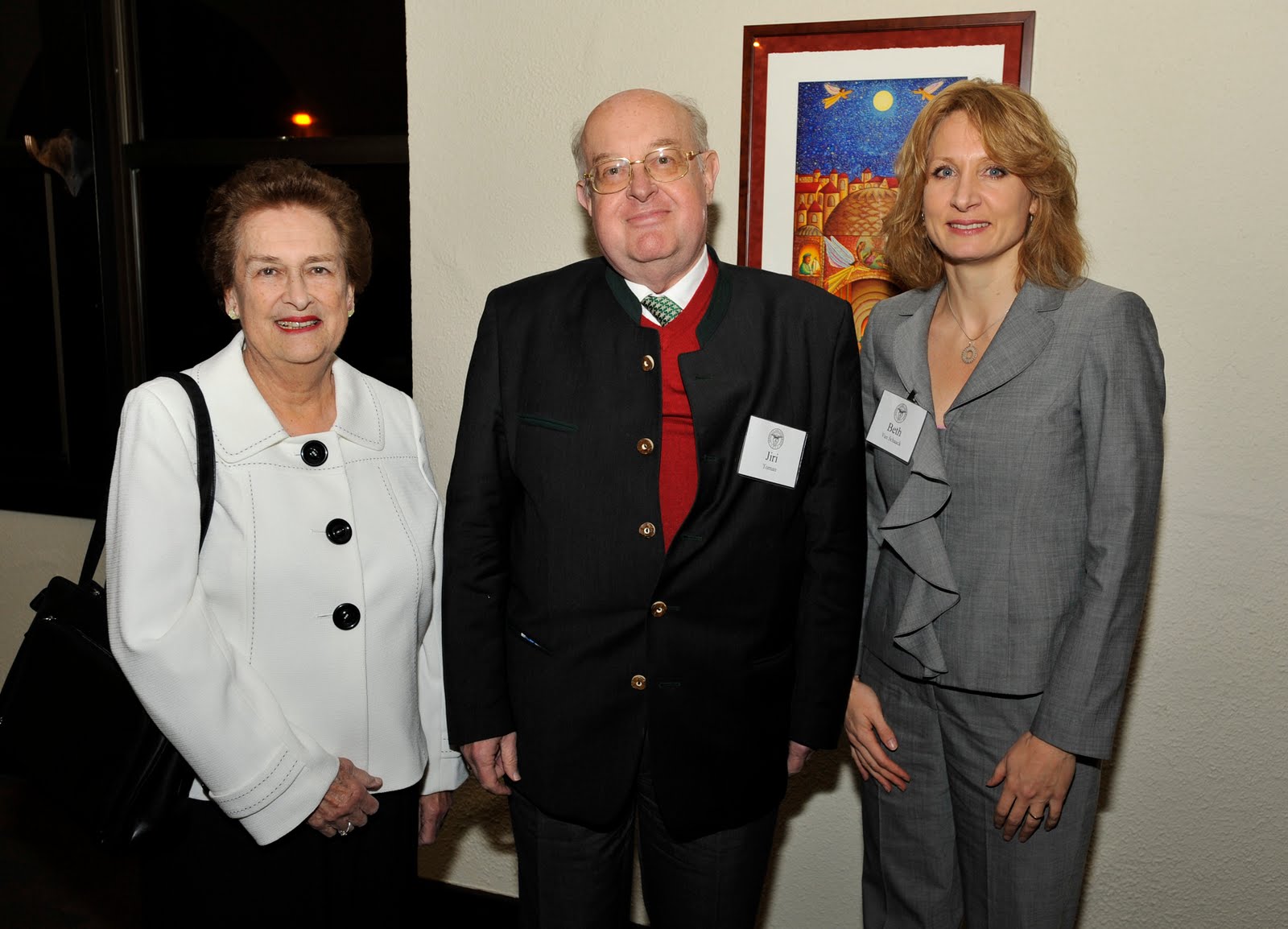
Hope to see you there! (Picture at left includes my colleague Jiri Toman, an old friend of Judge Higgins).

Recognizing Palestine

One nation in the Middle East is seeking a change in status even as a neighboring state faces a change in regime.
The nation is Palestine.
Though some members of the Palestinian people are dispersed, many live in the West Bank and Gaza, the latter of which shares a border with Egypt, locus of recent political ferment about which we've posted.* (map credit)
In these Palestinian territories, the entity known as the Palestinian Authority governs by dint of circa-1990s international agreement. The Authority administers "within the framework of a semi-presidential multi-party republic, with a Legislative Council, an executive President, and a Prime Minister leading the Cabinet."
IntLawyers will see in the above paragraph 3 of the 4 traditional indicia of statehood:
1) Permanent population;
2) Defined territory; and
3) Government.
Not immediately apparent is this indicator:
4) Capacity to enter into relations with other states.
The declaratory theory of statehood would emphasize the word "capacity" in that last phrase, so that statehood would exist whenever an entity possessing Nos. 1-3 has the ability to effect No. 4. Yet in practice the constitutive theory holds sway. For if no fully recognized states themselves recognize the entity -- if no states actually enter into relations with it -- the entity cannot act as a state.
Put another way:
Not everything that looks like a state and quacks like a state is able fully to operate as a state.
(image credit) The trickiness of that 4th indicator has left scholars chewing for years over Palestine's status.
► Even without sufficient recognition by others, does it sufficiently possess the 4 attributes?
► Is it a "state" for purposes, say, of litigating before the International Court of Justice, by ICJ Statute Article 34(1) a forum open only to "states"?
► For purposes of referring a situation to the International Criminal Court, as the Palestinian National Authority in fact is attempting to do?
► Does it benefit -- and it is burdened -- by other rights and duties of states?
Developments may be shifting this debate.
In recent months, a series of states has recognized Palestine as an equal sovereign.
December began with the announcement, on the 3d day of that month, that Brazil "recognized the state of Palestine along the 1967 borders before Israel's seizure of the West Bank." The notice in response to a Palestinian request, Politico's Laura Rozen reported, "took Washington by surprise." She added:
Brazil was the last of the so-called BRIC nations [Brazil, Russia, India, China] to recognize Palestine. More than 100 countries, including almost all the African and Arab ones, had recognized it, "so it was the natural thing to do," a Brazilian official explained ....
Days later, Argentina said it would recognize Palestine.
Less than a week into the New Year came news that Chile had recognized Palestine.
A couple weeks ago, Russia reaffirmed its recognition.
Then came Peru, reportedly joining Bolivia, Ecuador, Guyana, and Uruguay in addition to South American countries already named.
Last week, Suriname added its name to the list.
Such news has compelled France to deny reports that it too was ready to recognize.
Yet elsewhere in Europe, there are calls for recognition and, in the case of Ireland, a late January upgrading of the Irish presence in Palestine to a "diplomatic mission," a step short of recognition. (France, Spain, and Portugal already had made the same move.) Palestine continues to seek wider European recognition. The European Union-U.N.-Russia-U.S. "Quartet" was expected to discuss Palestine "on the sidelines" of a conference in Munich this past weekend.
What of the United States?
As of mid-January, the U.S. official word for such recognitions was "premature." Given that more than half the world's countries appear already to have recognized, it's a word that may be meant to imply a policy change sooner rather than later.


* Not-unrelated aside: CNN reports that in recent days, West Bank rallies in support of pro-democracy protests in Egypt have been "shut down by Palestinian Authority security claiming the participants did not have the appropriate permits to hold such events."

On February 6

On this day in ...
... 2006 (5 years ago today), Rosalyn Higgins was elected President of the International Court of Justice, a position she would hold until her retirement in 2009. Professor of International Law at the University of London before joining the ICJ in 1995, Higgins (left) was then the only woman ever to have served on that international bench (last autumn, as we then posted, 2 women were sworn in). In 2009, she was appointed the international law adviser to an official inquiry into British involvement in Iraq.

(Prior February 6 posts are here, here, and here.)

On February 3

On this day in ...
... 2006, the International Court of Justice issued a judgment concluding by a vote of 15 to 2 that it had no jurisdiction to consider an application that the Democratic Republic of Congo had lodged 4 years earlier, in which it alleged that Rwanda, one of its neighbors to the east (map credit), had committed
'massive, serious and flagrant violations of human rights and of international humanitarian law' resulting 'from acts of armed aggression perpetrated by Rwanda on the territory of the Democratic Republic of the Congo in flagrant violation of the sovereignty and territorial integrity of the Democratic Republic of the Congo, as guaranteed by the United Nations and OAU Charters'.
The ICJ's judgment in Armed Activities on the Territory of the Congo (New Application : 2002) (Democratic Republic of the Congo v. Rwanda), the court declined to exercise jurisdiction based on a laundry list of treaties. It held inapplicable, for instance: the 1984 Convention Against Torture, for the reason that Rwanda was not a state party; and the 1948 Convention Against Genocide, for the reason that Rwanda had attached a pertinent reservation to its ratification of the latter treaty. Nor did it agree with the DRC that Rwanda had waived its right to object to jurisdiction.


(Prior February 3 posts are here, here, and here.)

Go On! International Conflict & Negotiation Colloquium at Stanford

Anyone in the Bay Area should check out the Stanford Center on International Conflict & Negotiation's International Conflict Resolution Colloquium. The Colloquium is being convened by Professors Allen Weiner (Law--right); David Holloway (Political Science); and Lee Ross (Psychology).
All Colloquium sessions meet from 4:30 p.m. to 5:45 p.m. on Thursday in Room 90 of the Law School.

The schedule is below:

► January 6: Allen Weiner (above right)
Senior Lecturer in Law, Stanford Law School
Barriers to Conflict Resolution: The Israeli-Palestinian Conflict

► January 13: Richard Goldstone (right)
Former South African Constitutional Court Justice, Visiting Professor, Stanford Law School
South Africa’s Transition to Democracy: The Role of the Law

► January 20: James Fishkin (right)
Director, Center for Deliberative Democracy,
Janet M. Peck Chair in International Communication, Stanford University Deliberative Democracy and Conflict Resolution

► January 27: Christopher R. Hill (left)
Dean, Josef Korbel School of International Studies, University of Denver,
former United States Ambassador to Iraq
The Iraqi Conflicts

► February 3: Beth Van Schaack (right)
Associate Professor, Santa Clara Law School
Negotiating at the Intersection of Power and Law:
The International Criminal Court and the Definition of Aggression

► February 10: Omar Dajani (left)
Professor of Law, McGeorge School of Law, University of the Pacific
Shadow or Shade – The Roles of International Law in Palestinian-Israeli Peace Talks

► February 17: James T. Campbell (right)
Edgar E. Robinson Professor in United States History
Settling Accounts? History, Narrative, and Historical Reconciliation

► February 24: Avishai Margalit (left)
George F. Kennan Professor in the School of Historical Studies at the Institute for Advanced Study
Sectarianism

► March 3: Christopher Greenwood (right)
Judge, International Court of Justice
International Conflict Resolution and the International Court of Justice

Hope to see you there!

Kosovo: Secession dilemma déjà-vu

(Many thanks to IntLawGrrls for giving me the opportunity to contribute this guest post!)

Since 17 February 2008 – the day of Kosovo’s declaration of independence from Serbia – it has become rather pressing to understand whether this act has legal precedential value and hence what its consequences are. The International Court of Justice (below right) issued an Advisory Opinion on Kosovo this past summer. (Prior IntLawGrrls posts available here.) But that opinion has not shed much, if any, light on the question of precedence.
Whether the Court was asked, on the one hand, to analyze the legal consequences of the independence of Kosovo, or, on the other hand, merely to “narrow[ly] and specific[ally]” reply whether “the unilateral declaration of independence by the Provisional Institutions of Self-Government of Kosovo is in accordance with international law,” remains, of course, a separate debate.
Be it as it may, the dilemma remains:

Is Kosovo a precedent for (remedial) secession?
My article recently published in the Goettingen Journal of International Law, "Secession in Theory and Practice: The Case of Kosovo and Beyond," attempts to put forward a lucid account of the legal implications of Kosovo’s independence. To do so, the article explores the international regulations on secession, as well as the circumstances that led to the case at hand.
The paper carves out the place of secession in international law by appeal to fundamental principles and legal doctrine, and concludes:
► There is no general jus secedendi, or right to secede.
► There are instances in which a right to secession is recognized under international law. These refer to states explicitly acknowledging a right to secession in their domestic law, or multinational states recognizing that their constituent peoples have the right to self-determination.
► There is one controversial case that divides scholarship, the one of remedial secession.
► Lastly, there is a trend towards the legality principle governing secessions, as distinguished from the traditional neutrality doctrine.
It is useful to consider the theory on secession with state practice, to the extent that such practice can be discerned from major socio-political events of Kosovo’s history – from the battle of Kosovo Polje in 1389 to Security Council Resolution 1244 (1999) that set up the United Nations Interim Administration Mission in Kosovo (UNMIK). From the juxtaposition of this theory and practice, a second conclusion can be drawn: Kosovo is a case of remedial secession and thus it represents a potential legal precedent.
And yet the exceptionality discourse!
While the elements of remedial secession are gathered, states deprived this instance of practice of its precedential value, and made it a legally insignificant act.
Some explanations are in order.
An action that is novel or inconsistent with current practice gains precedential value if other states accept it; acquiescence and protest are the fundamental state reactions to an action, therefore those are of interest in the case of Kosovo. Serbia, as the state with most interest in resolving the Kosovo case, has strongly protested against the legality of Kosovo’s secession. Other states protested or decided to withhold recognition. All officially identify the potential of setting a legal precedent as reasoning.
The fascination about the Kosovo case lies in the discourse of those states that chose to support and recognize Kosovo as an independent state, describing it as a sui generis/special/exceptional case. Throughout the years that it has sought independence from Serbia, Kosovo has maintained that it has the legal right to do so. In this context, the most staggering statement is made by Kosovo itself in its own declaration of independence:

Kosovo is a special case arising from Yugoslavia’s non-consensual breakup and is not a precedent for any other situation.
The Kosovo secession has been articulated, but as a non-precedential situation. In the end, as scholars Georg Nolte and Helmut Philipp Aust wrote in an article published last year,

states are both subjected to international law and create and authoritatively interpret it.
And in this case, even the recognizing states have consciously and clearly opted not to create a general rule governing remedial secession. Ultimately, states have guarded the status quo, and continued to act allergic to a right to remedial secession with set boundaries and clear coordinates. Ironically, the consistent state practice is evidence of the absence of a customary right of remedial secession.
In other words, the international community missed a rare opportunity to clarify the concept of remedial secession and to reassert its preventive force as a non-traditional human rights protection mechanism. The consequences of not assuming the precedent are, regrettably, far more important.
The force of remedial secession lies in its prevention potential – empowering minority groups to hold governments accountable to their international obligations. It is not an implosive weapon within the Westphalian system, but rather a non-traditional human rights mechanism.
By presenting Kosovo as unique, the international community undermined the theory of remedial secession, and made states and their borders sacrosanct even when a government, by way of its discriminatory and repressive actions against part of its population, puts its own raison d’être into question. It is a perverse implication, one that states will have to deal with when another unique Kosovo enters the international arena.
Thirty-nine years ago, Bangladesh seceded from Pakistan. The debate whether Bangladesh set a precedent for a right to remedial secession continues. Regrettably, Kosovo is merely a Bangladeshi déjà-vu.

On December 19

On this day in ...
... 2005 (5 years ago today), Armed Activities on the Territory of the Congo, the caption given a dispute between the Democratic Republic of Congo and Uganda, was issued. In this judgment the International Court of Justice decided, inter alia, that Uganda violated principles of non-use of force and non-intervention by acting militarily on Congolese territory and by supporting rebels. It also found Uganda responsible for breaching obligations under international human rights and international humanitarian law on account of the killings, torture, and other abuse that its troops committed against Congolese civilians, and its own failure to put an end to such crimes. In addition, the ICJ determined that Congo violated its Vienna Convention on Diplomatic Relations obligations toward Uganda on account of attacks that Congolese troops committed at Uganda's embassy in Kinshasa. Each country was held to owe reparations to the other.

(Prior December 19 posts are here, here, and here.)

Responsibility of state bystanders

(Delighted to welcome back alumna Monica Hakimi, who contributes this guest post)

When must states protect people from abuses committed by third parties?
That obligation (termed the “obligation to protect”) is everywhere in modern human rights law. Consider a few examples of how decisionmakers prescribe, invoke, or apply it:
► Under the Convention on the Rights of the Child, states must take measures to protect children from “physical or mental violence…while in the care of parent(s).”
► Non-refoulement prohibits states from returning people home if there is a risk of third-party harm. A state that deports someone despite that risk typically does not participate in the abuse. Rather, the deporting state fails to satisfy an obligation to protect.
► The International Court of Justice (bottom right) has interpreted the Genocide Convention to require states to protect people from acts of genocide committed by or in another state.
► The concept of responsibility to protect posits: (1) that each state must protect its population from certain atrocities, including atrocities committed by third parties; and (2) if one state fails to satisfy that obligation, it shifts to the international community.
► The International Law Commission (below left) has proposed a rule rendering states responsible where they delegate authority to an international organization that then violates rights. (photo credit) Under the proposal, a delegating state would be responsible even if the abuse were attributable only to the international organization.
In each of those examples, the state must protect someone from third-party abuse.
The entity committing the abuse may be a private actor, another state, or an IO. The critical point is that the duty-holding state may be responsible simply for standing by—for not satisfying an affirmative obligation to protect. The state need not participate in the abuse to be responsible.
Though the obligation to protect is prevalent, no generalized framework exists for appraising when states have it or what it requires.
Instead, decisionmakers prescribe and apply the obligation ad hoc — under different sources of law and for discrete groups of victims (e.g., children), harms (e.g., physical violence), or abusers (e.g., private individuals). As a result, states' practice is splintered and, at times, inconsistent or confused. My article State Bystander Responsibility, published earlier this year in the European Journal of International Law, seeks to remedy that problem by presenting a generalized framework on when states are and should be responsible for failing to protect people from third-party harm.
The framework explains the practice where it is uniform, and helps guide decisions where the practice is inconsistent or confused:
First, whether a state has the obligation depends on its relationship with the (actual or potential) abuser.
A duty-holding state must restrain third parties from committing abuse. Of course, the interest in protecting potential victims favors establishing that obligation. But varied considerations favor limiting when and how states assert their authority over third parties. The obligation thus requires a normative judgment: Given its particular relationship with the third party, are the state’s restraints desirable or overly intrusive? The practice provides considerable guidance on that question. A state generally must restrain third parties to whom it delegates governmental functions or who operate in its territory (or in territory under its control). By contrast, a state generally need not restrain third parties in other states. Broad assertions to the contrary do not reflect legally operative obligations. Consider, for instance, the responsibility to protect contention that all states must restrain any particular state which commits atrocities. Such an assertion is essentially unenforceable and in practice unenforced against particular bystander states.
Nevertheless, the general rule that states lack extraterritorial obligations to protect is subject to an important exception: A state may have that obligation where it substantially enables a third party to violate rights. In that event, the duty-holding state may or may not participate in the abuse under the traditional rules on attribution. But having enabled the abuser, the state must protect against its harm. A few examples:
► Serbia had to restrain the Bosnian Serbs in the ICJ's Genocide Case. (prior IntLawGrrls post)
► Russia had to restrain Georgian and Moldovan separatists that it supported.
► Turkey had to restrain the Turkish Cypriot administration that it propped up.
► And arguably at least, deporting states enable entities in the home country to violate rights, thus triggering obligations of non-refoulement.
Second, obligations to protect depend on the kind of harm caused. States must protect only against conduct that:
(1) causes serious physical or psychological harm; or
(2) affects someone because she belongs to a vulnerable group.
Treaty bodies sometimes assert that states also must protect against other conduct, especially where the abuser is a private actor. That assertion is inconsistent with substantial other practice. Indeed, the treaty bodies themselves apply the obligation more narrowly—and almost exclusively to conduct falling in the above two categories. Thus, states must restrain an employer who beats its employees (category 1) or discriminates on the basis of sex (category 2). But they need not restrain an employer from terminating an employee who is a bad worker or no longer needed. Yes, the termination affects the employee’s right to work. It does not trigger an obligation to protect because the state need not restrain the employer to protect its employees from termination. Rather, the state must try to fulfill the employees’ right to work by, for instance, offering them educational programs.
Finally, a state that has the obligation — because of its relationship with the third party and the severity of the harm — must take reasonable measures to restrain the third party. Reasonableness depends on context, but several factors inform whether particular measures are reasonable:
(1) the nature of the abuser (i.e., whether a private actor, another state, or an international organization);
(2) the nature of the harm;
(3) whether the practice specifically identifies the measures the state must take (e.g., requires criminal action) or leaves that determination to each state’s discretion;
(4) the scale of the problem; and
(5) the state’s capacity to take more effective measures. A duty-holding state is responsible if it takes either no measures or measures that are unreasonably lax to restrain the third party.

Still pursuing "Africa's Pinochet"

A new casenote on the 1st-ever judgment of Africa's human rights court caught my eye:

It's one small step for the African Court of Human and People's Rights, but a giant leap for the African system of human rights protection.
Thus were the moonwalk words of Neil Armstrong paraphrased (in French) -- to indicate mixed sentiments about that 1st judgment -- by author Guy-Fleury Ntwari, a doctoral student at the Centre de Droit International at France's Université Lyon 3 Jean Moulin as well as a law school instructor in Burundi.
In his Note sur le premier arrêt de la Cour africaine des droits de l'homme et des peuples, published last month in the African Journal of International & Comparative Law, Ntwari analyzed the decision in a case in which a man from Chad, Michelot Yogogombaye, complained of a statute by which Senegal withdrew criminal proceedings against former Chadian dictator Hissène Habré, who for many years has lived in exile in Senegal's capital, Dakar. Yogogombaye asserted that the law violated rules, in national and international law, against nonretroactivity.
In a decision issued on December 15, 2009 (as Beth Van Schaack then posted), the court rejected the application, ruling that Senegal had not acceptance the court's jurisdiction over individual petitions.
Ntwari's note acknowledged that the decision interposed a legal bar to individual actions. Yet Ntwari found it significant that the court had ruled on personal jurisdiction grounds. This left open a "liberal approach" with respect to similar complaints brought through other paths, such as a state v. state application.
Moreover, Ntwari viewed the decision as part of an accumulation of matters against Habré, sometimes called "Africa's Pinochet" on account of the brutality of his reign in Chad. Other cases are pending before:
► Senegalese national courts;
► The International Court of Justice, in Questions relating to the Obligation to Prosecute or Extradite (Belgium v. Senegal), now in the pleadings stage; and
► The Court of Justice of the Economic Community of West African States (which heard argument in the case this past summer), a court about which we've previously posted here and here.
Ntwari looked forward as well to the potential of a fused court -- that is, one that would, if sufficient states parties ratify a treaty now open for signature -- join the work of the African human rights court with that of the African Court of Justice. Uncertainty in that regard affects the work of the current court.

On October 7

On this day in ...
... 1985 (25 years ago today), about 9 months after it had withdrawn from the case captioned Nicaragua v. United States, (later developments in the case here and here), U.S. Secretary of State George P. Shultz wrote U.N. Secretary-General Javier Pérez de Cuéllar, and announced that the United States terminated its acceptance of the compulsory jurisdiction of the International Court of Justice (courtroom at left). The termination took effect 6 months later, thus putting an end to nearly 40 years of U.S. compulsory participation in the Hague-based World Court. With regard to that 1946 acceptance, Shultz' letter said:
[T]his country expected that other states would soon act similarly. The essential underpinning of the UN system, of which the World Court is a part, is the principle of universality. Unfortunately, few other states have followed our example. Fewer than one-third of the world's states have accepted the Court's compulsory jurisdiction, and the Soviet Union and its allies have never been among them. Nor, in our judgment, has Nicaragua. Of the five permanent members of the UN Security Council, only the United States and the United Kingdom have submitted to the Court's compulsory jurisdiction.

(Prior October 7 posts are here, here, and here.)

2 women judges sworn in at ICJ

At 10 Central European Time this morning, Joan E. Donoghue of the United States and Dr. Xue Hanqin of China were sworn in as the newest Judges on the 15-member International Court of Justice (right) at The Hague, Netherlands.
Judges old and new then began a planned week of public hearings in the Case Concerning Application of the International Convention on the Elimination of All Forms of Racial Discrimination (Georgia v. Russian Federation). Pending since 2008, the dispute arose out of events that year in 2 provinces of the Republic of Georgia, South Ossetia and Abkhazia. (Prior IntLawGrrls posts available here.)
Today is the 1st in history that the 65-year-old ICJ bench was not composed of 14 or more men.
As posted, the only other women ever to have served was Rosalyn Higgins (left) of Great Britain, an ICJ Judge from 1995 to 2009 and ICJ President the last 3 years of that tenure.
Xue had been elected on June 29 by the U.N. Security Council and U.N. General Assembly; those bodies elected Donoghue just this past week, on September 9.
Each woman is filling out the term of a retiring judge, and each is eligible thereafter to run for election to a full term.
Both the newest members have devoted their careers to diplomacy.
Xue (left), who will celebrate her 55th birthday this Wednesday, was born in Shanghai. At Beijing University she earned her 1st law degree, a diploma in international law, a field in which she's published widely. Xue then earned an LL.M. and a J.S.D. at Columbia University School of Law in New York. As detailed at her ICJ webpage, she has held a myriad of positions in China's Ministry of Foreign Affairs and has represented China before many international organizations; most recently, as China's Ambassador to ASEAN, the Association of Southeast Asian Nations. She's served as the President of the Asian Society of International Law since 2009.
As we've posted, Donoghue (left) holds a double B.A. with honors in Russian Studies and Biology from the University of California, Santa Cruz, and a J.D. from the University of California, Berkeley, School of Law. She's been a Visiting Professor there, and also has held positions at the Council on Foreign Relations, Georgetown University Law Center, and the George Washington University School of Law. Save for 2 stints in the Treasury Department and at Freddie Mac, she's practiced at the U.S. State Department since 1984. She'd been serving as Principal Deputy Legal Adviser at the time of her nomination to the ICJ. Donoghue is a member of the American Society of International Law, which, as shown in the video below, held a June 2010 event that featured comments by Donoghue, by current State Department Legal Adviser Harold Hongju Koh, and by Koh's immediate predecessor, John B. Bellinger III.

 
Bloggers Team