Showing posts with label international humanitarian law. Show all posts

Go On! Web Seminar on Libya

The Program on Humanitarian Policy and Conflict Research at the Harvard School of Public Health will host on April 5 at 9:30 a.m. EST a Live Web Seminar on the “Crisis in Libya: Planning the International Response.” The presenters include:
  • Luis Moreno-Ocampo, Prosecutor, ICC;

  • R. Nicholas Burns, The Sultan of Oman Professor of the Practice of International Relations, Harvard Kennedy School of Government;

  • Sarah Leah Whitson, Executive Director, Middle East and North Africa Division, Human Rights Watch (below left);

  • Dirk Vandewalle, Associate Professor of Government, Dartmouth College; and

  • Philippa Thomas, Nieman Fellow, Harvard University & Foreign Correspondent, BBC (below right).
The seminar will examine the modalities through which the international community may respond to the ongoing crisis in Libya amid reports of violence, refugee and IDP flows, and other forms of instability. It will also touch on the legal, political and strategic dilemmas arising for the international community, especially in terms of prevention and mitigation of civilian harm.
Registration to the Live Web Seminar is free. Registration and background materials are available on the IHL Research Initiative Portal.
This Seminar is part of a series of monthly live web seminars on contemporary challenges and dilemmas in humanitarian law and policy. The seminars are tailored to practitioners and policy makers. Since 2008, these events have provided a source of interactive professional dialogue at a global level for thousands of professionals engaged in humanitarian action around the world.


Breaking News: Obama's Executive Order on Guantánamo

The White House released today the long-promised Executive Order on detainee policy along with a fact sheet setting forth additional policy points (see prior posts here, here and here). President Obama's statement on the new policy is here.

The E.O. states that it has been issued pursuant to the President's constitutional authority as well as the September 2001 Authorization for Use of Military Force. It does not purport to establish any additional or separate source of detention authority. The Order and fact sheet articulate the following elements:

1. The fact sheet calls for the resumption of trials before military commissions "for international terrorists that [sic] fall within their jurisdiction" in light of "key reforms" to the military commission system, including the bar on the use of statements taken as a result of cruel, inhuman or degrading treatment. As our readers will recall, in Hamdan v. Rumsfeld, the Supreme Court confirmed that military commissions may only assert jurisdiction over violations of the law of war as opposed over crimes that are defined by general international criminal law, domestic law, or the international prohibitions against terrorism. Here is Secretary of Defence Gates's statement rescinding the moratorium.

2. The E.O. establishes a periodic review of the continued detention of current detainees who have been deemed to qualify for prolonged security detention by the inter-agency review mandated by E.O. 13492 (Jan. 22, 2009) or those individuals who have been referred for prosecution but have not yet been charged or prosecuted. By the terms of the E.O., this periodic review will not apply to future detainees. This review is also separate and apart from the habeas rights already being asserted with varying degrees of success by detainees in federal courts. Although some details of this process are provided in the E.O., full implementing guidelines will be issued by the Secretary of Defense in consultation with the Attorney General. The standard for continued detention is that an individual's detention is

necessary to protect against a significant threat to the security of the United States.
3. Each current detainee is entitled to a full initial review within one year of this date before an inter-agency Periodic Review Board (PRB) composed of representatives from the Departments of State, Defense, Justice and Homeland Security as well as the offices of the Director of National Intelligence and the Chair of the Joint Chiefs of Staff. Then, detainees are entitled to a "file review" every 6 months that will consider "relevant new information" compiled by the Secretary of Defense plus a written statement from the detainee. The file review may result in a full review if "a significant question is raised as to whether the detainee's continued detention is warranted." Barring this, subsequent full reviews are to be provided triennially. (Note: The 4th Geneva Convention calls for a 6-month review of all security detentions of non-POWs).

4. The initial and periodic full reviews shall involve the following procedural steps and protections:
  • the provision of notice of the review and a summary of the factors to be considered by the PRB in determining whether continued detention is warranted;
  • the right of the detainee to submit evidence and witness testimony relevant to the determination of whether the detention remains necessary;
  • the provision of all information relevant to the inquiry, including "mitigating information," except where there are national security concerns that might require the provision of "a sufficient substitute or summary" rather than the raw material;
  • there is no adversarial discovery allowed from the government;
  • the detainee is entitled to a personal representative (who is an advocate) and private counsel (at the detainee's expense);
  • a "reliability" determination of all the information provided by the PRB;
  • a "prompt" written disposition, including recommendations for transfer conditions in the event that the continued detention standard has not been met;
  • review by a Review Committee (composed of the Secretary of State, the Secretary of Defense, the AG, the Secretary of Homeland Security, the Director of National Intelligence, and the Chair of the Joint Chiefs of Staff) on that Committee's discretion or if consensus within the PRB cannot be reached;
  • no appeal of any review process is available to the detainee.
5. According to this review process, once an individual's detention is no longer "necessary to protect against a significant threat to the security of the United States," the Secretaries of State and Defense are to identify a suitable transfer location outside the United States consistent with the national security and foreign policy interests of the United States. The Secretary of State shall be responsible for obtaining appropriate security and humane treatment assurances regarding transferees. Transfer efforts shall be reviewed annually by the Review Committee. This will include a consideratin of those individuals whose detention is no longer deemed warranted pursuant to the new periodic review process as well as those individuals whose petition for a writ of habeas corpus has been granted.

6. The fact sheet promises the launch of additional criminal prosecutions in Article III courts. The fact sheets criticizes Congress's "intrusion" into this process and promises to seek the repeal of restrictions on the prosecution of detainees in federal courts (see our discussion here and here).

5. The fact sheet indicates that the Executive remains committed to exercising its discretion to choose the appropriate forum for further prosecutions, including with respect to individuals whom the United States may "apprehend in the future." The fact sheet argues:
A one-size-fits-all policy for the prosecution of suspected terrorists, whether for past or future cases, undermines our Nation’s counterterrorism efforts and harms our national security.
6. The fact sheet expresses support for two "components" of the international legal framework governing armed conflicts:

a. Protocol II, i.e., the Protocol Additional to the Geneva Conventions of 12 August 1949, and relating to the Protection of Victims of Non-International Armed Conflicts (June 8, 1977), and
b. Article 75 of Protocol I to the 1949 Geneva Conventions.

With respect to the former, the Administration recommends ratification, particularly in light of the fact that an inter-agency review has concluded that U.S. military practice is consistent with the Protocol and its imperative of humane treatment in the conduct of armed conflicts. With respect to the latter, the United States is already on record indicating that Article 75 of Protocol I constitutes customary international law vis-a-vis international armed conflicts (query its relevance here given that the conflict has been characterized as non-international by the Supreme Court in Hamdan). The fact sheet does not repeat this observation, but it does reaffirm that the Article is "consistent with our current policies" and has historically earned our support. Article 75 provides certain "fundamental protections" that apply in international armed conflicts, broadly defined, to those individuals "in the power of a Party to the conflict and who do not benefit from more favourable treatment under the Conventions or under this Protocol." These basic protections include:

► The right to be treated humanely in all circumstances and without discrimination.
► The right to respect for the person, honour, convictions and religious practices of all such persons.
► Prohibitions on the following acts "at any time and in any place whatsoever, whether committed by civilian or by military agents:"
  • violence to the life, health, or physical or mental well-being of persons, including (i) murder; (ii) torture of all kinds, whether physical or mental; (iii) corporal punishment; and
    (iv) mutilation;
  • outrages upon personal dignity, in particular humiliating and degrading treatment, enforced prostitution and any form of indecent assault;
  • the taking of hostages;
  • collective punishments; and
  • threats to commit any of the foregoing acts.

► The right of any person arrested, detained or interned for actions related to the armed conflict to be informed promptly of the reasons for the detention. Any such preventative detention must be as short as possible:
Except in cases of arrest or detention for penal offences, such persons shall be released with the minimum delay possible and in any event as soon as the circumstances justifying the arrest, detention or internment have ceased to exist.

► The right to have any sentence or penalty be made pursuant to "a conviction pronounced by an impartial and regularly constituted court respecting the generally recognized principles of regular judicial procedure." These protections include the following:
  • the right to be informed of charges without delay,
  • all necessary rights and means to launch a defense,
  • the right to be judged based upon one's individual responsibility,
  • the protection against ex post facto prosecution,
  • the principle of lenity,
  • the right to be presumed innocent until proven guilty,
  • rights to be present at trial, confrontation rights and the protection against self-incrimination, and
  • the protection of res judicata
7. The fact sheet reiterates the administration's long-term policy of closing the detention facility on Guantánamo.

8. This law-of-war detention policy shall be reviewed every four years.

The Contours of Law of War Detention

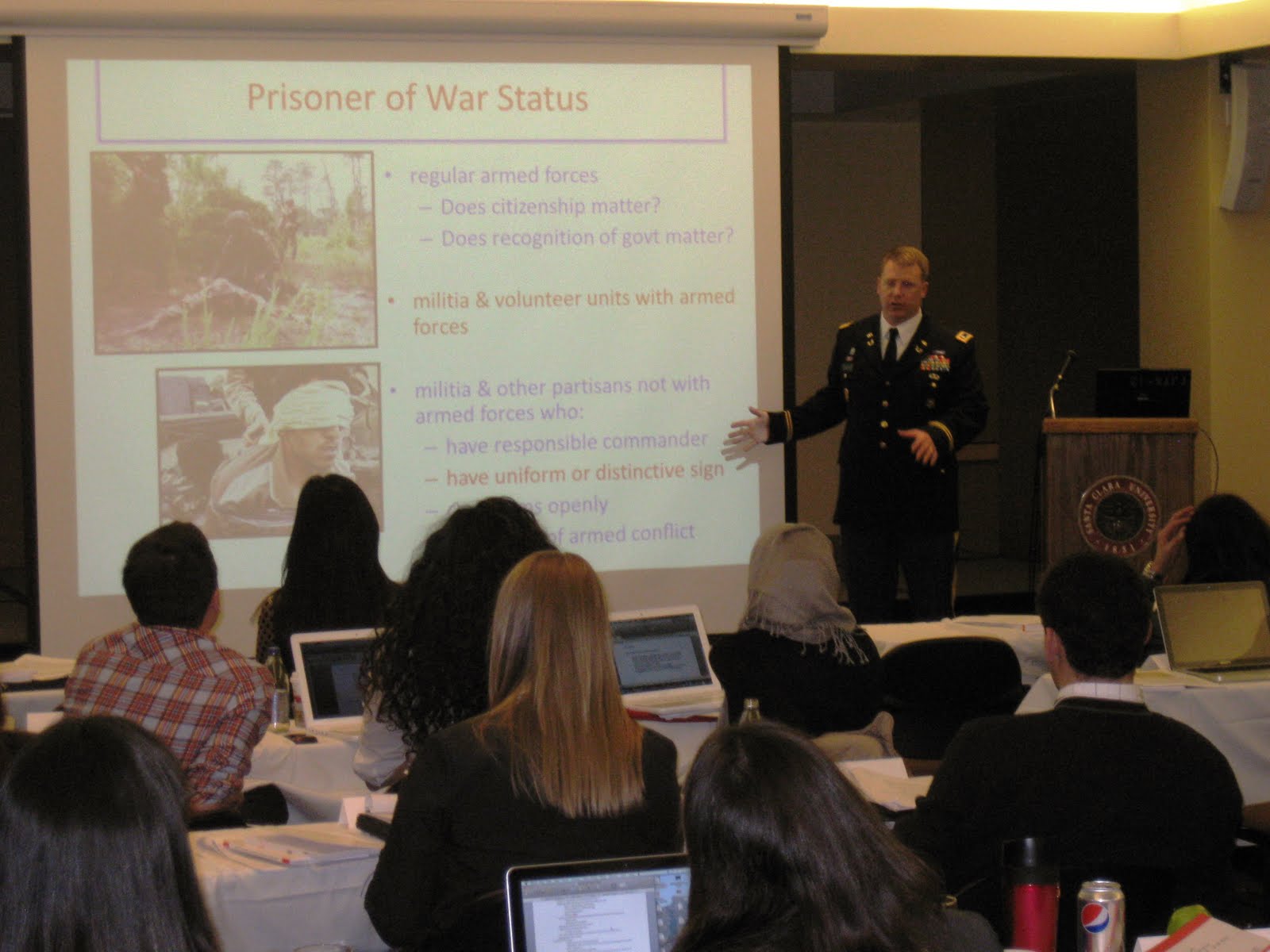
My institution recently co-hosted with the International Committee of the Red Cross an intensive workshop on International Humanitarian Law for law students. At left, is Lt. Colonel Chris Jenks of the Office of the Judge Advocate General teaching conflict classification.
This was the fifth annual such workshop, which focuses on lectures and hands-on exercises to elucidate the principles and challenges of applying humanitarian law to contemporary armed conflicts. In the past, the Workshop has culminated with a multilateral negotiation and drafting exercise focused on the intersection of acts of terrorism and the law of armed conflict. This year, participants engaged in a role play (two photos at right) in which they made comments before the House Armed Services Committee Subcommittee on Terrorism, Unconventional Threats, and Capabilities on a domestic law-of-war detention draft statute entitled the "Law of War Privileged and Unprivileged Belligerents Preventative Detention Act of 2011."
The exercise required students to debate a number of foundational issues, including:
  1. The definition of "armed conflict" to distinguish law of war detentions from other forms of administrative and punitive detention that the United States might engage in.
  2. The definition of "battlefield" to enable authorities to distinguish between battlefield detentions (which could be effectuated for short periods of time with minimal process) and detentions made outside of the battlefield. The draft language defined "battlefield" a number of alternative ways, including with reference to active zones of conflict (e.g., Iraq, Afghanistan, and the FATA areas of Pakistan), but also more generally as any area in which hostilities or acts of terrorism are regularly planned or launched and in which belligerents are billeted or trained. This is the topic of Laurie Blank's (Emory) research, as we've featured here.
  3. The definition of "member," to account for the fact that membership in Al Qaeda, the Taliban, or "associated forces" was one contemplated ground for detention. The draft legislation also grappled with how a detainee could demonstrate that any prior membership relationship had been terminated, as by desertion, withdrawal, or discharge.

  4. The definitions of "privileged" and "unprivileged" belligerents and differential detention regimes for each. The former was defined with reference to the categories enumerated in Article 4 of the Geneva Convention. The latter was defined with reference to both membership in enumerated and unenumerated groups as well as on conduct grounds. The legislation listed various forms of conduct that might constitute grounds for detention, including acquiring terrorist skills, possessing a thing that is connected with a hostile act, providing substantial support to any hostile or terrorist act against U.S. armed forces or coalition forces, and directly participating in hostilities against the United States or coalition partners without the privilege of doing so. In preparing these competing formulations, we drew on definitions of "enemy combatant" that have been employed in post-9/11 military orders, legislation, and jurisprudence as discussed here.

The legislation was premised on a three-phase detention regime:

  • Phase one involved a short (48 or 72 hours) battlefield detention that could be effectuated by any member of the U.S. armed forces (or member of a coalition force) pursuant to a minimal burden of proof. Extensions were contemplated in exceptional circumstances upon the order of any commanding officer.

  • Phase two, continued detention, would only follow a hearing before a Review Board (whose precise composition was in dispute). The government would be subject to a higher burden of proof at this stage, with possible standards ranging from preponderance of the evidence to compelling evidence. Phase 2 was subject to periodic review (6 months was proposed in keeping with the security detention regime envisioned by the Fourth Geneva Convention).

  • Stage three, so called extended detention, would follow after an undetermined number of periodic reviews and would be subject to an even higher burden of proof. Students also debated whether periodic review should be automatic or subject to some showing of changed circumstances or new evidence.

  • Students also debated a provision that would dissolve all detention orders after ten years.

Some members of the Committee were designated as opposed to the legislation altogether; accordingly, they argued that the original Authorization to Use Military Force (AUMF) provides all the detention authority the United States needs going forward. Other testified that it is harder to justify contemporary detentions under the 2001 AUMF, especially where individuals are detained far from Afghanistan. In addition to these substantive provisions, students also discussed various procedural issues concerning conditions of detention, the handling of classified information, and access to the outside world.

Now that they have had a chance to grapple with such specifics, the students involved in this exercise will no doubt be in a better position to evaluate President Obama impending Executive Order on indefinite detention to govern current detainees.

Go On! Teaching International Humanitarian Law Workshop

(Go On! is an occasional item on symposia and other events of interest)

On February 25-26, 2011, the International Humanitarian Law Clinic at Emory University Law School and the International Committee of the Red Cross (ICRC) will convene the semi-annual Teaching International Humanitarian Law (IHL) Workshop in Atlanta, Georgia.
The Workshop is targeted at law professors in the United States and Canada interested in
  • teaching an IHL course (otherwise known as the Law of Armed Conflict) for the first time,
  • integrating IHL modules into their current courses and/or
  • rethinking their current teaching of this important subject.
Topics covered will include:
  • Defining the scope and content of an IHL class;
  • Exploring the intersection between international human rights law, international humanitarian law, and international criminal law;
  • Incorporating IHL modules into the teaching of classes such as public international law, national security law, immigration law, constitutional law, administrative law and more;
  • Identifying strategies for developing curricula, responding to current events, and gaining support from school administrations for the teaching of IHL.
The Workshop provides an opportunity for law faculty to think creatively about their teaching of IHL and network with others to support and expand their teaching of the topics. The cost of the two-day seminar is $250 per person and includes breakfast and lunch for both days, dinner Friday night, as well as all materials.
Contact: IntLawGrrls guest/alumna Laurie Blank, Director of Emory's IHL Clinic (left). To register, visit here.

Intensive IHL Workshop

Students from several dozen U.S. and foreign law schools will descend on Santa Clara University School of Law this week for an intensive workshop in International Humanitarian Law (IHL) we are co-hosting with the International Committee of the Red Cross. This is the fifth annual such workshop.

This workshop, about which we've blogged before here and here, combines lectures and hands-on exercises. The workshop is led by legal professionals from the International Committee of the Red Cross (ICRC), lawyers for the U.S. Armed Forces and U.S. government, and law professors who specialize in IHL. It will culminate in a simulation exercise on draft legislation providing the United States with prospective legal authority to engage in law of war detention of enemy combatants. This exercise will occur in the shadow of the impending release of President Obama's Executive Order allowing for indefinite detention of some of the
Guantanamo detainees.

Topics of lectures and simulations include:
•Introduction to International Humanitarian Law
•When Does IHL Apply?
•Human Rights and IHL
•Protected Persons
•Internment/Detention
•Armed Conflicts of a Non-International Character
•The IHL/Terrorism Interface
•Implementation and Enforcement of IHL

The faculty are:
•Colonel (Ret.) William K. Lietzau, Deputy Assistant Secretary of Defense for Detainee Policy, former White House Deputy Legal Advisor to the National Security Council, former Judge Advocate, member of several U.S. delegations to multilateral treaty drafting negotiations including the International Criminal Court and the Terrorist Bombing Convention (above right).

• Professor Kate Jastram, Berkeley Law (who also hosts a Teaching IHL Workshop with the ICRC for law professors) (below right).

•Major Rob Barnsby, International and Operational Law Department, JAG Legal Center.

•Lt. Col. (Ret.) and Dr. Gary Solis, Adjunct Professor of Law, Georgetown Law; faculty, International Institute of Humanitarian Law (San Remo, Italy); former head of the law of war program at the U.S. Military Academy at West Point (above left).

•Lieutenant Colonel Christopher Jenks, U.S. Army Chief of the International Law Branch of the Office of the Judge Advocate General.

•Beth Van Schaack (yours truly), Associate Professor of Law, Santa Clara University School of Law (left)

•Ramin Mahnad, Deputy Legal Advisor, ICRC.

•Mariano Banos, Attorney Advisor, Office of the Legal Advisor, United States Department of State.

On December 19

On this day in ...
... 2005 (5 years ago today), Armed Activities on the Territory of the Congo, the caption given a dispute between the Democratic Republic of Congo and Uganda, was issued. In this judgment the International Court of Justice decided, inter alia, that Uganda violated principles of non-use of force and non-intervention by acting militarily on Congolese territory and by supporting rebels. It also found Uganda responsible for breaching obligations under international human rights and international humanitarian law on account of the killings, torture, and other abuse that its troops committed against Congolese civilians, and its own failure to put an end to such crimes. In addition, the ICJ determined that Congo violated its Vienna Convention on Diplomatic Relations obligations toward Uganda on account of attacks that Congolese troops committed at Uganda's embassy in Kinshasa. Each country was held to owe reparations to the other.

(Prior December 19 posts are here, here, and here.)

Intensive IHL Workshop

Santa Clara is pleased to again host with the International Committee of the Red Cross an intensive, hands-on workshop on international humanitarian law. Details and application materials are available here.

Now in its fifth year, the Workshop is free to law students and will be held January 4 - 7, 2011, at Santa Clara University School of Law. (We will also consider applications from LLM and other special students.) The Workshop features faculty drawn from the ICRC, the U.S. Armed Services’ JAG Corps, lawyers from the Department of Defense/State, and law professors specializing in humanitarian law. The Workshop involves a series of lectures as well as exercises on the various topics, including target selection and proportionality, protected persons, internment/detention rules, the interface of IHL with human rights law and the crime(s) of terrorism, and war crimes prosecutions. The Workshop includes three and a half days of instruction and culminates in a final drafting/negotiation simulation on Friday morning that consolidates the prior material in a real-world context. Participants who complete the program will receive a certificate from the ICRC.

Because there is no registration or other fee, the only cost involves travel and lodging costs. We arrange for a block of hotel rooms at a discounted rate for students. Some law schools have assisted their students with these costs.

The Workshop is quite competitive; in the past, we have received over 100 applications for the 40 available spots. Nearly all of the students accepted were 2nd or 3rd year law students, and most had substantial experience in this field. As a result, we cannot guarantee that everyone who applies will be accepted, but we do appreciate recommendations for good candidates for the program. Our student evaluations are consistently high; all students attending last year agreed that the course was an excellent supplement to their legal education and a great opportunity to meet IHL practitioners and learn more about this important area of law.

IHL was once a somewhat obscure, technical, and highly specialized area of law. It now is a topic of everyday conversations. This process pre-dated the events of 9-11, but those attacks thrust IHL into a spotlight in which it has remained ever since. Indeed, not a day goes by when there is not a story in the major newspapers implicating IHL, and dozens of cases are proceeding in U.S. and foreign courts adjudicating IHL rules and treaties. Notwithstanding this greater attention to the field, misunderstandings persist about when IHL applies and what it dictates. This misinformation is found within the press, among government policymakers, within the general public, and among the judiciary and lawyers.
One of the goals of this course is to give future young lawyers the tools they need to understand and apply IHL, evaluate arguments and claims about IHL, and be effective advocates in situations and cases that implicate IHL. Given the globalization of law, a basic understanding of international law in general and of IHL in particular are an essential part of any lawyer’s legal literacy. If you have any questions about this program, please feel free to contact Elyse Segnit.
For our prior posts on the workshop, see here and here.

Guest Blogger: Laurie Blank

It's IntLawGrrls' great pleasure to welcome Laurie Blank (left) as today's guest blogger.
Laurie's a principal founder and the Director of the International Humanitarian Law Clinic at Emory University School of Law in Atlanta, Georgia, established in 2007. She supervises law students in their work assisting organizations, law firms, and tribunals. Among Laurie's publications is Law of War Training: A Resource for Military and Civilian Leaders (2009) (below right), coauthored with Gregory P. Noone.
In her guest post below, Laurie discusses her article analyzing the concept of "zone of combat."
As a program officer in the Rule of Law Program at the Washington-based U.S. Institute of Peace before arriving at Emory, Laurie ran an expert working group on New Actors in the Implementation and Enforcement of International Humanitarian Law. She's also practiced as a litigation associate in the New York and Paris offices of Shearman & Sterling.
Laurie earned a law degree from New York University School of Law, where she was the 1996-98 Henry L. Boudin Fellow for Human Rights, a master's degree in international relations from The Paul H. Nitze Johns Hopkins School of Advanced International Studies, and a bachelor's degree in political science from Princeton University.

Heartfelt welcome!

New IHL web research tool

Researchers daunted by the challenge of ascertaining customary international law can rest easier. At least, that is, least if they're interested in custom related to international humanitarian law.
That's because yesterday -- the 61st anniversary of the signing of the 4 Geneva Conventions on the laws and customs of war -- marked the launch of an online version of the International Committee of the Red Cross study on Customary International Humanitarian Law that Jean-Marie Henckaerts and Louise Doswald-Beck (left) edited. The hard-copy version was published in two 2005 Cambridge University Press volumes (available here and here).
Contained in the ICRC's new, online research database are:
► Analysis of the customary rules of international humanitarian law that the Study considered applicable in international and non-international armed conflicts; and
► The sine qua non of customary international law, the practice that underlies the rules. Updated periodically thanks to a project of the British Red Cross, this section will include practice to be found in states' military manuals, legislation, case law, and official statements, and also in actions by at international conferences, by international organizations, and by judicial and quasi-judicial bodies.

Write On! IHL Yearbook

(Write On! is an occasional item about notable calls for papers.)

The Yearbook of International Humanitarian Law invites submissions of manuscripts on international humanitarian law. Sponsored by the Hague-based T.M.C. Asser Instituut (prior IntLawGrrls post), this peer-reviewed Yearbook is published annually by T.M.C. Asser Press/CambridgeUniversity Press.
Although papers on any topic related to international humanitarian law are welcome, the editors are especially interested in receiving submissions on the principal theme of their next issue, Volume 13 [2010]. The theme is "Maritime Operations" -- inspired, of course, by recent piracy news, yet broader in its potential scope. Topics might include:
► The applicability of international humanitarian law during counter-piracy operations;
► Detention during maritime operations;
► Maritime security zones;
► Blockades;
► Maritime operations during non-international armed conflicts; and
► Protection of the environment during maritime warfare.
The Yearbook also accepts both articles (ballpark range of 15,000-20,000 words, including footnotes) and shorter pieces on any current development in international humanitarian law. These current developments pieces, which are not limited to the volume's principal theme, typically address international humanitarian law issues that have arisen during the year, including, for example:
► Codification;
► Important publications; and
► Decisions of courts and tribunals.
Submissions should be sent by December 2010, via e-mail to the Yearbook's Managing Editor, Dr. Louise Arimatsu (left), Department of Law, London School of Economics, at l.arimatsu@lse.ac.uk. Questions may be addressed to her or to the Yearbook's Editor-in-Chief, Professor Michael N. Schmitt, Durham Law School, at michael.schmitt@durham.ac.uk.

On the Job! Crimes of War Project

(On the Job! pays occasional notice to interesting intlaw job notices)

The Crimes of War Project, a nonprofit organization that promotes knowledge of the laws of war and their application in contemporary conflicts, is seeking an Executive Director.
The Project provides analysis of current conflicts from the perspective of the laws of war to journalists, policymakers, academics, and the NGO community, in an effort to help prevent violations, to bring attention to violations that occur, and to push for accountability. It is known especially for publishing Crimes of War: What the Public Should Know (rev. ed. 2007).
The Executive Director inter alia will: lead the team at the Project's Washington, D.C., headquarters, and elsewhere; coordinate web and print publications; develop trainings and other programs; and, through media contacts and other means, entrench the Project's place as a foremost source of information about war crimes and international justice. Management, writing, and communications skills, as well as knowledge of international humanitarian law and ability to present it clearly, are required..
The applications period opened May 31, and will remain open till the position is filled. Applicants should send a letter of interest and résumé to Office@crimesofwar.org, or call 202-638-0230 for further information.

Work On! Teaching International Humanitarian Law West

We've blogged before on workshops offered by the International Committee of the Red Cross to professors (of law and otherwise) interested in integrating international humanitarian law into their curricula. This April 9-10, Berkeley under the leadership of Professor Kate Jastram (below left) will host another such workshop. Here are the details:

On April 9-10, 2010 the University of California, Berkeley Law School and the International Committee of the Red Cross (ICRC) will convene the first West Coast Teaching International Humanitarian Law (IHL) Workshop at the University of California, Berkeley. The Workshop is targeted at law professors interested in teaching an IHL course for the first time, integrating IHL modules into their current courses and/or rethinking their current teaching of this important subject.


Topics covered will include:
  • Defining the scope and content of an IHL class;
  • Exploring the intersection between international human rights law, international humanitarian law, international criminal law, and public international law (and the jus ad bellum);
  • Incorporating IHL modules into the teaching of classes such as public international law, national security law, immigration law; constitutional law; administrative law and more;
  • dentifying strategies for developing curricula, responding to current events, and gaining support from school administrations for the teaching of IHL.

The Berkeley Law Teaching IHL Workshop is an outcome of the 2007 ICRC/American University Washington College of law study, Teaching International Humanitarian Law in US Law Schools, which concluded that student demand for IHL courses is high but faculty needs better resources, materials and support to expand the teaching of IHL in law schools in the US. This Workshop is an attempt to address those needs.

Confirmed participants and topics include:

Larry Johnson & Gabor Rona (Columbia) (right and below right) on Intersections with Human Rights and International Criminal Law.

IntLawGrrl Beth Van Schaack (Santa Clara) (left) and Trevor Rush (U.S. Army JAG Legal Center and School) (Jus in Bello and Jus ad Bellum)

Geoff Corn (South Texas College of Law) (left) and Eric Jensen (Fordham) (Integration of IHL into Different Subject Areas)

Gary Solis (Georgetown) on Hot Topics in IHL.


To register or for more information on the Teaching IHL Workshop, please visit here or contact teachingihl@berkeley.edu

Work On! NatSec Law @ UT Law

(Work On! is an occasional item about workshops, roundtables, and other fora for scholarship-presentation-without-publication) Proposals for papers on national security law are being sought for the 3rd annual National Security Law Junior Faculty Workshop, to be held April 1 and 2, 2010, at the Robert S. Strauss Center for International Security and Law, University of Texas School of Law, Austin, cosponsor along with the International Committee of the Red Cross. Also participating in the workshop are our colleagues, Texas Law Professor Robert M. Chesney and South Texas Law Professor Geoffrey S. Corn, as well as the Judge Advocate General’s Legal Center and School and the U.S. Army.
Featured in addition to presentation and discussion of works-in-progress will be training in international humanitarian law.
Abstracts or manuscripts of unpublished papers should be sent to Chesney at rchesney@law.utexas.edu. Deadline is February 1; details here.


D.C. Circuit disappoints

(My thanks to IntLawGrrls for the opportunity to contribute this guest post)

After the Supreme Court ruled in 2008 in Boumediene v. Bush that the detainees at the Guantánamo Bay detention facility are entitled to habeas corpus to challenge the legality of their detention, the U.S. District Court for the District of Columbia started to take action on the hundreds of petitions filed. In these habeas proceedings, the court has faced the threshold legal question of the scope of the government’s authority to detain pursuant to the 2001 Authorization for Use of Military Force.
I thought it would be interesting to see how the D.C. District Court delimited the permissible bounds of the government’s detention authority, specifically focusing on whether the court’s decisions are consistent with the internment standards under the law of war, international humanitarian law. My conclusions were recently published as Guantánamo Habeas Review: Are the D.C. District Court’s Decisions Consistent with IHL Internment Standards?, 42 Case W. Res. J. Int’l L. 197 (2009).
When my article was submitted at the end of August 2009, the D.C. District Court had ruled on 35 petitions and granted 29, under both the Bush and Obama Administrations. The D.C. District Court has now ruled on 41 petitions, granting 32.
Significantly, on Tuesday, the U.S. Court of Appeals for the District of Columbia issued its first opinion, Al Bihani v. Obama, reviewing a habeas petition on the merits.
In affirming a decision below that had denied relief, the panel of the D.C. Circuit (courthouse above left), in an opinion written by Judge Janice Rogers Brown (right), embraced a detention authority more expansive not only than international humanitarian law permits but also than the D.C. District Court has generally asserted.
Both the Bush and Obama Administrations and the D.C. District Court have analogized to international humanitarian law of international armed conflicts in determining the internment standard to be applied to those detained in relation to what the Supreme Court in Hamdan v. Rumsfeld (2006), indicated to be a “conflict not of an international character” between the United States and al Qaeda in Afghanistan.
In their analogous application of international humanitarian law, both the Administrations and the court have analogized solely to the Third Geneva Convention, applicable to prisoners of war. No mention is made of the Fourth Geneva Convention, protecting civilians.
In my article, I discuss whether analogous application of international humanitarian law internment standards applicable to international armed conflict is appropriate in non-international armed conflict and, if so, in which form. I demonstrate that while it may be acceptable to apply the international humanitarian law standards of international armed conflict by analogy to non-international armed conflict, these standards do not and should not extend to any of those individuals at Guantánamo, who are interned in relation counter-terrorism operations not passing over the threshold into armed conflict.
My analysis indicates that the D.C. District Court’s application of the Bush Administration’s definition of “enemy combatant” and the refined standard provided by the Obama Administration are in some ways narrower and in other ways potentially broader than the international humanitarian law internment standards. Nevertheless, that court has done an admirable job in handling certain complicated and unsettled issues under international humanitarian law, such as the meaning of “direct participation in hostilities” and the analogous application of “combatancy” to non-international armed conflicts. While some of the factors that the judges of the D.C. District Court determined established “combatancy” raise concern of being beyond the scope of factors acceptable under international humanitarian law, the D.C. District Court appears to have thus far reined in the Administration’s standards in a manner more consistent with the definition of “combatant” as understood under international humanitarian law.
The recent D.C. Circuit’s decision, however, determined these international humanitarian law matters not to be of concern, as the court completely rejected the premise that international humanitarian law constrains the authority conveyed by the AUMF to detain. The court determined that international humanitarian law is “not a source of authority for U.S. courts.” The court did so despite the ruling of the Supreme Court in Hamdi v. Rumsfeld (2004) and despite the government view that international humanitarian law has a role in the interpretation of the AUMF’s grant of authority, as pointed out in Senior Judge Stephen F. Williams' concurrence.
The Circuit Court’s decision provides much for discussion.
Suffice it to say for the purpose of this posting that those who had hoped, either that the exclusion of international humanitarian law from the determination of the scope of detention authority or that D.C. Circuit’s clarification of the District Court’s differing interpretations of the internment standard would narrow the scope of government’s authority to detain, find themselves concerned and disappointed.

On the Job! Jurisprudence Collections Coordinator

(On the Job! pays occasional notice to interesting intlaw job notices) The War Crimes Research Office (WCRO) at American University Washington College of Law is seeking a qualified and highly motivated candidate for the position of Jurisprudence Collections Coordinator. This individual will be responsible for implementing and supervising the collection, organization, and indexing and digesting jurisprudence from international/ized courts and tribunals. The goal is to create and maintain a highly flexible legal research tool for practitioners worldwide.
After completion of the initial indexing project, the Coordinator will be expected to maintain and improve the Collection, work with the WCRO Director to explore opportunities for expansion, and help to maximize use of the resource among international/ized criminal courts, NGOs working in the field, academic institutions, and other relevant constituencies. The Coordinator may also be called upon to take on discrete research projects, depending on WCRO needs and the Coordinator's abilities.
Position Requirements:
► A high level of proficiency with Internet-based research, Microsoft Office, and Adobe Acrobat essential
► Familiarity with document management software or digital asset management required; familiarity with Extensis preferred
► Familiarity with web content development and content management systems preferred
► Knowledge of international/ized criminal tribunals, international humanitarian law and/or international criminal law
► Excellent oral and written English skills required
► Excellent organizational skills and attention to detail essential
This is a part-time 27 hour/week position at $20/hour with the potential to become full-time.
To Apply: Applicants should send a detailed resume, cover letter, writing sample, and the names and contact information for three references to WCRO Director Susana SáCouto by email at warcrimes@wcl.american.edu.

Military Commissions Act of 2009: New AND Improved?

Congress passed several amendments to the Military Commissions Act last Thursday, as part of the National Defense Authorization Act for Fiscal Year 2010. President Barack Obama signed the legislation yesterday.

An earlier version of this post stated that "There is much of importance — some good, some less good — in this legislation." That post went on to focus on the war crimes provisions of the MCA in light of our prior posts on this topic (see, e.g., here and here) (Others have discussed some of the procedural aspects governing the use of coerced confessions and the applicability of Miranda warnings or the collateral review aspects). Unfortunately, the earlier post was based on a prior version of the legislation that did not ultimately get passed. As a result, there is less good in the new legislation as I detail below.

►First (good), the legislation comes closer to standard international humanitarian law lexicon in addressing itself to “alien unprivileged enemy belligerents” rather than “alien unlawful combatants.” Thus, the basic concept statutory provision has been changed from:

§ 948b. Military commissions generally

(a) Purpose. This chapter establishes procedures governing the use of military commissions to try alien unlawful enemy combatants engaged in hostilities against the United States for violations of the law of war and other offenses triable by military commission.

to:

(a) Purpose. This chapter establishes procedures governing the use of military commissions to try alien unprivileged enemy belligerents for violations of the law of war and other offenses triable by military commission.

An “alien unprivileged enemy belligerent” is defined at Sec. 948a(7) as:

an individual (other than a privileged belligerent) who—
(A) has engaged in hostilities against the United States or its coalition partners;

(B) has purposefully and materially supported hostilities against the United States or its coalition partners; or

(C) is a member of al Qaeda.

This definition adds to our genealogy of efforts to define who may be detained and prosecuted in the post-9/11 era.

►Second (good), Congress has deleted reference to the status of military commissions as “regularly constituted courts” affording the necessary “judicial guarantees” for the purpose of common Article 3. The original legislation — passed in the wake of Hamdan v. Rumsfeld (2006), which classified the armed conflict with Al Qaeda and the deposed Taliban as a Common-Article-3 non-international armed conflict, at a minimum — boldly asserted that the military commissions satisfied common Article 3, as if the courts would simply accept such a claim:

(f) Status of commissions under common Article 3. A military commission established under this chapter is a regularly constituted court, affording all the necessary "judicial guarantees which are recognized as indispensable by civilized peoples" for purposes of common Article 3 of the Geneva Conventions.

In deleting this language, Congress acknowledged that it is the courts that will decide whether such commissions meet U.S. constitutional and international law obligations and that simply saying something is so does not make it so.

► Third (bad), the legislation still asserts that it does not create any new crimes. The 2006 MCA stated that all of its enumerated crimes pre-existed its enactment and thus could be invoked in a criminal prosecution arising out of pre-2006 events, such as the attacks of 9/11 or even the U.S.S. Cole and Khobar Towers attacks. The original language stated:

§ 950p. Statement of substantive offenses

(a) PURPOSE.—The provisions of this subchapter codify offenses that have traditionally been triable by military commissions. This chapter does not establish new crimes that did not exist before its enactment, but rather codifies those crimes for trial by military commission.

(b) EFFECT.—Because the provisions of this subchapter (including provisions that incorporate definitions in other provisions of law) are declarative of existing law, they do not preclude trial for crimes that occurred before the date of the enactment of this chapter.

A draft version of the legislation that did not get passed had more appropriately hedged this a bit when it stated:

§ 950p. Definitions; construction of certain offenses; common circumstances

(d) Offenses Encompassed Under Law of War—To the extent that the provisions of this subchapter codify offenses that have traditionally been triable under the law of war or otherwise triable by military commission, this subchapter does not preclude trial for offenses that occurred before the date of the enactment of the National Defense Authorization Act for Fiscal Year 2010.

This language, which acknowledges that just because Congress says something was already penalized by the law of war does not make it so, unfortunately did not make it into the final legislation. New Section 950p(d) has the same effect as the language in the 2006 MCA.

► Fourth (good), the status of the Geneva Conventions as a source of law has been elevated considerably. Originally, the legislation purported to prevent the treaties' invocation in any setting and for any purpose. This language stated:

(g) Geneva Conventions not establishing source of rights. No alien unlawful enemy combatant subject to trial by military commission under this chapter may invoke the Geneva Conventions as a source of rights.

The 2009 legislation states at Sec. 948b:

(e) Geneva Conventions Not Establishing Private Right of Action—No alien unprivileged enemy belligerent subject to trial by military commission under this chapter may invoke the Geneva Conventions as a basis for a private right of action.

Thus, while the original provision purported to bar any invocation of the Geneva Conventions, the new language accepts that the Conventions may be applicable offensively in habeas proceedings or defensively in penal proceedings by providing only that they may not give rise to an independent cause of action.

►Fifth (bad), conspiracy (the charge of choice before military commissions) is still listed as a substantive crime. In the rejected draft version of the legislation, conspiracy appeared only as a form of responsibility applicable to all the enumerated offenses along with attempt, solicitation, superior responsibility, accessoryship, etc. This change was not adopted, and so the new MCA still allows for the prosecution of an inchoate crime of conspiracy, notwithstanding that a plurality of the Supreme Court in Hamdan determined that no such crime exists under the law of war. Had the draft language been adopted, conspiracies would have been prosecutable only as a form of responsibility when some substantive war crime that was the object of the conspiracy was committed.

► Sixth (good), the legislation includes at §950p(c) a more explicit war nexus, thus limiting the ability of the government to use military commissions to prosecute crimes that occurred prior to the initiation of an armed conflict involving the U.S. The starting date for any conflict involving the U.S. has never been definitively established, but any such armed conflict likely commenced on September 11th at the earliest and October 7, 2001 (when the U.S. invaded Afghanistan) at the latest. (Although Justice Thomas in Hamdan and others have argued that any armed conflict was initiated earlier, either when Al Qaida "declared war" on the U.S. (Justice Thomas's theory) or attacked our embassies in Kenya & Tanzania). The new war nexus states:

(c) Common Circumstances—An offense specified in this subchapter is triable by military commission under this chapter only if the offense is committed in the context of and associated with armed conflict.

Incidentally, the formulation of the war nexus is identical to that in the ICC's Elements of Crimes.

► Seventh (good, I guess), the crime of spying has been slightly redefined to more clearly reference the law of war (added text in bold):

Any person subject to this chapter who, in violation of the law of war and with intent or reason to believe that it is to be used to the injury of the United States or to the advantage of a foreign power, collects or attempts to collect information by clandestine means or while acting under false pretenses, for the purpose of conveying such information to an enemy of the United States, or one of the co-belligerents of the enemy, shall be punished by death or such other punishment as a military commission under this chapter may direct.

There is much to digest in this massive piece of legislation. The amendments described above are welcome, albeit too modest. Congress would have done better to cut more deeply into the list of purported war crimes to cull out all the novel offenses, including
  • inchoate conspiracy,
  • material support for terrorism
  • and murder of a privileged combatant
rather the leaving the task of determining their cognizability to the commissions (and the courts if they're allowed to get their hands on these cases). Had the crime of conspiracy actually been deleted as was obviously contemplated, many of the existing military commission cases would have had to be re-worked in light of the heavy reliance on that charge.

Experts at Law: War & conflict, ICL & IHL

(One in a series on Experts at Law)

Inspired by Diane Marie Amann's post on female international law scholars with expertise in the field of national security law, IntLawGrrls has created a new series entitled Experts at Law. Organized by field of expertise, this series of posts aims to provide easily accessible information to conference organizers, media, and others who seek expert opinions on a variety of subjects while ensuring gender balance. The list below provides institutional affiliations for as well as links to the bios and publications of and blog posts by or about our Experts at Law, who are comprised of IntLawGrrls bloggers, guests, and alumnae and presented in alphabetical order. Some offer specific areas of expertise within the broader topic presented.
If you'd like to find this series again in the future, it's easy -- just scroll down the page until you find the "IntLawGrrls series" menu on the right, and click on "Experts at Law."
Today's list focuses on female international law scholars with expertise in areas of law relating to war and conflict, including international criminal law, international humanitarian law, national security law, terrorism, and transitional justice. If you seek an expert in another field of international law, not to worry -- additional areas of expertise will be listed in posts over the next two weeks.

International criminal law and transitional justice
Diane Marie Amann, Univ. of California at Davis, (publications, blogs): international and transnational criminal justice
Elena Baylis, Univ. of Pittsburgh, (publications, blogs): post-conflict justice
Doris Buss, Carleton Univ., Ottawa (publications, blogs)
Margaret deGuzman, Temple Univ., Philadelphia, (publications, blogs)
Chimene Keitner, Univ. of California, Hastings (publications, blogs)
Linda M. Keller, Thomas Jefferson School of Law, San Diego, (publications, blogs)
Fiona de Londras, Univ. College Dublin, (publications, blogs): feminist critiques of international criminal tribunals
Carmen Marquez-Carrasco, Univ. of Seville, (publications, blogs): the crime of aggression, crimes against humanity, history of international criminal law, the International Criminal Court, international criminal jurisdictions, reparations, universal jurisdiction
Valerie Oosterveld, Univ. of Western Ontario, (publications, blogs): gender issues in international criminal justice
Noëlle Quénivet, Bristol Law School, (publications, blogs): genocide, war crimes
Jaya Ramji-Nogales, Temple Univ., Philadelphia, (publications, blogs): transitional justice
Susan Harris Rimmer, Australian National Univ., (publications, blogs): feminist theory and transitional justice
Naomi Roht-Arriaza, Univ. of California, Hastings (publications, blogs): post-conflict and transitional justice, universal jurisdiction
Susana SaCouto, War Crimes Research Office, American Univ., Washington DC (publications, blogs): international criminal tribunals
Amy Senier, Foley, Hoag LLP, Boston, (publications, blogs): transitional justice
Beth Van Schaack, Santa Clara Univ., (publications, blogs)

International humanitarian law
Diane Marie Amann, Univ. of California at Davis, (publications, blogs)
Stephanie Farrior, Vermont Law School, (publications, blogs)
Carmen Marquez-Carrasco, Univ. of Seville, (publications, blogs): gender and IHL, humanitarian assistance
Monica Hakimi, Univ. of Michigan, (publications, blogs)
Noëlle Quénivet, Bristol Law School, (publications, blogs)
Susan Harris Rimmer Australian National Univ., (publications, blogs)
Beth Van Schaack, Santa Clara Univ., (publications, blogs)

National security and terrorism
See also Diane Marie Amann's list of experts here
Diane Marie Amann, Univ. of California at Davis, (publications, blogs)
Elena Baylis, Univ. of Pittsburgh, (publications, blogs): the "war on terror"
Karima Bennoune, Rutgers-Newark, (publications, blogs): terrorism
Monica Hakimi, Univ. of Michigan, (publications, blogs): the "war on terror" including detentions, mistreatment, questions on the applicable (U.S. and international) law, and renditions
Kristine A. Huskey, Univ. of Texas, (publications, blogs): national security law, the "war on terror"
Fiona de Londras, Univ. College Dublin, (publications, blogs): terrorism and counter-terrorism
Susan Harris Rimmer Australian National Univ., (publications, blogs): rights-based approaches to counter-terrorism law
Beth Van Schaack, Santa Clara Univ., (publications, blogs): the "war on terror"

War and conflict
Elena Baylis, Univ. of Pittsburgh, (publications, blogs): ethnic conflict and minority rights
Karima Bennoune, Rutgers-Newark, (publications, blogs): armed conflict, child soldiers, religious extremism
Doris Buss, Carleton Univ., Ottawa (publications, blogs): rape and sexual violence against women in conflict settings
Naomi Cahn, George Washington Univ., (publications, blogs): child soldiers, disarmament, demobilization, and reintegration, post-conflict transition
Monica Hakimi, Univ. of Michigan, (publications, blogs): armed conflict
Kristine A. Huskey, Univ. of Texas, (publications, blogs): United Nations draft convention regarding mercenaries, the use of private military/security companies in armed conflict
Carmen Marquez-Carrasco, Univ. of Seville, (publications, blogs): humanitarian intervention, prohibition on the use of force, Security Council powers and practice, right to self-defense
Noëlle Quénivet, Bristol Law School, (publications, blogs): girl soldiers, peacekeeping operations, rape and sexual violence against women in conflict settings, right to self defense


Bloggers Team