Showing posts with label Santa Clara University School of Law. Show all posts

The Contours of Law of War Detention

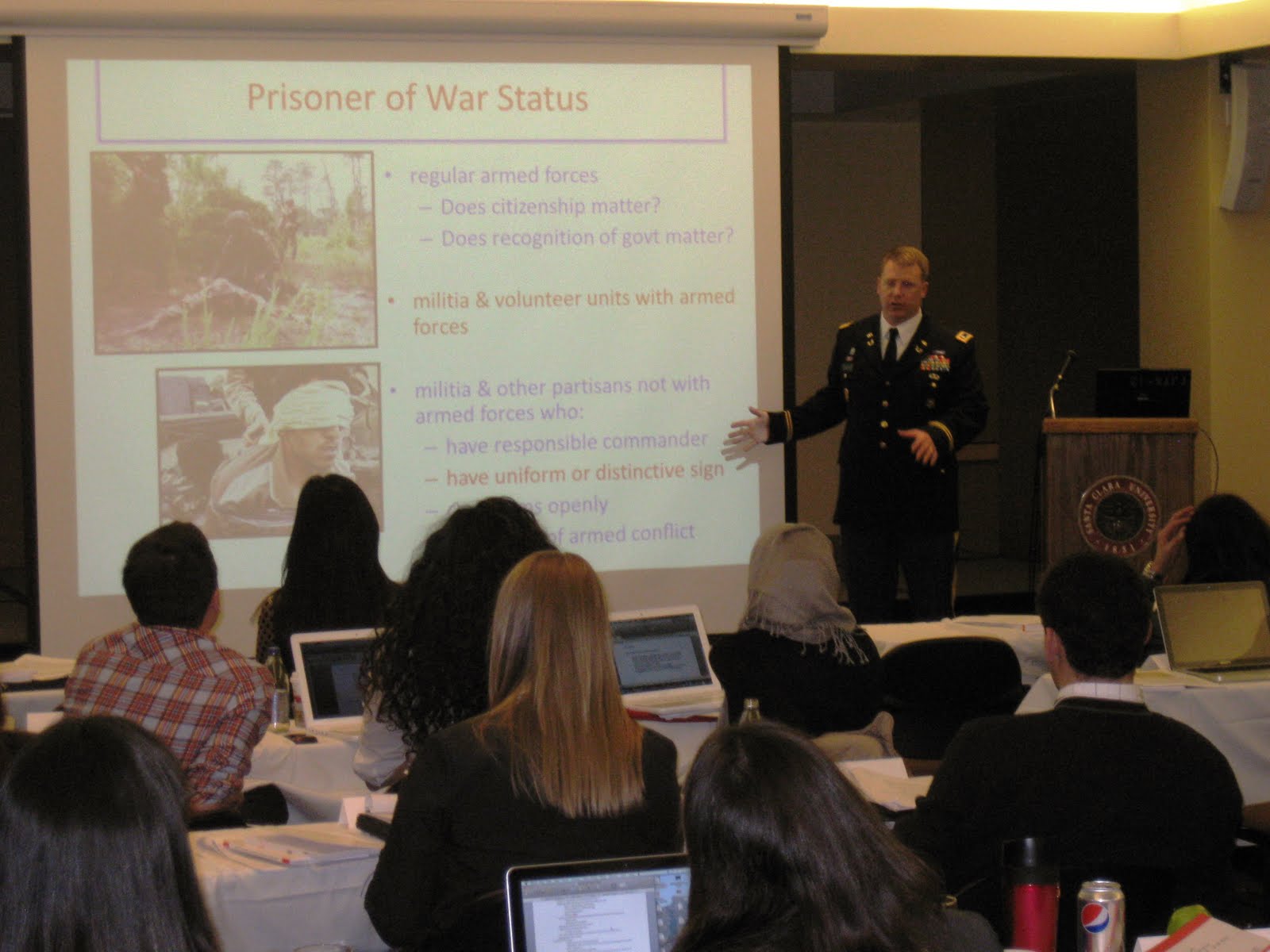
My institution recently co-hosted with the International Committee of the Red Cross an intensive workshop on International Humanitarian Law for law students. At left, is Lt. Colonel Chris Jenks of the Office of the Judge Advocate General teaching conflict classification.
This was the fifth annual such workshop, which focuses on lectures and hands-on exercises to elucidate the principles and challenges of applying humanitarian law to contemporary armed conflicts. In the past, the Workshop has culminated with a multilateral negotiation and drafting exercise focused on the intersection of acts of terrorism and the law of armed conflict. This year, participants engaged in a role play (two photos at right) in which they made comments before the House Armed Services Committee Subcommittee on Terrorism, Unconventional Threats, and Capabilities on a domestic law-of-war detention draft statute entitled the "Law of War Privileged and Unprivileged Belligerents Preventative Detention Act of 2011."
The exercise required students to debate a number of foundational issues, including:
  1. The definition of "armed conflict" to distinguish law of war detentions from other forms of administrative and punitive detention that the United States might engage in.
  2. The definition of "battlefield" to enable authorities to distinguish between battlefield detentions (which could be effectuated for short periods of time with minimal process) and detentions made outside of the battlefield. The draft language defined "battlefield" a number of alternative ways, including with reference to active zones of conflict (e.g., Iraq, Afghanistan, and the FATA areas of Pakistan), but also more generally as any area in which hostilities or acts of terrorism are regularly planned or launched and in which belligerents are billeted or trained. This is the topic of Laurie Blank's (Emory) research, as we've featured here.
  3. The definition of "member," to account for the fact that membership in Al Qaeda, the Taliban, or "associated forces" was one contemplated ground for detention. The draft legislation also grappled with how a detainee could demonstrate that any prior membership relationship had been terminated, as by desertion, withdrawal, or discharge.

  4. The definitions of "privileged" and "unprivileged" belligerents and differential detention regimes for each. The former was defined with reference to the categories enumerated in Article 4 of the Geneva Convention. The latter was defined with reference to both membership in enumerated and unenumerated groups as well as on conduct grounds. The legislation listed various forms of conduct that might constitute grounds for detention, including acquiring terrorist skills, possessing a thing that is connected with a hostile act, providing substantial support to any hostile or terrorist act against U.S. armed forces or coalition forces, and directly participating in hostilities against the United States or coalition partners without the privilege of doing so. In preparing these competing formulations, we drew on definitions of "enemy combatant" that have been employed in post-9/11 military orders, legislation, and jurisprudence as discussed here.

The legislation was premised on a three-phase detention regime:

  • Phase one involved a short (48 or 72 hours) battlefield detention that could be effectuated by any member of the U.S. armed forces (or member of a coalition force) pursuant to a minimal burden of proof. Extensions were contemplated in exceptional circumstances upon the order of any commanding officer.

  • Phase two, continued detention, would only follow a hearing before a Review Board (whose precise composition was in dispute). The government would be subject to a higher burden of proof at this stage, with possible standards ranging from preponderance of the evidence to compelling evidence. Phase 2 was subject to periodic review (6 months was proposed in keeping with the security detention regime envisioned by the Fourth Geneva Convention).

  • Stage three, so called extended detention, would follow after an undetermined number of periodic reviews and would be subject to an even higher burden of proof. Students also debated whether periodic review should be automatic or subject to some showing of changed circumstances or new evidence.

  • Students also debated a provision that would dissolve all detention orders after ten years.

Some members of the Committee were designated as opposed to the legislation altogether; accordingly, they argued that the original Authorization to Use Military Force (AUMF) provides all the detention authority the United States needs going forward. Other testified that it is harder to justify contemporary detentions under the 2001 AUMF, especially where individuals are detained far from Afghanistan. In addition to these substantive provisions, students also discussed various procedural issues concerning conditions of detention, the handling of classified information, and access to the outside world.

Now that they have had a chance to grapple with such specifics, the students involved in this exercise will no doubt be in a better position to evaluate President Obama impending Executive Order on indefinite detention to govern current detainees.

Write On! Student Writing Competition - Deadline Monday

One of the events celebrating Santa Clara University School of Law's centennial is its Centennial Writing Competition. The competition invites submission of original, unpublished scholarly papers on the topic of "future ethical challenges lawyers may face" in the areas of
  1. intellectual property law,
  2. international law or
  3. public interest law.
These topics correspond to Santa Clara's three areas of concentration.
There is a cash prize of $1,000 for the winning entry in each category, plus an additional $1,000 prize for the overall winner, and all three winners will be invited to present their papers and receive their prizes at an event on campus. The winning paper will also be considered for publication in the Santa Clara Law Review.
The deadline for submissions is Monday, January 31, 2011, at midnight Pacific Time.
For detailed information about the competition and how to submit entries, see here. For further information, contact centennialwriting@scu.edu.

Intensive IHL Workshop

Santa Clara is pleased to again host with the International Committee of the Red Cross an intensive, hands-on workshop on international humanitarian law. Details and application materials are available here.

Now in its fifth year, the Workshop is free to law students and will be held January 4 - 7, 2011, at Santa Clara University School of Law. (We will also consider applications from LLM and other special students.) The Workshop features faculty drawn from the ICRC, the U.S. Armed Services’ JAG Corps, lawyers from the Department of Defense/State, and law professors specializing in humanitarian law. The Workshop involves a series of lectures as well as exercises on the various topics, including target selection and proportionality, protected persons, internment/detention rules, the interface of IHL with human rights law and the crime(s) of terrorism, and war crimes prosecutions. The Workshop includes three and a half days of instruction and culminates in a final drafting/negotiation simulation on Friday morning that consolidates the prior material in a real-world context. Participants who complete the program will receive a certificate from the ICRC.

Because there is no registration or other fee, the only cost involves travel and lodging costs. We arrange for a block of hotel rooms at a discounted rate for students. Some law schools have assisted their students with these costs.

The Workshop is quite competitive; in the past, we have received over 100 applications for the 40 available spots. Nearly all of the students accepted were 2nd or 3rd year law students, and most had substantial experience in this field. As a result, we cannot guarantee that everyone who applies will be accepted, but we do appreciate recommendations for good candidates for the program. Our student evaluations are consistently high; all students attending last year agreed that the course was an excellent supplement to their legal education and a great opportunity to meet IHL practitioners and learn more about this important area of law.

IHL was once a somewhat obscure, technical, and highly specialized area of law. It now is a topic of everyday conversations. This process pre-dated the events of 9-11, but those attacks thrust IHL into a spotlight in which it has remained ever since. Indeed, not a day goes by when there is not a story in the major newspapers implicating IHL, and dozens of cases are proceeding in U.S. and foreign courts adjudicating IHL rules and treaties. Notwithstanding this greater attention to the field, misunderstandings persist about when IHL applies and what it dictates. This misinformation is found within the press, among government policymakers, within the general public, and among the judiciary and lawyers.
One of the goals of this course is to give future young lawyers the tools they need to understand and apply IHL, evaluate arguments and claims about IHL, and be effective advocates in situations and cases that implicate IHL. Given the globalization of law, a basic understanding of international law in general and of IHL in particular are an essential part of any lawyer’s legal literacy. If you have any questions about this program, please feel free to contact Elyse Segnit.
For our prior posts on the workshop, see here and here.

ICC's Bensouda online

Delighted to announce that a webcast of International Women's Day appearance of Fatou Bensouda (left), Deputy Prosecutor of the International Criminal Court, is now online.
Loyal blogreaders will recall that Bensouda made her 1st California visit a few weeks back, speaking at the University of California, Davis, School of Law (hosted by the California International Law Center at King Hall, for which I serve as Director) and the University of Santa Clara School of Law (hosted by the Center for Global Law & Policy, thanks to IntLawGrrl Beth Van Schaack and our colleague David Sloss). (photo credit)
While in Northern California, Bensouda also appeared on a news program at the Sacramento-based Capital Public Radio; the full interview is here, and a shorter audio clip here.
It's the CILC-hosted talk, entitled Gender Violence and International Criminal Law, that you can watch here.

Go On! Future of International Criminal Justice

(Go On! is an occasional item on symposia of interest) On March 13-14, Santa Clara University School of Law will host a symposium and experts' round table to discuss "The Future of International Criminal Law." The event is free and is co-sponsored by the American Society of International Law and its ASIL-West contingent.
The symposium will featured panels on:
► The International Crimes of Terrorism;
► Complementarity and the International Criminal Court;
► Universal Jurisdiction; and
► Systemic Criminality.
It will conclude with a roundtable discussion in which panelists will explore how the international legal system may better achieve the goals of international criminal law.
Professor M. Cherif Bassiouni (right) will provide the keynote address. The symposium will feature several Int'l Law Grrls members, alumnae, and visitors, including Naomi Norberg, Luz Estella Nagle (left), and Jenny Martinez (below right). Additional participants include Linda Carter, Jordan Paust, Payam Ahkavan, Steve Vladeck, Michael Scharf, Wolfgang Kaleck, Laura Dickinson, Jamie Mayerfeld, Allison Danner, Dapo Akande, Mark Drumbl, Andre Nollkaemper, Julian Ku, Allen S. Weiner and Almudena Bernabeu along with David Sloss and me from Santa Clara. Click here for a full schedule of events.
The symposium's theme is described below:
The international criminal proceedings held in Nuremberg and Tokyo following a global war of catastrophic proportions are credited with launching the modern regime of international criminal law. After a Cold War hiatus, the international community began to build upon this revolutionary postwar legacy in significant ways. Key events are the 1994 establishment of the first ad hoc criminal tribunal, the 1998 launch of a permanent International Criminal Court in The Hague; the 1998 arrest of General Augusto Pinochet of Chile [below left] in the United Kingdom in response to an arrest warrant from Spain for him to stand trial for torture, genocide, and other international crimes over which Spain asserts universal jurisdiction; and the 1999 indictment of President Slobodan Miloševic, the first against a sitting head of state.
Notwithstanding these important developments, progress toward a more comprehensive system of international justice has not been linear or continuous.
Rather, it has featured a number of oversteps and backslides that include the failure of international troops and domestic officials to arrest key indicted war criminals from the Yugoslav war; the in absentia indictment in Belgium of high-level political figures from powerful states, which resulted in an international backlash and a contrite amendment of Belgium’s universal jurisdiction law; the failure of the East Timor Special Panels to gain jurisdiction over any defendants of real consequence as a result of Indonesian obstructionism and international neglect; and the summary execution of Saddam Hussein [below right] after a controversial trial and while important charges remained pending against him. Most important, perhaps, the tragic events of September 11, 2001, led to the creation of "legal black holes" at Guantánamo and elsewhere where pure power for a time had all but eclipsed law.
It cannot be gainsaid that international criminal law has become a regular feature of international relations and part of the repertoire of any transitional government moving from a period of repression and state terror to one in which the rule of law can take root. At the same time, international criminal law is also invoked outside of conflict zones in states with transient custody over offenders, but scant other connection to the crimes in question. Even more controversially, states have attempted to assert jurisdiction over individuals who are not in their custody and who have never stepped foot on their territories. These expansive assertions of international and extraterritorial jurisdiction are not without their detractors. In these varied contexts, international actors do not resort to international criminal law in a vacuum. Rather, choosing to implement a regime of international criminal justice
is a political choice, among other available and competing political choices. As such, it is impossible to consider international criminal law without also invoking issues of state sovereignty, national security, and the exercise of power in international relations.
Given the centrality of institutions and processes of international criminal justice to contemporary public international law and international relations, this conference brings together leading academic and practitioners to discuss cutting edge issues associated with international criminal law and its enforcement. These topics include the controversial exercise of universal jurisdiction, the principle of complementarity before the International Criminal Court, responses to collective and systemic criminal behavior, and the contested crimes of terrorism. Our perspective is expressly forward looking in an effort to anticipate where the field is going in light of its current manifestations.
We welcome your contributions to our symposium and hope to see you there! Registration is helpful, so that we have enough food.

Teaching Terrorism

As we've discussed, Santa Clara University School of Law recently co-hosted a workshop with the International Committee of the Red Cross for law students interested in international humanitarian law. The various PowerPoint presentations delivered at that workshop have now been posted here.

The workshop culminated in a negotiation exercise involving a Working Group formed to generate a draft statute for a fictitious International Tribunal to Prosecute Acts of [International] Terrorism (ITPAT). Students were assigned to teams of 3-4 to represent the United States, the Philippines, Russia, Israel, Lebanon, the United Kingdom, South Africa, and other states with a particular interest in terrorism. Each team received a packet of materials on their “client” and its historical experience with, and legal approach to, terrorism. Like all diplomatic works-in-progress, the draft statutes itself was riven with brackets (even the title of the body remained contested). Students were charged with obtaining consensus on the open issues in formal and informal negotiations, whether multilateral or bilateral.
The key open issues were in many respects inter-related and reflect ongoing debates within the international law field:

► Students had to resolve whether the ITPAT would have jurisdiction over acts that would also implicate international humanitarian law, or the law of war. Draft language would have divested jurisdiction where the acts in question were committed within the context of an armed conflict, whether international or non-international. Alternative language enabled conduct to be simultaneously charged as war crimes and as acts of terrorism, where appropriate. In addition, this option proposed the creation of new international crimes of war, such as the crime of directly participating in hostilities (DPH). At the moment, the DPH doctrine is a feature of the principle of distinction and provides that individuals forfeit their protected civilian status when they directly participate in hostilities without the privilege of doing so. Such participation may render individuals subject to being targeted with military force, but it is not a war crime per se under contemporary IHL unless, e.g.,
  • it also constitutes perfidy
  • civilian objects are targeted or
  • disproportionate force is employed.
Teams that opted to include war crimes within the ITPAT’s subject matter jurisdiction had to decide whether to require some sort of nexus to terrorism crimes or allow for the prosecution of stand-alone war crimes, risking overlap with the jurisdiction of the International Criminal Court.

► Students next had to grapple with how to define prosecutable crimes of terrorism. As I note in a recent article, the international community has defined terrorism in a piecemeal fashion; a consensus omnibus definition has remained elusive. Nonetheless, crimes of terrorism contain similar structural elements, and the 1999 International Convention for the Suppression of the Financing of Terrorism comes close to a global definition:

Any other act intended to cause death or serious bodily injury to a civilian, or to any other person not taking an active part in the hostilities in a situation of armed conflict, when the purpose of such act, by its nature or context, is to intimidate a population, or to compel a government or an international organization to do or to abstain from doing any act. Students had the option of incorporating only existing terrorism treaties, or trying to craft their own omnibus definition.


► As the debate over the tribunal’s name reveals, students had to decide whether to assert jurisdiction only over acts of international, as opposed to purely domestic, terrorism. If a purely international definition was preferred, the students had to formulate an internationalizing element that would distinguish international from domestic terrorism.

► It was necessary to decide whether the Tribunal would exercise jurisdiction over non-state actors only or whether it would have jurisdiction over state actors.


In addition to these questions of subject matter jurisdiction, teams were invited to weigh in on trigger mechanisms, preconditions for the exercise of jurisdiction, the role of the Security Council in initiated or blocking prosecutions, and whether the ITPAT would be governed by principles of complementarity or primacy vis-à-vis domestic courts that may also have jurisdiction over the acts in question. These draft provisions were modeled roughly on the International Criminal Court Statute and draft iterations thereof.

Interestingly, students this year took an entirely different tack from last year. Last year, students almost unanimously agreed that the treaty should cover only acts of terrorism that occurred outside of a state of armed conflict. Under this approach, where the crimes had some nexus to an armed conflict, the ITPAT would have no jurisdiction. Last year's students also hesitated to assert international jurisdiction over acts of domestic terrorism.


By contrast, this year, students contemplated a tribunal with jurisdiction over war crimes in the traditional sense so long as they were connected with crimes of terrorism in terms of the purpose behind the attacks, the nature of the victims targeted, the pattern of the attacks (modus operandi), or the identity of the perpetrators. Participants favored language that would give a comprehensive tool set to the prosecution and fill holes in the existing international criminal law regime without creating redundancies or excessive overlap with the ICC, which does not assert jurisdiction over crimes of terrorism stricto sensu. Participants were also concerned that any ITPAT would necessarily adjudicate IHL in any case, as the Tribunal would have to decide whether the level of violence triggered the application of IHL. At the same time, while war crimes committed against so-called protected persons (like civilians or POWs) were easy to include in the proposed tribunal's subject matter jurisdiction, students grappled with how to precisely define crimes committed against combatants—both privileged and non-privileged. This group also favored the inclusion of both domestic and international terrorism, on the ground that the line between the two would be too difficult to draw in light of transnational terrorism networks and weapons markets.


In terms of the proposed Tribunal’s jurisdictional structure, students recommended adopting an express provision for self-referrals on the argument that there might be valid grounds for states to externalize the prosecution of crimes of terrorism — even purely domestic terrorism — committed in their midst. Where a state could in essence consent to jurisdiction, issues of complementarity less would be less pressing. They also suggested that the Security Council alone should be able to trigger cases involving state terrorism, on the idea that allowing state referrals for state terrorism would become too politicized.


At the moment, there is no movement toward an international tribunal for terrorism, although the Special Tribunal for Lebanon will assert jurisdiction over terrorism crimes as defined by Lebanese domestic law and the Rwanda and Sierra Leone Tribunals assert jurisdiction over the war crime of terrorizing civilians. The United Nations continues to work on a Comprehensive Convention against Terrorism. More on the United Nations’ efforts to combat terrorism can be found here.

The workshop is held annually and law students interested in international law and relations are encouraged to apply.

Teaching IHL

This week, my institution, Santa Clara University School of Law, is hosting our third International Humanitarian Law (IHL) Workshop with the International Committee of the Red Cross. Details here. The workshop, which is open to second- and third-year law students, features lectures and hands-on workshops led by members of the ICRC, current and former members of the Judge Advocates General Corps, and law faculty (including yours truly).
The topics are timely and include discussion of:

► When IHL Applies
► Conflict Classification
► Targeting and Limitations on the Means & Methods of Warfare
► The Regimes Governing Protected Persons
► Internment and Detention, with a Case Study on Current Detention Ops in Iraq
► Non-State Actors and IHL
► Direct Participation in Hostilities
► Implementation and Enforcement

The session on Direct Participation in Hostilities will feature the ICRC's most current thinking on this thorny topic, which has been the subject of ongoing discussions between the ICRC and the T.M.C. Asser Institute in the Netherlands.

The Workshop will culminates in a negotiation/role-play exercise, in which students, representing various nation-states, will be tasked with drafting a statute for a (fictitious)permanent international tribunal to prosecute crimes of terrorism. Students must grapple with

► defining the crimes within the court's jurisdiction;
► reaching consensus on whether to address domestic as well as international terrorism;
► theorizing the interface between crimes of terrorism and IHL;
► establishing the relationship between proceedings before domestic courts and the jurisdiction of the proposed international tribunal; and
► agreeing upon punishable forms of participation.

The Workshop is held annually, and our Center for Global Law & Policy accepts applications beginning in September. Interested law students are encouraged to apply next year. The Workshop is free, and the ICRC awards a certificate upon completion. Many law schools sponsor select students to attend to help defray the costs of travel and lodging.


Go On! Northern California intlaw roundtable

(Go on! is an occasional item on symposia of interest) A new West Coast legal academic institution will soon make its début. It's the Northern California International Law Scholars Roundtable, to be held 8:30 a.m. - 6:30 p.m. Monday, December 15, 2008 at St. Joseph's Hall, Executive Conference Room, Santa Clara University School of Law. Hosts are the law school, Northern California International Law Scholars, and ASIL-West, the regional pilot project of the American Society of International Law.
Papers to be presented:
► "Finding the Tort of Terrorism in International Criminal Law," presented by our own IntLawGrrl Beth Van Schaack (Santa Clara), with Allen Weiner (Stanford) as commentator
► "Constitutions Beyond Borders: Recourse for Extraterritorial Rights Violations in Comparative Perspective," presented by Chimène Keitner (California-Hastings, an IntLawGrrl guest/alumna), with yours truly, Diane Marie Amann (California-Davis), as commentator
► "The Role of Domestic Courts in Treaty Enforcement: A Comparative Analysis of State Practice," presented by David Sloss (Santa Clara), with William Dodge (California-Hastings) as commentator
► "Imbalance of Power: The Growth of Presidential Power Over U.S. International Lawmaking," presented by Oona Hathaway (California-Berkeley), with John Cary Sims (Pacific McGeorge) as commentator
► "The Future of Freedom," presented by John Barton (Stanford), with David Caron (California-Berkeley) as commentator.
Kudos to our colleagues David Sloss and Bill Dodge for their initiative in launching this welcome project. For more information, contact David at DLSloss@scu.edu.
 
Bloggers Team