Showing posts with label International Criminal Court. Show all posts

Expressive case selection at the ICC

(Delighted to welcome back alumna Margaret deGuzman, who contributes this guest post)

My draft article, Choosing to Prosecute: Expressive Selection at the International Criminal Court, tackles what I believe to be the most important challenge facing the ICC: how to allocate its extremely scarce resources.
The ICC has the mandate to “end impunity” for serious international crimes around the world but the resources to prosecute only a handful of cases each year. Unlike national courts, which are expected to prosecute most serious crimes in their jurisdictions, the ICC’s legitimacy is closely tied to perceptions of relevant audiences that it is choosing to prosecute the “right” crimes and the “right” defendants. Audiences who believe that the Court’s prosecutor, and to a lesser extent its judges, are focusing on the “wrong” cases tend therefore to challenge the legitimacy of the institution itself. Such challenges have been discouragingly common recently with African voices in particular speaking out against the ICC and one state – Kenya – threatening to withdraw from the regime.
The debate in academic and advocacy circles about how the ICC should select cases for prosecution currently centers on the role politics plays and should play in such decisions. Critics charge that the ICC operates as a tool of powerful states, while the Court’s Prosecutor, Luis Moreno-Ocampo (right), claims that his decisions are apolitical. Some scholars argue for greater recognition of the inevitable influence of politics on selection decisions, while others advocate selection procedures they believe will insulate the Court from such influence. Those who focus on process, including Moreno-Ocampo, suggest that selection decisions can enhance the Court’s legitimacy if they adhere to recognized principles of good process such as independence, impartiality, objectivity, and transparency. In particular, Moreno-Ocampo and others claim that cases can be selected according to an objective analysis of their relative gravity.
This focus on politics and process has obscured what I believe to be the chief threat to the ICC’s legitimacy: the absence of generally accepted goals and priorities for the institution’s work.
My article therefore seeks to reframe the debate about prosecutorial and judicial selection discretion at the ICC. The article demonstrates that the ICC’s selectivity threatens its legitimacy not merely because of the potential for improper political influence, but more centrally because the international community failed to endow the institution with clear objectives to guide its actions. To enhance the Court’s legitimacy, therefore, its supporters must engage in a constructive dialogue about the institution’s role in the global legal order.
In additional to highlighting the inadequate theoretical underpinnings of the Court’s work, the article proposes that the ICC adopt an expressive approach to selecting situations and cases to investigate and prosecute.
I do not dismiss the other dominant philosophies of international criminal law: retribution, deterrence, and restorative justice. Rather, I accept that each of these may help to justify particular prosecutions under particular circumstances.
At the same time, I argue that the primary basis for selecting one case or situation over another should not be the relative desert of perpetrators, which is extremely hard to measure, or the prospects for deterrence, which are virtually unknowable, or even the extent to which different individuals or communities are in need of restoration.
Rather, the best use of the ICC’s very limited resources is to focus on situations and cases that maximize the ICC’s expression of global norms. Such expression provides the best hope of contributing to crime prevention, not by deterring potential criminals, but by transforming the normative framework in which decision-makers operate.
My expressive prescription raises questions about what global norms the ICC should seek to express and in what order of priority – questions to which there are no clear answers, just as there is no international consensus about the goals of the Court more broadly. Nonetheless, I argue that by focusing explicitly on an expressive agenda, ICC selection decision makers can stimulate a dialogic process where norms are expressed, feedback received and, ideally, consensus builds over time.
To some extent this is already happening. When the ICC has pursued cases involving child soldiers or crimes against peacekeeper or election-related violence, it has sent a message that members of the international community – or at least the parties to the Rome Statute – feel strongly about condemning and preventing those types of crimes. In fact, as I posted, in a recent address at the American Society of International Law annual meeting, ICC Deputy Prosecutor Fatou Bensouda (left) highlighted this messaging function of the Court.
In my view, this focus on norm expression should be more explicitly adopted as a selection strategy, replacing the current pretense that selections are made based on objective assessments of relative gravity or the consistent application of other criteria.
An expressive agenda has at least the potential to enhance the ICC’s legitimacy by highlighting the value choices that undergird the Court’s selection decisions, inviting relevant audiences to react, and permitting the Court to adjust its choices to reflect the values of its constitutive communities.
The article is in draft form, and I welcome comments!


Responsibility to protect, Libya to Japan

(Thanks to IntLawGrrls for the opportunity to contribute this guest post)

On September 16, 2005, the General Assembly of the United Nations adopted by consensus a resolution recognizing the responsibility to protect. The core of the responsibility to protect (R2P) as adopted by the both the General Assembly and Security Council was first embodied in Paragraph 138 of the 2005 World Summit Outcome declaration:
'Each individual State has the responsibility to protect its populations from genocide, war crimes, ethnic cleansing and crimes against humanity. This responsibility entails the prevention of such crimes, including their incitement, through appropriate and necessary means. We accept that responsibility and will act in accordance with it.'

Paragraph 139 continues:
'The international community, through the United Nations, also has the responsibility to use appropriate diplomatic, humanitarian and other peaceful means, in accordance with Chapters VI and VIII of the Charter, to help to protect populations from genocide, war crimes, ethnic cleansing and crimes against humanity. In this context, we are prepared to take collective action, in a timely and decisive manner, through the Security Council, in accordance with the Charter, including Chapter VII, on a case-by-case basis and in cooperation with relevant regional organizations as appropriate, should peaceful means be inadequate and national authorities are manifestly failing to protect their populations from genocide, war crimes, ethnic cleansing and crimes against humanity. We stress the need for the General Assembly to continue consideration of the responsibility to protect populations from genocide, war crimes, ethnic cleansing and crimes against humanity and its implications, bearing in mind the principles of the Charter and international law. We also intend to commit ourselves, as necessary and appropriate, to helping States build capacity to protect their populations from genocide, war crimes, ethnic cleansing and crimes against humanity and to assisting those which are under stress before crises and conflicts break out.'

The original, and broader, formulation of the responsibility to protect was included in the December 2001 report, The Responsibility to Protect, from the International Commission on Intervention and State Sovereignty (ICISS). As a basic principle, this report concludes that
'where a population is suffering serious harm, as a result of internal war, insurgency, repression or state failure, and the state in question is unwilling or unable to halt or avert it, the principle of non-intervention yields to the international responsibility to protect.'

For military intervention to be justified for human protection purposes, there must be:
'serious and irreparable harm occurring to human beings, or imminently likely to occur, of the following kind:
'A. Large scale loss of life, actual or apprehended, with genocidal intent or not, which is the product either of deliberate state action, or state neglect or inability to act, or a failed state situation; or
'B. Large scale ‘ethnic cleansing’, actual or apprehended, whether carried out by killing, forced expulsion, acts of terror or rape.'

In dealing with what should occur if the Security Council fails to fulfill its responsibility or to do so “in a reasonable time,” “alternative options” are:
► Consideration of the matter by the General Assembly in Emergency Special Session under the “Uniting for Peace” procedure; and
► Action within area of jurisdiction by regional or sub-regional organizations under Chapter VIII of the Charter, subject to their seeking subsequent authorization from the Security Council.
The ICISS report cautions:
'The Security Council should take into account in all its deliberations that, if it fails to discharge its responsibility to protect in conscience-shocking situations crying out for action, concerned states may not rule out other means to meet the gravity and urgency of that situation –and that the stature and credibility of the United Nations may suffer thereby.'
Speaking from the perspective of September, 2001, the Commission concludes that it is impossible to find a legal consensus regarding humanitarian intervention without UN authorization but does not rule out the possibility of such intervention. It is for this reason that the Commission remarks that when a state or states intervene because the UN has failed to do so, and the states or state do so successfully, there may be “enduringly serious consequences for the stature and credibility of the UN itself.”
This R2P framework illuminates current events in Libya and Japan.

Libya
There are four basic sanctions against Libya in Security Council Resolution 1973 (prior IntLawGrrls post); specifically, the:
► Assets freeze;
► No-fly zone;
► Arms embargo; and
► Protection of civilians.
The assets freeze is left to individual states and does not involve force, so can be set aside for purposes of this discussion. (credit for March 2011 Goran Tomasevic/Reuters photo of airstrike in Libya)
The resolution authorizes states to “take all necessary means” to protect civilians. On March 24, 2011, NATO announced that it would be assuming responsibility for the arms embargo and the no-fly zone, and a few days later for protection of civilians as well.
Resort to the responsibility to protect, although cited by some commentators in reference to the resolution, is unnecessary to the legal authority of the resolution. The three-prong authorization of force falls easily within prior precedents predicated on a finding of a threat to peace or breach of peace under Chapter VII and authorization of collectively authorized humanitarian intervention within the term threat to peace.
Indeed, the crimes precedent to triggering the responsibility to protect may or may not have been sufficiently established to give rise to the responsibility. This responsibility is triggered only when a state has “manifestly” failed to protect its population from acts constituting genocide, war crimes, ethnic cleansing, or crimes against humanity.
The resolution refers to Libya’s responsibility to protect the Libyan population, the “widespread and systematic attacks in the Libyan Arab Jamahariya” which “may amount to crimes against humanity,” and the referral to the International Criminal Court of these possible crimes. It does not declare that Libya has committed any of these crimes. More importantly, a state’s failure to protect its own population from these crimes triggers a collective responsibility to protect using peaceful measures. With respect to force, the formulation says only that the international community is “prepared” to use force in such circumstances, not that it has an affirmative responsibility to do so. In short, resort to force remains as discretionary in terms of Security Council authorization as it was when predicated on a threat to peace.

Japan
Earthquakes, tsunamis, and climate disruption have focused international attention on environmental disasters, natural and anthropocentric, and the ability of the global community to respond adequately and immediately. Whatever the magnitude of the humanitarian violations in Libya, they are eclipsed by the sheer magnitude of the earthquake, tsunami, and nuclear disaster in Japan. (credit for NOAA animated model)


UN officials, including Secretary-General Ban Ki-moon, have been quick to deny that the responsibility to protect applies to environmental crises, including specifically climate change and its consequences. Nevertheless, the four specified crimes can encompass situations of abusive governments or non-state actors inflicting environmental damage.
In Iraq, for example, Saddam Hussein's destruction of the natural resources essential to living conditions of the Marsh Arabs could have been considered “deliberately inflicting conditions of life calculated” to bring about the physical destruction of the group in whole or in part.
The ICISS formulation calls for intervention even by force whenever there is large-scale loss of life, coupled with a state’s unwillingness or inability to act.
The reality of a deteriorating planet and multiple environmental disasters, which even the most well-prepared and well-intentioned state may find itself unable to address, highlights the shortsightedness in the UN position that the responsibility to protect should not be formulated to address environmental disasters.
Is there a humanitarian disaster which calls for global responsibility to respond and protect, with or without a state’s consent, more than a convergence of environmental disasters?
There is a pressing need for reconsideration of the responsibility in an environmental context, before the next disaster occurs in a state that is unable, and unwilling, to act.


Diane Amann talk at GW

Earlier this week, just before President Obama addressed the nation on why the US is involved in Libya, I was privileged to hear Diane Amann give a talk at an International Law Colloquium at George Washington University Law School. Her talk, which was titled The Value of Peace and the Crime of Aggression, explores the contradictions involved in pursuing "a peace envisioned as the absence of war, yet often pursued through military intervention."
She began by pointing out that, even though President Obama had received the Nobel Prize for Peace, the US is now involved in three different conflicts, and previewed how President Obama would defend the US role in Libya. Indeed, as I listened to Obama's speech that evening, Diane's talk repeatedly echoed in my mind; she had presciently predicted his approach almost to a word!
The main part of her talk focused on the crime of aggression. She reviewed the adoption in Kampala last year of amendments to the Rome Statute that define the crime and how the ICC will exercise its jurisdiction over this crime. She described the eloquence of Ben Ferencz, the 90-plus year old former Nuremberg prosecutor, at the Kampala conference as he urged development of the crime of aggression. In addition, she discussed the US approach to securing peace around the world, and then analyzed the proposed aggression amendments in the context of this history. It was fascinating to hear her explore the paradoxes in American policy as we use force to achieve peace and as we hail mechanisms for international accountability while seeking to avoid such accountability ourselves.
The article is part of a work in progress that I very much look forward to reading!


Bensouda on ICC prosecutions

(Delighted to welcome back alumna Margaret deGuzman, who contributes this guest post)

At last week’s annual meeting of the American Society of International Law, participants were treated to a luncheon presentation by Fatou Bensouda (right), Deputy Prosecutor of the International Criminal Court and candidate for the top job when Luis Moreno Ocampo’s term expires next year. Bensouda presented some opening remarks and then was ably questioned by our own Diane Marie Amann, as well as a few audience members.
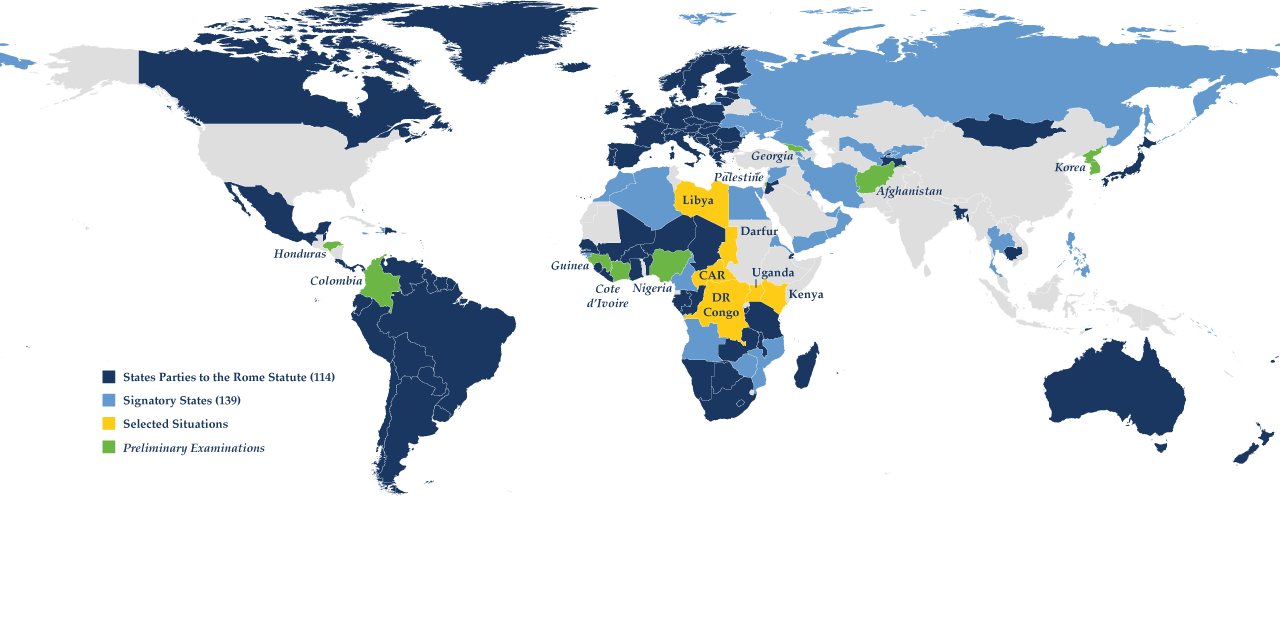
In her luncheon dialogue, which is available for web viewing here, Bensouda began by providing an overview of the work of the International Criminal Court Office of the Prosecutor (OTP) in the most active situations before the Court. Illustrating her talk was the map at bottom, which depicts the 114 states parties to the Rome Statute in dark blue, signatory states in light blue, selected situations in yellow, and preliminary examinations in green.
With regard to Libya, Bensouda stated that the OTP has notified those with formal and de facto authority, including Gaddafi, that their crimes will be investigated. The OTP has made clear that warning civilians to leave before attacking civilian areas does not relieve those involved of criminal responsibility. Bensouda emphasized that the OTP is seeking to be as transparent as possible in its dealings with the Libyan leadership.
In discussing the various situations, Bensouda revealed her vision of the ICC’s role in the global legal order: to prevent crimes through deterrence and by “sending messages” about the types of offenses the international community will not tolerate.
In discussing the OTP’s work with regard to the post-election violence in Kenya, for example, Bensouda asserted that the prosecutions will prevent crimes by “sending the message” that those who gain power by violence will be held accountable.
Similarly, she stated that the prosecution of those who killed peacekeepers in Sudan “sends an important message that the Court supports peacekeeping;” and the trial of Thomas Lubanga for recruiting child soldiers in the Democratic Republic of Congo “signals” the seriousness of that crime.
Bensouda also mentioned a situation in which the OTP is seeking to prevent crimes through incapacitation of key actors. She asserted that the arrest last fall of Callixte Mbarushimana, leader of the rebel group the Democratic Forces for the Liberation of Rwanda, was an effort to “destabilize” that organization and thus prevent crimes in Eastern Congo.
Bensouda also described the OTP’s approach to deciding which situations of alleged international crimes the ICC should investigate. The process of determining whether to pursue a formal investigation has become known as the “preliminary examination.”
Last October, the OTP issued a Draft Policy Paper on Preliminary Examinations. Bensouda promised that the final policy statement would be issued soon. Under Article 53 of the ICC Statute, the preliminary examination phase requires the OTP to determine whether a “reasonable basis” exists to proceed in a situation. This “reasonable basis” analysis has three components. It requires the OTP to assess whether:
► (1) crimes within the ICC’s jurisdiction appear to have been committed;
► (2) potential cases within the situation would be admissible (that is, they are sufficiently grave and meet the complementarity requirement that no State with jurisdiction is already acting in good faith); and
► (3) prosecution would not contravene the “interests of justice.”
The most interesting thing about the OTP’s draft policy on preliminary examinations is that it purports to disavow any role for prosecutorial discretion in deciding which situations to investigate. Whereas an earlier draft policy paper talked about the OTP “selecting” situations to investigate, the 2010 paper takes the position that the OTP must investigate if the statutory criteria are met.
Bensouda’s comments confirmed this approach. She noted that when the office began operations, Colombia and the Democratic Republic of Congo were the “gravest” situations within the Court’s jurisdiction; however, no investigation was opened in Colombia because that country was pursuing some national prosecutions. She also reiterated the OTP’s position that no investigation was undertaken with regard to the war crimes committed by British soldiers in Iraq because they were not sufficiently grave to be admissible.
As I have written elsewhere, this assessment seems mistaken – surely war crimes resulting in the deaths of even a small number of civilians are admissible before the ICC. The decision not to investigate the Iraq situation makes more sense if articulated as an exercise of the prosecutor’s discretion to focus on the most serious situations available. The OTP’s current policy, however, seems to preclude such an approach. Moreover, when questioned about the Court’s selection criteria, Bensouda seemed to admit that gravity is sometimes primarily a matter of numbers of victims – as in the Iraq situation – and at other times is conceived as relating more to the nature and impact of the crimes – in particular, what “signal” a particular prosecution is going to send.
Finally, Bensouda stated that there is no timeline for concluding preliminary examinations, and opined that the act of engaging in a preliminary examination itself has a deterrent impact. Echoing her current boss, Bensouda also emphasized that the OTP “has a legal mandate with no flexibility to adjust to political considerations,” a position that has been challenged recently by writers such as Bill Schabas and James Goldston.
Bensouda concluded that the ICC represents a “paradigm shift” from the Westphalian model of state sovereignty to one of international scrutiny and the rule of law.
In the questioning, Bensouda was pressed hardest on the problems associated with the ICC’s exclusive prosecution of African cases. She noted that such criticisms often overlook the victims of the African conflicts, and stated that she would “not apologize” for seeking to give victims a voice. She also sought to justify the emphasis on African situations by reference to the requirements of the ICC Statute, in particular the principle of complementarity. She noted that the OTP always encourages national proceedings but that unfortunately those are “not happening in Africa.” She reminded the audience that three of the African situations were referred by the affected governments themselves.
Nonetheless, when asked whether the ICC’s focus on Africa mitigates in favor of an African as the next prosecutor Bensouda, a native of the Gambia, was (unsurprisingly) supportive!


Ask OTP / ICC

Have a question you'd like to ask the Office of the Prosecutor of the International Criminal Court?
Now's your chance.
Wearing my hat as a Vice President of the American Society of International Law, yours truly, Diane Marie Amann, has the honor of joining ICC Deputy Prosecutor Fatou Bensouda (right) in a luncheon dialogue from 12:30-2:30 p.m. this Friday, March 25, in Plaza I & II at the Ritz Carlton Hotel in Washington, D.C. (photo credit)
Bensouda will begin by describing the process of preliminary examinations, by which OTP decides whether to open an investigation, and will touch on certain matters now before the court. Before audience Q&A, Bensouda and I will engage in a discussion of ICC hot topics.
That's where you come in.
Please feel free to communicate your questions for the Deputy Prosecutor Bensouda, either by posting a comment to this message or by e-mailing us at intlawgrrls@gmail.com. Will try to include topics of interest in Friday's discussion.
This lunch is one of many many events at ASIL's 105th Annual Meeting, which begins tomorrow. Full program here; prior IntLawGrrls posts on events at the meeting are available here. For persons who can't attend in person, many sessions -- including the Bensouda lunch -- may be viewed live on demand thanks to FORA.tv. Details here.
Hope to see you there!


Major Staff Turnover Anticipated at the ICC


The ICC is poised to experience a major turnover in its professional staff in 2012. These upcoming elections and appointments will constitute the most significant and dramatic changes in the ICC's leadership corps since the inaugural elections in 2003.
On the judicial side: the terms of six of the Court's 18 judges (depicted above) will expire next year. (The ICC Statute staggered the terms of office of the first batch of judges so that one third would serve 9 year terms. It is this group of judges whose terms are now ending.) The nomination period for the open positions shall run from June 13 to September 2, 2011. Candidates will be elected at the tenth session of the Assembly of States Parties (ASP) (December 12-21, 2011) to be held at United Nations Headquarters. The Court also needs a new President and new Vice Presidents. This radical overhaul of the bench will come just as the first trials before the Court are coming to a close and the ad hoc tribunals are shutting their doors.
The Judicial Division is composed of 18 judges in three divisions. The Pre-Trial Division is composed of 6 judges. Some of the responsibilities of the Division are carried out by two Pre-Trial Chambers of 3 judges each or by a single judge. As the name implies, the Pre-Trial Division carries out a number of functions prior to the initiation of trial:

  • authorizing the prosecutor's proprio motu investigation,
  • ruling on admissibility challenges, including on complementarity and gravity grounds,
  • reviewing decisions by the prosecutor not to proceed in the event of the referral of a situation,
  • upholding the rights of the accused and protecting victims and witnesses in the investigative phase,
  • authorizing investigations on the territories of states parties,
  • issuing warrants for arrest,
  • confirming the charges against an accused, and
  • (eventually) serving as a filter to charges of aggression (if the ASP decides to activate the aggression amendments in 2017).

The Trial Division, composed of 8 judges with criminal law experience, is charged with conducting fair and expeditious trials to determine the individual responsibility, vel non, of the accused and to award any reparations due to the victims. Finally, the Appeals Division, consisting of the President of the Court and four other judges, is responsible for adjudicating any appeals emerging from the Pre-Trial Division or the Trial Division.
Among those ICC judges whose terms are ending are three women:
Fatoumata Dembélé Diarra of Mali, the First Vice President of the Court and a member of the Trial Division (above right), Elizabeth Odio Benito of Costa Rica and a member of the Trial Division (immediate right), and Sylvia Steiner of Brazil, who is a member of the Pre-Trial Division (above left).
The current prosecutor's term ends in June 2012, and the ASP has established a representative search committee to find his replacement pursuant to the same schedule as the judicial elections. The Committee is being coordinated by H.R.H. Zeid Ra’ad Zeid al-Hussein, Permanent Representative of Jordan to the United Nations. The Committee hopes to have a short list of candidates by the end of this summer.
As they consider their nominations, the ASP will do well to recall the qualifications of judges and the prosecutor, which are set forth in part in Articles 36 and 42 of the ICC Statute, respectively. In particular, Article 36(8)(a) directs the ASP to in the selection of judges, to
take into account the need, within the membership of the Court, for: ... (iii) A fair representation of female and male judges.

Not surprisingly, NGOs are calling for a merits-based set of nominations rather than politicized vote-trading. To this end, the Coalition for an ICC has created a high-level expert panel to assess the candidates put forward by States Parties. See here for more on this campaign. (Diane's prior post on the CICC panel convened to vet judicial candidates is here.)
The ASP is going to experience an overhaul as well, with the election of new members of the Bureau (the executive committee of the ASP), a new President, and 6 new members for the Committee of Budget and Finance. (Ambassador Simona Mirela Miculescu (left), Permanent Representative of Romania to the United Nations, recently assumed the position of Vice-President of the Assembly).
The crime of aggression will likely become operational during the terms of office of this group. (The ASP can make a decision as early as 2017 to activate the Court's jurisdiction over the crime). No doubt this too will impact states parties' choices of candidates as it is these individuals who must be trusted to adjudicate this new and controversial crime.
Stay tuned...

'Nuff said

(Taking context-optional note of thought-provoking quotes)


'[I]f you want to confine your energies to big fish, you need larger holes. Otherwise, you'll spend all your time picking out the sardines, minnows, and plastic bottles. One of the greatest challenges of international criminal justice is the selection of cases. Resources must be focused using the concept of 'those who bear the greatest responsibility' or something similar.


-- Our colleague William A. Schabas, Professor of Human Rights Law, and Director of the Irish Centre for Human Rights, National University of Ireland-Galway, in "Prosecuting Dr Strangelove, Goldfinger, and the Joker at the International Criminal Court: Closing the Loopholes," published in a Leiden Journal of International Law forum on the policy element included in the ICC definition of crimes against humanity. At issue, to be precise, is Article 7(2)(a) of the Rome Statute, which requires that the requisite anti-civilian attack occur "pursuant to or in furtherance of a State or organizational policy to commit such attack." Schabas' concluding essay constitutes a biting smackdown of proposals to relax the requirement.


Libya and the Codification of the Crime of Aggression

There has been a lot of attention in the press and blogosphere about the worrisome situation in Libya, the (in)adequacy of the United States' and United Nations' response thereto, and the Security Council's unanimous referral of the situation to the International Criminal Court via Resolution 1970 on February 26, 2011. (See our prior coverage here). On March 2, 2011, the ICC Prosecutor announced that he had opened his investigation into potential crimes committed in Libya (see his press conference here). The President of the ICC, Judge Sang-Hyun Song (S. Korea), thereafter assigned the situation to Pre-Trial Chamber I.

In undertaking his investigation into international crimes committed since February 15th, the ICC Prosecutor has already signaled that he will consider the commission of crimes against humanity—a constellation of acts made criminal under international law when they are committed within the context of a widespread or systematic attack against a civilian population with knowledge of that attack. Certainly the strafing of peaceful demonstrators with helicopter gunships, the indiscriminate bombing of residential neighborhoods by warplanes (left, photo credit), and the unleashing of mercenaries and snipers on the ground collectively rise to the level of such an attack. This is especially true given that at least a thousand people have been killed and thousands others have been injured and/or displaced. (Although, I should note that Judge Kaul, who does not sit on this PTC, will likely disagree here).

War crimes may also have been committed, depending on whether the situation in eastern Libya or elsewhere rises to the level of armed conflict. Common Article 3, whose prohibitions are listed as war crimes in Article 8(2)(c) of the ICC Statute, is applicable once there is an "armed conflict" occurring "on the territory of" a party to the Geneva Conventions. The determination of when violence rises to the level of an "armed conflict" depends on the level of violence and the degree of organization of the parties. Certainly, the formation of an increasingly hierarchized and united armed opposition—populated and led by courageous defectors from Libyan armed forces' officer corps—goes far toward finding the necessary degree of organization. In addition, there are indications that swaths of the country are under the control of opposition groups forging a transitional government (the Libyan National Council) after governmental authorities collapsed.

All this implies that the heightened threshold of Protocol II, which also governs non-international armed conflicts and whose prohibitions may be prosecuted as war crimes pursuant to Article 8(2)(e) of the ICC Statute, may also be satisfied. That treaty becomes applicable when there is a non-international armed conflict

which take place in the territory of a High Contracting Party between its armed forces and dissident armed forces or other organized armed groups which, under responsible command, exercise such control over a part of its territory as to enable them to carry out sustained and concerted military operations and to implement this Protocol.
It explicitly excludes situations

of internal disturbances and tensions, such as riots, isolated and sporadic acts of violence and other acts of a similar nature, as not being armed conflicts.
There thus may be reasonable grounds to conclude the existence of a full-scale civil war, albeit an unbalanced one according to comparative military assessments, which would lay the groundwork for war crimes charges.

The crime of aggression is not immediately implicated in the Libyan situation. For one, the aggression amendments will not come into force until 2017 at the earliest. Moreover, the definition of the crime does not envision the act of aggression being committed by or against non-state actors that are not linked to a state. Nonetheless, the crime of aggression may bear on responses by the international community to the crisis in Libya.

Indeed, military options are not off the table, according to recent comments by President Obama and other world leaders. In particular, it has been proposed that the international community—or some subset thereof—should impose a no-fly zone over the country in an effort to prevent Libya's increasingly erratic and vicious leader from committing further violence against his own people. The Gulf Cooperation Council and Arab League reportedly support such a measure as do several vocal members of Congress. France and Britain are working on a draft Security Council resolution that would authorize such a response, although it is unclear if Russia and China would support this measure, which sounds of military intervention. This raises the prospects that a group of states, such as NATO or some other coalition of the willing, might move forward without explicit Council approval. This is exactly the kind of scenario that worries detractors of the codification of the crime of aggression in the ICC Statute.

The imposition of a no-fly zone without prior Council approval might run afoul of the prohibition of aggression as it has been defined in the aggression amendments. Article 8bis(2) of the amendments defines “act of aggression” broadly as
the use of armed force by a State against the sovereignty, territorial integrity or political independence of another State...
The amendments go on to list the following as acts of aggression:

a) The invasion or attack by the armed forces of a State of the territory of another State ...;
b) Bombardment by the armed forces of a State against the territory of another State or the use of any weapons by a State against the territory of another State; ...
d) An attack by the armed forces of a State on the land, sea or air forces, or marine and air fleets of another State...
Simply policing the no-fly zone might constitute a breach of Libya's territorial integrity, and for a no-fly zone to be effective, it would likely be necessary to neutralize Libya's air defense capabilities, which would involve air strikes. To be sure, such acts would only be prosecutable as the crime of aggression if they are deemed to constitute a "manifest" violation of the U.N. Charter with reference to their character, gravity and scale as per Article 8bis(1). As we have discussed at length in our crime of aggression series, no explicit exception was carved out for bona fide humanitarian interventions or for considerations of a state's motives for engaging in military action. However, important understandings adopted in Kampala imply that a consideration of the "consequences" of military action might shield actions from being characterized as an act of aggression. This would depend, of course, on the views of
  • the prosecutor (exercising prosecutorial discretion),
  • the Pre-Trial Division (which would need to approve aggression charges), and
  • the Security Council (which also acts as a filter to aggression charges and can defer prosecutions for a renewable period of a year).
In any case, the ICC is poised to enter the debate about such humanitarian interventions in the event that they occur once the aggression amendments are operational. The situation in Libya offers yet another potential scenario in which a deployment of armed force might be warranted and beneficial, but may not—for whatever reason—be able to garner Security Council approval.

Breaking News from the ICC

The ICC recently released three important decisions in the last two days:

1. The first two are decisions by Pre-Trial Chamber II, by a majority, to issue summons to the six Kenyan suspects (about which we've blogged before) to appear before the ICC on April 4, 2011:

  • William Samoei Ruto (Ruto),
  • Henry Kiprono Kosgey (Kosgey),
  • Joshua Arap Sang (Sang),
  • Francis Kirimi Muthaura (Muthaura),
  • Uhuru Muigai Kenyatta (Kenyatta) and
  • Mohammed Hussein Ali (Ali).

The Chamber found reasonable grounds to believe that Ruto, Kosgey and Sang (the Odinga defendants) can be prosecute for specified crimes against humanity (murder, forcible transfer and persecution). (The Chamber rejected efforts to prosecute the three for torture). The cases against Ruto and Kosgey will proceed under a theory of indirect co-perpetration (i.e., committing crimes through another person(s)) in accordance with article 25(3)(a) of the Rome Statute. The case against Sang, by contrast, will proceed under a theory of complicity rather than co-perpetration, because the PTC determined that no reasonable grounds existed to believe that Sang's contribution to the commission of the crimes was essential.

Maintaining almost perfect symmetry, the PTC determined Muthaura and Kenyatta (the Kibaki defendants) will be prosecuted as co-perpetrators of the crimes against humanity of murder, forcible transfer, rape, persecution and other inhumane acts. Likewise, the case against Ali will proceed under a theory of complicity based on the finding that there were reasonable grounds to believe that Ali otherwise contributed to the commission of the crimes in accordance with article 25(3)(d) of the Rome Statute.

Unsurprisingly (see prior post), Judge Hans-Peter Kaul dissented (opinion as yet unavailable), arguing that the Prosecutor had failed to establish reasonable grounds to believe that the crimes were committed pursuant to or in furtherance of the policy of an organization as required by the definition of crimes against humanity in the ICC Statute.

2. In the Darfur situation, PTC I confirmed charges against two rebel leaders (Abdallah Banda Abakaer Nourain and Saleh Mohammed Jerbo Jamus) based upon alleged attacks on the compound of the African Union peacekeeping mission in Sudan on the evening of September 29, 2007. The two will be prosecuted for the war crimes of:

•violence to life and attempted violence to life;
•intentionally directing attacks against personnel, installations, material, units and vehicles involved in a peacekeeping mission; and
•pillaging.

Stay tuned...

International Gender Justice: Progress in International War Crimes Tribunals and the UN Security Council


On International Women’s Day, it is appropriate to recognize the remarkable progress that women and girls have secured for gender related crimes in contemporary international war crimes tribunals. The International Criminal Tribunal for the former Yugoslavia (ICTY) was established in 1993 and its sister tribunal, the International Criminal Tribunal for Rwanda (ICTR), was set up the following year. These two tribunals, set up by the UN Security Council, have together successfully prosecuted rape as a war crime, a crime against humanity, and an instrument of genocide (the groundbreaking cases which established the leading precedent are ICTR: Akayesu, Muhimana; ICTY: Celebici, Furundzija, Kunarac); they’ve recognized rape and enslavement as a form of sexual slavery (ICTY: Kunarac); they’ve recognized rape as forms and means of torture (ICTR: Akayesu; ICTY: Celebici, Furundzija, Kunarac), as well as forms and means of persecution (ICTY: Krstic, Kvocka), that gender crimes may form part of a joint criminal enterprise (JCE) and both perpetrators and others participating in the JCE may be held responsible for intended or foreseeable crimes committed in furtherance of the JCE (ICTY: Krstic, Kvocka), and that men and boys are subjected to sexual violence (ICTY: Tadic, Celebici). They have also noted that other gender-related crimes, such as forced marriage, forced nudity, forced pregnancy and forced abortion, may constitute an international crime (ICTY: Kvocka).


In 1998, the Rome Statute of the permanent International Criminal Court (ICC) formally listed rape, sexual slavery, enforced prostitution, forced pregnancy, enforced sterilization, and “other forms of sexual violence of comparable gravity,” as war crimes and crimes against humanity (arts. 7 and 8) and also emphasized that gender based persecution as well as trafficking in women and children may be prosecuted (art. 7). While no judgment has yet been rendered in the ICC, the court has accused individuals of rape or sexual slavery as war crimes and crimes against humanity committed in Uganda (Kony et. al), the Democratic Republic of Congo (Katanga & Ngudjolo; Mbarushimana), the Central African Republic (Bemba), and the Darfur region of Sudan (Harun & Ali Kushayb; Bashir). There will likely be sex crimes included in the situations in Kenya and Libya once charges are formalized and arrest warrants sought for these situation.
(See here for more on the gender report card at the ICC).

The Special Court for Sierra Leone (SCSL) has successfully prosecuted rape, sexual slavery, and inhumane acts of forced marriage (AFRC) and in 2009 the Extraordinary Chambers in the Courts of Cambodia convicted the head of a Khmer Rouge torture facility of a number of crimes, including rape (Duch). Mixed chambers in East Timor and Bosnia have also brought war crime and crime against humanity charges for rape crimes.

Unquestionably, in the last 18 years, unprecedented progress has been made on securing justice for gender related crimes in international/ized war crimes tribunals. Yet to be sure, the number of indictments charging individuals with gender crimes, particularly senior military and civilian leaders far from the battlefield, is grossly inadequate, and many sex crime charges that have been brought have been dropped or acquitted. Moreover it is past time for the tribunals to prosecute other recognized crimes, including forced pregnancy and enforced sterilization, which are committed far too commonly in this era when sexual violence is intentionally committed both with random abandon and with callous calculation – as powerful weapons of terror and destruction.

In part in recognition of the strategic use of sexual violence as powerful tools of warfare, as well as its common occurrence because the atmosphere of war and the long history of impunity for sex crimes exploits the opportunity, the UN Security Council has stepped up its efforts to ensure wartime sexual violence is redressed. Over the last decade the council has devoted no fewer than nine resolutions exclusively to ending and punishing war time sexual violence and enhancing the empowerment of women in peacemaking and peacekeeping: 1325 (2000), 1612 (2005), 1674 (2006), 1820 (2008), 1882 (2009), 1888 (2009), 1889 (2009), 1894 (2009), and 1960 (2010). (Prior posts). To reinforce these efforts, in 2010, the Secretary-General appointed a Special Representative on Sexual Violence in Conflict (Margot Wallstrom).

Clearly, enormous – albeit unsatisfactory – progress has been achieved on securing justice for survivors of gender related crimes. Much remains to be done, yet the situation is far from bleak. When leaders who order, ignore, or acquiesce to crimes committed by subordinates are tried, thousands in the victimized communities can have their crimes addressed by those most responsible – perhaps even more so than the physical perpetrators – for the crimes committed against them. As international and domestic courts increasingly go up the power chain to prosecute top leaders, wider justice will be provided. And great satisfaction can be gained in recognizing that over the last fifteen years, there is now worldwide recognition that sex crimes are among the most serious international crimes committable, and these crimes are regarded as those that threaten international peace and security and thus demand action to halt and punish such crimes. If as much progress is made on gender justice in the next fifteen years as the past fifteen, the world community will be well on its way to ending impunity for gender related sex crimes, and for reversing the shame and stigma wrongly attached to victims, instead of perpetrators, of sex crimes.
See our Women & ICL series for more.

The International Criminal Court and the Transformation of International Law? Maybe not quite yet . . .

(Delighted to welcome back alumna Leila Nadya Sadat, who contributes this guest post from Paris)

This week, unexpectedly, the Security Council voted unanimously to refer the situation in Libya to the International Criminal Court. That is cause for celebration; but celebration tempered with a strong dose of caution and even some real pessimism about the future.
On the plus side, the ICC is now becoming an international institution that is increasingly seen as a real partner in the maintenance of international peace and security.
Also, on the plus side, as Diane Marie Amann mentioned in an earlier IntLawGrrls post, the U.S. voted for the Resolution, rather than simply abstaining from vetoing it as the U.S. had done with Resolution 1593, referring to the Court the situation in Darfur.
Finally, I entitled this blog entry after my 2002 book of the same name, because one sees in the Resolution glimmers of change — that war is not the only answer to international conflict, that law is a relevant consideration in its resolution and that justice may be a possibility. That would be cause for celebration indeed.
At the same time, there are many worrisome elements in the Resolution which bode ill for the Court and for the referral. The Resolution itself retains two outrageous Bush-administration provisions (while admittedly discarding a third).
First, while deciding in paragraph 5 that the Libyan authorities “shall cooperate fully with and provide any necessary assistance to the Court and the Prosecutor” (even though Libya is not a State Party to the Court) the paragraph continues that “States not party to the Rome Statute have no obligation under the Statute. . . ” and, in paragraph 6, “decides, that national, current or former officials or personnel from a State outside [Libya] . . . shall be subject to the exclusive jurisdiction of that State” for any acts they may commit relating to UN operations in Libya. What an extraordinary display of double standards, given that several members of the Council who voted for the Resolution are not parties to the Rome Statute! Can a rule of law be a rule of law if it applies to some but not all?
The Resolution also provides that the ICC, not the United Nations, shall bear all the expenses relating to the referral, apparently as a way of appeasing the U.S. Congress, many of whose members continue to threaten the Court. So the United States and other non-Party States (China, India, Russia) are using — but not paying for — the ICC as a tool of coercive diplomacy. This is not good news.
Finally, the ICC is already struggling to convince African states that it is not a Court directed at them. The first four referrals all seemed quite sensible; but the fifth, the situation involving Kenya, was far more troublesome, given that the Prosecutor undertook the case on his own initiative, and at least some questioned whether it met the legal standards necessary in terms of subject matter jurisdiction, gravity and complementarity to be pursued at the ICC rather than in Kenya or otherwise. (Prior IntLawGrrls posts available here.) There were also serious questions raised at last summer's ICC Review Conference at Kampala as to whether it would not be preferable to see a proprio motu referral of the Colombia or Afghan situations. A sixth referral involving an African state — even in a case involving the clear commission of atrocities — may encourage the ICC’s detractors in Africa, and the double standards evinced by the Resolution’s text do not assist in this regard.
In the view of this writer, the Libya referral, in and of itself, is a good thing. The atrocities taking place as reported in the media seem clearly to warrant ICC intervention. But the failure of the great powers to fully support this Court, and to use it cynically when and as they please, rather than committing their money, time, energy and political support to helping it grow strong and endure, feeds the perception that this Court is not about justice, but about power, undermining its legitimacy. Thomas Friedman recently opined that President Barack Obama’s 2009 speech in Cairo (above) strengthened the case for democracy in the Arab world as he led others through the salutary example of his own life. Would that Obama will find the same courage to champion the International Criminal Court, and to show the world that Americans believe in accountability too.


(Cross-posted at Leila's An American in Paris blog)


ICC referral: sweet, or bittersweet?

Some sweet irony in the referral of the Gadhafi regime to the International Criminal Court.
As watchers of the Hague-based court at left well know, longtime Libyan leader Moammar Gadhafi long has been a thorn in the ICC's side.
It's not just that Libya's not a party to the Rome Statute of the ICC. As the map below shows, the same holds true of many of its Arab neighbors -- and of certain very large states to the west and east of Libya.
Rather, Libya's particularly prickly relation to the ICC stems from Gadhafi's efforts to exerts his brand of leadership on the African continent.
To cite an example: It's no accident that, as Pittsburgh Law Professor Charles Jalloh, among others, has noted, the 1st African Union resolution condemning the ICC's pursuit of Sudanese President Omar al-Bashir occurred at a meeting in Libya.
Libya also is a member of the Human Rights Council, formed in 2006 as a means better to promote human rights within U.N. member states and throughout the world.
The Human Rights Council broke with Libya on Friday, as we posted here and here. Reports that the Gadhafi regime had ordered aerial attacks and street-thuggery against its own, unarmed civilians compelled the Council unanimously to urge the General Assembly to suspend Libya's U.N. membership.
Last night the Security Council went giant steps further, not only imposing sanctions and an arms embargo, but also referring the Libya matter to the ICC. The vote was unanimous among the T-10 and P-5 alike: ICC nonparty China put aside earlier-reported misgivings, and the United States, another ICC nonparty, openly supported an ICC referral for the 1st time ever.
Here're the pivotal paragraphs of Security Council Resolution 1970 (February 26, 2011):

The Security Council,
....
Acting under Chapter VII of the Charter of the United Nations, and taking measures under its Article 41,
....
ICC referral
4. Decides to refer the situation in the Libyan Arab Jamahiriya since 15 February 2011 to the Prosecutor of the International Criminal Court;
5. Decides that the Libyan authorities shall cooperate fully with and provide any necessary assistance to the Court and the Prosecutor pursuant to this resolution and, while recognizing that States not party to the Rome Statute have no obligation under the Statute, urges all States and concerned regional and other international organizations to cooperate fully with the Court and the Prosecutor;
6. Decides that nationals, current or former officials or personnel from a State outside the Libyan Arab Jamahiriya which is not a party to the Rome Statute of the International Criminal Court shall be subject to the exclusive jurisdiction of that State for all alleged acts or omissions arising out of or related to operations in the Libyan Arab Jamahiriya established or authorized by the Council, unless such exclusive jurisdiction has been expressly waived by the State;
7. Invites the Prosecutor to address the Security Council within two months of the adoption of this resolution and every six months thereafter on actions taken pursuant to this resolution;
8. Recognizes that none of the expenses incurred in connection with the referral, including expenses related to investigations or prosecutions in connection with that referral, shall be borne by the United Nations and that such costs shall be borne by the parties to the Rome Statute and those States that wish to contribute voluntarily; ...

The resolution zeroes in on Gadhafi -- and what little seems left of his regime in the wake of many ministerial defections to the antigovernment side.
Worth noting: The caveat concerning a national of a nonparty state present at the scene by authorization of the Council -- presumably, a person deployed as a U.N. peacekeeer. Evidence that such a person took part in criminal behavior must be referred to the state of nationality; by the terms of ¶6, absent a waiver the ICC would have no jurisdiction over such a malefactor. (Thanks to our colleague Kevin Jon Heller (his OJ post here) for pointing out my initial, erroneous interpretation.)
Some cause for concern: The foisting of the costs of ICC investigation onto the ICC and states that choose to contribute. That provision in ¶8 hints at certain lingering reluctances, and serves to remind of the deaf ear that the Security Council has turned to the ICC Prosecutor's pleas for aid in effecting the arrest of international fugitive and still-incumbent President Bashir.
It's to be hoped the Security Council's newfound spine will translate into helping the ICC as it endeavors to respond responsibly to yet another weighty referral. It's also to be hoped that the ICC will rise to the "test," to quote our colleague William Schabas; that is, it "must inspire confidence in its ability to provide a meaningful, significant and above all prompt response to the crisis."
If not, today's irony may prove more bitter than sweet.


(Credit for 2010 map indicating: in grey, states, like Libya and China, that have neither signed nor ratified the ICC Statute; in orange, states, like the United States, Sudan, and Russia, that at one time signed but never ratified; and in green, full states parties to the ICC Statute. Though slightly out of date -- it shows 111 rather than the current 114 states parties -- the map is accurate with regard to the states discussed in this post, a version of which is cross-posted at The Huffington Post.)


A crime against humanity trial in South Kivu, DRC: Proof Complementarity Can Work

When the International Criminal Tribunal for the former Yugoslavia (ICTY) exploded on the justice scene in 1993, a refreshing effort against impunity for war crimes, crimes against humanity, and genocide began. A year later, the establishment of the International Criminal Tribunal for Rwanda (ICTR) signaled that the United Nations and international community were recognizing that the accepted practice of letting mass murderers and rapists off scot free denigrated respect for the rule of law and threatened international peace and security. By 1998 the Statute for a permanent International Criminal Court (ICC) was signed in Rome and the court became operational in 2002. It now has cases/situations in Uganda, the Democratic Republic of Congo, the Darfur region of Sudan, the Central African Republic, and Kenya.
While the ICC was being established, mixed domestic and international war crimes chambers were set up to prosecute the highest level persons accused of horrific crimes in Sierra Leone, East Timor, Cambodia, Bosnia, and Kosovo. In these courts, hacking off limbs, extermination, rape and sexual slavery, torture, forced displacement, and a slew of other heinous offenses against large numbers of innocent civilians are commonplace. (A mixed court was also set up to try murder by assassination in Lebanon).
Eighteen years since the global paradigm began to shift from blanket impunity toward accountability for the most serious international crimes, there is now broad recognition that international and mixed courts can handle only a small number of the most senior culpable civilian and military leaders and the most notorious physical perpetrators. Thousands - perhaps millions - of others will escape punishment in these specialized courts for the tens of millions of victims of atrocity crimes committed during war and brutal oppression worldwide.
It is the primary responsibility of national jurisdictions to enforce the law and punish those who break local and international laws, and only when states are truly unable or unwilling to investigate or prosecute should internationalized courts step in. This concept - known by ICC supporters as complementarity, since domestic trials 'complement' the efforts of the ICC which tries higher lever suspects typically out of reach of national courts - is well at work in some discrete areas of the Democratic Republic of Congo.
Here, in South Kivu, a mobile gender justice court (pictured above right) has already prosecuted over 150 individuals in the past 18 months, and is currently holding a rape as a crime against humanity trial against Lieutenant Colonel Kibibi Mutware (pictured below left, in handcuffs) and 10 of his soldiers for the mass rape and other crimes committed in Fizi.
Professional military judges, prosecutors, defense counsel and civil party lawyers have been studiously adjudicating the case for over a week, and hundreds of locals have turned out daily to observe their first trial ever. They are clearly fascinated and enthralled by the process. For many, it brings a glimmer of hope for the future.
As indicated in two previous blogs (here and here), I too have been observing the mobile court trial for the past few days. During this time, I have been most impressed with the proceedings, which have been as professional and fair as many trials I've observed in international and mixed tribunals. The trial assuredly has been far more expeditious than other legitimate atrocity crimes trials, being held some 6 weeks after the crimes were committed. The local police, the UN and NGOs participated in the investigation.
Colleagues and I have asked survivors here if they've heard of the ICC, where the DRC trials of Lubanga and Katanga-Ngudjolo are underway and the Mbarushimana trial is expected to begin soon. Relatedly, Bosco Ntaganda is still at large and apparently roaming around freely in Goma. Former Congolese Vice President Bemba is on trial at the ICC for principally sex crimes committed in Central African Republic. In general, unless they listen to the radio regularly, victims and others here in this very remote area of Congo are unaware of the ICC. That is not particularly surprising, as the other trials (not including Mbarushimana, which hasn't started yet), were committed outside the Kivus. Contrarily, as my OSISA colleague Louise Olivier reported yesterday (here), some of the accused, including the leader, apparently have. Kibibi reportedly assured his troops before the orchestrated attack on New Years Day that they wouldn't go to The Hague for this.
Unquestionably, Lt Col Kabibi and his soldiers are more than a little stunned to find themselves on trial before this groundbreaking domestic mobile court. If word about the court is spread around the country, it could have an enormous impact on deterring future crimes, now that the rule of law is finally being enforced domestically, to at least some extent, in parts of eastern DRC. If other crimes could be prosecuted as seriously as gender crimes - the DRC government hates being known as the rape capital of the world - genuine progress on respecting the rule of law, maintaining order, and creating stability and prosperity is not only possible, but probable.

(credit to Galya Ruffer for photos of the Fizi trials)


Bloggers Team