Showing posts with label American Society of International Law. Show all posts

Go On! Intlaw teaching

(Go On! is an occasional item on symposia and other events of interest)

"Teaching International Law Beyond the Classroom: Engaging Students in Experiential Learning, in Webpages and Blogs, and in Historical and Empirical Research" is the topic of a conference to be held on Friday, May 6, at Pace Law School in White Plains, New York. Cosponsors are the Teaching International Law Interest Group of the American Society of International Law and the American Branch of the International Law Association.
Co-chairing the event are IntLawGrrl guest/alumna Cindy Galway Buys (Southern Illinois) and Thomas McDonnell (Pace). Through the conference they aim
to raise awareness on different modalities of teaching and researching in the area of international law to expand beyond the traditional classroom and the standard law review article. Law schools around the country have initiated international law and human rights clinics; International law faculty have increasingly used blogs and the internet to carry out their scholarly work; and the legal academy has begun to recognize the contribution that history and empirical research can make. This workshop explores each of these modalities and attempts to help the participants expand their teaching and research accordingly.

As set forth in full in the program among the many speakers are a number of IntLawGrrl guests/alumnae addition to Cindy: Laura Dickinson (Arizona State), Peggy McGuinness (St. John's), and Beth A. Simmons (Harvard).
Details and registration here.


Guest Blogger: Ruth Wedgwood

We at IntLawGrrls are honored to welcome Ruth Wedgwood (left) as today's guest blogger.
Ruth is the Edward B. Burling Professor of International Law and Diplomacy and the Director of the International Law and Organizations Program at SAIS, the Washington, D.C.-based Paul H. Nitze School of Advanced International Studies of Johns Hopkins University.
In addition to teaching at SAIS, Ruth has been a Professor at Yale Law School, a Visiting Professor at the University of Paris I (Sorbonne), Berlin Prize Fellow of the American Academy, and Charles H. Stockton Professor at the U.S. Naval War College.
From 2002 to 2010 she was a member of the U.N. Human Rights Committee, which monitors state compliance with the International Covenant on Civil and Political Rights; she's also been an independent expert for International Criminal Tribunal for the former Yugoslavia. Ruth has served on the Advisory Committee on International Law of the U.S. Department of State, on the Defense Policy Board, and on the CIA Historical Review Panel. She was a U.S. public delegate to Organization for Security and Co-operation in Europe and to the Wehrkunde Munich Security Conference. Among many other professional achievements, she is a founding member of Davos World Economic Forum Council on International Law, and has served as a Senior Fellow at the Council on Foreign Relations, as a Vice President of the American Society of International Law, on the Board of Editors of the American Journal of International Law, as Director of Studies at the Hague Academy for International Law. Currently she is President of the American Branch of the International Law Association; her guest post below seeks participation in and proposals for sessions at ABILA's next annual meeting.
After earning her J.D. from Yale Law School, where she was Executive Editor of the Yale Law Journal, Ruth served as law clerk to Judge Henry Friendly of the U.S. Court of Appeals for the Second Circuit and to Justice Harry Blackmun of the U.S. Supreme Court. She was a federal prosecutor in the Southern District of New York before entering academia.
Ruth chooses to honor her great-grandmother, Belle Hamer, who, Ruth writes,
taught school in a one-room school house on the Olympic Peninsula in late 1800s, before Washington was a state ... hardly world historical, but my kind of gal ...

(credit for photo of a circa 1904 one-room schoolhouse in Port Angeles, largest city on the peninsula) Today Hamer joins IntLawGrrls' other foremothers in the list just below our "visiting from..." map at right.

Heartfelt welcome!


Expressive case selection at the ICC

(Delighted to welcome back alumna Margaret deGuzman, who contributes this guest post)

My draft article, Choosing to Prosecute: Expressive Selection at the International Criminal Court, tackles what I believe to be the most important challenge facing the ICC: how to allocate its extremely scarce resources.
The ICC has the mandate to “end impunity” for serious international crimes around the world but the resources to prosecute only a handful of cases each year. Unlike national courts, which are expected to prosecute most serious crimes in their jurisdictions, the ICC’s legitimacy is closely tied to perceptions of relevant audiences that it is choosing to prosecute the “right” crimes and the “right” defendants. Audiences who believe that the Court’s prosecutor, and to a lesser extent its judges, are focusing on the “wrong” cases tend therefore to challenge the legitimacy of the institution itself. Such challenges have been discouragingly common recently with African voices in particular speaking out against the ICC and one state – Kenya – threatening to withdraw from the regime.
The debate in academic and advocacy circles about how the ICC should select cases for prosecution currently centers on the role politics plays and should play in such decisions. Critics charge that the ICC operates as a tool of powerful states, while the Court’s Prosecutor, Luis Moreno-Ocampo (right), claims that his decisions are apolitical. Some scholars argue for greater recognition of the inevitable influence of politics on selection decisions, while others advocate selection procedures they believe will insulate the Court from such influence. Those who focus on process, including Moreno-Ocampo, suggest that selection decisions can enhance the Court’s legitimacy if they adhere to recognized principles of good process such as independence, impartiality, objectivity, and transparency. In particular, Moreno-Ocampo and others claim that cases can be selected according to an objective analysis of their relative gravity.
This focus on politics and process has obscured what I believe to be the chief threat to the ICC’s legitimacy: the absence of generally accepted goals and priorities for the institution’s work.
My article therefore seeks to reframe the debate about prosecutorial and judicial selection discretion at the ICC. The article demonstrates that the ICC’s selectivity threatens its legitimacy not merely because of the potential for improper political influence, but more centrally because the international community failed to endow the institution with clear objectives to guide its actions. To enhance the Court’s legitimacy, therefore, its supporters must engage in a constructive dialogue about the institution’s role in the global legal order.
In additional to highlighting the inadequate theoretical underpinnings of the Court’s work, the article proposes that the ICC adopt an expressive approach to selecting situations and cases to investigate and prosecute.
I do not dismiss the other dominant philosophies of international criminal law: retribution, deterrence, and restorative justice. Rather, I accept that each of these may help to justify particular prosecutions under particular circumstances.
At the same time, I argue that the primary basis for selecting one case or situation over another should not be the relative desert of perpetrators, which is extremely hard to measure, or the prospects for deterrence, which are virtually unknowable, or even the extent to which different individuals or communities are in need of restoration.
Rather, the best use of the ICC’s very limited resources is to focus on situations and cases that maximize the ICC’s expression of global norms. Such expression provides the best hope of contributing to crime prevention, not by deterring potential criminals, but by transforming the normative framework in which decision-makers operate.
My expressive prescription raises questions about what global norms the ICC should seek to express and in what order of priority – questions to which there are no clear answers, just as there is no international consensus about the goals of the Court more broadly. Nonetheless, I argue that by focusing explicitly on an expressive agenda, ICC selection decision makers can stimulate a dialogic process where norms are expressed, feedback received and, ideally, consensus builds over time.
To some extent this is already happening. When the ICC has pursued cases involving child soldiers or crimes against peacekeeper or election-related violence, it has sent a message that members of the international community – or at least the parties to the Rome Statute – feel strongly about condemning and preventing those types of crimes. In fact, as I posted, in a recent address at the American Society of International Law annual meeting, ICC Deputy Prosecutor Fatou Bensouda (left) highlighted this messaging function of the Court.
In my view, this focus on norm expression should be more explicitly adopted as a selection strategy, replacing the current pretense that selections are made based on objective assessments of relative gravity or the consistent application of other criteria.
An expressive agenda has at least the potential to enhance the ICC’s legitimacy by highlighting the value choices that undergird the Court’s selection decisions, inviting relevant audiences to react, and permitting the Court to adjust its choices to reflect the values of its constitutive communities.
The article is in draft form, and I welcome comments!


Bensouda on ICC prosecutions

(Delighted to welcome back alumna Margaret deGuzman, who contributes this guest post)

At last week’s annual meeting of the American Society of International Law, participants were treated to a luncheon presentation by Fatou Bensouda (right), Deputy Prosecutor of the International Criminal Court and candidate for the top job when Luis Moreno Ocampo’s term expires next year. Bensouda presented some opening remarks and then was ably questioned by our own Diane Marie Amann, as well as a few audience members.
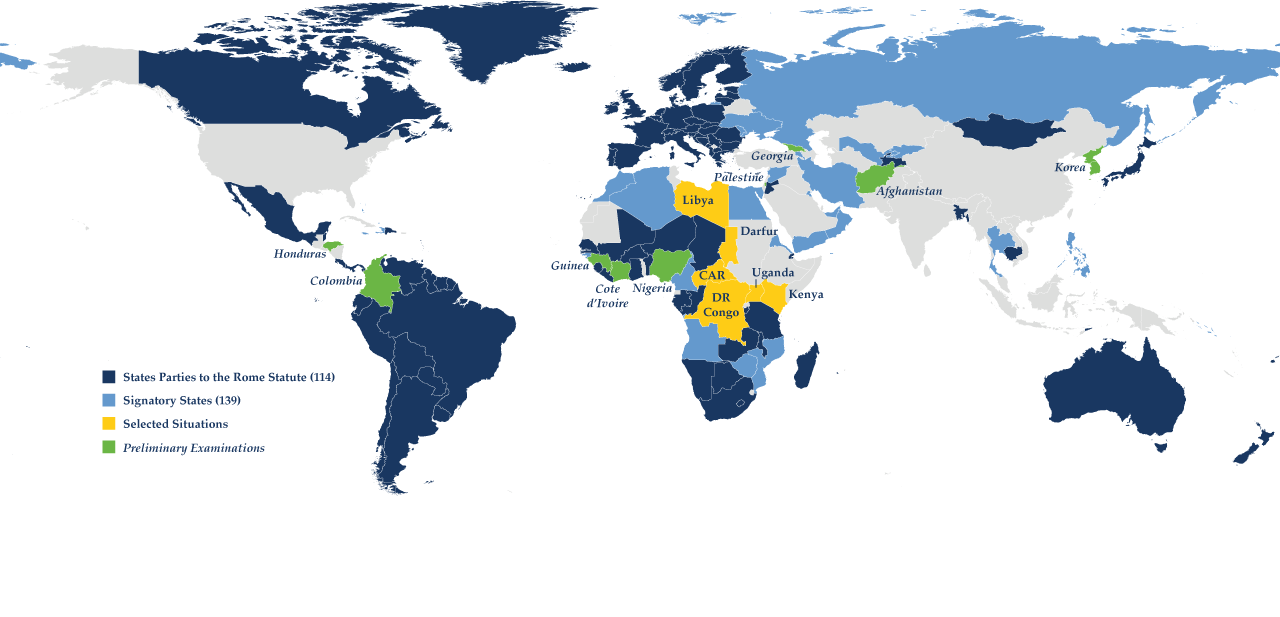
In her luncheon dialogue, which is available for web viewing here, Bensouda began by providing an overview of the work of the International Criminal Court Office of the Prosecutor (OTP) in the most active situations before the Court. Illustrating her talk was the map at bottom, which depicts the 114 states parties to the Rome Statute in dark blue, signatory states in light blue, selected situations in yellow, and preliminary examinations in green.
With regard to Libya, Bensouda stated that the OTP has notified those with formal and de facto authority, including Gaddafi, that their crimes will be investigated. The OTP has made clear that warning civilians to leave before attacking civilian areas does not relieve those involved of criminal responsibility. Bensouda emphasized that the OTP is seeking to be as transparent as possible in its dealings with the Libyan leadership.
In discussing the various situations, Bensouda revealed her vision of the ICC’s role in the global legal order: to prevent crimes through deterrence and by “sending messages” about the types of offenses the international community will not tolerate.
In discussing the OTP’s work with regard to the post-election violence in Kenya, for example, Bensouda asserted that the prosecutions will prevent crimes by “sending the message” that those who gain power by violence will be held accountable.
Similarly, she stated that the prosecution of those who killed peacekeepers in Sudan “sends an important message that the Court supports peacekeeping;” and the trial of Thomas Lubanga for recruiting child soldiers in the Democratic Republic of Congo “signals” the seriousness of that crime.
Bensouda also mentioned a situation in which the OTP is seeking to prevent crimes through incapacitation of key actors. She asserted that the arrest last fall of Callixte Mbarushimana, leader of the rebel group the Democratic Forces for the Liberation of Rwanda, was an effort to “destabilize” that organization and thus prevent crimes in Eastern Congo.
Bensouda also described the OTP’s approach to deciding which situations of alleged international crimes the ICC should investigate. The process of determining whether to pursue a formal investigation has become known as the “preliminary examination.”
Last October, the OTP issued a Draft Policy Paper on Preliminary Examinations. Bensouda promised that the final policy statement would be issued soon. Under Article 53 of the ICC Statute, the preliminary examination phase requires the OTP to determine whether a “reasonable basis” exists to proceed in a situation. This “reasonable basis” analysis has three components. It requires the OTP to assess whether:
► (1) crimes within the ICC’s jurisdiction appear to have been committed;
► (2) potential cases within the situation would be admissible (that is, they are sufficiently grave and meet the complementarity requirement that no State with jurisdiction is already acting in good faith); and
► (3) prosecution would not contravene the “interests of justice.”
The most interesting thing about the OTP’s draft policy on preliminary examinations is that it purports to disavow any role for prosecutorial discretion in deciding which situations to investigate. Whereas an earlier draft policy paper talked about the OTP “selecting” situations to investigate, the 2010 paper takes the position that the OTP must investigate if the statutory criteria are met.
Bensouda’s comments confirmed this approach. She noted that when the office began operations, Colombia and the Democratic Republic of Congo were the “gravest” situations within the Court’s jurisdiction; however, no investigation was opened in Colombia because that country was pursuing some national prosecutions. She also reiterated the OTP’s position that no investigation was undertaken with regard to the war crimes committed by British soldiers in Iraq because they were not sufficiently grave to be admissible.
As I have written elsewhere, this assessment seems mistaken – surely war crimes resulting in the deaths of even a small number of civilians are admissible before the ICC. The decision not to investigate the Iraq situation makes more sense if articulated as an exercise of the prosecutor’s discretion to focus on the most serious situations available. The OTP’s current policy, however, seems to preclude such an approach. Moreover, when questioned about the Court’s selection criteria, Bensouda seemed to admit that gravity is sometimes primarily a matter of numbers of victims – as in the Iraq situation – and at other times is conceived as relating more to the nature and impact of the crimes – in particular, what “signal” a particular prosecution is going to send.
Finally, Bensouda stated that there is no timeline for concluding preliminary examinations, and opined that the act of engaging in a preliminary examination itself has a deterrent impact. Echoing her current boss, Bensouda also emphasized that the OTP “has a legal mandate with no flexibility to adjust to political considerations,” a position that has been challenged recently by writers such as Bill Schabas and James Goldston.
Bensouda concluded that the ICC represents a “paradigm shift” from the Westphalian model of state sovereignty to one of international scrutiny and the rule of law.
In the questioning, Bensouda was pressed hardest on the problems associated with the ICC’s exclusive prosecution of African cases. She noted that such criticisms often overlook the victims of the African conflicts, and stated that she would “not apologize” for seeking to give victims a voice. She also sought to justify the emphasis on African situations by reference to the requirements of the ICC Statute, in particular the principle of complementarity. She noted that the OTP always encourages national proceedings but that unfortunately those are “not happening in Africa.” She reminded the audience that three of the African situations were referred by the affected governments themselves.
Nonetheless, when asked whether the ICC’s focus on Africa mitigates in favor of an African as the next prosecutor Bensouda, a native of the Gambia, was (unsurprisingly) supportive!


Guest Blogger: Laura Dickinson

It's IntLawGrrls' great pleasure to welcome Laura Dickinson (left) as today's guest blogger.
Laura is the Foundation Professor of Law and Faculty Director of the Center for Law and Global Affairs at Arizona State University Sandra Day O'Connor College of Law.
She joined the ASU law faculty in 2008, having taught previously at the University of Connecticut School of Law. She was a Visiting Research Scholar and Visiting Professor in the Law and Public Affairs Program at Princeton University in 2006-2007.
An expert on human rights, national security, foreign affairs privatization, and qualitative empirical approaches to international law, Laura is the author of Outsourcing War and Peace (2011). This just-published book examines the privatization of military, security, and foreign aid functions of government and its impact on core public values.
During the Clinton Administration, Laura served as a senior policy adviser to Harold Hongju Koh when he was Assistant Secretary of State for Democracy, Human Rights, and Labor. Before that, she clerked for U.S. Supreme Court Justices Harry A. Blackmun and Stephen G. Breyer and for Judge Dorothy Nelson of the U.S. Court of Appeals for the Ninth Circuit. A term member of the Council on Foreign Relations and and co-organizer of a Collaborative Research Network on Empirical Approaches to International Human Rights Law, convened under the auspices of the Law & Society Association, Laura is also a member of the Executive Council of the American Society of International Law. Her guest post below sets forth the call for papers for an ASIL initiative, the Research Forum for which she serves as a 2011 co-chair.
Heartfelt welcome!

Write On! ASIL Research Forum

(Thanks to IntLawGrrls for the opportunity to contribute this guest post, another in IntLawGrrls' Write On! series)

The American Society of International Law has launched a new initiative that may be of interest. On November 4 and 5 of this year we will be launching the first ASIL Research Forum at UCLA Law School. We hope that the Forum will become be a yearly scholarly conference on new research in international law.
Spearheading the initiative is the 2011 ASIL Research Forum Committee:
► Co-Chairs: yours truly, Laura Dickinson, Foundation Professor and Faculty Director at the Center for Law and Global Affairs, Arizona State University Sandra Day O'Connor College of Law, along with Kal Raustiala, Professor at the UCLA School of Law and Director of UCLA's Ronald W. Burkle Center for International Relations.
► Committee members: Mark A. Drumbl, Class of 1975 Alumni Professor of Law & Director, Transnational Law Institute, Washington & Lee University School of Law, along with IntLawGrrl guests/alumnae Nienke Grossman, University of Baltimore School of Law, and Mary Ellen O’Connell, an ASIL Vice President and the Robert and Marion Short Professor of Law and Research Professor of International Dispute Resolution at Notre Dame Law School.
The idea is to hold an event that is focused around in-depth discussion of works in progress. Particularly welcome are interdisciplinary projects, empirical studies, and research that deploys new methodologies to study international or transnational law.
Proposals are due April 30, and will be reviewed anonymously.
The official call for papers is below:

Call for Scholarly Papers
The Inaugural ASIL Research Forum
November 4-5, 2011
The American Society of International Law calls for submissions of scholarly paper proposals for the inaugural ASIL Research Forum to be held at UCLA Law School on November 4-5, 2011.
The Research Forum is a new initiative of the Society aimed at providing a setting for the presentation and focused discussion of works in progress. The Spring Annual Meeting does this in part through its "works-in-progress" sessions, but the Research Forum aims to do this exclusively.
The Research Forum will be held in the fall and, as possible, coordinated as an integral part of the Fall ASIL Mid-Year Meeting. All ASIL members are invited to attend the Forum, whether presenting a paper or not.
Interested participants should submit a proposal (preferably 500, and no more than 1,000, words in length) summarizing the scholarly paper to be presented at the forum. Papers can be on any topic related to international and transnational law. Works-in-progress are particularly encouraged. Interdisciplinary projects, empirical studies, and jointly authored proposals are welcome.
Submissions should be sent to 2011forum@asil.org by April 30. Proposals will be vetted anonymously by the Research Forum Committee with selections to be announced by June 15.
At present, it is the intent of the Research Forum Committee to organize the selected paper proposals around common issues, themes, and approaches. Discussants, who will comment on the papers, will be assigned to each cluster of papers.


ER & 'Grrls

Having come to Washington for the annual meeting of the American Society of International Law, some of the many women who have contributed to IntLawGrrls gathered bright and early Friday morning to pose with our founding foremother, Eleanor Roosevelt (prior posts). Sorry about the glitches (D.C. traffic, our-fault crossed wires on when and where to meet, plus a couple unexpectedly early ASIL sessions) that kept some of you from making it to the the photo shoot at the FDR Memorial, nestled Friday amid cherry trees in bloom. Not to worry, though: this is a a tradition we hope to continue, and we look forward to welcoming more 'Grrlfriends next year.


Read Mary Wollstonecraft

Read Mary Wollstonecraft.
That advice was at the core of the keynote speech that Amartya Sen delivered yesterday to open the 105th Annual Meeting of the American Society of International Law, under way through Saturday in Washington, D.C. (Prior posts available here.)
In his address on the history and nature of human rights, Sen, a Harvard professor and winner of the 1998 Nobel Prize in economics, Sen referred frequently to Wollstonecraft (right). (image credit)
As we've posted, Wollstonecraft, an IntLawGrrls foremother, was born in 1759 in London. She was a noted theorist and intellectual during her short life -- she died in 1797 giving birth to Mary Shelley, future author of Frankenstein. Wollstonecraft often is categorized as a feminist, but Sen described her more generally, as

'the most neglected thinker of the Enlightenment period.'

Wollstonecraft's works included A Vindication of the Rights of Women, A Vindication of the Rights of Men, in a Letter to the Right Honourable Edmund Burke, occaisioned by his Reflections on the Revolution in France, and and various travelogues. Insights within these works, Sen said, include:
► Demonstration that rights were not dependent on legislation, but rather could serve as a precedent inspiration for legislating human rights; and
► Emphasis on the importance of rights within the family.
Sen further noted the "very strong normative claim" about rights made by another Englishwoman about whom we've posted: suffragist Christabel Pankhurst (below right). In 1911, nearly 2 decades before British legislation would accord women the vote, Pankhurst said:
'We are here to claim our rights as women. Not only to be free, but also to fight for freedom.'
As the discussant at yesterday's lecture, our colleague and Princeton Professor Kim Lane Scheppele, said, this emphasis on the capabilities of individuals to open doors to opportunities is central to Sen's thinking -- thinking that, in her view, could benefit from greater engagement with the significance of law in effecting human rights.

Do women judges matter?

(Delighted to welcome back alumna Nienke Grossman, who contributes this guest post) Thank you to IntLawGrrls for inviting me to blog about my most recent article: “Sex on the Bench: Do Women Judges Matter to the Legitimacy of International Courts?” I will also be discussing this article at the International Legal Theory Interest Group session from 3 to 4:30 p.m. this Friday, March 25, in Salon IIIB of the Ritz Carlton in Washington, D.C., at the annual meeting of the American Society of International Law. (Prior IntLawGrrls posts on the meeting are available here.) For the most part, women participate in meager numbers on the world’s most important international courts. In its sixty-five year history, only three permanent women judges have ever served on the International Court of Justice. Two of them sit on the bench today. The European Court of Justice had only 15% permanent female judges in May 2010. Women were appointed to World Trade Organization panels only 17% of the time in 2009, although women constituted 43% of the appellate body in mid-2010, up from only 19% historically. At the same time, women accounted for 29% of the judges on the Inter-American Court of Human Rights, and only one woman had ever served as an ad hoc judge. No women sit on the International Tribunal for the Law of the Sea. The International Criminal Court is the only court, of eleven surveyed in my article, in which women outnumbered men on the bench. As is frequently noted, international courts are playing a growing role in both deciding international disputes and defining the content of international law. And their increasing importance has led to many serious questions about their legitimacy. Because international courts generally lack enforcement powers and guaranteed funds, without legitimacy – defined as justified authority – states and others are less likely to cooperate and comply with their judgments. Among the factors that may impact a court’s legitimacy is the ratio of the sexes, or “sex representation,” on the bench. My article suggests sex representation matters to legitimacy in at least three ways: ► First, when men and women approach the law or facts differently, both are necessary for impartiality, an important prerequisite of legitimate adjudication. Because of the low numbers of women judges on international courts, empirical studies of a gender effect are rare. But one study of sentencing at the International Criminal Tribunal for the former Yugoslavia, by Dr. Kimi Lynn King and Megan Greening, shows that female judges gave weightier sentences to defendants who assaulted women, while male judges did the same for male victims. Further, many female international court judges, including frequent IntLawGrrls guest Judge Patricia M. Wald, suggest their life experiences as women make a difference in at least some cases. ► Second, sex representation is important to legitimacy even if men and women are not inherently different because at least some constituencies seem to believe they are nonetheless. For example, as demonstrated in my forthcoming International Criminal Law Review piece, co-sponsored by IntLawGrrls, as part of its "Women and International Criminal Law" project, some non-government organizations and states sought to include female judges on post-World War II international criminal tribunals because they thought women would alter the development of facts and the direction of the law. Unisex courts would lack justified authority for them. Similarly, when a group has suffered discrimination or exclusion, it is likely to question the authority of an institution that continues to exclude it. Women’s participation in low numbers is not limited to international courts; it extends to the prestigious International Law Commission, the Inter-American Juridical Committee, and several of the United Nations treaty bodies. For many, these institutions (and international law) will face legitimacy troubles until they more accurately reflect the ratio of the sexes. ► Finally, women judges matter for reasons of democratic legitimacy. Imagine a world court with only jurists from one nation. Even if it possessed the most credentialed of benches, such a court would lack justified authority. Legitimate adjudication requires both impartial judges and judges with some link to the constituencies their rulings impact. Just as geographic diversity – a virtually ubiquitous requirement in international court statutes – strengthens international courts’ legitimacy, so too does sex representation. Consequently, perhaps the strongest argument for sex representation is that women make up almost half the world's population, and thus, an important constituency of international courts. In fact, states have already taken steps toward sex representation in the statutes of the International Criminal Court, the African Court of Human and Peoples' Rights, and for ad litem judges on the International Criminal Tribunals for the Former Yugoslavia and Rwanda." Similarly, the Parliamentary Assembly of the Council of Europe resolved to reject unisex lists of candidates to the European Court of Human Rights. The argument for sex representation is all the more compelling when female Presidents, Supreme Court Judges, and Ministers of Justice have served in a wide range of countries. Surely qualified candidates for international judgeships can be found in countries where women achieve so much. More international courts make decisions that affect our lives today than ever before. They define the scope of our human rights and decide who will be held accountable for what kind of international crimes. They determine which communities will benefit from the exploitation of oil in disputed parts of the ocean, and whether environmental harm has taken place, what reparations must be paid and to whom. They play an integral role in defining fair trade practices and whether natural resources belong to the people within a state or to multinational corporations. This article seeks to shine light on the paucity of women judges participating in these vital decisions and in defining the content of international law today. It argues that we must pay more attention to sex representation if we wish to strengthen the legitimacy of these increasingly important institutions.


Ask OTP / ICC

Have a question you'd like to ask the Office of the Prosecutor of the International Criminal Court?
Now's your chance.
Wearing my hat as a Vice President of the American Society of International Law, yours truly, Diane Marie Amann, has the honor of joining ICC Deputy Prosecutor Fatou Bensouda (right) in a luncheon dialogue from 12:30-2:30 p.m. this Friday, March 25, in Plaza I & II at the Ritz Carlton Hotel in Washington, D.C. (photo credit)
Bensouda will begin by describing the process of preliminary examinations, by which OTP decides whether to open an investigation, and will touch on certain matters now before the court. Before audience Q&A, Bensouda and I will engage in a discussion of ICC hot topics.
That's where you come in.
Please feel free to communicate your questions for the Deputy Prosecutor Bensouda, either by posting a comment to this message or by e-mailing us at intlawgrrls@gmail.com. Will try to include topics of interest in Friday's discussion.
This lunch is one of many many events at ASIL's 105th Annual Meeting, which begins tomorrow. Full program here; prior IntLawGrrls posts on events at the meeting are available here. For persons who can't attend in person, many sessions -- including the Bensouda lunch -- may be viewed live on demand thanks to FORA.tv. Details here.
Hope to see you there!


Go On! ASIL interest group session: Fact-Finding in International Criminal Law

(Go On! is an occasional item on symposia and other events of interest)

International criminal law enthusiasts should be sure to attend this week's ICL Interest Group meeting at the American Society of International Law (ASIL) Annual Meeting in Washington, D.C., about which we've already blogged here, here, here, and here. The Interest Group, of which I am honored to serve as Co-Chair, is hosting a panel discussion with IntLawGrrl guest/alumna Nancy Combs, Cabell Research Professor of Law at William and Mary Law School (left), about her book, previously featured here. The session is Friday, March from 10:45 am - 12:15 p.m. (Full annual meeting schedule here).
The session will be moderated by the group's other Co-Chair, Linda Malone, the Marshall-Wythe Foundation Professor of Law and Director of the Human Security Law Program at William & Mary Law School (right).
The panel will also feature prepared remarks and questions by discussants drawn from our interest group, including:
►David Crane, Professor of practice at Syracuse University College of Law and founding Chief Prosecutor of the Special Court for Sierra Leone (left).
► Hannah Garry, Director of USC Law's International Human Rights Clinic (right).
► IntLawGrrl guest/alumna Saira Mohamed, Assistant Professor of Law at Berkeley Law (below left).
► Dan Saxon, formerly a legal officer of the Office of the Prosecutor of the International Criminal tribunal for the Former Yugoslavia and now a lecturer at Cambridge University.
► IntLawGrrl guest/alumna Meg DeGuzman, Assistant Professor of Law at Temple University Beasley School of Law (right).
► Marko Oberg, Legal Officer at International Criminal Tribunal for the Former Yugoslavia.

Go On! Transitional Justice for Darfur

(Go On! is an occasional item on symposia and other events of interest)

A report entitled Toward Peace with Justice in Darfur: A Framework for Accountability will be launched this Wednesday, March 23, from 10 -11:30 a.m. at Tillar House, American Society of International Law, 2223 Massachusetts Avenue, N.W., Washington, D.C. The report represents the culmination of the two-year Darfur Project partnership between the D.C.-based Robert F. Kennedy Center for Justice and Human Rights and the California International Law Center at King Hall, University of California Davis, School of Law.
Envisioned by Dr. Mohammed Ahmed Abdallah Eisa (prior posts), Darfuri physician and recipient of the 2007 RFK Human Rights Award, and principally authored by yours truly, CILC Fellow Kathleen A. Doty, the report was prepared under the direction of RFK Human Rights Director Monika Kalra Varma, an IntLawGrrls guest/alumna, and CILC Director Diane Marie Amann, IntLawGrrl. Each of the four of us will speak at Wednesday's event.
The Toward Peace with Justice report provides a comprehensive analysis of the key transitional justice issues that will face the Darfuri people as they come to grips with past atrocities in Sudan. It is intended to be used as a tool to aid members of Darfuri civil society in determining which transitional justice mechanisms to implement.
Please join us for the launch. Space is limited, so please reserve your place to rsvp@rfkcenter.org.


Go On! IHL emerging issues

(Go On! is an occasional item on symposia and other events of interest)

"International Humanitarian Law: Emerging Issues in the Law of Armed Conflict" is the theme of a conference to be held from 9:30 a.m. to 3:30 p.m. Wednesday, March 23, at American University Washington College of the Law in Washington, D.C. It's cosponsored by the law school's Center for Human Rights & Humanitarian Law and the American Society of International Law. The date coincides with the 1st day of ASIL's annual meeting, about which we've posted here and here.
The event's organized as part of an inaugural student writing competition in the area of international humanitarian law. Winning law students are:
► Elizabeth Holland, Suffolk University Law School in Boston, for "Holder v. Humanitarian Law Project and Its Crippling Impact on Humanitarian Assistance in Armed Conflict"; and
► Robert Clarke, University of Western Australia in Perth, for "The Klub-K Anti-Ship Missile System -- A Hypothetical Case Study in Perfidy and Its Repression".
They'll present papers to panels comprising IntLawGrrl Susana SáCouto (American) and IntLawGrrls' guest/alumna Laurie Blank (Emory), as well as Lucy Brown (American Red Cross), Morris Davis (Crimes of War Project), Hadar Harris (American), Dick Jackson (Lieber Society), Kate Jastram (California-Berkeley), Gary Solis (Georgetown; aside: kudos to Gary, who'll receive an ASIL Certificate of Merit for Contribution to a Specialized Field of International Law for his book The Law of Armed Conflict), Jon Tracy (National Institute of Military Justice), Jamie Williamson (International Committee of the Red Cross), and Rick Wilson (American). Our colleague David M. Crane (Syracuse), formerly the Chief Prosecutor for the Special Court for Sierra Leone, will deliver a keynote address. (image=detail from conference flyer)
Details here.

Women @ ASIL (5th ed.)

As we have each year since our founding ((here, here, here, here, and here), IntLawGrrls is proud today to highlight women who will speak March 23-26 at the forthcoming annual meeting of the American Society of International Law.
This 105th gathering of the Society, entitled Harmony and Dissonance in International Law, kicks off with the Grotius Lecture by Nobel Prizewinning economist Amartya Sen, for which our colleague Kim Lane Scheppele (Princeton) will serve as discussant. Also of note are: the annual WILIG luncheon, featuring IntLawGrrl Lucy Reed, immediate past President of ASIL; an opening plenary by Michael H. Posner, Assistant Secretary of State for the Bureau of Democracy, Human Rights, and Labor; and a plenary among several international judges. I'm especially excited about the Friday lunch dialogue featuring International Criminal Court Deputy Prosecutor Fatou Bensouda (left) -- wearing my hat as an ASIL vice president, I've been given the honor of serving as discussant/moderator for her talk. (photo credit)
All events will take place at the Ritz Carlton Hotel, 1150 22d Street, N.W., Washington, D.C. (Details and registration here.)
Delighted to see from the program that, once again, there's much diversity in topics and presenters. Virtually all panels again have at least 1 woman participating, and that many have many more. Particularly proud that so many persons featured are IntLawGrrls or IntLawGrrls alumnae!
Without further ado, here's this year's honor roll of Women @ ASIL:

Wednesday, March 23, 4:30-6 p.m.
► "The Global Status of Rights": Kim Lane Scheppele (Princeton) as discussant for Grotius Lecture by Amartya Sen.

Thursday, March 24, 11:15 a.m.-12:45 p.m.
► "The Supreme Court & Arbitration Law": Lorraine M. Brennan (JAMS International).
► "Legal Origins, Doing Business and Rule of Law Indicators: The Economic Evaluation of Legal Systems": Corinne Boismain (Université de Metz).
► "International Environmental Law Making and the International Court of Justice": Malgosia Fitzmaurice (University of London) (right), Natalie Klein (Macquarie), and IntLawGrrl guest/alumna Cymie Payne (Lewis & Clark) as panelists; Caroline Foster (Auckland) will moderate.
► "International Courts and Tribunals Interest Group: Judicial Selection": Eloïse Obadia (International Centre for Settlement of Investment Disputes) and Gabrielle Kirk McDonald (Iran-U.S. Claims Tribunal) (left).
► "Commissions of Inquiry into Armed Conflict, Breaches of the Laws of War and Human Rights Abuses: Process, Standards, and Lessons Learned": Agnieszka Jachec Neale (Essex) and Heidi Tagliavini (Swiss Ministry of Foreign Affairs).
►"New Voices I: Global Health, Trade & Common Resource Regimes": Lisa Clarke (Amsterdam), Erika Techera (Macquarie), and Margaret Young (Melbourne).

Thursday, March 24, 1-2:30 p.m.
► IntLawGrrl Lucy Reed (right), immediate past President of ASIL and a partner at Freshfields Bruckhaus Deringer LLP in New York, at the annual luncheon of WILIG, the Women in International Law Interest Group.
► "Fragmentation of International Legal Orders and International Law: Ways Forward?": Nele Matz-Lück (Max Planck Institute for Comparative Public Law and International Law, Heidelberg) as panelist; Ruti Teitel (New York Law School) will moderate.
► "Responding to Nuclear Security Challenges in a Fragmented World": Asli Ü. Bâli (UCLA) and Rose Gottemoeller (Assistant Secretary of State, Bureau of Verification, Compliance, and Implementation).
► "Seamlessness or Segmentation? International Economic Governance and European Sovereign Debt": Odette Lienau (Cornell) and Ann Misback (Federal Reserve Board).

Thursday, March 24, 3-4:30 p.m.
► "Annual Benjamin Ferencz Session: Integrating the Crime of Aggression into International Criminal law and Public International Law": Teresa McHenry (U.S. Department of Justice) and IntLawGrrl Beth Van Schaack (Santa Clara).
► "The Role of International Tribunals in Managing Coherence and Diversity in International Law": IntLawGrrls guest/alumna Andrea K. Bjorklund (California-Davis) and Valerie Hughes (Legal Affairs Director, World Trade Organization).
► "Dispute Resolution Interest Group: IS ICSID Losing Its Appeal...Again?": Andrea Menaker (White & Case LLP), moderator.
► "Espionage and the First Amendment After Wikileaks": Mary-Rose Papandrea (Boston College).

Thursday, March 24, 5-6:15 p.m.
► "Decision Making in International Courts and Tribunals: A Conversation": plenary keynote featuring numerous international jurists, including Dame Rosalyn Higgins (former President of the International Court of Justice) (left) and Brigitte Stern (Université de Paris I (Panthéon-Sorbonne)).

Friday, March 25, 7-8:30 a.m.
► "Targeting with Drone Technology: Humanitarian Law Implications": Naz Modirzadeh (Harvard) will moderate.

Friday, March 25, 9-10:30 a.m.
► "Strategy and Planning Meeting for ASIL's new International Disability Rights Interest Group," about which IntLawGrrl Hope Lewis, interest group co-chair along with Stephanie Ortoleva (BlueLaw), posted yesterday.
► "International Environmental Law Interest Group: Roundtable on Research Methodologies," an all-woman panel: Cinnamon Carlarne (South Carolina), Edith Brown Weiss (Georgetown) (right) and Jutta Brunnée (Toronto) as panelists; Sara Seck (Western Ontario) will moderate.
► "International Trade Law and International Investment Law: Convergence or Divergence?": Marinn Carlson (Sidley & Austin LLP).
► "What the Kosovo Advisory Opinion Means for the Future": Anne Peters (Basel).
► "The Role of Legal Norms in Mediation and Negotiation: Views from the Field": Jennifer Lake (Legal Advisor, Independent Diplomat, an advisory group).
► "Ethical and Practical Challenges for Corporate Lawyers Advising Clients on Human Rights": Sarah Altschuller (Foley Hoag LLP), Rachel Davis (Harvard's Kennedy School), and Alexandra Guáqueta (Flinders University).

Friday, Ma
rch 25, 10:45 a.m.-12:15 p.m.
► "International Criminal Law Interest Group: 'Fact Finding Without Facts': A Conversation with Nancy Combs": IntLawGrrls guest/alumna Nancy Amoury Combs (William & Mary) will speak on her book titled above, about which she posted here; discussant will be her William & Mary colleague, Linda A. Malone.
► "Intellectual Property Law Interest Group: Harmonizing International Law: An IP Perspective": Seagull Song (Renmin University); Elizabeth Chien-Hale (Institute for Intellectual Property in Asia) will moderate.
► "Recent Trends in International Investment Treaty Law": Carolyn Lamm (White & Case LLP) and Loretta Malintoppi (Eversheds LLP).
► "The Roles and Responsibilities of International Organizations": Vera Gowlland-Debbas (Université de Génève) and Daphna Shraga (Office of Legal Affairs, United Nations) as panelists; Blanca Montejo (Office of Legal Affairs, United Nations) will moderate.
► "New Battlefields/Old Laws: Shaping a Legal Environment for Counterinsurgency": Ashley Deeks (Columbia) and Sarah Sewall (Harvard's Kennedy School).
► "Elections and Ethnic Violence": Susan Benesch (World Policy Institute); Sarah Knuckey (NYU) will moderate.

Friday, March 25, 12:30-2:30 p.m.
► "Luncheon Dialogue on the International Criminal Court": ICC Deputy Prosecutor Fatou Bensouda will be the principal speaker; yours truly, Diane Marie Amann (California-Davis), will serve as moderator/discussant.

Friday, March 25, 1-2:30 p.m.
► "International Legal Research Interest Group: Greater than the Sum of Its Parts: Global Cooperation in Making the World's Laws Accessible": Hongxia Liu (World Justice Project), Marylin Raisch (Georgetown), and Roberta Shaffer (Law Librarian of Congress) (left) as panelists; Amy Emerson (Cornell) will moderate.
► "Harmony and Dissonance in Extraterritorial Regulation": IntLawGrrls guest/alumna Hannah Buxbaum (Indiana).
► "Labor and Migration in International Law: Challenges of Protection, Specialization and Bilateralism": Nisha Varia (Human Rights Watch) and Ayelet Schachar (Toronto) as panelists; Regan Ralph (Fund for Global Human Rights) will moderate.

Friday, March 25, 3-4:30 p.m.
► "International Law and the Liability for Catastrophic Environmental Damage": Monika Hinteregger (University of Graz) as panelist; Marie Soveroski (ASIL International Environmental Law Interest Group Co-Chair) will moderate.
► "New Voices II: Internationalizing & Domesticating Law": Anna Dolidze (Cornell), IntLawGrrls guest/alumna Molly Beutz Land (New York Law School), and Tonya Putnam (Columbia).
► "Are There 'Regional' Approaches to International Dispute Resolution?": Katia Fach Gómez (Fordham), Judge Nkemdilim Amelia Izuako (U.N. Dispute Tribunal), and Catherine Kessedjian (Université Panthéon-Assas).
► "International Legal Theory Interest Group: Harmony and Dissonance in International Legal Theory": IntLawGrrls guest/alumna Nienke Grossman and Helen Stacy (Stanford).
► "International Legal Implications of Israel's Attack on the Gaza Aid Flotilla": Sari Bashi (Gisha: Legal Center for Freedom of Movement); Sarah Weiss Maudi (Israel Ministry of Foreign Affairs); Naz Modirzadeh (Harvard).

Friday, March 25, 8-10 p.m.
► "ASIL Annual Dinner: A Celebration of Distinction and Promise": featuring, inter alia, award of the Goler T. Butcher Medal to IntLawGrrl guest/alumna Gay McDougall, (left), U.N. Independent Expert on Minorities; Certificate for Scholarship (Creative Scholarship) to Jutta Brunnée, coauthor with Stephen J. Toope of Legitimacy and Legality in International Law; and Certificate for Scholarship (Honorable Mention in a specialized area of international law) to IntLawGrrl guest/alumna Anne Gallagher, author of The International Law of Human Trafficking, on which she posted here.

Saturday, March 26, 9-10:30 a.m.
► "Duplication and Divergence in the Work of the United Nations Human Rights Treaty Bodies": Sarah McCosker (Office of the Australian Attorney General) and Catherine Powell (State Department) (right) as panelists; Christina Cerna (Organization of American States) will moderate.
► "Trade and Investment in Africa: Harmony and Disharmony with the International Community": Uche Ewelukwa (Arkansas) as panelist; Angela M. Banks (William & Mary) will moderate.
► "Geoengineering Climate Change: Can the Law Catch Up?": IntLawGrrl Hari M. Osofsky (Minnesota) as panelist; IntLawGrrl Rebecca Bratspies (CUNY) will moderate.
► "Author Meets Reader; International Law in the U.S. Supreme Court: Continuity and Change": IntLawGrrls guest/alumna Mary Dudziak (Southern California) and Lori Damrosch (Columbia) as panelists; Ingrid Wuerth (Vanderbilt) will moderate.
► "Transnational Piracy: To Pay or Prosecute?": Jennifer Landsidle (State Department) as panelist; Mileno Sterio (Cleveland-Marshall) will moderate.

Kudos to: ASIL President David Caron; ASIL Executive Director Betsy Andersen; the Program Committee Co-Chairs, IntLawGrrls' guest/alumna Chimène Keitner (California-Hastings), Catherine Amirfar (Debevoise & Plimpton LLP), and Tai-Heng Cheng (New York Law School), as well as Planning Committee members Kristen Boon (Seton Hall), Christiane Bourloyannis-Vrailas (EC/UN), Harlan Cohen (Georgia), Omar Dajani (Pacific McGeorge), Jennifer Daskal (Department of Justice), John Fellas (Hughes Hubbard & Reed LLP), Chiara Giorgetti (White & Case LLP), Dick Jackson (Department of Defense), Rebecca Jenkin (Debevoise & Plimpton LLP), Larry Johnson (Columbia), Erasmo Lara (Mexico Foreign Ministry), Blanca Montejo (United Nations), Michael Newton (Vanderbilt), IntLawGrrl Christiana Ochoa (Indiana), Jeffrey Pryce (Steptoe & Johnson LLP), Regan Ralph (Fund for Global Human Rights), Hina Shamsi (American Civil Liberties Union), Ingrid Wuerth (Vanderbilt), Lionel Yee (Singapore Attorney-General's Chambers), and Nassib Ziadé (International Centre for the Settlement of International Disputes)!

 
Bloggers Team