Showing posts with label human rights. Show all posts

On April 10

On this day in ...
... 1981 (30 years ago today), an inmate on hunger strike in a Belfast prison was elected to the British Parliament. Fifty-two percent of the electorate in the region of Fermanagh and South Tyrone, Northern Ireland, voted for Bobby Sands, who ran as a candidate of the "Anti-H Block" campaign, a term that referred to the section of the Maze prison in "reserved for republicans and loyalists convicted of terrorist offences." (credit for photo of campaigners putting up pro-Sands poster) As stated by the BBC:
In spite of attempts by the European Commission on Human Rights to mediate, Bobby Sands died on 5 May 1981.
He was the first of 10 republican prisoners to die after hunger strikes.
They attracted international media attention and sympathy for the republicans.
The hunger strikes came to an end in October 1981.
However, the Conservative Government of Margaret Thatcher granted the republicans only a few minor concessions.

(Prior April 10 posts are here, here, here, and here.)

State's new Country Reports


This year's edition of the Country Reports on Human Rights Practices, an annual publication of the U.S. Department of State, has just been released and is available online here.


New human rights LLM in Ireland

(Today we welcome back alumna Siobhán Mullaly, who contributes this guest post)

We at University College Cork, Ireland, are delighted to announce the launch of a new LLM in International Human Rights Law and Public Policy, to commence in September 2011.
This an innovative and exciting new LLM programme, which builds on the Law Faculty’s strengths in the fields of International and European human rights law. The programme is taught by academic staff with extensive experience in human rights law and public policy, both at national and international levels. It includes a core International Human Rights clinic module, which is designed specifically to engage students in the practice and policy context of Human Rights Law. Students will benefit from a series of guest seminars and workshops with representatives of civil society, Government, international human rights bodies and the world of legal practice.
The Programme Director is, yours truly, Dr Siobhán Mullally.
Our teaching team includes staff with distinguished records in research, teaching and public policy engagement: Professor Caroline Fennell, Dr Ursula Kilkelly; Dr Darren O’Donovan, Dr Siobhán Wills; Dr Conor O’Mahony, Dr Louise Crowley, Dr Aisling Parkes, and me.
The Law Faculty is delighted to include in its team of Adjunct Professors leading world experts on human rights law and practice: Professor Samantha Power, Special Adviser to President Obama on Multilateral Affairs and Human Rights and; Lord Lester of Herne Hill QC, Blackstone Chambers, London and of Europe’s leading human rights law practitioners.
Details on the program and its curriculum are here. The deadline for applications for the session beginning this autumn is May 1, 2011.
I am happy to answer any queries (e-mail: s.mullally@ucc.ie) that you might have concerning the programme and opportunities for prospective students.

On March 30

On this day in ...
... 2007, María Julia Hernández (left) died from a heart attack at age 68 in San Salvador, El Salvador. She'd been a human rights activist during the country's civil war, having begun to work in the Archdiocese of San Salvador in 1977, at the same time that Oscar Romero was denouncing human rights violations, and she continued in that role after Romero's assassination in 1980. In 1983 Hernández became director of the San Salvador archbishop's legal aid office, and so dedicated herself to helping civilians harmed during the war.

(Prior March 30 posts are here, here, here, and here.)

Read Mary Wollstonecraft

Read Mary Wollstonecraft.
That advice was at the core of the keynote speech that Amartya Sen delivered yesterday to open the 105th Annual Meeting of the American Society of International Law, under way through Saturday in Washington, D.C. (Prior posts available here.)
In his address on the history and nature of human rights, Sen, a Harvard professor and winner of the 1998 Nobel Prize in economics, Sen referred frequently to Wollstonecraft (right). (image credit)
As we've posted, Wollstonecraft, an IntLawGrrls foremother, was born in 1759 in London. She was a noted theorist and intellectual during her short life -- she died in 1797 giving birth to Mary Shelley, future author of Frankenstein. Wollstonecraft often is categorized as a feminist, but Sen described her more generally, as

'the most neglected thinker of the Enlightenment period.'

Wollstonecraft's works included A Vindication of the Rights of Women, A Vindication of the Rights of Men, in a Letter to the Right Honourable Edmund Burke, occaisioned by his Reflections on the Revolution in France, and and various travelogues. Insights within these works, Sen said, include:
► Demonstration that rights were not dependent on legislation, but rather could serve as a precedent inspiration for legislating human rights; and
► Emphasis on the importance of rights within the family.
Sen further noted the "very strong normative claim" about rights made by another Englishwoman about whom we've posted: suffragist Christabel Pankhurst (below right). In 1911, nearly 2 decades before British legislation would accord women the vote, Pankhurst said:
'We are here to claim our rights as women. Not only to be free, but also to fight for freedom.'
As the discussant at yesterday's lecture, our colleague and Princeton Professor Kim Lane Scheppele, said, this emphasis on the capabilities of individuals to open doors to opportunities is central to Sen's thinking -- thinking that, in her view, could benefit from greater engagement with the significance of law in effecting human rights.

Go On! AI annual meeting in San Francisco

(Go On! is an occasional item on symposia and other events of interest)

Amnesty International USA will host its Annual General Meeting this weekend, March 18-20, in San Francisco. Registration details here; full agenda here. (photo at right is from last year's meeting)
Amnesty is convening a special session for human rights lawyers on Friday, March 18 at the Fairmont Hotel, 950 Mason Street, from 9 a.m.-4 p.m. The event is free, but registration is recommened. Topics will include:
  • the Foreign Sovereign Immunities Act,

  • the Torture Victims Protection Act,

  • the Alien Tort Statute,

  • corporate accountability for complicity in human rights violations, and

  • applying actions from international human rights mechanisms in U.S. courts.

Here is the full schedule:

9:00 – 9:30 Welcome and Opening Remarks: Jessica Carvalho Morris (left), Vice-Chair AIUSA Board of Directors and Director of the International and Foreign Graduate Programs, University of Miami School of Law
9:30 – 11:00 Civil Actions to Hold Human Rights Violators Accountable: Successes, Obstacles, and Future Challenges
William S. Dodge, Professor of Law at the University of California’s Hastings College of the Law

IntLawGrrl Chimène Keitner, Associate Professor of Law at the University of California’s Hastings College of the Law (right)

Andrea Evans, Litigation Director, Center for Justice and Accountability (left)

11:00 – 12:30 No Safe Haven: Criminal and Administrative Enforcement

IntLawGrrl Pamela Merchant, Executive Director, Center for Justice and Accountability (left, at podium)
IntLawGrrl Beth Van Schaack, Associate Professor of Law, Santa Clara University School of Law (below left)

Theresa Harris, AIUSA Board of Directors and Executive Director of the World Organization for Human Rights USA (right)

12:30 – 2:00 Lunch

2:00 – 3:30 Corporate Accountability: Emerging Standards

• Paul Hoffman, Schonbrun, Seplow, Seplow, Harris, Hoffman & Harrison, LLP

IntLawGrrl Natalie Bridgeman Fields, Founder and Executive Director of Accountability Counsel (right)

• Morton Winston, Founding Chair of the AIUSA Business & Human Rights Group

3:30 – 4:00 Discussion and Closing Remarks

Hope to see you there!

Go On! Human rights & cultural heritage

(Delighted to welcome back alumna Jennifer Kreder, who contributes this Go On! guest post)

With the political turmoil in the Middle East and recent devastating earthquakes in Haiti, Chile, and Turkey, the timing is – unfortunately – excellent for Human Rights and Cultural Heritage: From the Holocaust to the Haitian Earthquake, a conference to be held March 31, 2011, at Benjamin Cardozo School of Law, 55 Fifth Avenue, New York City.
Cohosting in addition to Cardozo's Art Law Society are the Cultural Heritage and the Arts Interest Group of the American Society of International Law (an interest group for which I serve as co-chair), the Lawyers' Committee for Cultural Heritage Preservation, and the Hofstra Law School Art and Cultural Heritage Club. Generously supporting the conference are the Commission for Art Recovery and the New York law firm Herrick Feinstein, LLP.
The daylong conference will include an impressive group of diverse perspectives – including a keynote address by Howard N. Spiegler, partner and co-chair of Herrick Feinstein's Art Law Group – and will cover a broad range of topics relating to the intersection of human rights and cultural heritage across the globe.
The schedule of speakers and topics is available here. Space is limited, so be sure to register soon!


Monitoring rights abuses in Western Sahara

(Thanks to IntLawGrrls for the opportunity to contribute this guest post)

In January, a delegation from the RFK Center for Justice and Human Rights, led by prominent Sahrawi activist Aminatou Haidar, 2008 recipient of the RFK Center's Human Rights Award, found evidence of human rights abuses that Moroccan government forces have inflicted on civilians in Western Sahara. (credit for 2009 Borja Suarez/Reuters photo of Haidar) Regularly referred to as the "Sahrawi Gandhi," Aminatou is one of the most prominent human rights defenders in Western Sahara -- as IntLawGrrls have posted, a region in northwest Africa (below left) occupied by Morocco.
Our delegation comprised Lynn Delaney, Executive Director of the RFK Center, Advocacy Officer Mary Beth Gallagher, and myself, the Director of the Center for Human Rights.
Many of our meetings focused on abuses that ensued from last November's dismantling of the Gdaim Izik protest camp, which houses 12,000 displaced Sahrawis, and the aftermath in the following weeks and months. We interviewed dozens of people who were victims of abuse, torture, and imprisonment, along with witnesses and family members.
We also met with representatives of the United Nations Mission for the Referendum in Western Sahara, which has operated in the region since 1991. MINURSO was created to oversee the ceasefire between Morocco and the Polisario Front (the representative of the Sahrawi people) and to implement a referendum on self-determination. Two decades later, this referendum has not occurred, and widespread human rights abuses by the Moroccan government persist. MINURSO remains the only modern-day peacekeeping mission in the world without a human rights mandate.
Our accounts have been compiled into a new report. Entitled Western Sahara: Accounts of Human Rights Abuses Persist in Wake of November Unrest, it is available, in English, French, and Spanish, here.
The report reinforces the need for international human rights monitoring in West Sahara.
It includes several stories of human rights violations, including that of 15 young men who disappeared in 2005 and have yet to be accounted for. Their families told us that repeated complaints to government officials have led nowhere. When we inquired about the case, the government told us that their family members had "drowned in the sea."
We were told about human rights defenders who were sent to a military prison hundreds of miles away from their homes and brutally beaten. Lawyers and recently released detainees spoke about the use of fraudulent evidence and forced confessions, and about the failure to treat serious medical conditions in prisons -- all acts that violate Morocco's own laws.
Looking for all sides of the story, we spoke to the Moroccan government as well. We were told unequivocally that the government does not use torture and that any reports of torture would be duly investigated. But defense lawyers told us they have repeatedly lodged complaints, only to have them ignored.
This report will be disseminated to lawmakers, advocates, and civil society in order to encourage greater protection of human rights in Western Sahara.


In Defense of Human Rights Defenders

On this day in 1998, paramilitaries stormed into the office of Jesús María Valle Jaramillo (left), a Colombian lawyer and human rights defender who had been active in denouncing crimes committed by paramilitaries in conjunction with members of the Colombian army. Valle Jaramillo was executed. With him on this day 13 years ago were his sister Nelly Valle Jaramillo and a friend, Carlos Fernando Jaramillo Correa. These two individuals were tied, dragged across the office, and threatened with death.
The victims brought a case against Colombia before the Inter-American human rights system (the Commission and the Court). Remarkably, before the Commission, the state partially admitted its responsibility by omission, apologized, and offered reparations. The victims, however, argued that the terms of the admission denied the State's responsibility for its agents as co-authors, accomplices, or instigators in the alleged violations and thus did not fully contribute to the victims' desires for truth and justice. Accordingly, they pressed the Commission to forward the case to the Court.
Before the Court, Colombia was found responsible by omission for violations of the victims' rights to
  • personal liberty (Article 7 of the American Convention on Human Rights),
  • humane treatment (Article 5),
  • life (Article 4),
  • freedom of movement and residence (Article 22) and
  • judicial protection (Article 25).
Drawing on the conclusions of its prior cases involving Colombia, the Court noted that the state originally encouraged the creation of “self defense” paramilitary groups, but that these groups began to "function beyond the law" and commit human rights abuses. The Court also noted that prior cases demonstrated numerous links between paramilitary groups and members of the armed forces such that the Colombian state bore direct international responsibility for the failure to comply with “its obligation to ensure human rights, [and, thus,] its duty of prevention and protection.” In addition, the Court found that

even though the State has adopted certain legislative measures to prohibit, prevent and sanction the activities of the “self defense” or paramilitary groups, these measures did not translate into the effective deactivation of the danger that the State helped create. [T]his accentuates the State’s special obligations of prevention and protection...
In addition, the Court made note of the special guarantees owed to human rights advocates in light of their work defending and promoting human rights. The Court acknowledged that Colombia had already implemented a series of measures to assist and protect human rights defenders including

  • the legal recognition of human rights organizations;
  • the formulation and implementation of the National Action Plan on Human Rights and International Humanitarian Law; and
  • the provision of police protection to human rights organizations.

Nonetheless, full compliance with the obligation that states create the necessary conditions for the effective enjoyment and exercise of the rights established in the Convention,

is tied intrinsically to the protection and recognition of the importance of the role of human rights defenders, whose work is essential to strengthen democracy and the rule of law.

Thus, where a state is aware of a real and immediate danger to human rights defenders, a State

has the obligation to adopt all reasonable measures required to guarantee the rights to life, to personal liberty, and to personal integrity of those defenders who denounce human rights violations and who are in a situation of special vulnerability such as the internal armed conflict in Colombia.
With respect to reparations, the Court also undertook an interesting discussion of which family members should be recognized as "next of kin", reflecting the civil law's more expansive notions of dependents/beneficiaries.

For more on the risks undertaken by human rights defenders, see the programs at Amnesty International, the International Federation for Human Rights (FIDH), and Human Rights First.

Go On! Dame Rosalyn Higgins at Santa Clara

We're pleased to announce that Dame Rosalyn Higgins, former Judge on, and President of, the International Court of Justice, will be giving two talks open to the public at Santa Clara University (campus map here) this month:

Wednesday, February 23 at 4:00 p.m.:
"The International Court of Justice and Human Rights"
Location: Bannan Hall 127

Thursday, February 24 at 7:30 p.m.:
Presidential Speaker Series Lecture

"Does the United Nations Have A Judicial System?"

Location: Mission Church

Given our many prior posts about her, Dame Rosalyn Higgins hardly needs an introduction on this blog. She made legal history by becoming the first woman to be elected as a judge of the International Court of Justice. Higgins’ tenure at the United Nation’s highest judicial body will be remembered for a number of important rulings, including the historic ruling on Serbia’s genocide during the Bosnian war and her Joint Separate Opinion on universal jurisdiction in the Yerodia case. Prior to becoming a member of the Court, she was professor of international law at the University of London from 1981–95, and earlier held positions at the Royal Institute of International Affairs, the London School of Economics, and the University of Kent. In 1986, she had become Queen’s Counsel followed, three years later, by the position of Bencher of the Inner Temple. Judge Higgins has practiced public international law and petroleum law in the English Court and before various international tribunals and held offices in many professional organizations. She has served as honorary vice president of the American Society of International Law and is currently a vice president of the British Institute of International and Comparative Law.


Judge Higgins received her bachelor’s degree in 1959 from Girton College and a doctorate in 1962 from Yale University. She was also a Harkness Fellow from 1959 to 1961. She has published various works and articles on international legal theory, United Nations law, the use of force, state and diplomatic immunities, human rights, and international petroleum law.

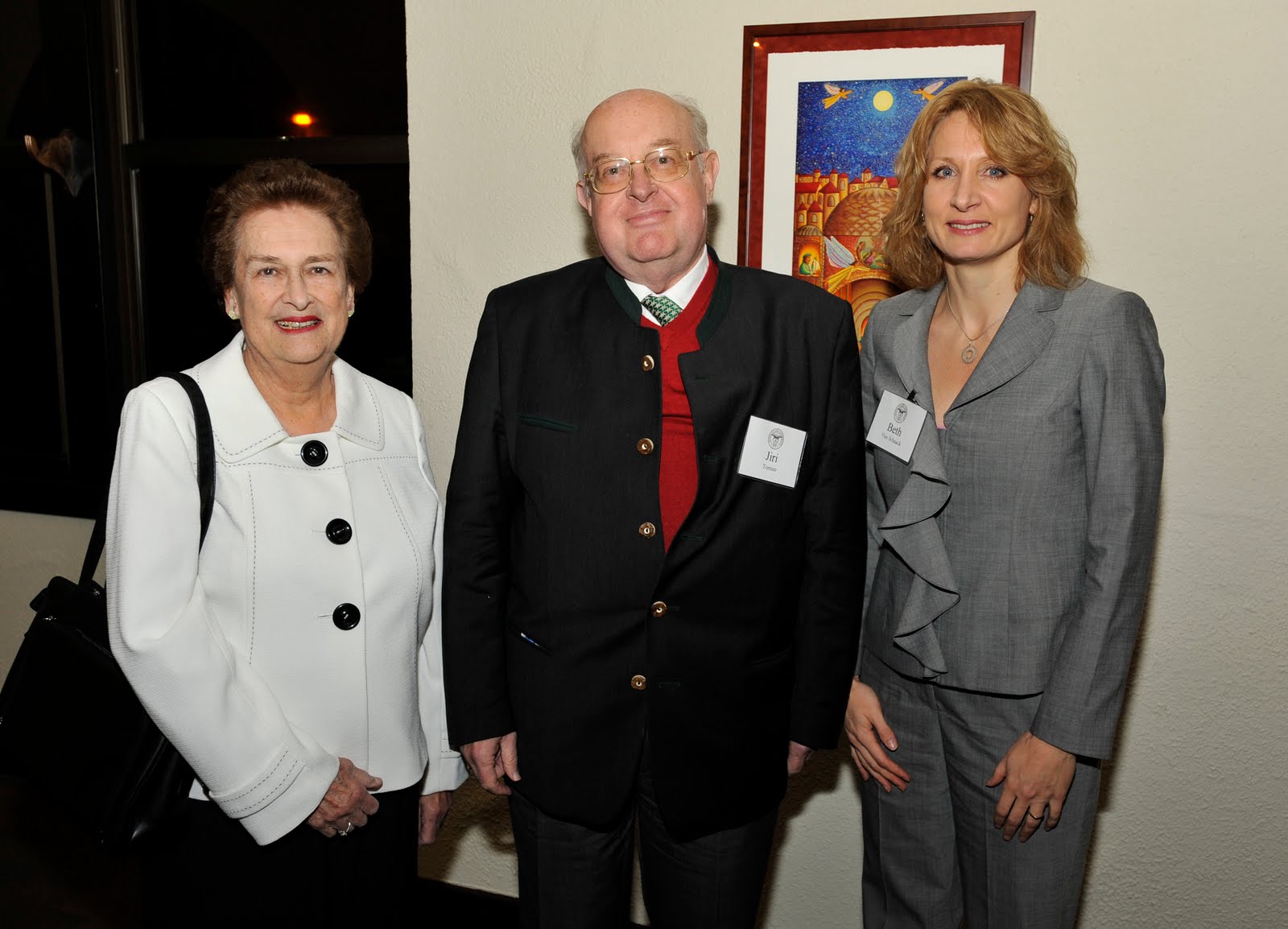
Hope to see you there! (Picture at left includes my colleague Jiri Toman, an old friend of Judge Higgins).

Guest Blogger: Jayne Stoyles

We are delighted to welcome Jayne Stoyles (left) as today's guest blogger.
Jayne is a lawyer, the first Executive Director of the Canadian Centre for International Justice, and an Ashoka Canada Fellow. A decision issued recently in a human rights case in which CCIJ has submitted a friend of the court brief forms the core of her guest post below.
Prior to joining CCIJ, Jayne served for several years as the Program Director of the NGO Coalition for the International Criminal Court in New York, a global network of 2,000 NGOs that helped bring about the establishment of the Court and that was twice nominated for a Nobel Peace Prize during her tenure. She: was also a Senior Adviser to the Institute for Global Policy in New York on issues of human security, UN reform and international justice; provided International Humanitarian Law training for the Red Cross; and taught international law at Carleton University in Canada.
Jayne has spent time in Africa, Latin America, and a First Nations community in northern Canada with a variety of volunteer placements, including working with Centro de Derechos de Mujeres in Honduras on updates to the criminal code from a gender perspective. She is the 2010 winner of the Walter S. Tarnopolsky Human Rights Award and of the Lord Reading Law Society Human Rights Award, was named one of Ottawa’s Top 50 People in 2008 by Ottawa Life Magazine, and has been featured in Canadian legal magazine The Precedent and in the on-line Charity Village Spotlight. She has just accepted a position on the Board of Directors of the International Institute for Criminal Investigations, an international organization of professional investigators, lawyers and academics dedicated to the training and deployment of professionals for the investigation of atrocities. Jayne regularly speaks, writes and provides media interviews about the making of the ICC and international justice issues from a Canadian perspective.
Like Pam Spees, Valerie Oosterveld, and Mary Hansel before her, Jayne would like to dedicate her IntLawGrrls contribution to the beloved Rhonda Copelon.


Heartfelt welcome!

Sovereign immunity in Canada

(Thanks much to IntLawGrrls for inviting me to contribute this guest post on several important developments in human rights litigation in Canada)

One of the things that always strikes me in working with torture survivors and victims’ families is how consistently people say they want to help prevent others from experiencing the same trauma. They want something hopeful to result from such dramatic pain and loss, and often see the pursuit of justice as one of the means to achieve this.
That was certainly the message from Canadian-Iranian Stephan Kazemi as he digested the outcome of a key decision in his lawsuit against Iran for the torture and death of his mother, Zahra Kazemi (left). He could see that while the decision is a victory in terms of his own ability to proceed, it closes the door to most other cases in Canada for torture suffered overseas and undermines his broader goal.
Zahra Kazemi was a photojournalist from Montreal, Canada,, whose work sought to shed light on political and human rights issues, often highlighting the strength of women in situations of poverty and oppression. In 2003, she traveled to Iran during a time of demonstrations against the government, and with a press card took photographs of family members outside the notorious Evin prison who were seeking information about those thought to have been falsely imprisoned.
As a result, Zahra was herself detained, brutally raped and beaten. Her son in Canada, an only child in his twenties at the time, sought her return for treatment in Canada. This was denied, and she died of her injuries. No one was ever held accountable in Iran for Zahra’s torture and death. After other possible avenues to redress had been exhausted, a lawsuit was filed against Iran in Quebec Superior Court, on behalf of Zahra’s estate and of her son Stephan. The first hurdle in the case was the need to address the claims of the Government of Iran and the three named individual officials that they were immune from the lawsuit because of Canada’s State Immunity Act (SIA).
Passed in 1982, the SIA was intended to provide assurance to other governments that they would not be sued in Canada as they carried out their official or “sovereign” duties. A strong argument can be made that acts that are in clear contravention of international law – such as torture – cannot be considered “sovereign”. The SIA uses a restrictive approach and contains two exceptions to immunity – for commercial activities and for injuries suffered inside Canada. Unfortunately there is currently no exception in the legislation for torture or other serious violations of international human rights. The intervention of the Canadian Centre for International Justice, for which I serve as Executive Director, as a friend of the court in the Kazemi case was an attempt to remedy this.
The Quebec Superior Court took almost a year to issue its judgment on the state immunity issue. When it finally came in late January, it was a very mixed result. The court permitted Stephan's individual claims to proceed on the basis of the existing exception written into the SIA that eliminates immunity for injuries suffered inside Canada. It found that the nervous shock Stephan suffered as a result the mistreatment of his mother could fall under this exception. His individual part of the case will proceed and it will certainly be significant – the first trial of its kind in Canada.
However, the claims by the Estate of Zahra Kazemi were dismissed on the ground that the abuses Zahra suffered were only in Iran; she never suffered an injury in Canada. The court upheld immunity in those circumstances, rejecting arguments that immunity should not be permitted for torture and other serious human rights violations. The paradoxical result of the court's approach is that relatives in Canada of persons tortured or killed abroad may have a remedy while the persons who were actually tortured often will not.
Yet while the judgment is disappointing, there is still hope:
► Aspects of the case could be subject to appeal, and decisions about that will be made in the coming weeks.
► The judgment is also a clear invitation to Canadian Members of Parliament to act by passing a bill that is currently before them, intended to clarify that there should never be immunity for torture, war crimes, genocide or crimes against humanity. Bill C-483, a private member’s bill, was re-introduced in Parliament on March 3, 2010 by Liberal MP Irwin Cotler (right) with the support of MPs from the other three parties that hold seats: the Conservatives, New Democratic Party and Bloc Quebecois. The bill would deny immunity to countries and officials alleged to be responsible for torture, genocide, war crimes and crimes against humanity by creating a new exception to the general rule in the SIA that foreign governments cannot be sued in Canada. The exception would remove the key barrier to lawsuits involving allegations of these violations of human rights and humanitarian law, and create an important precedent as the civil courts of other countries also grapple with the issue of state immunity.
Further developments in the Kazemi case will be important to watch, as will progress on the parallel efforts at law reform through the legislature. It is my very deep hope that Stephan Kazemi will have the opportunity to offer this final tribute to the tremendous courage his mother demonstrated through her work and art.

Go On! Salvador Study Program

My former client, Carlos Mauricio (right), is once again hosting a Summer Intensive Program in Modern Salvadoran History and Human Rights: June 20 – July 15, 2011. Carlos was a plaintiff in the case of Romagoza v. Arce brought under the Alien Tort Statute against two former Ministers of Defense of El Salvador that resulted in a $54 million plaintiffs' judgment. Although we only recovered a fraction of that amount, Carlos used his share to launch the Stop Impunity Project, which is aimed at bringing to justice individuals who violate international human rights norms. It also contributes to the movement to close the School of the Americas.

The Stop Impunity Project, in partnership with the University of El Salvador, will offer a four-week summer intensive program in modern Salvadoran History and Human Rights. The program has been designed for students of law, sociology, history, human rights, anthropology, social work and other related disciplines and is also appropriate for those working with immigration organizations and legal and social service providers that support the Salvadoran community.

The program will explore the history of El Salvador since the genocide of 1932 and will deepen participants’ understanding of conditions that led to the Salvadoran Civil War, the Civil War itself, the consequent diaspora, and the state of human rights throughout.

Core classes will be taught by experienced faculty from the University of El Salvador’s MA program in Human Rights and/or the staff of the Salvadoran Human Rights Ombudsman’s office. The program will include a series of lectures by founders of and participants in modern Salvadoran social and popular movements. Past speakers have included
  • Nydia Diaz (below left), former guerrilla commander and current member of the Central American Parliament,

  • Zaira Navas, Inspector General of the National Police,

  • Roberto Cañas, former guerrilla commander and signatory to the 1992 Peace Accords,

  • Manlio Argueta, prize-winning author and Director of the National Library,

  • Santiago Gonsalvi, Director of the Museo de la Imagen y la Palabra, and others.
Participants will visit El Mozote (memorial above right), where more than 900 villagers were massacred by the army, the Universidad Centroamericana (la UCA) where six Jesuit priests and their housekeepers were murdered by the Salvadoran army, the chapel where Archbishop Romero was assassinated, and his tomb in the national cathedral. Participants will also visit NGOs and human rights organizations such as Participants will be guided in a short research project that meets their interest in the field. The language of instruction will be Spanish, and participants should be capable of participating in classroom discussions in Spanish, however, instruction will be designed with non-native speakers of Spanish in mind. Program participants meeting all the course requirements will be awarded with a Diploma in Salvadoran History and Human Rights from the University of El Salvador.

The course fee of $2,500 includes tuition, a round-trip economy class ticket from a major US hub, and shared bed and breakfast accommodation. Transportation to and from the airport, and for the two-day field trip to El Mozote is included, as is an overnight stay at a nearby hotel. Lunch, dinner and daily incidentals are not included, nor the nominal cost of urban transportation to sites within the city of San Salvador. Photos from last year's session are available here.

Go On! Religion & International Law

Santa Clara University School of Law's annual international law symposium will be on the topic of "Religion & International Law."
The event will be Friday, Feb. 18 and Saturday, Feb 19, 2011 in the California Mission Room, Benson Center, Santa Clara University.
The Symposium homepage is here. Online registration may be undertaken here (MCLE credit is available). The papers and proceedings will be published in our Journal of International Law.
The Symposium is organized around a series of papers by our main presenters as well as commentary from other experts. The full schedule is here.
Speakers and commentators include (full bios are here):
Lama Abu-Odeh (Georgetown) (top right)
Peter Danchin (U. Maryland)
Haider Hamoudi (Pittsburgh)
IntLawGrrls guest/alumna Saira Mohamed (Berkeley Law) (top left)
Anissa Helie (John Jay College of Criminal Law & International Solidarity Network of Women Living Under Muslim Laws)
► Dr. Hisham Hellyer (Warwick)
Asifa Quraishi (Wisconsin) (middle right)
Brett Scharffs (Brigham Young)
Shadi Mokhtari (American) (middle left)
► Dr. Manisuli Ssenyonjo (Brunel University)
Seval Yildirim (Whittier) (bottom right)
IntLawGrrl Karima Bennoune (Rutgers-Newark) (bottom left)
The keynote speaker is Robert Steiple, the first ever U.S. Ambassador-at-Large for International Religious Freedom.
Hope to see you there!

Guest Blogger: Erin Daly

It's IntLawGrrls' great pleasure to welcome Erin Daly (left) as today's guest blogger.
Erin is Professor of Law and Associate Dean of Faculty Research and Development at Widener Law School in Wilmington, Delaware. She earned her B.A. from Wesleyan University and her J.D. cum laude from the University of Michigan, then practiced 1st Amendment and employment law at the San Francisco law firm of Cooper White & Cooper.
Since entering academia in 1993, she's produced many publications on comparative environmental law, constitutional law, and transitional justice, among them Reconciliation in Divided Societies: Finding Common Ground (2006), for which a Nobel Peace Prizewinner, Archbishop Desmond Tutu, wrote the foreword. Co-authoring the book (issued in paperback in 2010) with Erin was Jeremy Sarkin, the South African legal expert about whom we posted yesterday.
Erin has served as a Vice-Chair of the Young Lawyer’s Division Law and Media Committee of the American Bar Association. Earlier this month, Erin was elected the Chair of the Section on International Human Rights of the Association of American Law Schools (a position that IntLawGrrl Christiana Ochoa held a while back). In her guest post below, Erin recaps the Section's "new voices" programs during AALS' 2010 annual meeting, discusses Section plans, and welcomes suggestions for the coming year.
Erin dedicates her post to Coretta Scott King (1927-2006), about whom we IntLawGrrls have frequently posted. She was, of course, the widow of Dr. Martin Luther King, Jr. (prior posts) -- and she was also a civil rights and human rights activist in her own right. Today the United States observes Martin Luther King, Jr. Day. It is, as Erin writes, a holiday that Coretta Scott King

named in honor of her husband, but which is really a testament to her own lifelong commitment to making the world a better place through service to others and to holding up ideals of equality and human dignity, whether in the context of literacy, poverty eradication, or the rights of minorities of all kinds in the United States and abroad. She took on each new challenge with grace and intelligence and continued throughout her life to push for greater rights for all.

(source for 1984 Charles Tasnadi/AP photo of her leading a picket of South African embassy in Washington, D.C.) Today we are honored to include Coretta Scott King in our list of foremothers just below the "visiting from..." map at right.


Heartfelt welcome!

AALS human rights section news

(My thanks to IntLawGrrls for the opportunity to contribute this guest post)

As the new Chair of the Section on International Human Rights of the Association of American Law Schools, I want to welcome everyone to the section and invite you to become active members.
We had a terrific session earlier this month at the AALS annual meeting, on which IntLawGrrls posted here and here.
Featured at our section's session were 8 “new voices” in human rights.
► In the first part, presenters spoke on specific current issues in international human rights law. Jena Martin Amerson (West Virginia) (left) examined the role of transnational corporations as bystanders under international law in order to move towards a better working theory of corporate accountability. Angela B. Cornell (Cornell) (left) approached the human rights responsibilities of corporations from a different angle, suggesting that private international agreements might provide opportunities to encourage corporate entities to take more responsibility toward the individuals and communities in which they operate. Benedetta Faedi Duramy (Golden Gate) (left) spoke about the ways in which women are victims of violence can become perpetrators of violence, exploring the reasons why women commit violence, based on her research in Haiti; and Jonathan Todres (Georgia State) emphasized the importance of listening to and working directly with children who are the victims of human rights abuses so that we can better understand the challenges they face.
► In the second part of the session, we focused on implementation issues. David Baluarte (American) spoke about state implementation of regional human rights bodies, with particular emphasis on the Inter-American system. IntLawGrrls alumna Alexandra Huneeus (Wisconsin) (near right) followed David's presentation up by looking more closely at which institutions within the domestic government are responsible for implementing orders from the Inter-American Court; Alexandra further made recommendations to encourage greater enforcement of regional court orders. Austen Parrish (Southwestern) argued that globalization and territorial governance can be consistent in the field of human rights. And IntLawGrrls alumna Caroline Bettinger-López (above, far right) described a collaborative effort among several human rights clinical faculty using lessons of critical theory to offer a proposed shift in human rights lawyering and advocacy; that is, a shift from identifying the immediate circumstances of human rights violations to articulating the structural realities that serve as the framework for those violations, and incorporating victims’/clients’ voices and goals into the advocacy.
The Executive Committee of the Section comprises William V. Dunlap (Quinnipiac), Michèle Alexandre (Mississippi) (near left), Stuart Ford (John Marshall), immediate past Chair Sarah Paoletti (Penn) (far left) and me. Right now we are working on:
► Setting the communications platform which we hope to develop as a list-serv for faculty members interested in human rights law; and
► Establishing a mentoring project to help new faculty members who are just starting to teach in this area.
Watch for announcements about these projects, as well as plans for the 2012 annual meeting, to be held in January in Washington, D.C.
Most of all, we welcome suggestions, comments or any other expressions of interest. So please contact one of us to share your thoughts.

Kosovo: Secession dilemma déjà-vu

(Many thanks to IntLawGrrls for giving me the opportunity to contribute this guest post!)

Since 17 February 2008 – the day of Kosovo’s declaration of independence from Serbia – it has become rather pressing to understand whether this act has legal precedential value and hence what its consequences are. The International Court of Justice (below right) issued an Advisory Opinion on Kosovo this past summer. (Prior IntLawGrrls posts available here.) But that opinion has not shed much, if any, light on the question of precedence.
Whether the Court was asked, on the one hand, to analyze the legal consequences of the independence of Kosovo, or, on the other hand, merely to “narrow[ly] and specific[ally]” reply whether “the unilateral declaration of independence by the Provisional Institutions of Self-Government of Kosovo is in accordance with international law,” remains, of course, a separate debate.
Be it as it may, the dilemma remains:

Is Kosovo a precedent for (remedial) secession?
My article recently published in the Goettingen Journal of International Law, "Secession in Theory and Practice: The Case of Kosovo and Beyond," attempts to put forward a lucid account of the legal implications of Kosovo’s independence. To do so, the article explores the international regulations on secession, as well as the circumstances that led to the case at hand.
The paper carves out the place of secession in international law by appeal to fundamental principles and legal doctrine, and concludes:
► There is no general jus secedendi, or right to secede.
► There are instances in which a right to secession is recognized under international law. These refer to states explicitly acknowledging a right to secession in their domestic law, or multinational states recognizing that their constituent peoples have the right to self-determination.
► There is one controversial case that divides scholarship, the one of remedial secession.
► Lastly, there is a trend towards the legality principle governing secessions, as distinguished from the traditional neutrality doctrine.
It is useful to consider the theory on secession with state practice, to the extent that such practice can be discerned from major socio-political events of Kosovo’s history – from the battle of Kosovo Polje in 1389 to Security Council Resolution 1244 (1999) that set up the United Nations Interim Administration Mission in Kosovo (UNMIK). From the juxtaposition of this theory and practice, a second conclusion can be drawn: Kosovo is a case of remedial secession and thus it represents a potential legal precedent.
And yet the exceptionality discourse!
While the elements of remedial secession are gathered, states deprived this instance of practice of its precedential value, and made it a legally insignificant act.
Some explanations are in order.
An action that is novel or inconsistent with current practice gains precedential value if other states accept it; acquiescence and protest are the fundamental state reactions to an action, therefore those are of interest in the case of Kosovo. Serbia, as the state with most interest in resolving the Kosovo case, has strongly protested against the legality of Kosovo’s secession. Other states protested or decided to withhold recognition. All officially identify the potential of setting a legal precedent as reasoning.
The fascination about the Kosovo case lies in the discourse of those states that chose to support and recognize Kosovo as an independent state, describing it as a sui generis/special/exceptional case. Throughout the years that it has sought independence from Serbia, Kosovo has maintained that it has the legal right to do so. In this context, the most staggering statement is made by Kosovo itself in its own declaration of independence:

Kosovo is a special case arising from Yugoslavia’s non-consensual breakup and is not a precedent for any other situation.
The Kosovo secession has been articulated, but as a non-precedential situation. In the end, as scholars Georg Nolte and Helmut Philipp Aust wrote in an article published last year,

states are both subjected to international law and create and authoritatively interpret it.
And in this case, even the recognizing states have consciously and clearly opted not to create a general rule governing remedial secession. Ultimately, states have guarded the status quo, and continued to act allergic to a right to remedial secession with set boundaries and clear coordinates. Ironically, the consistent state practice is evidence of the absence of a customary right of remedial secession.
In other words, the international community missed a rare opportunity to clarify the concept of remedial secession and to reassert its preventive force as a non-traditional human rights protection mechanism. The consequences of not assuming the precedent are, regrettably, far more important.
The force of remedial secession lies in its prevention potential – empowering minority groups to hold governments accountable to their international obligations. It is not an implosive weapon within the Westphalian system, but rather a non-traditional human rights mechanism.
By presenting Kosovo as unique, the international community undermined the theory of remedial secession, and made states and their borders sacrosanct even when a government, by way of its discriminatory and repressive actions against part of its population, puts its own raison d’être into question. It is a perverse implication, one that states will have to deal with when another unique Kosovo enters the international arena.
Thirty-nine years ago, Bangladesh seceded from Pakistan. The debate whether Bangladesh set a precedent for a right to remedial secession continues. Regrettably, Kosovo is merely a Bangladeshi déjà-vu.

 
Bloggers Team