Showing posts with label self-determination. Show all posts

Kosovo: Secession dilemma déjà-vu

(Many thanks to IntLawGrrls for giving me the opportunity to contribute this guest post!)

Since 17 February 2008 – the day of Kosovo’s declaration of independence from Serbia – it has become rather pressing to understand whether this act has legal precedential value and hence what its consequences are. The International Court of Justice (below right) issued an Advisory Opinion on Kosovo this past summer. (Prior IntLawGrrls posts available here.) But that opinion has not shed much, if any, light on the question of precedence.
Whether the Court was asked, on the one hand, to analyze the legal consequences of the independence of Kosovo, or, on the other hand, merely to “narrow[ly] and specific[ally]” reply whether “the unilateral declaration of independence by the Provisional Institutions of Self-Government of Kosovo is in accordance with international law,” remains, of course, a separate debate.
Be it as it may, the dilemma remains:

Is Kosovo a precedent for (remedial) secession?
My article recently published in the Goettingen Journal of International Law, "Secession in Theory and Practice: The Case of Kosovo and Beyond," attempts to put forward a lucid account of the legal implications of Kosovo’s independence. To do so, the article explores the international regulations on secession, as well as the circumstances that led to the case at hand.
The paper carves out the place of secession in international law by appeal to fundamental principles and legal doctrine, and concludes:
► There is no general jus secedendi, or right to secede.
► There are instances in which a right to secession is recognized under international law. These refer to states explicitly acknowledging a right to secession in their domestic law, or multinational states recognizing that their constituent peoples have the right to self-determination.
► There is one controversial case that divides scholarship, the one of remedial secession.
► Lastly, there is a trend towards the legality principle governing secessions, as distinguished from the traditional neutrality doctrine.
It is useful to consider the theory on secession with state practice, to the extent that such practice can be discerned from major socio-political events of Kosovo’s history – from the battle of Kosovo Polje in 1389 to Security Council Resolution 1244 (1999) that set up the United Nations Interim Administration Mission in Kosovo (UNMIK). From the juxtaposition of this theory and practice, a second conclusion can be drawn: Kosovo is a case of remedial secession and thus it represents a potential legal precedent.
And yet the exceptionality discourse!
While the elements of remedial secession are gathered, states deprived this instance of practice of its precedential value, and made it a legally insignificant act.
Some explanations are in order.
An action that is novel or inconsistent with current practice gains precedential value if other states accept it; acquiescence and protest are the fundamental state reactions to an action, therefore those are of interest in the case of Kosovo. Serbia, as the state with most interest in resolving the Kosovo case, has strongly protested against the legality of Kosovo’s secession. Other states protested or decided to withhold recognition. All officially identify the potential of setting a legal precedent as reasoning.
The fascination about the Kosovo case lies in the discourse of those states that chose to support and recognize Kosovo as an independent state, describing it as a sui generis/special/exceptional case. Throughout the years that it has sought independence from Serbia, Kosovo has maintained that it has the legal right to do so. In this context, the most staggering statement is made by Kosovo itself in its own declaration of independence:

Kosovo is a special case arising from Yugoslavia’s non-consensual breakup and is not a precedent for any other situation.
The Kosovo secession has been articulated, but as a non-precedential situation. In the end, as scholars Georg Nolte and Helmut Philipp Aust wrote in an article published last year,

states are both subjected to international law and create and authoritatively interpret it.
And in this case, even the recognizing states have consciously and clearly opted not to create a general rule governing remedial secession. Ultimately, states have guarded the status quo, and continued to act allergic to a right to remedial secession with set boundaries and clear coordinates. Ironically, the consistent state practice is evidence of the absence of a customary right of remedial secession.
In other words, the international community missed a rare opportunity to clarify the concept of remedial secession and to reassert its preventive force as a non-traditional human rights protection mechanism. The consequences of not assuming the precedent are, regrettably, far more important.
The force of remedial secession lies in its prevention potential – empowering minority groups to hold governments accountable to their international obligations. It is not an implosive weapon within the Westphalian system, but rather a non-traditional human rights mechanism.
By presenting Kosovo as unique, the international community undermined the theory of remedial secession, and made states and their borders sacrosanct even when a government, by way of its discriminatory and repressive actions against part of its population, puts its own raison d’être into question. It is a perverse implication, one that states will have to deal with when another unique Kosovo enters the international arena.
Thirty-nine years ago, Bangladesh seceded from Pakistan. The debate whether Bangladesh set a precedent for a right to remedial secession continues. Regrettably, Kosovo is merely a Bangladeshi déjà-vu.

On November 23

On this day in ...
... 1984, the U.N. General Assembly adopted Resolution 39/17, discussing the "Importance of the universal realization of the right of peoples to self-determination and of the speedy granting of independence to colonial countries and peoples for the effective guarantee and observance of human rights." Occasioning the restatement of the self-determination right were a laundry list of events: continuing apartheid in South Africa, occupation of Namibia and part of Angola by South Africa, and recent invasion of Lebanon by Israel.

(Prior November 23 posts are here, here, and here.)

New flash: Kosovo a state independent, per International Court of Justice

[FINAL UPDATE 8:42 p.m. EDT:] Now on the ICJ website is a pdf of the 40-plus-page Advisory Opinion on Accordance with international law of the unilateral declaration of independence in respect of Kosovo.
Voting on the ultimate opinion, that Kosovo's February 17, 2008, declaration of independence did not violate international law:
In favor:
ICJ President Hisashi Owada (Japan), as well as Judges Awn Shawkat Al-Khasawneh (Jordan), Thomas Buergenthal (United States), Bruno Simma (Germany), Ronny Abraham (France), Kenneth Keith (New Zealand), Bernardo Sepúlveda-Amor (Mexico), Antônio A. Cançado Trindade (Brazil), Abdulqawi Ahmed Yusuf (Somalia), and Christopher Greenwood (United Kingdom).
Against:
ICJ Vice-President Peter Tomka (Slovakia), as well as Judges Abdul G. Koroma (Sierra Leone), Mohamed Bennouna (Morocco), and Leonid Skotnikov (Russia).
Therein lies a rub.

* * *

[UPDATE 3 p.m. EDT:] Per this article, the 10-4 ICJ ruling did not go so far as to declare Kosovo a state:
[L]egal experts emphasized that while the court had ruled that Kosovo’s declaration of independence was legal, it had scrupulously avoided saying that the state of Kosovo was legal under international law, a narrow and carefully calibrated compromise that they said could allow both sides to declare victory in a dispute that remains raw even 11 years after the war there.
Website still inaccessible.

* * *

[1:04 p.m. original post:] So says this article respecting a just-issued Advisory Opinion on Kosovo, formerly a province of Serbia. Perhaps not surprisingly, the International Court of Justice website's overfull. More later.

On May 29

On this day in ...
... 1919, a group led by a former schoolmaster who'd fought in World War I invoked the self-determination provision in U.S. President Woodrow Wilson's Fourteen Points speech, and declared the independent Republic of Prekmurje, the land (left) on which they lived, in southeastern Europe. (photo credit) Their effort was short-lived: within weeks the territory was "incorporated" into the Kingdom of the Serbs, Croats, and Slovenes created in the wake of the war. Later it was part of Yugoslavia. Today it's the eastermost tip of Slovenia.

(Prior May 29 posts are here, here, and here.)

On March 22

On this day in ...
...2006, Euskadi Ta Askatasuna, the group that favors separation of the Basque region from northern Spain and southwest France, and is better known by its acronym, ETA, declared a permanent ceasefire following 4 decades of political violence that claimed more the 800 lives. "In a statement released to Basque media," the BBC reported, "the group said its objective now was 'to promote a democratic process in the Basque country'." In recent days, however, allegations of ETA violence have resurfaced.

(Prior March 22 posts are here)

On July 13

On this day in ...
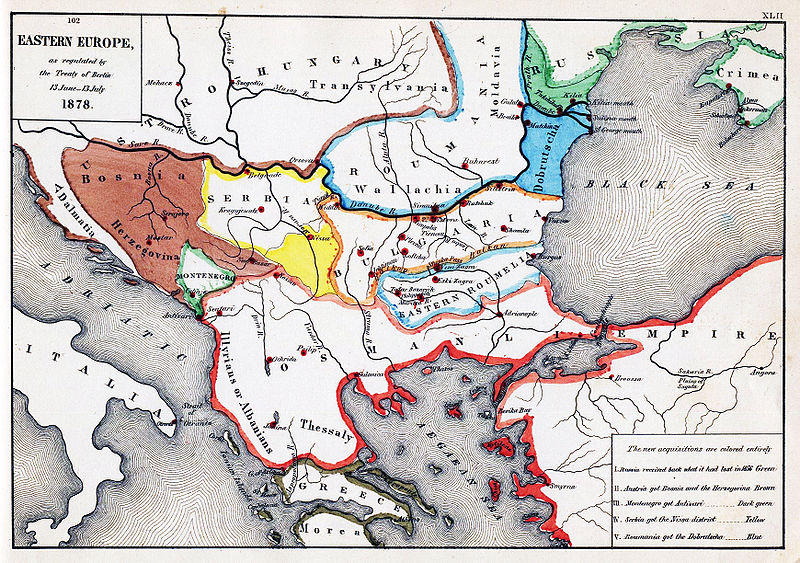
1878, the Treaty of Berlin, the final act of the Congress of Berlin, was signed by Britain, Austria-Hungary, France, Germany, Italy, Russia, and the Ottoman Empire. As a result, a Balkan crisis ended, and Serbia, Montenegro, and Romania became completely independent of the Ottoman Empire. Additionally, the treaty granted special legal status to some religious groups and served as a model for the minorities system that was subsequently established within the framework of the League of Nations. (credit for map of South-Eastern Europe after the Congress of Berlin)
1973, Alexander Butterfield, a deputy assistant to President Richard Nixon, revealed the existence of tapes to the special Senate committee investigating the Watergate break-in. Nixon had recorded almost every meeting in his White House offices since 1971 -- the tapes would prove vital in documenting that high-ranking officials had been involved in a cover up and other illegal activities. After a series of court battles, the Supreme Court unanimously ruled in United States v. Nixon (1974) that the President had to hand over the tapes; he ultimately complied. In recent weeks, many tapes have been made newly available to the public. (credit for July 30, 1973, cover of Newsweek)

(Prior July 13 posts are here and here.)

On July 8

On this day in ...
1992, The Organization for Security and Co-operation in Europe (logo at right) created the office of High Commissioner on National Minorities. According to the OSCE website,

The post of the OSCE High Commissioner on National Minorities was established in 1992 to identify and seek early resolution of ethnic tensions that might endanger peace, stability or friendly relations between OSCE participating States.
High Commissioner Knut Vollebaek, former Norwegian ambassador to the United States, began a 3-year term in 2007.
1970, U.S. President Richard Nixon (below left) delivered a special congressional message enunciating Native American self-determination as official U.S. policy. Previously, it had been the stated policy objective of the federal government eventually to terminate the trusteeship relation between the federal government and tribal nations. (photo credit) In his address, "Message from the President of the United States Transmitting Recommendations for Indian Policy," Nixon contended that such termination policies did not work, and called instead for broad-sweeping self-determination legislation. Five years later, Congress would pass the Indian Self-Determination and Education Assistance Act.

(Prior July 8 posts are here and here.)

On January 8

On this day in ...
... 1918, before a joint session of Congress, President Woodrow Wilson outlined what, in his view, were the "terms upon which Germany may obtain peace" and thus bring World War I to an end. The New York Times' story on the speech is instructive: though it does discuss some of the terms, it devotes much space to the internal political response. It thus evinces little recognition that this Fourteen Points speech would become a foundational document of 20th century developments respecting foreign policy, international organizations like the League of Nations, and concepts such as self-determination. (credit for shorthand draft of Wilson's speech)
... 1975, Ella Grasso was sworn in as Governor of Connecticut, making her the 1st woman to serve as the chief executive of a U.S. state who had been elected on her own, without having succeeded her husband into office. She'd been born Ella Tambussi in 1919, the daughter of Italian immigrants. Following marriage to her husband, Thomas Grasso, with whom she's depicted entering her inaugural ball, and the birth of their 2 children, she was a state legislator before becoming governor. Grasso was mentioned as a possible Vice Presidential candidate in 1976, but never did become a national politician. She died in 1981, a couple months after she had resigned following a diagnosis of cancer. (credit for S. Robert Pugliese photo, Hartford Collection, Hartford Public Library)


On October 30

On this day in ...
... 1938 (70 years ago today), on the eve of Hallows Eve, Americans were thunderstruck by CBS' nationwide announcement that Martians had landed "in giant machines with metal legs" and "destroyed everything in their path with a heat ray." Within minutes switchboards jammed. Even before the end of Orson Welles' radio broadcast "War of the Worlds" -- adapting H.G. Wells' 1898 novel -- the Associated Press "issued a bulletin at 8:48 pm that there was no invasion from Mars," and the host of the next radio show began with these words:
'Mr. and Mrs. America, there's no cause for alarm. America has not fallen.'
... 1995, voters in the Québec province of Canada narrowly answered "No" to a secession referendum, which asked in relevant part: "Do you agree that should become sovereign, after having made a formal offer to Canada for a new economic and political partnership ....?" The razor-thin margin -- 50.56% opposed -- led to the 1998 Canada Supreme Court decision holding that Canada was respecting and ensuring the right of self-determination of the people of Québec (flag at left), so that those people had no right under law to secede from the state.

Sahrawi activist to receive RFK rights award

Soon to receive the 2008 Robert F. Kennedy Human Rights Award is Aminatou Haidar (right), for the last 2 decades a campaigner for the self-determination of the people of her native Western Sahara. (photo credit)
Haidar's homeland, once a Spanish colony, has been under Morocco's military control since 1975. That same year that an International Court of Justice Advisory Opinion rejected Moroccan claims to sovereignty. Soon the independence Frente Polisario proclaimed a government in exile for the region. The United Nations Mission for the Referendum in Western Sahara (MINURSO) has operated there since a ceasefire was signed in 1991. The planned referendum has yet to be held. (A new article on this matter is hot off the presses: Erika Conti, The Referendum for Self-Determination: Is it still a solution? The never-ending dispute over Western Sahara, 16 African Journal of International & Comparative Law 178 (2008).)
Because of her own efforts on behalf of self-determination Haidar has spent years behind bars:
In 1987, at the age of 21, Ms. Haidar was one of 700 peaceful protestors arrested for participating in a rally in support of a referendum. Later she was 'disappeared' without charge or trial and held in secret detention centers for four years, where she and 17 other Sahrawi women were tortured. In 2005, the Moroccan police detained and beat her after another peaceful demonstration. She was released after 7 months, thanks to international pressure from groups like Amnesty International and European Parliament.

Notwithstanding, Haidar continues to work for nonviolent settlement of the dispute, an approach for which she's known as the "Sahrawi Gandhi."
Haidar will receive a prize of $30,000 at a November ceremony in Washington. That is "the beginning of the RFK Center's long-term partnership with Ms. Haidar and our commitment to work closely with her to realize the right to self-determination for the Sahrawi people," said Monika Kalra Varma (left), Director of the RFK Memorial Center for Human Rights (and, I'm proud to say, a former student of mine). The 1st such award was given in 1984, since then, 38 human rights defenders, from 22 countries, have been honored.

Secession & ethnicity in Kosovo

Following on my post last week about the legality of Kosovo’s declaration of independence, readers interested in this subject might want to take a look at these views of the legality debate from our colleagues at Opinio Juris. And to balance those relatively secession-friendly outlooks, consider this skeptical assessment of the legality of unilateral secession, written in the context of the Quebec Secession case.
In considering these questions, I am troubled by the history of deliberate manipulation of ethnic populations in Kosovo in light of the role that Kosovo's current ethnic composition plays in assessments of its independence claim. Of course, the Serbian attempt at ethnic cleansing of the Albanian population from Kosovo was one of the reasons for NATO’s intervention and UN administration of the province. But under the UN administration, other efforts at manipulation have continued. On the one hand, periodic riots and attacks on Serbian enclaves by Albanians have pushed out most of the few Serbs who stayed after 1999. On the other hand, Serbia has provided considerable support to the Serbian enclaves to persuade the Serbs there to remain within Kosovo. When a claim to self-determination depends on an ethnic group's claim to be a people in possession of a territory, there are strong and dangerous incentives for all concerned to try to shape the ethnic composition of that territory, and certainly those have been at work here.

(credit for 2005 map of Kosovo ethnic makeup, based on data from the Organization for Security and Co-operation in Europe)


Indigenous Rights Declaration: backstory

Kristine's introduction of Sacagawea -- who joins Michelle's choice, Nancy Ward, as an IntLawGrrls transnational foremother of Native American heritage -- prompts another look at contemporary norms on native peoples.
As posted here, the U.N. General Assembly voted last month to adopt the Declaration on the Rights of Indigenous Peoples. (At right, a New York rally before the September 2007 vote; the speaker is Beverly Jacobs, President of the Native Women's Association of Canada.)
For the backstory on the "more than 20 years of work" that preceded the vote -- and on why Australia, Canada, New Zealand, and the United States voted nay, compared with 143 aye votes and 11 abstentions -- check out this ASIL Insight by Stefania Errico. After detailing this history, which includes insertion of language designed to privilege internal rather than external self-determination, Errico concludes: "The question to be addressed now is how to implement the provisions incorporated in the Declaration." That question, she writes, is already on the agenda of the United Nations' Human Rights Council.
((c) photo courtesy of Amnesty International Canada.)

On August 20, ...

...1998, in the Quebec Secession Case, the Canadian Supreme Court applied international norms relating to self-determination of peoples to hold unanimously that people with in the predominantly French-speaking province of Québec (flag at right) had no right under either international or domestic law to secede; rather, they were expected to achieve self-determination within the framework of the state of Canada (flag at left). The decision has become a landmark judicial examination of secession and self-determination.
...1966, U.S. Rep. Kathy Castor (D-Fla.) was born in Miami.
 
Bloggers Team