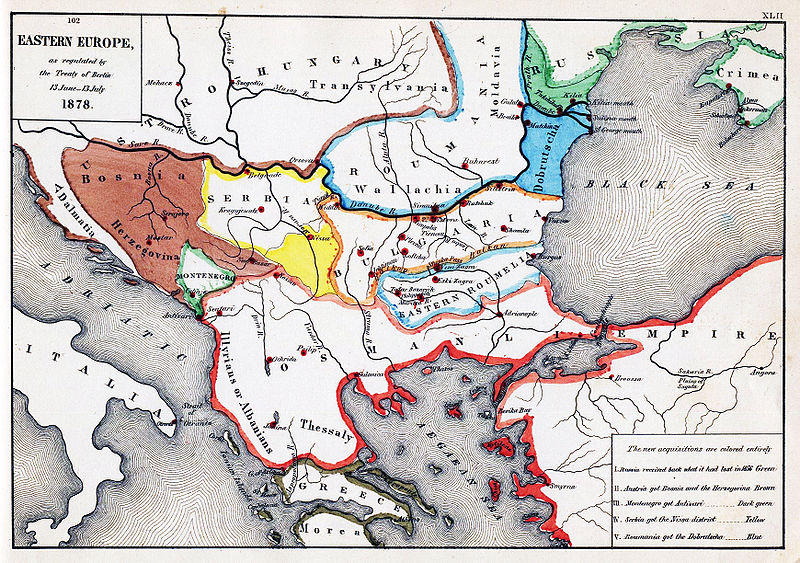
 On this day in ...
… 1878, the Treaty of Berlin, the final act of the Congress of Berlin, was signed by Britain, Austria-Hungary, France, Germany, Italy, Russia, and the Ottoman Empire. As a result, a Balkan crisis ended, and Serbia, Montenegro, and Romania became completely independent of the Ottoman Empire. Additionally, the treaty granted special legal status to some religious groups and served as a model for the minorities system that was subsequently established within the framework of the League of Nations. (credit for map of South-Eastern Europe after the Congress of Berlin)
… 1973, Alexander Butterfield, a deputy assistant to President Richard Nixon, revealed the existence of tapes to the special Senate committee investigating the Watergate break-in. Nixon had recorded almost every meeting in his White House offices since 1971 --
 the tapes would prove vital in documenting that high-ranking officials had been involved in a cover up and other illegal activities. After a series of court battles, the Supreme Court unanimously ruled in United States v. Nixon (1974) that the President had to hand over the tapes; he ultimately complied. In recent weeks, many tapes have been made newly available to the public. (credit for July 30, 1973, cover of Newsweek)
(Prior July 13 posts are here and here.)


