Showing posts with label Sudan. Show all posts

What Role for the African Human Rights System in the Current Transformation of North Africa?

(My thanks to IntLawGrrls for the opportunity to contribute this guest post)

TUNIS - In Tunis last week, human rights defenders from across North Africa gathered to discuss the role that the regional African human rights system can play in the current transformation of North Africa. They were attending a workshop organized by the North African Litigation Initiative, a programme established by the Cairo-based Egyptian Initiative for Personal Rights.
Pictured above at far right, I work as the Legal Advisor for NALI, and it was our pleasure to host participants from Mauritania, Algeria, Tunisia, Libya, Egypt and Sudan.
We were also honored to have Justice Fatsah Ouguergouz (left), the Algerian Justice from the African Court on Human and Peoples’ Rights, join us for the three-day proceedings.
It was particularly exciting to hear from Justice Ouguergouz given the pioneering ruling issued by the African Court on March 25. In issuing this Order for provisional measures against Libya, the Court instructed Libya to
'immediately refrain from any action that would result in loss of life or violation of physical integrity of persons.'

The Court’s judgment is its first binding ruling issued against a State. It is an important intervention by the African human rights system in recent North African events.
Overall, however, the view of the workshop participants is that the response of the African system to developments in North Africa has, to date, been slow and lacking in conviction.
Indeed, the fact that African institutions mandated with protecting and promoting human rights have, on the whole, reacted in a limited manner to events in North Africa led a couple of human rights workers to criticize our decision to hold the Tunis workshop. One human rights lawyer from the United Kingdom wrote to me a couple of weeks ago and said that he felt that the workshop was “mistimed.” The African human rights bodies, he said, could only offer recourses that are “time consuming and typically remote from real effects in actual situations.” At this point, he said, it was necessary both in Tunisia and across North Africa to deal with immediate human rights abuses and the rebuilding of domestic institutions. “So why,” he asked, “was this topic chosen at this time and place?”
This question played through my mind on the first day when I arrived in Tunis and went downtown to have tea with a Tunisian activist. Tanks and barbed wire lined the streets (left and below). But the atmosphere was initially peaceful: a couple of women were even taking photographs of each other with the soldiers and tanks.
Suddenly, however, the mood changed. Police with batons and riot shields began chasing a group of young men and all of us sitting at the street-tables ran inside for cover. My Tunisian friend explained:
'The tensions are rising. There is frustration that reform is not occurring quickly enough. We have so much work to do and so many human rights abuses that must be remedied.'

This experience in downtown Tunis emphasized the continuing volatility in Tunisia – a volatility also evident in Egypt, where I live and work. It highlighted the fact that many immediate, domestic steps must be undertaken to ensure the creation of democratic societies fully removed from the past oppressive regimes.
Yet the fact that much work needs to be completed at the domestic level should not exclude engagement with the regional human rights system. On the contrary, it is especially important at this particular moment to consider how the new governments in Tunisia and Egypt (and also, let us hope, in Libya) can develop strong relationships with the African human rights system so that the new regimes actively promote, protect and fulfill the rights they pledged to uphold when they ratified the African Charter on Human and Peoples’ Rights.
The belief that the African human rights system has the potential to reinforce and strengthen domestic reform certainly influences the work of the EPIR, my organization in Cairo. Over the last few months, EIPR staff members have been working around the clock to document and address the continuing domestic human rights abuses in Egypt (see also here).
However, EIPR has also been looking beyond the domestic judicial realm and has been attempting to engage with the African human rights system. In partnership with Human Rights Watch and INTERIGHTS, we requested the African Commission to issue provisional measures to stop human rights abuses in both Egypt and Libya. In the case of Libya, such requests undoubtedly helped to motivate the African Commission to refer the situation to the African Court.
It is critical that North African human rights defenders take this type of proactive approach so that the African human rights system is encouraged to play a positive role in the transformation of North African societies. In his introductory remarks to our Tunis workshop, Justice Ouguergouz reminded us:
'The African Court cannot act, but can only react. Civil society therefore has a crucial role to play in creating an environment where it is possible for both the African Court and Commission to take steps to protect human rights.'

Following these remarks by Justice Ouguergouz, one Tunisian lawyer took me aside and showed me some of the scars that riddle his body following 8 years of imprisonment under the Ben Ali regime. The lawyer told me:
'I will fight for justice for these scars, and for the scars of thousands of other Tunisians. After this workshop I know that I needn’t stop at the domestic level. I will continue the fight for justice within the African system so my country can become a place of tolerance and dignity.'

It remains to be seen how exactly the African human rights system can play a role in the incredible societal transformations occurring across North Africa. One thing, however, is clear: North African human rights defenders are determined to seize this historical moment to ensure that human rights principles are respected. It is NALI’s mission to ensure they are given assistance to utilize every means available to achieve this goal, including recourse to the African regional system.

Bensouda on ICC prosecutions

(Delighted to welcome back alumna Margaret deGuzman, who contributes this guest post)

At last week’s annual meeting of the American Society of International Law, participants were treated to a luncheon presentation by Fatou Bensouda (right), Deputy Prosecutor of the International Criminal Court and candidate for the top job when Luis Moreno Ocampo’s term expires next year. Bensouda presented some opening remarks and then was ably questioned by our own Diane Marie Amann, as well as a few audience members.
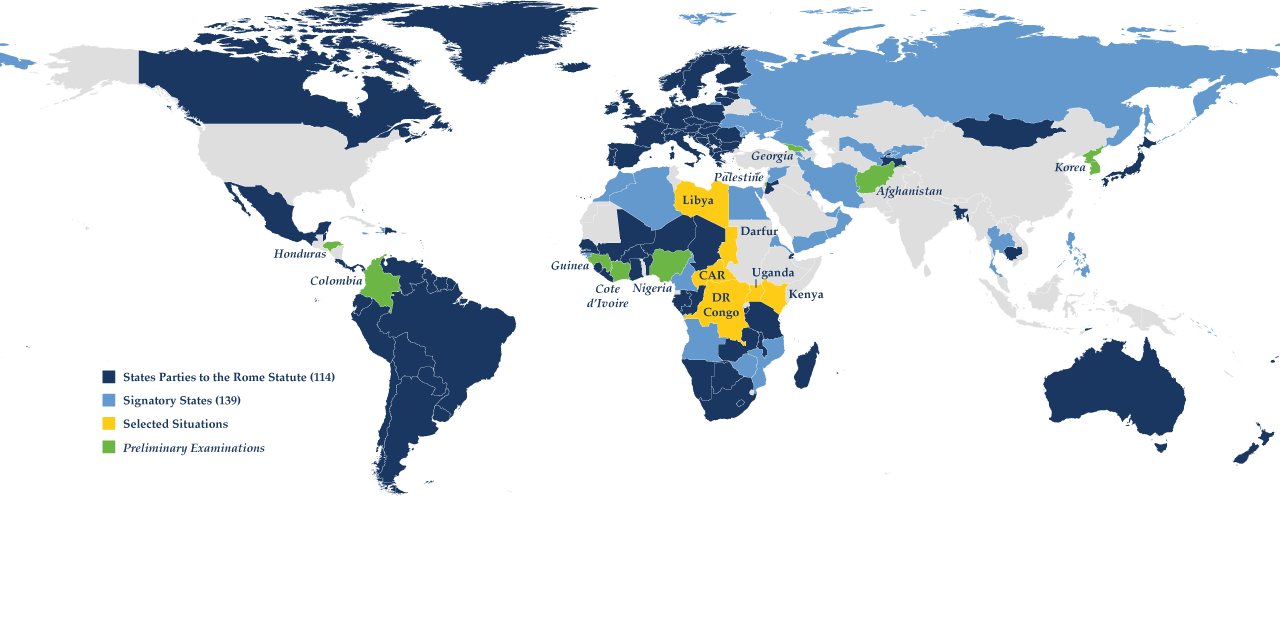
In her luncheon dialogue, which is available for web viewing here, Bensouda began by providing an overview of the work of the International Criminal Court Office of the Prosecutor (OTP) in the most active situations before the Court. Illustrating her talk was the map at bottom, which depicts the 114 states parties to the Rome Statute in dark blue, signatory states in light blue, selected situations in yellow, and preliminary examinations in green.
With regard to Libya, Bensouda stated that the OTP has notified those with formal and de facto authority, including Gaddafi, that their crimes will be investigated. The OTP has made clear that warning civilians to leave before attacking civilian areas does not relieve those involved of criminal responsibility. Bensouda emphasized that the OTP is seeking to be as transparent as possible in its dealings with the Libyan leadership.
In discussing the various situations, Bensouda revealed her vision of the ICC’s role in the global legal order: to prevent crimes through deterrence and by “sending messages” about the types of offenses the international community will not tolerate.
In discussing the OTP’s work with regard to the post-election violence in Kenya, for example, Bensouda asserted that the prosecutions will prevent crimes by “sending the message” that those who gain power by violence will be held accountable.
Similarly, she stated that the prosecution of those who killed peacekeepers in Sudan “sends an important message that the Court supports peacekeeping;” and the trial of Thomas Lubanga for recruiting child soldiers in the Democratic Republic of Congo “signals” the seriousness of that crime.
Bensouda also mentioned a situation in which the OTP is seeking to prevent crimes through incapacitation of key actors. She asserted that the arrest last fall of Callixte Mbarushimana, leader of the rebel group the Democratic Forces for the Liberation of Rwanda, was an effort to “destabilize” that organization and thus prevent crimes in Eastern Congo.
Bensouda also described the OTP’s approach to deciding which situations of alleged international crimes the ICC should investigate. The process of determining whether to pursue a formal investigation has become known as the “preliminary examination.”
Last October, the OTP issued a Draft Policy Paper on Preliminary Examinations. Bensouda promised that the final policy statement would be issued soon. Under Article 53 of the ICC Statute, the preliminary examination phase requires the OTP to determine whether a “reasonable basis” exists to proceed in a situation. This “reasonable basis” analysis has three components. It requires the OTP to assess whether:
► (1) crimes within the ICC’s jurisdiction appear to have been committed;
► (2) potential cases within the situation would be admissible (that is, they are sufficiently grave and meet the complementarity requirement that no State with jurisdiction is already acting in good faith); and
► (3) prosecution would not contravene the “interests of justice.”
The most interesting thing about the OTP’s draft policy on preliminary examinations is that it purports to disavow any role for prosecutorial discretion in deciding which situations to investigate. Whereas an earlier draft policy paper talked about the OTP “selecting” situations to investigate, the 2010 paper takes the position that the OTP must investigate if the statutory criteria are met.
Bensouda’s comments confirmed this approach. She noted that when the office began operations, Colombia and the Democratic Republic of Congo were the “gravest” situations within the Court’s jurisdiction; however, no investigation was opened in Colombia because that country was pursuing some national prosecutions. She also reiterated the OTP’s position that no investigation was undertaken with regard to the war crimes committed by British soldiers in Iraq because they were not sufficiently grave to be admissible.
As I have written elsewhere, this assessment seems mistaken – surely war crimes resulting in the deaths of even a small number of civilians are admissible before the ICC. The decision not to investigate the Iraq situation makes more sense if articulated as an exercise of the prosecutor’s discretion to focus on the most serious situations available. The OTP’s current policy, however, seems to preclude such an approach. Moreover, when questioned about the Court’s selection criteria, Bensouda seemed to admit that gravity is sometimes primarily a matter of numbers of victims – as in the Iraq situation – and at other times is conceived as relating more to the nature and impact of the crimes – in particular, what “signal” a particular prosecution is going to send.
Finally, Bensouda stated that there is no timeline for concluding preliminary examinations, and opined that the act of engaging in a preliminary examination itself has a deterrent impact. Echoing her current boss, Bensouda also emphasized that the OTP “has a legal mandate with no flexibility to adjust to political considerations,” a position that has been challenged recently by writers such as Bill Schabas and James Goldston.
Bensouda concluded that the ICC represents a “paradigm shift” from the Westphalian model of state sovereignty to one of international scrutiny and the rule of law.
In the questioning, Bensouda was pressed hardest on the problems associated with the ICC’s exclusive prosecution of African cases. She noted that such criticisms often overlook the victims of the African conflicts, and stated that she would “not apologize” for seeking to give victims a voice. She also sought to justify the emphasis on African situations by reference to the requirements of the ICC Statute, in particular the principle of complementarity. She noted that the OTP always encourages national proceedings but that unfortunately those are “not happening in Africa.” She reminded the audience that three of the African situations were referred by the affected governments themselves.
Nonetheless, when asked whether the ICC’s focus on Africa mitigates in favor of an African as the next prosecutor Bensouda, a native of the Gambia, was (unsurprisingly) supportive!


ICC referral: sweet, or bittersweet?

Some sweet irony in the referral of the Gadhafi regime to the International Criminal Court.
As watchers of the Hague-based court at left well know, longtime Libyan leader Moammar Gadhafi long has been a thorn in the ICC's side.
It's not just that Libya's not a party to the Rome Statute of the ICC. As the map below shows, the same holds true of many of its Arab neighbors -- and of certain very large states to the west and east of Libya.
Rather, Libya's particularly prickly relation to the ICC stems from Gadhafi's efforts to exerts his brand of leadership on the African continent.
To cite an example: It's no accident that, as Pittsburgh Law Professor Charles Jalloh, among others, has noted, the 1st African Union resolution condemning the ICC's pursuit of Sudanese President Omar al-Bashir occurred at a meeting in Libya.
Libya also is a member of the Human Rights Council, formed in 2006 as a means better to promote human rights within U.N. member states and throughout the world.
The Human Rights Council broke with Libya on Friday, as we posted here and here. Reports that the Gadhafi regime had ordered aerial attacks and street-thuggery against its own, unarmed civilians compelled the Council unanimously to urge the General Assembly to suspend Libya's U.N. membership.
Last night the Security Council went giant steps further, not only imposing sanctions and an arms embargo, but also referring the Libya matter to the ICC. The vote was unanimous among the T-10 and P-5 alike: ICC nonparty China put aside earlier-reported misgivings, and the United States, another ICC nonparty, openly supported an ICC referral for the 1st time ever.
Here're the pivotal paragraphs of Security Council Resolution 1970 (February 26, 2011):

The Security Council,
....
Acting under Chapter VII of the Charter of the United Nations, and taking measures under its Article 41,
....
ICC referral
4. Decides to refer the situation in the Libyan Arab Jamahiriya since 15 February 2011 to the Prosecutor of the International Criminal Court;
5. Decides that the Libyan authorities shall cooperate fully with and provide any necessary assistance to the Court and the Prosecutor pursuant to this resolution and, while recognizing that States not party to the Rome Statute have no obligation under the Statute, urges all States and concerned regional and other international organizations to cooperate fully with the Court and the Prosecutor;
6. Decides that nationals, current or former officials or personnel from a State outside the Libyan Arab Jamahiriya which is not a party to the Rome Statute of the International Criminal Court shall be subject to the exclusive jurisdiction of that State for all alleged acts or omissions arising out of or related to operations in the Libyan Arab Jamahiriya established or authorized by the Council, unless such exclusive jurisdiction has been expressly waived by the State;
7. Invites the Prosecutor to address the Security Council within two months of the adoption of this resolution and every six months thereafter on actions taken pursuant to this resolution;
8. Recognizes that none of the expenses incurred in connection with the referral, including expenses related to investigations or prosecutions in connection with that referral, shall be borne by the United Nations and that such costs shall be borne by the parties to the Rome Statute and those States that wish to contribute voluntarily; ...

The resolution zeroes in on Gadhafi -- and what little seems left of his regime in the wake of many ministerial defections to the antigovernment side.
Worth noting: The caveat concerning a national of a nonparty state present at the scene by authorization of the Council -- presumably, a person deployed as a U.N. peacekeeer. Evidence that such a person took part in criminal behavior must be referred to the state of nationality; by the terms of ¶6, absent a waiver the ICC would have no jurisdiction over such a malefactor. (Thanks to our colleague Kevin Jon Heller (his OJ post here) for pointing out my initial, erroneous interpretation.)
Some cause for concern: The foisting of the costs of ICC investigation onto the ICC and states that choose to contribute. That provision in ¶8 hints at certain lingering reluctances, and serves to remind of the deaf ear that the Security Council has turned to the ICC Prosecutor's pleas for aid in effecting the arrest of international fugitive and still-incumbent President Bashir.
It's to be hoped the Security Council's newfound spine will translate into helping the ICC as it endeavors to respond responsibly to yet another weighty referral. It's also to be hoped that the ICC will rise to the "test," to quote our colleague William Schabas; that is, it "must inspire confidence in its ability to provide a meaningful, significant and above all prompt response to the crisis."
If not, today's irony may prove more bitter than sweet.


(Credit for 2010 map indicating: in grey, states, like Libya and China, that have neither signed nor ratified the ICC Statute; in orange, states, like the United States, Sudan, and Russia, that at one time signed but never ratified; and in green, full states parties to the ICC Statute. Though slightly out of date -- it shows 111 rather than the current 114 states parties -- the map is accurate with regard to the states discussed in this post, a version of which is cross-posted at The Huffington Post.)


North African women's power?

'How many women are there?'
The question, heard on my commuter train yesterday, spoke volumes.
The question referred to this week's anti-government protests in Egypt. But it applied to all the ferment throughout North Africa and the Middle East this young but remarkable new year.
Mass demonstrations in Egypt, which yesterday prompted 30-plus-year-President Hosni Mubarak to attempt an LBJ.
Mass demonstrations as well, as IntLawGrrl Karima Bennoune has posted, in Algeria and Tunisia. Still more in Yemen and Sudan. Plans are on for Syria this weekend.
Then too there was yesterday's trying-to-get-in-front-of-events dismissal of the Cabinet of Jordan, another site of demonstrations, by its king.
The gender dynamics in countries like these are fraught. For that reason, a marker of the true democratic potential of these events is inherent in the commuter's question quoted above. Rephrased, it is:

Are women taking part, and if so, to what extent?

As to the 1st part of the question, it seems the answer is "yes."
Although most photos shows seas of men, within can be found islands of women. Women, young and old, with and without head coverings. (In addition to photos accompanying this post, see, e.g., here and here.) Other women reporting on the scene, via all the channels of social networking about which Hope Lewis posted earlier this week. (Some are local women. Some -- like Sonia Verma, tweeting for Toronto's Globe and Mail (far right), and Harriet Sherwood, tweeting for London's Guardian (near right) -- are not.)
As to the 2d part of the question?
How extensive is women's participation, now and for the long term?
The answer awaits further events. In the meantime, IntLawGrrls welcome readers' realtime comments and reports.


(Clockwise from top left: Suhaib Salem/Reuters photo of women at demonstration in Egypt appeared in a photo array yesterday at The New York Times' site; credit for Reuters/Muhammad Hamed photo of Jan. 28 demonstration in Amman, Jordan; credit for Jan. 30 BBC image of Sudan protest; credit for Jan. 15 cover photo from the Paris daily Libération, depicting a protest in Tunisia; credit for Hani Mohammed/AP photo of students chanting at Jan. 29 Yemen protest)

Look On, Read On: Can watching & reading stop a renewal of Sudan's other war?

Yesterday marked the launch of the Satellite Sentinel Project, which aims to use technology to provide early warnings and raise public awareness about violence in Africa's largest country (map credit), and so to try "to deter the resumption of war between North and South Sudan."
Satellite Sentinel's a partnership of Hollywood celebrities (George Clooney et al.), corporate America (Google et al.), nongovernmental organizations (the Enough Project and the Harvard Humanitarian Initiative), and intergovernmental organizations (agencies of the United Nations). It promises to provide corroborated information
in near real-time (within 24-36 hours), with the aim of heading off humanitarian disaster and human rights crimes before they occur.
A core objective -- to use this information to prod the public to pressure public officials -- is apparent in the Project's slogan: "The world is watching because you are watching."
Can it work?
At the least, it may make more difficult a full-scale return to Sudan's other war -- not Darfur, the western Sudan (green on the map) turmoil that continues to simmer even as Sudanese President Omar al-Bashir continues to evade an International Criminal Court warrant, but rather the civil war that ravaged the southerly regions of Sudan for 20 years before the signing of a Comprehensive Peace Agreement in 2005. The agreement granted the south some autonomy and provided for a future referendum on full independence from the government in Khartoum (in the orange region on the map). Voting is just around the corner: January 9, 2011, in Southern Sudan (blue) and Abyei (red). Backers of Satellite Sentinel hope that the Project's eyes in the sky -- commercial satellites -- and voices on the ground will help to avoid violence during or after the election.
(Unstated is another potential use of these data. Should proactive efforts fall short, surveillance footage and contemporaneous reports would create a trove of evidence for prosecution of perpetators. To name a possible forum, the International Criminal Court is keenly interested these days in election-related violence. (And see here.)
Missing from the Project mix?
In contrast with Darfur, the history of North-South troubles is largely unknown. This absence of background knowledge may make it harder to push the public to push their officials. But there is much background information available.
In addition to any number of weighty tomes, here are a few mass market treatments that provide contexts for what is to come:
► Emma's War: An Aid Worker, a Warlord, Radical Islam, and the Politics of Oil--A True Story of Love and Death in Sudan (2002) by Deborah Scroggins, formerly a reporter for the Atlanta Journal-Constitution. The title pretty much says it all: this is the biography of Emma McCune, a Briton whose art history studies led her to Southern Sudan, 1st as an aid worker, then as an independence advocate, and ultimately to marriage with a rebel leader and death, in a Nairobi car crash, at age 30. McCune's trajectory sweeps with it much about the war.
► Acts of Faith (2005) by Philip Caputo, a onetime Chicago Tribune reporter and Pulitzer Prizewinner. Readers of Emma's War will find in this novel a familiar charater -- a lost young woman, American rather than British, who arrives in Sudan as an aid worker and eventually marries a rebel warlord. She's easier to understand than McCune, perhaps because the fictional format allowed the author more free rein. Acts benefits too from other characters and other subplots, all woven around a large and complex story of Western involvement (charitable and otherwise) in the civil war and the warriors' practice of enslaving captives.
► What Is the What (2006) by Dave Eggers. In this book Eggers, the subject of a prior post, writes the autobiography of Valentino Achak Deng, born in the midst of the civil war. Deng's tragic journeys include a short stint as a child soldier and a much longer one as a "Lost Boy," wandering with other unfortunates in a wilderness that leads 1st to a refugee camp in Kenya and ultimately to a new and strange life in the United States. This is the best written of the 3 books, but the reader will better understand it if informed as well by the other 2.

There's No Place Like Home

Though voluntary repatriation is the most appealing of the durable solutions available for refugees, those who return home face many obstacles. The news this week is full of stories of the hardships confronted by returning IDPs and refugees: of the impact of floods in northern Sri Lanka on those who have just returned home, of the difficult readjustment from urban to rural living for southern Sudanese, and of the landmines facing those who fled the Lord's Resistance Army in northern Uganda. Despite these challenging realities, the repatriation process as currently designed assumes that once refugees return home, they're safe and they're there to stay.
Dr. Lucy Hovil (prior IntLawGrrls post), Senior Researcher for the International Refugee Rights Initiative, (pictured below right) published last month a UNHCR Research Paper challenging this disconnect between the policy and reality of repatriation. The article, entitled Hoping for peace, afraid of war: the dilemmas of repatriation and belonging on the borders of Uganda and South Sudan, notes that while the official process of repatriation is a unidirectional single course of action, the realities on the ground are significantly more multi-faceted. Hovil argues that repatriation should be reconceived as restoration of citizenship bonds or empatriation rather than just the crossing of a border.
What exactly does she mean by this? Using the case study of southern Sudanese refugees living in northern Uganda, Hovil notes that while Sudan has reached an officially acceptable level of stability according to UNHCR, individuals and families who return still face threats to their safety and chronic uncertainty. As a result, those who return informally tend to do so in several steps, carefully ensuring the safety of their family. One interviewee described how he returned to Sudan to see his land and build a house, then returned a year later to farm his land, and then a year later brought back his family members. Even at that point he did not consider himself fully repatriated; he was still monitoring the situation and was ready to return to northern Uganda if necessary.
In other words, restoration of the bonds of citizenship is a process that takes time; abrupt return fosters dependence and insecurity. In contrast to those who are allowed to return at their own pace, those repatriated by UNHCR have only the food they come with and have forgone the opportunity for protection from future threats by officially relinquishing their refugee status.
Hovil also notes that the reconstruction of community is a slow and organic process. Returnees generally repatriate out of a desire to restore the roots lost through exile. They are in search of community, which will in turn provide them with a sense of local belonging and also of national legitimacy.
Hovil argues that successful community reconstruction requires freedom of movement within and between states so that former refugees can access social, economic, and cultural resources outside of their state of origin. Without such reconstruction, the profound political change needed to stabilize a shattered state is unlikely.


(credit for photo above left)

Building Barricades to Protection

This week, Israel began building a $372 million, 155-mile barrier, including electric fencing and surveillance technology, along its border with Egypt.
As other routes for African migrants (such as the sea route between Libya and Italy) have been blocked, the numbers of migrants crossing the border from Egypt has increased dramatically. In 2009, Israel reported just over 4,000 undocumented migrants; that number is up to over 10,000 so far this calendar year. While the Israeli government claims that the wall will prevent Islamic militants and human traffickers from reaching Israel, it will also significantly impair the ability of asylum seekers to reach Israel.
One might expect a nation of refugees for whom the UN Refugee Convention was created to have a generous policy towards those seeking protection within its borders. This new barrier, however, presents just one more instance of Israel's failures to live up to its responsibilities under the UN Refugee Convention.
Israel hosted just over 4,000 asylum seekers in 2009, most from Eritrea and Sudan, yet Israeli NGOs report that the country has granted asylum to fewer than 200 applicants since it ratified the UN Refugee Convention in 1954. As described further in this report by the Israeli NGO Refugees' Rights Forum, the asylum process in Israel is dysfunctional, often requiring a wait of over a year for an interview. Rather than legally recognizing refugees from Eritrea and Sudan -- nations to which the UNHCR forbids deportation because of the dangers facing those who return -- Israel instead grants most of them temporary protection, a much less stable status that does not permit them to work and allows the Israeli government to return them when the situation the refugees' home country improves.
Those who are less lucky are detained (currently, over 2000 asylum seekers) or worse. Under Israel's "Hot Return" policy, authorities expel undocumented migrants directly to Egypt without providing access to asylum procedures and without obtaining guarantees against refoulement from the Egyptian government. The U.S. State Department reports that Egyptian authorities detain some of these asylum seekers, holding them in conditions that violate international human rights standards, and refoules thousands of others back to Eritrea and Sudan.
Though Israel must take seriously threats to its national security, this nation of refugees does itself a disservice by building further barricades to protection for those fleeing persecution.

ICC-Kenya-Bashir continued

The International Criminal Court is stepping up pressure on Kenya.
Last month Kenya permitted Sudan's President Omar al-Bashir to attend a Constitution Day celebration in Nairobi -- notwithstanding that Bashir's been indicted by the ICC, nor that Kenya, as an ICC state party, is obliged to cooperate with the court's efforts to secure personal jurisdiction over Bashir.
The safe passage Kenya allowed Bashir in September drew rebuke from U.S. President Barack Obama, as we then posted.
The ICC had made its own complaints a number of times earlier, among them an August bid before the U.N. Security Council.
This past Monday, the ICC sent a new message, this one directly to Kenya.
In its Decision requesting observations from the Republic of Kenya, ICC Pre-Trial Chamber I asked Kenya for information on

any problem which would impede or prevent the arrest and surrender of Omar Al Bashir in the event that he visits the country on 30 October, 2010.
Meanwhile, nearly 2 dozen nongovernmental organizations, representing Africa's civil society, also sent a letter urging Kenya to arrest Bashir.
Kenya's supposed to give its response to the ICC no later than this Friday, the day before the possible visit of the fugitive head of state, in connection with a summit session of IGAD (logo at left), the Djibouti-based Inter-Governmental Authority for Development. That group's expressed "dismay" regarding ICC charges against Bashir.
All this unfolds against the backdrop of Kenya's own problems with the ICC, which is investigating post-election violence in that country. Governmental resistance to inquiry (including that by the truth commission) is stiffening.
Stay tuned.

Read On! Zeitoun

(Read On! ... occasional posts on writing we're reading)

Feel a bit late to the table commenting on Zeitoun, the 2009 book by Dave Eggers. Blurbs on and in the paperback edition indicate that a host of reviews named it a best book of last year. Yet it's new to me, and worth a word or 2.
In Zeitoun Eggers writes at the overlap of fiction and nonfiction, novelizing the "true story" of persons whom he's interviewed extensively. It's a technique he also employed in What Is the What (2007), an epic biographical novel/autobiography of a man who'd been a Lost Boy during the war in Southern Sudan. Zeitoun is slimmer and makes no claim to autobiography; in this author's humble opinion, the newer book works less well, and perhaps that is one reason why.
(Eggers deserves much credit for his Voice of Witness efforts to publish stories of victims of human rights violations, and for his establishment of charities, like The Zeitoun Foundation, to continue his books' good works.)
The new book's principal characters are the Zeitouns, a Syrian-born husband of Arab heritage and his Louisiana-born wife of European heritage. Their home is New Orleans. Both are Muslims --he by birth, she by conversion shortly before meeting him -- and both suffered during and after Hurricana Katrina.
Eggers tries to present the story through the eyes of this couple, but the narrational voice remains his own. Thus at times certain passages, like that which attributes to the wife a reference to Islam, Judaism, and Christianity as "not-so-distantly related branches of the same monotheistic Abrahamic faith" (p. 66), lack an authentic ring.
Perhaps it's because of the Eggers' apparent outrage at how the couple were treated. That outrage is entirely appropriate, but his desire to explain the couple and their family, to contextualize their experience, occasionally gets in the way of their story. To name another example: even if it had been made far less overtly, caring contemporary readers would get the Guantánamo comparison that underlay the husband's travails and his wife's traumatic response to them.
That said, any caring reader will profit from pondering the story of the Zeitouns. It is, as Eggers recognizes, inevitably a story of contemporary policy and practice regarding human and national security.

A bad September for suits against corporations under the Alien Tort Statute

First there was Citizens United (2010), in which the U.S. Supreme Court gave corporations more ability to influence our politics. Now, one of the few avenues for holding bad corporate actors responsible for overseas violations of basic human rights has been seriously undermined. In a pair of cases from two highly influential federal courts, plaintiffs have lost appeals in cases involving corporate defendants under the Alien Tort Statute (prior posts).
Issuing the 1st decision was the U.S. Court of Appeals for the 9th Circuit.
In a mid-September decision, the 9th Circuit denied plaintiffs’ appeal from an adverse jury verdict in Bowoto v. Chevron (prior posts here and here). A jury in December 2008 had found Chevron not liable for the death of one protester and injuries to others when security forces, at Chevron’s request, attacked a group of protesters on an oil rig in the Niger Delta. Plaintiffs appealed on a number of grounds, including faulty jury instructions and the judge’s failure to allow a number of claims. (credit for photo above right)
The appeals court decision in Bowoto, from a panel consisting of 9th Circuit Judges Mary M. Schroeder, Jay Bybee (yes, that Bybee, the one who signed off on the torture memos) and District Court Judge Owen Panner, threw out all of plaintiffs’ claims. The opinion for the panel, written by Judge Schroeder (right):
► Held that the summary execution claim is not allowable under the ATS because it is preempted by the Death on the High Seas Act – a somewhat ironic result given that piracy on the high seas was one of the first, and most enduring, types of ATS claims. The court recognized the possibility of piracy claims but nonetheless held that all plaintiffs’ claims for wrongful death and survival had been preempted.
► Also dismissed all the allegations of improper jury instructions.
These rulings are disappointing, but case-specific enough to have limited application elsewhere.
► Not so the court’s ruling that corporations cannot be sued under the Torture Victims Protection Act. The TVPA applies to cases of torture or summary execution committed under color of foreign law. In Bowoto the 9th Circuit undertook to construe the statute's extension of liability to “an individual who…subjects an individual to torture.” The court held that use of the word “individual” rather than “person” to characterize both potential plaintiffs and defendants made clear that Congress meant to exempt corporations from the ambit of the law. Future TVPA cases therefore may sue individual defendants only.
(This ruling is now definitive for cases in the 9th Circuit (comprising Alaska, Arizona, California, Guam, Hawai'i, Idaho, Montana, Nevada, Northern Marianas Island, Oregon, and Washington); it is in conflict with the only other appeals court to consider the issue, the 11th Circuit.)
Issuing the 2d decision was the U.S. Court of Appeals for the 2d Circuit.
The 2d Circuit's late-September decision in Kiobel v. Royal Dutch Petroleum Co. (prior post) compounded the blow dealt by the 9th Circuit in Bowoto.
Kiobel is a companion case to Wiwa v. Shell, both brought by family of Nigerian activists killed for their protest activities against oil drilling in the Niger Delta, allegedly with the complicity and connivance of Shell officials. (photo credit) Wiwa settled in 2009 for $15.5 million, but the panel in Kiobel, led by Judge José Cabranes, decided to request supplemental briefing on the issue of whether corporations could be sued at all under the ATS. In the Kiobel decision, the panel decided that they cannot.
Thus, in the 2d Circuit, which includes New York, corporations have a liability-free zone for depredations abroad.
How could this happen, after a decade of litigation against corporations under the ATS and a number of settlements and jury trials, without the issue ever arising before?
Here’s one chronology:
Back in 2002, there was the Unocal case, involving allegations of forced labor, slavery and other rights violations as part of a pipeline project in Burma. (photo credit) As part of the years of legal skirmishing in that case, a 9th Circuit panel split on the question of whether it was international law or domestic legal doctrines that governed ancillary issues arising under the ATS. (Prior posts here and here.) That is, everyone agreed that the core definition of the “violation of the law of nations” came from international law.
But what about the innumerable other issues, like who can be sued and under what definitions of liability?
► Judge Harry Pregerson held that those questions were governed by international law, and looked to the jurisprudence of the International Criminal Tribunal for the former Yugoslavia to answer the question of how to define “aiding and abetting” for purposes of ATS liability.
► Judge Stephen Reinhardt thought that domestic doctrines of agency, unjust enrichment and tort were more than sufficient and should be used to fill in all the necessary gaps in international law.
At the time, it was not clear to litigators what the implications of this choice could be, since both international and domestic law pointed in the same direction.
Because the panel decision was eventually withdrawn for unrelated reasons, the Unocal case created no precedent. It was up to the 2d Circuit to define the issue.
At first, the 2nd Circuit had as much trouble as the 9th. In Khulumani v. Barclay Int'l Bank Ltd., 504 F.3d 254 (2007), involving allegations of corporate complicity in shoring up the apartheid regime in South Africa, the judges split again. (prior post) (image credit) Judge Robert Katzmann, on the question of aiding and abetting, found that ancillary issues were governed by international law. Rather than look to the ICTY, however, he looked at the Rome Statute of the International Criminal Court, and concluded that aiding and abetting had a “purpose” requirement in international law, one not found in domestic law. Thus, turning to international law had the effect of raising the bar for what plaintiffs needed to prove.
A 2d Circuit panel that included Judge Cabranes agreed with this analysis in a subsequent decision in Presbyterian Church of Sudan v. Talisman Energy, Inc. (October 2009). It dismissed the case on grounds that the plaintiffs could not show that Talisman Energy had the purpose of aiding and abetting the crimes of the Sudanese security forces, even though the oil company knew about the violations and acted despite that knowledge. Plaintiffs’ certiorari petition was set for review by the U.S. Supreme Court at the end of September, but the Court seems not yet to have decided whether to weigh in.
Judge Cabranes’ decision in Kiobel took the reasoning in these earlier cases one step further: if we look for the definition of “aiding and abetting” in international law, then logically we should look for the answer to whether corporations are entities capable of committing actionable violations in international law as well.
Judge Cabranes, predictably, could find few cases in which corporations as such (as opposed to their officers and owners) were held criminally liable for international crimes. He too used the ICC Statute against plaintiffs, using the decision of the Rome Statute drafters not to allow prosecutions of legal persons as evidence of a customary norm excluding corporate liability. (This even though the Rome Statute makes clear that it does not necessarily follow customary law.)
Unfortunately, because of the very nature of international law, it is unlikely to provide answers to lots of questions – including this one – which have always been considered to be issues of domestic law.
As Judge Pierre Leval, concurring in the judgment in Kiobel, put it:

So long as they incorporate (or act in the form of a trust), businesses will now be free to trade in or exploit slaves, employ mercenary armies to do dirty work for despots, perform genocides or operate torture prisons for a despot's political opponents, or engage in piracy – all without civil liability to victims.
Let’s hope this new month of October brings better news on the ATS litigation front.

The United States & the ICC

(Part 2 of a 3-part series)

For all the years of its existence, the International Criminal Court has, in effect, shared space with another occupant. Ever present, though sometimes hard to see, has been the United States of America.
The story of the ICC is also a story of U.S. foreign policy. It is a story of the relation between the world’s remaining superpower, a key proponent of the post-World War II International Military Tribunals, and today’s direct descendant of those tribunals, the ICC.
The United States was among a handful of countries to vote against the ICC Statute at the 1998 Rome diplomatic conference (above left). (credit) The United States has kept its distance ever since, sometimes quite hostilely so. Its status as a nonparty state deprived it of any vote at the 2010 Kampala Review Conference and other meetings of the ICC Assembly of States Parties. Yet the importance of the United States to the project of international criminal justice cannot be ignored.
Thus it was at the recent 4th International Humanitarian Law Dialogs at Chautauqua, New York, on "Crimes Against Peace - Aggression in the 21st Century": participants repeatedly turned to talk of the United States.
John L. Washburn, Convener of AMICC, the American NGO Coalition for the ICC, said it well:
For a country as powerful as the United States, the limitation of being a nonparty state is that instead of being the 2,000-pound gorilla, you’re the 1,800-pound gorilla in the room.
U.S. heft left its imprint on the package of crime-of-aggression amendments adopted at Kampala.
A definition forged in the years when U.S. officials had absented themselves from ICC discussions survived with little change, save for the agreement that the offense occurs only when a U.N. Charter violation is "manifest" – an adjective deemed more stringent than others considered. Even more important was the effect that concerns voiced by the United States had on amendments setting forth the paths by which the ICC may investigate and prosecute allegations of aggression.
At Chautauqua, 2 succinct critiques underscored this effect:
► "We came out of Kampala with a consensus," said former Nuremberg Prosecutor Benjamin B. Ferencz, a longstanding supporter of making the crime of aggression punishable in international criminal fora. The consensus, in his view: "Everybody can veto everything."
► Washburn again came quickly to the point. "Any country that’s paying attention can avoid jurisdiction over it for aggression," he said, adding, "I think this was probably the outcome that the United States was hoping for but not sure they could get."
(The negotiations leading to the Kampala package, now open for states’ ratification, are aptly detailed in IntLawGrrl Beth Van Schaack's new paper, on which she recently posted.)
For the official U.S. perspective, Dialogs participants turned to one of their own – former international prosecutor Stephen J. Rapp (right), since last September the United States’ Ambassador-at-Large for War Crimes Issues. Rapp, whose arrival at the State Department coincided with the return of the United States to ICC negotiations (prior posts here and here), told the Dialogs participants:
While we had been absent from the ICC, we had not been silent in the faces of crimes that shock the conscience.
Rapp cited as proof U.S. support for the Special Court for Sierra Leone (of which he used to be Chief Prosecutor), for the International Criminal Tribunal for the former Yugoslavia, and for other tribunals.
Why the rapprochement?
The reason for our involvement in the ICC is that if there’s to be an answer at the international level for the atrocities that are being committed, tonight, it will not be in the ad hoc tribunals. It will be either at the national level, where of course it’s always best, or in the ICC.
Rapp continued:
That’s where the butchers will be tried. That’s where Americans need to be supportive, to ensure its success.
(See too this transcript of a post-Kampala press conference featuring Rapp and State Department Legal Adviser Harold Hongju Koh.) Though he deemed U.S. ratification of the ICC treaty "difficult," Rapp said that "at least at this stage we want to make it possible for this institution to succeed."
As IntLawGrrls’ own Valerie Oosterveld explained in her superb year-in-review lecture at the Dialogs (left), since late last year the United States has pursued a policy of positive engagement with the ICC. Although the United States remains a nonparty state, on a case-by-case basis it makes political or diplomatic statements in support of the ICC, considers ICC cooperation requests, shares information with the ICC, and provides the ICC with witness assistance.
Rapp gave to 2 specific examples of this policy in action:
► This spring, Congress enacted the Lord’s Resistance Army Disarmament and Northern Uganda Recovery Act (prior post); and
► Just weeks ago, President Barack Obama criticized Kenya for giving safe passage to Omar al-Bashir, the Sudanese President whom the ICC seeks to arrest on charges of genocide.
► Had Rapp spoken today rather than last week, he might have added yesterday's related news; specifically, the proclamation by Secretary of State Hillary Clinton of a "new American moment" of "global leadership," and the announcement by the United States' U.N. Ambassador, Susan E. Rice, that on September 24 Obama will attend a U.N.-organized summit on Sudan, focusing on Darfur and the impending referendum on South Sudan secession.
On this, Rapp was rather less fervid.
Rapp described the definition of aggression in proposed Article 8 bis as "one that departed significantly from Nuremberg." He cited an International Herald Tribune op-ed that another Dialogs participant – former international prosecutor Richard J. Goldstone – had written in the runup to Kampala (prior post), and warned that definitional ambiguity could invite confused constructions and could force the ICC on one side or the other of a conflict.
A particular concern, Rapp said, is that worthy military interventions might be subjected to allegations of aggression. Resounding a note that Obama had struck in his Nobel Peace Prize Lecture last year, Rapp spoke of "the debt we owe to people who went into harm’s way and who exercised force." Referring to the Nuremberg trials (right), Rapp added, "The Nazi leaders would never have been in the dock if lives were not lost."
That note stirs many in the world to unease, particularly when it is struck by a country engaged in military intervention, Rapp acknowledged. "That’s a challenge that we in Kampala had to confront," he said, "to deal with the reality in the world while signaling our desire for a world of law, a world where law can eventually displace force."
A number of participants welcomed the United States’ embrace of ICC observer status.
Noting Rapp’s reiteration of the positive-engagement policy in his Chautauqua remarks, Oosterveld, who has served as a member of the Canadian delegation to the ICC Assembly of States Parties, commented,
I felt very heartwarmed about it because I had been there in 2000 when the United States withdrew from the ICC. To hear this from Rapp was a very, very wonderful breakthrough.
Washburn nonetheless expressed concern that as events elsewhere have moved to the fore, on the matter of the ICC "there has been a certain complacency" among U.S. officials since Kampala. He warned against too great a disconnect.
Washburn’s cautionary tale?
Reminder of the dysfunction that impeded relations between the United States and others at the Rome Conference that established the ICC.


(This series on the crime of aggression and the 4th IHL Dialogs, which IntLawGrrls cosponsored, concludes tomorrow with Part 3 (here), a report on the celebratory speech that closed the Dialogs. Part 1 of this series is here.)

Darfur.Gitmo.dot.

There's a constant in the subtext of stories about Sudan.
For years, criticism of Sudan's treatment of its western and southern regions has come from many corners -- from college campuses, political candidates, human rights groups, aid workers, even states themselves. Not much progress, for all of that:
► The western region, Darfur, remains a humanitarian-aid disaster, as posted just days ago. Moreover, the current suspension of outright civil war in that region (in light green on the map at left) seems to have a rather short fuse.
► The warrant issued in March 2009 by the International Criminal Court, for the arrest of Sudan's President on charges of genocide and other atrocities in Darfur, remains unfulfilled. Indeed, it is flouted not only by its target, Omar al-Bashir, but also by the African Union, the regional organization through which some of Bashir's fellow leaders have promised him cover against the global court.
► Meanwhile, concerns mount that the government will put off a Southern Sudan independence referendum, which a 2005 peace agreement set for January 2011. Yesterday, according to the Associated Press, a local leader predicted "the collapse of a peace accord that ended a war that killed more than 2 million people if it stalls" the election, "which could turn the arid region," in red on the map at left, "into the world's newest nation and split Africa's largest country in two."
That's the text.
Why such disarray?
Why no change given the apparent consensus, at least in the West, that the Darfur conflict needs to come to an end?
Given further apparent consensus that the Southern Sudan peace agreement should be honored?
In short, what's the subtext?
In an article published this week, the Wall Street Journal's Jess Bravin connected dots that may answer some of these questions.
Reporting from Guantánamo Bay, Cuba, on a military commission's recommendation that "former al Qaeda cook Ibrahim al-Qosi" be sentenced to 14 years in prison, Bravin wrote:

The U.S. has been working with the Sudanese government to repatriate detainees from Guantanamo Bay, according to evidence presented ....
Indications are that upon imposition of sentence, Qosi will be repatriated to Sudan, along with 9 other Sudanese men detained at Gitmo. Adduced, Bravin wrote, was a letter which said:
'Sudan is ready to cooperate with President Obama in his effort to close down the Guantanamo facility ...'
Bravin connected this readiness to cooperate to Bashir's continuing at-large status. Experts he contacted -- Juan E. Méndez and IntLawGrrls' own guest/alumna, Mary Ellen O'Connell, disagreed on whether including Gitmo in the Sudan/ICC mix was a good or bad idea.
Truth is, given the way that countries interact, conflation of the 2 is probably inevitable. So too the add-on of concerns about the on-the-ground situation in Darfur -- even apart from consideration of the ICC charges. So three the add-on of concerns about what's up with Southern Sudan.
There's yet a 4th add-on, implicit but not quite overt in these Guantánamo revelations: Sudan's been a linchpin in counterterrorism at least since the days that the government tolerated Osama bin Laden's presence there, so that the United States and its allies are loathe to dismiss out of hand any aid the Sudanese government gives to anti-Qaeda efforts.
Kudos to Bravin for bringing subtext to light.
Time now for people who care to push the United States -- and other countries with clout, in the Security Council or elsewhere -- squarely to confront the complex of issues related to policy on Sudan.

 
Bloggers Team