Showing posts with label Egypt. Show all posts

Guest Blogger: Rebecca Wright

It's IntLawGrrls' great pleasure to welcome Dr. Rebecca Wright (right) as today's guest blogger.
Rebecca is the Legal Advisor for the North African Litigation Initiative (NALI) at the Cairo-based Egyptian Initiative for Personal Rights (EIPR). NALI aims to raise awareness of the African human rights system in six target countries: Mauritania, Algeria, Tunisia, Libya, Egypt, and Sudan. It assists human rights defenders from these countries to bring cases before the African Commission on Human and Peoples’ Rights by holding training workshops and hosting potential litigants at the Ordinary Sessions of the Commission. In her guest post below, Rebecca discusses this work and further describes a recent human rights defenders workshop that NALI hosted in Tunisia.
Rebecca joined EIPR in 2007 after receiving a Harvard Law School Heningson Fellowship. She worked in Egypt for a year before traveling to Afghanistan to conduct research on the cost of conflict for civilians for CIVIC, a Washington, D.C.-based nongovernmental organization. She returned to Afghanistan on two other occasions to work for the Afghan NGO Human Rights Research and Advocacy Consortium on workers’ rights, provincial governance, and women’s leadership. After also working in Qatar and Lebanon, Rebecca returned to EIPR in April 2010 in order to help establish NALI.
Rebecca earned her J.D. from the University of California-Berkeley and her Ph.D. in English Literature from the University of Oxford. Her dissertation analysed the concept of female heroism in the autobiographies of British suffragists, and today she honors one of those women:
I would like my transnational foremother to be Sylvia Pankhurst [left]. I wrote one of the chapters of my PhD on her. She and the other suffragettes I studied inspired me to become a woman of action and to pursue causes that are just, including those outside the UK.

Pankhurst (1882-1960) joins other IntLawGrrls foremothers -- including her mother, Emmeline Pankhurst (prior posts) -- in the list just below our "visiting from..." map at right.
Heartfelt welcome!


What Role for the African Human Rights System in the Current Transformation of North Africa?

(My thanks to IntLawGrrls for the opportunity to contribute this guest post)

TUNIS - In Tunis last week, human rights defenders from across North Africa gathered to discuss the role that the regional African human rights system can play in the current transformation of North Africa. They were attending a workshop organized by the North African Litigation Initiative, a programme established by the Cairo-based Egyptian Initiative for Personal Rights.
Pictured above at far right, I work as the Legal Advisor for NALI, and it was our pleasure to host participants from Mauritania, Algeria, Tunisia, Libya, Egypt and Sudan.
We were also honored to have Justice Fatsah Ouguergouz (left), the Algerian Justice from the African Court on Human and Peoples’ Rights, join us for the three-day proceedings.
It was particularly exciting to hear from Justice Ouguergouz given the pioneering ruling issued by the African Court on March 25. In issuing this Order for provisional measures against Libya, the Court instructed Libya to
'immediately refrain from any action that would result in loss of life or violation of physical integrity of persons.'

The Court’s judgment is its first binding ruling issued against a State. It is an important intervention by the African human rights system in recent North African events.
Overall, however, the view of the workshop participants is that the response of the African system to developments in North Africa has, to date, been slow and lacking in conviction.
Indeed, the fact that African institutions mandated with protecting and promoting human rights have, on the whole, reacted in a limited manner to events in North Africa led a couple of human rights workers to criticize our decision to hold the Tunis workshop. One human rights lawyer from the United Kingdom wrote to me a couple of weeks ago and said that he felt that the workshop was “mistimed.” The African human rights bodies, he said, could only offer recourses that are “time consuming and typically remote from real effects in actual situations.” At this point, he said, it was necessary both in Tunisia and across North Africa to deal with immediate human rights abuses and the rebuilding of domestic institutions. “So why,” he asked, “was this topic chosen at this time and place?”
This question played through my mind on the first day when I arrived in Tunis and went downtown to have tea with a Tunisian activist. Tanks and barbed wire lined the streets (left and below). But the atmosphere was initially peaceful: a couple of women were even taking photographs of each other with the soldiers and tanks.
Suddenly, however, the mood changed. Police with batons and riot shields began chasing a group of young men and all of us sitting at the street-tables ran inside for cover. My Tunisian friend explained:
'The tensions are rising. There is frustration that reform is not occurring quickly enough. We have so much work to do and so many human rights abuses that must be remedied.'

This experience in downtown Tunis emphasized the continuing volatility in Tunisia – a volatility also evident in Egypt, where I live and work. It highlighted the fact that many immediate, domestic steps must be undertaken to ensure the creation of democratic societies fully removed from the past oppressive regimes.
Yet the fact that much work needs to be completed at the domestic level should not exclude engagement with the regional human rights system. On the contrary, it is especially important at this particular moment to consider how the new governments in Tunisia and Egypt (and also, let us hope, in Libya) can develop strong relationships with the African human rights system so that the new regimes actively promote, protect and fulfill the rights they pledged to uphold when they ratified the African Charter on Human and Peoples’ Rights.
The belief that the African human rights system has the potential to reinforce and strengthen domestic reform certainly influences the work of the EPIR, my organization in Cairo. Over the last few months, EIPR staff members have been working around the clock to document and address the continuing domestic human rights abuses in Egypt (see also here).
However, EIPR has also been looking beyond the domestic judicial realm and has been attempting to engage with the African human rights system. In partnership with Human Rights Watch and INTERIGHTS, we requested the African Commission to issue provisional measures to stop human rights abuses in both Egypt and Libya. In the case of Libya, such requests undoubtedly helped to motivate the African Commission to refer the situation to the African Court.
It is critical that North African human rights defenders take this type of proactive approach so that the African human rights system is encouraged to play a positive role in the transformation of North African societies. In his introductory remarks to our Tunis workshop, Justice Ouguergouz reminded us:
'The African Court cannot act, but can only react. Civil society therefore has a crucial role to play in creating an environment where it is possible for both the African Court and Commission to take steps to protect human rights.'

Following these remarks by Justice Ouguergouz, one Tunisian lawyer took me aside and showed me some of the scars that riddle his body following 8 years of imprisonment under the Ben Ali regime. The lawyer told me:
'I will fight for justice for these scars, and for the scars of thousands of other Tunisians. After this workshop I know that I needn’t stop at the domestic level. I will continue the fight for justice within the African system so my country can become a place of tolerance and dignity.'

It remains to be seen how exactly the African human rights system can play a role in the incredible societal transformations occurring across North Africa. One thing, however, is clear: North African human rights defenders are determined to seize this historical moment to ensure that human rights principles are respected. It is NALI’s mission to ensure they are given assistance to utilize every means available to achieve this goal, including recourse to the African regional system.


Beyond Libya's Borders

With the news media focused on the estimated 180,000 migrants who have fled Libya in the past 10 days, it's a good moment to think about the impact of the crisis on migrants beyond Libya's borders.
To start, the unrest has cut off a World Food Programme supply chain used to feed tens of thousands of Darfurian refugees and displaced persons in Chad. Food supplies that had for many years been discharged at Benghazi port in Libya have been re-routed to Port Sudan, at great expense and with questionable outcomes, as aid convoys now must traverse Darfur to reach their intended recipients. The consequences for these refugees are sure to be dire.
The instability in Egypt may also obstruct efforts to protect migrants in that country against human rights abuses. Haaretz reports that the number of African migrants entering Israel through Egypt has dropped precipitously in the wake of the crisis. The concern here, given credible and frequent reports of abuse of African migrants by smugglers in the Sinai, is that many Africans are being held for ransom in the desert. Though the Egyptian government's efforts to crack down on organized crime in the Sinai were insufficient at the best of times, the current political situation has likely resulted in even less attention being paid to the situation of these migrants.
On the development side of the ledger, the loss of migrant worker jobs throughout North Africa will have global repercussions. The widely reported repatriation of many foreign workers in Libya will result in the loss of millions of dollars of remittances. Not only current but also future jobs are at stake; the Philippines and Indonesia have suspended the sending of their national workers to Bahrain, Egypt, Libya, and Yemen. Though this decision is to be applauded, it will come at great cost to families in need of remittance funds.
While there's much to celebrate in North Africa, and much assistance needed for migrants escaping the unrest in Libya, the impact of the crisis on migrants and their families will be felt far beyond Libya's borders.


'Nuff said

(Taking context-optional note of thought-provoking quotes)


'I have never felt as at peace and as safe as I did during those days in Tahrir. There was a sense of coexistence that overcame all of the problems that usually happen - whether religious or gender based.'

-- Mona Seif (above left), a 24-year-old researcher who helped organize demonstrations in Cairo that led to the resignation of Egyptian President Hosni Mubarak. (Prior IntLawGrrls posts.) Seif was quoted in an Al Jazeera English article and video entitled "Women of the revolution" by Fatma Naib (right). The item appeared amid news of continuing political unrest -- and some violent crackdowns against same -- in countries including Algeria, Bahrain, Iran, Libya, Morocco, and Yemen.


'Nuff said

(Taking context-optional note of thought-provoking quotes)

Nearby were framed photos of her idols: Dr. Martin Luther King Jr., Mahatma Gandhi and Nelson Mandela. These days, though, Karman is most inspired by her peers. 'Look at Egypt,' she said with pride. 'We will win.'

-- Reporter Sudarsan Raghavan, in yesterday's Washington Post profile of Tawakkol Karman (right). The head of an organization called Women Journalists Without Chains, she's using the internet to push for change in her native country of Yemen, site of unrest for the last several days. Karman's received death threats, been attacked by a mob, and detained by police for 38 hours. (photo credit)

"Yesterday Egypt, today Algeria"

ALGIERS – In the wake of Friday's historic events in Cairo, over 1,000 peaceful demonstrators defied a ban on protests in Algiers on the Place de 1er Mai on Saturday.
The goal of the National Coordination Committee for Change and Democracy, the organisers of what was supposed to have been a march to Martyr's Square, was to call for an end to the 19-year state of emergency, for democratic freedoms, and for a change in Algeria's political system. Invigorated by Cairo's great event, this Saturday in Algiers they chanted slogans like "Djazair Horra Dimocratia" ("A free and democratic Algeria"), "système dégage" ("government out") and indeed,

'Yesterday Egypt, today Algeria'.

There were small echoes of Egypt. Thousands of police in full riot gear painted the square blue in their uniforms, attempting to occupy the space and prevent the demonstration, yet the protestors remained, for hours risking arrest and beatings, shouting slogans and singing effervescently. A large group of young men, with the obvious cooperation of the police, entered the scene violently, chanting in favour of President Bouteflika (in power since 1999) and attempting to provoke fights with the protestors. (This was so reminiscent of Cairo, that for a moment, one half-expected a charge of men riding camels like in Tahrir Square.) At one point, these youths rushed the bench where I stood taking photographs with journalists, and we all toppled to the ground. Later, the pro-government provocateurs started throwing large stones.
The single most moving part of the day was the women's demonstration. A group of about 50 of the many women present – a few young women in hijab, many other young women in jeans, older, seasoned feminist activists wearing khaffiyehs and dresses – took up position next to the bus station at 1st of May Square holding a large Algerian flag. (credit for Reuters/Zohra Bensemra photo above)
One of these women, prominent psychologist Cherifa Bouatta (below right), told me on Friday as we watched the celebration in Cairo:
'I have been waiting for this for years. This is the beginning. From the years of terrorism [the 1990s] and what came after, everything seemed lost. Our hopes for a just society were dying. But now the possibilities are fantastic.'
On Saturday in 1st of May Square, she and the other women explored those possibilities. They occupied the street; they called for profound political change; they ululated (what Algerians call "pousser les youyous"; a high-pitched glottal chanting); they sang "Kassaman", the national anthem, and "Listiqlal" (independence), a song of the anti-colonial movement that freed the country from French rule in 1962 at the cost of a million martyrs. Most importantly, they refused to cede to the police. The pro-Boutef youth repeatedly confronted them, and even began shouting in favour of an Islamic state at one point as a confused riposte to the women.
The most surreal moment came as I watched the unyielding female activists attacked by a group of young policewomen in pants and boots – their own career paths only imaginable thanks to the hard work of some of the very women activists they hit and shoved. A young policewoman, the age of one of the students I teach, slapped me for taking a picture as this occurred. The women protesters' only "crime" had been to stand peacefully on the sidewalk of their own capital city singing the national anthem and calling for democracy.
Reportedly, as many as 350 were arrested during the day. Many were roughed up, including the prominent, 90-year-old lawyer Ali Yahia Abdennour, who is the honorary president of the Algerian League for the Defence of Human Rights (LADDH). Cherifa Khaddar, the redoubtable human rights activist and president of Djazairouna, an association of the victims of the fundamentalist terrorism of the 1990s, whose brother and sister were brutally murdered in 1996 by the Armed Islamic Group (GIA), was arrested twice. I watched in horror as policewomen manhandled her – unfortunately, not an oxymoron.
Just before she was arrested the first time, Khaddar (left; credit) was attacked by a group of the young pro-government "protesters", some of whom attempted to pull her clothes off while another attempted to simulate sex with her. A policewoman dragged her away from this melee, only to help a group of male cops throw her to the ground and arrest her, rather than the perpetrators. Later on, at the police station, she found herself in a cell with 20 other women. Together, they continued the protest, chanting and singing:

'My brothers do not forget our martyrs. They are calling you from their tombs. Listen to their voices, you free ones.'

The police became enraged and attacked the women in the cell, dragging one away by her hair. Khaddar was later released.
The situation is fluid. As the protest waned, the square was taken over by a large group of mostly young male protesters, many from the surrounding neighbourhood. Some of them had previously chanted pro-government slogans and insulted the women demonstrators, but now took up anti-government slogans themselves, talked supportively with the freed Khaddar and challenged the police alone. Hundreds of riot police then brought out their guns, marched in formation and shut down the square altogether. It looked like a scene out of the Costa Gavras film "Z".
I hope that what happens in Algeria in the coming period will be watched carefully, notwithstanding the understandable preoccupation with events to the east in Egypt. (Prior IntLawGrrls posts.) The contexts are different, but the struggles are the same. Moreover, the brave Algerian activists of 1st of May Square – women and men, young and old – also deserve solidarity and support on the road ahead. Algerian writer and journalist Mustapha Benfodil said that this demonstration's goal was to turn 1st of May Square into an Algerian Tahrir Square, and that what occurred on Saturday was a very important step in that direction. But he noted that much work remains to be done to that end.
Clearly, the wall of fear needs to be broken down here – perhaps a harder task than elsewhere, given the terrible violence of the 1990s that killed as many as 200,000 people and terrorised the entire society. The opposition needs to be united and organised. Additionally, activists need to build critical links with broader segments of the society to achieve the political change so clearly needed in the country and which the police overreaction only underscored – change that Tunisia and Egypt have proven to be entirely possible.
For now, perhaps it is more accurate to say,
'Yesterday Egypt, tomorrow Algeria …'


(Cross-posted at the Guardian)

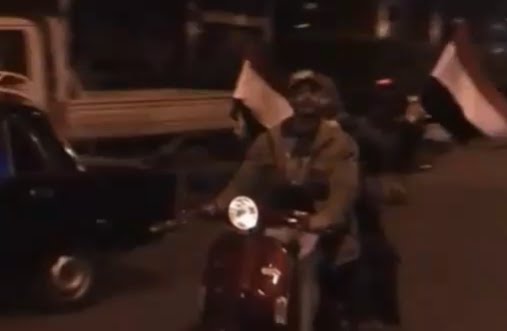
Egypts enjoys Mubarak ouster


(images from yesterday's video clip by the Associated Press; latest news here and here)

Egypt Right Here in America

The world has watched, spellbound, over the past few weeks as North Africans have taken to the streets to oust authoritarian and arbitrary regimes. But the recent unrest also provides an unfortunate reminder of the arbitrary and authoritarian treatment to which immigrants, even documented, are subject right here in America. The story of Samaa Kerba (pictured left), a lawful permanent resident who tried to return to the United States from Egypt with her 4-year old US citizen son last weekend offers insight into the excessive discretion placed in the hands of the government officials assessing the national security threat posed by non-citizens (as I've described in more detail here).
Kerba, who sought to return to her home in Los Angeles to flee the turmoil in Egypt, was stopped in transit in Amsterdam last Thursday, presumably because she had been placed on the FBI's No Fly List. An airline official told her "America does not want you to get on this flight. You can't enter the plane." When they told Kerba she and her son would be sent back to Cairo, she contacted the ACLU. Ahilan Arulanantham, who directs the immigrants' rights and national security program at the ACLU of Southern California, filed a temporary restraining order on her behalf, arguing that the government's actions violated both the immigration statute and the Due Process Clause. By the end of the day, the government agreed to let Kerba return to Los Angeles.
The government did not tell Kerba why she was on the No Fly List. She and her lawyers assume that it is because of her now deceased husband, Daniel Abdullah, an Egyptian-born U.S. citizen. Kerba became estranged from Abdullah in late 2009 after Abdullah travelled to Somalia to further his religious education. Kerba, who did not agree with Abdullah's decision, had limited contact with her husband afterwards. Abdullah was killed in Somalia last November, but the FBI continues to question Kerba at airports about her husband, most recently at Los Angeles International Airport upon her return last Saturday.
Kerba was lucky in that her lawyer was able to mount a speedy and successful challenge that enabled her to return to the US immediately. Unfortunately, that's not the case for many immigrants in her situation. In a recent example, in the UK last month, a Border Agency official was sacked for adding his wife's name to a list of terrorist suspects. After a trip to Pakistan to visit family, his wife was unable to return to the UK for three years. The dangerous combination of heightened discretion in the hands of government officials and minimal political power in the hands of non-citizens has led time and time again to such abuses in the United States and beyond. As I've written before, human rights law and standards should be incorporated into these processes to create an institutional culture that more appropriately balances national security and due process concerns. Until then, we'll have our own sphere of authoritarianism and arbitrariness, our own little bit of Egypt right here in America.


(credit to Ana P. Gutierrez, for the Orange County Register, for the photo of Samaa Kerba)

'Nuff said

(Taking context-optional note of thought-provoking quotes)

Because of our policy in supporting autocrats in that part of the world, ElBaradei's record of standing up to the U.S. in the lead-up to the Iraq invasion bolsters his credibility within Egypt, where he has not lived for many years.
-- Our colleague Bert B. Lockwood (below right), Editor-in-Chief of Human Rights Quarterly and Distinguished Service Professor of Law and Director of the Urban Morgan Institute for Human Rights at the University of Cincinnati, in an op-ed about Dr. Mohamed ElBaradei, Bert's colleague since both were at the Center for International Studies at New York University in the 1970s. Later the Director General of the International Atomic Energy Agency and a Nobel Peace Prizewinner, ElBaradei has emerged as a spokesperson for opponents of the current regime in Egypt. (credit for above left Reuters/Asmaa Waguih photo; video interview here.) Bert's op-ed provides welcome background on ElBaradei -- and acts as a complement to Scott Shane's thought-provoking New York Times piece, "America's Journeys With Strongmen."

Adrien K. Wing on Egypt

Our colleague Adrien K. Wing, who's been traveling to Egypt for more than a quarter-century, has just published an op-ed inspired by recent political events on which we've posted.
Appearing in the Des Moines Register, the essay's entitled "Before now, Egyptians never dreamed of anything like Iowa's caucuses." In it, Adrien (right) recalls that many of her Egyptian hosts had been fascinated with the U.S. Presidential race. That race begins every 4 years in Iowa, the state where Adrien is Bessie Dutton Murray Professor of Law at the University of Iowa College of Law.
Adrien's essay recounts discussions she had following Barack Obama's 2008 victory:

After the election of an African-American president, something that many Americans thought would never happen, I asked my Egyptian friends how they felt while watching our process. Could they imagine an Egyptian election in which Hosni Mubarak might not win? Needless to say, for them, it was beyond imagining.

Adrien continues with thoughts on the unveiling imagination of just that.

North African women's power?

'How many women are there?'
The question, heard on my commuter train yesterday, spoke volumes.
The question referred to this week's anti-government protests in Egypt. But it applied to all the ferment throughout North Africa and the Middle East this young but remarkable new year.
Mass demonstrations in Egypt, which yesterday prompted 30-plus-year-President Hosni Mubarak to attempt an LBJ.
Mass demonstrations as well, as IntLawGrrl Karima Bennoune has posted, in Algeria and Tunisia. Still more in Yemen and Sudan. Plans are on for Syria this weekend.
Then too there was yesterday's trying-to-get-in-front-of-events dismissal of the Cabinet of Jordan, another site of demonstrations, by its king.
The gender dynamics in countries like these are fraught. For that reason, a marker of the true democratic potential of these events is inherent in the commuter's question quoted above. Rephrased, it is:

Are women taking part, and if so, to what extent?

As to the 1st part of the question, it seems the answer is "yes."
Although most photos shows seas of men, within can be found islands of women. Women, young and old, with and without head coverings. (In addition to photos accompanying this post, see, e.g., here and here.) Other women reporting on the scene, via all the channels of social networking about which Hope Lewis posted earlier this week. (Some are local women. Some -- like Sonia Verma, tweeting for Toronto's Globe and Mail (far right), and Harriet Sherwood, tweeting for London's Guardian (near right) -- are not.)
As to the 2d part of the question?
How extensive is women's participation, now and for the long term?
The answer awaits further events. In the meantime, IntLawGrrls welcome readers' realtime comments and reports.


(Clockwise from top left: Suhaib Salem/Reuters photo of women at demonstration in Egypt appeared in a photo array yesterday at The New York Times' site; credit for Reuters/Muhammad Hamed photo of Jan. 28 demonstration in Amman, Jordan; credit for Jan. 30 BBC image of Sudan protest; credit for Jan. 15 cover photo from the Paris daily Libération, depicting a protest in Tunisia; credit for Hani Mohammed/AP photo of students chanting at Jan. 29 Yemen protest)

Egypt: From Social Networks to Social Movements


Stronger Signals: But From Whom?
Human Rights Watch is calling on the aid donor governments of the United States and the European Union to send strong signals urging the Egyptian government to stop using violence against its own people (see press release here.) Let’s hope any such signals work. The text of a Joint UK-France-Germany Statement appears here, the text of U.S. Secretary of State Hillary Clinton’s televised interview can be read here, and Friday evening’s statement by U.S. President Barack Obama is linked here. Of course, what matters most are the strong and clear signals being sent by the Egyptian people themselves.
Fluid Situation
The remarkable events in Egypt remain fluid. Thousands of peaceful protesters are demanding democratic change. BBC reports indicate that dozens of civilian protesters have been killed or injured by live fire from police and security forces, which Human Rights Watch condemns as violations of international law.
The protests have been predominantly peaceful and the mood among many ordinary Egyptians is cautiously celebratory and hopeful for the possibility of a democratic future.
There are isolated incidents of looting, particularly in poorer areas where there is no national army presence. Some civilian watch groups are forming to protect neighborhoods.
So far, the national army, made up of conscripted Egyptians from all classes, is believed to remain “neutral.” Many protesters see the domestic police forces as allied with the presidency of Hosni Mubarak.
Beyond Information Control
Whatever “signals” are being sent internationally through diplomatic channels, the Egyptian government has impose blackouts on other means of communication including the internet and cellular access (press release.)
As previous IntLawGrrls posts indicate, information technology and social networks have been central to communication and organizing in recent popular uprisings, mass disaster response, elections monitoring, and political dissent in places like Tunisia, Algeria, Haiti, Iran, Kenya, China, and elsewhere. (See our North Africa series and our posts here, here, here, and here.) Obviously, this is equally true in Egypt.
Ironically, and even necessarily, the rise of new media is occurring just as international old media is suffering from severe budget cuts, the withdrawal of foreign correspondents, and the closure of foreign desks. See, for example, this story about budget cuts to the World Service of the BBC.
From Social Networks to Social Movements
Protesters and their relatives and friends outside Egypt used social networks like Facebook and Twitter to provide up-to-the- minute information about where to assemble and about police crackdowns. They texted, e-mailed, and used Skype to let each other know that they were safe. Smartphones recorded both peaceful events and injuries to civilians on the streets; YouTube posted the video clips. Bloggers, of course, posted everything they could get their hands on. Others stayed glued to the Al-Jazeera television network for round-the-clock visual images of the protests and abuses.
Rather than change their behavior, some governments still try to hide by blocking the internet. But, as discussed on today’s broadcast of CNN’s “Reliable Sources,” creative bloggers, tweeters, e-mailers, social networkers, and even Old School ham radio operators the world over often find ways around government attempts to silence the peoples’ voices.
Knowing About Rights
Oddly, it seems that governments never learn that people already know that they have basic rights . They may not know the names of treaties or declarations or principles. They may not know how to translate international norms into domestic constitutional provisions or state and local statutes. They may not concern themselves with the best ways to balance state and private obligations or how to present legal arguments on the most effective remedies before judicial or administrative bodies. Hopefully, lawyers, judges, and legal scholars working at their direction can assist in that regard.
Still, ordinary people know when they are prevented from saying what is on their minds. They know when their children cannot attend school. They know when only certain favored classes benefit from government programs or from natural resources or job opportunities. They know when women, minorities, and children are scapegoated and mistreated. They know when an election is not really an election. They know when their homes are inadequate or non-existent. They know that they should not be beaten up, tortured, abused, raped, or shot.
Lawyers and human rights activists can, therefore, also work in solidarity with people to ensure that such rights are respected, protected, promoted, and fulfilled by powerful actors. This must be so not only for elites in palaces and high places in Geneva, Washington, London, and Paris, but also in small jail cells, apartments, and streetcorners in Cairo, Kingston, Beijing, Chicago, and Ciudad Juarez.
The Right to Self-determination, the Right to Know, and More
This latest version of a new social movement seems to have taken the international media and pundits by surprise. Yet the hopes and dreams of the people in the streets sound very familiar even though new and unpredictable technologies and consequences may surround them.
People throughout the region appear to be marching for the realization of the full range of familiar human rights (civil, political, economic, social, and cultural) outlined in the International Bill of Rights.
Nevertheless, I excerpt below only a few articles from the International Bill which seem to be particularly relevant to the Egyptian crisis at the moment.
Universal Declaration of Human Rights
Freedom of Opinion and Expression
Article 19
Everyone has the right to freedom of opinion and expression; this right includes freedom to hold opinions without interference and to seek, receive and impart information and ideas through any media and regardless of frontiers.
Freedom of Assembly
Article 20
(1) Everyone has the right to freedom of peaceful assembly and association…
The Right to Political Participation
Article 21
(1) Everyone has the right to take part in the government of his country, directly or through freely chosen representatives.
(2) Everyone has the right of equal access to public service in his country.
(3) The will of the people shall be the basis of the authority of government; this will shall be expressed in periodic and genuine elections which shall be by universal and equal suffrage and shall be held by secret vote or by equivalent free voting procedures.
The International Covenant on Civil and Political Rights
The Right to Self-determination of Peoples
Article 1
1. All peoples have the right of self-determination. By virtue of that right they freely determine their political status and freely pursue their economic, social and cultural development.
2. All peoples may, for their own ends, freely dispose of their natural wealth and resources without prejudice to any obligations arising out of international economic co-operation, based upon the principle of mutual benefit, and international law. In no case may a people be deprived of its own means of subsistence.
Helpful Resources on Egypt, Human Rights, and Internet Access
►Special Rapporteur on the Promotion and Protection of the Right to Freedom of Opinion and Expression (main page for UN expert)
►Egypt (Office of the High Commissioner for Human Rights country homepage)
►2009 Human Rights Report on Egypt (U.S. Department of State, 10 March 2010)
►Egypt (Human Rights Watch continuously updated page)
►"Egypt Women Blog For Their Rights" (BBC News, 18 March 2009)
►Association for Progressive Communications (coalition advocating for increased grassroots digital access)
My heartfelt thanks to Northeastern University School of Law Research Assistants Melissa Joyce and Gil Rochbert and to Northeastern University undergraduate Research Assistant Nicholas Martin.
(Photo: UN Photo. Boys working in carpet factory in Egypt)

Displaced

Probably not the ad placement this tourism company was hoping for.
News on Egypt -- the latest country in North Africa to take to the streets -- here, there, everywhere.

Building Barricades to Protection

This week, Israel began building a $372 million, 155-mile barrier, including electric fencing and surveillance technology, along its border with Egypt.
As other routes for African migrants (such as the sea route between Libya and Italy) have been blocked, the numbers of migrants crossing the border from Egypt has increased dramatically. In 2009, Israel reported just over 4,000 undocumented migrants; that number is up to over 10,000 so far this calendar year. While the Israeli government claims that the wall will prevent Islamic militants and human traffickers from reaching Israel, it will also significantly impair the ability of asylum seekers to reach Israel.
One might expect a nation of refugees for whom the UN Refugee Convention was created to have a generous policy towards those seeking protection within its borders. This new barrier, however, presents just one more instance of Israel's failures to live up to its responsibilities under the UN Refugee Convention.
Israel hosted just over 4,000 asylum seekers in 2009, most from Eritrea and Sudan, yet Israeli NGOs report that the country has granted asylum to fewer than 200 applicants since it ratified the UN Refugee Convention in 1954. As described further in this report by the Israeli NGO Refugees' Rights Forum, the asylum process in Israel is dysfunctional, often requiring a wait of over a year for an interview. Rather than legally recognizing refugees from Eritrea and Sudan -- nations to which the UNHCR forbids deportation because of the dangers facing those who return -- Israel instead grants most of them temporary protection, a much less stable status that does not permit them to work and allows the Israeli government to return them when the situation the refugees' home country improves.
Those who are less lucky are detained (currently, over 2000 asylum seekers) or worse. Under Israel's "Hot Return" policy, authorities expel undocumented migrants directly to Egypt without providing access to asylum procedures and without obtaining guarantees against refoulement from the Egyptian government. The U.S. State Department reports that Egyptian authorities detain some of these asylum seekers, holding them in conditions that violate international human rights standards, and refoules thousands of others back to Eritrea and Sudan.
Though Israel must take seriously threats to its national security, this nation of refugees does itself a disservice by building further barricades to protection for those fleeing persecution.

On September 28

On this day in ...
... 1995 (15 years ago today), a 400-page agreement to give control over a significant portion of the West Bank to Palestinians was signed by the leaders of Israeli and the Palestine Liberation Organization at a ceremony in the White House, as U.S. President Bill Clinton, Egyptian President Hosni Mubarak, and King Hussein of Jordan looked on. The signing leaders, Yitzhak Rabin and Yasser Arafat, then shook hands. Rabin would be assassinated in just 6 weeks; Arafat would die from natural causes 9 years later. As discussed in the press briefing at right by President Barack Obama, Secretary of State Clinton, and envoy George Mitchell, a new round of talks between current leaders of Israel and the Palestinian Authority was launched earlier this month.

(Prior September 28 posts are here, here, and here.)

On August 12

On this day in ...
... 30 B.C. (2,040 years ago today), the last head of the Ptolemaic dynasty that had ruled Egypt for the previous 2 decades, 30-something Cleopatra VII, died. Tradition -- reinforced by Shakespeare -- holds that she committed suicide by placing an asp to her breast. Recent research, however, suggests that she died from poison. Popular culture holds that her distress over the death of Roman lover Mark Anthony drove her to this measure -- but this BBC account suggests added, political reasons for her demise. (prior post) The site says of Cleopatra:
Whether she was as beautiful as was claimed, she was a highly intelligent woman and an astute politician, who brought prosperity and peace to a country that was bankrupt and split by civil war.


(Prior August 12 posts are here, here, and here.)

On July 23

On this day in ...
... 1952, revolution broke out in Egypt as military officers seized control. Within days, deposed King Farouk I would go into exile, the monarchy would be abolished, and a republic declared. General Mohammed Naguib was its 1st President, though he'd be replaced within 2 years by another officer, Gamal Abdel Nasser. The website of the National Archives of Egypt attributes the 1952 takeover to "[p]olitical, economic and social circumstances in Egypt during the late 1940s and the early 1950s, in addition to Egypt's defeat at war in Palestine (1948) ..." In curious contrast is this New York Times commentary, published as the coup unfolded; it treated the news as further evidence of "[t]he violent cross-currents of nationalism, religious fanaticism and revolt against political incompetence and corruption that sweep through the Middle East ..." Today remains a national holiday, Revolution Day, in Egypt.

(Prior July 23 posts are here, here, and here.)

Write On! ASIL/Egypt conference

(Write On! is an occasional item about notable calls for papers.) Papers are being sought that address the question "Are There Regional Approaches to International Law and Institutions?" -- title of a joint meeting, to be held June 20 & 21 at the Four Seasons Resort in Alexandria, Egypt, by the Egyptian Society of International Law and the American Society of International Law. The aim of the meeting, according to organizers, is "to build a dialogue at the broadest level and also with respect to pressing current issues and controversies, probing the normative commitments and structural features of contemporary international law."
Questions to be explored:
► What methodologies and frameworks are most useful in analyzing contemporary international governance?
► How might our assessments vary as a result of social or geographical location?
► What emerging terrains are created by current international dispute settlement processes – criminal tribunals, commercial arbitration, multilateral trade panels, domestic causes of action seeking remedies for international legal harms?
► What patterns or contrasts, harmonizations or fragmentations, exist across tribunals and regimes?
Exploration will occur in sessions on General International Law, International Law and Human Right, International Criminal Law and Transitional Justice, and International Economic Law. (credit for photo of pink granite sphinx in Alexandria)
Deadline is March 15, 2010 to send proposals of no more than 250 words to our colleague Chantal Thomas, Chair of ASIL's Africa Interest Group, at ct343@cornell.edu. Complete call for papers is here.

On February 3

On this day in ...
... 1830 (180 years ago today), ministers plenipotentiary for Britain, France, and Russia, signed Protocole* (No 1) tenu à Londres le 3 Février 1830, relatif à l’indépendance de la Grèce. Together with 2 additional instruments signed that day, this London Protocol established Greece as an independent monarchy within defined borders. The accords "were the outcome of the destruction" by Britain, France, and Russia "of the Ottoman and Egyptian fleets" the previous autumn at the Battle of Navarino, now Pylos, Greece. (credit for map of Greece circa 1830)

(Prior February 3 posts are here and here.)

On December 21

On this day in ...
... 1973, in Switzerland, diplomats from Egypt, Israel, and Jordan launched face-to-face negotiations. (A place was set for Syria, though it did not attend.) Noting that the peace talks had begun just 6 years after Arab leaders meeting in Khartoum, Sudan, had renounced all negotiation with Israel, The New York Times wrote:

Not for a quarter of a century--the entire history of modern Israel's existence--have the belligerents of the Middle East entered upon a solemn and direct encounter such as is now about to open in Geneva.

The meeting did not end in any agreement. (credit for photo of December 24, 1973, session) But it is viewed here as a forerunner to later, bilateral pacts.

(Prior December 21 posts are here and here.)
 
Bloggers Team