Showing posts with label Libya. Show all posts

What Role for the African Human Rights System in the Current Transformation of North Africa?

(My thanks to IntLawGrrls for the opportunity to contribute this guest post)

TUNIS - In Tunis last week, human rights defenders from across North Africa gathered to discuss the role that the regional African human rights system can play in the current transformation of North Africa. They were attending a workshop organized by the North African Litigation Initiative, a programme established by the Cairo-based Egyptian Initiative for Personal Rights.
Pictured above at far right, I work as the Legal Advisor for NALI, and it was our pleasure to host participants from Mauritania, Algeria, Tunisia, Libya, Egypt and Sudan.
We were also honored to have Justice Fatsah Ouguergouz (left), the Algerian Justice from the African Court on Human and Peoples’ Rights, join us for the three-day proceedings.
It was particularly exciting to hear from Justice Ouguergouz given the pioneering ruling issued by the African Court on March 25. In issuing this Order for provisional measures against Libya, the Court instructed Libya to
'immediately refrain from any action that would result in loss of life or violation of physical integrity of persons.'

The Court’s judgment is its first binding ruling issued against a State. It is an important intervention by the African human rights system in recent North African events.
Overall, however, the view of the workshop participants is that the response of the African system to developments in North Africa has, to date, been slow and lacking in conviction.
Indeed, the fact that African institutions mandated with protecting and promoting human rights have, on the whole, reacted in a limited manner to events in North Africa led a couple of human rights workers to criticize our decision to hold the Tunis workshop. One human rights lawyer from the United Kingdom wrote to me a couple of weeks ago and said that he felt that the workshop was “mistimed.” The African human rights bodies, he said, could only offer recourses that are “time consuming and typically remote from real effects in actual situations.” At this point, he said, it was necessary both in Tunisia and across North Africa to deal with immediate human rights abuses and the rebuilding of domestic institutions. “So why,” he asked, “was this topic chosen at this time and place?”
This question played through my mind on the first day when I arrived in Tunis and went downtown to have tea with a Tunisian activist. Tanks and barbed wire lined the streets (left and below). But the atmosphere was initially peaceful: a couple of women were even taking photographs of each other with the soldiers and tanks.
Suddenly, however, the mood changed. Police with batons and riot shields began chasing a group of young men and all of us sitting at the street-tables ran inside for cover. My Tunisian friend explained:
'The tensions are rising. There is frustration that reform is not occurring quickly enough. We have so much work to do and so many human rights abuses that must be remedied.'

This experience in downtown Tunis emphasized the continuing volatility in Tunisia – a volatility also evident in Egypt, where I live and work. It highlighted the fact that many immediate, domestic steps must be undertaken to ensure the creation of democratic societies fully removed from the past oppressive regimes.
Yet the fact that much work needs to be completed at the domestic level should not exclude engagement with the regional human rights system. On the contrary, it is especially important at this particular moment to consider how the new governments in Tunisia and Egypt (and also, let us hope, in Libya) can develop strong relationships with the African human rights system so that the new regimes actively promote, protect and fulfill the rights they pledged to uphold when they ratified the African Charter on Human and Peoples’ Rights.
The belief that the African human rights system has the potential to reinforce and strengthen domestic reform certainly influences the work of the EPIR, my organization in Cairo. Over the last few months, EIPR staff members have been working around the clock to document and address the continuing domestic human rights abuses in Egypt (see also here).
However, EIPR has also been looking beyond the domestic judicial realm and has been attempting to engage with the African human rights system. In partnership with Human Rights Watch and INTERIGHTS, we requested the African Commission to issue provisional measures to stop human rights abuses in both Egypt and Libya. In the case of Libya, such requests undoubtedly helped to motivate the African Commission to refer the situation to the African Court.
It is critical that North African human rights defenders take this type of proactive approach so that the African human rights system is encouraged to play a positive role in the transformation of North African societies. In his introductory remarks to our Tunis workshop, Justice Ouguergouz reminded us:
'The African Court cannot act, but can only react. Civil society therefore has a crucial role to play in creating an environment where it is possible for both the African Court and Commission to take steps to protect human rights.'

Following these remarks by Justice Ouguergouz, one Tunisian lawyer took me aside and showed me some of the scars that riddle his body following 8 years of imprisonment under the Ben Ali regime. The lawyer told me:
'I will fight for justice for these scars, and for the scars of thousands of other Tunisians. After this workshop I know that I needn’t stop at the domestic level. I will continue the fight for justice within the African system so my country can become a place of tolerance and dignity.'

It remains to be seen how exactly the African human rights system can play a role in the incredible societal transformations occurring across North Africa. One thing, however, is clear: North African human rights defenders are determined to seize this historical moment to ensure that human rights principles are respected. It is NALI’s mission to ensure they are given assistance to utilize every means available to achieve this goal, including recourse to the African regional system.


On April 5

On this day in ...
... 1986 (25 years ago today), a bomb exploded in a Berlin discotheque popular with American servicemembers and filled at the time with nearly 500 women and men. Killed as a result of the bombing of the club called La Belle were 2 U.S. soldiers and a Turkish woman. More than 200 persons, among them many Americans, were injured. (credit for photo of plaque commemorating tragedy) The bombing touched off tit-for-tat retaliations: an April 1986 U.S. bombing in Libya that claimed the life of the daughter of Libya's leader, Moammar Gadhafi, followed by the 1988 explosion over Lockerbie, Scotland, of a jet carrying many U.S. and British passengers. The incidents have garnered new scrutiny recently on account of Security Council-authorized action against Libya.

(Prior April 5 posts are here, here, and here, and here.)

Responsibility to protect, Libya to Japan

(Thanks to IntLawGrrls for the opportunity to contribute this guest post)

On September 16, 2005, the General Assembly of the United Nations adopted by consensus a resolution recognizing the responsibility to protect. The core of the responsibility to protect (R2P) as adopted by the both the General Assembly and Security Council was first embodied in Paragraph 138 of the 2005 World Summit Outcome declaration:
'Each individual State has the responsibility to protect its populations from genocide, war crimes, ethnic cleansing and crimes against humanity. This responsibility entails the prevention of such crimes, including their incitement, through appropriate and necessary means. We accept that responsibility and will act in accordance with it.'

Paragraph 139 continues:
'The international community, through the United Nations, also has the responsibility to use appropriate diplomatic, humanitarian and other peaceful means, in accordance with Chapters VI and VIII of the Charter, to help to protect populations from genocide, war crimes, ethnic cleansing and crimes against humanity. In this context, we are prepared to take collective action, in a timely and decisive manner, through the Security Council, in accordance with the Charter, including Chapter VII, on a case-by-case basis and in cooperation with relevant regional organizations as appropriate, should peaceful means be inadequate and national authorities are manifestly failing to protect their populations from genocide, war crimes, ethnic cleansing and crimes against humanity. We stress the need for the General Assembly to continue consideration of the responsibility to protect populations from genocide, war crimes, ethnic cleansing and crimes against humanity and its implications, bearing in mind the principles of the Charter and international law. We also intend to commit ourselves, as necessary and appropriate, to helping States build capacity to protect their populations from genocide, war crimes, ethnic cleansing and crimes against humanity and to assisting those which are under stress before crises and conflicts break out.'

The original, and broader, formulation of the responsibility to protect was included in the December 2001 report, The Responsibility to Protect, from the International Commission on Intervention and State Sovereignty (ICISS). As a basic principle, this report concludes that
'where a population is suffering serious harm, as a result of internal war, insurgency, repression or state failure, and the state in question is unwilling or unable to halt or avert it, the principle of non-intervention yields to the international responsibility to protect.'

For military intervention to be justified for human protection purposes, there must be:
'serious and irreparable harm occurring to human beings, or imminently likely to occur, of the following kind:
'A. Large scale loss of life, actual or apprehended, with genocidal intent or not, which is the product either of deliberate state action, or state neglect or inability to act, or a failed state situation; or
'B. Large scale ‘ethnic cleansing’, actual or apprehended, whether carried out by killing, forced expulsion, acts of terror or rape.'

In dealing with what should occur if the Security Council fails to fulfill its responsibility or to do so “in a reasonable time,” “alternative options” are:
► Consideration of the matter by the General Assembly in Emergency Special Session under the “Uniting for Peace” procedure; and
► Action within area of jurisdiction by regional or sub-regional organizations under Chapter VIII of the Charter, subject to their seeking subsequent authorization from the Security Council.
The ICISS report cautions:
'The Security Council should take into account in all its deliberations that, if it fails to discharge its responsibility to protect in conscience-shocking situations crying out for action, concerned states may not rule out other means to meet the gravity and urgency of that situation –and that the stature and credibility of the United Nations may suffer thereby.'
Speaking from the perspective of September, 2001, the Commission concludes that it is impossible to find a legal consensus regarding humanitarian intervention without UN authorization but does not rule out the possibility of such intervention. It is for this reason that the Commission remarks that when a state or states intervene because the UN has failed to do so, and the states or state do so successfully, there may be “enduringly serious consequences for the stature and credibility of the UN itself.”
This R2P framework illuminates current events in Libya and Japan.

Libya
There are four basic sanctions against Libya in Security Council Resolution 1973 (prior IntLawGrrls post); specifically, the:
► Assets freeze;
► No-fly zone;
► Arms embargo; and
► Protection of civilians.
The assets freeze is left to individual states and does not involve force, so can be set aside for purposes of this discussion. (credit for March 2011 Goran Tomasevic/Reuters photo of airstrike in Libya)
The resolution authorizes states to “take all necessary means” to protect civilians. On March 24, 2011, NATO announced that it would be assuming responsibility for the arms embargo and the no-fly zone, and a few days later for protection of civilians as well.
Resort to the responsibility to protect, although cited by some commentators in reference to the resolution, is unnecessary to the legal authority of the resolution. The three-prong authorization of force falls easily within prior precedents predicated on a finding of a threat to peace or breach of peace under Chapter VII and authorization of collectively authorized humanitarian intervention within the term threat to peace.
Indeed, the crimes precedent to triggering the responsibility to protect may or may not have been sufficiently established to give rise to the responsibility. This responsibility is triggered only when a state has “manifestly” failed to protect its population from acts constituting genocide, war crimes, ethnic cleansing, or crimes against humanity.
The resolution refers to Libya’s responsibility to protect the Libyan population, the “widespread and systematic attacks in the Libyan Arab Jamahariya” which “may amount to crimes against humanity,” and the referral to the International Criminal Court of these possible crimes. It does not declare that Libya has committed any of these crimes. More importantly, a state’s failure to protect its own population from these crimes triggers a collective responsibility to protect using peaceful measures. With respect to force, the formulation says only that the international community is “prepared” to use force in such circumstances, not that it has an affirmative responsibility to do so. In short, resort to force remains as discretionary in terms of Security Council authorization as it was when predicated on a threat to peace.

Japan
Earthquakes, tsunamis, and climate disruption have focused international attention on environmental disasters, natural and anthropocentric, and the ability of the global community to respond adequately and immediately. Whatever the magnitude of the humanitarian violations in Libya, they are eclipsed by the sheer magnitude of the earthquake, tsunami, and nuclear disaster in Japan. (credit for NOAA animated model)


UN officials, including Secretary-General Ban Ki-moon, have been quick to deny that the responsibility to protect applies to environmental crises, including specifically climate change and its consequences. Nevertheless, the four specified crimes can encompass situations of abusive governments or non-state actors inflicting environmental damage.
In Iraq, for example, Saddam Hussein's destruction of the natural resources essential to living conditions of the Marsh Arabs could have been considered “deliberately inflicting conditions of life calculated” to bring about the physical destruction of the group in whole or in part.
The ICISS formulation calls for intervention even by force whenever there is large-scale loss of life, coupled with a state’s unwillingness or inability to act.
The reality of a deteriorating planet and multiple environmental disasters, which even the most well-prepared and well-intentioned state may find itself unable to address, highlights the shortsightedness in the UN position that the responsibility to protect should not be formulated to address environmental disasters.
Is there a humanitarian disaster which calls for global responsibility to respond and protect, with or without a state’s consent, more than a convergence of environmental disasters?
There is a pressing need for reconsideration of the responsibility in an environmental context, before the next disaster occurs in a state that is unable, and unwilling, to act.


Go On! Web Seminar on Libya

The Program on Humanitarian Policy and Conflict Research at the Harvard School of Public Health will host on April 5 at 9:30 a.m. EST a Live Web Seminar on the “Crisis in Libya: Planning the International Response.” The presenters include:
  • Luis Moreno-Ocampo, Prosecutor, ICC;

  • R. Nicholas Burns, The Sultan of Oman Professor of the Practice of International Relations, Harvard Kennedy School of Government;

  • Sarah Leah Whitson, Executive Director, Middle East and North Africa Division, Human Rights Watch (below left);

  • Dirk Vandewalle, Associate Professor of Government, Dartmouth College; and

  • Philippa Thomas, Nieman Fellow, Harvard University & Foreign Correspondent, BBC (below right).
The seminar will examine the modalities through which the international community may respond to the ongoing crisis in Libya amid reports of violence, refugee and IDP flows, and other forms of instability. It will also touch on the legal, political and strategic dilemmas arising for the international community, especially in terms of prevention and mitigation of civilian harm.
Registration to the Live Web Seminar is free. Registration and background materials are available on the IHL Research Initiative Portal.
This Seminar is part of a series of monthly live web seminars on contemporary challenges and dilemmas in humanitarian law and policy. The seminars are tailored to practitioners and policy makers. Since 2008, these events have provided a source of interactive professional dialogue at a global level for thousands of professionals engaged in humanitarian action around the world.


Diane Amann talk at GW

Earlier this week, just before President Obama addressed the nation on why the US is involved in Libya, I was privileged to hear Diane Amann give a talk at an International Law Colloquium at George Washington University Law School. Her talk, which was titled The Value of Peace and the Crime of Aggression, explores the contradictions involved in pursuing "a peace envisioned as the absence of war, yet often pursued through military intervention."
She began by pointing out that, even though President Obama had received the Nobel Prize for Peace, the US is now involved in three different conflicts, and previewed how President Obama would defend the US role in Libya. Indeed, as I listened to Obama's speech that evening, Diane's talk repeatedly echoed in my mind; she had presciently predicted his approach almost to a word!
The main part of her talk focused on the crime of aggression. She reviewed the adoption in Kampala last year of amendments to the Rome Statute that define the crime and how the ICC will exercise its jurisdiction over this crime. She described the eloquence of Ben Ferencz, the 90-plus year old former Nuremberg prosecutor, at the Kampala conference as he urged development of the crime of aggression. In addition, she discussed the US approach to securing peace around the world, and then analyzed the proposed aggression amendments in the context of this history. It was fascinating to hear her explore the paradoxes in American policy as we use force to achieve peace and as we hail mechanisms for international accountability while seeking to avoid such accountability ourselves.
The article is part of a work in progress that I very much look forward to reading!


Bensouda on ICC prosecutions

(Delighted to welcome back alumna Margaret deGuzman, who contributes this guest post)

At last week’s annual meeting of the American Society of International Law, participants were treated to a luncheon presentation by Fatou Bensouda (right), Deputy Prosecutor of the International Criminal Court and candidate for the top job when Luis Moreno Ocampo’s term expires next year. Bensouda presented some opening remarks and then was ably questioned by our own Diane Marie Amann, as well as a few audience members.
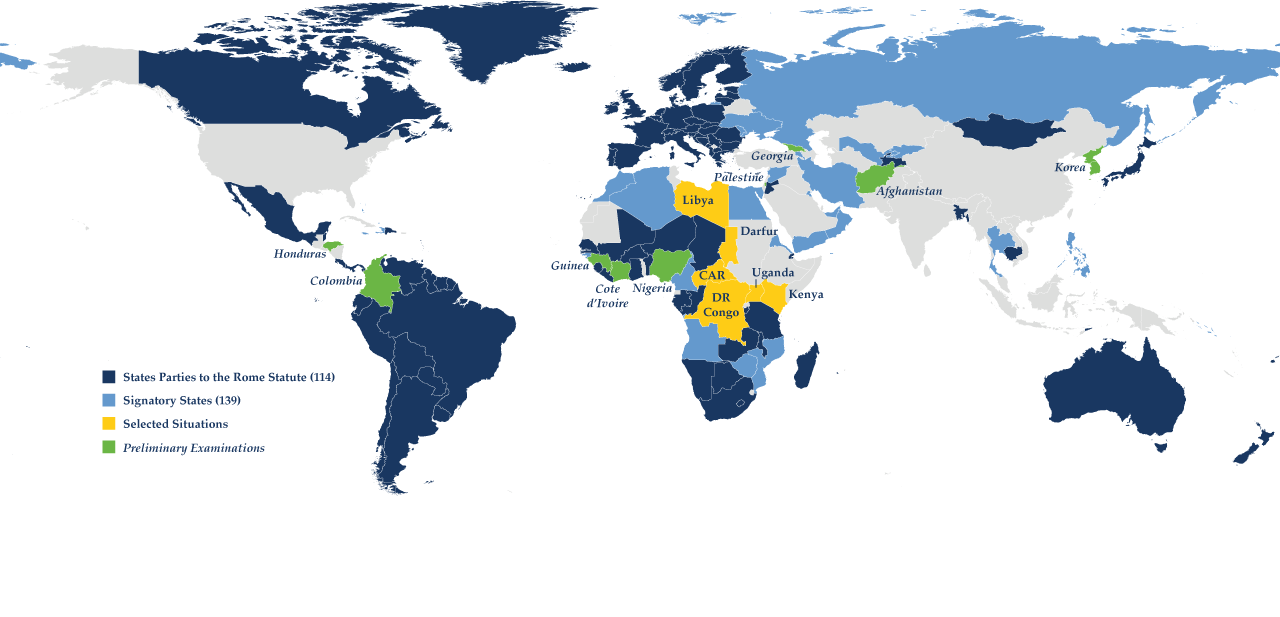
In her luncheon dialogue, which is available for web viewing here, Bensouda began by providing an overview of the work of the International Criminal Court Office of the Prosecutor (OTP) in the most active situations before the Court. Illustrating her talk was the map at bottom, which depicts the 114 states parties to the Rome Statute in dark blue, signatory states in light blue, selected situations in yellow, and preliminary examinations in green.
With regard to Libya, Bensouda stated that the OTP has notified those with formal and de facto authority, including Gaddafi, that their crimes will be investigated. The OTP has made clear that warning civilians to leave before attacking civilian areas does not relieve those involved of criminal responsibility. Bensouda emphasized that the OTP is seeking to be as transparent as possible in its dealings with the Libyan leadership.
In discussing the various situations, Bensouda revealed her vision of the ICC’s role in the global legal order: to prevent crimes through deterrence and by “sending messages” about the types of offenses the international community will not tolerate.
In discussing the OTP’s work with regard to the post-election violence in Kenya, for example, Bensouda asserted that the prosecutions will prevent crimes by “sending the message” that those who gain power by violence will be held accountable.
Similarly, she stated that the prosecution of those who killed peacekeepers in Sudan “sends an important message that the Court supports peacekeeping;” and the trial of Thomas Lubanga for recruiting child soldiers in the Democratic Republic of Congo “signals” the seriousness of that crime.
Bensouda also mentioned a situation in which the OTP is seeking to prevent crimes through incapacitation of key actors. She asserted that the arrest last fall of Callixte Mbarushimana, leader of the rebel group the Democratic Forces for the Liberation of Rwanda, was an effort to “destabilize” that organization and thus prevent crimes in Eastern Congo.
Bensouda also described the OTP’s approach to deciding which situations of alleged international crimes the ICC should investigate. The process of determining whether to pursue a formal investigation has become known as the “preliminary examination.”
Last October, the OTP issued a Draft Policy Paper on Preliminary Examinations. Bensouda promised that the final policy statement would be issued soon. Under Article 53 of the ICC Statute, the preliminary examination phase requires the OTP to determine whether a “reasonable basis” exists to proceed in a situation. This “reasonable basis” analysis has three components. It requires the OTP to assess whether:
► (1) crimes within the ICC’s jurisdiction appear to have been committed;
► (2) potential cases within the situation would be admissible (that is, they are sufficiently grave and meet the complementarity requirement that no State with jurisdiction is already acting in good faith); and
► (3) prosecution would not contravene the “interests of justice.”
The most interesting thing about the OTP’s draft policy on preliminary examinations is that it purports to disavow any role for prosecutorial discretion in deciding which situations to investigate. Whereas an earlier draft policy paper talked about the OTP “selecting” situations to investigate, the 2010 paper takes the position that the OTP must investigate if the statutory criteria are met.
Bensouda’s comments confirmed this approach. She noted that when the office began operations, Colombia and the Democratic Republic of Congo were the “gravest” situations within the Court’s jurisdiction; however, no investigation was opened in Colombia because that country was pursuing some national prosecutions. She also reiterated the OTP’s position that no investigation was undertaken with regard to the war crimes committed by British soldiers in Iraq because they were not sufficiently grave to be admissible.
As I have written elsewhere, this assessment seems mistaken – surely war crimes resulting in the deaths of even a small number of civilians are admissible before the ICC. The decision not to investigate the Iraq situation makes more sense if articulated as an exercise of the prosecutor’s discretion to focus on the most serious situations available. The OTP’s current policy, however, seems to preclude such an approach. Moreover, when questioned about the Court’s selection criteria, Bensouda seemed to admit that gravity is sometimes primarily a matter of numbers of victims – as in the Iraq situation – and at other times is conceived as relating more to the nature and impact of the crimes – in particular, what “signal” a particular prosecution is going to send.
Finally, Bensouda stated that there is no timeline for concluding preliminary examinations, and opined that the act of engaging in a preliminary examination itself has a deterrent impact. Echoing her current boss, Bensouda also emphasized that the OTP “has a legal mandate with no flexibility to adjust to political considerations,” a position that has been challenged recently by writers such as Bill Schabas and James Goldston.
Bensouda concluded that the ICC represents a “paradigm shift” from the Westphalian model of state sovereignty to one of international scrutiny and the rule of law.
In the questioning, Bensouda was pressed hardest on the problems associated with the ICC’s exclusive prosecution of African cases. She noted that such criticisms often overlook the victims of the African conflicts, and stated that she would “not apologize” for seeking to give victims a voice. She also sought to justify the emphasis on African situations by reference to the requirements of the ICC Statute, in particular the principle of complementarity. She noted that the OTP always encourages national proceedings but that unfortunately those are “not happening in Africa.” She reminded the audience that three of the African situations were referred by the affected governments themselves.
Nonetheless, when asked whether the ICC’s focus on Africa mitigates in favor of an African as the next prosecutor Bensouda, a native of the Gambia, was (unsurprisingly) supportive!


On March 31

On this day in ...
... 1992, following the explosions of 2 passenger jets in which hundreds of persons perished -- that of Pan Am Flight 103 in December 1988 (right) (photo credit) and of Union de transports aériens Flight 772 in September 1989 -- U.N. Security Council Resolution 748 was adopted by a vote of 10 ayes, 0 nays, and 5 abstentions. The resolution banned flights and arms sales to Libya, and called upon the North African state to renounce support for terrorism.

(Prior March 31 posts are here, here, here, and here.)

...and counting...

(Occasional sobering thoughts.) The United States, France, and other countries intervened militarily against Libya's government yesterday -- the 8th anniversary of the U.S.-led invasion of Iraq.
Participation by France (under President Nicolas Sarkozy) departed from the earlier script, when France (under President Jacques Chirac) vocally opposed intervention and so thwarted the United States' bid for U.N. Security Council authorization.
This time around, France pushed earlier and hard for a Security Council resolution. Some officials in the United States initially resisted. But as predicted nearly a month ago by our Opinio Juris colleague Chris Borgen, a tweet heard 'round the world (below center, by Anne-Marie Slaughter, who just finished a 2-year stint as the head of policy planning at the State Department) seemed to set the stage for support by Secretary of State Hillary Clinton and, eventually, President Barack Obama.


Five of the 15 Security Council states, including China, Russia, and Germany, abstained from Resolution 1973, which was billed as a no-fly resolution during early negotiations, yet included this paragraph authorizing greater intervention:
Protection of civilians
4. Authorizes Member States that have notified the Secretary-General, acting nationally or through regional organizations or arrangements, and acting in cooperation with the Secretary-General, to take all necessary measures, notwithstanding paragraph 9 of resolution 1970 (2011), to protect civilians and civilian populated areas under threat of attack in the Libyan Arab Jamahiriya, including Benghazi, while excluding a foreign occupation force of any form on any part of Libyan territory, and requests the Member States concerned to inform the Secretary-General immediately of the measures they take pursuant to the authorization conferred by this paragraph which shall be immediately reported to the Security Council; ....

Hence yesterday's Tomahawk strikes on Libyan air defense systems. Hence, too, today's complaint from an advocate of the no-fly zone -- the leader of the Arab League said "the use of force was excessive following an overnight bombing campaign that Libya claims killed at least 48 people."
The Security Council-endorsed actions are taking place in the name of civilians. A noble cause, yet one without end. If Libya, why not other countries whose governments harm their own people? To name one, why not CĂ´te d'Ivoire, site of tragic deaths amid months-long post-election violence?
As made explicit in the preamble to Resolution 1973, the Security Council resolved to act in the name of the fledgling doctrine of responsibility to protect. The Council's choice of Libya, to the exclusion of other global trouble spots, exposes once again the unsettling selection bias inherent in current conceptualizations of that doctrine.
Unsettling too is the notion of a 3d (or 4th, depending on how one counts AfPak) armed conflict in which the United States is engaged -- and in which civilian deaths are likely to occur even in the course of efforts to protect civilians.
While waiting to see what transpires on the Libyan front, it is due time to review casualties since our last post, 16 weeks ago, in the long-running conflicts in Afghanistan and Iraq.
► In Afghanistan, "[t]argeted killings of civilians in Afghanistan doubled" in 2010, according to an annual report recently issued by the United Nations. Specifically, there was "a 15 percent increase in the number of civilians killed to 2,777 -- continuing a steady rise over the past four years" in the nearly decade-old conflict.
The U.S. Department of Defense reports that in Afghanistan, coalition military casualties stand at 1,505 Americans, 360 Britons, and 507 other coalition servicemembers. That's an increase of 89, 15, and 23 casualties, respectively, in the last 16 weeks. The total coalition casualty count in the Afghanistan conflict is 2,372 service women and men.
► Respecting the Iraq War launched 8 years ago this weekend -- a milestone observed by scattered protests --Iraq Body Count reports that between 100, 051 and 109,318 Iraqi women, children, and men have died in the conflict in Iraq since the U.S.-led invasion in March 2003. That represents an increase of between 1,030 and 1,224 persons since 16 weeks ago. According to the U.S. Defense Department, 4,440 American servicemembers have been killed in Iraq, representing 11 servicemember deaths in the last 16 weeks. (As posted, U.S. troops are the only foreign forces remaining in Iraq.)

On March 20

On this day in ...
... 1956 (55 years ago today), Tunisia won independence from France, which had exercised a "protectorate" over the North African territory since 1881. In 1987 Tunisia's 1st President would be deposed by a successor -- Zine El Abidine Ben Ali -- who, as we've posted, ruled until his own people ousted him from office this past January. Protests have persisted since then, and the flight of refugees from conflict-ridden Libya has exacerbated the situation.

(Prior March 20 posts are here, here, here, and here.)

Libya inquiry appointed

'We have a tough task ahead but I will personally exert all my efforts to come up with an objective report that reflects the reality in Libya and convey the voices of victims of human rights violations.'

So stated Asma Khader (left) in an interview appearing in today's Jordan Times. (photo credit)
Khader, a lawyer, rights activist, and former government minister in Jordan, is among 3 persons whom the U.N. Human Rights Council has selected as a commission of inquiry into human rights violations in Libya. The commission was authorized earlier this month; its work will run in tandem with the investigation of the International Criminal Court undertaken pursuant to a separate resolution of the U.N. Security Council. (Prior IntLawGrrls posts available here.)
Chairing the Libya inquiry will be our colleague M. Cherif Bassiouni, Distinguished Research Professor of Law at Chicago's De Paul University and a human rights expert whose U.N. service includes chairing the Security Council's Commission to Investigate War Crimes in the Former Yugoslavia.
Completing the three-member panel will be Philippe Kirsch, the Canadian jurist who served as the ICC's 1st President, from 2003 to 2009.
The commission reportedly will begin its work in weeks, with an eye to reporting at the June session of the Human Rights Council.
In the Jordan Times interview, Khader framed her appointment itself as a milestone; in her words, it
'proves that we have eligible experts in the Arab world and that Arab and Jordanian women are qualified to take on such a tough responsibility along with their male peers.'

Libya and the Codification of the Crime of Aggression

There has been a lot of attention in the press and blogosphere about the worrisome situation in Libya, the (in)adequacy of the United States' and United Nations' response thereto, and the Security Council's unanimous referral of the situation to the International Criminal Court via Resolution 1970 on February 26, 2011. (See our prior coverage here). On March 2, 2011, the ICC Prosecutor announced that he had opened his investigation into potential crimes committed in Libya (see his press conference here). The President of the ICC, Judge Sang-Hyun Song (S. Korea), thereafter assigned the situation to Pre-Trial Chamber I.

In undertaking his investigation into international crimes committed since February 15th, the ICC Prosecutor has already signaled that he will consider the commission of crimes against humanity—a constellation of acts made criminal under international law when they are committed within the context of a widespread or systematic attack against a civilian population with knowledge of that attack. Certainly the strafing of peaceful demonstrators with helicopter gunships, the indiscriminate bombing of residential neighborhoods by warplanes (left, photo credit), and the unleashing of mercenaries and snipers on the ground collectively rise to the level of such an attack. This is especially true given that at least a thousand people have been killed and thousands others have been injured and/or displaced. (Although, I should note that Judge Kaul, who does not sit on this PTC, will likely disagree here).

War crimes may also have been committed, depending on whether the situation in eastern Libya or elsewhere rises to the level of armed conflict. Common Article 3, whose prohibitions are listed as war crimes in Article 8(2)(c) of the ICC Statute, is applicable once there is an "armed conflict" occurring "on the territory of" a party to the Geneva Conventions. The determination of when violence rises to the level of an "armed conflict" depends on the level of violence and the degree of organization of the parties. Certainly, the formation of an increasingly hierarchized and united armed opposition—populated and led by courageous defectors from Libyan armed forces' officer corps—goes far toward finding the necessary degree of organization. In addition, there are indications that swaths of the country are under the control of opposition groups forging a transitional government (the Libyan National Council) after governmental authorities collapsed.

All this implies that the heightened threshold of Protocol II, which also governs non-international armed conflicts and whose prohibitions may be prosecuted as war crimes pursuant to Article 8(2)(e) of the ICC Statute, may also be satisfied. That treaty becomes applicable when there is a non-international armed conflict

which take place in the territory of a High Contracting Party between its armed forces and dissident armed forces or other organized armed groups which, under responsible command, exercise such control over a part of its territory as to enable them to carry out sustained and concerted military operations and to implement this Protocol.
It explicitly excludes situations

of internal disturbances and tensions, such as riots, isolated and sporadic acts of violence and other acts of a similar nature, as not being armed conflicts.
There thus may be reasonable grounds to conclude the existence of a full-scale civil war, albeit an unbalanced one according to comparative military assessments, which would lay the groundwork for war crimes charges.

The crime of aggression is not immediately implicated in the Libyan situation. For one, the aggression amendments will not come into force until 2017 at the earliest. Moreover, the definition of the crime does not envision the act of aggression being committed by or against non-state actors that are not linked to a state. Nonetheless, the crime of aggression may bear on responses by the international community to the crisis in Libya.

Indeed, military options are not off the table, according to recent comments by President Obama and other world leaders. In particular, it has been proposed that the international community—or some subset thereof—should impose a no-fly zone over the country in an effort to prevent Libya's increasingly erratic and vicious leader from committing further violence against his own people. The Gulf Cooperation Council and Arab League reportedly support such a measure as do several vocal members of Congress. France and Britain are working on a draft Security Council resolution that would authorize such a response, although it is unclear if Russia and China would support this measure, which sounds of military intervention. This raises the prospects that a group of states, such as NATO or some other coalition of the willing, might move forward without explicit Council approval. This is exactly the kind of scenario that worries detractors of the codification of the crime of aggression in the ICC Statute.

The imposition of a no-fly zone without prior Council approval might run afoul of the prohibition of aggression as it has been defined in the aggression amendments. Article 8bis(2) of the amendments defines “act of aggression” broadly as
the use of armed force by a State against the sovereignty, territorial integrity or political independence of another State...
The amendments go on to list the following as acts of aggression:

a) The invasion or attack by the armed forces of a State of the territory of another State ...;
b) Bombardment by the armed forces of a State against the territory of another State or the use of any weapons by a State against the territory of another State; ...
d) An attack by the armed forces of a State on the land, sea or air forces, or marine and air fleets of another State...
Simply policing the no-fly zone might constitute a breach of Libya's territorial integrity, and for a no-fly zone to be effective, it would likely be necessary to neutralize Libya's air defense capabilities, which would involve air strikes. To be sure, such acts would only be prosecutable as the crime of aggression if they are deemed to constitute a "manifest" violation of the U.N. Charter with reference to their character, gravity and scale as per Article 8bis(1). As we have discussed at length in our crime of aggression series, no explicit exception was carved out for bona fide humanitarian interventions or for considerations of a state's motives for engaging in military action. However, important understandings adopted in Kampala imply that a consideration of the "consequences" of military action might shield actions from being characterized as an act of aggression. This would depend, of course, on the views of
  • the prosecutor (exercising prosecutorial discretion),
  • the Pre-Trial Division (which would need to approve aggression charges), and
  • the Security Council (which also acts as a filter to aggression charges and can defer prosecutions for a renewable period of a year).
In any case, the ICC is poised to enter the debate about such humanitarian interventions in the event that they occur once the aggression amendments are operational. The situation in Libya offers yet another potential scenario in which a deployment of armed force might be warranted and beneficial, but may not—for whatever reason—be able to garner Security Council approval.

The International Criminal Court and the Transformation of International Law? Maybe not quite yet . . .

(Delighted to welcome back alumna Leila Nadya Sadat, who contributes this guest post from Paris)

This week, unexpectedly, the Security Council voted unanimously to refer the situation in Libya to the International Criminal Court. That is cause for celebration; but celebration tempered with a strong dose of caution and even some real pessimism about the future.
On the plus side, the ICC is now becoming an international institution that is increasingly seen as a real partner in the maintenance of international peace and security.
Also, on the plus side, as Diane Marie Amann mentioned in an earlier IntLawGrrls post, the U.S. voted for the Resolution, rather than simply abstaining from vetoing it as the U.S. had done with Resolution 1593, referring to the Court the situation in Darfur.
Finally, I entitled this blog entry after my 2002 book of the same name, because one sees in the Resolution glimmers of change — that war is not the only answer to international conflict, that law is a relevant consideration in its resolution and that justice may be a possibility. That would be cause for celebration indeed.
At the same time, there are many worrisome elements in the Resolution which bode ill for the Court and for the referral. The Resolution itself retains two outrageous Bush-administration provisions (while admittedly discarding a third).
First, while deciding in paragraph 5 that the Libyan authorities “shall cooperate fully with and provide any necessary assistance to the Court and the Prosecutor” (even though Libya is not a State Party to the Court) the paragraph continues that “States not party to the Rome Statute have no obligation under the Statute. . . ” and, in paragraph 6, “decides, that national, current or former officials or personnel from a State outside [Libya] . . . shall be subject to the exclusive jurisdiction of that State” for any acts they may commit relating to UN operations in Libya. What an extraordinary display of double standards, given that several members of the Council who voted for the Resolution are not parties to the Rome Statute! Can a rule of law be a rule of law if it applies to some but not all?
The Resolution also provides that the ICC, not the United Nations, shall bear all the expenses relating to the referral, apparently as a way of appeasing the U.S. Congress, many of whose members continue to threaten the Court. So the United States and other non-Party States (China, India, Russia) are using — but not paying for — the ICC as a tool of coercive diplomacy. This is not good news.
Finally, the ICC is already struggling to convince African states that it is not a Court directed at them. The first four referrals all seemed quite sensible; but the fifth, the situation involving Kenya, was far more troublesome, given that the Prosecutor undertook the case on his own initiative, and at least some questioned whether it met the legal standards necessary in terms of subject matter jurisdiction, gravity and complementarity to be pursued at the ICC rather than in Kenya or otherwise. (Prior IntLawGrrls posts available here.) There were also serious questions raised at last summer's ICC Review Conference at Kampala as to whether it would not be preferable to see a proprio motu referral of the Colombia or Afghan situations. A sixth referral involving an African state — even in a case involving the clear commission of atrocities — may encourage the ICC’s detractors in Africa, and the double standards evinced by the Resolution’s text do not assist in this regard.
In the view of this writer, the Libya referral, in and of itself, is a good thing. The atrocities taking place as reported in the media seem clearly to warrant ICC intervention. But the failure of the great powers to fully support this Court, and to use it cynically when and as they please, rather than committing their money, time, energy and political support to helping it grow strong and endure, feeds the perception that this Court is not about justice, but about power, undermining its legitimacy. Thomas Friedman recently opined that President Barack Obama’s 2009 speech in Cairo (above) strengthened the case for democracy in the Arab world as he led others through the salutary example of his own life. Would that Obama will find the same courage to champion the International Criminal Court, and to show the world that Americans believe in accountability too.


(Cross-posted at Leila's An American in Paris blog)


Beyond Libya's Borders

With the news media focused on the estimated 180,000 migrants who have fled Libya in the past 10 days, it's a good moment to think about the impact of the crisis on migrants beyond Libya's borders.
To start, the unrest has cut off a World Food Programme supply chain used to feed tens of thousands of Darfurian refugees and displaced persons in Chad. Food supplies that had for many years been discharged at Benghazi port in Libya have been re-routed to Port Sudan, at great expense and with questionable outcomes, as aid convoys now must traverse Darfur to reach their intended recipients. The consequences for these refugees are sure to be dire.
The instability in Egypt may also obstruct efforts to protect migrants in that country against human rights abuses. Haaretz reports that the number of African migrants entering Israel through Egypt has dropped precipitously in the wake of the crisis. The concern here, given credible and frequent reports of abuse of African migrants by smugglers in the Sinai, is that many Africans are being held for ransom in the desert. Though the Egyptian government's efforts to crack down on organized crime in the Sinai were insufficient at the best of times, the current political situation has likely resulted in even less attention being paid to the situation of these migrants.
On the development side of the ledger, the loss of migrant worker jobs throughout North Africa will have global repercussions. The widely reported repatriation of many foreign workers in Libya will result in the loss of millions of dollars of remittances. Not only current but also future jobs are at stake; the Philippines and Indonesia have suspended the sending of their national workers to Bahrain, Egypt, Libya, and Yemen. Though this decision is to be applauded, it will come at great cost to families in need of remittance funds.
While there's much to celebrate in North Africa, and much assistance needed for migrants escaping the unrest in Libya, the impact of the crisis on migrants and their families will be felt far beyond Libya's borders.


ICC referral: sweet, or bittersweet?

Some sweet irony in the referral of the Gadhafi regime to the International Criminal Court.
As watchers of the Hague-based court at left well know, longtime Libyan leader Moammar Gadhafi long has been a thorn in the ICC's side.
It's not just that Libya's not a party to the Rome Statute of the ICC. As the map below shows, the same holds true of many of its Arab neighbors -- and of certain very large states to the west and east of Libya.
Rather, Libya's particularly prickly relation to the ICC stems from Gadhafi's efforts to exerts his brand of leadership on the African continent.
To cite an example: It's no accident that, as Pittsburgh Law Professor Charles Jalloh, among others, has noted, the 1st African Union resolution condemning the ICC's pursuit of Sudanese President Omar al-Bashir occurred at a meeting in Libya.
Libya also is a member of the Human Rights Council, formed in 2006 as a means better to promote human rights within U.N. member states and throughout the world.
The Human Rights Council broke with Libya on Friday, as we posted here and here. Reports that the Gadhafi regime had ordered aerial attacks and street-thuggery against its own, unarmed civilians compelled the Council unanimously to urge the General Assembly to suspend Libya's U.N. membership.
Last night the Security Council went giant steps further, not only imposing sanctions and an arms embargo, but also referring the Libya matter to the ICC. The vote was unanimous among the T-10 and P-5 alike: ICC nonparty China put aside earlier-reported misgivings, and the United States, another ICC nonparty, openly supported an ICC referral for the 1st time ever.
Here're the pivotal paragraphs of Security Council Resolution 1970 (February 26, 2011):

The Security Council,
....
Acting under Chapter VII of the Charter of the United Nations, and taking measures under its Article 41,
....
ICC referral
4. Decides to refer the situation in the Libyan Arab Jamahiriya since 15 February 2011 to the Prosecutor of the International Criminal Court;
5. Decides that the Libyan authorities shall cooperate fully with and provide any necessary assistance to the Court and the Prosecutor pursuant to this resolution and, while recognizing that States not party to the Rome Statute have no obligation under the Statute, urges all States and concerned regional and other international organizations to cooperate fully with the Court and the Prosecutor;
6. Decides that nationals, current or former officials or personnel from a State outside the Libyan Arab Jamahiriya which is not a party to the Rome Statute of the International Criminal Court shall be subject to the exclusive jurisdiction of that State for all alleged acts or omissions arising out of or related to operations in the Libyan Arab Jamahiriya established or authorized by the Council, unless such exclusive jurisdiction has been expressly waived by the State;
7. Invites the Prosecutor to address the Security Council within two months of the adoption of this resolution and every six months thereafter on actions taken pursuant to this resolution;
8. Recognizes that none of the expenses incurred in connection with the referral, including expenses related to investigations or prosecutions in connection with that referral, shall be borne by the United Nations and that such costs shall be borne by the parties to the Rome Statute and those States that wish to contribute voluntarily; ...

The resolution zeroes in on Gadhafi -- and what little seems left of his regime in the wake of many ministerial defections to the antigovernment side.
Worth noting: The caveat concerning a national of a nonparty state present at the scene by authorization of the Council -- presumably, a person deployed as a U.N. peacekeeer. Evidence that such a person took part in criminal behavior must be referred to the state of nationality; by the terms of ¶6, absent a waiver the ICC would have no jurisdiction over such a malefactor. (Thanks to our colleague Kevin Jon Heller (his OJ post here) for pointing out my initial, erroneous interpretation.)
Some cause for concern: The foisting of the costs of ICC investigation onto the ICC and states that choose to contribute. That provision in ¶8 hints at certain lingering reluctances, and serves to remind of the deaf ear that the Security Council has turned to the ICC Prosecutor's pleas for aid in effecting the arrest of international fugitive and still-incumbent President Bashir.
It's to be hoped the Security Council's newfound spine will translate into helping the ICC as it endeavors to respond responsibly to yet another weighty referral. It's also to be hoped that the ICC will rise to the "test," to quote our colleague William Schabas; that is, it "must inspire confidence in its ability to provide a meaningful, significant and above all prompt response to the crisis."
If not, today's irony may prove more bitter than sweet.


(Credit for 2010 map indicating: in grey, states, like Libya and China, that have neither signed nor ratified the ICC Statute; in orange, states, like the United States, Sudan, and Russia, that at one time signed but never ratified; and in green, full states parties to the ICC Statute. Though slightly out of date -- it shows 111 rather than the current 114 states parties -- the map is accurate with regard to the states discussed in this post, a version of which is cross-posted at The Huffington Post.)


Libya: Global Condemnations of Human Rights Violations


As the World Watches...
As posted here by IntLawGrrls Diane Marie Amann and Jaya Ramji-Nogales, human rights abuses against Libyan civilians include indiscriminate use of force, killings, forced disappearances, and violations of the rights to freedom of thought, conscience, opinion, peaceful assembly, and access to information. (Pictured, flag displayed by protesters and diplomats that have denounced the current government.) The reported violations have outraged observers around the world. This, despite a virtual communications blackout that has made monitoring events in Tripoli and other parts of the country difficult.
The United Nations Security Council meets today to discuss the potential imposition of sanctions under UN Charter Chapter VII authority.
Condemnations of Colonel Moammar Gaddafi's actions have included those from diplomats previously associated with his government.
A selected list of international statements and developments appears below.
The world is watching, but the people of the world must do more than watch. They must also insist that their leaders take appropriate joint actions to end the killings and other abuses.
UN Condemnations
►“Libya: Gaddafi in Spotlight at UN Security Council,” BBC News, 26 February 2011
►“UN Resolution on Libya ‘possible’ on Saturday, Security Council President,” Xinhua, February 26, 2011
►“Ban Calls on UN Security Council to Consider Immediate Steps to Stop Killings in Libya,” 25 February 2011
►"UN Human Rights Council Recommends Suspension of Libya," UN Office of the High Commissioner for Human Rights, 25 February 2011
►“15th Special Session on the situation of human rights in the Libyan Arab Jamahiriya” Human Rights Council, 25 February 2011 (links to statements by High Commissioner Navi Pillay, a statement on behalf of all “special procedures” mandate-holders, statements by member countries, and civil society, and Human Rights Council resolution calling for the suspension of Libya from membership on the Council)
Regional Condemnations
►“AU Peace and Security Council on the Situation in Libya,” EuropAfrica.net, 24 February 2011
►Josh Rogin, “Over 200 Arab Groups Call for Libya No-fly Zone,” The Cable, Friday, February 25, 2011 (includes full texts of statements by prominent Arab intellectuals and by NGOs)
►“Request for Provisional Measures to the African Commission on Human and Peoples’ Rights” INTERIGHTS, 24 February 2011
(joint request by Egyptian Initiative for Personal Rights, Human Rights Watch, and INTERIGHTS)
Condemnations by Libyan Diplomats
► “UN Ambassador’s Tears for Libya,” BBC News, 26 February 2011 (UN Ambassador Mohamed Shalgham’s denunciation of the government’s use of force against civilians and request for Security Council action.)
►“Libyan Arab League delegation renounces Gaddafi,” Reuters, 25 February 2011
Legal Standards
►Libyan Arab Jamahiriya Homepage, UN Office of the High Commission for Human Rights
(listing Libya's international human rights obligations under treaty law and customary international law)
►“Responsibility to Protect,” UN General Assembly Resolution A/RES/63/309, 4 September 2009 (International Coalition ofn the Responsibility to Protect webpage) (link to resolution and history of UN efforts to ennumerate the responsibilities of the international community when states fail to protect civilians within their borders or affirmatively harm them.)
News Updates
►Live: Libya Revolt, BBC News (continuously updated page, visited 26 February 2011).

On February 26

On this day in ...
... 2004, in an executive order, U.S. President George W. Bush lifted some restrictions on contacts with Libya. The move followed Libya's December 2003 pledge to dismantle its nuclear technology program, which was aimed at producing nuclear weapons but which was far from that goal at the time of the pledge. The New York Times reported:

The partial lifting of sanctions enables Libya, which produces about 1.4 million barrels of oil every day, to draw back American oil companies. A number of American companies, including Marathon Oil, Occidental Petroleum and ConocoPhillips, have already indicated interest in exploring new relationships with Libya.

Any such relationships are again in doubt given bloody attacks by leader Moammar Gadhafi (prior posts) on Libyan civilians who are demonstrating against his regime. Indeed, current events are provoking not only new U.S. sanctions, but also questions about the wisdom of the thawing of U.S.-Libya relations that began on this day in 2004.


(Prior February 26 posts are here, here, here, and here.)
 
Bloggers Team