Showing posts with label Margaret deGuzman. Show all posts

Expressive case selection at the ICC

(Delighted to welcome back alumna Margaret deGuzman, who contributes this guest post)

My draft article, Choosing to Prosecute: Expressive Selection at the International Criminal Court, tackles what I believe to be the most important challenge facing the ICC: how to allocate its extremely scarce resources.
The ICC has the mandate to “end impunity” for serious international crimes around the world but the resources to prosecute only a handful of cases each year. Unlike national courts, which are expected to prosecute most serious crimes in their jurisdictions, the ICC’s legitimacy is closely tied to perceptions of relevant audiences that it is choosing to prosecute the “right” crimes and the “right” defendants. Audiences who believe that the Court’s prosecutor, and to a lesser extent its judges, are focusing on the “wrong” cases tend therefore to challenge the legitimacy of the institution itself. Such challenges have been discouragingly common recently with African voices in particular speaking out against the ICC and one state – Kenya – threatening to withdraw from the regime.
The debate in academic and advocacy circles about how the ICC should select cases for prosecution currently centers on the role politics plays and should play in such decisions. Critics charge that the ICC operates as a tool of powerful states, while the Court’s Prosecutor, Luis Moreno-Ocampo (right), claims that his decisions are apolitical. Some scholars argue for greater recognition of the inevitable influence of politics on selection decisions, while others advocate selection procedures they believe will insulate the Court from such influence. Those who focus on process, including Moreno-Ocampo, suggest that selection decisions can enhance the Court’s legitimacy if they adhere to recognized principles of good process such as independence, impartiality, objectivity, and transparency. In particular, Moreno-Ocampo and others claim that cases can be selected according to an objective analysis of their relative gravity.
This focus on politics and process has obscured what I believe to be the chief threat to the ICC’s legitimacy: the absence of generally accepted goals and priorities for the institution’s work.
My article therefore seeks to reframe the debate about prosecutorial and judicial selection discretion at the ICC. The article demonstrates that the ICC’s selectivity threatens its legitimacy not merely because of the potential for improper political influence, but more centrally because the international community failed to endow the institution with clear objectives to guide its actions. To enhance the Court’s legitimacy, therefore, its supporters must engage in a constructive dialogue about the institution’s role in the global legal order.
In additional to highlighting the inadequate theoretical underpinnings of the Court’s work, the article proposes that the ICC adopt an expressive approach to selecting situations and cases to investigate and prosecute.
I do not dismiss the other dominant philosophies of international criminal law: retribution, deterrence, and restorative justice. Rather, I accept that each of these may help to justify particular prosecutions under particular circumstances.
At the same time, I argue that the primary basis for selecting one case or situation over another should not be the relative desert of perpetrators, which is extremely hard to measure, or the prospects for deterrence, which are virtually unknowable, or even the extent to which different individuals or communities are in need of restoration.
Rather, the best use of the ICC’s very limited resources is to focus on situations and cases that maximize the ICC’s expression of global norms. Such expression provides the best hope of contributing to crime prevention, not by deterring potential criminals, but by transforming the normative framework in which decision-makers operate.
My expressive prescription raises questions about what global norms the ICC should seek to express and in what order of priority – questions to which there are no clear answers, just as there is no international consensus about the goals of the Court more broadly. Nonetheless, I argue that by focusing explicitly on an expressive agenda, ICC selection decision makers can stimulate a dialogic process where norms are expressed, feedback received and, ideally, consensus builds over time.
To some extent this is already happening. When the ICC has pursued cases involving child soldiers or crimes against peacekeeper or election-related violence, it has sent a message that members of the international community – or at least the parties to the Rome Statute – feel strongly about condemning and preventing those types of crimes. In fact, as I posted, in a recent address at the American Society of International Law annual meeting, ICC Deputy Prosecutor Fatou Bensouda (left) highlighted this messaging function of the Court.
In my view, this focus on norm expression should be more explicitly adopted as a selection strategy, replacing the current pretense that selections are made based on objective assessments of relative gravity or the consistent application of other criteria.
An expressive agenda has at least the potential to enhance the ICC’s legitimacy by highlighting the value choices that undergird the Court’s selection decisions, inviting relevant audiences to react, and permitting the Court to adjust its choices to reflect the values of its constitutive communities.
The article is in draft form, and I welcome comments!

Bensouda on ICC prosecutions

(Delighted to welcome back alumna Margaret deGuzman, who contributes this guest post)

At last week’s annual meeting of the American Society of International Law, participants were treated to a luncheon presentation by Fatou Bensouda (right), Deputy Prosecutor of the International Criminal Court and candidate for the top job when Luis Moreno Ocampo’s term expires next year. Bensouda presented some opening remarks and then was ably questioned by our own Diane Marie Amann, as well as a few audience members.
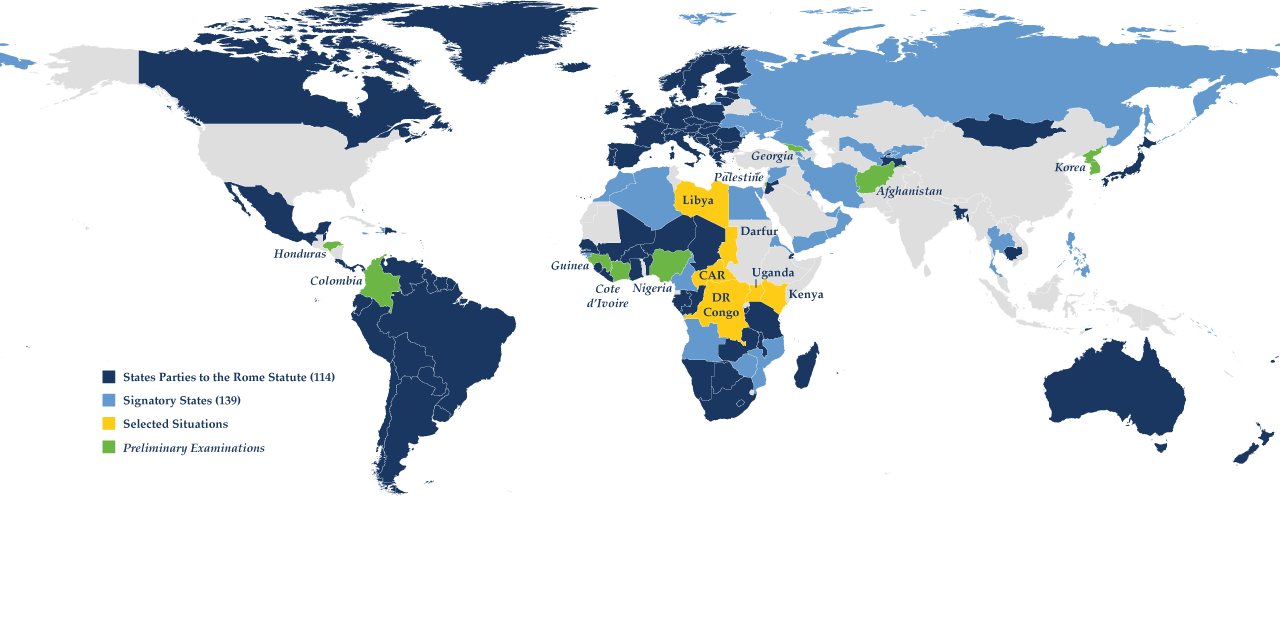
In her luncheon dialogue, which is available for web viewing here, Bensouda began by providing an overview of the work of the International Criminal Court Office of the Prosecutor (OTP) in the most active situations before the Court. Illustrating her talk was the map at bottom, which depicts the 114 states parties to the Rome Statute in dark blue, signatory states in light blue, selected situations in yellow, and preliminary examinations in green.
With regard to Libya, Bensouda stated that the OTP has notified those with formal and de facto authority, including Gaddafi, that their crimes will be investigated. The OTP has made clear that warning civilians to leave before attacking civilian areas does not relieve those involved of criminal responsibility. Bensouda emphasized that the OTP is seeking to be as transparent as possible in its dealings with the Libyan leadership.
In discussing the various situations, Bensouda revealed her vision of the ICC’s role in the global legal order: to prevent crimes through deterrence and by “sending messages” about the types of offenses the international community will not tolerate.
In discussing the OTP’s work with regard to the post-election violence in Kenya, for example, Bensouda asserted that the prosecutions will prevent crimes by “sending the message” that those who gain power by violence will be held accountable.
Similarly, she stated that the prosecution of those who killed peacekeepers in Sudan “sends an important message that the Court supports peacekeeping;” and the trial of Thomas Lubanga for recruiting child soldiers in the Democratic Republic of Congo “signals” the seriousness of that crime.
Bensouda also mentioned a situation in which the OTP is seeking to prevent crimes through incapacitation of key actors. She asserted that the arrest last fall of Callixte Mbarushimana, leader of the rebel group the Democratic Forces for the Liberation of Rwanda, was an effort to “destabilize” that organization and thus prevent crimes in Eastern Congo.
Bensouda also described the OTP’s approach to deciding which situations of alleged international crimes the ICC should investigate. The process of determining whether to pursue a formal investigation has become known as the “preliminary examination.”
Last October, the OTP issued a Draft Policy Paper on Preliminary Examinations. Bensouda promised that the final policy statement would be issued soon. Under Article 53 of the ICC Statute, the preliminary examination phase requires the OTP to determine whether a “reasonable basis” exists to proceed in a situation. This “reasonable basis” analysis has three components. It requires the OTP to assess whether:
► (1) crimes within the ICC’s jurisdiction appear to have been committed;
► (2) potential cases within the situation would be admissible (that is, they are sufficiently grave and meet the complementarity requirement that no State with jurisdiction is already acting in good faith); and
► (3) prosecution would not contravene the “interests of justice.”
The most interesting thing about the OTP’s draft policy on preliminary examinations is that it purports to disavow any role for prosecutorial discretion in deciding which situations to investigate. Whereas an earlier draft policy paper talked about the OTP “selecting” situations to investigate, the 2010 paper takes the position that the OTP must investigate if the statutory criteria are met.
Bensouda’s comments confirmed this approach. She noted that when the office began operations, Colombia and the Democratic Republic of Congo were the “gravest” situations within the Court’s jurisdiction; however, no investigation was opened in Colombia because that country was pursuing some national prosecutions. She also reiterated the OTP’s position that no investigation was undertaken with regard to the war crimes committed by British soldiers in Iraq because they were not sufficiently grave to be admissible.
As I have written elsewhere, this assessment seems mistaken – surely war crimes resulting in the deaths of even a small number of civilians are admissible before the ICC. The decision not to investigate the Iraq situation makes more sense if articulated as an exercise of the prosecutor’s discretion to focus on the most serious situations available. The OTP’s current policy, however, seems to preclude such an approach. Moreover, when questioned about the Court’s selection criteria, Bensouda seemed to admit that gravity is sometimes primarily a matter of numbers of victims – as in the Iraq situation – and at other times is conceived as relating more to the nature and impact of the crimes – in particular, what “signal” a particular prosecution is going to send.
Finally, Bensouda stated that there is no timeline for concluding preliminary examinations, and opined that the act of engaging in a preliminary examination itself has a deterrent impact. Echoing her current boss, Bensouda also emphasized that the OTP “has a legal mandate with no flexibility to adjust to political considerations,” a position that has been challenged recently by writers such as Bill Schabas and James Goldston.
Bensouda concluded that the ICC represents a “paradigm shift” from the Westphalian model of state sovereignty to one of international scrutiny and the rule of law.
In the questioning, Bensouda was pressed hardest on the problems associated with the ICC’s exclusive prosecution of African cases. She noted that such criticisms often overlook the victims of the African conflicts, and stated that she would “not apologize” for seeking to give victims a voice. She also sought to justify the emphasis on African situations by reference to the requirements of the ICC Statute, in particular the principle of complementarity. She noted that the OTP always encourages national proceedings but that unfortunately those are “not happening in Africa.” She reminded the audience that three of the African situations were referred by the affected governments themselves.
Nonetheless, when asked whether the ICC’s focus on Africa mitigates in favor of an African as the next prosecutor Bensouda, a native of the Gambia, was (unsurprisingly) supportive!


Go On! ASIL interest group session: Fact-Finding in International Criminal Law

(Go On! is an occasional item on symposia and other events of interest)

International criminal law enthusiasts should be sure to attend this week's ICL Interest Group meeting at the American Society of International Law (ASIL) Annual Meeting in Washington, D.C., about which we've already blogged here, here, here, and here. The Interest Group, of which I am honored to serve as Co-Chair, is hosting a panel discussion with IntLawGrrl guest/alumna Nancy Combs, Cabell Research Professor of Law at William and Mary Law School (left), about her book, previously featured here. The session is Friday, March from 10:45 am - 12:15 p.m. (Full annual meeting schedule here).
The session will be moderated by the group's other Co-Chair, Linda Malone, the Marshall-Wythe Foundation Professor of Law and Director of the Human Security Law Program at William & Mary Law School (right).
The panel will also feature prepared remarks and questions by discussants drawn from our interest group, including:
►David Crane, Professor of practice at Syracuse University College of Law and founding Chief Prosecutor of the Special Court for Sierra Leone (left).
► Hannah Garry, Director of USC Law's International Human Rights Clinic (right).
► IntLawGrrl guest/alumna Saira Mohamed, Assistant Professor of Law at Berkeley Law (below left).
► Dan Saxon, formerly a legal officer of the Office of the Prosecutor of the International Criminal tribunal for the Former Yugoslavia and now a lecturer at Cambridge University.
► IntLawGrrl guest/alumna Meg DeGuzman, Assistant Professor of Law at Temple University Beasley School of Law (right).
► Marko Oberg, Legal Officer at International Criminal Tribunal for the Former Yugoslavia.

Women & ICL series continues

Our readers will recall that this past fall, IntLawGrrls co-sponsored our first symposium along with the American Society of International Law, on the topic of Women and International Criminal Law (full program here).
The papers featured at this symposium will be published in a special 2011 issue of the International Criminal Law Review dedicated to Judge Patricia M. Wald, an IntLawGrrls guest/alumna. Some papers were commissioned; others we received through a global call to papers. We've been spotlighting these papers over the last few months -- Diane Marie Amann's post on her paper is here, Jaya Ramji-Nogales' post on hers is here, and that of Dina Francesca Haynes, Naomi Cahn, and Fionnuala Ní Aoláin is here. Jaya's paper, also subject of an earlier post, is now available online here. We'll continue to post these as we move into the production phase.
Today we feature another paper, posted below, by Margaret deGuzman (left), another IntLawGrrls alumna and Assistant Professor of Law at Temple University Beasley School of Law in Philadelphia. We're delighted to welcome her back. Meg's paper engages the question of "Why Should International Courts Prosecute Sex Crimes?" The full paper, available here, is part of her ongoing work on gravity as an organizing principle for international criminal law and prosecutorial discretion.

Should international courts prosecute sex crimes?

(Alumna Margaret deGuzman contributes this guest post, another in our series of posts on essays forthcoming in "Women and International Criminal Law," a special issue of the International Criminal Law Review)

As a participant in the IntlawGrrls-sponsored roundtable on “Women in International Criminal Law” last October, I presented my research on the philosophical justifications for giving priority to the prosecution of sex crimes at international criminal courts. My essay will appear in our special issue under the title "Why Should International Courts Prosecute Sex Crimes?"
International courts face serious resource constraints; they can generally prosecute only a small fraction of the serious crimes within their jurisdictions. Ever since the Nuremberg and Tokyo trials, where sex crimes were largely ignored or prosecuted under such euphemistic labels as “failure to respect family honor,” feminists have advocated for more resources to be allocated to the prosecution of sex crimes. (credit for 2009 photo of ICTY in session)
International prosecutors have heeded this call to some extent, placing greater emphasis on the investigation and prosecution of sex crimes. Selecting sex crimes for prosecution, however, often requires leaving other serious crimes unpunished, including crimes that resulted in death.
Some have questioned the appropriateness of such selection decisions. For example, in a 2002 article (pp. 310-11) a former trial attorney at the International Criminal Tribunal for the former Yugoslavia, Peggy Kuo (right), reported that in the early days of the ICTY investigators made comments like:

'I’ve got ten dead bodies, how do I have time for rape?'
Moreover, empirical evidence from various national fora indicates that many people consider sex crimes less serious than crimes resulting in death.
My symposium contribution represents an initial effort to provide philosophical justification for giving priority to sex crime prosecutions at international courts.
The essay examines each of the primary philosophical bases advanced for international prosecution to determine how they inform decisions whether to give priority to sex crime. These are:
► Retribution,
► Deterrence,
► Expressivism, and
► Restorative justice.
The essay finds that retribution and deterrence support such selections at least some of the time, and that expressivism and restorative justice provide an even stronger foundation for giving priority to sex crimes.
► While notions of retributive desert are complex, an argument can be made that at least some perpetrators of sex crimes are more deserving of punishment than some perpetrators of crimes resulting in death. In particular, killing crimes are sometimes unintentional, while sex crimes generally involve purposeful conduct.
► Prosecution of sex crimes may also provide greater deterrent benefits at least under some circumstances, such as when conviction for such crimes carries a greater stigma than conviction for illegal killings.
► Most importantly, there is a significantly greater need for the international community to express condemnation of sex crimes than of killing crimes, which are already considered serious violations of moral norms throughout the world.
► Finally, restorative justice goals may be more achievable in the context of sex crimes than crimes involving killing, because the immediate victims remain alive and thus potentially able to participate in and benefit from restorative processes.
I will be further developing the ideas sketched in this essay in the context of "Thematic Investigation and Prosecution of International Sex Crimes," a conference in which IntLawGrrl Valerie Oosterveld also will take part. Cosponsored by Yale University and the Belgium-based Forum for International Criminal and Humanitarian Law, the conference will be held in Cape Town, South Africa, on March 7-8, 2011. A publication will follow.

Read On! ICL Handbook

(Delighted to welcome back alumna Nadia Bernaz, who contributes this Read On! guest post)

It is a pleasure to come back on IntLawGrrls (my previous posts are here and here) to announce the Routledge Handbook of International Criminal Law, published last month.
I co-edited the Handbook with Professor William A. Schabas, Director of the Irish Centre for Human Rights at the National University of Ireland, Galway. We wanted to put together a book that would provide a reader new to the area with an introduction to this fast-growing area of law. But, at the same time, we did not want to edit a mere textbook. The whole idea was to give our contributors (who include a number of IntLawGrrls besides myself: Fiona de Londras, Leila Nadya Sadat, Margaret deGuzman, and Nancy Amoury Combs) the freedom to express their opinions, as scholars, on the areas they were asked to write on.
We are really happy with the results as our contributors have manage to deliver concise, original and provocative papers which, combined together in one single publication, make this book greatly relevant to students, scholars and practitioners working in the field.
Here is the table of contents:

1. Introduction, William Schabas and Nadia Bernaz

Part 1: Historical and Institutional Framework
2. Trial at Nuremberg, Guénaël Mettraux
3. The Tokyo Trial, Neil Boister
4. The Trials of Eichmann, Barbie and Finta, Joseph Powderly
5. The Ad Hoc International Criminal Tribunals: Launching a New Era of Accountability, Michael P. Scharf and Margaux Day
6. The International Criminal Court, David Scheffer
7. Hybrid Tribunals, Fidelma Donlon

Part 2: The Crimes
8. Genocide, Paola Gaeta
9. Crimes Against Humanity, Margaret M. deGuzman
10. War Crimes, Anthony Cullen
11. Aggression, Nicolaos Strapatsas
12. Terrorism as an International Crime, Fiona De Londras
13. Drug Crimes and Money Laundering, Robert Cryer

Part 3: The Practice of International Tribunals
14. Understanding the Complexities of International Criminal Tribunal Jurisdiction, Leila Sadat
15. Admissibility in International Criminal Law, Mohamed M. El Zeidy
16. Defences to International Crimes, Shane Darcy
17. Participation in Crimes in the Jurisprudence of the ICTY and ICTR, Mohamed Elewa Badar
18. International Criminal Procedures: Trial and Appeal Procedures, Hakan Friman
19. Sentencing and Penalties, Nadia Bernaz
20. State Cooperation and Transfers, Judge Kimberley Prost
21. Evidence, Nancy Combs

Part 4: Key Issues in International Criminal Law
22. The Rise and Fall of Universal Jurisdiction, Luc Reydams
23. Immunities, Rémy Prouvèze
24. Truth Commissions, Eric Wiebelhaus-Brahm
25. State Responsibility and International Crimes, Eric Wyler and León Castellanos-Jankiewicz
26. International Criminal Law and Victims’ Rights, Carla Ferstman
27. Amnesties, Louise Mallinder
28. International Criminal Law and Human Rights, Thomas Margueritte
29. Conclusion, William Schabas and Nadia Bernaz

Guest Blogger: Nancy Amoury Combs

It's IntLawGrrls' great pleasure to welcome Dr. Nancy Amoury Combs (right) as today's guest blogger.
Nancy's the 2009-11 Cabell Research Professor of Law at William & Mary Law School in Williamsburg, Virginia, which she joined in 2004 and where she teaches Human Rights Law, International Criminal Law, International Law, and Transitional Justice, all areas on which her scholarship touches. In her guest post below, Nancy discusses her just-published book on fact-finding by international criminal tribunals.
She holds a Ph.D. from Leiden University in the Netherlands. Her J.D. is from the University of California-Berkeley, where she served as Articles Editor of the California Law Review and received the Thelin Marrin prize for graduating 1st in her class. After law school, she clerked for Judge Diarmuid O'Scannlain, U.S. Court of Appeals for the Ninth Circuit, and U.S. Supreme Court Justice Anthony M. Kennedy. She also earned a Certificate from the Hague Academy of International Law, and served as legal advisor at the Iran-United States Claims Tribunal in The Hague. Nancy was graduated summa cum laude with a B.A. in philosophy from the University of Portland in Oregon.
Along with IntLawGrrls' guests/alumnae Margaret deGuzman, Yvonne McDermott, and Jenia Iontcheva Turner, Nancy serves as an Expert Researcher for the Netherlands-based International Expert Framework on International Criminal Procedure. Our distinguished guest/alumna, Judge Patricia M. Wald, belongs to the IEF Advisory Board.
Before attending university, Nancy owned and operated a chimney sweeping business.
Heartfelt welcome!

Crimes Against Humanity: Enduring normative debates and doctrinal ambiguities

(Delighted to welcome back alumna Margaret deGuzman, who contributes this guest post on Crimes Against Humanity, her forthcoming book chapter)

In the summer of 1997 I was a law student intern in the Legal Advisor’s Office of the Office of the Prosecutor of the International Criminal Tribunal for Former Yugoslavia at The Hague (left). When I walked in the door I was told that my assignment was to try to figure out the mens rea of crimes against humanity.
I was shocked. Surely someone who had spent more than a semester studying criminal law had already worked out the elements of crimes against humanity?
I spent a fascinating summer digging through cases decided under the Nuremberg Charter and under Control Council Law No. 10, as well as anything else I could get my hands on that might provide some insight into the mental element of crimes against humanity. (In those days, international criminal law sources were not as readily available as they are now.)
In the end I wrote an article that argued, as much on policy grounds as on precedent, that the mens rea should involve knowledge of the connection between the individual’s inhumane act and the broader attack against a civilian population. I like to think that my work influenced the adoption of the knowledge standard in the Appeals Chamber's July 15, 1999, Judgement in Tadić, but who knows?
I have remained fascinated with crimes against humanity ever since. One of the things that most intrigues me is that although this category of crimes is supposed to represent, along with genocide, the worst of the worst that people can do to each other, there is still lots of uncertainty about the elements and the theoretical underpinning of the legal prohibition.
The persistent uncertainties surrounding crimes against humanity are due in part to their historical origins. After World War II, the Allies wanted to prosecute the Nazis for crimes committed within German territory, conduct that was not covered by the laws of war. They found purchase for the new crime in the Martens Clause, part of the preamble of the Hague (IV) Convention Respecting the Laws and Customs of War on Land. Invoking natural law protections for any lacunae in the laws of war, the Martens Clause provides that persons not otherwise covered in the 1907 Convention
remain under the protection and rule of the principles of the law of nations, as they result from the usages among civilized peoples, from the laws of humanity, and the dictates of the public conscience.
From those cryptic words, a new category of international crimes was born, without any diplomatic negotiations, drafting committees, or treaty ratifications.
This unusual history is only partly to blame for the persistent uncertainties that surround crimes against humanity, however. Figuring out what is meant by “crimes against humanity” has simply proven tricky for many smart people over the years. The International Law Commission debated the matter for decades, diplomats pondered the elements when they drafted the statutes of the ad hoc tribunals, and the international community spent years trying to work out a definition for the Rome Statute of the International Criminal Court. Nonetheless, the ICC definition, in some ways the culmination of all these efforts, remains controversial in a number of important respects. Furthermore, the normative justification for crimes against humanity continues to engage deep thinkers, as illustrated by a number of recent treatments by such scholars as David Luban, Larry May, and Richard Vernon.
I explore some of the persistent normative debates and doctrinal ambiguities that surround crimes against humanity in my contribution to the forthcoming The Routledge Handbook on International Criminal Law, edited by our colleagues, William A. Schabas and IntLawGrrl guest/alumna Nadia Bernaz. My chapter first provides an overview of the evolution of the definition of crimes against humanity, before surveying the competing normative visions of this category of crimes. A number of justifications have been advanced for international jurisdiction over crimes against humanity, including that they:
► Threaten international peace and security;
► Are particularly grave and thus shock the conscience of humanity;
► Involve actions of states or state-like organizations that would otherwise go unpunished; and
► Target groups rather than isolated individuals.
I conclude that ultimately none of these approaches provides a clear and complete rationale for categorizing certain inhumane acts as crimes against humanity.
I then explore the doctrinal debates that necessarily result from the lack of clear philosophical underpinnings for these crimes:
► What constitutes a widespread or systematic attack?
► Is a policy required and, if so, what kind?
► What defines a “civilian population”?
► What connection is required between the individual inhumane act and the broader attack?
Last year, a group of experts on crimes against humanity gathered in St. Louis at the invitation of Washington University Law Professor Leila Nadya Sadat, an IntLawGrrls guest/alumna, to consider a Convention on Crimes Against Humanity. Initially, there was much discussion of how to “improve” the definition for inclusion in the Convention. Ultimately, however, the organizers decided it would be unwise to create a new definition that would compete with that included in the Rome Statute and simply adopted the latter’s definition. Perhaps the debates about crimes against humanity will now subside, and the Rome Statute’s definition as interpreted by the court will gain general acceptance.
In the meantime, I’ll continue to be intrigued.

Kampala pix redux

From alumna Margaret deGuzman, a guest post contributing more photos -- captions at bottom -- from the just-ended the ICC Conference, another in IntLawGrrls' series on events in Kampala)


At left, Benjamin B. Ferencz, former U.S. prosecutor before the post-World War II International Military Tribunal at Nuremberg and indefatigable advocate for international criminal justice, adance.

IntLawGrrl Beth Van Schaack (right), who served as academic advisor with the U.S. delegation in Kampala, and me.


Conference session; at far left of the podium is Prince Zeid Ra'ad Zeid al-Hussein of Jordan, Chair of the Working Group on the Crime of Aggression.

Preparation for whitewater rafting on the Nile River. Familiar faces include Case Western Law Professor Michael P. Scharf, 3d from left. To his right: Robert Petit, former International Co-Prosecutor at the Extraordinary Chambers in the Courts of Cambodia; me; Duke Visiting Assistant Law Professor Noah Weisbord; and Professor William A. Schabas, Director of the Irish Centre for Human Rights in Galway.

ICC Review Conference Considers When International Criminal Adjudication Makes Sense

(Delighted to welcome back alumna Margaret deGuzman, who contributes this guest post to IntLawGrrls' series on the ICC Kampala Conference)

KAMPALA, Uganda – As others have noted in this series of posts, the Review Conference of the Rome Statute of the International Criminal Court under way in Kampala has devoted two days to a “stocktaking” exercise. The idea was to review key issues in international criminal justice with a view to enhancing the work of the ICC. These portions of the Review Conference felt a lot like law school panel discussions, except that after the panelists spoke they took questions and comments from representatives of states and NGOs rather than from faculty and students.
Two of the stocktaking topics – peace/justice and complementarity – raised important issues relevant to the advisability and legitimacy of ICC prosecutions in particular situations. The peace/justice discussion considered whether it is ever appropriate for justice to be sacrificed in the name of peace (a question on which IntLawGrrl Kathleen A. Doty yesterday posted with regard to Darfur). The complementarity session, meanwhile, concerned how the task of providing justice should be allocated between international and domestic courts. This post provides some details on those discussions, as well as a few thoughts about what was left out.

Peace/justice
Setting the stage for the peace/justice session was Human Rights Watch Executive Director Kenneth Roth session, who questioned the common assumption that peace and justice are in conflict. As evidence of a more harmonious relationship between these goals, Roth cited the claim by Richard Goldstone, the 1st Prosecutor of the ad hoc tribunals, that the Dayton peace accord would not have been possible without the issuance of arrest warrants of Bosnian Serb leaders Radovan Karadžić and Ratko Mladić. Roth also noted that many believe the peace process was assisted both by the indictments of Charles Taylor, then President of Liberia, by the Special Court for Sierra Leone and by the ICC’s pursuit of the leaders of the Lord's Resistance Army in Uganda. In contrast, Roth noted that amnesty agreements have often failed to secure lasting peace, citing Sierra Leone and Angola as examples.
David Tolbert, formerly Deputy Chief Prosecutor at the International Criminal Tribunal for the former Yugoslavia and now head of of the International Center for Transitional Justice, opined that amnesty is now entirely off the table in conflict resolution efforts. Tolbert noted, however, that prosecutors must be sensitive to the political situation on the ground – although politics can’t impact the decision to prosecute they might affect the timing of prosecutions.
Providing a somewhat different perspective was James LeMoyne, an experienced conflict mediator. LeMoyne emphasized the importance of stopping conflict to advance human rights. He recalled the threats of commanders with whom he negotiated in El Salvador that any talk of prosecution would lead directly to more killing. LeMoyne also pointed out that many of the people with whom he negotiates have not even heard of the ICC.
Barney Afako, a Ugandan human rights lawyer, cautioned that the LRA arrest warrants may have prevented an agreement to end the war, while Cambodian activist and Khmer Rouge survivor Youk Chhang asserted that victims always want justice. State representatives also expressed conflicting views on the peace/justice debate.
While many delegates, including representatives of Congo and the European Parliament, emphasized the importance of justice for peace, China expressed the view that the two sometimes conflict and that the ICC should be more careful about exercising jurisdiction in ongoing conflicts. Iran also spoke out in favor of amnesty in some circumstances.
In sum, the discussion surfaced many of the crucial and controversial elements of the peace/justice debate. At the same time, there was little concrete discussion of the ICC’s contributions thus far to peace or justice, and even less progress in resolving how the ICC should approach the selection of situations and cases in ongoing conflicts.
Complementarity
The complementarity discussion was kicked off by U.N. High Commissioner for Human Rights Navanethem Pillay (right) (prior posts), who raised concerns about the ICC’s policy of focusing on the most responsible perpetrators. Pillay worried that the policy may leave states with the impression that national prosecutorial obligations are also limited to high-level perpetrators. Pillay also expressed the hope that the ICC’s complementarity regime would promote respect for the ability of states to conduct trials for international crimes; in so doing, she stated that the ad hoc tribunals have not always shown such respect. She implicitly criticized decisions by which the International Criminal Tribunal for Rwanda (of which she previously served as President, before becoming an ICC Judge and, subsequently, the High Commissioner) refused to transfer cases to the domestic courts, refusals based on the ICTR's conclusion that domestic trials would not meet international standards.
Two national court judges involved in adjudicating international crimes provided interesting perspectives from the national justice side. Justice Dan Akiiki-Kiiza of Uganda, along with a Congolese counterpart, emphasized that their national systems are cooperating with the ICC. Interestingly, however, Justice Kiiza also stated that the Ugandan system is both willing and able to try all suspected criminals – in effect, saying that Uganda doesn’t really need the ICC.
The state interventions after the panel were mostly pledges of support for the notions that states must take primary responsibility for prosecuting international crimes and reiterations of the view that it is appropriate for both the ICC and states to assist one another in developing such capacity.
Some states, including Spain and Germany, seemed concerned about the ICC’s policy of “positive complementarity,” whereby it seeks to assist states in bolstering their ability to prosecute international crimes. These states were concerned that positive complementarity implies some additional bureaucracy outside the confines of the Rome Statute. The German representative noted that complementarity is a negative concept in Article 17 of the Rome Statute, which precludes the ICC from intervening when a relevant state is doing so genuinely.
At the end of the session, however, ICC Prosecutor Luis Moreno-Ocampo (near left) addressed the issue. (photo credit) In Moreno-Ocampo's view, the statutory basis for “positive complementarity” is not Article 17, but rather Article 93(10), which authorizes the Court to provide various kinds of assistance to states. Moreno-Ocampo assured the states that no additional bureaucracy is needed for such assistance, since the ICC already possesses the relevant information and materials by virtue of its regular activities.
Finally, the ICC President, Judge Sang-Hyun Song (above, far left), said that in his view, complementarity is either a rule of customary international law or close to attaining that status.
In all, the complementarity discussion was fairly uncontroversial – certainly less so than peace/justice. Like in the earlier session, though, there were little in the way of concrete suggestions concerning the appropriate relationship between the ICC and national courts. A number of difficult issues remained just under the surface of the conversation – including whether it is appropriate for the ICC to prosecute “self-referred” cases if the referring government is perfectly capable of doing the job itself.
Conclusion
In all, the Review Conference’s stocktaking on peace/justice and complementarity was more interesting for its tone than its content. Unlike at the 1998 Rome Conference, where many states expressed skepticism or even outright hostility toward the notion of international criminal justice, those that spoke in Kampala were overwhelmingly supportive of the enterprise. Even non-party states that have traditionally portrayed the ICC as an improper assault on sovereignty were careful to couch their comments as broadly supportive of international justice efforts.
Anyone who was hoping for a more substantive and introspective discussion of the legitimacy of ICC action was, however, disappointed.

IntLawGrrls at ICC Review Conference

(1st in a series of IntLawGrrls' Kampala Conference posts)

The Review Conference of the Rome Statute of the International Criminal Court will open in Kampala, Uganda, this Monday, May 31, and will run until June 11. This is the first Review Conference since the adoption of the Rome Statute in 1998.
As detailed in the provisional work programme, the Review Conference will begin with a plenary, with statements by the current UN Secretary-General, Ban Ki-moon, and the former UN Secretary-General, Kofi Annan. The President of Uganda will also make a statement, as will the President of the ICC’s Assembly of States Parties, the President of the ICC and the ICC’s Prosecutor. These statements will be followed by country statements, including statements by many of the 111 States Parties.
On the evening of June 1, discussions on the subject of IntLawGrrls' year long series, the crime of aggression, begin. So do discussions on the Belgian proposal to amend the war crimes provision to prohibit the use during non-international armed conflict of certain weapons (poison or poisoned weapons; asphyxiating, poisonous or other gases; and bullets which expand or flatten easily in the human body).
On June 2 and 3, there will be a series of stocktaking exercises, evaluating the ICC’s past, current and future impact on victims and affected communities, as well as peace and justice issues, and the application of the ICC’s complementarity and cooperation provisions.
The remainder of the Review Conference will be dedicated to discussions on the crime of aggression, the Belgian proposal, strengthening the enforcement of sentences, and the potential deletion of article 124 (a transitional provision permitting a State to make a declaration excluding the Court’s jurisdiction over war crimes for seven years).
In addition, civil society will hold a wide variety of side-events, taking place in the People’s Space. One that we are very excited about is the Women’s Court, to be held all day on June 1. It is being organized by the Hague-based nongovernmental organization Women’s Initiatives for Gender Justice. At this Court, women’s rights activists from Uganda, Democratic Republic of the Congo, Central African Republic and Sudan will speak. (image at right courtesy of the Women's Initiatives)
Approximately 2000 state representatives and representatives of nongovernmental and intergovernmental organizations will be in attendance at the Review Conference, including a number of our very own IntLawGrrls. Beth Van Schaack will serve as an academic advisor on the U.S. delegation (her series posts here, here, and here), and yours truly will serve as an academic advisor on the Canadian delegation. A new guest, Pam Spees, and I will contribute a joint post (here) in honor of our recently departed friend and mentor, Rhonda Copelon, now an IntLawGrrls foremother. In addition to this and to my solo posts (here, here, here, here, and here), IntLawGrrls planning to post from Kampala include Susana SáCouto (here) and Kelly Askin. Another new guest, our colleague Leila Nadya Sadat, will contribute posts from Kampala (here and here). IntLawGrrls guests/alumnae will also contribute: Margaret deGuzman will post about the stocktaking complementarity discussion (here; additional post here), and Brigid Inder, Kate Orlovsky and Katrina Anderson will blog (here) about the Women’s Court and other Women’s Initiatives events. From elsewhere in our world, IntLawGrrl Diane Marie Amann will write "Against aggression" (here; additional posts here, here, here, here, here, and here), IntLawGrrl Kathleen A. Doty will discuss the ICC and Darfur (here), and IntLawGrrl Naomi Roht-Arriaza will examine a "positive complementarity" analogue in Guatemala (here). Guests/alumnae Pamela Yates will tell us about the work Skylight Pictures is doing in Kampala (here), and Carmen Márquez-Carrasco will provide a post (here) about the European Union and the ICC.
More soon from (and about) Kampala ...

The Grrls Are Back in Town

Today, Temple Law School hosts the annual Junior International Law Scholars' (JILS)conference. Created several years ago by Rosa Ehrenreich Brooks and Tim Wu, JILS aims to establish a safe space for its members, pre-tenure and recently tenured international law scholars, to present and receive feedback on works-in-progress, as well as to ensure friendly dialogue between scholars with differing perspectives on the international law project. Today's workshop, organized by IntLawGrrls guest blogger Chimène Keitner (right) and David Zaring, and hosted by yours truly, will also be something of an IntLawGrrls reunion.
There's lots of good stuff on the agenda, including IntLawGrrl Karen Bravo's (left) paper Transborder Labor Liberalization: A Path to Enforcement of the Global Social Contract for Labor?, in which she argues from an economic as well as a human rights perspective that free movement of labor is appropriate and necessary in our globalized economy. We also have IntLawGrrl Hari Osofsky (below right) presenting her work-in-progress, Diagonal Climate Regulation: Implications for the Obama Administration, in which she examines the potential approaches the new administration could take to enforcing environmental regulations and presents a path forward aimed at integrating entities at different levels of government, thereby creating cross-cutting synergies; IntLawGrrl Rebecca Bratspies will comment. I will also discuss my current paper, Resolving Dueling Legitimacies: Buying Into Transitional Justice Mechanisms, which critically examines currently favored transitional justice mechanisms and suggests a new approach that emphasizes the needs and interests of societies afflicted by mass violence; IntLawGrrl guest blogger Meg DeGuzman will comment. Finally, IntLawGrrl guest blogger Jenia Iontcheva Turner (left) will present an early stage work-in-progress on ethical issues faced by international criminal defense lawyers, and how professional responsibility should be regulated in internationalized criminal courts. And of course, there are plenty of other interesting papers on topics as varied as the right to property in international law, federalism and foreign affairs, and comparative employment discrimination law. Wish you were here!

Guest Blogger: Margaret deGuzman

It's IntLawGrrls' great pleasure today to welcome Margaret deGuzman (left) as a guest blogger.
A Ph.D. candidate at the Irish Centre for Human Rights, National University of Ireland-Galway, Margaret's an Adjunct Professor of International Human Rights Law at Georgetown University’s Institute for International Law and Politics. Previously, she practiced criminal defense law for six years at a San Francisco firm. While attending Yale Law School, from which she earned her J.D. in 1999, Margaret served as a legal advisor to the Senegal delegation at the U.N. Diplomatic Conference of Plenipotentiaries on the Establishment of an International Criminal Court, held in Rome in summer 1998, and at subsequent Preparatory Commission meetings.
Margaret's publications focus on international criminal law issues -- not only the ICC, but also crimes against humanity and efforts to secure accountability in Cambodia. Her guest post below discusses her most recent article, an examination of the concept of "gravity" as it pertains to offenses within the jurisdiction of the ICC.
Margaret is a candidate for law teaching positions this fall.
Heartfelt welcome!

Gravity, legitimacy & the ICC

Thank you to IntLawGrrls for inviting me to write this guest post about my work in progress, entitled "Gravity and the Legitimacy of the International Criminal Court."
The article seeks to unlock a puzzle concerning the appropriate demarcation of spheres of jurisdiction of national and international criminal courts. In particular, the work examines the concept of gravity of crimes and cases embedded in the Rome Statute of the International Criminal Court.
For the ICC regime, the gravity of the crimes and cases at issue represents the primary normative justification for international adjudication. The notion that the core international crimes are particularly grave or serious is not new. In fact, most international criminal law scholarship and jurisprudence simply assume the necessity of a gravity element. This article takes a critical look at the roles that gravity plays in the ICC regime, from both theoretical and doctrinal standpoints, as follows:
► In terms of theory, the article posits gravity as a key determinant of the ICC’s moral and sociological legitimacy. The Rome Statute’s gravity threshold for admissibility in Article 17 helps to ensure the Court’s minimal moral legitimacy by requiring a preliminary balancing of justice and sovereignty before the Court exercises jurisdiction.
► In a related but distinct role, the prosecution’s discretionary consideration of relative gravity, pursuant to Article 53 of the Rome Statute, helps to ensure the Court’s sociological legitimacy in relevant audiences.
The article’s prescriptive contribution seeks to assist the Court – not only the judges, but also Prosecutor Luis Moreno-Ocampo (above right) and his team, which must ensure the gravity of the cases it investigates and prosecutes – in developing a gravity doctrine and policies that comport with the theoretical roles that gravity plays in the ICC regime.

 
Bloggers Team