Showing posts with label U.N. Charter. Show all posts

On April 8

On this day in ...
... 1946 (65 years ago today), the League of Nations held its last meeting, 25-1/2 years after its initial session in Geneva, Switzerland. The alliance had foundered with the onset and onslaught of World War II. The United Nations Organization, established by dint of the San Francisco Charter, would assume the intergovernmental security tasks that the League had been designed to discharge.

(Prior April 8 posts are here, here, here, and here.)

You Go, 'Grrl

Our very own Diane Marie Amann (left) will be moving at midsummer to the University of Georgia School of Law, where she will hold the Emily and Ernest Woodruff Chair in International Law.
The chair was created 30 years ago for international law luminary Louis Sohn, who helped to draft the UN Charter, and whose "knowledge of international law and attention to detail were legendary."
Sounds just like an IntLawGrrl we know . . . In any case, a fitting honor for this blog's founding mother and nurturer-in-chief, and, in our humble opinion, a coup for UGA!Link

On February 20

On this day in ...
... 1976 (35 years ago today), Dr. René Cassin died in Paris, 88 years after his birth in Bayonne, France. Having earned his Ph.D. in law from the University of Aix-en-Provence in 1914, Cassin was wounded as an infantryman during World War I, then began a career in the teaching and promotion of human rights and humanitarian law. Among his many posts: delegate to the League of Nations, chief legal adviser during World War II to de Gaulle's French government in exile, President of the Permanent Court of Arbitration, and President of the European Court of Human Rights. Central to his legacy was his service as the 1st vice chair of the U.N. Commission on Human Rights: along with Chair Eleanor Roosevelt and others, Cassin was instrumental in the drafting and promulgation of the 1948 Universal Declaration of Human Rights, an instrument that he contended "had not just moral, but legal weight" within the system established by the Charter of the United Nations:
It was the development of the Charter which had brought human rights within the scope of positive international law. That being so, it could not be said that the Declaration was a purely theoretical instrument. It was only a potential instrument; but that fact in no way detracted from the binding force of the provisions of the Charter.
(credit for 1947 U.N. photo of Cassin, right, with Roosevelt) Winner of the 1968 Nobel Peace Prize, Cassin is interred in the Panthéon in Paris.

(Prior February 20 posts are here, here, here, and here.)

Need for new nuclear containment tools

(My thanks to IntLawGrrls for the opportunity to contribute a 2-part series of guest posts. Part 2 is below; Part 1, published yesterday, is here)

Just announced are the terms for the next round of talks on Iran's nuclear technology. They are set for next Monday and Tuesday in Geneva, Switzerland, between:
► Catherine Ashton, the European Union's High Representative for Foreign Affairs and Security Policy, formerly an officer of the London-based Campaign for Nuclear Disarmament; and
► Dr. Saeed Jalili, secretary of Iran's Supreme National Security Council and its lead nuclear negotiator.
As demonstrated in my post yesterday, to date these negotations have been marked by lack of trust on all sides. Debate remains, however, to what extent the lack of trust can generate legal implications.
Some argue that without a ‘smoking gun’, there is no ground to act against Iran. They warn of the danger in relying on strategic assessment, which may prove to be misguided, as was the case of Iraq in 2003.
Others emphasise the severity of the risks, on the one hand, and the ability of proliferators to hide the evidence, on the other hand. They agree that comprehensive and logical assessments regarding nuclear proliferation need to include as much hard evidence as possible; nonetheless, they contend that in the interest of non-proliferation, such assessments should not be held hostage to the absence of such evidence. (credit for above logo from Iran's atomic energy site)
No less significant is the question of how to deal with a state once it is identified as a suspected proliferator.
Clearly the regime established by the 1968 Nuclear Non-Proliferation Treaty is ill-equipped to deal with cases such as Iran’s.
The provisions of the treaty are not geared to seeking out and stopping suspected defectors; moreover, these provisions lack precise criteria for dealing with such suspicions when they arise. Drafters devoted little attention to the prospect that a state might develop an interest in becoming a nuclear-weapon state without first withdrawing from the treaty.

(credit for map showing states with nuclear weapons in red, treaty-established Nuclear Free Zone in blue, and nuclear sharing states in orange, and states that are none of the above yet members of the treaty) In a world of new instabilities, where nuclear technology is increasingly accessible, the treaty is failing to achieve containment. The treaty's consensual regime was established during the Cold War, which encouraged adherence to the treaty and to the safeguards regime of the International Atomic Energy Agency. Some argue that this consensual regime is not only increasingly ill-fitted to address nuclear weapons proliferation risk, but actually enhances the incentive to proliferate.
Various initiatives and proposals attempt to escape this impasse.
Some proposals would try to strengthen the existing non-proliferation regime from the inside, both substantively and institutionally.
Other proposals move away from consensual mechanisms aimed at encouraging compliance, and towards effective enforcement. Even initiatives related directly to strengthening compliance with safeguard agreements invest in non-consensual mechanisms for strengthening the existing regime. Examples include:
► Generic Security Council resolutions to address the case of a state that has been found by the Agency to be deliberately in non-compliance with its safeguards undertakings; or
► Declaration that nuclear weapons proliferation constitutes a ‘threat to the peace’, thereby engaging the sanctions regime of U.N. Charter Chapter VII in every case of non-compliance with the Atomic Energy Agency.
None of these proposals, however, addresses what is perhaps the greatest obstacle to success of the Non-Proliferation Treaty regime: its unique formal asymmetry and the legacy of international practice. Whatever the legal extent of the obligation to disarm, undoubtedly the political legitimacy of the regime is being undermined by what is perceived as abuse of status by the 5 treaty-recognized nuclear weapons states, Britain, China, France, Russia, and the United States.
It remains to be seen whether effective legal tools will be adopted in a timely manner to prevent Iran’s nuclear programme from maturing into a nuclear threat, or whether international law will continue to play a merely responsive role to that threat.

On October 19

On this day in ...
... 1945 (65 years ago today), in a classic example of half-empty/half-full, occurred an event reported in very different ways on either side of the northern North America border. According to a site maintained by Toronto's Globe and Mail, Canada's Parliament unanimously ratified the U.N. Charter and accompanying Statute of the International Court of Justice. According to The New York Times, a week of debate in Ottawa "terminated" in the Parliament's "acceptance without a vote." The latter article included coverage that underscored issues still current in the United Nations. Its headline:

CANADA EXPRESSES DOUBT ON CHARTER; Although Accepting UNO, Many Deplore Preponderance of Power Given to Big 3

Why join despite those doubts? In answer, The Times quoted the country's Justice Minister:
'Canada is prepared to take whatever risk may be involved in joining this organization because the other risk -- that of not having an international organization -- is something of such consequence that one dare hardly envisage it.'

(Prior October 19 posts are here, here, and here.)

Question on the ICC aggression filter

We've been blogging extensively on the recent International Criminal Court Review Conference in Kampala and the new crime-of-aggression provisions adopted there. This post will focus on one important jurisdictional component of these provisions, which yet must be ratified by ICC states parties before they become actual amendments to the Rome Statute of the International Criminal Court.
That component is the aggression filter.

Filtering claims
Pursuant to the new provisions, when an investigation is triggered by either a State Party referral or a proprio motu investigation by the Prosecutor pursuant to Articles 13(a) and (c) respectively, the crime of aggression will be subject to two alternative filters, which operate in tandem:

  • Pursuant to the new Article 15bis(6), once the Prosecutor has determined there is a "reasonable basis to proceed with an investigation" into potential crimes of aggression (based upon an internal preliminary investigation), the Prosecutor will first determine whether the Security Council (right) has made a determination as to whether the putative Aggressor State has committed an act of aggression. If so, the Prosecutor can pursuant to Article 15bis(7) proceed with a formal investigation and, if warranted, seek an arrest warrant and confirmation of charges. The Security Council’s determination is not binding on the Court, which will determine the existence of an act of aggression anew at trial under the terms of the Statute and the penal burden of proof. The Council’s determination, however, will undoubtedly exert considerable evidentiary pull.
  • If the Council has not made the necessary determination within 6 months of receiving notification from the Prosecutor, the Prosecutor can subsequently request permission from the Pre-Trial Division (sitting en banc) to open a formal investigation into potential crimes of aggression pursuant to Article 15bis(8). This process will proceed under the same provision (Article 15) that governs the Prosecutor’s request to launch an investigation proprio motu. At this time, the Prosecutor will present the Pre-Trial Division with any supporting material, including victim testimony.
Investigations triggered by the Security Council pursuant to Article 13(b) are not subject to any filter within the new Article 15ter. Following the activation of any of the three trigger mechanisms, the U.N. Security Council can utilize Article 16 of the Rome Statute to defer the case for a year (renewable) with a Resolution adopted under Chapter VII of the U.N. Charter.
Since these provisions were pulled together under hectic circumstances at Kampala, delegates did not consider how the procedures governing the initiation of proprio motu investigations in Article 15 will need to be adapted to the aggression determination by the Pre-Trial Division.
Most importantly, Article 15 does not give any participatory rights to States. During the preliminary investigation phase, prior to when the Prosecutor goes before the Division, Article 15(2) invites the Prosecutor to seek additional information and written or oral testimony from States, U.N. organs, non-governmental organizations and other reliable sources to determine the “seriousness” of the information received. Once the Prosecutor goes before the Division, however, only victims are entitled to make representations to the Chamber, according to Article 15(3).
Indeed, States have few participatory rights in the ICC Statute, which is perhaps understandable given that with respect to the original crimes, the Court exercises jurisdiction over individuals and not States.
One key area where States do have participatory rights is in connection with asserting the privilege of complementarity. States are entitled to challenge the jurisdiction of the Court pursuant to Articles 18 and 19(2)(b) on the grounds that they are investigating or prosecuting the matter themselves (or have done so). The putative territorial State or nationality State can also contest jurisdiction if the Article 12 preconditions for jurisdiction are not met (requiring either the territorial or nationality State to be a party to the Statute), per Article 19(2)(c).
Because the Article 15 process launches the formal investigation, it normally occurs prior to the identification of particular defendants. As a result, no provision allows an accused to participate in this process. Thus, absent some amendment or procedural rule to govern the aggression context, neither States nor defendants are entitled to raise arguments on behalf of the supposed aggressor State at the time that the Pre-Trial Division is to make the aggression determination.

Burdens of proof
In terms of the applicable burden of proof under Article 15, the Prosecutor must demonstrate a “reasonable basis to proceed” with a proprio motu investigation according to Rome Statute Article 15(4). At the moment, this burden of proof appears to apply at the time of the Pre-Trial Division’s aggression determination. States did not contemplate altering this burden, although they might have. Under the newly adoption provisions, the aggression determination will be subject to two additional pre-trial tests:
  • at the time an arrest warrant is sought (when it must be shown that there are reasonable grounds to believe the person committed the crime per Article 58) and
  • when the charges are confirmed (when it must be shown that each charge is supported with sufficient evidence to establish substantial grounds to believe that the person committed the crime charged per Article 61(5)).
At trial, the Trial Chamber will be obliged to definitively determine whether the putative aggressor State committed the predicate act of aggression pursuant to the beyond reasonable doubt standard of Article 66 of the Rome Statute. This is because the act of aggression is an element of the crime of aggression. At this time, pursuant to Article 73, presumably, representatives of the State will be invited to provide evidence — although as the proposed provisions stand they are not entitled to do so.
Of course, a defendant charged with aggression will likely raise arguments and present evidence refuting the existence of an act of aggression at trial. This may not occur, however, where there are substantial conflicts of interest between the defendant and the aggressor State, or where the defendant chooses to emphasize other defenses.
It seems that the preliminary decision on the existence of an act of aggression will be subject to an interlocutory appeal under Article 82 of the Rome Statute — either as a decision on jurisdiction (Article 82(1)(a)) or as a

decision that involves an issue that would significantly affect the fair and expeditious conduct of the proceedings or the outcome of the trial, and for which, in the opinion of the Pre-Trial or Trial Chamber, an immediate resolution by the Appeals Chamber may materially advance the proceedings (Article 82(1)(d)).

The preliminary aggression determination can also be appealed post-verdict (Article 81).
States, however, are not given any rights to appeal, except by Rome Statute Article 57(d)(3) with respect to decisions by the Pre-Trial Chamber to allow for in situ investigations in non-cooperating States.
So, the aggression determination may never be subject to appeal if a convicted accused chooses to appeal other aspects of the Prosecutor's case against him or her.

Question of State participation
Read together, the provisions governing the aggression filter provide no meaningful opportunity for the impugned State to be heard. This raises questions of fundamental fairness.
It could be argued that there are no direct or binding implications to an ICC determination that a State has committed an act of aggression. The ruling, for example, will carry no res judicata effect in any subsequent inter-state adjudication.
This argument, however, belies the expressive force of a judicial determination. Such a decision inevitably will carry great moral weight in dealings and negotiations between the relevant parties and the international community. It will, moreover, have evidentiary significance in any subsequent inter-state dispute. Finally, a declaration of rights standing alone may be a remedy, as recognized in Principle 22(d) of the U.N. Basic Principles and Guidelines on the Right to a Remedy and Reparation for Victims of Gross Violations of International Human Rights Law and Serious Violations of International Humanitarian Law (2005). Such a declaration is often conceived of as a remedy in international adjudications.
As such, as the IICC Assembly of States Parties considers how to integrate the new aggression provisions into the ICC Statute, it would do well to focus on this question:
Given that a finding of State aggression is central to adjudicating the crime of aggression, in cases involving aggression charges, when and how may implicated States exercise a meaningful opportunity to be heard?

Haiti's Lesson to the World: Opportunity in Disaster

(My thanks to IntLawGrrls for the opportunity to contribute this guest post)

Today, Canada will host an emergency meeting in Montreal to draw a longer-term rebuilding plan for Haiti. On the table will certainly be a governance formula to assist Haitians on their road out of the current catastrophe and towards a viable stable and prosperous democracy. Haitian governance history has been fraught with disappointments since its independence in 1804, and more recently since the early 1990s. (credit for photo at left of Haiti's national palace post-earthquake).
A sustainable government is requisite as a care taker of not only ordinary and daily affairs for its citizens, but in Haiti’s case – an island geographically prone to nature’s onslaughts – also as a manager capable to face similar frequent challenges. At this backdrop, one wonders whether the current disaster and crisis, and the Monday international meeting, offer an opportunity to dust off the idea of international trusteeship and reconsider at least its partial revival in a fashion adapted to 21st century’s reality.
A long forgotten tool, the Trusteeship Council figures as one of the UN six main permanent organs. True, the historical circumstances prevailing at the time of the Charter’s adoption, namely post World War II decolonization, mostly no longer apply. Nevertheless, elements of the chief rationale underlying the two UN international trusteeship chapters XII and XII are as valid today as they were then. Equally true is that the trusteeship concept leaves a bad taste associated with past colonial misfortunes and coupled with fear of lurking neo-colonialism. To counter these concerns however, one should refer to the rich "acquis international", the extant body of international law accumulating since decolonization and designed to reassure newly independent states and peoples of their sovereignty, human rights, equality among the family of nations, to mention a few among the legal safeguards adopted since 1945. In this context, an international trusteeship concept, reconfigured and revamped, is worth giving a try.
Let’s face it. It is not a secret that Canadian assistance to Haiti was conceptualized to support the “establishment of a functioning state architecture” of a state loosely characterized as “fragile and failed”. As it currently stands, Haiti is not only fragile; it effectively lacks a functioning government, and some time will pass until such is re-instituted. Although legally sovereign, what is left after the earthquake is a government unable to discharge its duty of carrying out the attached jurisdiction. In a way, factually, Haiti’s sovereignty has been suspended. Some form of legal authority and institution must step in to fill the vacuum.
UN trusteeship is currently unavailable to Haiti because this system does not apply to members of the UN. Nevertheless, the spirit and the provisions laid down in both the UN Charter trusteeship chapters offer guidelines worthwhile embracing. These provisions are expressly instructed by Article 76.b. which lists among its objectives
to promote the political, economic, social, and educational advancement of the inhabitants of the trust territories, and their progressive development towards self government or independence as may be appropriate to the particular circumstances of each territory and its peoples and the freely expressed wishes of the peoples concerned and may be provided by the terms of each trusteeship agreement.

Some form of an “international partnership based trusteeship”, managed by a council made up of the Friends of Haiti and the participants in Monday’s meeting, and chaired by Haiti’s Prime Minister therefore offers a reasonable and workable governance solution.
Transitional internationally administered territories (TIAT) have featured as an important tool used by the UN in handling “governance gap” type of challenges in the Balkans, Africa, East and South East Asia, and Afghanistan. In many respects, they have mirrored the trusteeship concept quite closely. However, due to their ad hoc nature, knowledge gained from this valuable tool has been dispersed across UN bodies and documents, contributing members’ archives, academic publication, and the like. The benefit of an already extant UN permanent organ lies in its availability to operate as an institutional hub for such information and administrator for the purpose of drawing lessons for use in future similar cases. Therefore, while it will not be a surprise if TIAT becomes the next title of a post-earthquake formula for Haiti, it would be advisable to re-use the good offices of an already available UN trusteeship organ. The Trusteeship Council designated as custodian of a central library and home to assess, research, and educate about international trusteeship-like experiences is a first step towards rejuvenating and re-inventing this old institution.


On October 30

On this day in ...
... 1945, India was admitted to membership in the United Nations. The milestone was achieved 6 days after the U.N. Charter entered into force (prior post), and 2 years before the country attained full independence from its colonizer, Britain (prior post).

(Prior October 30 posts are here and here.)

On September 12

On this day in ...
... 2001, Article 5 of the North Atlantic Treaty of 1949 was invoked. It states:
The Parties agree that an armed attack against one or more of them in Europe or North America shall be considered an attack against them all and consequently they agree that, if such an armed attack occurs, each of them, in exercise of the right of individual or collective self-defence recognised by Article 51 of the Charter of the United Nations, will assist the Party or Parties so attacked by taking forthwith, individually and in concert with the other Parties, such action as it deems necessary, including the use of armed force, to restore and maintain the security of the North Atlantic area.
Any such armed attack and all measures taken as a result thereof shall immediately be reported to the Security Council. Such measures shall be terminated when the Security Council has taken the measures necessary to restore and maintain international peace and security.
Invocation meant that if the United States determined "foreign nationals" had committed the terrorist attacks of the previous day, "its 18 NATO partners" would support a military response, according to NATO Secretary-General George Robertson.

(Prior September 12 posts are here and here.)

On August 8

On this day in ...
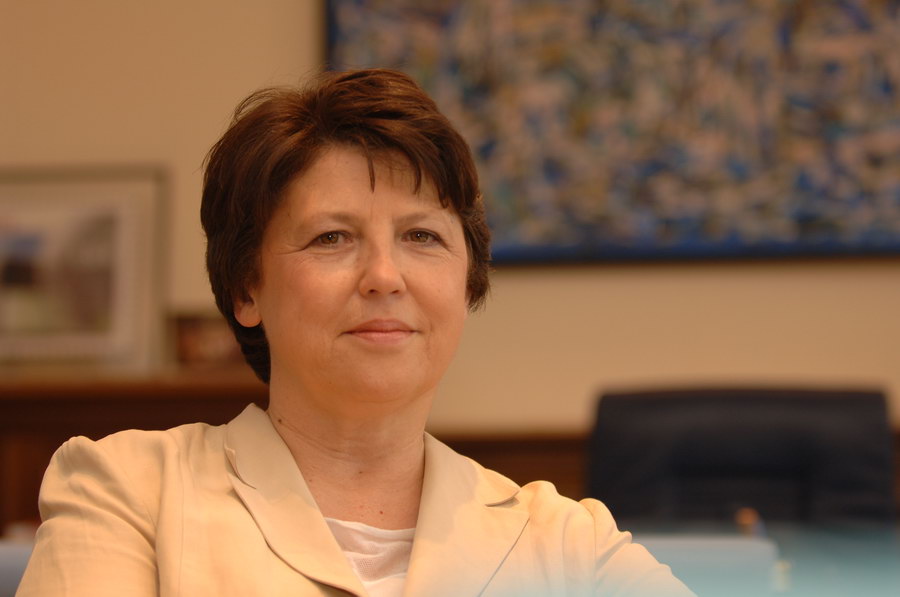
… 1950, Martine Aubry (left), current leader of the French Socialist Party, was born in Paris. (photo credit) As Minister for Employment and Solidarity from 1997 to 2000, she implemented the "Loi Aubry," reducing the full-time working week from 39 to 35 hours. During that time, she also introduced the universal health coverage initiative which allows basic access to health insurance for any person of French or foreign nationality residing in France for over three months on a regular basis who is not already covered by a social security scheme. She has been the mayor of Lille, a city in northern France, since March 2001 and president of the Urban Community of Lille since April 2008. She was selected as leader of the French Socialist Party last November.
… 1945, The U.N. Charter (prior posts), the foundational instrument of the international organization called the United Nations, was ratified by 50 countries at the at the conclusion of the U.N. Conference on International Organization in San Francisco, California. The Charter entered into force on October 24 of the same year, after the 5 permanent members of the Security Council and a majority of the other signatories ratified it. The Charter states that obligations to the United Nations prevail over all other treaty obligations. Today, there are 192 parties to the Charter; this animation shows the accession of member states, and changes in national borders, from 1945 to 2008. (credit)

(Prior August 8 posts are here and here.)

Someone give Kristof the U.N. Charter

A recent column by New York Times writer Nicholas Kristof included the following paragraph:

President Obama could also announce that from now on, when Sudan violates the U.N. ban on offensive military flights in Darfur by bombing villagers, we will afterward destroy a Sudanese military aircraft on the ground in Darfur (we can do this from our base in Djibouti in the Horn of Africa).
Huh?
Kristof deserves credit for his columns, which repeatedly pique public consciousness -- and consciences -- about human rights violations in the 3d World and, on occasion, here at home. But paragraphs like that quoted above sap his efforts.
As all international lawyers know, for a country to enter another's air space and destroys its property likely violate the pledge, contained in Article 2(4) of the U.N. Charter, that it shall

refrain in [its] international relations from the threat or use of force against the territorial integrity or political independence of any state, or in any other manner inconsistent with the Purposes of the United Nations.
The Charter expressly exempts from this ban uses of force that:
► qualify as individual or collective self-defense meeting all requirements of Article 51 of the Charter (requirements that guest/alumna Valerie Epps analyzed in her recent post); or
► are sanctioned by the U.N. Security Council pursuant to Chapter VII of the Charter.
Neither exception would cover the scenario that Kristof proposes:
► Self-defense does not apply for the simple reason that Darfur is not a U.N. member state; it represents yet another tragic example of a state attacking its own populace.
► There seems almost no chance that all 5 permanent members of the Security Council would vote to authorize the use of force.
One presumes that Kristof -- or whoever suggested this scenario to him -- is operating on the assumption that such a U.S. military foray could be justified as an exercise of humanitarian intervention or its younger sibling, responsibility to protect. Put to one side the fact that just because a state can do something does not mean that it should. Put to one side as well the fact that taking out a Sudanese military jet seems far more like old-fashioned reprisal than an act promising to advance a humanitarian goal. The core legal problem is that no international law -- no customary norm, no treaty provision -- allows either humanitarian intervention or intervention in service of a responsibility to protect. Even commentators favorable to articulation of such a law often limit its scope to genocide, and, rightly or not, both a U.N. Commission of Inquiry and a panel of the International Criminal Court have refused to label the horrors in Darfur genocide.
There seems little doubt that other international offenses -- crimes against humanity and war crimes -- have occurred in Darfur. (map credit) No doubt, then, that the crisis in Darfur deserves all our best efforts. That's why the 1st venture of our California International Law Center at King Hall, UC Davis School of Law, is to partner with the Robert F. Kennedy Center for Justice & Human Rights to craft a framework for peace and reconciliation in that troubled region of Sudan. (See here and here.)
But those who argue for unauthorized military strikes do not make use of best efforts.
Rather than urge yet another American President to order unilateral military action, humanitarians ought to push for collective solutions achieved within the bounds of law.

Rejecting the Supposed Right of Anticipatory Self-Defence

(In this guest post Valerie Epps discusses her article recently published at Northeast Asian Law Review 1 (2008) and available here)

During the spring semester 2008, I taught international law and human rights at Hongik University College of Law in Seoul, South Korea, as a visiting professor. During the semester, Professor Lyou Byang Woon organized a conference on various aspects of the laws of war and asked participants to contribute an article to Hongik's law review. This article was the result.
Ever since the administration of former U.S. President George W. Bush announced the “preemption” doctrine as one of what was to become many attempts to justify the U.S. invasion of Iraq, I had been surprised that virtually all, if not all, of the criticisms of preemption had, nevertheless, accepted the doctrine of anticipatory self-defence. I have never been happy with anticipatory self-defence for all of the usual reasons:
► It doesn’t comport with the language of Article 51 of the Charter of the United Nations, which states:
Nothing in the present Charter shall impair the inherent right of individual or collective self-defence if an armed attack occurs against a Member of the United Nations, until the Security Council has taken measures necessary to maintain international peace and security. Measures taken by Members in the exercise of this right of self-defence shall be immediately reported to the Security Council and shall not in any way affect the authority and responsibility of the Security Council under the present Charter to take at any time such action as it deems necessary in order to maintain or restore international peace and security.
► I don’t believe the Caroline doctrine (prior IntLawGrrls posts) in fact accepts anticipatory self-defence.
► I don’t think that Article 51's reference to the “inherent” right of self-defence was meant to incorporate anticipatory self-defence into the Charter.
► The doctrine cannot satisfy necessity or proportionality requirements of self-defence.
… And so on.
But more than all of these well-worn arguments, I had become convinced that the decisions of the International Court of Justice (logo at left) in the Nicaragua, Oil Platforms, and DRC cases, although not discussing anticipatory self-defence, practically ruled it out by implication. Those three cases all interpreted Article 2(4) of the Charter, which states:
All Members shall refrain in their international relations from the threat or use of force against the territorial integrity or political independence of any state, or in any other manner inconsistent with the Purposes of the United Nations.
In each case the ICJ held that even if a state suffers an illegal use of force against it by another state that violates Article 2(4), the victim state does not get a right of self-defence unless the use of force reached a certain level in gravity and scale. In other words, even suffering low-level uses of armed force doesn’t give rise to a right to self-defence.
If that is so, I thought, how could a state that had not yet suffered any use of force against it possibly have a right of self-defence?
This logic led me to investigate language of the Charter and the commentary of scholars contemporary with its drafting. I was not surprised to discover that most of them were quite clear that the Charter meant to prohibit anticipatory self-defence.
The article examines the pre-Charter law on the use of force; the drafting and language of the Charter and the international legal cases that address self-defence. I conclude that international law prohibits anticipatory self-defence, and thus leaves no doubt that the use of preemptive force is illegal.

On December 4

On this day in ...
... 1961, the British National Health Service made The Pill available to all women. But concern about the advisability of use of this form of contraception lingered, as indicated by this BBC reports on comments by Sir Charles Dodds, a leading physician:

He compared a woman's body with a clock mechanism. 'Even if you thoroughly understand the mechanism of a clock, provided it is going well it is very much better to leave it alone. To interfere with it if you do not understand it can be disastrous,' he said.
... 1945, having ratified the U.N. Charter 89-2 in July, the U.S. Senate voted 65-7 in favor of "legislation to give the United States full, active participation in the United Nations Organization." In this vote the 2 Republicans who'd voted against ratification were joined by 4 members of their party and 1 Democrat. It took place following a debate in which, as The New York Times reported, 2 of the opponents

sought to require the President to obtain specific Congressional authorization before he could make armed forces available to the UNO Security Council to halt an aggression or to maintain peace.

That proposal lost 65-9, thus leaving the President free for prompt and decisive action in international emergencies, once the size, state of readiness and general deployment of the United States peace-enforcement forces had been approved by majority votes of the two houses of Congress.


STL H-R-D 2 C R2P

Gareth Evans (left) has published a must-read op-ed criticizing Russia's invocation of the concept of "responsibility to protect" -- infelicitously dubbed "R2P" -- as justification for warring against Georgia over South Ossetia and Abkhazia.
Evans, President of the Brussels-based International Crisis Group and former Foreign Minister of Australia, chaired the International Commission on Intervention and State Sovereignty that issued the report The Responsibility to Protect (2001). He writes:

For those of us who have worked long and hard to create a consensus that the world should never again turn its back on another Cambodia or Rwanda, this and every misapplication of R2P -- genuine or cynical -- is an occasion for alarm. We are conscious of the fragility of that consensus should the impression gain hold that R2P is just another excuse for the major powers to throw their weight around. It needs to be made clear beyond a doubt that whatever other explanation Russia had for its military action in Georgia, the R2P principle was not among the valid ones.
An accurate critique, well made.
But is it really any surprise that Russia would lay claim to "responsibility to protect"? Seems scarcely more surprising than the fact that Russia has -- as Mary Ellen O'Connell guest-noted last month -- equated its August embrace of breakaway independence in the Caucasus with the West's February embrace of breakaway independence in Kosovo. (IntLawGrrl Elena Baylis' February Kosovo posts are here and here.)
The aims behind the R2P movement are exemplary. Nonetheless, as I've written in this essay and in posts here and here, and as José Alvarez wrote here, skepticism's due any undue focus on rhetorical flourish over actual reform of existing mechanisms.
R2P, like any effort at collective avoidance of atrocity, must operate primarily within the collective security framework established in 1945; that is, within the Security Council (right). Article 27(3) of the U.N. Charter, of course, permits permanent-member Russia -- and permanent-members China, and France, and Britain, and the United States -- to sideline all collective bids to act against them or their ally/client states.
The core problem in the conflict in Georgia, then, is the veto power. Russia's dubious claim that it's shouldering a "responsibility to protect" is but a symptom.


On August 6

On this day in ...
... 1942, Wilhelmina of the Netherlands became the 1st reigning queen to address Congress. The Dutch monarch (right), who had been living in exile in Britain since Nazi Germany overtook her country in 1940, declared to a joint session of the U.S. legislature that although her people

'see their families go without what they most need in food and clothing, their workers enslaved by the oppressor, ... "No Surrender" remains their constant motto.'

... 1990, acting pursuant to Chapter VII of the U.N. Charter in response to Iraq's invasion of Kuwait, the Security Council adopted Resolution 661, which imposed an embargo against Iraq and Kuwait. It thus forbade U.N. member states from "the import into their territories of all commodities and products originating in Iraq or Kuwait," as well as transactions between member states' nationals and those 2 countries. (map credit)

On July 28

On this day in ...
... 1945, in a move that New York Times reporter James B. Reston termed the payment of "a first installment on an old debt," the U.S. Senate voted 89-2 to ratify the Charter of the United Nations (right). The "debt" to which Reston referred: the Senate's 1920 rejection of a post-World War I precursor to the post-World War II Charter, the Covenant of the League of Nations. Debate in 1945 lasted "only six days," compared with the nine-month Senate debate over the League. Voting against the Charter were 2 Republicans, Henrik Shipstead of Minnesota and William Langer of North Dakota; the latter maintained that the Charter "would mean 'perpetual war' and the 'enslavement' of millions of poor people from Poland and India."
... 2003 (5 years ago today), Lady Valerie Goulding (below left) died in a nursing home in Shankill, County Dublin, Ireland. Born in England in 1918, she'd moved to Ireland following her marriage to "a fertiliser manufacturer and art collector, Sir Basil Goulding." In Dublin in 1951, she founded the Central Remedial Clinic for the care of 2 persons with physical disabilities; it now serves 4,000 patients. This launched her life's work on behalf of the disabled. She served by appointment to Seanad Éireann, Ireland's Senate, from 1977 to 1981; lost 2 bids for election to the Dail, Ireland's principal parliamentary chamber; and was considered as a candidate for Uachtarán na hÉireann, President of Ireland, in 1983. (photo credit)

Papal Benediction for International Law

An encomium to international law is headline news this morning. Not, alas, because of its content, but rather because of its source: Pope Benedict XVI. In his address to the General Assembly of the United Nations yesterday, the pope warned against an international order dependent solely on the whims of sovereign countries. "Discernment, that is, the capacity to distinguish good from evil," he said,

shows that entrusting exclusively to individual States, with their laws and institutions, the final responsibility to meet the aspirations of persons, communities and entire peoples, can sometimes have consequences that exclude the possibility of a social order respectful of the dignity and the rights of the person.

Benedict (right) looked, rather, to transnational and international institutions as vehicles to promote human dignity, using a "common language" and not "a relativistic conception." For the pope religion is one such transnational vehicle, of course; "relativist" is, after all, an antonym of "catholic," itself a a synonym of "universal." Yet he devoted much of his address to a vehicle typically expressed on the temporal plane: human rights, the promotion of which Benedict called

the most effective strategy for eliminating inequalities between countries and social groups, and for increasing security.

Even as he found traces of human rights in the centuries-old writings of Catholic scholars like Augustine and de Vitoria, the pope found its contemporary source in a 20th C. secular instrument, the 1948 Universal Declaration of Human Rights. In tacit reprimand of those who would privilege civil and political rights over economic, social, and cultural rights -- or vice versa -- Benedict reaffirmed the 60-year-old decision to intertwine those rights:


[E]fforts need to be redoubled in the face of pressure to reinterpret the foundations of the Declaration and to compromise its inner unity so as to facilitate a move away from the protection of human dignity towards the satisfaction of simple interests, often particular interests. The Declaration was adopted as a 'common standard of achievement' (Preamble) and cannot be applied piecemeal, according to trends or
selective choices that merely run the risk of contradicting the unity of the human person and thus the indivisibility of human rights.

Perhaps most notable was the pope's embrace of "responsibility to protect," the international law concept that each nation-state has the primary duty to protect persons within its jurisdiction and control, but if it does not do so, the international community as a whole has a duty to protect those persons against, as the pope put it, "grave and sustained violations of human rights, as well as from the consequences of humanitarian crises, whether natural or man-made." Use of means permitted by the the law of the U.N. Charter is not "an unwarranted imposition or a limitation of sovereignty," the pope maintained, for "it is indifference or failure to intervene that do the real damage."
Some approach the "responsibility to protect" with skepticism, wondering whether the energy spent on pushing a new concept with a catchy acronym -- R2P -- might be better spent on working to strengthen the U.N. Security Council and other pre-existing mechanism that in the end would have to effect any such intervention. I'm among those skeptics, so too José Alvarez, Columbia law professor and immediate past president of the American Society of International Law. Despite disagreement on means, however, we all agree on the ultimate goal, greater enforcement of human rights. And so yesterday's strong statement in support of that objective, from one of the globe's premier norm-shapers, is welcome.


(cross-posted at Slate's Convictions blog)

At our peril

Our colleague Mary Ellen O'Connell (below right) marked this week's anniversary of the invasion of Iraq with a most trenchant observation:
Five years on, the most tangible lesson of Iraq is that our nation ignores international law at its peril.
Ignored was not only the U.N. Charter's collective security regime, which constrains the use of force (about which IntLawGrrls also posted this week). Ignored as well, O'Connell wrote in her Jurist commentary, was the Geneva Conventions regime, which prohibits inhumane conditions of detention and interrogation. And yet, in the mainstream media and in the policymaking corridors of Washington,
The talk on Iraq is all about what went wrong, whether the surge is working, and when we can get out. We hear virtually nothing about international law and look set to repeat our mistakes. Violating the law has cost our nation and Iraq dearly. It has denied us the guidance of rules based on long experience and moral consensus. We have lost standing in the world, a literal fortune, and precious lives. Rather than internalizing the lesson of law violation in Iraq, we continue to defy the law in serious and self-destructive ways.
She concludes by repeating concerns that some seem poised to launch "yet another unlawful war," against Iran. (It's a concern she raised more than a year ago, as we posted.) O'Connell fears that policymakers have not learned from their mistakes:
The lesson of Iraq could not be plainer.

On November 8, ...

... 1897 (110 years ago today), Dorothy Day (left) was born in Brooklyn, New York. She and her family lived through the 1906 San Francisco earthquake, then moved to Chicago. At age 19, after having studied 2 years at the University of Illinois, Day moved to New York, where she began writing for socialist newspapers. Active in antiwar and other "hot-button issues of the day," "women's rights, free love, and birth control," in her early years Day terminated a pregnancy by abortion, married and divorced, and gave birth to a child outside of marriage. She had the child baptized Catholic, an indicator of her movement toward working for social change within that religion. In 1933 Day cofounded a social movement and newspaper, both known as Catholic Worker. To this day Workers, sworn to poverty, work with and among America's poorest inner-city neighborhoods.
... 2002 (5 years ago today), U.N. Security Council Resolution 1441 won unanimous approval. Invoking coercive powers granted it by Chapter VII of the U.N. Charter, the Council declared Iraq, and thereby its President, Saddam Hussein, in "material breach" of prior weapons inspections mandates, and gave Iraq a "final opportunity" to submit to intensified weapons inspections.

On October 24, ...

... 1961, U.S. Rep. Mary Bono (R-Calif.) was born in Cleveland, Ohio.
... 1945, with the midafternoon deposit by the Soviet Union of the 29th instrument of ratification, and the 4:50 p.m. attesting signature by U.S. Secretary of State James F. Byrnes in Washington, D.C., the Charter of the United Nations entered into force. The event marked a formation process begun with a 1942 declaration. On signing, a prescient Byrnes said that

the Charter was now a 'part of the law of nations' and that it was 'a memorable day for the peace-loving peoples of all nations.' But he warned that peace depended upon the will of the peoples for peace rather than upon documents.

The date is set aside as United Nations Day, for which this year's slogan is “Global Health: A Critical Component to Development.”
 
Bloggers Team