Showing posts with label New Zealand. Show all posts

On November 7

On this day in ...
... 1943, Silvia Rose Cartwright (right) was born in Dunedin, New Zealand. She studied at the Otago Girls' High School in the same town, as well as the University of Otago, from which she earned her LL.B. degree in 1967. Since then, she's served as the 1st woman Chief District Judge, the 1st woman on New Zealand's High Court, and the 2d woman Governor-General of New Zealand. On the last post, WikiPedia writes:
Dame Silvia's term as Governor-General was from 4 April 2001 to 4 August 2006. This was the first (and so far only) time when the Monarch (Elizabeth II), Governor-General, Chief Justice (Dame Sian Elias), Speaker of the House (Margaret Wilson) and Prime Minister (Helen Clark) of a Commonwealth Realm were all female.
While a member of the Committee on the Elimination of Discrimination Against Women, she helped to draft the Optional Protocol to CEDAW, the Convention on the Elimination of All Forms of Discrimination Against Women. Since 2007, Cartwright's been a Judge on the Extraordinary Chambers in the Courts of Cambodia.

(Prior November 7 posts are here, here, and here.)

On November 3

On this day in ...
... 1985 (25 years ago today), at a High Court in Auckland, New Zealand, 2 agents of the French secret service pleaded guilty to charges of arson and manslaughter arising out of the bombing of the Rainbow Warrior the previous July. The vessel, owned by the environmental nongovernmental organization Greenpeace, sank (photo credit), and one of its photographers drowned. The bombing had taken place, according to the BBC, "just before the Greenpeace team were to set sail to Muroroa Atoll -- a French territory in the Pacific Ocean -- to protest against French nuclear testing there." Dominique Prieur (above right) and her fellow French agent would be sentenced to 10 years, yet released in 1988. Later she became a human resources staffer for firefighters in Paris.

(Prior November 3 posts are here, here, and here.)

On July 9

On this day in ...
... 1986, the Parliament of New Zealand passed the Homosexual Law Reform Act, which "removed criminal sanctions against consensual male homosexual practices." The law applied to males aged 16 and over. Although sex between women never had been against the law, "many lesbians suffered the same social discrimination as gay men and were staunch supporters of the reform movement." The Parliamentary sponsor of the bill was Fran Wilde (right), who'd been elected on a Labour ticket 5 years earlier. Later she would serve as Mayor of the City of Wellington.

(Prior July 9 posts are here, here, and here.)

FemInt workshop-in-progress

(IntLawGrrls is pleased to welcome back alumna Susan Harris Rimmer, who contributes this guest post)

As previously posted, The Australian National University is currently hosting a workshop on Feminist Internationalisms in Canberra, Australia. The workshop is intended to reflect on twenty years of feminist scholarship in the fields of international law and international relations, in Australia, New Zealand, and the Pacific.
IntLawGrrls everywhere can follow the proceedings:
Live
Click on the conference Twitter account here and receive tweets live from the conference floor.
Podcasts
The following podcasts from the workshop also are available: "You May Never Understand: Prospects for Feminist Futures in International Relations," the keynote address by Dr. J. Ann Tickner (below right), Professor of International Relations at the University of Southern California in Los Angeles, is here, and the Q&A that followed is here.
Here's a taste of what Ann had to say:

While feminist research has been successful in making women visible, it has gone much deeper. Getting beyond women and IR, and even beyond gender and IR, it has successfully demonstrated -- not maybe as much as we would like to the discipline as a whole -- that IR theory is thoroughly gendered, both in the questions it chooses to ask, as well as how it goes about answering them.
One of the most creative moves feminism has made is to challenge disciplinary boundaries and bring in new issues and voices.
Rich empirical case studies –- using methodologies not normally employed by IR scholars -- have shed light on those on the margins (both women and men) whose lives are deeply impacted by global politics and economics. Feminists have sccessfully demonstrated how the lives of sex workers, domestic servants, home-based workers and those who work at unremunerated caring and reproductive labour, are intertwined with global politics and the global economy. They have also suggested that the security of states is sometimes dependent on rendering insecure the lives of certain, often marginalized, people, and how the global capitalist economy could not function without unremunerated labour, the majority of which is performed by women. IR feminists have also pointed to the inadequacies of social scientific methodologies for answering many of the questions they want to ask.
All workshop papers will appear in a special issue of the Australian Feminist Law Journal in July 2010.

On October 19

On this day in ...
... 1974 (35 years ago today), the South Pacific island nation of Niue became "a self governing state in free association with New Zealand" upon adoption of the Niue Constitution Act, which had been approved by 66% of the electorate in a referendum the previous month. Niueans -- about 1,400 persons -- remain New Zealand citizens. Niue is not a member of the United Nations, but is a state party to a number of treaties.

(Prior October 19 posts are here and here.)

On September 1

On this day in ...
... 1951, diplomats signed the Security Treaty between Australia, New Zealand and the United States of America, better known as the ANZUS Pact, at San Francisco, California (right). As detailed at the U.S. State Department's website, this mutual defense treaty, designed to ensure security in the Pacific region, did not include Great Britain notwithstanding the Commonwealth status of 2 states parties. However, Britain and the ANZUS states all joined the Southeast Asian Treaty Organization in 1954. Three decades later, "the ANZUS Treaty began to unravel when New Zealand declared its country a nuclear-free zone and refused to allow U.S. nuclear-powered submarines to visit its ports," a move that led eventually to U.S. suspension in 1986 of "its treaty obligations toward New Zealand." Bottom line:
Although the agreement has not been formally abrogated, the United States and New Zealand no longer maintain the security relationship between their countries.

(credit for photo of John Foster Dulles, the U.S. negotiator who would become Secretary of State in 1953, signing the ANZUS Treaty while others, including the Secretary of State at that time, Dean Acheson (far right), look on)

(Prior September 1 posts are here and here.)

On July 12

On this day in ...
… 1926, Gertrude Bell (right) died. The England-born archaeologist, writer, and spy is an IntLawGrrls transnational foremother, thanks to guest/alumna Ursula Bentele. Bell was the first woman to graduate with a history degree from Oxford. She became fluent in Arabic, Persian, French, German, Italian, and Turkish. (image credit) The establishment of early 20th C. Iraq is attributed in part to her, so that she bears the nickname "uncrowned queen of Iraq." Bell also helped form the Baghdad Archaeological Museum, ensuring, against European wishes, that a collection of Iraq's antiquities would remain in that country. She is buried in Baghdad.
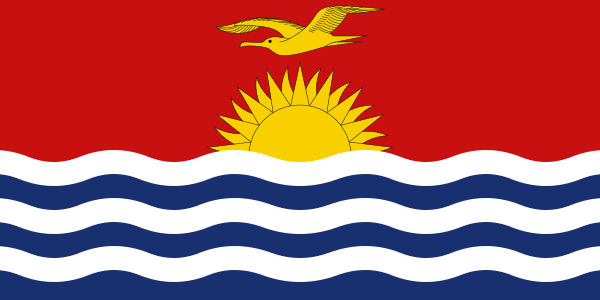
… 1979 (30 years ago today), the island nation of Kiribati (flag below left) became independent from Britain. In 1892 what were then called the Gilbert Islands had consented to become a British protectorate. They had gained self-rule in 1971, and were granted internal self-government by Britain thereafter. The island nation took the name Kiribati on its independence. In summer 2008, Kiribati officials asked Australia and New Zealand to accept Kiribati citizens as permanent refugees: it is expected to be the first country in which land territory disappears due to global climate change.

(Prior July 12 posts are here and here.)

On September 17

On this day in ...
... 1936, Ettie Annie Rout (right) died of "a 'self-administered' quinine overdose" in Cook Islands, 59 years after she'd been born in Tasmania. Rout grew up in Wellington, New Zealand, where her work as a typist for courts and commissions of inquiry "gave her a wide range of experiences on social issues." Later she worked as a writer and in business, but became best known as a health activist, concerned about the spread sexually transmitted diseases. Her emphasis on the problem, while she was a volunteer nurse during World War I, drew praise in France criticism in New Zealand. New Zealand also banned her Safe Marriage: A Return to Sanity (1922), "a contraceptive and prophylactic manual for women." Britain published it -- prompting a bishop to proclaim her

the most wicked woman in Britain.

... 1374, by means of the Pact of Koszyce, named after the city whose coat of arms is at left, Ludwik the Great, King of Poland and Hungary, granted certain privileges to the Polish nobles in exchange for their promise that he could "occupy the Polish throne should one of his daughters have no male heirs."

On this day

On March 13, ...
... 1949, Rt. Hon. Dame Sian Elias (left) was born in London, England, the daughter of a father of Armenian heritage and a mother of Welsh heritage. Educated at Auckland University in New Zealand and Stanford University in the United States, she became a barrister in Auckland in the early 1970s. Appointed a Queen's Counsel in 1988 and a High Court judge in 1995, she became New Zealand's 1st woman Chief Justice, a position she holds to this day, in 1999. That same year she was named Dame Grand Companion of the New Zealand Order of Merit and appointed to the Privy Council. She also serves as Administrator of the Government, the person who would assume the duties of the Governor-General, the "personal representative of" the "Head of State, Queen Elizabeth II of New Zealand," if the Governor-General should be unable to perform those duties.
... 1979, "members of the New Jewel party, a left-wing opposition group" in parliament, staged a coup d'état in Grenada, a Caribbean island state. The group's leader, Maurice Bishop, would govern until October 1983, when he was killed by "supporters of his deputy, Bernard Coard, who resented attempts to mend bridges with the US," according to BBC, which added that "[l]ater that month 6,000 US troops invaded Grenada." Detention occurring during the 1983 military action was held violative of the 1948 American Declaration of the Rights and Duties of Man in Coard v. United States, a 1999 decision of the Inter-American Court of Human Rights about which I've written here.

On February 6, ...

... 1893, Canada and France signed a reciprocity treaty in Paris, the North American country's 1st with a European state. Among other things it guaranteed lower duty rates to French wines. In fewer than 15 years, it would be superseded by a far more comprehensive, bilateral commercial trade agreement.
... 1840, in the Bay of Islands, English settlers and Māori rangatira, or chieftains, signed the Treaty of Waitangi (right), rendered in both the English and Māori languages. Over the course of the year the signatures of 500 Māori, of whom 13 were women, were added to the treaty, which constitutes the founding document of New Zealand.

On November 27, ...

... 1999, Helen Clark was elected Prime Minister of New Zealand. On December 5 of the same year Clark (right), born in 1950, was sworn in to the office that she holds to this day. The eldest of 4 girls who grew up on the family sheep ranch, Clark eventually studied and became a lecturer in politics at the University of Auckland. Inspired by issues such as the Vietnam War and South African apartheid, she was elected a Labour Party member of Parliament in 1981. Eventually Clark was dubbed "Mother of the House" as the woman who'd served the longest time in that legislative body. She served in a number of Cabinet ministries before becoming Prime Minister.
... 1963, the Convention on the Unification of Certain Points of Substantive Law on Patents for Invention was signed in Strasbourg, France. Number 47 in the European Treaty Series of the Council of Europe, this Strasbourg Patent Convention, which entered into force on August 1, 1980, helped harmonize patent laws throughout the region.

Not the usual suspects

As the stain of discriminatory arrests continues to spread as terrorism provides an excuse for a global crackdown on challenges to government everywhere, 20 heavily armed New Zealand police officers arrested Maori rights activist Tame Iti (Photo by Dean Treml/AFP, appeared in the IHT). Iti was among 16 environmentalists, peace activists and advocates for indigenous rights jailed without bail (except for 1 of them), mostly on charges of possessing firearms without a license. Police claim that they’ve been watching a camp where armed men in balaclavas were seen training about 2 years ago, and acted only after the group’s threat level rose to unacceptable (for ex., one of the arrestees, a white man, supposedly sent text messages saying he was “training to be a vicious, dangerous commando” and suggesting that white New Zealanders were in mortal danger. Iti, on the other hand, is one of the most well known defenders of Maori rights and works for a government-funded program to help troubled youth of the Tuhoe tribe. While Iti’s protest tactics are flamboyant and sometimes involve firearms, weaponry is a Tuhoe tradition. According to locals, Ruatoki, the community in which Iti lives, will be known from now on as the first to be raided under the New Zealand’s Terrorist Suppression Act of 2002. And they’re waiting for the egg to appear on the raiders’ faces.

On September 20, ...

.... 1973, Carol C. Laise became the 1st woman Assistant Secretary in the U.S. State Department. Appointed Assistant Secretary of State for Public Affairs, she held the post until March 27, 1975, then served as the 1st woman Director General of the Foreign Service (1975-1977). Other government posts included the U.S. Civil Service Commission; State Department international relations officer in Indian and South Asian affairs (1948 to 1956); and U.S. Ambassador to Nepal (1966-1973). In 1991, she died at age 73, having survived her husband, diplomat Ellsworth Bunker.
... 1999, a force of 1,190 soldiers, most from Australia or New Zealand, landed at the airport in the capital city of Dili in a U.N. effort "restore law and order" in East Timor, where militias "are thought to have killed thousands" in the couple of weeks since the electorate voted overwhelmingly for independence from Indonesia, which had invaded in 1975 after Portugal ended its 450-year colonization of the tiny state (flag at left), which occupies half an island.

On September 19, ...

... 1945, Donna M. Christian-Christensen, a Democrat and the U.S. Virgin Islands’ delegate to the U.S. House of Representatives, was born in Teaneck, N.J.
... 1893, legislators passed the Electoral Act that extended suffrage to women in New Zealand, as depicted in this illustration from the New Zealand Graphic and Ladies Journal. On this achievement -- New Zealand was the 1st country so to act -- the feisty suffragist Kate Sheppard commented:
It does not seem a great thing to be thankful for, that the gentlemen who confirm the laws which render women liable to taxation and penal servitude have declared us to be 'persons.' ... We are glad and proud to think that even in so conservative a body as the Legislative Council there is a majority of men who are guided by the principles of reason and justice, who desire to see their womenkind treated as reasonable beings, and who have triumphed over prejudice, narrow-mindedness and selfishness.

Indigenous Peoples Declaration

By an overwhelming margin, the U.N. General Assembly's voted to adopt the Declaration on the Rights of Indigenous Peoples.
The 1st article of the Declaration, which was "twenty years in the making," provides:
Indigenous peoples have the right to the full enjoyment, as a collective or as individuals, of all human rights and fundamental freedoms as recognized in the Charter of the United Nations, the Universal Declaration of Human Rights and international human rights law.
The 45 articles that follow elaborate, setting forth explicit rights to, for example: self-determination, financial and technical assistance, land use, conservation and environmental protection, and enforcement of treaties.
In favor were 143 states, with 4 in opposition and 11 abstaining. Against the nonbinding instrument? Australia, Canada, New Zealand and the United States, each of which has significant indigenous populations. According to a U.N. release, here're their reasons for opposition:
Australia: Asserting that self-determination ought to apply only in narrow, often colonialist situations, it "supported and encouraged the full engagement of indigenous peoples in the democratic decision-making process, but did not support a concept that could be construed as encouraging action that would impair, even in part, the territorial and political integrity of a State with a system of democratic representative Government."
Canada: "[P]rovisions in the Declaration on lands, territories and resources were overly broad, unclear, and capable of a wide variety of interpretations, discounting the need to recognize a range of rights over land and possibly putting into question matters that have been settled by treaty."
United States: Stating that in mid-2006 the Declaration had passed by a "splintered vote" of the Human Rights Council [the vote was 30 votes to 2, with 12 abstentions -- ed.], expressed concern regarding the risk of "'endless conflicting interpretations and debate about its application, as already evidenced by the numerous complex interpretive statements issued by States...'"
A day after the General Assembly vote, New Zealand said it had opposed the Declaration on the ground that it "disadvantages non-indigenous people and conflicts with the country's laws."
In a twist, the Taipei Times, a newspaper in the capital city of non-U.N.-member Taiwan, praised the Declaration as giving to "[l]ocal Aboriginal activists ... new, concrete benchmarks against which they can judge and, as is often necessary, embarrass the government." The paper concluded, "The scene is set, then, for a test of how committed Taiwanese officials, politicians and members of the public really are to a subset of UN principles that are genuinely honorable."
The same might be said for officials elsewhere in the world.

On September 1, ...

... 2007 (today), New Zealanders will celebrate a national day that deserves to go global. It's R.A.K. Day, or Random Acts of Kindness Day. Ideas for the day are simple enough for schoolchildren -- "Start a conversation with a new student or with a classmate who seems lonely. " -- and complex enough for adults, even for corporate bodies -- "[M]ake a difference to a child, family or community overseas." Your ideas?
... 1876, Harriet Shaw Weaver was born in Frodsham, Cheshire, England. When her parents forbade her to go to university, she became a social worker and women's suffragist, and eventually joined England's Women's Social and Political Union. She provided essential financial support to writers Ezra Pound, an editor of her periodical The Egoist, and James Joyce, whose A Portrait of the Artist as a Young Man and Ulysses 1st appeared in serial form in that periodical.

On July 10, ...

... 1985, shortly before midnight in Auckland Harbour, New Zealand, explosions 60 seconds apart exploded the stern of Rainbow Warrior (right), killing a crew member and sinking the flagship of an environment-focused nongovernmental organization, Greenpeace. The mining of the ship, which had been "preparing to visit Moruroa Atoll for a major campaign against French nuclear testing," later was linked to intelligence agents from France. France eventually paid New Zealand $7 million compensation.
... 1992 (15 years ago today), a federal judge in Miami sentenced Gen. Manuel Antonio Noriega, de facto leader of Panama until deposed by the U.S. military in 1989, to 40 years in prison following conviction on drug-trafficking and money-laundering charges. The sentence was later reduced, and Noriega's possible release this year has begun to stir debate in Panama.
 
Bloggers Team