Showing posts with label Susan Harris Rimmer. Show all posts

Gender off the agenda in Australian election aftermath

(We are delighted to welcome back IntLawGrrls guest/alumna Susan Harris Rimmer with a special post on the recent Australian election)

There is a website that contains all the information the rest of the world needs to know about the recent Australian election on 21 August: doesaustraliahaveagovernmentyet.com? It is a black screen with one large white word - no. Yes, we are still cheeky and irreverent. No, we no longer have a dominant two party system, and the change this is causing is painful, but hopefully good for Parliament in the long term. Yes, policy issues played out in a weird bubble during the campaign, as if the rest of the world and climate change and the financial crisis and the causes of boat arrivals of asylum-seekers simply did not exist. Most of the messages from the two major parties were negative and targeted at a few marginal seats. But we did get our youngest ever MP (at 20 years old), our first Indigenous MP, and our first Muslim MP.
The fact Australia had the chance to elect its first female Prime Minister seems not to have had much impact on the way the polls played out. At least overtly. Julia Gillard (credit for photo below right) did not sweep to power on a feminist voting landslide, that much is for sure. Research before the poll suggested that 64% of women participants would choose to vote for Gillard because they are strongly influenced by Gillard’s views and priorities first and foremost, her leadership style, second and her achievements, third, before the considerations that she is the first woman PM in Australia and that she will do more for women’s issues if elected.
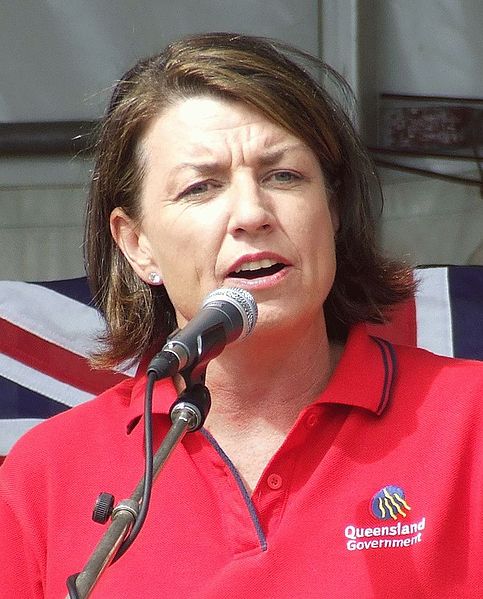
Except they didn't. At least they didn't in the 20 odd marginal seats that counted. And the way that Julia Gillard took power from Kevin Rudd -- in a very sudden and clinical fashion -- was certainly a factor in the election, as was the deep unpopularity of two governments at the State level, New South Wales and Queensland, which are also led by women, Anna Bligh (credit for photo below left) and Kristina Keneally (credit for photo below right) .
Ostensibly, the election couldn't have been more stark on women's issues at the level of representation. In one corner was a feminist and the first female PM, who was famously denigrated for being 'deliberately barren' by a fellow Parliamentarian (as best described by Kathy Lette in the UK Daily Mail). Gillard is tough and competent and resolutely cool under fire. She stated early and often that the campaign wasn't about gender, then promptly did a cover shoot for the Australian Women's Weekly.
In the other corner was Tony Abbott, an uber-masculine, fitness junkie ex-novitiate with such a negative background on women's issues that activists were able to create a full advertisement by simply cutting together his previous comments. But Abbott ran a disciplined campaign with clear messages, announced a very generous paid maternity leave scheme, and gathered his wife and daughters about him at every opportunity. Abbott also managed to curb his normal enthusiasm for gaffes about women, except for saying 'no means no' to a repeated request for Gillard to debate her on economic issues. (And he kept his clothes on - Tony Abbott is famous for getting about a in very small swimming costume, known colloquially in Australia as 'budgie smugglers'. Think Putin, but cheekier).
But in meaningful terms, there was no emphasis on any women's policy issues in the campaign whatsoever, neither at the domestic or international level (see the election platform calls from the women's sector). Admittedly there was almost no social policy or foreign policy either. The BBC always saves its best dry wit for its Australian reportage and their Sydney correspondent Nick Bryant gave the best analysis I've seen, despairing that the campaign was parochial, scrappy and lacked vision.
So here we are, many days after the election with no end in sight, and the players now are five independents in the House of Representatives, four representing rural and regional electorates. One is a very colourful character, Bob Katter - his 'Force from the North' rural rap is a big hit on YouTube. It is unlikely that women's issues are going to get much play in what is likely to be a difficult negotiation leading to a fragile minority government. It is also likely Australia might head back to the polls.
Overall? An election campaign full of sound of fury, signifying nothing? It often felt that way. Is the fact that Julia's gender did not turn the election one way or another to be celebrated? What will be the long-term impact of this election on the participation of women in public policy decision-making?
For thoughtful commentary on the role of gender in the Australian election, these opinions columns by Marian Sawer and Julia Baird are well worth a read.


(credit for map of Australia top left)

FemInt workshop-in-progress

(IntLawGrrls is pleased to welcome back alumna Susan Harris Rimmer, who contributes this guest post)

As previously posted, The Australian National University is currently hosting a workshop on Feminist Internationalisms in Canberra, Australia. The workshop is intended to reflect on twenty years of feminist scholarship in the fields of international law and international relations, in Australia, New Zealand, and the Pacific.
IntLawGrrls everywhere can follow the proceedings:
Live
Click on the conference Twitter account here and receive tweets live from the conference floor.
Podcasts
The following podcasts from the workshop also are available: "You May Never Understand: Prospects for Feminist Futures in International Relations," the keynote address by Dr. J. Ann Tickner (below right), Professor of International Relations at the University of Southern California in Los Angeles, is here, and the Q&A that followed is here.
Here's a taste of what Ann had to say:

While feminist research has been successful in making women visible, it has gone much deeper. Getting beyond women and IR, and even beyond gender and IR, it has successfully demonstrated -- not maybe as much as we would like to the discipline as a whole -- that IR theory is thoroughly gendered, both in the questions it chooses to ask, as well as how it goes about answering them.
One of the most creative moves feminism has made is to challenge disciplinary boundaries and bring in new issues and voices.
Rich empirical case studies –- using methodologies not normally employed by IR scholars -- have shed light on those on the margins (both women and men) whose lives are deeply impacted by global politics and economics. Feminists have sccessfully demonstrated how the lives of sex workers, domestic servants, home-based workers and those who work at unremunerated caring and reproductive labour, are intertwined with global politics and the global economy. They have also suggested that the security of states is sometimes dependent on rendering insecure the lives of certain, often marginalized, people, and how the global capitalist economy could not function without unremunerated labour, the majority of which is performed by women. IR feminists have also pointed to the inadequacies of social scientific methodologies for answering many of the questions they want to ask.
All workshop papers will appear in a special issue of the Australian Feminist Law Journal in July 2010.

Guest Blogger: Susan Harris Rimmer

It's IntLawGrrls' great pleasure today to welcome Dr. Susan Harris Rimmer (left) as a guest blogger.
Susan is a Research Officer at the Centre for International Governance and Justice (prior post), where she works with IntLawGrrls guest/alumna Hilary Charlesworth, Centre Director, on the building of democracy after conflict. Susan graduated from the University of Queensland in 1997 with a bachelor' degree in government and an LL.B., both with honors, having received a University Medal in 1996. In December 2008 she earned a Doctor of Juridical Science from the Australian National University College of Law for her thesis, which Routledge will publish as Gender and Transitional Justice: The Women of East Timor in 2010. In 2006 the University of Texas School of Law awarded Susan the Audre Rapoport Prize for Scholarship on the Human Rights of Women.
Susan currently serves as a member of the Board of UNIFEM Australia and is President of the Australian Lawyers for Human Rights.
Her career before entering academia was diverse. After some volunteer work with the U.N. High Commissioner for Refugees and the International Criminal Tribunal for the Former Yugoslavia, Susan did her articles of clerkship with national law firm Blake Dawson Waldron, and was admitted as a solicitor in March 2000. Since then, Susan has pursued human rights and refugee advocacy work with the National Council of Churches in Australia, the Australian Council for International Development, and the UNHCR. From 2005 until 2008, Susan was a Research Specialist at the Parliamentary Library, advising Australia's Federal Parliamentarians on legal issues relating to refugees and terrorism.
In her guest post below, Susan describes the continuing struggle, by women in post-independence East Timor, against sexual and gender-based violence.
Susan dedicates her post to Shirley Perry Smith (1924-1998), better known as Mum Shirl (below right). Susan explains:
Mum Shirl was a prominent Aboriginal Australian and activist committed to justice and welfare of Aboriginal Australians. Smith began to visit Aboriginal people in prison after one of her brothers was incarcerated, and she discovered that her visits were beneficial to other prisoners as well. Her community activism also saw her accompanying indigenous people who were unfamiliar with the legal system to court when they had been charged with a crime. Her nickname came from her habit of replying, 'I’m his Mum,' whenever officials queried her relationship with the prisoners.
Mum Shirl also spent considerable time and money finding homes for children whose parents could not look after them, and helping displaced children to find their own parents again. The children with nowhere to go often ended up living with her. By the early 1990s she had raised over 60 children. Likewise, many people with no family or friends in Sydney arrived at Mum Shirl’s house seeking shelter.
She was a founding member of the Aboriginal Legal Service, Aboriginal Medical Service, Aboriginal Tent Embassy, the Aboriginal Children’s Service, and the Aboriginal Housing Company in Redfern, a suburb of Sydney, Australia.

Today Smith joins other IntLawGrrls foremothers in the list below our "visiting from ..." map at right.
Heartfelt welcome!

A Luta Continua! The struggle for gender justice in East Timor 10 years after the independence ballot

(My thanks to IntLawGrrls for the opportunity to contribution this guest post)

One of the bravest but least known acts during the East Timorese resistance to Indonesian occupation occurred in November 1998, when over 20 Timorese women told their stories of surviving sexual violence to crowds of hundreds at a public meeting in Dili. The stories were collated into a 1999 book called Buibere, which means ‘woman’ in Mumbai, the second most common Timorese language after Tetum. It was written only in English, published in Australia, and intended as an advocacy document for the international community. The persecution, as described first-hand in these collected testimonies, was intense, and included rape, torture and other inhumane acts.
Today marks the tenth anniversary of the popular consultation held in Indonesian-occupied East Timor on 30 August 1999. On 4 September 1999, it was announced that 78.5% of the population had voted against East Timor remaining as part of Indonesia, despite intimidation and full knowledge of the likely reprisal. Independence was granted to the territory after 25 years of brutal invasion. The announcement of the ballot result on 4 September 1999 resulted in immediate acts of violence, a scorched earth policy, looting, massive evacuations, and forced deportation of the population. In the months surrounding the 1999 vote, pro-Jakarta militias killed an estimated 1,400 people, burned towns to the ground, destroyed 80% of the territory's infrastructure, and forced or led more than a quarter of a million villagers into Indonesian-ruled West Timor.
In November 2001, in an independent East Timor controlled by a UN mission, the local women’s rights nongovernmental organization, FOKUPERS, released a second version of Buibere, in Tetum, at a public event, with many of the women who contributed stories to the book present. The second edition is intended to formally respect and honour both the contribution of East Timorese women to independence and the high price they paid during the Indonesian occupation.
Some of the problems that continue to face the women of East Timor were graphically outlined by advocate Sister Maria de Lourdes Martins Cruz at the launch:
‘A luta continua!’ she said, and described how the women of East Timor were still second-class citizens in their own land. ‘A luta continua!’ and she described how girls still don’t receive the same educational or employment opportunities as men. ‘A luta continua!’ and she told of domestic violence still rampant, women still serving as slaves in their own homes, women bought and sold like commodities under the tradition of bride price, and men leaders still unwilling to accept East Timorese women as equals. Ovation after ovation shook the hall.
Given the serious nature of the crimes outlined in Buibere, Sister Lourdes’ speech is striking in that in the eyes of those survivors present that day, independence did not necessarily mark the end of violence against women, but rather just a new manifestation of violence and subordination. (credit for 1998 photo by Jude Conway of demonstration in Dili challenging violence against women; the sign says "STOP Murder!")
I contend that Sister Maria was correct in stating that the problems facing Timorese women in the independence period are linked to the problems women faced during the occupation. Recognition and redress under the law for gender-based violence in war is linked to recognition and redress for domestic violence and socio-economic rights in the ‘peace’.
The danger for East Timorese women now is what I term the ‘changing the curtains’ phenomena — that fundamental changes in the sovereignty of the State in the form of independence may mean that the basic conditions of women’s lives, or their potential to claim their legal rights, does not change in any meaningful sense, as described in the call to arms by Sister Lourdes. Despite some important efforts to include women and their experiences in the justice mechanisms established in East Timor since 1999, Timorese women such as Sister Maria may indeed have cause to be disenchanted.
This then raises the crucial question — transitional justice rests on the assumption that there has been a transition from a state of conflict to a state of peace, however uneasy. If women are still experiencing serious levels of domestic violence and economic deprivation, commensurate with their experience of violence during the proclaimed conflict, have they entered a state of transition at all? If we ask the question — transition to what? — then the next logical question is therefore — justice for whom?

(See further: CAVR Final Report Chega!, and Independent women. The story of women’s activism in East Timor, by Irena Cristalis and Catherine Scott.)

Go On! "Feminist Internationalisms"

(Go On! is an occasional item on symposia of interest) The Centre for International Governance and Justice at the Australian National University will sponsor a 2-day workshop November 23 & 24, 2009, at Hedley Bull Centre at the university, in Canberra.
Entitled "Feminist Internationalisms: Celebrating feminist engagements with international law and politics," the workshop will focus on Australasian work on feminist internationalism in the fields of international relations and international law.
J. Ann Tickner (below right) (photo credit), Professor of International Relations at the University of Southern California in Los Angeles, will give the keynote address. Also scheduled to take part are: IntLawGrrls guest/alumna Penelope Andrews, Valparaiso University; Hilary Charlesworth, Bina D'Costa, Nicole George, Susan Harris Rimmer, and Katrina Lee-Koo, Australian National University; Anne Orford and Dianne Otto, University of Melbourne; Andrew Byrnes, University of New South Wales; Juanita Elias and Judith Gardam, University of Adelaide; Marianne Hanson, University of Queensland; and Jaqcui True, University of Auckland. Papers will explore economics, security, democracy and human rights, using feminist inquiry both as a theoretical lens and a methodology.

Details and registration here.
 
Bloggers Team