Showing posts with label Nobel Prize. Show all posts

On December 10

On this day in ...
... 1945 (65 years ago today), Gabriela Mistral addressed a banquet at City Hall in Stockholm, where earlier in the day she'd been awarded the Nobel Prize in Literature. She stressed the bonds between Sweden and her own country:

As a daughter of Chilean democracy, I am moved to have before me a representative of the Swedish democratic tradition, a tradition whose originality consists in perpetually renewing itself within the framework of the most valuable creations of society. ...
At this moment, by an undeserved stroke of fortune, I am the direct voice of the poets of my race and the indirect voice for the noble Spanish and Portuguese tongues. Both rejoice to have been invited to this festival of Nordic life with its tradition of centuries of folklore and poetry.
Mistral (prior posts), who'd been born Lucila Godoy y Alcayaga 56 years earlier, was not only a renowned poet, but also a diplomat, serving on League of Nations cultural committee and as a Chilean consul in Italy, Spain, and Portugal. (credit for photo of 5,000-peso note honoring her) She's the transnational foremother of IntLawGrrl Naomi Roht-Arriaza.

(Prior December 10 posts are here, here, and here.)

On November 8

On this day ...
... 1895 (115 years ago today), the X-ray was discovered by Wilhelm Conrad Röntgen. Researching cathode rays with a group of scientists, the German physicist found that in a dark room, objects placed in the rays' path could be captured on film. Experiments continued. A month later, when he immobilized the hand of his wife, Bertha (right),
in the path of the rays over a photographic plate, he observed after development of the plate an image of his wife's hand which showed the shadows thrown by the bones of her hand and that of a ring she was wearing, surrounded by the penumbra of the flesh, which was more permeable to the rays and therefore threw a fainter shadow.
"When she saw her skeleton she exclaimed 'I have seen my death!'" The discovery revolutionized the practice of medicine; for it, Röntgen won the 1901 Nobel Prize in physics.

(Prior November 8 posts are here, here, and here.)

On September 29

On this day in ...
... 1954, the European Organization for Nuclear Research began operations. Dissolved was the provisional council on nuclear research in the region, which had been established a couple years earlier; nonetheless, the French acronym by which that first effort had been known, CERN, remains the shorthand term for this organization to this day. The organization now has 20 member states. Its laboratory, which "sits astride the Franco–Swiss border near Geneva," is a center for physics research; a number of its scientists have earned Nobel Prizes in the field.

(Prior September 29 posts are here, here, and here.)

On July 30

On this day in ...
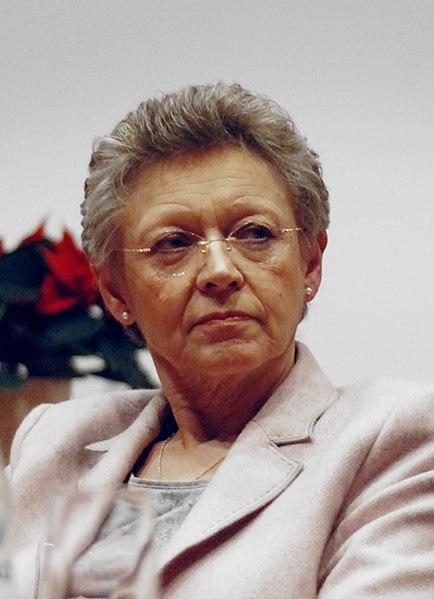
… 1947, Françoise Barré-Sinoussi (left) was born in Paris, France. (photo credit) In 1983, while researching retroviruses at Paris'Institut Pasteur , she discovered the HIV virus. Together with her boss, she was awarded the 2008 Nobel Prize in Physiology or Medicine for her discovery. She is currently the director of the Unité de Régulation des Infections Rétrovirales at the Institut. In 2009, Barré-Sinoussi wrote an open letter to Pope Benedict XVI to protes his statements that condoms are at best ineffective in combating HIV/AIDS.
… 1863, President Abraham Lincoln (right) issued the "eye-for-eye" order to shoot rebel prisoners under certain circumstances. (photo credit) Known as the Order of Retaliation, it stated:

It is … ordered that for every soldier of the United States killed in violation of the laws of war, a rebel soldier shall be executed; and for every one enslaved by the enemy or sold into slavery, a rebel soldier shall be placed at hard labor on the public works and continued at such labor until the other shall be released and receive the treatment due to a prisoner of war.

(Prior July 30 posts are here and here.)

On July 29

On this day in ...
… 1994 (15 years ago today), British chemist Dorothy Crowfoot Hodgkin (left) died in Ilmington, Warwickshire, England. Among her most influential discoveries was the structure of vitamin B12, for which she was awarded the 1964 Nobel Prize in Chemistry. In 1969, after 35 years of work, Hodgkin was able to decipher the structure of insulin, which she considered her greatest scientific achievement. She cooperated with laboratories active in insulin research and traveled to give talks about insulin and diabetes. Hodgkin also was concerned about social inequalities and stopping conflict: from 1976 to 1988, she was President of the Pugwash Conferences on Science and World Affairs, an international organization that works toward reducing the danger of armed conflict and global security threats. (credit for 1996 British stamp honoring Hodgkin as 1 of 5 “20th Century Women of Achievement")
… 1987, Indian Prime Minister Rajiv Gandhi (below, at left) and Sri Lankan President J. R. Jayawardene (below, at right) signed the Indo-Lankan Pact, also known as the Indo-Sri Lanka Peace Accord. (photo credit) The agreement aimed to end ongoing anti-insurgent operation by Sri Lankan forces in the Northern peninsula. Sri Lankan troops were to withdraw to their barracks, and the Tamil rebels (mainly the Liberation Tigers of Tamil Eelam, also known as the Tamil Tigers) were to disarm. India agreed to end support for the Tamil separatist movement and recognize the unity of Sri Lanka. Under the accord, India pledged military assistance to promote peace. The pact did not in fact put an end to conflict. Just this past May, the Sri Lankan military crushed Tamil Tiger rebels, in operations that, as IntLawGrrl Jaya Ramji-Nogales posted here and here, raised humanitarian law concerns.

(Prior July 29 posts are here and here.)

Guest Blogger: Audrey Guinchard

It's IntLawGrrls' great pleasure to welcome Dr. Audrey Guinchard (left) as today's guest blogger.
Audrey is a Lecturer in Law and Director of the LL.B./Maîtrise program at University of Essex in Colchester, England. Before joining Essex in 2000, she taught at France's University of Jean Moulin (Lyon III), from which she earned a Ph.D. in Criminal Law upon completion of a thèse entitled « Les enjeux du pouvoir de répression en matière pénale. Du modèle judiciaire à l’attraction d’un système unitaire » ("The power to impose penalties in criminal matters. From the judiciary model towards a unitary criminal system"). Focusing her scholarship on French Law, Comparative Law, Criminal Law and Procedure, and Cybercrime, Audrey is the editor of the blog Cybercrime at Essex, newest addition to our "connection" blogroll at right. In her guest post below, Audrey describes her analysis of hate crime online, the subject of her forthcoming article in the journal Information & Communications Technology Law (2009).
Audrey dedicates her post to 2-time Nobel Prizewinner Marie Sklodowska Curie (below left) (prior IntLawGrrls posts here and here). Audrey writes that Marie Curie

lived at a time where women did not work in science, certainly not at her level of knowledge and skills. She was Polish, emigrated to France, had to learn a new language, adapt to a different society, and overcome prejudices among male colleagues who, with rare exceptions, just considered she was insane. Yet, her discovery of radioactivity, with Pierre Curie, her husband, changed the world as we know it today. During the first world war, she created the first mobile X-ray ambulances, changing the lives of millions of soldiers whose injuries would have killed them had it not been for the X-rays and the new opportunities they offer to surgeons to try new techniques. If, at the time, the dangers were not fully understood (and Marie probably died of them), X-rays are now a common tool for doctors and at high doses, they are used to treat cancer. It is a well deserved
homage that some European funded fellowships are named after her. She was a pioneer and a true European/international woman, interested in improving people's lives wherever they are and whoever they are.

Curie joins other IntLawGrrls transnational foremothers in the list just below our "visiting from ..." map at right.
Heartfelt welcome!

On July 15

On this day in ...
… 1927, the July Revolt in Vienna, Austria resulted the deaths of 84 protesters and 4 police officers. The political situation there at the time was fraught with tension because of antagonisms between the progressive, pro-labor Social Democrats and a powerful alliance of wealthy industrialists with fascist leanings. According a New York Times report,
The demonstration, which rapidly developed revolutionary tendencies, began after a Vienna jury, despite their plea of guilty, had acquitted three Fascists who last January shot and killed a Socialist and his child.
The announcement of the verdict led to a general strike intended to overthrow the government headed by Chancellor Ignaz Seipel. Protesters also set fire to the Justizpalast (above left), the building housing the Court of Justice that had delivered the incendiary trial verdict. (photo credit)
… 1943, Jocelyn Bell Burnell (below right), astrophysicist, was born Susan Jocelyn Bell in Belfast, Northern Ireland. (photo credit) In 1965, she began work on her Ph.D. at Cambridge University, assisting in the construction of a radio telescope that was to be used to track quasars. After several weeks of analysis, Bell noticed some marking that was too fast and regular to be a quasar. Further study identified the signals as coming from rapidly rotating neutron stars; they became known as pulsars. The paper announcing the discovery had 5 authors; Bell's name appeared 2d. Yet when 2 of the researchers were honored with the 1974 Nobel Prize in Physics, Bell was not among them. She is now a Fellow of the Royal Society, a British scientific association; a Dame Commander of the British Empire; and a Visiting Professor of Astrophysics at the University of Oxford.

(Prior July 15 posts are here and here.)

On December 10

On this day in ...
... 1909 (100 years ago today), the Nobel Prize for Literature was presented to Swedish writer Selma Lagerlöf (right). Author of novels, travelogues, and historical works, she won much acclaim for Gösta Berlings Saga (The story of Gösta Berling), a romanticist 1st novel whose fantasy elements are akin to magical realism, published in 1891.
... 1983 (25 years ago today), military rule ended as Raúl Alfonsín, became President of Argentina (flag at left). The return of civilian government marked the end of repression of political dissidents, known as the Dirty War of 1976-83.

Afriqueries

An uplifting page on the African Union's website, entitled "Nobel Prize Laureates from Africa and the Diaspora," gives rise to these puzzlers:

a) How many of these 18 laureates are women?
b) How many won the Nobel Peace Prize?
c) Besides peacemaking, in what other fields of achievement were honors bestowed?

Answers below.


Afriqueries Answered


Answers to the IntLawGrrls puzzler above, "Afriqueries," put together courtesy of an African Union webpage:

a) 3 of the 18 Nobel laureates are women: Kenyan environmental activist Wangari Muta Mathaai (right; prior IntLawGrrls posts) and South African author Nadine Gordimer (left), and from the African diaspora, the American author Toni Morrison (below left; prior post).

b) 10 of the 18 won the Peace Prize. From Africa itself, they are (in addition to Mathaai, introduced in (a) above): International Atomic Energy Agency leader Mohamed ElBaradei of Egypt (prior post), former U.N. Secretary-General Kofi Annan (prior posts), former South African Presidents Nelson Mandela (prior posts) and F.W. de Klerk, the late Egyptian President Anwar Sadat (prior posts), Archbishop Desmond Tutu (prior post), and the late South African anti-apartheid leader Albert John Lutuli. From the African diaspora, 2 Americans, the late diplomat Ralph Bunche (prior post) and the late civil rights activist Rev. Martin Luther King, Jr. (prior posts).

c) The other fields of achievement are Literature, with 6 prizewinners from Africa and its diaspora, and Chemistry and Economics, each with 1 African prizewinner.

On October 27

On this day in ...
... 1968 (40 years ago today), a month shy of her 90th birthday, Lise Meitner (right) died in Cambridge, England. The 3d of 8 children born into a Viennese family, Meitner surmounted "Austrian restrictions on female education" to enroll in 1901 at the University of Vienna, where she earned a doctorate in physics, then went to Berlin, where eventually she and a collaborator, Otto Hahn, "achieved important results in the new field of nuclear physics, competing with Irène Curie" and other scientists. The rise of Nazism forced Meitner to emigrate in 1938; this forced separation "led to the Nobel committee's failure to understand her part in the work" that she and Hahn did in the development of nuclear fission -- work for which he alone received the 1944 Nobel Prize in Chemistry. She has been otherwise recognized, however; as 1 example, the radioactive element Meitnerium (abbreviated Mt, No. 109 on the periodic table) was named after her. (photo credit)
... 1983 (25 years ago today), the U.N. General Assembly adopted a resolution demanding the retreating of all "foreign forces" from Cambodia (flag at left) -- a country then occupied by Vietnam.

Party like it's 1929

About a year ago, having spent the day traveling cross-continent for a conference set to begin 1st thing next morning, I arrived at my hotel quite late. It being New York, the kitchen was open for another 1/2 hour. It being New York, a glance at the menu told me that much more than a beverage and a bowl of soup would exceed my public-university per diem.
At that hour the room was empty save for the 4 women and 4 men who sat at center table, lingering over the dregs of what appeared to have been a long and languid dinner. All 8 were dressed to the 9s. At the feet of each chair stood a shopping bag brimming with latest designer delights from Bloomie's, Versace, and the like.
The banter among the 8 likewise bespoke money: while supping my soup I found myself eavesdropping on a debate over the strengths and weaknesses of various wines, of the "good value" one could get from a particular bottle of $200 vintage, of how much better it was than its much-vaunted $500 rival.
None of the 8 looked old enough to have been drinking legally for much more than months.
My glimpse at Gatsby circa 2007 gave me the chills. It was a world far away from mine. A world worlds away from the vast majority of people in the world who every day struggle, literally, to survive.
That glimpse came back to me when research revealed, as I put it in an article published earlier this year in the Harvard Human Rights Journal, that "the income gap separating America's haves and have-nots is on par with that of the year just before Roaring Twenties boom ended in economic bust."
The glimpse came back to me again and again week as markets reeled -- as the world watched policymakers flying blind into a global economic storm.
The solution du jour for the United States -- and, if the United States has its way, for the rest of the world -- seems to be a massive public bailout of those wee Gatsby wannabes and the Wall Street financial complex that employed them. It's a solution offered with reassurances that call to mind another risky venture that the United States and some of its allies undertook 5 years ago.
In March 2003, Paul D. Wolfowitz, a Bush Administration bureaucrat, assured a Congress concerned about the U.S.-led invasion of Iraq:
'The oil revenue of that country could bring between 50 and 100 billion dollars over the course of the next two or three years. We're dealing with a country that could really finance its own reconstruction, and relatively soon.'
All know that reality took a different turn. Far from paying for itself, the Iraq incident has cost U.S. taxpayers trillions. Back in February Nobel Prizewinning economist Joseph Stiglitz and public policy expert Linda Bilmes gave Iraq a price tag of $3.3 trillion -- a number that, if claims that the war costs $720 million a day are right, is by now a profound underestimate.
The Stiglitz-Bilmes study, moreover, linked those costs to the economic crisis. "The Iraq war has cost the US 50-60 times more than the Bush administration predicted and was a central cause of the sub-prime banking crisis threatening the world economy," an Australian interview with Stiglitz began.
That interview, which spoke in present-tense of a "crisis," took place in February. IntLawGrrls likewise posted back then on threats to the economy. So why weren't leaders in Congress "stunned" by the grave state of the global economy long before this past week?
Let's hope that those leaders subject this Bush Administration reassurance to greater scrutiny than they did Wolfowitz' light and lively -- yet dead wrong -- predictions in March 2003:
Treasury Secretary Henry M. Paulson Jr. today defended the escalating price tag of his plan to rescue the financial markets, saying it is unlikely that taxpayers will end up paying the full $700 billion the Bush administration is requesting to buy the troubled mortgage assets of crippled financial firms.
Perhaps they might consider too these reassurances from 2 leaders of U.S. industry:
SCHWAB OPTIMISTIC ON BUSINESS FUTURE; He Tells Steel Men at Meeting That Industry Is Stable and Prospect Never Brighter. SEES PROSPERITY FIRM ... FARRELL BACKS HIS VIEWS Deplores Pessimism in Some Quarters ...
The date of The New York Times story that bore those headlines?
October 26, 1929 -- 3 days before the Crash that, finally, made all acknowledge that Gatsby had given way to the Great Depression.

On July 15

On this day in ...

... 1955, at a conference in Germany, 18 Nobel laureates signed the Mainau Declaration condemning the military use of nuclear weapons. Eventually more than 50 Nobelists would sign.

... 1979, U.S. President Jimmy Carter declared that America was suffering from a "crisis of confidence," particularly with regard to the then-current energy troubles. His recommendation that the country begin conserving were met with derision then. But it's enjoyed a revival in some circles during the energy crisis of today. See the full speech below.

Biofuel versus food?

Yesterday, the Food and Agriculture Organization (FAO) and the Organization for Economic Coordination and Development (OECD) released their joint Agricultural Outlook 2008-2017. The Report makes for sobering reading. All of the commodities covered in the report (cereals, oilseeds, sugar, meats, milk and dairy products) are at record highs. When the average for 2008 to 2017 is compared with that over 1998 to 2007, the Report projects that
beef and pork prices may be some 20% higher; raw and white sugar around 30%; wheat, maize and skim milk powder 40 to 60%; butter and oilseeds more than 60% and vegetable oils over 80%.

The Report attributes these price increases to fundamental changes in demand (ethanol and increased demand for meat in developing countries) as well as changes in agricultural productivity due to climate change. It seems that higher food prices are here to stay.
The only glimmer of good news comes in the form of FAO/OECD projections that prices will retreat from their record highs. Of course, these projection rest on the assumption that weather patterns have been only temporarily disrupted and will return to "normal." Even if this optimistic projection about the effects of climate change is proved right, prices that are merely elevated will still put hundreds of millions at risk of hunger and malnutrition.

Food insecurity is growing
The FAO's slogan is "helping to build a world without hunger." It seems a fairly modest goal, particularly since Nobel Laureate Amartya Sen convincingly demonstrated decades ago that food insecurity is primarily a distribution problem. If that remains true, all it should take to make the FAO slogan a reality is political will. And, that of course is the catch. In our globalized economy, food is a commodity available to the highest bidder. If that high bidder wants to turn food into biofuel rather than feed it to those in need, so be it.
The real world consequences of this approach are ugly; and they are only going to get worse! In many low-income countries, food expenditures already average over 50% of income. Higher prices mean that more people will be undernourished. This hunger map compiled by FAOSTAT shows how high the percentages of food insecurity already are.
In the poorest countries, more than half the population is undernourished! The UN Millennium Development Goals set a target of halving the number of people suffering hunger by 2015. It is important to read the FAO/OECD Report with these Millenium Goals in mind.
There are relatively easy steps that could take us closer to the Millenium Goals. For example, the FAO/OECD Report calls biofuel demand

the largest source of new demand in decades and a strong factor underpinning the upward shift in agricultural commodity prices.


Characterizing the energy, environmental and economic benefits of biofuels made from agricultural commodities as "at best modest, and sometimes even negative,” the Report recommends considering alternative approaches that offer potentially greater benefits with less of the unintended market impact.
Food prices and the global economy will be one of the issues addressed at the June 4-5 OECD Ministerial Council Meeting in Paris. FAO is holding a separate High-Level food crisis summit in Rome on June 3-5. Let's hope that they focus more on feeding those in need, and less on boosting nascent biofuel industries.

On April 28

On this day in ...
... 1932, researchers announced the discovery of the 1st effective vaccine for yellow fever, a sometimes fatal disease apparently so named because the skin of some of its victims becomes jaundiced. Discoverer Max Theiler was awarded the Nobel Prize in Medicine in 1951. Carried by mosquito from human to human(virus at left), "yellow fever has increased in the last two decades of the 20th century and is again a serious public health issue."
... 1970, the United States notified Cambodian officials of the decision of President Richard M. Nixon "to approve and assist the South Vietnamese sweep into Cambodia, with the objectives of saving the Government of Premier Lon Nol and destroying Communist hideouts in Cambodian territory," the New York Times reported. U.S. involvement in Cambodia ended, as we've posted, with defeat in the same month 5 years later. After U.S. withdrawal Lon Nol (right), who'd overthrown Cambodia's Prince Sihanouk in March 1970, went into exile in Hawaii.

On this day

On February 21, ...
... 1999, Gertrude B. Elion (left), 81, died after collapsing while taking her daily walk in Chapel Hill, North Carolina. Born "in New York City on a cold January night" in 1918, to a father and mother who'd emigrated from Lithuania and Russia, respectively, she was by her own description "a child with an insatiable thirst for knowledge and remember enjoying all of my courses almost equally." She chose to pursue a career in biochemistry, and in 1988 Elion and 2 men shared the Nobel Prize in Physiology or Medicine in recognition of "their discoveries of important principles for drug treatment."
... 1848 (160 years ago today) , in London, Friedrich Engels and Karl Marx published Manifest der kommunistischen Partei, better known as the Communist Manifesto. The document (full text here) set forth a critique of contemporary Europe and a vision for leadership by the proletariat. It claimed inter alia that because of industrialization,
Differences of age and sex have no longer any distinctive social validity for the working class. All are instruments of labor, more or less expensive to use, according to their age and sex.

On this day

On February 18, ...
... 1931, Chloe Anthony Wofford was born in Lorain, Ohio, the 2d of 4 children of a shipyard worker and a homemaker. In 1st grade she was the only African-American child. Displaying an early aptitude for literature, she received degrees from Howard and Cornell universities. During her marriage, which would end in divorce, she became known as Toni Morrison -- the name by which she's written some of the most powerful novels and short stories of her generation, among them a personal favorite, the slavery-era work, Beloved. Her achievements earned her the Nobel Prize in Literature in 1993.
... 2005, a controversial law banning foxhunting, harecoursing, and other sports the aim of which is killing wild mammals, came into effect in Britain.

On January 10, ...

... 1957, Gabriela Mistral (right), who in 1945 had become the 1st Latin American woman to win the Nobel Prize for Literature, died in Hempstead, New York. She'd been born in 1889, in Vicuña, Chile, and given the name Lucila Godoy y Alcayaga. "The daughter of a dilettante poet, she began to write poetry as a village schoolteacher after a passionate romance with a railway employee who committed suicide." Her works included poetry collections entitled Sonetos de la muerte (1914), Desolación (1922), and Ternura (1924). In addition to writing and teaching, Mistral "played an important role in the educational systems of Mexico and Chile, was active in cultural committees of the League of Nations, and was Chilean consul in Naples, Madrid, and Lisbon." She is an inspiration to IntLawGrrl Naomi Roht-Arriaza.
... 1938, U.S. Rep. Lois Capps (D-Cal.) was born in Ladysmith, Wisconsin.
... 1863 (145 years ago today), in London, England, the world's 1st subway began transporting passengers. The Metropolitan Railway, as it was called, moved at speeds of up to 25 mph along the 3¾-mile distance between Paddington and Farringdon Street stations. In the photo above left, many gentlemen and a lone woman at left take a test ride shortly before the official opening date.

Kudos to 2007 Nobelist Doris Lessing

A round of heartfelt hurrahs to the committee that today made Doris Lessing the winner of the 2007 Nobel Prize in Literature.
The London-based Lessing, pictured at left as she prepares to celebrate her 88th birthday on October 22, is a woman of truly transnational renown. Born Doris May Taylor to British parents in Persia, in a city now known as Bakhtaran, Iran, she lived on a farm in Southern Rhodesia -- now Zimbabwe -- till she was sent away for an education. She quit formal schooling at age 14, worked a series of jobs, and had 3 children; each of 2 marriages ended in divorce. On moving to London in 1949, she began her extraordinary writing career.
Among her many books is 1 of my favorites, The Golden Notebook, issued in 1962 (that's a contemporaneous publicity photo of Lessing at right). Of this "breakthrough" work Lessing's Nobel bio states:
The burgeoning feminist movement saw it as a pioneering work and it belongs to the handful of books that informed the 20th-century view of the male-female relationship. It used a more complex narrative technique to reveal how political and emotion conflicts are intertwined. The style levels of differing documents and experiences mix: newspaper cuttings, news items, films, dreams and diaries. Anna Wulf, the main character, has five notebooks for her thoughts about Africa, politics and the communist party, her relationship to men and sex, Jungian analysis and dream interpretation. The disjointed form reflects that of the main character's mind. There is no single perspective from which to capture the entirety of her life experience.

That last sentence likewise fits Lessing, this year's worthy Nobel prizewinner.

(photo credits here and here)

Way-Faring Justice

Notable at the end of a U.S. Supreme Court Term notably lacking in transnational references is Justice John Paul Stevens' reach across borders of time as well as place. (For upcoming transnational cases, see below.)
Yesterday's plurality opinion invalidating programs designed to maintain racially integrated public schools relied on Brown v. Board of Education (II), the 1955 judgment that ordered desegregation with "all deliberate speed." This reference by Chief Justice John G. Roberts Jr. (above right) rankled Stevens (above left), whose involvement with the Court and desegregation, as I wrote here, well predates Brown. In the 1948 case of Ada Sipuel Fisher (right), who'd sought admission to the University of Oklahoma Law School, a typescript memorandum by then-law clerk Stevens advised Justice Wiley B. Rutledge:

I would think it possible to take judicial notice of the fact that (a) a law school for one student cannot be equal, even if you accept the equal but separate doctrine, and (b) the doctrine of segregation is itself a violationof the Constitutional requirement.

Nearly 6 decades later Stevens, who'd gone on to serve as a judicial brother to Sipuel lawyer Thurgood Marshall (left), found "a cruel irony" in Roberts' invocation of Brown II. Elaborating, Stevens' wrote that Roberts' opinion concludes with the sentence

"Before Brown, schoolchildren were told where they could and could not go to school based on the color of their skin." This sentence reminds me of Anatole France's observation: "The majestic equality of the law, forbids rich and poor alike to sleep under bridges, to beg in the streets, and to steal their bread." The Chief Justice fails to note that it was only black schoolchildren who were so ordered; indeed, the history books do not tell stories of white children struggling to attend black schools. In this and other ways, The Chief Justice rewrites the history of one of this Court's most important decisions. Compare ante ("history will be heard"), with Brewer v. Quarterman (2007) (Roberts, C.J., dissenting) ("It is a familiar adage that history is written by the victors").

The transnational reference is to Le Lys Rouge, or The Red Lily, an 1897 novel by Anatole France (left). The renowned French author used his 1921 Nobel Prize speech to condemn the Versailles agreement as "a peace treaty that is not a treaty of peace but a continuation of war" on account of which, if not amended, "Europe will perish." The sentence that Stevens invoked yesterday comes from a passage likewise laden with social commentary. In a chapter entitled "Madame Has Her Way," the character Choulette delivers a bitter critique of what he sees as France's Revolutionary legacy:

"... We are warlike in France, and we are citizens. Another reason to be proud, this being a citizen! For the poor it consists in sustaining and preserving the wealthy in their power and their laziness. The poor must work for this, in presence of the majestic quality of the law which prohibits the wealthy as well as the poor from sleeping under the bridges, from begging in the streets, and from stealing bread. That is one of the good effects of the Revolution. As this Revolution was made by fools and idiots for the benefit of those who acquired national lands, and resulted in nothing but making the fortune of crafty peasants and financiering bourgeois, the Revolution only made stronger, under the pretence of making all men equal, the empire of wealth. It has betrayed France into the hands of the men of wealth. ..."

Choulette's traveling companion, Countess Martin, thinks his ideas "a little absurd," the novel continues. "She did not think that the past had ever been better than the present." And so she replies with resignation:

"I believe, Monsieur Choulette, that men were always as they are to-day, selfish, avaricious, and pitiless. I believe that laws and manners were always harsh and cruel to the unfortunate."

Stevens' dissent underscores the continuing relevance of this 110-year-old debate over formal versus substantive equality.
 
Bloggers Team