Showing posts with label international criminal law. Show all posts

Guest Blogger: Linda A. Malone

It's IntLawGrrls' great pleasure to welcome Linda A. Malone (left) as today's guest blogger.
Linda, as we've posted in the past, is the Marshall-Wythe Foundation Professor of Law and Director of the Human Security Law Program at the College of William and Mary School of Law. She's been a Visiting Professor at the law schools of the University of Virginia, Washington and Lee, Duke University, University of Arizona, and University of Denver, and has taught law at the University of Illinois and University of Arkansas, Fayetteville.
An original representative on the Environmental Commission of the World Conservation Union (IUCN), Linda is the author of numerous articles and books in the areas of international law, human rights, and environmental law. A recent example is the co-authored Defending the Environment: Civil Society Strategies to Enforce International Environmental Law (2006). Linda also was the Associate Editor of the Yearbook of International Environmental Law, has served on the Advisory Council to the National Enforcement Training Institute of the U.S. Environmental Protection Agency, and serves on the Board of Directors for the International Society for the Reform of Criminal Law, among many other professional affiliations. In her guest post below, she examines -- against the backdrop of the principle of responsibility to protect -- international responses to the conflict in Libya and to the tsunami in Japan.
Linda was a delegate to the U.N. Conference on the Environment and Development in Rio in 1992, co-counsel to Bosnia-Herzegovina in its genocide case against Serbia and Montenegro before the International Court of Justice, co-counsel to Paraguay in its challenge to the death penalty in Paraguay v. Virginia, and an amicus co-counsel in the U.S. Supreme Court in Padilla v. Rumsfeld (2004) and Hamdan v. Rumsfeld (2006).
In 2009-2010, Linda held the Fulbright Distinguished Chair in International Environmental Law at the University of Turin, Italy, and in 1998, she received the Fulbright/OSCE Regional Research Award for her work on women's and children's rights in Eastern Europe. She's served on the Special Subcommittee on the Rights of the Child for the American Bar Association, and she received the Millennium Award of the Virginia Women's Bar Association in 2000 for her contributions to women's rights.
Linda earned her B.A. from Vassar; her J.D. from Duke, where she was Research and Managing Editor of the Duke Law Journal; and her LL.M. from the University of Illinois. She clerked for Judge Wilbur F. Pell of the U.S. Court of Appeals for the Seventh Circuit, and practiced law in Chicago and Atlanta before joining the faculty at William and Mary.


Heartfelt welcome!


Go On! ASIL interest group session: Fact-Finding in International Criminal Law

(Go On! is an occasional item on symposia and other events of interest)

International criminal law enthusiasts should be sure to attend this week's ICL Interest Group meeting at the American Society of International Law (ASIL) Annual Meeting in Washington, D.C., about which we've already blogged here, here, here, and here. The Interest Group, of which I am honored to serve as Co-Chair, is hosting a panel discussion with IntLawGrrl guest/alumna Nancy Combs, Cabell Research Professor of Law at William and Mary Law School (left), about her book, previously featured here. The session is Friday, March from 10:45 am - 12:15 p.m. (Full annual meeting schedule here).
The session will be moderated by the group's other Co-Chair, Linda Malone, the Marshall-Wythe Foundation Professor of Law and Director of the Human Security Law Program at William & Mary Law School (right).
The panel will also feature prepared remarks and questions by discussants drawn from our interest group, including:
►David Crane, Professor of practice at Syracuse University College of Law and founding Chief Prosecutor of the Special Court for Sierra Leone (left).
► Hannah Garry, Director of USC Law's International Human Rights Clinic (right).
► IntLawGrrl guest/alumna Saira Mohamed, Assistant Professor of Law at Berkeley Law (below left).
► Dan Saxon, formerly a legal officer of the Office of the Prosecutor of the International Criminal tribunal for the Former Yugoslavia and now a lecturer at Cambridge University.
► IntLawGrrl guest/alumna Meg DeGuzman, Assistant Professor of Law at Temple University Beasley School of Law (right).
► Marko Oberg, Legal Officer at International Criminal Tribunal for the Former Yugoslavia.

Terrorism said to be defined

Terrorism law is the central concern of the Netherlands-based Special Tribunal for Lebanon, an internationalized tribunal about which we've posted in the past. Established in 2007, it is charged with investigation and adjudication stemming from the 2005 assassination in Beirut of Prime Minister Rafik Hariri.
An ASIL Insight by our colleague Michael P. Scharf reports that last month the tribunal's "Appeals Chamber handed down a landmark ruling"; to be precise, it sets forth what its judges consider to be "the customary international law definition of terrorism." Entitled Interlocutory Decision on the Applicable Law: Terrorism, Conspiracy, Homicide, Perpetration, Cumulative Charging (available in Arabic, English, and French here), the 154-page decision was written by President Antonio Cassese (below right) (prior IntLawGrrls posts) on behalf of a five-man panel (men make up all the judges of this tribunal; a couple of the prosecution and defense officers listed are women).
Scharf quoted paragraph 85 of the decision -- issued in answer to request of the pre-trial chamber considering whether to confirm a pending indictment -- which sets forth the elements of the definition of terrorism at customary international law as follows:

► '[P]erpetration of a criminal act (such as murder, kidnapping, hostage-taking, arson, and so on), or threatening such an act';
► '[I]ntent to spread fear among the population (which would generally entail the creation of public danger) or directly or indirectly coerce a national or international authority to take some action, or to refrain from taking it'; and
► '[T]he act involves a transnational element.'

Scharf predicted that the definition will have ramifications that extend past the work of this tribunal -- into the work of the U.N. Security Council Counter-Terrorism Committee established pursuant to Resolution 1373 (2001), and even into national legal systems.
That is not an entirely comforting thought.
The definition, at least as stated above, would appear to know few bounds:
► The definition would seem to sweep in state as well as nonstate actors. That should make more than a few countries uncomfortable.
► What's more, the definition would seem potentially applicable to many transnational offenses not colloquially understood to be terrorism. To name one example, much violence committed in the course of cross-border smuggling enterprises would seem to fit the bill.
Those concerns are reflected in definitions set forth elsewhere on the subject.
► For instance, 22 U.S.C. § 2656f(d)(2), which requires annual country reports on terrorism, withdraws many state actors from the net by stating:

the term 'terrorism' means premeditated, politically motivated violence perpetrated against noncombatant targets by subnational groups or clandestine agents ...

► The catchall definition set forth in Article 2(1)(b) of the 1999 International Convention for Suppression of Financing of Terrorism also is narrower, for it applies only to acts
intended to cause death or serious bodily injury to a civilian, or to any other person not taking an active part in the hostilities in a situation of armed conflict.

Arson of a structure known to be unoccupied -- or of a building occupied by combatants -- would be excluded from the Convention's definition, but not, it would seem, from the definition advanced in the new judgment from the Special Tribunal for Lebanon.
These 2 counterexamples of state practice stand in tension with the tribunal's contention that its definition constitutes customary international law.
The tribunal's decision, Scharf reports, further endorsed at least some aspects of the encompassing accomplice-liability doctrine of "joint criminal enterprise," about which we've frequently posted. That embrace of expansive culpability, coupled with the breadth of the definition stated above, creates a risk that the stigma of "international terrorist" could be applied well beyond advisable limits.


Breaking News from the ICC

The ICC recently released three important decisions in the last two days:

1. The first two are decisions by Pre-Trial Chamber II, by a majority, to issue summons to the six Kenyan suspects (about which we've blogged before) to appear before the ICC on April 4, 2011:

  • William Samoei Ruto (Ruto),
  • Henry Kiprono Kosgey (Kosgey),
  • Joshua Arap Sang (Sang),
  • Francis Kirimi Muthaura (Muthaura),
  • Uhuru Muigai Kenyatta (Kenyatta) and
  • Mohammed Hussein Ali (Ali).

The Chamber found reasonable grounds to believe that Ruto, Kosgey and Sang (the Odinga defendants) can be prosecute for specified crimes against humanity (murder, forcible transfer and persecution). (The Chamber rejected efforts to prosecute the three for torture). The cases against Ruto and Kosgey will proceed under a theory of indirect co-perpetration (i.e., committing crimes through another person(s)) in accordance with article 25(3)(a) of the Rome Statute. The case against Sang, by contrast, will proceed under a theory of complicity rather than co-perpetration, because the PTC determined that no reasonable grounds existed to believe that Sang's contribution to the commission of the crimes was essential.

Maintaining almost perfect symmetry, the PTC determined Muthaura and Kenyatta (the Kibaki defendants) will be prosecuted as co-perpetrators of the crimes against humanity of murder, forcible transfer, rape, persecution and other inhumane acts. Likewise, the case against Ali will proceed under a theory of complicity based on the finding that there were reasonable grounds to believe that Ali otherwise contributed to the commission of the crimes in accordance with article 25(3)(d) of the Rome Statute.

Unsurprisingly (see prior post), Judge Hans-Peter Kaul dissented (opinion as yet unavailable), arguing that the Prosecutor had failed to establish reasonable grounds to believe that the crimes were committed pursuant to or in furtherance of the policy of an organization as required by the definition of crimes against humanity in the ICC Statute.

2. In the Darfur situation, PTC I confirmed charges against two rebel leaders (Abdallah Banda Abakaer Nourain and Saleh Mohammed Jerbo Jamus) based upon alleged attacks on the compound of the African Union peacekeeping mission in Sudan on the evening of September 29, 2007. The two will be prosecuted for the war crimes of:

•violence to life and attempted violence to life;
•intentionally directing attacks against personnel, installations, material, units and vehicles involved in a peacekeeping mission; and
•pillaging.

Stay tuned...

International Gender Justice: Progress in International War Crimes Tribunals and the UN Security Council


On International Women’s Day, it is appropriate to recognize the remarkable progress that women and girls have secured for gender related crimes in contemporary international war crimes tribunals. The International Criminal Tribunal for the former Yugoslavia (ICTY) was established in 1993 and its sister tribunal, the International Criminal Tribunal for Rwanda (ICTR), was set up the following year. These two tribunals, set up by the UN Security Council, have together successfully prosecuted rape as a war crime, a crime against humanity, and an instrument of genocide (the groundbreaking cases which established the leading precedent are ICTR: Akayesu, Muhimana; ICTY: Celebici, Furundzija, Kunarac); they’ve recognized rape and enslavement as a form of sexual slavery (ICTY: Kunarac); they’ve recognized rape as forms and means of torture (ICTR: Akayesu; ICTY: Celebici, Furundzija, Kunarac), as well as forms and means of persecution (ICTY: Krstic, Kvocka), that gender crimes may form part of a joint criminal enterprise (JCE) and both perpetrators and others participating in the JCE may be held responsible for intended or foreseeable crimes committed in furtherance of the JCE (ICTY: Krstic, Kvocka), and that men and boys are subjected to sexual violence (ICTY: Tadic, Celebici). They have also noted that other gender-related crimes, such as forced marriage, forced nudity, forced pregnancy and forced abortion, may constitute an international crime (ICTY: Kvocka).


In 1998, the Rome Statute of the permanent International Criminal Court (ICC) formally listed rape, sexual slavery, enforced prostitution, forced pregnancy, enforced sterilization, and “other forms of sexual violence of comparable gravity,” as war crimes and crimes against humanity (arts. 7 and 8) and also emphasized that gender based persecution as well as trafficking in women and children may be prosecuted (art. 7). While no judgment has yet been rendered in the ICC, the court has accused individuals of rape or sexual slavery as war crimes and crimes against humanity committed in Uganda (Kony et. al), the Democratic Republic of Congo (Katanga & Ngudjolo; Mbarushimana), the Central African Republic (Bemba), and the Darfur region of Sudan (Harun & Ali Kushayb; Bashir). There will likely be sex crimes included in the situations in Kenya and Libya once charges are formalized and arrest warrants sought for these situation.
(See here for more on the gender report card at the ICC).

The Special Court for Sierra Leone (SCSL) has successfully prosecuted rape, sexual slavery, and inhumane acts of forced marriage (AFRC) and in 2009 the Extraordinary Chambers in the Courts of Cambodia convicted the head of a Khmer Rouge torture facility of a number of crimes, including rape (Duch). Mixed chambers in East Timor and Bosnia have also brought war crime and crime against humanity charges for rape crimes.

Unquestionably, in the last 18 years, unprecedented progress has been made on securing justice for gender related crimes in international/ized war crimes tribunals. Yet to be sure, the number of indictments charging individuals with gender crimes, particularly senior military and civilian leaders far from the battlefield, is grossly inadequate, and many sex crime charges that have been brought have been dropped or acquitted. Moreover it is past time for the tribunals to prosecute other recognized crimes, including forced pregnancy and enforced sterilization, which are committed far too commonly in this era when sexual violence is intentionally committed both with random abandon and with callous calculation – as powerful weapons of terror and destruction.

In part in recognition of the strategic use of sexual violence as powerful tools of warfare, as well as its common occurrence because the atmosphere of war and the long history of impunity for sex crimes exploits the opportunity, the UN Security Council has stepped up its efforts to ensure wartime sexual violence is redressed. Over the last decade the council has devoted no fewer than nine resolutions exclusively to ending and punishing war time sexual violence and enhancing the empowerment of women in peacemaking and peacekeeping: 1325 (2000), 1612 (2005), 1674 (2006), 1820 (2008), 1882 (2009), 1888 (2009), 1889 (2009), 1894 (2009), and 1960 (2010). (Prior posts). To reinforce these efforts, in 2010, the Secretary-General appointed a Special Representative on Sexual Violence in Conflict (Margot Wallstrom).

Clearly, enormous – albeit unsatisfactory – progress has been achieved on securing justice for survivors of gender related crimes. Much remains to be done, yet the situation is far from bleak. When leaders who order, ignore, or acquiesce to crimes committed by subordinates are tried, thousands in the victimized communities can have their crimes addressed by those most responsible – perhaps even more so than the physical perpetrators – for the crimes committed against them. As international and domestic courts increasingly go up the power chain to prosecute top leaders, wider justice will be provided. And great satisfaction can be gained in recognizing that over the last fifteen years, there is now worldwide recognition that sex crimes are among the most serious international crimes committable, and these crimes are regarded as those that threaten international peace and security and thus demand action to halt and punish such crimes. If as much progress is made on gender justice in the next fifteen years as the past fifteen, the world community will be well on its way to ending impunity for gender related sex crimes, and for reversing the shame and stigma wrongly attached to victims, instead of perpetrators, of sex crimes.
See our Women & ICL series for more.

International Court of Justice Roundup

In connection with meetings at the Peace Palace (left) last week and the recent visit of Dame Rosalyn Higgins to Santa Clara, I had occasion to take a peek at the current docket of the International Court of Justice. The ICJ has entertained 150 cases since its inception in 1947. At the moment, 16 cases are pending on its docket—more than at any other point in history. I asked Judge Higgins about the more frequent resort to the Court and she credited several factors, including an increased faith in the ability of international law to resolve disputes, a recognition of the Court's ability to render just and efficient outcomes, and greater litigiousness generally.
Among the cases pending before the ICJ (another of whose judges, as we've posted here and here, will be in the Bay Area this week), we see:
► Frontier disputes:

► Cases invoking environmental law:

► Near and dear to my heart, are several cases involving international criminal law:

► Cases involving claims of violations of territorial integrity and the prohibition on uses of force:

► Human rights

► Civil jurisdiction


A final dispute that is hard to categorize (though I must admit that the word "petty" came instantly to mind) concerns the continuing fight over the use of the word “Macedonia” by the former Yugoslav Republic of Macedonia. Application of the Interim Accord of 13 September 1995 (Greece v. former Yugoslav Republic of Macedonia). Greece has jealously guarded the term, arguing that the former Yugoslav Republic of Macedonia, which declared its independence in 1991, harbors irredentist territorial ambitions toward Greece’s northern province of Macedonia.
In addition to these contentious cases, there is one matter invoking the Court's advisory jurisdiction. Judgment No.2867 of the Administrative Tribunal of the International Labour Organization upon a Complaint Filed against the International Fund for Agricultural Development relates to a complaint filed against IFAD on a terminated employment contract that went before the ILO.
Busy times at the ICJ indeed.


Aggression, Humanitarian Intervention & Women

(From IntLawGrrl Beth Van Schaack, another in our series of posts on essays forthcoming in "Women and International Criminal Law," a special issue of the International Criminal Law Review)

For this special issue dedicated to Judge Patricia M. Wald, an IntLawGrrls alumna, I contributed an article on the potential for the new crime-of-aggression provisions in the Statute of the International Criminal Court to chill bona fide exercises of humanitarian intervention, given that:
► The crime is expansively drafted to potentially cover all uses of sovereign force,
► Delegates rejected efforts by the United States to include an express exception for military operations launched to prevent the commission of other crimes within the jurisdiction of the ICC, and
► Other proposals that would have prevented humanitarian interventions from being considered “acts of aggression” were not fully explored or implemented.
Drawing on elements of feminist theory, the article acknowledges that feminists may never fully come to terms with a notion of humanitarian intervention given the doctrine’s valorization of militarism. This is especially true in light of the fact that women are so often excluded from decisions about uses of force. The article nonetheless argues that if we want to hold out the possibility of humanitarian intervention being deployed in defense of women, elements of the new provisions (such as the terms “manifest,” “character,” “gravity,” and “consequences”) should be interpreted to exclude situations involving the nascent responsibility to protect doctrine.
Entitled "The Crime of Aggression and Humanitarian Intervention on Behalf of Women," this article is part of a larger project to analyze the rarely-considered gender aspects of the crime of aggression and to explore whether or not the amendments adding the crime of aggression to the ICC Statute would represent an advancement for women, as discussed here.
This work was inspired by the Bayeux Tapestry—the longest piece of embroidery on record—which tells in detail how William the Conqueror contested the coronation of King Harold II upon the death of King Edward the Confessor. After arriving in England, William's troops pillaged the locals in preparation for battle. Among other atrocities that we would today designate as war crimes, they burned a home, sending the mother depicted at left and her child fleeing.

Women & ICL series continues

Our readers will recall that this past fall, IntLawGrrls co-sponsored our first symposium along with the American Society of International Law, on the topic of Women and International Criminal Law (full program here).
The papers featured at this symposium will be published in a special 2011 issue of the International Criminal Law Review dedicated to Judge Patricia M. Wald, an IntLawGrrls guest/alumna. Some papers were commissioned; others we received through a global call to papers. We've been spotlighting these papers over the last few months -- Diane Marie Amann's post on her paper is here, Jaya Ramji-Nogales' post on hers is here, and that of Dina Francesca Haynes, Naomi Cahn, and Fionnuala Ní Aoláin is here. Jaya's paper, also subject of an earlier post, is now available online here. We'll continue to post these as we move into the production phase.
Today we feature another paper, posted below, by Margaret deGuzman (left), another IntLawGrrls alumna and Assistant Professor of Law at Temple University Beasley School of Law in Philadelphia. We're delighted to welcome her back. Meg's paper engages the question of "Why Should International Courts Prosecute Sex Crimes?" The full paper, available here, is part of her ongoing work on gravity as an organizing principle for international criminal law and prosecutorial discretion.

Should international courts prosecute sex crimes?

(Alumna Margaret deGuzman contributes this guest post, another in our series of posts on essays forthcoming in "Women and International Criminal Law," a special issue of the International Criminal Law Review)

As a participant in the IntlawGrrls-sponsored roundtable on “Women in International Criminal Law” last October, I presented my research on the philosophical justifications for giving priority to the prosecution of sex crimes at international criminal courts. My essay will appear in our special issue under the title "Why Should International Courts Prosecute Sex Crimes?"
International courts face serious resource constraints; they can generally prosecute only a small fraction of the serious crimes within their jurisdictions. Ever since the Nuremberg and Tokyo trials, where sex crimes were largely ignored or prosecuted under such euphemistic labels as “failure to respect family honor,” feminists have advocated for more resources to be allocated to the prosecution of sex crimes. (credit for 2009 photo of ICTY in session)
International prosecutors have heeded this call to some extent, placing greater emphasis on the investigation and prosecution of sex crimes. Selecting sex crimes for prosecution, however, often requires leaving other serious crimes unpunished, including crimes that resulted in death.
Some have questioned the appropriateness of such selection decisions. For example, in a 2002 article (pp. 310-11) a former trial attorney at the International Criminal Tribunal for the former Yugoslavia, Peggy Kuo (right), reported that in the early days of the ICTY investigators made comments like:

'I’ve got ten dead bodies, how do I have time for rape?'
Moreover, empirical evidence from various national fora indicates that many people consider sex crimes less serious than crimes resulting in death.
My symposium contribution represents an initial effort to provide philosophical justification for giving priority to sex crime prosecutions at international courts.
The essay examines each of the primary philosophical bases advanced for international prosecution to determine how they inform decisions whether to give priority to sex crime. These are:
► Retribution,
► Deterrence,
► Expressivism, and
► Restorative justice.
The essay finds that retribution and deterrence support such selections at least some of the time, and that expressivism and restorative justice provide an even stronger foundation for giving priority to sex crimes.
► While notions of retributive desert are complex, an argument can be made that at least some perpetrators of sex crimes are more deserving of punishment than some perpetrators of crimes resulting in death. In particular, killing crimes are sometimes unintentional, while sex crimes generally involve purposeful conduct.
► Prosecution of sex crimes may also provide greater deterrent benefits at least under some circumstances, such as when conviction for such crimes carries a greater stigma than conviction for illegal killings.
► Most importantly, there is a significantly greater need for the international community to express condemnation of sex crimes than of killing crimes, which are already considered serious violations of moral norms throughout the world.
► Finally, restorative justice goals may be more achievable in the context of sex crimes than crimes involving killing, because the immediate victims remain alive and thus potentially able to participate in and benefit from restorative processes.
I will be further developing the ideas sketched in this essay in the context of "Thematic Investigation and Prosecution of International Sex Crimes," a conference in which IntLawGrrl Valerie Oosterveld also will take part. Cosponsored by Yale University and the Belgium-based Forum for International Criminal and Humanitarian Law, the conference will be held in Cape Town, South Africa, on March 7-8, 2011. A publication will follow.

Post-Conflict Justice Survey Invitation

If you are now working or have ever worked in the field of post-conflict justice, you are invited to take part in a survey about your work experiences. You can take the survey in English here or in French here. Those who have worked on accountability (trials, international/hybrid criminal tribunals, truth and reconciliation commissions, and so on) and those who have worked on post-conflict rule of law are all welcome to participate.The survey should take only about 15 minutes to complete, it is anonymous, and participants are eligible to win a $100 amazon.com gift card. (We've given some away already!) More details are discussed in my earlier post about this study.
To those of you who have already completed the survey, thank you! If you haven't taken it yet, please take a few minutes to fill it out and help us understand this growing area of international law. And of course, you are also welcome to forward this invitation to your post-conflict justice colleagues and friends.
This survey is part of a research study that I am conducting. If you would like any additional information, you can contact me directly at ebaylis@pitt.edu.

Designing Bespoke Transitional Justice

The field of transitional justice is in need of a unified theory that addresses flaws in contemporary approaches to accountability for mass violence. My most recent article, Designing Bespoke Transitional Justice: A Pluralist Process Approach (published in the Michigan Journal of International Law) presents a novel theory of effective transitional justice processes as those that successfully reconstruct social norms concerning mass violence.
Because norm generation is an inherently communal and contingent social process, transitional justice ought to be primarily locally-controlled and always precisely tailored to particular events and societies. In a word, it must be bespoke. This approach seeks to replace a universalist vision of transitional justice -- imposition of a uniform set of substantive values -- with a pluralist approach to transitional justice -- reconciliation of competing value frames through an inclusive process. This theory should be used to inform the design of effective transitional justice mechanisms ex ante, rather than to assess the impact of extant institutions ex post.
The current reliance on international criminal law as the favored normative framework for transitional justice results in several theoretical and structural problems (detailed further in the paper). Drawing on several academic disciplines, the article suggests that, in order to successfully reconstruct social norms, the local population must perceive transitional justice mechanisms as legitimate and the values they propound as worthy of internalization. Transitional justice mechanisms carefully tailored to the society they serve will be perceived as significantly more legitimate than institutions drawn from a "universal" mold.
The article provides the first comprehensive attempt to catalogue the perceptions and attitudes of local populations toward contemporary transitional justice mechanisms. Empirical surveys and cultural studies demonstrate legitimacy gaps that have largely been caused by failures of international criminal courts to incorporate local perspectives and preferences. Other mechanisms have been more successful in garnering legitimacy, but these locally grounded accountability efforts have limitations of their own. The central lesson from these case studies is that the existing catalogue of transitional justice institutions should be viewed as a spectrum rather than a hierarchy of options.
The article then offers concrete suggestions for crafting effective transitional justice mechanisms. It presents design principles that aim to buttress the legitimacy of the source, procedure, and substance of these institutions, as well as evidence-based and locally grounded mechanisms to implement these principles.
The article concludes by situating its proposals in current international law and dispute resolution literature. Global legal pluralism scholarship assumes that competing visions of substantive justice will exist within the society afflicted by mass violence and aims to incorporate, or at least respond to, a variety of perspectives. Dispute resolution literature advocates for a flexible, inclusive process of dispute resolution design rather than a rigid adversarial legalist approach. Drawing from both of these literatures, an inclusive and carefully structured design process achieved through prescriptive empiricism offers tantalizing potential to create more effective mechanisms of transitional justice.

Questioning hierarchies of harm

Many IntLawGrrls have gathered this morning to honor Judge Patricia Wald at our roundtable on "Women and International Criminal Law." I'll be participating in the first panel, entitled The Limits of International Criminal Law, and look forward to receiving comments on my paper, "Questioning Hierarchies of Harm: Women, Forced Migration, and International Criminal Law." It's available in full here; here's a preview of some of the ideas therein:
From the Akayesu case to the Revolutionary United Front decision, international criminal law has made great strides in addressing harm perpetrated against women in wartime. Though these doctrinal developments are laudable, the gendered structure of international criminal law diverts attention away from other significant harms that women endure as a result of armed conflict. In particular, international criminal law’s hierarchy of harm is deeply problematic. This hierarchy elevates crimes committed as part of a plan or pattern across political groups – for example, by members of one group against members of a second group on the other side of a political conflict, whether during war or otherwise – over equally serious forms of harm perpetrated randomly, often within political groups – for example, by men against women on the same side of a conflict. This approach is problematic because female forced migrants suffer serious harms that do not fall clearly within the framework of international criminal law. These harms include rape, sexual assault, and other forms of physical violence that are not part of a master criminal plan but are rather private and opportunistic harms enabled by situations of displacement.
Refugees and internally displaced women suffer extensive violence at the hands of husbands, boyfriends, family members, neighbors, aid workers, peacekeepers, and strangers, none of whom is acting at the behest of a state or militia or fulfilling an organizational master plan. Is the Rome Statute of the International Criminal Court applicable to these crimes? While the language of the statute does not provide an obvious basis for prosecuting opportunistic crimes against female forced migrants, international refugee law offers a potential avenue for interpreting international criminal law to cover such crimes. Even so, the fit is imperfect – perhaps unsurprisingly given that the law was created to address very different crimes. Beyond the limitations of international criminal law, a vacuum of accountability exists on several levels in situations of forced displacement. Female forced migrants cannot rely on their own governments, their host governments, and often even international humanitarian organizations to protect them against opportunistic violence.
Should international criminal law step into the void? One might argue that the purpose of international criminal law is to provide accountability for conflict-related harms that would not otherwise be addressed. From that perspective, redress for the myriad forms of violence suffered by female forced migrants – harms that usually fall outside of any legal accountability mechanisms – seems an important component of that goal. Similarly, if the central aim of international criminal law is to account for crimes of such severity that they can be considered to be harms against all humankind, violence against women in situations of displacement is so prevalent and destructive that its prosecution should be viewed as a significant component of this goal. Such a step would require quite serious reconstruction of international criminal law, namely expansion of its scope and restructuring of its focus.
It may be that a structure designed specifically to prevent and account for opportunistic violence against female forced migrants would be better equipped to perform that task. Criminal accountability might be better performed in national legal systems or informal justice systems created within camp environments. There are also solutions other than criminal accountability, such as human rights law, that might be more appropriate in addressing such harms. In the meantime, until a solution is found that places these “private” crimes on equal footing with “public” attacks currently prohibited by international criminal law, the serious and frequent harms suffered by forcibly displaced women will continue to be overlooked, relegated to the bottom of the hierarchy of harms.

'Nuff said

(Taking context-optional note of thought-provoking quotes)

Imagine the events that led to those and similarly-grounded judgments as they actually took place in real life. Picture the school where women were held with unrestrained soldiers, the prison camp guarded by drunken, ill-disciplined troops; the compound surrounded by Hutus, where terrified Tutsi women had sought refuge and protection. Place these situations in their very real context of ethnic cleansing and genocide and then ask yourselves if consent could have anything to do, or have any meaning at all, in such circumstances.

-- Navanethem Pillay (above right), U.N. High Commissioner for Human Rights, former Judge of the International Criminal Court, and former President of the International Criminal Tribunal for Rwanda (prior posts), in "Sexual Violence: Standing by the Victim." Her 2009 lecture appears in a 2010 edition of the Case Western Reserve Journal of International Law, which also includes papers (one by IntLawGrrls' guest/alumna Laura M. Olson) from an "After Guantánamo" symposium.

Read On! ICL group newsletter

(Read On! ... occasional posts on writing worth reading)

The International Criminal Law Interest Group of the American Society of International Law (of which I am pleased to serve as Co-Chair along with Linda Malone (right), has just issued its most recent issue of "Accountability," the Group's newsletter. The newsletter includes articles by our own Valerie Oosterveld. Here is editor Margaret Zimmerman's (below right) introduction to the volume:

This issue of Accountability takes account of recent trends in
international criminal law with a particular eye towards the future of prosecuting international crimes. In doing so, the issue opens with Keith Petty and Dov Jacobs discussing the crime of aggression. In a point-counter-point format, these authors examine the arguments for and against the UN Security Council playing a role in defining the crime and determining jurisdiction over the crime. While this section of the newsletter focuses on the progression of the ICC, the next two articles bring to light the challenges faced by the closing ad hoc tribunals highlighted by Valerie Oosterveld in her recap of the ASIL conference roundtable which took place in March 2010.
This is explored further by Ousman Njikam’s article examining the ICTY’s procedures of pardoning, sentencing and early release which, he points out, act to ensure the continuation of the tribunal’s efforts towards justice. The pursuits of justice continue at the Special Court for Sierra Leone where Haydee Dijkstal studies an accused’s right to counsel as it has played out in the Charles Taylor trial
court over the past year.
Pubudu Sachithanandan in his article regarding the Office of the Prosecutor’s Policy Paper on Victim Participation provides an overview of the procedural safeguards and way forward for victims at the ICC.
The newsletter wraps up with a domestic look at prosecuting international crimes when Olga Martin-Ortega and Rosa Ana Alija-Fernandez highlight the efforts of Argentinean courts to open cases under the principle of universal jurisdiction for those crimes committed during Francoist Spain.

[The articles provide] a glimpse into the progression of international criminal law from a substantive viewpoint regarding the future of the crime of aggression, procedural safeguards at both the ICC and ad hoc tribunals and the rise of national prosecutions.


Check it out!

Write On! Thematic Investigation and Prosecution of International Sex Crimes

Our colleague Morten Bergsmo (left) has passed along a call to papers for a conference on "Thematic Investigation and Prosecution of International Sex Crimes" to be held in Cape Town on March 7-8, 2011 under the auspices of the Forum on International Criminal and Humanitarian Law.

This event follows on a seminar being held this week at Yale University on "Proving Sex Crimes," as we discuss here. The Forum, which is under Morten's direction, seeks proposals addressed to the following topics:


International sex crimes were first investigated and prosecuted in a systematic manner by the ICTY through the so-called 'Fo?a cases' (referring to Foca Municipality in Bosnia and Herzegovina). The Tribunal used a default strategy of 'thematic prosecution': that is, it gave at least initially the international sex crimes priority over other crimes, including more serious crimes such as killings. This was considered necessary by the ICTY Office of the Prosecutor in order to focus adequate resources to build complex and time-consuming cases. It was done as an exception to the standard approach which is to consider the totality of crimes first - including possible sex crimes - and when that is done, proceed to prioritize those crimes that are most serious overall. Thematic prosecution of sex crimes, on the other hand, entails that these crimes are singled out and prioritised for investigation and prosecution, even if that means that there may not be enough resources to investigate murders or other serious crimes that do not involve sexual violence. The ICC has later used thematic prosecution for the recruitment and use of child soldiers.

A reasoned justification for thematic prosecution of core international crimes - in particular sex crimes - has not yet been developed. This is a serious lacunae insofar as the practice of thematic prosecution is potentially controversial. It is easy for criminal justice officials worldwide to insist that the most serious core international crimes must be prioritised for investigation and prosecution, whether before international or national criminal jurisdictions. Most criteria for the prioritisation of cases place decisive emphasis on the gravity of the crimes. Regrettably, contemporary armed conflicts are still characterised by many killings, normally many more than the criminal justice systems concerned can process. Murder is widely considered more grave than sex crimes and torture.

Against this background, the seminar seeks to address the justification for why criminal justice officials can prioritise the investigation and prosecution of international sex crimes. The seminar will also consider the related questions of whether there should be thematic jurisdictions for international sex crimes (special courts or chambers), whether there should be special investigative and case preparatory institutional capacity for such crimes, or other forms of special measures to facilitate such investigations and prosecutions.

If you would like to present a seminar paper that would contribute substantially to the analysis of these questions, please send an abstract and your curriculum vitae to info@fichl.org by 20 November 2010.

Breaking News: New ICC Arrest

French authorities today arrested Mr. Callixte Mbarushimana (left), a Rwandan leader of the Forces Démocratiques pour la Libération du Rwanda (FDLR), in Paris on a sealed ICC arrest warrant. The FDLR is implicated in rapes in the Democratic Republic of Congo, Kivu provinces. He has been charged with five counts of crimes against humanity (murder, torture, rape, inhumane acts and persecution) and six counts of war crimes (attacks against the civilian population, destruction of property, murder, torture, rape and inhuman treatment). Here and here are the press releases.
Mbarushimana had long been implicated in violence in his home country of Rwanda, but an indictment against him was never filed.

Teeing Up ECCC Case 002

The Co-Investigating Judges of the Extraordinary Chambers in the Courts of Cambodia (ECCC) recently filed the Closing Order for Case 002 indicting four defendants for international crimes allegedly committed during the Khmer Rouge era (1975-1979). The four defendants in question, who have been in pre-trial detention since 2007, are the surviving members of the Khmer Rouge Central Committee and/or Standing Committee:
► Ieng Sary (former Deputy Prime Minister for Foreign Affairs) (left),
► Khieu Samphan (former Chair of the State Presidium) (below right),
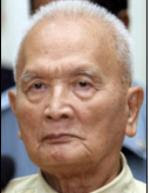
► Nuon Chea (former Chair of the People’s Representative Assembly and the Khmer Rouge’s chief ideologue) (below left), and
► Ieng Thirith (former Minister of Social Affairs and Ieng Sary’s wife) (below right).
As a result of the Closing Order, which officially ends the formal investigation by the Co-Investigating Judges, the four defendants will be tried for crimes against humanity, grave breaches of the Geneva Conventions, genocide, and offenses under the 1956 Cambodia Criminal Code. In light of the enormity of the crimes committed by the Khmer Rouge, the Co-Prosecutors in their 2007 Introductory Submission asked the Co-Investigating Judges (“CIJs”) to focus their investigation on specific crimes in specific sectors, including:

  • the multiple displacements of the population;
  • the establishment of abusive cooperatives and worksites;
  • the “re-education” of “bad elements” and the elimination of "enemies” in security centers and execution sites;
  • crimes against particular minorities in Cambodia (including Cham Muslims, those of Vietnamese descent, Buddhist adherents, and individuals affiliated with prior regimes);
  • and the “regulation of marriage,” which concerns forcible marriage and sexual relations as discussed here.
The overarching theory of the cases is that the Khmer Rouge used these criminal means to implement its revolutionary project. The Closing Order notes:
Whilst the existence of an ideological project cannot, as such, be considered to be a legal element of crimes against humanity, the implementation of the plan adopted, by criminal means in the case in point by the [Khmer Rouge] authorities demonstrates the widespread and systematic character of the attack.
As we've seen in a number of such cases, the CIJs invoke crimes against humanity as an umbrella charge to cover a range of abuses. The murder and extermination charges stem from purges of Khmer Rouge enemies (such as members of the prior regime) and killings committed at security centers and execution sites. Starting in 1977, the killing of members of the Vietnamese and Cham communities reached a scale so as to qualify as extermination as well as genocide. In addition, the CIJs imply that the charged persons could be convicted for extermination for the high numbers of deaths resulting from the large-scale population movements as well as the conditions of life in the security centers.
Enslavement, imprisonment and torture charges stem mainly from abuses at worksites, cooperatives, and security centers. At these sites, Khmer Rouge staff exercised

total control and all of the powers attaching to the right of ownership over the persons placed there . . . .
The infringements on freedom in the worksites and cooperatives also deemed to constitute imprisonment. Deportation charges concern persons of Vietnamese descent forced to leave Cambodia after the Khmer Rouge came to power.
Evolving patterns of persecution on political grounds (against intellectuals, individuals associated with the prior regime), religious grounds (against members of the Cham community and adherents to Buddhism), and racial grounds (against people of Vietnamese descent) involved grave violations of fundamental rights recognized under customary or conventional international law. The charge alleging the commission of other inhumane acts through attacks on human dignity encompasses everything from deprivations of food, shelter, medical care, sanitation etc. during the population movements to the condition of life at worksites. The rape charges stem from the arrangement of forced marriages, which are also charged as other inhumane acts.
The Co-Investigating Judges have already determined the admissibility of over two thousand Civil Party applications (of over four thousand filed). Other applications were rejected primarily because the Civil Parties did not allege acts falling within the situations under investigation, and a number of these are under appeal. The Civil Parties whose applications were deemed admissible include forty-one victims based in the United States who are represented by the Center for Justice & Accountability, a human rights law firm based in San Francisco, led by IntLawGrrl guest/alumna Pamela Merchant, which has heretofore focused on Alien Tort Statute/Torture Victim Protection Act litigation.
There is no question that these defendants were high-level figures within the Khmer Rouge, responsible for launching a radical and ultimately disastrous revolutionary program. Case 002 will determine the extent to which they can be held responsible for the crimes committed in connection with implementing this project throughout the country given that mid-level cadre may have had considerably discretion in to how to best advance the revolution.
To date, all these defendants have either denied their knowledge of or involvement in abuses by their subordinates or laid responsibility at the feet of their dead compatriots, Pol Pot (“Brother Number One”) (right) or Ta Mok (head of the Revolutionary Army of Kampuchea) (above left).

Stay tuned!

For a longer discussion of the Closing Order, see my ASIL Insight.

Go On! Proving International Sex Crimes

The Forum for International Criminal and Humanitarian Law in connection with Yale University and the University of Cape Town is hosting a seminar on "Proving International Sex Crimes" in New Haven on Oct. 15-16, 2010.
Professor Morten Bergsmo (University of Oslo, Visiting Professor at Georgetown Law Center) (right) is organizing the seminar and will also serve as a moderator for IntLawGrrls' workshop two weeks later on Gender and International Criminal Law at ASIL's Tillar House.
The purpose of the Yale seminar is to

advance the discourse on international gender crimes by addressing one of its weakest links, the effective enforcement of individual criminal responsibility for such violations, in particular for those with higher responsibility.

Key questions to be explored include:

  • What are the legal requirements for such crimes for the different forms of participation in their commission?
  • Which requirements are conduct-specific and which refer to the context in which the conduct occurred?
  • How have the different legal requirements been proved in cases?
  • Where do the main difficulties lie and what are the typical excuses?
  • What is the significance of 'systematic' sexual violence, sexual violence as a 'tool or instrument of warfare', and sexual violence as 'persecution'?
  • What can be learned from the prosecution of other international crimes for the prosecution of sex crimes?
The full program is available here.
Speakers include our colleagues:
IntLawGrrl Kelly Dawn Askin (Open Society Justice Initiative)
IntLawGrrl Beth Hillman (Hastings School of Law, Visiting Professor at Santa Clara University School of Law) (left)
Elisabeth Wood (Yale University) (right)
David Cohen (U.C. Berkeley)
Hope to see you there!

 
Bloggers Team