Showing posts with label Pamela Merchant. Show all posts

Go On! AI annual meeting in San Francisco

(Go On! is an occasional item on symposia and other events of interest)

Amnesty International USA will host its Annual General Meeting this weekend, March 18-20, in San Francisco. Registration details here; full agenda here. (photo at right is from last year's meeting)
Amnesty is convening a special session for human rights lawyers on Friday, March 18 at the Fairmont Hotel, 950 Mason Street, from 9 a.m.-4 p.m. The event is free, but registration is recommened. Topics will include:
  • the Foreign Sovereign Immunities Act,

  • the Torture Victims Protection Act,

  • the Alien Tort Statute,

  • corporate accountability for complicity in human rights violations, and

  • applying actions from international human rights mechanisms in U.S. courts.

Here is the full schedule:

9:00 – 9:30 Welcome and Opening Remarks: Jessica Carvalho Morris (left), Vice-Chair AIUSA Board of Directors and Director of the International and Foreign Graduate Programs, University of Miami School of Law
9:30 – 11:00 Civil Actions to Hold Human Rights Violators Accountable: Successes, Obstacles, and Future Challenges
William S. Dodge, Professor of Law at the University of California’s Hastings College of the Law

IntLawGrrl Chimène Keitner, Associate Professor of Law at the University of California’s Hastings College of the Law (right)

Andrea Evans, Litigation Director, Center for Justice and Accountability (left)

11:00 – 12:30 No Safe Haven: Criminal and Administrative Enforcement

IntLawGrrl Pamela Merchant, Executive Director, Center for Justice and Accountability (left, at podium)
IntLawGrrl Beth Van Schaack, Associate Professor of Law, Santa Clara University School of Law (below left)

Theresa Harris, AIUSA Board of Directors and Executive Director of the World Organization for Human Rights USA (right)

12:30 – 2:00 Lunch

2:00 – 3:30 Corporate Accountability: Emerging Standards

• Paul Hoffman, Schonbrun, Seplow, Seplow, Harris, Hoffman & Harrison, LLP

IntLawGrrl Natalie Bridgeman Fields, Founder and Executive Director of Accountability Counsel (right)

• Morton Winston, Founding Chair of the AIUSA Business & Human Rights Group

3:30 – 4:00 Discussion and Closing Remarks

Hope to see you there!

Samantar accountability advances

(Delighted to welcome back IntLawGrrls alumna Pamela Merchant, who contributes this guest post)

I am pleased to update you on a recent development in Yousuf v. Samantar, a human rights case that five survivors of torture brought in 2004 against General Mohamed Ali Samantar, who was Minister of Defense in Somalia (left) during the brutal Siad Barre regime.

On February 15th, the U.S. District Judge Leonie M. Brinkema ruled that this former Somali offical is not immune from suit.

This ruling in the Eastern District of Virginia clears a legal hurdle that we have been contesting for years, including at the U.S. Supreme Court.

Last June, the Supreme Court held that General Samantar was not entitled to immunity under the Federal Sovereign Immunities Act, but left open the question of whether he is entitled immunity under the common law. (Prior IntLawGrrls posts available here.) Last month's district court ruling settled that question by deferring to a statement from the State Department which unequivocally declared that General Samantar is not entitled to any immunity from suit.

The intervention in the Samantar case by the State Department is particularly significant because the United States only occasionally intervenes in litigation, and very rarely intervenes to claim that a defendant is not entitled to immunity.

The ruling ensures that our march towards accountability will continue. To learn more about the case, filed by the San Francisco-based Center for Justice & Accountability, for which I serve as Executive Director, and pro bono co-counsel Akin Gump Strauss Hauer & Feld LLP, please click here.


Teeing Up ECCC Case 002

The Co-Investigating Judges of the Extraordinary Chambers in the Courts of Cambodia (ECCC) recently filed the Closing Order for Case 002 indicting four defendants for international crimes allegedly committed during the Khmer Rouge era (1975-1979). The four defendants in question, who have been in pre-trial detention since 2007, are the surviving members of the Khmer Rouge Central Committee and/or Standing Committee:
Ieng Sary (former Deputy Prime Minister for Foreign Affairs) (left),
Khieu Samphan (former Chair of the State Presidium) (below right),
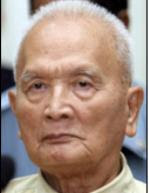
Nuon Chea (former Chair of the People’s Representative Assembly and the Khmer Rouge’s chief ideologue) (below left), and
Ieng Thirith (former Minister of Social Affairs and Ieng Sary’s wife) (below right).
As a result of the Closing Order, which officially ends the formal investigation by the Co-Investigating Judges, the four defendants will be tried for crimes against humanity, grave breaches of the Geneva Conventions, genocide, and offenses under the 1956 Cambodia Criminal Code. In light of the enormity of the crimes committed by the Khmer Rouge, the Co-Prosecutors in their 2007 Introductory Submission asked the Co-Investigating Judges (“CIJs”) to focus their investigation on specific crimes in specific sectors, including:

  • the multiple displacements of the population;
  • the establishment of abusive cooperatives and worksites;
  • the “re-education” of “bad elements” and the elimination of "enemies” in security centers and execution sites;
  • crimes against particular minorities in Cambodia (including Cham Muslims, those of Vietnamese descent, Buddhist adherents, and individuals affiliated with prior regimes);
  • and the “regulation of marriage,” which concerns forcible marriage and sexual relations as discussed here.
The overarching theory of the cases is that the Khmer Rouge used these criminal means to implement its revolutionary project. The Closing Order notes:
Whilst the existence of an ideological project cannot, as such, be considered to be a legal element of crimes against humanity, the implementation of the plan adopted, by criminal means in the case in point by the [Khmer Rouge] authorities demonstrates the widespread and systematic character of the attack.
As we've seen in a number of such cases, the CIJs invoke crimes against humanity as an umbrella charge to cover a range of abuses. The murder and extermination charges stem from purges of Khmer Rouge enemies (such as members of the prior regime) and killings committed at security centers and execution sites. Starting in 1977, the killing of members of the Vietnamese and Cham communities reached a scale so as to qualify as extermination as well as genocide. In addition, the CIJs imply that the charged persons could be convicted for extermination for the high numbers of deaths resulting from the large-scale population movements as well as the conditions of life in the security centers.
Enslavement, imprisonment and torture charges stem mainly from abuses at worksites, cooperatives, and security centers. At these sites, Khmer Rouge staff exercised

total control and all of the powers attaching to the right of ownership over the persons placed there . . . .
The infringements on freedom in the worksites and cooperatives also deemed to constitute imprisonment. Deportation charges concern persons of Vietnamese descent forced to leave Cambodia after the Khmer Rouge came to power.
Evolving patterns of persecution on political grounds (against intellectuals, individuals associated with the prior regime), religious grounds (against members of the Cham community and adherents to Buddhism), and racial grounds (against people of Vietnamese descent) involved grave violations of fundamental rights recognized under customary or conventional international law. The charge alleging the commission of other inhumane acts through attacks on human dignity encompasses everything from deprivations of food, shelter, medical care, sanitation etc. during the population movements to the condition of life at worksites. The rape charges stem from the arrangement of forced marriages, which are also charged as other inhumane acts.
The Co-Investigating Judges have already determined the admissibility of over two thousand Civil Party applications (of over four thousand filed). Other applications were rejected primarily because the Civil Parties did not allege acts falling within the situations under investigation, and a number of these are under appeal. The Civil Parties whose applications were deemed admissible include forty-one victims based in the United States who are represented by the Center for Justice & Accountability, a human rights law firm based in San Francisco, led by IntLawGrrl guest/alumna Pamela Merchant, which has heretofore focused on Alien Tort Statute/Torture Victim Protection Act litigation.
There is no question that these defendants were high-level figures within the Khmer Rouge, responsible for launching a radical and ultimately disastrous revolutionary program. Case 002 will determine the extent to which they can be held responsible for the crimes committed in connection with implementing this project throughout the country given that mid-level cadre may have had considerably discretion in to how to best advance the revolution.
To date, all these defendants have either denied their knowledge of or involvement in abuses by their subordinates or laid responsibility at the feet of their dead compatriots, Pol Pot (“Brother Number One”) (right) or Ta Mok (head of the Revolutionary Army of Kampuchea) (above left).

Stay tuned!

For a longer discussion of the Closing Order, see my ASIL Insight.

Prizing human rights

An institution established in memory of a Nuremberg prosecutor is seeking prize nominees.
Institution:
The Thomas J. Dodd Research Center, dedicated in 1995 at the University of Connecticut. The Center's namesake is Thomas J. Dodd, who began his career in the U.S. Department of Justice and went on to serve as a senior prosecutor at Nuremberg (right), cross-examining defendants in the Trial of the Major War Criminals and serving too in subsequent Nuremberg proceedings. (photo credit) Dodd, born in 1907, was a Democratic U.S. Senator from Connecticut from 1959 until a few months before his death in 1971; his children include the retiring senior Senator from Connecticut, who published his father's Letters from Nuremberg (2007), as well as a former U.S. Ambassador.
Prize:
The Thomas J. Dodd Prize in International Justice and Human Rights, awarded biennially by the University of Connecticut "to an individual or group who has made a significant effort to advance the cause of international justice and global human rights." Previous winners (here and here): 2003, Bertie Ahern and Tony Blair, then Prime Ministers of Ireland and Britain, respectively; 2005, Louise Arbour (left), then U.N. High Commissioner for Human Rights, and former South African Constitutional Court Justice Richard J. Goldstone, like Arbour a onetime Chief Prosecutor of the International Criminal Tribunals for the former Yugoslavia and Rwanda; 2007, the Center for Justice & Accountability, of which IntLawGrrls guest/alumna Pamela Merchant serves as Executive Director, and Mental Disability Rights International, last month renamed Disability Rights International; and 2009, the Committee to Protect Journalists.
To nominate a worthy individual or group for this monetary prize (no self-nominations accepted), complete and submit the form available here. Deadline is December 31, 2010.

U.S. Supreme Court soon to hear Somalia human rights case

(IntLawGrrls welcomes this guest post from our guest/alumna Pamela Merchant)

At the start of its new Term this month, the U.S. Supreme Court announced that it will hear arguments in Case No. 08-1555, Samantar v. Yousuf. The decision represents a 1st for the nongovernmental organization that I head, the San Francisco-based Center for Justice and Accountability.
In 2004, CJA and and pro bono co-counsel at the law firm of Cooley Godward Kronish sued Somali General Mohamed Ali Samantar on behalf of 4 Somali men and 1 Somali woman. The complaint, based on the Torture Victim Protection Act and filed in the the U.S. District Court for the Eastern District of Virginia, accused Samantar of a wide range of human rights abuses, including torture, extrajudicial killing, and war crimes, committed during the regime of Siad Barré during the 1980s. Samantar was Somalia's Minister of Defense from 1980 to 1986 and Prime Minister from 1987 to 1990; he now resides in Fairfax, Virginia.
This past January, the U.S. Court of Appeals for the Fourth Circuit reinstated the suit, thus reversing the district court's 2007 dismissal.
Here's the issue before the Supreme Court:
Whether a foreign state’s immunity from suit under the Foreign Sovereign Immunities Act (FSIA), 28 U.S.C. § 1604, extends to an individual acting in his official capacity on behalf of a foreign state and whether an individual who is no longer an official of a foreign state at the time suit is filed retains immunity for acts taken in the individual’s former capacity as an official acting on behalf of a foreign state.
To date, no person has ever been held legally responsible for the abuses committed by the military government against the civilian population of Somalia in the 1980s.
The Supreme Court's decision to hear Samantar represents a key point in CJA's struggle to combat the recent rise of immunity defenses to avoid accountability in human rights cases. Given the fact that the Supreme Court takes only 80 cases per year, we were surprised that a CJA human rights case made it to the top of the docket. Having said that, we are confident that we prevail and that our clients will ultimately have their day in court.


Gitmo 'Grrls

(One in a series on Experts at Law)Link

As mentioned in our recent Read On! Review, a recurrent theme in IntLawGrrl Kristine A. Huskey's new book is, to quote her,
the fact that women are woefully scarce in national security law, my chosen field. I do not mean to convey that I am the only woman in this field, as there are many women writing, speaking about, and practicing nationalsecurity legal issues, specifically relating to Guantánamo ...
She continued:
[E]very one of these women will tell you that they, too, are often the only female speaker on these issues in a conference room or on a panel filled with men. The world can stand to have more women in fields that are traditionally filled by men.
(pp. iv-v) Kristine then proceeded "to name a few" of the Gitmo 'Grrls who jumped to mind. Her list is reproduced here, along with links to these women and some of their works:
► IntLawGrrl Beth Van Schaack, Santa Clara Law. Her IntLawGrrls posts are here; list of other publications is here.
► IntLawGrrl yours truly (thanks, Kristine!), University of California, Davis. My IntLawGrrls posts are here; list of other publications is here.
Leila Nadya Sadat, Washington University. IntLawGrrls posts about her are here; publications list is here.
Gitanjali S. Gutierrez, Center for Constitutional Rights, attorney for detainees. IntLawGrrls posts about her are here; her op-ed is here.
Agnieszka M. Fryszman, partner at Cohen Milstein, attorney for detainees.
Beth Gilson, attorney for detainees.
H. Candace Gorman, attorney for detainees, whom the Chicago Tribune recently profiled. She runs 2 Gitmo blogs, here and here.
Sylvia Royce, attorney for detainees.
Sarah Havens, Allen & Avery, attorney for detainees.
Becky Dick, attorney for detainees.
Hina Shamsi, staff attorney at the National Security Project of the American Civil Liberties Union. Her ACLU blog posts are here.
Maria LaHood, Center for Constitutional Rights.
Opinio Juris' Deborah Pearlstein, Princeton University. IntLawGrrls posts about her are here; her OJ posts are here; her publications list is here.
Karen J. Greenberg, New York University. IntLawGrrls posts about are her here; some publications are listed here; her newest Gitmo book is here.
Suzanne Spaulding, Bingham Consulting Group and former Executive Director of the National Commission on Terrorism, among many other natsec posts. An op-ed by her is here.
Kate Martin, Center for National Security Studies. Some of her publications are here.
Sahar Aziz, formerly an associate at Cohen Milstein, now Senior Policy Advisor at Office for Civil Rights, U.S. Department of Homeland Security.
Barbara Olshansky, attorney for detainees. Her books are here.
Jennifer Daskal, formerly senior counterterrorism counsel at Human Rights Watch, now a Department of Justice attorney.
Recognition is due to many other women as well, of course. (Readers' nominations welcome!)
There are, for example, all the IntLawGrrls and guests/alumnae who have contributed posts in IntLawGrrls' "Guantánamo" series. In addition to Beth, Kristine, and I, they are Elena Baylis, Ursula Bentele, Fiona de Londras, Monica Hakimi, Lynne Henderson, Elizabeth L. Hillman, Dawn Johnsen, Michelle Leighton, Pamela Merchant, Naomi Norberg, Hari M. Osofsky, Jaya Ramji-Nogales, and Lucy Reed. Not to mention guests/alumnae Mary L. Dudziak, editor of this book, and Mary Ellen O'Connell, interviewed here, both with respect to post-9/11 issues. Or my University of California colleague Laurel E. Fletcher, co-author of this book, an empirical study of the fate of ex-detainees.
And there are also the women who shared a Quonset-like tent with Jen Daskal and me during the December '08 week that, as posted earlier, I spent observing Gitmo military commissions on behalf of the National Institute of Military Justice. (A fuller account of my visit begins at page 9 of this report, which also includes dispatches from Executive Director Michelle Lindo McCluer and other NIMJ'ers) These tentmates were: Jill Heine, Amnesty International; Stacy Sullivan, Human Rights Watch; and Devon Chaffee, Human Rights First. And don't get me started on the many women journalists I met at Gitmo, or on the women JAG lawyers whom I watched provide excellent representation of various detainees as detailed defense counsel.
Bottom line -- memo to media reps, conference organizers, anthology editors, etc.:
There are many, many women now working in the field of national security. We've given you the list; it's your job to get in touch. As we posted when a similar issue arose years ago, the key is not only having women "in" the supposedly nontraditional fields of law. It's also having them recognized as being there.

In Spain, jurisdiction won't be truly universal

(Thanks to IntLawGrrls for giving me this opportunity to contribute this guest post and my transnational foremother dedication.)

The bill that would restrict universal jurisdiction in Spain, about which IntLawGrrls have posted here and here, constitutes an important setback in the Spanish contribution to the fight against impunity.
Why the setback?
A number of factors that have paved the way for the reform of Spanish legislation:
► The concerns of some about the ongoing dozen cases being investigated by Spain's Audiencia Nacional, cases through which it plays a role as, effectively, a universal court;
► Political pressure from states like China and Israel; and
► The path taken by the European Union to come to terms with the African Union, as reflected in the April 2009 AU-EU Expert Report on the Principle of Universal Jurisdiction -- about these regional organizations' respective understandings on the principle of universal jurisdiction.
This bill (text in English here) would move away from the “pure” universal jurisdiction allowed in Spain's current law, codified at Articles 23 and 24 of Ley Orgánica 6/1985, de 1 de julio, del Poder Judicial. As IntLawGrrl guest/alumna Pamela Merchant has noted, the proposed legislation has many flaws. By way of example, it would introduce:
► Extremely demanding conditions -- even a reverse interpretation of the principle of complementarity that is a cornerstone of the Statute of the International Criminal Court.
► Limitations on the exercise of universal jurisdiction that resemble a doctrine repudiated by Spain's highest court. The limitations resemble the doctrine that Spain's Tribunal Supremo advanced in 2003, in an appeal against the Audiencia Nacional decision in the Guatemala Genocide Case mentioned in Merchant's post. By an 8-7 vote Spain's supreme court maintained in 2003 that only cases with a “legitimating connection,” such as the nationality of the victim or the presence of the offender, could proceed; moreover, the connection was said to have to be present in the principal charges, not just in related or ancillary charges against the defendant. But a higher court in Spain, the Tribunal Constitucional, annulled that ruling two years later. The constitutional court (left) held that the physical presence of the suspect is not required to initiate an investigation based on universal jurisdiction. It also held that territorial courts and an international court have priority over Spanish courts exercising universal jurisdiction; however, universal jurisdiction could be exercised by Spanish courts if a party to the case submitted demonstrated that courts in the territorial state were unwilling or unable to investigate and prosecute effectively the crimes alleged in the complaint. Thus it established that the law did not require the showing of a link between the prosecution of a universal jurisdiction crime and Spain's national interest; indeed, the Tribunal Constitucional considered requirement of such a link to be "contrary to the spirit" of the principle of universal jurisdiction. (photo credit)
It is one thing is to limit abuse and subject the exercise of universal jurisdiction to reasonable limits, such as those envisaged in the Princeton Principles on Universal Jurisdiction (2001) or in some of the provisions of the Krakow Resolution on "universal criminal jurisdiction with regard to the crime of genocide, crimes against humanity and war crimes," adopted in 2005 by the Institut de Droit International. But it is very different thing to adopt limitations so far-reaching that the defeat the purpose of the principle of universal jurisdiction.
As Lloyd Axworthy, formerly Canada's Foreign Minister and now President and Vice Chancellor of the University of Winnipeg, put it in this 2006 essay:

The application of universal jurisdiction does not entail a diminution of state sovereignty but rather the enforcement of a collective and fundamental system of criminal justice.

An end to universal jurisdiction?

(Thanks to IntLawGrrls for giving me this opportunity to contribute another guest post.)

El Congreso de los Disputados (left), Spain's lower house of Parliament, has passed a bill that would limit the reach of universal jurisdiction and profoundly restrict Spain's ability to prosecute serious human rights crimes. (The legislative push was mentioned in this prior IntLawGrrls post.) The bill, available in English translation here, will go before the Spanish Senate for a final vote in the fall.
As is well known, the Spanish universal jurisdiction law was used to pursue former Chilean dictator Augusto Pinochet in 1998. Since then, the law has allowed Spanish courts to stand as a last resort for victims who cannot find justice at home:
► Using this law, Spanish courts have issued warrants for top Rwandan leaders and convicted an Argentine official for "dirty war" killings.
► The law also forms the basis for the Guatemala Genocide Case and the 1989 Jesuits Massacre Case in El Salvador, both now being litigated by the Center for Justice & Accountability, the San Francisco-based nongovernmental organization for which I am Executive Director.
As detailed here, the bill is flawed, yet there may well be constructive means by which the Spanish legislature can clarify the application of the universal jurisdiction law. For instance, the proposed bill correctly adds crimes against humanity to the list of admissible crimes. But the amendment will do nothing to streamline the legal process or to weed out spurious claims from the many legitimate human rights cases that have been brought. Worse still, this amendment may close the doors of Spanish justice to thousands of survivors of human rights abuses. This bill should not become law.
We'll continue to work with the Asociación Pro Derechos Humanos de España, and other partners around the world, to oppose this legislation as it stands and to seek reforms that will protect this powerful tool for human rights.

Guest Blogger: Pamela Merchant

It's IntLawGrrls' great pleasure today to welcome a most timely guest post from our colleague Pamela Merchant (left).
Pamela is Executive Director of the Center for Justice and Accountability, an 11-year-old, San Francisco-based nongovernmental organization that promotes human rights through means including litigation against persons accused of committing torture.
An honors graduate of Georgetown University and Boston College School of Law, Pamela has 20 years' experience in the practice of complex state and federal litigation. She served for 8 years as a federal prosecutor with the U. S. Department of Justice, Criminal Division, where she specialized in white collar prosecutions. More recently, she was Special Counsel to the California Attorney General where she coordinated the affirmative litigation that the state filed in connection with the California energy crisis. She has also been a civil prosecutor for the Commonwealth of Massachusetts, and has represented clients in private practice. Immediately before joining CJA, she represented the San Francisco in energy and telecommunications matters.
A member of the Board of Directors of the International Gay and Lesbian Human Rights Commission, the Northern California Community Loan Fund, and Continuum (which provides innovative services to low income individuals living with HIV/AIDS), Pamela recently completed a 3-year term on the board of Bay Area Lawyers for Individual Freedom. She was the founding President of a Massachusetts non-profit which provides financial services to lo- income elderly individuals, and was a member of the Expert Review Panel for the City of San Francisco’s Department on the Status of Women, Violence Against Women Grant Program. For many years she was a member of the Board of Directors of Gay and Lesbian Advocates and Defenders (GLAD), of which she also served as President.
In her guest post below, Pamela discusses the recently released "torture memos" in relation to CJA's ex-detainee clients, and argues that the United States should move now toward accountability at home.
Heartfelt welcome!

Time for US to move toward accountability

(My thanks to IntLawGrrls for the opportunity to guest-post on an issue of special importance to the NGO for which I am Executive Director, the Center for Justice and Accountability)

Last week, President Obama released four declassified memos written by the Office of Legal Counsel under the Bush administration. These memos provided a legal framework for the torture of detainees held by the CIA in connection with the "War on Terror." (Prior IntLawGrrls posts here, here, and here.)
The contents of the memos are spine-chilling. Government lawyers employed strained legal reasoning to eviscerate the definition of torture under international and domestic U.S. law. In effect, these memos gave the imprimatur of the U.S. Justice Department to abhorrent and illegal acts. The memos authorized interrogators:
► to slam a prisoner's head against a wall repeatedly;
► to deprive prisoners of sleep for eleven days at a time; and even
► to subject prisoners to "waterboarding," a technique of controlled suffocation that was used extensively by the Spanish Inquisition and by the Khmer Rouge during the genocide in Cambodia. As a result of these legal opinions, one prisoner was waterboarded 183 times.
In one of the memos, Steven G. Bradbury, then Principal Deputy Assistant Attorney General, opines on what constitutes "prolonged mental harm" as a result of torture. In doing so, he cites to Mehinovic v. Vuckovic, CJA's case against a Bosnian torturer Nikola Vuckovic. Bradbury juxtaposes waterboarding, which is used to "induce a sensation of drowning," with the game of "Russian roulette," which CJA clients Kemal Mehinovic, Muhamed Bicic, Safet Hadzialijagic and Hasan Subasic experienced while being held in a Bosnian detention camp. Strangely, Bradbury concludes that that waterboarding is an acceptable form of torture, but "Russian roulette" is not. Needless to say, CJA's clients who have been subjected to waterboarding would disagree.
In the statement accompanying the release of these memos, President Obama stated that he believes strongly in "transparency and accountability." Certainly, transparency is a virtue, and more light must be shed on the torture program outlined in these memos. But transparency alone will not serve to deter torture unless it is followed by accountability. The disclosure of these memos is only the first step in ensuring that the United States will never again violate the prohibition against torture.
It is time to make the next step.
In order to hold the authors of these memos accountable, CJA joins human rights groups around the world in calling on Congress and the Obama administration to investigate and, if warranted, prosecute U.S. officials responsible for torture. Those held responsible should include:
► the interrogators who committed torture,
► the lawyers and senior officials who authorized torture, and
► the medical personnel who oversaw torture.
Investigating torture is not only our moral duty: it is our legal obligation. When the U.S. Senate ratified the Convention Against Torture in 1994, we committed ourselves as a nation not only to refrain from torture but to prosecute perpetrators when there is evidence of a crime.
Recent events show that if the U.S. government fails to enforce its own laws, foreign courts may step into the breach.
One effort to hold U.S. officials accountable in a foreign court is already underway. Last Friday, Judge Baltasar Garzón (left) of the Spanish National Court decided that a criminal complaint against six Bush administration lawyers and advisers could proceed. The complaint alleges that Spanish citizens detained at Guantánamo were subjected to a program of torture devised and authorized by senior Bush administration officials. (Prior IntLawGrrls posts here and here.) Although CJA supports the principle of universal jurisdiction underlying the Spanish criminal complaint, we strongly believe that the endgame must be a formal investigation of the allegations of torture and prosecutions in the U.S. justice system.
The timely release of the OLC torture memos and the Spanish criminal complaint underscore the urgent need for the U.S. government to take this essential step towards accountability.
Our human rights reputation depends on it.

Child soldier accountability

The good news:
Upon signature last week by President George W. Bush, the Child Soldier Accountability Act became U.S. law. This means that recruitment and use in combat of children are now criminal acts subject to prosecution in U.S. courts. Criminalized is recruitment of children "under 15." As Human Rights Watch details here, that age line comports with the 31-year-old protocols to the 59-year-old Geneva Conventions; however, it is much lower than the line of 18 drawn in many later international law instruments.
The bad news:
The age-line discrepancy is no small thing.
Notwithstanding U.S. officials' apparent recognition that children recruited to serve as soldiers are victims of crime, the United States persists in its prosecution of alleged child soldiers. Among them, as we've posted, is Toronto-born Omar Khadr, was 15 years old when captured in Afghanistan. He's spent his adolescence at the U.S. military base at Guantánamo Bay, Cuba, under conditions of detention and interrogation (above; credit) that his lawyers say have harmed his mental health. The situation has been condemned by Canada's Supreme Court, and lawyers have demanded Khadr's repatriation. Although plans to start a trial by military commission yesterday have been scrapped, U.S. efforts to prosecute Khadr -- on charges of murder, attempted murder, conspiracy, material support for terrorism -- continue. In similar predicament is another detainee, Mohammed Jawad, 16 when captured; see Jamil Dakwar 's ACLU Blog post here.
Some day, perhaps, there will be a measure of accountability for the treatment of these child soldiers?


(Hat tip on news of the new U.S. law to Pamela Merchant at the Center for Justice and Accountability, a San Francisco-based NGO)

 
Bloggers Team