Showing posts with label detention. Show all posts

Law, not fear, should guide detention

(Delighted to welcome back alumna Laurie Blank, who contributes this guest post)

Hearings have begun on proposed House and Senate legislation designed to create a comprehensive framework for the detention of individuals captured in the course of U.S. counterterrorism operations against al Qaeda and other terrorist groups. Those who have decried the lack of a statutory framework for what appears to be the inevitable long-term detention of suspected terrorists will likely welcome the proposed legislation as the long-awaited antidote to the ad hoc process that has developed over the past nine-and-a-half years.
As I argue in a recent op-ed in the Atlanta Journal Constitution, entitled "Build Detainee Policy on Sound Law," however, mere legislation itself is not the answer.
Legislation based on the fundamental moral and legal principles that guide our country would be a giant step forward – for fair and effective counterterrorism that balances national security and individual rights. But neither the Detainee Security Act (House, proposed by Representative McKeon) nor the Military Detainee Procedures Improvement Act (Senate, proposed by Senators McCain, Graham, Lieberman and others) fits the bill.
These proposed bills are based primarily on fear. On the fear that civilian courts cannot handle terrorism cases and on the fear that courts will not defer completely to the Executive’s claims of national security when faced with grave violations of individual rights.
The first fear is unfounded.
Since September 11th, over two hundred suspected terrorists have been prosecuted in federal courts with a conviction rate over 91%. We have hundreds of convicted foreign terrorists in prison in the U.S. right now. In contrast, fewer than five have been tried before the military commissions and most of those have already been released. The military commissions have seen significant improvement from their first iteration, but still remain barely tested both in substance and numbers of prosecutions.
These numbers demonstrate that completely foreclosing all trials in civilian courts and all transfers of detainees to the United States is not grounded in careful policy analysis. It seems to be based instead on the fear of those who are suspected – not proven – of trying to kill Americans, and a reactive desire to therefore deny them rights. The worst serial murders in U.S. history got full and fair trials. What is it about the word “terrorist” that makes us forget where we come from?
But it is the second fear that should catch the breath of every American.
The proposed bills simply legislate the courts out of the picture altogether. The annual periodic review process created to assess the continued detainability of detainees at Guantánamo (or future detainees) has no appeal process. This is important enough to repeat – no appeal process. There is no doubt that an annual review is better than long-term detention with no review process at all. This incremental improvement is insignificant, however, when the review board is not accountable in any way to a court or any other method of independent judicial review.
The Senate bill actually goes one step further still. In a total bow to Executive authority, the legislation states that the review panel’s finding regarding a detainee’s continued detention is simply a recommendation and does not bind the President. This is the ultimate dagger in the heart of separation of powers and checks and balances – a Congressional license of complete Executive authority and no courts to say otherwise.
The Geneva Conventions do not, to be sure, mandate judicial review of all detention determinations, either for prisoners of war under Article 5 of the Third Geneva Convention or under Article 43 of the Fourth Geneva Convention. Both require necessary guarantees of independence and impartiality, not a particular type of forum, judicial or administrative or other. Beyond the fact that the proposed legislation raises serious questions about whether the review panels can meet this test, the lack of judicial involvement in the long-term detention review process poses a much greater problem. As I discussed in my recent article, on which I previously posted, to call the indefinite detention at Guantánamo – both ongoing and future – detention “under the laws of war”” is a significant stretch of the traditional concept of law of war detention. When we do not know how long this conflict will last or the parameters of the battlefield, when detention effectively serves a punitive purpose rather than a protective purpose, judicial engagement in the process is critical to ensuring protection of individual rights.
The only reason to keep the courts out, as the proposed legislation seeks to do, is the fear that the courts will not approve of the process, either in individual cases or overall. The fear that courts might actually inject individual rights into the equation, upsetting the current complete dominance of national security interests over any other interest, no matter how fundamental.
We have learned the lesson of an unchecked executive before – with the suspension of habeas corpus during the Civil War and the internment of Japanese-Americans during World War II – and in both cases it was the courts that set us back on course and restored the balance between national security and individual rights.
As detailed in IntLawGrrls' many posts on Guantánamo, when detention there threatened to become truly a legal black hole in the first years after September 11th, the Supreme Court repeatedly held that detainees at Guantánamo have a right to legal representation and to habeas corpus – in essence, a right to exist in a legal framework. Let’s give our courts a direct role in that legal framework – detention without trial raises extraordinary challenges to American values; independent and robust judicial review throughout the process can help to mitigate those challenges and the risk to fundamental principles.
Supporters of indefinite detention – and likely of the proposed bills in the House and Senate – staunchly defend it as “detention under the laws of war.” If the detention is founded on fundamental legal principles signed and ratified by every nation around the world, then why keep the courts out of the business of reviewing and assessing the lawfulness of such detention?
Legislating based on panic is neither moral nor effective. America needs a counterterrorism strategy – including detention of suspected terrorists where appropriate – that is based on sound legal principles and paradigms, not just on the fear of a future attack.

African lessons on terror detention

(My thanks to IntLawGrrls for the opportunity to contribute this guest post)

On 7 March President Barack Obama signed an executive order facilitating the indefinite detention of a group of Guantánamo prisoners. As IntLawGrrl Beth Van Schaack posted, the order introduces a new system of periodic review of Guantanamo prisoners as well as the resumption of military trials.
Human rights activists view this as a step backwards.
I believe South Africa's Apartheid experience has a special relevance and resonance for the so-called ‘war on terror’.
Much of the current concern regarding the impact of security legislation on human rights centers on the treatment of detainees in places of detention. "The Regulation of Detention in the Age of Terror - Lessons from the Apartheid Experience", an article that my co-author James Fowkes and I published in 2009 in the South African Law Journal, considered the regulation of detention during Apartheid to see what principles or lessons can be gleaned from that experience that can be useful for regulating detention in the context of terrorism.
Following a summary of the most important security legislation during Apartheid, the article examines the nature of the Guidelines and Measures for the Prohibition and Prevention of Torture, Cruel, Inhuman or Degrading Treatment or Punishment in Africa (Robben Island Guidelines). These Guidelines, drawn up in 2002 by the African Commission on Human and Peoples' Rights (logo below left), aimed at the punishment and prevention of torture in Africa. It is the aim of the Robben Island Guidelines to assist African countries in designing systems that will be effective in combating torture. It is our contention that the Apartheid experience reveals several respects in which they are not an adequate guide. Whereas the monitoring mechanisms of the Guidelines should be taken seriously, they can be improved upon.
The paper examines the behaviour of the Apartheid judiciary and its performance in providing oversight of the executive’s actions. It then turns to consider the performance of the Apartheid judiciary in two areas key to court regulation of torture:
► The approach to the admissibility of evidence, and
► The weighing of fact in adjudicating torture allegations.
We conclude that even in authoritarian systems threats to national security (whether real or imaginary) seldom fall exclusively within the domain of the executive. It is therefore not naïve to believe that the law can have a positive effect on the way detainees are treated. We offer proposals in the article, as a contribution to the African effort to design systems that will be resilient to practices such as torture in security situations. We believe our proposals have a wider significance and can be a resource upon which lawyers all over the world can draw.


Breaking News: Obama's Executive Order on Guantánamo

The White House released today the long-promised Executive Order on detainee policy along with a fact sheet setting forth additional policy points (see prior posts here, here and here). President Obama's statement on the new policy is here.

The E.O. states that it has been issued pursuant to the President's constitutional authority as well as the September 2001 Authorization for Use of Military Force. It does not purport to establish any additional or separate source of detention authority. The Order and fact sheet articulate the following elements:

1. The fact sheet calls for the resumption of trials before military commissions "for international terrorists that [sic] fall within their jurisdiction" in light of "key reforms" to the military commission system, including the bar on the use of statements taken as a result of cruel, inhuman or degrading treatment. As our readers will recall, in Hamdan v. Rumsfeld, the Supreme Court confirmed that military commissions may only assert jurisdiction over violations of the law of war as opposed over crimes that are defined by general international criminal law, domestic law, or the international prohibitions against terrorism. Here is Secretary of Defence Gates's statement rescinding the moratorium.

2. The E.O. establishes a periodic review of the continued detention of current detainees who have been deemed to qualify for prolonged security detention by the inter-agency review mandated by E.O. 13492 (Jan. 22, 2009) or those individuals who have been referred for prosecution but have not yet been charged or prosecuted. By the terms of the E.O., this periodic review will not apply to future detainees. This review is also separate and apart from the habeas rights already being asserted with varying degrees of success by detainees in federal courts. Although some details of this process are provided in the E.O., full implementing guidelines will be issued by the Secretary of Defense in consultation with the Attorney General. The standard for continued detention is that an individual's detention is

necessary to protect against a significant threat to the security of the United States.
3. Each current detainee is entitled to a full initial review within one year of this date before an inter-agency Periodic Review Board (PRB) composed of representatives from the Departments of State, Defense, Justice and Homeland Security as well as the offices of the Director of National Intelligence and the Chair of the Joint Chiefs of Staff. Then, detainees are entitled to a "file review" every 6 months that will consider "relevant new information" compiled by the Secretary of Defense plus a written statement from the detainee. The file review may result in a full review if "a significant question is raised as to whether the detainee's continued detention is warranted." Barring this, subsequent full reviews are to be provided triennially. (Note: The 4th Geneva Convention calls for a 6-month review of all security detentions of non-POWs).

4. The initial and periodic full reviews shall involve the following procedural steps and protections:
  • the provision of notice of the review and a summary of the factors to be considered by the PRB in determining whether continued detention is warranted;
  • the right of the detainee to submit evidence and witness testimony relevant to the determination of whether the detention remains necessary;
  • the provision of all information relevant to the inquiry, including "mitigating information," except where there are national security concerns that might require the provision of "a sufficient substitute or summary" rather than the raw material;
  • there is no adversarial discovery allowed from the government;
  • the detainee is entitled to a personal representative (who is an advocate) and private counsel (at the detainee's expense);
  • a "reliability" determination of all the information provided by the PRB;
  • a "prompt" written disposition, including recommendations for transfer conditions in the event that the continued detention standard has not been met;
  • review by a Review Committee (composed of the Secretary of State, the Secretary of Defense, the AG, the Secretary of Homeland Security, the Director of National Intelligence, and the Chair of the Joint Chiefs of Staff) on that Committee's discretion or if consensus within the PRB cannot be reached;
  • no appeal of any review process is available to the detainee.
5. According to this review process, once an individual's detention is no longer "necessary to protect against a significant threat to the security of the United States," the Secretaries of State and Defense are to identify a suitable transfer location outside the United States consistent with the national security and foreign policy interests of the United States. The Secretary of State shall be responsible for obtaining appropriate security and humane treatment assurances regarding transferees. Transfer efforts shall be reviewed annually by the Review Committee. This will include a consideratin of those individuals whose detention is no longer deemed warranted pursuant to the new periodic review process as well as those individuals whose petition for a writ of habeas corpus has been granted.

6. The fact sheet promises the launch of additional criminal prosecutions in Article III courts. The fact sheets criticizes Congress's "intrusion" into this process and promises to seek the repeal of restrictions on the prosecution of detainees in federal courts (see our discussion here and here).

5. The fact sheet indicates that the Executive remains committed to exercising its discretion to choose the appropriate forum for further prosecutions, including with respect to individuals whom the United States may "apprehend in the future." The fact sheet argues:
A one-size-fits-all policy for the prosecution of suspected terrorists, whether for past or future cases, undermines our Nation’s counterterrorism efforts and harms our national security.
6. The fact sheet expresses support for two "components" of the international legal framework governing armed conflicts:

a. Protocol II, i.e., the Protocol Additional to the Geneva Conventions of 12 August 1949, and relating to the Protection of Victims of Non-International Armed Conflicts (June 8, 1977), and
b. Article 75 of Protocol I to the 1949 Geneva Conventions.

With respect to the former, the Administration recommends ratification, particularly in light of the fact that an inter-agency review has concluded that U.S. military practice is consistent with the Protocol and its imperative of humane treatment in the conduct of armed conflicts. With respect to the latter, the United States is already on record indicating that Article 75 of Protocol I constitutes customary international law vis-a-vis international armed conflicts (query its relevance here given that the conflict has been characterized as non-international by the Supreme Court in Hamdan). The fact sheet does not repeat this observation, but it does reaffirm that the Article is "consistent with our current policies" and has historically earned our support. Article 75 provides certain "fundamental protections" that apply in international armed conflicts, broadly defined, to those individuals "in the power of a Party to the conflict and who do not benefit from more favourable treatment under the Conventions or under this Protocol." These basic protections include:

► The right to be treated humanely in all circumstances and without discrimination.
► The right to respect for the person, honour, convictions and religious practices of all such persons.
► Prohibitions on the following acts "at any time and in any place whatsoever, whether committed by civilian or by military agents:"
  • violence to the life, health, or physical or mental well-being of persons, including (i) murder; (ii) torture of all kinds, whether physical or mental; (iii) corporal punishment; and
    (iv) mutilation;
  • outrages upon personal dignity, in particular humiliating and degrading treatment, enforced prostitution and any form of indecent assault;
  • the taking of hostages;
  • collective punishments; and
  • threats to commit any of the foregoing acts.

► The right of any person arrested, detained or interned for actions related to the armed conflict to be informed promptly of the reasons for the detention. Any such preventative detention must be as short as possible:
Except in cases of arrest or detention for penal offences, such persons shall be released with the minimum delay possible and in any event as soon as the circumstances justifying the arrest, detention or internment have ceased to exist.

► The right to have any sentence or penalty be made pursuant to "a conviction pronounced by an impartial and regularly constituted court respecting the generally recognized principles of regular judicial procedure." These protections include the following:
  • the right to be informed of charges without delay,
  • all necessary rights and means to launch a defense,
  • the right to be judged based upon one's individual responsibility,
  • the protection against ex post facto prosecution,
  • the principle of lenity,
  • the right to be presumed innocent until proven guilty,
  • rights to be present at trial, confrontation rights and the protection against self-incrimination, and
  • the protection of res judicata
7. The fact sheet reiterates the administration's long-term policy of closing the detention facility on Guantánamo.

8. This law-of-war detention policy shall be reviewed every four years.

Go On! Law of War Detention

(Go On! is an occasional item on symposia and other events of interest)

A discussion on "Law of War Detention" will be held from 3-4:30 p.m. next Wednesday, February 9, at Tillar House, the headquarters of the American Society of International Law, 2223 Massachusetts Avenue, N.W., Washington, D.C.
Speakers include IntLawGrrls guest/alumna Laurie Blank (left), Director of the International Humanitarian Law Clinic at Emory University School of Law in Atlanta; Joanne Mariner (below left), Director of the Human Rights Program and Rita E. Hauser Distinguished Lecturer in Human Rights at Hunter College in New York and former Director of the Terrorism & Counterterrorism Program at Human Rights Watch; Eric Jensen, formerly Chief of the International Law division of the Army's Office of the Judge Advocate General and now a Visiting Assistant Professor at Fordham Law in New York; and Benjamin Wittes, Senior Fellow in Governance Studies at D.C.'s Brookings Institute. Moderating will be Dick Jackson, Special Assistant for Law of War Matters, U.S. Army, and Chair of the Lieber Society on the Law of Armed Conflict, the ASIL interest group that's sponsoring the panel. Topics to be discussed:
► Who may be detained?
► For how long?
► Under what standard of treatment?
Register here -- the panel and reception to follow are free, but space is limited.

The Contours of Law of War Detention

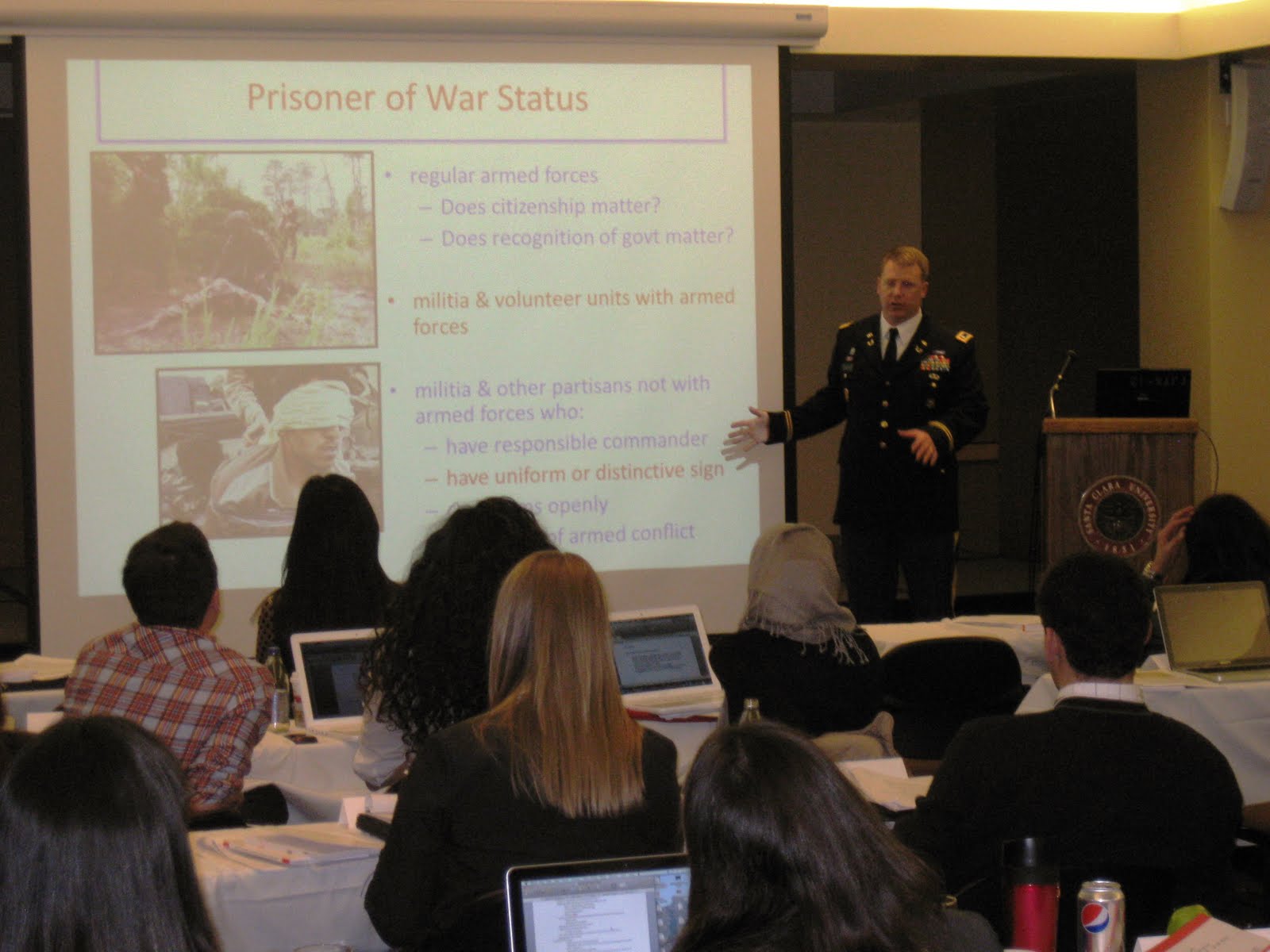
My institution recently co-hosted with the International Committee of the Red Cross an intensive workshop on International Humanitarian Law for law students. At left, is Lt. Colonel Chris Jenks of the Office of the Judge Advocate General teaching conflict classification.
This was the fifth annual such workshop, which focuses on lectures and hands-on exercises to elucidate the principles and challenges of applying humanitarian law to contemporary armed conflicts. In the past, the Workshop has culminated with a multilateral negotiation and drafting exercise focused on the intersection of acts of terrorism and the law of armed conflict. This year, participants engaged in a role play (two photos at right) in which they made comments before the House Armed Services Committee Subcommittee on Terrorism, Unconventional Threats, and Capabilities on a domestic law-of-war detention draft statute entitled the "Law of War Privileged and Unprivileged Belligerents Preventative Detention Act of 2011."
The exercise required students to debate a number of foundational issues, including:
  1. The definition of "armed conflict" to distinguish law of war detentions from other forms of administrative and punitive detention that the United States might engage in.
  2. The definition of "battlefield" to enable authorities to distinguish between battlefield detentions (which could be effectuated for short periods of time with minimal process) and detentions made outside of the battlefield. The draft language defined "battlefield" a number of alternative ways, including with reference to active zones of conflict (e.g., Iraq, Afghanistan, and the FATA areas of Pakistan), but also more generally as any area in which hostilities or acts of terrorism are regularly planned or launched and in which belligerents are billeted or trained. This is the topic of Laurie Blank's (Emory) research, as we've featured here.
  3. The definition of "member," to account for the fact that membership in Al Qaeda, the Taliban, or "associated forces" was one contemplated ground for detention. The draft legislation also grappled with how a detainee could demonstrate that any prior membership relationship had been terminated, as by desertion, withdrawal, or discharge.

  4. The definitions of "privileged" and "unprivileged" belligerents and differential detention regimes for each. The former was defined with reference to the categories enumerated in Article 4 of the Geneva Convention. The latter was defined with reference to both membership in enumerated and unenumerated groups as well as on conduct grounds. The legislation listed various forms of conduct that might constitute grounds for detention, including acquiring terrorist skills, possessing a thing that is connected with a hostile act, providing substantial support to any hostile or terrorist act against U.S. armed forces or coalition forces, and directly participating in hostilities against the United States or coalition partners without the privilege of doing so. In preparing these competing formulations, we drew on definitions of "enemy combatant" that have been employed in post-9/11 military orders, legislation, and jurisprudence as discussed here.

The legislation was premised on a three-phase detention regime:

  • Phase one involved a short (48 or 72 hours) battlefield detention that could be effectuated by any member of the U.S. armed forces (or member of a coalition force) pursuant to a minimal burden of proof. Extensions were contemplated in exceptional circumstances upon the order of any commanding officer.

  • Phase two, continued detention, would only follow a hearing before a Review Board (whose precise composition was in dispute). The government would be subject to a higher burden of proof at this stage, with possible standards ranging from preponderance of the evidence to compelling evidence. Phase 2 was subject to periodic review (6 months was proposed in keeping with the security detention regime envisioned by the Fourth Geneva Convention).

  • Stage three, so called extended detention, would follow after an undetermined number of periodic reviews and would be subject to an even higher burden of proof. Students also debated whether periodic review should be automatic or subject to some showing of changed circumstances or new evidence.

  • Students also debated a provision that would dissolve all detention orders after ten years.

Some members of the Committee were designated as opposed to the legislation altogether; accordingly, they argued that the original Authorization to Use Military Force (AUMF) provides all the detention authority the United States needs going forward. Other testified that it is harder to justify contemporary detentions under the 2001 AUMF, especially where individuals are detained far from Afghanistan. In addition to these substantive provisions, students also discussed various procedural issues concerning conditions of detention, the handling of classified information, and access to the outside world.

Now that they have had a chance to grapple with such specifics, the students involved in this exercise will no doubt be in a better position to evaluate President Obama impending Executive Order on indefinite detention to govern current detainees.

On the Job: Bipartisan Task Force on Detainee Treatment


The Constitution Project (TCP) is hiring an investigative staff to work with its newly created, bipartisan Task Force on Detainee Treatment.

The goal of the Task Force is to bring to the American people a comprehensive understanding of what is known and what may still be unknown about the past and current treatment of detainees by the U.S. government, as part of the counterterrorism policies of the Obama, Bush and Clinton administrations. The Task Force will help policymakers and the public confront alleged past abuses—including torture and cruel treatment—by following the facts.

The Task Force will review available information, determine where the holes are and then pass the baton to the administration, Congress and ultimately—to the American people—who will determine what steps should be taken next.

The members of the Task Force represent a full spectrum of political views and a wide range of professional backgrounds—legal, public policy, intelligence, military, law enforcement, religious, academic, public service, and medical. The staff, working under the direction of TCP’s president and the Task Force Staff Director, will carry out factual investigation, legal and policy research and assist in the development of the Task Force report and recommendations. These positions are full-time, temporary positions with an expected duration of 12-18 months, the anticipated duration of the Task Force Review. TCP may hire multiple people at each of the positions depending on the anticipated needs of the Task Force.

TCP has the following staff openings:

TASK FORCE COUNSEL

Minimum qualifications: Law degree and at least five years of experience practicing or
teaching law in one or more of the following areas:

• Human Rights Law or the Law of Armed Conflict
• National Security Law
• Military Law
• Intelligence Law
• Constitutional, statutory law and judicial authority relevant to the treatment of detainees

The ideal candidate will have:
• Extensive and high level experience with oversight and investigations, policymaking, and policy analysis
• Outstanding research and writing skills
• The ability to manage competing demands and thrive in a challenging, fast-paced environment
• A commitment to factual objectivity, consensus-building and to working in a bipartisan environment

SENIOR INVESTIGATOR
Minimum qualifications: At least three years experience with complex factual nvestigations related to sensitive policy issues.

The ideal candidate will have:

• Extensive and high level experience in investigations with or about the federal government, either as a lawyer or investigative journalist
• Deep knowledge of and experience in law and policy on national security, human rights, armed conflict, military law, intelligence law, Constitutional, statutory law or other law relevant to the treatment of detainees
• Experience in formulating policy recommendations from results of investigation and
research
• Outstanding research and writing skills
• The ability to manage competing demands and thrive in a challenging, fast-paced environment
• A commitment to factual objectivity, consensus building and to working in a bipartisan environment

RESEARCHER

Minimum Qualifications: At least one year of work dedicated to research on complex legal and policy matters.

The ideal candidate will have:

• Research experience in law, with the federal government, or in high level academic settings
• Experience with law and policy on national security, human rights, armed conflict, military law, intelligence law, Constitutional, statutory law or other law relevant to the treatment of detainees
• Experience with fact-checking and review of citations and footnotes for accuracy and consistency
• Outstanding research and writing skills
• The ability to manage competing demands and thrive in a challenging, fast-paced environment
• A commitment to factual objectivity, consensus building and to working in a bipartisan environment

ADMINISTRATOR

Minimum Qualifications:
• The ability to manage production and storage of a large volume of documents, and to manage and maintain online document storage, either in a law practice or with a government or non-governmental investigation
• Experience in scheduling meetings, conferences, hearings, traveling and interviews
• Working knowledge of Microsoft Office
• The ability to format and proofread complex legal, policy or factual documents.
• The ability to manage technology needs, provide IT help desk support, and liaise with external IT consultants as needed

A competitive salary and benefits are available.

To apply: dubmit letter of interest, resume, references, and, except for applicants for the administrator position, a writing sample, to the attention of Charles Martel via email at cmartel@constitutionproject.org. Please indentify in the subject line of your email and in your letter the position for which you wish to be considered. No phone calls.

Guantánamo 9 years on

Today, January 11, 2011, marks the ninth year of the existence of the detention center (left) at the U.S. Naval Base at Guantánamo Bay, Cuba.
Translate that to measure the effect on human beings. What this means is that scores of men have been detained by the United States for nine years now, in prison-like conditions, without trial.
Detention for nine years without trial.
If I appear impassioned, forgive me. But, yours truly has represented Guantánamo detainees for close to nine years—almost as long as the detention camp has been around. Over the years, I have:
► Played a direct role in the litigation journey that ended in the U.S. Supreme Court judgment in Boumediene v. Bush (2008) (prior posts).
► Seen several bills pass in attempt to restrict the rights of the detainees.
► Seen numerous military commissions start and stop. Child soldier Omar Khadr (right), whom I represented for a short time, has faced no fewer than three different military commissions, operating under different rules.
Seen my clients on hunger strike. And I heard from my fellow habeas counsel the stories of attempted suicides, successful suicides and whispers of homicide. In total, six men have died in custody.
A lot has happened in these last nine years, though for the detainees there, frankly, too little has happened. In those circumstances nine years can seem like a lifetime. And for some of those men, detention at Guantánamo may be a lifetime.
This brings us to the current state of Guantánamo and the detainees.
Of the original 779 detainees, 599 have been released, but 173 men remain in the detention camp. Despite the executive order issued by President Obama in January 2009 that calls for the closure of the detention camp within a year, which I wrote about here, Guantánamo remains open. And as posted by IntLawGrrl Diane Marie Amann this weekend, the most recent piece of legislation signed into law just a few days ago—The National Defense Authorization Act for 2011—makes it clear that closing Guantánamo will be very difficult. This Act:
► Prohibits the use of funds authorized by the bill for the transfer or release to the United States (or any U.S territory or possession) of Guantánamo detainees, including 9/11 defendant Khalid Sheikh Mohammed, who is specifically named.
► Requires certification from a foreign country regarding the transfer of Guantánamo detainees to that foreign country. The country must certify, among other items, that it: is not a sponsor of terrorism; maintains control over the detention facility; has agreed to take steps to ensure the individual won’t take action to threaten the U.S.; and has agreed to share information with the U.S. regarding the individual.
► Prohibits the use of funds authorized by the bill to modify or construct facilities in the U.S. to house detainees from Guantánamo for detention or imprisonment in the custody of the Department of Defense.
On Friday, January 7, President Obama signed the bill into law but issued a signing statement that specifically address two of the provisions relating to Guantánamo: the restriction on transfer into the U.S. and the certification requirement from foreign countries. (photo credit) Some criticized it as weak. But as Diane's post observed, the signing statement includes a pretty clear denouncement of Congress’ attempt to intrude on executive prerogative. Obama wrote:
'Section 1032 represents a dangerous and unprecedented challenge to critical executive branch authority to determine when and where to prosecute Guantanamo detainees, based on the facts and the circumstances of each case and our national security interests. The prosecution of terrorists in Federal court is a powerful tool in our efforts to protect the Nation and must be among the options available to us. Any attempt to deprive the executive branch of that tool undermines our Nation's counterterrorism efforts and has the potential to harm our national security.'
President Obama also stated that his administration would
'work with the Congress to seek repeal of these restrictions, will seek to mitigate their effects, and will oppose any attempt to extend or expand them in the future.'
The confrontation between the two branches is certainly interesting, and will require a watchful eye as to exactly how the administration will work with a new Congress that now has a Republican majority in the House.
A more interesting and disheartening development, I believe, are reports of a pending executive order on indefinite detention.
On Sunday, Laurie Blank contributed an IntLawGrrls guest post criticizing such an attempt to routinize indefinite detention. Also well worth reading is the extended article by Dafna Linzer (right), a ProPublica national security reporter, available here. (credit for photo by Lars Klove)
According to Linzer, the White House has been busy for over a year preparing an executive order that sets forth a system for indefinite detention. This system would enable detainees to challenge their detention on a regular basis by requiring a minimal review every six months and then a more lengthy annual review before a ‘parole-like’ board made up of officials from civilian and military agencies. Further, detainees would have access to an attorney to assist them in the process. This review would not replace the court habeas review required by Boumediene, but would supplement it. In essence, the executive review would weigh the necessity of the detention, rather than its lawfulness. The ‘parole board’ would have the authority to release the detainee if appropriate.
The National Defense law just enacted, however, with its severe restrictions on transfer to third countries, would fairly undermine this assertion of executive authority.
In the end:
There are still men at Guantánamo, who by either court order or executive determination (recall the Guantanamo Review Task Force Report that identified approximately 50 men who could neither be tried or released), will continue to be detained without trial either at Guantánamo or elsewhere.
It has already been nine years of detention for the men at Guantánamo, and recent events only confirm that indefinite detention may very well be a reality for some of these men. Equally disturbing, it may very well be a permanent part of our democratic society.

Detention, trials & American values

(Delighted to welcome back alumna Laurie Blank, who contributes this guest post)

As Professor Amos Guiora and I argue in "Don’t Deny Detainees Their Day in Court," an op-ed published a few days ago in the Los Angeles Times, the idea that every person deserves his or her "day in court" is a fundamental principle in the United States and many countries worldwide. Yet more than nine years after 9/11, the United States remains paralyzed not just about how to give the thousands of detainees in U.S. custody around the world their day in court but about whether to give them that day in court.
Multiple judicial forums have been created to try nonstate actors who have perpetrated war crimes from Rwanda to Sierra Leone to Cambodia to the former Yugoslavia — to give them their day in court. That makes the failure to answer this question for post-9/11 detainees particularly perplexing and deeply troubling.
Two successive administrations have been incapable of answering what should be the most basic questions: if, how and where to try terrorists. In the meantime, post-9/11 detainees languish in indefinite detention. The result is a fundamental and overwhelming violation of the rights of individuals who are no more than suspects, in either past or (more problematic) future acts.
The Obama administration reportedly now intends to issue an executive order establishing indefinite detention without trial for detainees at Guantánamo Bay. Such a decision would formalize this violation of basic rights. Denying individual accountability would now be official U.S. policy and law.
The claim that granting prisoners the right to file petitions for habeas corpus and receive regular reviews is sufficient is disingenuous. At best, that only addresses detention status, without doubt an important question. But it does not facilitate the resolution of individual accountability, the principle that requires that an individual have the opportunity for adjudication of his or her guilt or innocence. It is wrong morally, not to mention legally.
The first step, therefore, is to determine that individuals detained post 9/11 deserve their day in court, just like domestic criminals and perpetrators of war crimes. The next step is to implement a mechanism that can do so fairly and effectively. Speedy resolution is, by now, wishful thinking at best.
Unfortunately, for the last nine years, the U.S. has skipped the first step, and has let narrow political considerations devoid of morality, legality and decency determine the nature of the second step. Decision-makers talk of constitutional law and a "beacon on the hill," but acting on that talk seems to present overwhelming challenges. Principles have been discarded in the name of expediency.
Just as crimes grant the state the power to punish, so the state owes the detainees a duty of resolution, a duty to give them their day in court and either prosecute or release, convict or acquit. In the absence of an effective framework to do so, the state is engaging in unconscionable behavior - with an immunity largely granted by Congress and courts alike. Supreme Court and congressional acquiescence in the face of executive power has historically ill-served the American people.
Those who argue that indefinite detention accords with the treatment of prisoners of war gloss over two key distinctions: POWs are held in protective custody and released at the end of hostilities, whereas post-9/11 detainees are held in de facto punitive detention and terrorism has no end to trigger release. Those who want to argue that we are at war with al-Qaeda and other terrorists fail to consider that the law of war and principles of morality in armed conflict do not countenance such an approach, where detainees face the prospect of generational, even lifetime, detention without charge or trial.
Under the law of war, detention is a fundamental aspect of the authority to wage war and has the critical purpose of removing enemy fighters from the battlefield.
Within this framework, POWs are held as a preventive measure – states cannot prosecute POWs for engaging in lawful belligerent acts, i.e., for simply being enemy soldiers fighting on the battlefield. Battlefield detention is lawful and appropriate within this framework and there is no obligation to prosecute or release in this paradigm. The similarity to the indefinite detention we talk about today for detainees at Guantanamo thus lies in the fact that POWs are held without charge and for an unknown (but, critically, not undefined) period of time.
It is the differences that are critical here, though. The differences stretch traditional law of war detention to the extreme and create the effect of forcing a square peg into a round hole. Geography, lawful belligerency, suspected criminality, time parameters – each of these creates another stretch, another tear in the fabric.
► First, battlefield detention is just that – detention of those picked up on the battlefield.
As I’ve noted in an earlier blog post, defining the battlefield in the current conflict against Al Qaeda and other terrorist groups is a critical task, albeit one not yet undertaken or accomplished. We therefore face a situation in which detainees may be held indefinitely under this new framework even if they were picked up either far from a battlefield or – perhaps – in an area where we are uncertain if it is the battlefield. If we cannot identify the battlefield, how can we identify battlefield detainees?
► Second, law of war detention is designed to hold enemy fighters until the “cessation of active hostilities.” In World War II, we held German soldiers for several years, until the end of the war. Several years – not a lifetime. The nature of terrorism and counterterrorism is that we are not going to defeat terrorism; rather, terrorism is something to be managed, minimized, defended against. Not only can we not envision an end to the hostilities, but more problematic, we have absolutely no way of identifying what that end might look like. Sure, we might defeat Al Qaeda in some meaningful way, ending their ability to launch any effective attacks against the U.S. or its allies, but some other terrorist group will take up, or have already taken up, the same fight and we will still be engaged in a conflict with terrorist groups. The consequence of this uncertainty and this very nature of terrorism is that indefinite detention effectively means generational, if not lifetime, detention. Such detention is on another scale entirely from law of war detention as we know it.
► Finally, belligerency and criminality also raise questions here. Law of war detention is primarily designed for lawful belligerents, prisoners of war. The U.S. has gone to great pains – and rightly so in most cases – to argue and demonstrate that the folks at Guantanamo are not lawful belligerents. Rather, they are persons not entitled to any form of privileged combatancy under traditional principles of international law. Still more, they are generally persons we suspect (or could likely prove depending on the evidence available) have committed violent crimes against Americans, American interests and our allies. Unlike law of war detention, therefore, where individuals held in protective custody are specifically not suspected of or charged with any crime, the detainees to be held in indefinite detention are effectively held in punitive custody, suspected of culpability in violent, criminal terrorist attacks but neither charged nor prosecuted.
Indefinite detention in these circumstances is a square peg in a round hole and completely undermines the basic notion of individual accountability, thus constituting a fundamental miscarriage of justice. The United States, uncertain whether the detainees are criminals or more akin to fighters in an armed conflict, must still grant them the basic right to a day in court. Without that, individual accountability is simply eliminated, effectively saying that the adjudication of individual liability is burdensome, perhaps even irrelevant.
This is not the American way; rather, it is a repudiation of American values. Whatever method of trial one prefers – civilian courts, national security courts, or military commissions, the time has come to decide and adjudicate.

2 tacks to combat piracy

Year's end finds 2 countries setting different courses to combat the recent spate of pirate attacks in the Gulf of Aden off the coast of Somalia.
In the United States, just before Thanksgiving, a federal jury in Virginia returned convictions for piracy and other offenses against 4 Somali defendants. (credit for detail from 2010 courtroom sketch by Alba Bragoli/AP) The verdict came one month after the judge in the case, United States v. Hasan, sustained a charge brought under 18 U.S.C. § 1651. The statute provides, in language dating to 1819:

Whoever, on the high seas, commits the crime of piracy as defined by the law of nations, and is afterwards brought into or found in the United States, shall be imprisoned for life.
Yet in the same courthouse a few months earlier, a different federal judge, in the case of United States v. Said, had dismissed a piracy charge brought against 6 other Somali men. Tripping the latter judge up was Congress' reference in § 1651 to "the law of nations."
The opposite rulings reflect uncertainties about whether an old legal framework presents the proper way to proceed against 21st C. pirates. It's a puzzle addressed in this discussion by our OJ colleagues, and in many IntLawGrrls posts available here.
In the United States, the discrepancy next awaits consideration by the Virginia-based Court of Appeals for the 4th Circuit.
France, meanwhile, has taken another tack.
France also has been involved in policing piracy in the Gulf of Aden. (credit for March 2010 of French naval vessel, with "Somali pirate skiffs" in foreground) France also has found that its old laws fell short -- and so it's opted for a legislative fix.
Shortly before Christmas, the Sénat voted unanimously in favor of the Loi de lutte contre la piraterie et d'exercice des pouvoirs de police de l'Etat en mer -- a bill to ease the pursuit and punishment of pirates that the legislature's lower house already had approved.
Key components:
► An 1825 French antipiracy law having been abrogated in 2007, the newly adopted law reintroduces into the penal code the crime of piracy -- a crime may be pursued via universal jurisdiction. The new law applies to acts of piracy "within the meaning of" the 1982 U.N. Convention on the Law of the Sea, "committed ... on the high seas," "in maritime spaces outside any state's jurisdiction," and "when international law permits, in a state's territorial waters." That Convention is an artifact of the law of nations to which France has been a state party since 1996, but to which, as posted, the United States does not belong.
► The new statute further establishes a legal regime for detaining suspects onboard French naval vessels while they are being transported to judicial authorities. These Mesures prises à l'encontre des personnes à bord des navires respond to a March 2010 judgment, Affaire Medvedyev et Autres c. France, in which the European Court of Human Rights held that France had violated the guarantee of liberty and security of person in Article 5 of Europe's human rights convention by its high-seas detention in 2002 of members of a ship's crew who were suspected of trafficking in drugs.


(Deep thanks for invaluable assistance with this post to University of California-Davis LL.M. student Johann Morri, on leave this year from his post as a French administrative law judge.)

Tearing Apart Immigrant Families

As many of us prepare to reunite with our families over the holidays, the Women's Refugee Commission has released a new report, Torn Apart by Immigration Enforcement: Parental Rights and Immigration Detention, that describes the horrific consequences of the interaction of the immigration enforcement and child welfare systems in the United States.
While hard data are difficult to come by, there are at least three million children living in mixed families in the United States -- that is, families with a US citizen child and an undocumented parent. Between 1998 and 2007, over 100,000 non-citizen parents of US citizen children were deported. For some, this results in painful decisions about whether to leave the child in the US or bring the child with them. But those are the lucky families; many parents do not ever even get this choice. In the worst cases, undocumented immigrants' parental rights are terminated without their knowledge.
The report breaks down the problem into several stages. To start, when U.S. Immigration and Customs Enforcement (ICE) apprehend undocumented immigrants, their protocols are insufficient to identify parents and prioritize them for release. Indeed, the guidance for agents who encounter juveniles during fugitive operations directs officers to contact child welfare services, which can complicate parents rights. In any case, there are no procedures to ensure that parents can make care arrangements for their children before they are detained.
Once undocumented parents are detained, it becomes extremely difficult to communicate with their children and the child welfare system due to limitations on telephone access and frequent distant transfers of immigration detainees. Not only does this pose serious obstacles to ensuring safe care for immigrants' children, it may contribute directly to termination of parental rights. For example, the child welfare system's family reunification plan may require regular phone calls and contact visits that are all but impossible for detained parents. Detained parents are also often unable to participate in family court proceedings, either because child welfare services cannot locate them so they do not receive notice of the hearing or because they are unable to be present at the hearing.
Finally, when undocumented parents are deported, the dearth of information provided by ICE about the timing of deportation can make reunification very difficult. Parents are often notified of their deportation at the very last minute -- too late to make travel arrangements for their children -- or ICE changes travel plans after parents have already purchased expensive, nonrefundable tickets for their children to accompany them. This and the other failures of coordination between immigration and child welfare systems described above result in the long-term and in some cases permanent separation of families, inflicting serious psychological trauma on the citizen children of undocumented immigrants.


(Hat tip to my student, Jessica Jones, who worked on the Women's Refugee Commission report this summer and is currently writing a research paper on the interaction of the child welfare and immigration enforcement systems under my supervision.)

Nottebohm’s Nightmare

(Delighted to welcome back IntLawGrrls alumna Cindy Galway Buys, who contributes this guest post on her scholarship)

Many international law professors likely teach the 1955 International Court of Justice decision in The Nottebohm Case.
If so, they will recall that Frederic Nottebohm was a German-born businessman living in Guatemala at the time of World War II. He traveled to Liechtenstein during the war and became a citizen of that country in very short order. Guatemala refused to recognize his change in citizenship, leading Liechtenstein to bring suit against Guatemala at the ICJ. The ICJ held that Guatemala did not have to recognize Liechtenstein’s grant of citizenship to Nottebohm because he did not have a genuine connection to Liechtenstein.
Reading the ICJ decision always left me with unanswered questions. Accordingly, I began digging into the history a bit more to better understand why the ICJ reached the decision that it did.My research revealed that Nottebohm was the victim a little-known program run by the United States during World War II in which the United States pressured Latin American countries like Guatemala to identify persons of German nationality or ancestry and turn them over to the United States for internment for the duration of the war. Many of these persons were arrested and detained for lengthy periods of time as Nazi sympathizers on the basis of mere accusations unsupported by any real investigation or evidence. Sadly, as with the Japanese-Americans who were forced into detention camps during World War II, U.S. law and courts allowed these arrests and detentions of persons with German connections with little or no proof of Nazi sympathies, much less subversive activities. (credit for photo at right of arrival at Camp Kennedy, Texas, whose detainees included Germans from Latin America)
The original motivation for the U.S.-Latin American Detention Program appears to have been national security concerns, especially after the attack on Pearl Harbor on December 7, 1941. However, as time went on, the United States continued detaining persons who, like Nottebohm, had been deemed to present little or no security risks, because it was beneficial for the United States and Latin American governments to do so for economic reasons.
Thus, what started as a national security measure evolved into a program aimed at increasing U.S. economic influence in Latin America. Continuing to treat Nottebohm as an alien enemy ultimately paved the way for the Guatemalan government to expropriate his assets in Guatemala without compensation. The wartime setting and the alien enemy accusations also may have influenced the ICJ in its decision.
The article begins by telling the story of how Frederic Nottebohm and his extended family came to be caught up in the U.S.-Latin American Detention Program. It relates the motivations behind the creation of the program and analyzes the legality of the program under both United States and international law existing at the time. The article next examines the extent to which the law has evolved and whether the changes in the law would lead to a different result today. (credit for photo at left of Crystal City, Texas, detention camp for interned Latin American families)
The article then draws parallels between the arrest, detention, and trial of alleged alien enemies during World War II and those practices being employed today with respect to alleged “unlawful enemy combatants” in the current fight against terrorism. Finally, the article suggests some lessons that may be learned regarding the treatment of so-called alien enemies during times of conflict that have relevance for current U.S. policies regarding the arrest, detention and trial of suspected foreign terrorists.

No Alien Tort Liability for Corporations?

A serious, perhaps, mortal blow has been dealt to the Alien Tort Statute by the U.S. Court of Appeals for the Second Circuit. The ATS creates federal jurisdiction over

any civil action by an alien for a tort only, committed in violation of the law of nations or a treaty of the United States.
In its opinion in Kiobel v. Royal Dutch Petroleum Co., however, the Second Circuit dramatically narrowed the scope of the ATS by ruling that it did not apply to "juridical persons," meaning corporations.
Since the groundbreaking judgment in Filártiga v. Peña-Irala (2d Cir. 1980), which was brought by my dearly-missed colleague Rhonda Copelon and the Center for Constitutional Rights, the ATS has offered victims of human rights abuses the prospect of access to U.S. courts.
In Kiobel, the oil company defendants stood accused of aiding and abetting the Nigerian government's campaign of human rights abuses in the Niger Delta, Nigeria's oil-producing region. The litany of human rights violations at issue in the case included allegations of torture, arbitrary detention, and crimes against humanity. Unfortunately, these allegations can no longer be heard in U.S.courts. The Second Circuit ruled on September 17th that corporations cannot be sued under the Alien Tort Statute because they are “juridical” entities rather than natural persons. Should this ruling be adopted throughout the U.S. court system, it would gut the scope of the ATS, making it very likely that corporations participating in human rights abuses will escape any accountability for their conduct.
The Niger Delta is home to 31 million people. (map credit) Since oil exploration began some 50 years ago, the region has suffered an Exxon Valdez-sized oil spill every year. As you can imagine, these spills have devastated the local population. In 2009 Amnesty International reported that the oil industry in the Niger Delta of Nigeria
has brought impoverishment, conflict, human rights abuses and despair to the majority of the people in the oil-producing areas.
Local populations have failed to benefit from the wealth generated by oil production, even as they suffer its environmental consequences. Before being despoiled by oil pollution, the Niger Delta was one of the most important wetlands in the world. BP's oil spill in the Gulf of Mexico (see previous Intlawgrrl posts here, here and here) focused public attention, albeit briefly, on the ongoing environmental devastation in the Niger Delta. (You can hear an interview I did with WBEZ Chicago Public Radio’s Worldview Program on this topic here.)
Just last year, Shell Oil settled an ATS case alleging the company’s complicity in the hanging deaths of nine Ogoni activists, including the world-renown poet Ken Siro Wiwa. Cases alleging similar human rights abuses in oil production have been brought against Talisman Energy for its activities in the Sudan, Unocal for its activities in Burma, and Chevron for its activities in Ecuador. (News on that last suit here.)
Second Circuit Judge José A. Cabranes interpreted international law precedents extremely narrowly in order to concluded that, throughout history,
the principle of individual liability for violations of international law has been limited to natural persons—not ‘juridical' persons such as corporations.
This despite the fact that the Universal Declaration of Human Rights explicitly applies to "every individual and every organ of society." Over the objections of Judge Pierre N. Leval, Judge Cabranes, joined by Judge Dennis Jacobs concluded that that U.S. courts lacked jurisdiction over ATS claims brought against corporate entities.
Given that oil production often takes place in countries without robust judicial systems, this cramped ruling virtually assures that victims will have no avenue of redress.
The United States consumes a quarter of the world’s oil—10% of which comes from Nigeria. That makes the United States the largest purchaser of oil produced in the Niger Delta. Our participation as end-consumers makes us unwitting collaborators to abuse in Nigeria and around the world. We surely have an interest in giving victims of these human rights abuses a forum in which to seek justice.

Law and Policy Collide: HIV/AIDS in China

On Tuesday, China took the first step towards meaningful enforcement of anti-discrimination laws designed to protect those living with HIV/AIDS when a court in the Anhui Provence accepted a case brought by an HIV positive man claiming he was illegally denied a job on the basis of his HIV status. (photo credit, left) The plaintiff, an unidentified man in his early 20s, claims that he passed a written test and interviews for a teaching job, but that he was ultimately rejected for the position after a physical exam revealed he was HIV positive. His suit is based on a March 2006 State Council regulation that prohibits institutional or individual discrimination based on HIV status. Since 2006, Yirenping, a civil rights advocacy group, has brought 15 similar lawsuits, all of which have been declined by the courts. Zheng Jineng, the attorney for the plaintiff in this case, says:
In the past on sensitive cases like this, the court would be very reluctant to accept the case. But this time they accepted it smoothly and quickly. That means the legal system in China is making progress.
Indeed this is a good sign. However, it is a small step against a ghastly background of persecution of people living with HIV/AIDS and activists in China. In July of this year, Joe Amon, Program Director for Health and Human Rights Division at Human Rights Watch, wrote:
On paper, the Chinese government has laws and policies that are protective of the rights of an estimated 700,000 people living with HIV in the country. In practice, these policies are frequently undermined by the actions of police and public security forces, who round up "undesirables" such as sex workers and drug users and intimidate and censor civil society organizations working to expand HIV outreach.
The Chinese court's decision to hear the case at hand comes after its participation in the 2010 International Aids Conference in Vienna, which explored the theme "Rights here, right now." There, Michel Kazatchkine, executive director of the Global Fund to Fight AIDS, Tuberculosis and Malaria, joined a number of international organizations and NGOs in calling for the closure of compulsory drug detention facilities. Drug users are detained in such facilities for up to six years and subjected to forced labor and other inhumane conditions. However, Kazatchinke decided that despite the clear human rights problem the detention facilities present, the Global Fund will continue to provide support to these facilities so that detainees will have access to condoms, clean injecting equipment, and antiretroviral treatment. (photo credit, left).
He was not kidding when he called this choice an "ethical dilemma." It will be difficult to make progress when rule of law efforts collide with internationally-funded and highly questionable HIV policy in China. While those in detention should not be denied care for lack of funding, serious international pressure is needed to close the detention camps. And while China appears to be making some progress in this area, going forward, efforts should be made to strengthen civil society groups that call China to enforce its anti-discrimination laws.

 
Bloggers Team