Showing posts with label World War II. Show all posts

On April 11

On this day in ...
... 1961 (50 years ago today), the trial of Adolf Eichmann began in a national court in Jerusalem on 15 charges of crimes against humanity, crimes against the Jewish people, and war crimes, all stemming from the onetime Nazi bureaucrat's World War II involvement in the Holocaust. (photo credit) As posted here and here, his eventual conviction would be upheld by Israel's Supreme Court, and he would be executed by hanging in 1962. The trial is the subject of a brand-new book. YouTube video of more than 200 hours of trial sessions is available here.

(Prior April 11 posts are here, here, here, and here.)

On April 8

On this day in ...
... 1946 (65 years ago today), the League of Nations held its last meeting, 25-1/2 years after its initial session in Geneva, Switzerland. The alliance had foundered with the onset and onslaught of World War II. The United Nations Organization, established by dint of the San Francisco Charter, would assume the intergovernmental security tasks that the League had been designed to discharge.

(Prior April 8 posts are here, here, here, and here.)

On March 26

On this day in ...
... 1913, in Chartres, France, a daughter, Jacqueline, was born to a novelist and her husband, a philosophy professor, who was killed in World War I combat the next year. As a school girl Jacqueline was a top student in Latin and ancient Greek, eventually studying the latter at École Normale Supérieure. Her 1940 marriage would end in divorce; she would be forced out of a teaching job and into hiding because of her Jewish heritage. After World War II, however, Dr. Jacqueline de Romilly (above left) would become a champion of the humanities, "one of France’s leading scholars of Greek civilization and language and only the second woman to be elected to the Académie Française." In 1973, de Romilly became the 1st woman professor at the Collège de France, the prestigious institution now home to IntLawGrrls ' guest/alumna Mireille Delmas-Marty. Professor de Romilly died, at age 97, in December of last year.

(Prior March 26 posts are here, here, here, and here.)

On March 17

On this day in ...
... 1921 (90 years ago today), the Republic of Poland that had been formed in 1918, after both World War I and the ouster by uprising of German/Prussian occupying forces, adopted a Polish Constitution. Based on its French counterpart, this Polish charter included many democratic elements, such as this ban on discrimination, in Article 95:
The Republic of Poland guarantees on its territory, to all, without distinction of extraction, nationality, language, race, or religion, full protection of life, liberty, and property.
It would come to an end with the adoption of a more authoritarian charter in 1935, in what would prove to be the runup to World War II.

(Prior March 17 posts are here, here, and here, and here.)

On January 18

On this day in ...

... 2000, Margarete Schütte-Lihotzky (right) died in Vienna, Austria, where she'd been born 102 years earlier. She'd been the 1st woman to study at the arts university where painters like Kokoschka and Klimt were teaching; soon Austria's 1st woman architect, after World War I she helped design housing for veterans. After moving to Germany in the 1920s, she created the design for which she became famous: the Frankfurt Kitchen (below left), forerunner of today's built-in kitchens. The design derived from the belief of Schütte-Lihotzky, who'd "'never cooked'" herself, that
women’s struggle for economic independence and personal development meant that the rationalization of housework was an absolute necessity.
Schütte-Lihotzky and her husband worked in the Soviet Union in the 1930s; they lived as well in France, England, and Turkey. From the last country, she and another exile returned to Nazi-controlled Austria to serve in the Communist Resistance movement. Soon arrested, Schütte-Lihotzky remained in a Bavarian prison. Despite the need to rebuild after the war, on account of her Communist beliefs she found both work and acclaim hard to come by; she did some consulting in Cuba, East Germany, and China. One her 100th birthday she remarked:
I would have enjoyed it, for a change, to design a house for a rich man.


(Prior January 18 posts are here, here, and here.)

On January 11

On this day in ...
... 1943, in what The New York Times called a "first concrete step toward the new era that is expected to follow the war in the Far East, with full restoration of China's sovereignty over her own soil," United States, Britain, and China signed treaties that ceded extraterritoriality and other special privileges that the 1st 2 countries had claimed over China (then flying the Republic of China/Nationalist flag at left) for the preceding hundred years. The Chinese-American treaty was signed in Washington; the Chinese-British treaty, by which Britain held on to its claims over Hong Kong, was signed in Chungking (today, the Sichuan province city of Chongqing).

(Prior January 11 posts are here, here, and here.)

On January 6

On this day in ...
... 1941 (70 years ago today), President Franklin D. Roosevelt addressed a joint session of Congress. Today his State of the Union speech is perhaps best known for its concluding paragraphs, setting forth the 4 Freedoms still recognized as a keystone of human rights, at home and abroad. That aspect was not wholly lost -- a commentator hailed the speech as providing a "Magna Charta of Democracy." But many paid particular attention to the call for war matériel and monetary aid for Britain and other countries already waging the conflict against aggression, as Roosevelt repeatedly called it, that the United States would not join formally for another 11 months. The dual nature of the address is evident in these newsreel clips (the 4 Freedoms segment begins at about 5:26).


(Prior January 6 posts are here, here, and here.)

On December 18

On this day in ...
... 2003, Susan Travers (left) died in the Paris area, 94 years after her birth in southern England. The daughter of an admiral, she grew up "a young tennis-playing socialite in the south of France," and eventually "became the first and only woman ever to serve" in the French Foreign Legion. Her sojourn began with the onset of the World War II. Travers joined the French Red Cross, serving 1st as a nurse and later as an ambulance driver. (photo credit) She volunteered as a driver for Free French officers in the North Africa campaign, and took part in a month-long battle with Nazi Germans at Bir Hakeim, Libya. Officially admitted to the Foreign Legion's ranks, Travers, "creating her own uniform," served in Vietnam, then married another legionnaire and retired to Paris. Travers published a memoir shortly before her death.

(Prior December 18 posts are here, here, and here.)
On November 27

On this day in ...
... 1981, Lotte Lenya (right) died from cancer in New York City, 83 years after she'd been born in Vienna, Austria, to working-class parents who'd named her Karoline Wilhelmine Charlotte Blamauer. After moving to Zurich as a teen-aged student, she took her 1st entertainment job and adopted the stage name that would stay with her for life. (photo credit) By 1921, Lenya was in Berlin, where eventually she created the role of Jenny Diver at the premiere performance of the play known in English as The Threepenny Opera, by Bertold Brecht and Lenya's husband, Kurt Weill. After World War II, which Lenya spent in Paris performing inter alia for the Voice of America, Lenya launched a Broadway and film career that included memorable turns as the Russian Colonel Rosa Klebb, a SPECTRE agent who battled James Bond.

(Prior November 27 posts are here, here, and here.)

On November 26

On this day in ...
... 1940 (70 years ago today), workers in Nazi-occupied Poland began to wall off a part of Warsaw as a ghetto "in which the Germans intend to herd the local Jewish population under dreadful living conditions. The Germans describe the move as a 'health measure.'" For the story of this World War II tragedy, click here.

(Prior November 26 posts are here, here, and here.)

On November 16

On this day in ...
... 1945 (65 years ago today), 88 German scientists, most of whom had served in the Nazi regime, secretly were brought to the United States in order to help with U.S. rocket technology production. The admission came despite controversy because of U.S. fears that the Soviet Union was "also utilizing captured German scientists for the same end," given the destructive success of German rockets like the "V-1 Flying Bomb" above left. As noted by this site:

The situation pointed out one of the many ironies connected with the Cold War. The United States and the Soviet Union, once allies against Germany and the Nazi regime during World War II, were now in a fierce contest to acquire the best and brightest scientists who had helped arm the German forces in order to construct weapons systems to threaten each other.

(Prior November 16 posts are here, here, and here.)

On November 11

On this day in ...

... 1945, meeting in upstate New York, a coalition of national women's groups adopted a resolution calling for the appointment of women to the U.S. delegation to the U.N. General Assembly session to be held the following January in London, England. Concerns voiced in the resolution, directed at President Harry S. Truman, included global rebuilding, disease control, and equal pay for women. Implicitly paying heed to the trend by which World War II-era "Rosie the Riveters" were exiting the work force as male veterans were mustered out of the armed forces, Frieda Miller (left), Director of the Women's Bureau of the Department of Labor, expressed another concern:
'In the months ahead women must do all in their power to stem the rising tide of feeling that women must go back to the home.'


(Prior November 11 posts are here, here, and here.)

On November 5

On this day in ...

... 1917, a daughter, Jacqueline Marie-Thérèse Suzanne Douet, was born into a weathy family in Challans, a town southwest of Nantes, France. After completing university and art studies, she married the son of a Socialist Party leader, became known as Jacqueline Auriol, and gave birth to 2 sons. During World War II she aided the French Resistance. Becoming a pilot at war's end, Auriol is known as "France's most distinguished aviatrix." Among her achievements, for which she was admitted to the Legion d'Honneur: "the world's first woman test pilot"; setting of "a new women's speed record"; and "second woman to break the sound barrier"; and "one of the first pilots to fly the supersonic Concorde." She did humanitarian work, too:
Madame Auriol worked with the Ministere de la Cooperation, using remote sensing techniques to gather information for agricultural development. The United Nations Food and Agriculture Organization presented her with the Ceres Medal for her significant contributions.
Auriol, who published her autobiography (above right) in 1968, died in 2000 at age 82.


(Prior November 5 posts are here, here, and here.)

On November 2

On this day in ...
... 1945 (65 years ago today), fewer than 6 months after World War II ended in Europe, and a little over a year after the Allies liberated Paris from the Nazis, a program for the protection of mothers and infants was established in France. A key component of la Protection maternelle et infantile, better known by its acronym PMI, was distribution of contraceptive pills. Administered through France's public service (logo above left), PMI today includes an array of services -- medical, midwifery, and social -- to pregnant women, to mothers, and to their children.

(Prior November 2 posts are here, here, and here.)

On October 29

On this day in ...
... 1940 (70 years ago today), even though it had not joined the conflict then raging in Europe, the United States began conscripting men into the armed forces via a lottery. Secretary of War Henry L. Stimson chose the numbers, as illustrated in this cartoon, part of a super timeline of U.S. activities in this World War II year before the Pearl Harbor attack. Quoting church leaders who supported the move, President Franklin D. Roosevelt gave a speech defending the 1st-ever peacetime draft.


(Prior October 29 posts are here, here, and here.)

On October 21

On this day in ...
... 1999, the highest court in France rejected an appeal by a Frenchman convicted of crimes against humanity committed during World War II. The court ruling that the convicted man, Maurice Papon, had forfeited the right to appeal upon taking flight to Switzerland earlier in the month. Papon had been sentenced to 10 years in prison in April 1998. Within weeks of the ruling on this day, Papon would be back in custody in France. As posted, the former Vichy official (left) died in 2007 at age 96. (photo credit)

(Prior October 21 posts are here, here, and here.)

On October 15

On this day in ...
... 1940 (70 years ago today), more than a year before the attack at Pearl Harbor would draw the United States into World War II, Hollywood released the talking motion picture The Great Dictator, "the only major film of its period to bitterly satirize Nazism and Adolf Hitler." Director and star of the movie was Charlie Chaplin, appearing in his first "talkie" role following a celebrated career in silent films. According to this site:

The film is unusual for its period, as the United States was still formally at peace with Nazi Germany. Chaplin's film advanced a stirring, controversial condemnation of Hitler, fascism, antisemitism, and the Nazis, the latter of whom he excoriates in the film as "machine men, with machine minds and machine hearts".

(Prior October 15 posts are here, here, and here.)

On October 9

On this day in ...
... 1930 (80 years ago today), 25-year-old Laura Ingalls (left) claimed the women's world record for a solo east-to-west trans-United States flight when she touched down at an airport in Glendale, California, 30 hours 27 minutes after her takeoff in New York. (She stopped to refuel and did at least one overnight stay during the sojourn). Ingalls had been winning air derby and aerobatics records in the 2 years since she'd begun flying, and she'd go on to claim many more records throughout North and South America (also see here.) The career of Ingalls (no relation to the novelist of similar name) would end in disgrace: during World War II, despite her protestations of innocence, Ingalls served nearly 2 years at Alderson, the federal women's prison, for failing to register as an agent of the Nazi German government.

(Prior October 9 posts are here, here, and here.)

Nottebohm’s Nightmare

(Delighted to welcome back IntLawGrrls alumna Cindy Galway Buys, who contributes this guest post on her scholarship)

Many international law professors likely teach the 1955 International Court of Justice decision in The Nottebohm Case.
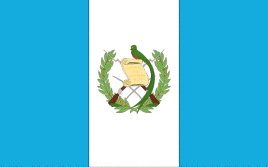
If so, they will recall that Frederic Nottebohm was a German-born businessman living in Guatemala at the time of World War II. He traveled to Liechtenstein during the war and became a citizen of that country in very short order. Guatemala refused to recognize his change in citizenship, leading Liechtenstein to bring suit against Guatemala at the ICJ. The ICJ held that Guatemala did not have to recognize Liechtenstein’s grant of citizenship to Nottebohm because he did not have a genuine connection to Liechtenstein.
Reading the ICJ decision always left me with unanswered questions. Accordingly, I began digging into the history a bit more to better understand why the ICJ reached the decision that it did.My research revealed that Nottebohm was the victim a little-known program run by the United States during World War II in which the United States pressured Latin American countries like Guatemala to identify persons of German nationality or ancestry and turn them over to the United States for internment for the duration of the war. Many of these persons were arrested and detained for lengthy periods of time as Nazi sympathizers on the basis of mere accusations unsupported by any real investigation or evidence. Sadly, as with the Japanese-Americans who were forced into detention camps during World War II, U.S. law and courts allowed these arrests and detentions of persons with German connections with little or no proof of Nazi sympathies, much less subversive activities. (credit for photo at right of arrival at Camp Kennedy, Texas, whose detainees included Germans from Latin America)
The original motivation for the U.S.-Latin American Detention Program appears to have been national security concerns, especially after the attack on Pearl Harbor on December 7, 1941. However, as time went on, the United States continued detaining persons who, like Nottebohm, had been deemed to present little or no security risks, because it was beneficial for the United States and Latin American governments to do so for economic reasons.
Thus, what started as a national security measure evolved into a program aimed at increasing U.S. economic influence in Latin America. Continuing to treat Nottebohm as an alien enemy ultimately paved the way for the Guatemalan government to expropriate his assets in Guatemala without compensation. The wartime setting and the alien enemy accusations also may have influenced the ICJ in its decision.
The article begins by telling the story of how Frederic Nottebohm and his extended family came to be caught up in the U.S.-Latin American Detention Program. It relates the motivations behind the creation of the program and analyzes the legality of the program under both United States and international law existing at the time. The article next examines the extent to which the law has evolved and whether the changes in the law would lead to a different result today. (credit for photo at left of Crystal City, Texas, detention camp for interned Latin American families)
The article then draws parallels between the arrest, detention, and trial of alleged alien enemies during World War II and those practices being employed today with respect to alleged “unlawful enemy combatants” in the current fight against terrorism. Finally, the article suggests some lessons that may be learned regarding the treatment of so-called alien enemies during times of conflict that have relevance for current U.S. policies regarding the arrest, detention and trial of suspected foreign terrorists.

On October 3

On this day in ...
... 1940 (70 years ago today), the Vichy government promulgated the Loi du 3 octobre portant statut des juifs, the 1st French law to define who was a Jew and then to restrict those persons' access to an array of professions. The statute came 5 years after similar laws in Nazi Germany. Deportations and other persecution would follow. As detailed on the poster at right, the 70th anniversary will be marked in Paris with a colloquium from 2-6 p.m. today at the Maison du Barreau de Paris. Topics to be discussed are the historical evolution of the law and the contemporary question of reparations for the harm caused by the law. (image credit)

(Prior October 3 posts are here, here, and here.)
 
Bloggers Team