Showing posts with label art. Show all posts

Go On! Human rights & cultural heritage

(Delighted to welcome back alumna Jennifer Kreder, who contributes this Go On! guest post)

With the political turmoil in the Middle East and recent devastating earthquakes in Haiti, Chile, and Turkey, the timing is – unfortunately – excellent for Human Rights and Cultural Heritage: From the Holocaust to the Haitian Earthquake, a conference to be held March 31, 2011, at Benjamin Cardozo School of Law, 55 Fifth Avenue, New York City.
Cohosting in addition to Cardozo's Art Law Society are the Cultural Heritage and the Arts Interest Group of the American Society of International Law (an interest group for which I serve as co-chair), the Lawyers' Committee for Cultural Heritage Preservation, and the Hofstra Law School Art and Cultural Heritage Club. Generously supporting the conference are the Commission for Art Recovery and the New York law firm Herrick Feinstein, LLP.
The daylong conference will include an impressive group of diverse perspectives – including a keynote address by Howard N. Spiegler, partner and co-chair of Herrick Feinstein's Art Law Group – and will cover a broad range of topics relating to the intersection of human rights and cultural heritage across the globe.
The schedule of speakers and topics is available here. Space is limited, so be sure to register soon!


Go On! Languages @ War

(Go On! is an occasional item on symposia and other events of interest)

An interdisciplinary and international conference entitled Languages at War: policies and practices of language contacts in conflict will be held April 7 to 9, 2011, at the Imperial War Museum in London, England.
Kicking off the conference will be a discussion of art and war inspired by "Baghdad Car," an installation featured a bombed automobile, by prizewinning artist Jeremy Deller. Delivering keynotes during the conference will be: Joanna Bourke (far right), Professor of History in the Department of History, Classics and Archaeology, Birkbeck College, University of London; Professor Mona Baker (near right), Professor of Translation Studies at the University of Manchester; and representatives from the British Council and the British Ministry of Defence. Panelists on the Provisional Programme hail from institutions in England, of course, but also in Belgium, Canada, Cyprus, Finland, France, Germany, Ireland, Italy, Japan, Macedonia, Slovenia, Spain, the United States, and Wales.
Questions to be addressed:
► What are the foreign language policies of government, military and multilateral agencies in conflict situations?
► What are the language-related experiences of those involved 'on the ground' in these conflicts?
► What are the implications for language intermediaries who work in conflict zones?
Details and registration here.


In passing: Maria Altmann

Maria Altmann (right), who won her Supreme Court case seeking recovery of art stolen from her family during the Nazi era, died Monday at her home.
She'd been born Maria Viktoria Bloch-Bauer 94 years earlier, the youngest child in a wealthy Viennese family. The family included her maternal aunt Adele, who sat for the 1907 portrait at right, by Gustav Klimt. (credit for 2006 photo by Tom Tugend)
Having fled Nazi-occupied Vienna as a newlywed, Altmann did not learn of the whereabouts of this and other items in her family's art collection until 1999. By then she was an 82-year-old widowed grandmother living in Los Angeles County.
She filed a claim that went all the way to the U.S. Supreme Court. In Republic of Austria v. Altmann (2004), Justices ruled 8-1 in her favor and, as described in a post by IntLawGrrls guest/alumna Jennifer Kreder, the portrait and other paintings were returned to her.

On January 18

On this day in ...

... 2000, Margarete Schütte-Lihotzky (right) died in Vienna, Austria, where she'd been born 102 years earlier. She'd been the 1st woman to study at the arts university where painters like Kokoschka and Klimt were teaching; soon Austria's 1st woman architect, after World War I she helped design housing for veterans. After moving to Germany in the 1920s, she created the design for which she became famous: the Frankfurt Kitchen (below left), forerunner of today's built-in kitchens. The design derived from the belief of Schütte-Lihotzky, who'd "'never cooked'" herself, that
women’s struggle for economic independence and personal development meant that the rationalization of housework was an absolute necessity.
Schütte-Lihotzky and her husband worked in the Soviet Union in the 1930s; they lived as well in France, England, and Turkey. From the last country, she and another exile returned to Nazi-controlled Austria to serve in the Communist Resistance movement. Soon arrested, Schütte-Lihotzky remained in a Bavarian prison. Despite the need to rebuild after the war, on account of her Communist beliefs she found both work and acclaim hard to come by; she did some consulting in Cuba, East Germany, and China. One her 100th birthday she remarked:
I would have enjoyed it, for a change, to design a house for a rich man.


(Prior January 18 posts are here, here, and here.)

On January 14

On this day in ...

... 1841 (170 years ago today), Berthe Morisot was born in Bourges, France. Along with her sister, Edma, said to be the granddaughters of painter Jean-Honoré Fragonard, she began painting in childhood. The 2 studied with leading painters in Paris. "Despite the fact that as women they were not allowed to join official arts institutions, the sisters earned respect in art circles for their talent." Although Edma eventually would spend more time on family matters than on painting, Berthe, in her late 20s, joined the circle of artists who would create Impressionism. She married into the Manet family and exhibited her paintings every year but 1877, when she gave birth. A recent retrospective prompted an intriguing article on Morisot's treatment of gender, inspired in part by the 1885 self-portrait above left. (credit) In 1895, Morisot, 54, died from pneumonia contracted while caring for her only child -- the teenaged Julie Manet, who would herself become a painter and art collector. (credit for Pierre-Auguste Renoir portrait of mother and daughter made the year before Morisot's death)


(Prior January 14 posts are here, here, and here.)

On December 23

On this day in ...
... 1979, Peggy Guggenheim (right) died at age 81 in a hospital near Venice, Italy, the city where she'd lived for more than 3 decades. (photo credit) She'd been born in 1898 in New York City, a child of wealth, and grew up on the east side of Central Park. As a young woman she married, gave birth to 2 children, divorced, married, and led a "Bohemian" life in Europe, amid notables like Isadora Duncan, Samuel Beckett, Emma Goldman, and Max Ernst. She collected art. As World War II broke out, she sent paintings to the United States for safety, labeling the shipment "household goods." The Peggy Guggenheim Collection remains intact at her palazzo in Venice -- and in this 'Grrl's humble opinion, deserves its claim to be "among the most important museums in Italy for European and American art of the first half of the 20th century."

(Prior December 23 posts are here, here, and here.)

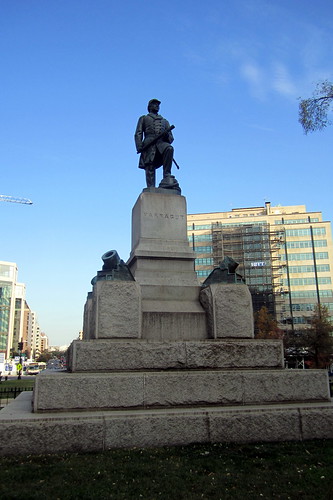
The Civil War Navy As Seen In DC's Public Art

Anyone who has visited or lived in Washington, DC knows that public art -- especially in the form of monuments and statuary -- is prevalent in nearly all of the city's green spaces. Four of these pieces are directly related to the Civil War Navy and are well worth noticing next time you are in the area.


Admiral David G. Farragut appears in standing statue form in Farragut Square (17th and K St. NW). The piece was sculpted by Vinnie Ream Hoxie, cost $20,000, and was dedicated on 25 April 1881.


The Naval Peace Monument also known as the Naval Monument or Peace Monument, was created by Franklin Simmons in 1877 to honor those who died honorably at sea during the Civil War. It is located at Pennsylvania Ave. and 1st St. NW. The cost of the piece was $20,000, paid for primarily by subscriptions from naval personnel.


The DuPont Memorial, a monumental fountain located in Dupont Circle at the intersections of Massachusetts Ave., Connecticut Ave., 19th St. and P St. NW, was paid for by the family of Admiral Samuel DuPont and was dedicated on 17 April 1921. It was sculpted by Daniel Chester French (of Lincoln Memorial fame) and cost $77,521.33.


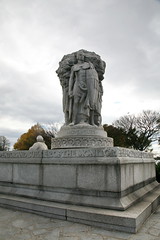
John Ericsson, the inventor behind the famous Monitor, can be found in West Potomac Park sitting with an allegorical group representing his heritage and contributions. The monument was sculpted by J.E. Fraser at the price of $63,500 and was dedicated on 29 May 1926.


Photographs courtesy of flickr.

On November 27

On this day in ...
... 1981, Lotte Lenya (right) died from cancer in New York City, 83 years after she'd been born in Vienna, Austria, to working-class parents who'd named her Karoline Wilhelmine Charlotte Blamauer. After moving to Zurich as a teen-aged student, she took her 1st entertainment job and adopted the stage name that would stay with her for life. (photo credit) By 1921, Lenya was in Berlin, where eventually she created the role of Jenny Diver at the premiere performance of the play known in English as The Threepenny Opera, by Bertold Brecht and Lenya's husband, Kurt Weill. After World War II, which Lenya spent in Paris performing inter alia for the Voice of America, Lenya launched a Broadway and film career that included memorable turns as the Russian Colonel Rosa Klebb, a SPECTRE agent who battled James Bond.

(Prior November 27 posts are here, here, and here.)

On November 24

On this day in ...
... 1950 (60 years ago today), Guys and Dolls, a musical based on Damon Runyon's short story of an improbable romance between Sky Masterson, a New York gambler, and Sarah Brown, head of a Salvation Army mission, made its Broadway début at the 46th Street Theater. "[M]iraculously able to mock the desperate denizens of Dream Street and celebrate them at the same time," the show, which featured a rendezvous in Havana and songs like "Luck Be a Lady," ran for 1,200 performances and within 5 years was made into a film starring Marlon Brando, Frank Sinatra, and Jean Simmons.


(Prior November 24 posts are here, here, and here.)

On October 27

On this day in ...
... 1885 (125 years ago today), Sigrid Hjertén (left) was born in Sundsvall, Sweden. Following university studies in the teaching of art, Hjertén, then in her mid-20s, met an art student (her future husband) who persuaded her that she had a future in painting. The 2 subsequently studied with Henri Matisse in Paris. Hjertén painted for 3 decades and "is considered a major figure in Swedish modernism." (credit for 1916 painting by her, at right) Her career ended when, suffering from schizophrenia, she was lobotomized. Hjertén died in Stockholm in 1948, at age 62.

(Prior October 27 posts are here, here, and here.)

Nazi-looted art & California

(Delighted to welcome back IntLawGrrl alumna Jennifer Kreder, who contributes this On Art! guest post)

Latest developments in California respecting claims for recovery of artworks stolen by the Nazis in World War II: legislation that would ease the ligitation of looted-art-recovery claims awaits decision by California governor, and an en banc panel of the U.S. Court of Appeals for the Ninth Circuit has issued an interlocutory ruling in favor of one such claim.

Pending legislation
Some history is in order to understand the significance of A.B. 2765, the bill that California legislators approved at the end of last month.
► In 2009, in von Saher v. Norton Simon Museum of Art at Pasadena, a 3-member panel of the U.S. Court of Appeals for the Ninth Circuit struck down § 354.3 of the California Code of Civil Procedure. That law had attempted to extend, to December 31, 2010, the statute of limitations applicable to claims seeking restitution of Nazi-looted art against museums and galleries. But the Ninth Circuit held that the state statute was preempted under the foreign affairs doctrine.
The von Saher case involves Adam and Eve (right), a circa-1530 diptych painted by Lucas Cranach the Elder, which had undeniably been stolen from one of the most prominent art dealers in Europe, Jacques Goudstikker, whose Amsterdam gallery was aryanized after he fled for his life (and who died in an accident on the fleeing ship). The Dutch government seems to have mistakenly returned the paintings to the wrong family after the war, and the paintings were later sold by an art dealer to the museum. Under the American common law of property, an axiomatic rule is that title to stolen art does not pass except in limited circumstances involving bailments – although limitations periods could bar a claim.
A petition for certiorari is set to be considered by the U.S. Supreme Court at its conference on September 27.
► In 2007, another 3-member panel of the Ninth Circuit, in Orkin v. Taylor, had ruled both that federal law created no private right of action for Holocaust survivors and heirs to seek restitution of their art, and that the California conversion/replevin cause of action accrues when the “plaintiff discovers or reasonably could have discovered her claim to and the whereabouts of her property.” (credit for photo of Vincent Van Gogh painting in dispute in Orkin)
A number of courts across the country recently have been interpreting constructive notice standards in ways that do not account for the inability of Holocaust survivors and their heirs to truly discover until now their ability to reclaim artwork stolen or sold under duress or in a forced sale.
The Supreme Court declined the petition for certiorari filed in this case.
The California legislation that is awaiting signature or veto by Governor Arnold Schwarzenegger would:
► Require actual notice; and
► Double the length of time allowed between actual discovery and commencement of the cause of action, from three to six years.
The law would apply to all new and pending causes of action commenced on or before December 31, 2017. It also would include actions that were dismissed based on the expiration of the statute of limitations in effect prior to the date of enactment. Although the new standard would apply only to art in museums and galleries in California, it could pave the way for more state-level reform.

New ruling
While this statewide legislation was pending, an en banc panel of the San Francisco-based federal appellate court issued a ruling that permitted another recovery suit to go forward.
In Cassirer v. Kingdom of Spain, decided in mid-August, the en banc Ninth Circuit panel held 9-2 that Spain and its instrumentality, the Madrid-based Thyssen-Bornemisza Collection Foundation, are subject to U.S. jurisdiction under the expropriation exception of the Foreign Sovereign Immunities Act – even though it was the Nazis, not Spain, that engaged in the expropriation.
The court in Cassirer held that the plain language of 28 U.S.C. § 1605(a)(3), which states only that the property be “taken in violation of international law,” has no requirement as to who must actually engage in the taking. The court then found that the Foundation is engaged in sufficient commercial activity in the United States – advertising for tourism – to fall under the commercial activity exception in this section of the FSIA.
In light of the limited jurisdiction it possessed on interlocutory appeal, the Ninth Circuit in Cassirer declined to engage in an extensive review of defense arguments that the plaintiff was required to exhaust local remedies for jurisdiction to lie in the United States. It also declined to review the lower court’s denial of the motion to dismiss on grounds related to personal jurisdiction and the case-or-controversy requirement.
The plaintiff, Southern California resident Claude Cassirer, seeks recovery of Rue Saint-Honoré, après-midi, effet de pluie (below right). A Nazi agent allegedly (and in this author’s opinion certainly) confiscated this 1897 painting by the impressionist Camille Pissaro from the plaintiff’s grandmother, Lily Cassirer. (image credit) The Ninth Circuit in Cassirer reiterated the basic allegations as follows:

In 1939 Lilly decided she had no choice but to leave Germany. By that time – as the district court judicially noticed – German Jews had been deprived of their civil rights, including their German citizenship; their property was being “Aryanized”; and the Kristallnacht pogroms had taken place throughout the country. Permission was required both to leave and to take belongings. The Nazi government appointed Munich art dealer Jakob Scheidwimmer as the official appraiser to evaluate the works of art, including the Pissarro painting, that Lilly wished to take with her. Scheidwimmer refused to allow her to take the painting out of Germany and demanded that she hand it over to him for approximately $360. Fearing she would not otherwise be allowed to go, and knowing she would not actually get the money because the funds would be paid into a blocked account, Lilly complied.

The court explained how the painting made its way to the collection of the Thyssen-Bornemisza Collection Foundation:

Schweidwimmer traded the painting to another art dealer, who was also persecuted and fled Germany for Holland. After Germany invaded Holland, the Gestapo confiscated the painting and returned it to Germany, where it was sold at auction to an anonymous purchaser in 1943. It turned up at a New York gallery in 1952 and was sold to a St. Louis collector; it was sold again in 1976 to a New York art dealer who, in turn, sold it to Baron Hans-Heinrich Thyssen-Bornemisza. Bornemisza lived in Switzerland and was a preeminent private collector.

A petition for certiorari almost certainly will be filed with the Supreme Court.

On September 12

On this day in ...
... 1940 (70 years ago today), 4 French teenagers followed their dog into a narrow cave at Montignac, a town near the city of Bordeaux. They found a trove of illustrations in the Lascaux grotto -- "15,000- to 17,000-year-old paintings, consisting mostly of animal representations," like the one at left, that "are among the finest examples of art from the Upper Paleolithic period." Closed to the public in the 1960s because lighting was causing harm, the paintings may be seen today solely in replica, at a site "opened nearby in 1983," which "receives tens of thousands of visitors annually."

(Prior September 12 posts are here, here, and here.)

Guest Blogger: Yvonne McDermott

It's IntLawGrrls' great pleasure to welcome Yvonne McDermott (left) as today's guest blogger.
Yvonne is a Ph.D. candidate and doctoral research fellow at the Irish Centre for Human Rights, National University of Ireland-Galway, where she is also a Lecturer on Children's Rights. Her research focuses on due process in international criminal proceedings, and her guest post below examines the jurisprudential doctrine of abuse of process, an ongoing issue in 3 International Criminal Court cases now proceeding against defendants from the Democratic Republic of Congo.
Yvonne holds a Diploma in Irish (Gaeilge), a Bachelor of Corporate Law and a Bachelor of Laws from the National University of Ireland, Galway. In 2008, Yvonne earned an LL.M. cum laude in Public International Law from Leiden University in the Netherlands. Her scholarship includes the journal article Victims and International Law: Remedies in the Courtroom (2009), for which last year she was named the inaugural recipient of the Böhler Franken Koppe Wijngaarden advocaten Hague Academic Coalition Award for Young Professionals. Yvonne is the Managing Editor of the Oxford Reports in International Criminal Law.
Yvonne chooses to dedicate her post to 2 Irish women. Both "are perhaps better known for their associations with famous men," she writes, but both "deserve to be recognised in their own right." Yvonne continues:
Mary Ann McCracken [left; 1770-1886], the sister of executed United Irishman Henry Joy McCracken, was born in Belfast. She too was committed to social reform, and was a dedicated philanthropist and activist, committed to helping the poor of Belfast,
pioneering for equal rights for women and the abolition of slavery. There are descriptions of her at the age of 88 handing out leaflets at the docks of Belfast to those heading for the southern ports of the United States, where slavery was still practiced.
Maud Gonne [below right; 1866-1953] was born in England but her legacy is cemented as a pivotal player in the Irish struggle for independence. She was particularly involved in countering evictions and in famine relief in counties Connaught in the late 19th century. She was the founder of Inghinidhe na hÉireann (Daughters of Ireland), an Irish nationalist feminist organisation, in 1900, and was fiercely devoted to the promotion and preservation of Irish culture through the arts. In spite of her own achievements, Maud Gonne is often celebrated as the muse of William Butler Yeats and the mother of diplomat and Nobel Peace Prize winner, Seán MacBride.
Today Gonne (prior post) and McCracken join the foremothers' list just below our "visiting from..." map in the righthand column -- and thus also join what Yvonne aptly calls "the wonderful Mná na hÉireann so honoured on this blog before me." The "Women of Ireland" to whom she refers are foremothers Grace O'Malley/Gráinne Ní Mháille, Eva Gore-Booth, Mary Harris "Mother" Jones, Eibhlín Dhubh Ní Chonaill, Hanna Sheehy Skeffington, and Constance Markiewicz.

Heartfelt welcome!

Open wounds after war

(Delighted to welcome back alumna Jennifer Kreder, who contributes this guest post)

The first major Khmer Rouge defendant has been brought to justice with the 30-year sentence just handed down (left), as posted, by the Extraordinary Chambers in the Courts of Cambodia. (photo credit)
I believe postwar prosecutions for human rights violations are beneficial for victims, but that there are risks as well. When people who have committed heinous crimes get less than the maximum sentence, I think it is foreseeable that many victims will be hurt again. On the other hand, if every defendant gets the maximum sentence, the tribunal will not appear to be objective.
Then, there are other ways to deal with postwar open wounds, such as truth commissions and civil litigation, which may occur in courts beyond the borders of the nation that experienced war (often internal civil war).
I would love to hear others' viewpoints about these issues:
► What do you think is helpful for the individual victims and the nation, and why?
► Should U.S. courts hear postwar claims? If so, when and why?
► Should it depend on the location of victims who fled a murderous regime? Or on the location of their property? Or on whether significant remedies are available in the nation where the war occurred?
► Should it depend on a green light from the executive branch?
I am currently exploring the intersection of the "open wounds" idea and the cultural property arena.
For example, Tuol Sleng (right), the prison where the just-sentenced defendant, known as Duch, led the torture and murder of so many innocents, is now a Genocide Museum.
Part of Tuol Sleng's roof collapsed last week. Some people said the souls of the dead were crying out for justice.
Certain types of property, real property and chattels, have meaning that transcends finances. Caring for such property thoughtfully can help heal postwar wounds, whereas its destruction can feel like new wounds to wartime victims.
Another example of the intersection of human rights, war, and cultural property concerns terrorism and antiquities that were found within the borders of modern-day Iran but now are located in U.S. museums.
In recent years Congress a number of laws purporting to give victims of terrorism means to redress:
► That part of the 1996 Antiterrorism and Effective Death Penalty Act that allows American victims to sue countries designated as sponsors of terrorism; and
► The Civil Liability for Acts of State Sponsored Terrorism Act, a/k/a the Flatow Amendment in honor of victim Alisa Flatow), which authorizes U.S. courts to award money damages to victims of terrorism.
In fact, this legislation has proved ineffectual -- a “sound bite” that has foisted conflicting jurisdictional mandates upon the federal courts, sucked terrorist victims into a vacuous, exhausting drama with no chance for justice, and interfered with the President’s ability to conduct diplomatic relations in the Middle East.
One group of victims is mired in multiple jurisdictions, trying to enforce an extremely large default judgment against the Islamic Republic of Iran by forcing auctions of antiquities like these Persian tablets, housed at the University of Chicago's Oriental Institute. Other collections subject to this complex litigation may be found at, to name a few sites, Harvard University, the Field Museum of Natural History in Chicago, and the Museum of Fine Arts in Boston. Congress, in this political posturing, required the U.S. Department of Justice to participate in the litigation in a way that runs counter to the victims’ interest. The victims likely feel ignored and maligned by their own President, while Congress all along was the master puppeteer of their false hopes. Kimberly deGraaf and I have co-authored an article on the subject, "Museums in the Crosshairs: Unintended Consequences of the War on Terror," forthcoming in the Duke Journal of Comparative & International Law.
No one believes that dealing with property ever will bring back the dead or afford full "justice" to victims. But many of us believe that the symbolism of such property is significant.
Do you have thoughts on these issues?
Can you provide other examples of postwar wounds that need redress to allow healing to occur?


(A version of this post appears at PrawsfBlog)

Some Artistic Representations of John Ericsson in Washington, DC

John Ericsson’s design for the USS Monitor was crucial to the Union in the early years of the war and proved so important that it became the namesake of that style of ironclad warship. The United States Navy needed their own ironclad to go up against the CSS Virginia, and Swedish-born Ericsson—already a technological inventor and engineer of some renown—saved the day with his idea that seemed "the image of nothing in heaven above, or the earth beneath, or the water under the earth."

Ericsson has a rightful though often forgotten place in American history and one of the best ways to reconnect with slightly obscure figures is to experience artistic representations of their person. A quick search reveals that the Smithsonian’s National Portrait Gallery in Washington, DC has at least twelve pieces of Ericsson-related art ranging from a marble sculpture to traditional oil on canvas to albumen silver print. Most of these portraits are viewable online and this portrait of Ericcson as well as this 1862 group portrait entitled Men of Progress are viewable in person in the National Portrait Gallery’s American Origins exhibit.

After seeing Ericsson’s portraits, don’t forget to visit the John Ericsson National Memorial, located in West Potomac Park, south of the Lincoln Memorial. Here a six-foot-five figure of Ericsson sits surrounded by figures representing “adventure,” “labor,” and “vision”—three qualities that Ericsson and the Civil War Navies truly exemplified.

On Art! History & Holocaust claims

(Today alumna Jennifer Kreder contributes another On Art! guest post, prompted by her work in a pending looted-art case; her prior, related posts are here and here)

What judges think of their function and task undoubtedly informs their understanding of their power or jurisdiction.
In a March 3d order denying reconsideration of her January 6th dismissal of the heirs' lawsuit in the Nazi-looted-art case of Grosz v. MoMA, U.S. District Court Judge Colleen McMahon (below right) of the Southern District of New York stated on page 11 that the court was confronted
with a legal, not a historical, question.
This view is a false dichotomizing of the judicial function.
Judges cannot be expected to know intimately the historical context of all cases that come before them. But under precedents like Iqbal, Twombly and their progeny, judges should not ignore widely accepted historical facts when deciding whether a claim arguing that a seemingly voluntary transaction was, in fact, made under duress is “plausible.”
From the very beginning of the Nazi era, law and jurisprudence became a strong component of justification of regulations that deprived “enemies of the State” of their liberty and property, and these deprivations led in turn to mass murder.
Indeed, as documented in Robbing the Jews: The Confiscation of Jewish Property in the Holocaust, 1933-1945 (2008), by a Research Scholar at the Center for Advanced Holocaust Studies of the U.S. Holocaust Memorial Museum, Martin C. Dean, the “legalized” grand larceny became a form of financing the mass murder.
The Führerprinzip demanded unquestioning loyalty to the concentrated power of a “unitary executive.” Both legislators and judges in Nazi Germany participated in the normalization of practices of State grand theft that were engineered to make involuntary transactions appear “ordinary and legal” from the very first weeks of the Nazi regime early in 1933, even before the infamous racist Nuremberg laws of “blood and honor” in 1935, and even before the final push to a “Final Solution.” The U.S. Consul General in Vienna, immediately after the Anschluss of Austria in March 1938, poignantly observed:
There is a curious respect for legal formalities. The signature of the person despoiled is always obtained, even if the person in question has to be sent to Dachau in order to break down his resistance.
Jews were systematically excluded from professions and forced to compile inventories to streamline the despoliation of their property from 1933 to 1942, when Jews had little or no property left to rob, and when the focus turned to “cost-efficient” mass murder in the death camps of occupied Poland.
It is a gross distortion of reality to suggest that the financial despair of Jews in 1933, during widespread, sporadic boycotts and until the passage of the first Nuremberg law in 1935, resulted from a series of isolated private setbacks brought about by generalized, severe financial conditions akin to the Great Depression. The National Socialist platform, adopted as official German state policy as of 1933, was committed to driving Jews and other “enemies of the State” out of economic life.
This is the historical context in which modern claims to Nazi-looted art should be viewed.
Too frequently, some of our judges seem to have forgotten history. In kneejerk fashion, some seem to assume that claims 70 years old simply cannot be viable. This reaction is contrary to history, and to the U.S. executive policy. Consider, in addition to documents on which I earlier posted, this August 27, 1951, statement, "The Recovery of Cultural Objects Dispersed during World War II," by Ardelia R. Hall, the Fine Arts & Monuments Adviser to the U.S. State Department, which appeared in the Department's Bulletin:
For the first time in history, restitution may be expected to continue for as long as works of art known to have been plundered during a war continue to be rediscovered.
The executive branch has not deviated from this position to date.

(A version of this post appears at PrawsfBlog)

On July 24

On this day in ...
... 1900 (110 years ago today), in Montgomery, Alabama, Zelda was born, daughter of an Alabama Supreme Court Justice, Anthony Dickson Sayre, and his wife, Minnie Buckner Machen Sayre. "[N]amed after the gypsy heroine of an obscure 1874 novel," as a teenager Zelda was a belle of country club society. A month after graduating from high school she met a young Army officer, F. Scott Fitzgerald. Their courtship and globe-trotting marriage inspired a trove of literature -- not only his novels and short stories, but also Zelda Fitzgerald's own works, like Save Me the Waltz (1932), a semi-autobiographical novel that's worth the read. This website, moreover, notes

the frequent addition of his name to her bylines on nearly two dozen stories and articles she produced between 1922 and 1934. In fact, Scott's agent or editors added his name in several instances without his knowledge because the joint byline increased the price that these works received from leading magazines.
Her efforts to succeed as a writer, then a painter (credit for her self-portrait above left, circa early 1940s), even a ballerina, as well as her separation from her husband and death in 1948 by a fire that swept through the hospital where she was being treated for depression, are recounted in Nancy Milford's biography, Zelda (1970).

(Prior July 24 posts are here, here, and here.)

On July 16

On this day in ...
... 2003, the woman whom fans had crowned the Queen of Salsa died at her New Jersey home, from complications after brain surgery. At her birth in Havana, Cuba, 77 years earlier, she'd been given the name Úrsula Hilaria Celia de la Caridad Cruz Alfonso. As Celia Cruz (left) she became an internationally known performer, earning a Grammy Award, gold albums, and an honorary doctorate. In 1960, the same year of her performance below (credit), Cruz was touring Mexico when revolution came to Cuba. She did not return home, eventually moving to the United States.


(Prior July 16 posts are here, here, and here.)

Cultural property postcard from Italy

(Delighted to welcome back alumna Jennifer Kreder, who contributes another this guest post)

AMELIA, Umbria, Italy -- The field of cultural property is not just about restitution. It’s also about preservation of monuments, objects, heritage and the archaeological record, among other things. When objects are clandestinely ripped from the ground for the black market, their contexts are destroyed, and we lose historical data from which we would know so much more about beautiful objects.
I’m currently writing during a sleepless, hot night in this beautiful town outside of Rome, a place with a rich history.
The region, Umbria, is a place of incredible archaeological richness. (credit for photo at left of Roman Theatre at Spoleto in Umbria)
At the top of this hill city, Amelia (above right), is featured a tower outside the beautiful Catholic church; it utilizes Roman and pre-Roman archeological materials. (photo credit)
When I was still in Rome, I managed to squeeze in time at the Roman Forum, Palatine, Borghese Galleries (and surrounds) and at the Piazza Navona (for tartufo, the ice cream dessert below right).
But, I must return to my husband and four-year-old son. My son believes part of my mission to Italy was to determine which Transformers (below left) Italian kids like. The outcome of this anthropological study remarkably coincides with the secret Transformer stash in our basement.
Anyway . . .
By 1909, Italy passed its first “in-the-ground” statute, which vested ownership of all unearthed antiquities in the state. Greek vases have nonetheless, since then, been dug out of Roman soil by the truckloads. They have trafficked through “reputable” dealers into some of the most esteemed museums in the world. A few of our most esteemed institutions that have returned loot, among them The Getty in Southern California, the Cleveland Museum of Art, and the Metropolitan Museum of Art in New York. Over 100 objects have been returned from U.S. museums and collectors in the last three years or so, largely as a result of Polaroids found in a raid on a Swiss warehouse in a Geneva airport, as documented in The Medici Conspiracy: The Illicit Journey of Looted Antiquities--From Italy's Tomb Raiders to the World's Greatest Museums, a 2006 book by Peter Watson and Cecelia Todeschini. Some of those antiquities are now on display in Rome, including in the National Etruscan Museum in the Villa Giulia.
The 2010 Conference on the Study of Art Crime was the occasion for my trip to Italy. It was hosted by ARCA, the Association for Research into Crimes against Art, a think tank which runs the first master's program in the interdisciplinary field of art theft.
Conference presentations, which will be posted on-line in the near future, covered a diverse array of fields, including:
► Museum security,
► Cultural identity,
► Archaeology,
► The relationship of looting and terrorist funding, and
► Nazi-looted art.
I particularly enjoyed hearing from Giovanni Pastore, former Vice-Commandant of the Carabinieri Division for the Protection of Cultural Heritage and an ARCA trustee. Part of his presentation was broadcast on Italian television.
* * *
Do you love antiquity? History? Beautiful objects? Culture? Heritage? Art – old or new? If so, I hope you’ll consider joining the American Society of International Law Interest Group on Cultural Heritage and the Arts (prior post), for which I serve as co-chair, or contributing to our Cultural Heritage & the Arts Review (prior post), which our interest group publishes.
Our field is highly polarized. Very few of us agree with each other on all issues, but most of us are open to a good debate and to introduction of new views. The field consists of a small number of lawyers, but a much larger community of people involved in archaeology, site preservation, government, museums, collecting, auction houses, military, indigenous groups and other organizations, and there is room for more -- more profs, law students, and others! Join us to learn about the law surrounding cultural property and heritage!

(A version of this post appeared at PrawfsBlawg)

On Art! U.S. executive policy on looted art

(Today alumna Jennifer Kreder contributes another On Art! guest post, prompted by her work in a pending looted-art case; her 1st, related post is here)

The Executive Branch of the United States long has carried out a consistent policy respecting art looted by Nazi Germany. This policy bears on the lawsuit in which heirs lay claim to certain paintings now in the George Grosz collection of the Museum of Modern Art in New York.
In January, a trial court dismissed the lawsuit as time-barred without reference to the complex historical factors delaying the heirs' assertion of their claims. In so doing, the court contravened foreign policy goals that the United States and the Allies pursued during and immediately after World War II and that a broad coalition of states pursued, via diplomatic breakthroughs, in 1998, 2000, and 2009. I detail the history in this post, which derives from the amicus brief that I co-authored in support of the heirs' pending appeal to the U.S. Court of Appeals for the 2d Circuit in Manhattan (courthouse at right).
In the normal course of judicial administration touching on foreign policy, federal judges typically defer to determinations of policy matters by the executive branch.
One example of this rule unfolded in mid-20th C. litigation of Bernstein v. N. V. Nederlansche-Amerikaansche Stoomvaart-Maatschappij. In a 1949 decision in Bernstein, 173 F.2d 71, the 2d Circuit ruled inadmissible statements in which a Jewish victim of persecution described the brutal Nazi imprisonment that led him to “transfer” major assets under duress. To admit such evidence, the court reasoned, would denigrate a foreign country. Then, however, with regard to the same litigation, Jack B. Tate (below left), Acting Legal Adviser in the U.S. Department of State, wrote, as quoted here, of his

Government’s opposition to forcible acts of dispossession of a discriminatory and confiscatory nature practiced by the Germans on the countries or peoples subject to their controls . . . [and that] the policy of the Executive, with respect to claims asserted in the United States for restitution of such property, is to relieve American courts from any restraint upon the exercise of their jurisdiction to pass upon the validity of the acts of Nazi officials.
Having thus been informed of the government’s views of coerced “transactions” during the Nazi era in Germany, the 2d Circuit's 1954 judgment in Bernstein reversed its previous ruling in the same case.
This Tate letter was in no means the only exemplar of U.S. executive policy.
U.S. diplomats led efforts to warn other countries against looting in the landmark London Declaration of January 5, 1943, which

declare[d] invalid any [coerced] transfers of, or dealings with, property . . . whether such transfers or dealings have taken the form of open looting or plunder, or of transactions apparently legal in form, even when they purport to be voluntarily effected.

Immediately after the war, moreover, the International Military Tribunal at Nuremberg (right) -- convened by the United States along with Britain, France, and the Soviet Union -- had evaluated detailed evidence of coerced sales. (photo credit) The plunder of art was declared a war crime, and is so recognized today. At Nuremberg, it was perfectly clear to the factfinders who had done what and to whom. Thus the Tribunal convicted Alfred Rosenberg, head of the Einsatzstab Reichsleiter Rosenberg art-looting unit, and sentenced him to death by hanging.
Shortly thereafter in Bonn and Vienna it was made clear in, for example, Military Government Law 59, that Germany and Austria had to repudiate all spurious “transactions” of the entire Nazi era, including art “deals” that were really seizures.
Thus, the model chosen was a restitution model for individual claims, and these claims were not subsumed in reparations paid after the war -- reparations that became limited as the United States implemented the Marshall Plan.
The amicus brief that I co-authored argues that the 2d Circuit must, as it did in its 1954 Bernstein ruling, accord to the Executive the deference described in the Tate letter.
Diplomats from the State Department, particularly Ambassador Stuart E. Eizenstat, played a leading role in securing multilateral public commitments, by scores of countries, to effective, fact-based resolution of Nazi-looted art claims. For example:
to develop national processes to implement these principles, particularly as they relate to alternative dispute resolution mechanisms for resolving ownership issues.
(credit for 1945 photo, republished during the 1999 Washington Conference, of U.S. soldier examining "paintings, part of the loot gathered from all parts of Europe by Hermann Goering, in 1945 in Germany")
► The 2009 Terezín Declaration similarly calls on countries to secure
just and fair solutions with regard to Nazi-confiscated and looted art, and to make certain that claims to recover such art are resolved expeditiously and based on the facts and merits of the claims and all the relevant documents submitted by all parties.
The Declaration further stresses that

Governments should consider all relevant issues when applying various legal provisions that may impede the restitution of art and cultural property, in order to achieve just and fair solutions, as well as alternative dispute resolution, where appropriate under law.
To give credit when due, this development in foreign policy was sparked in no small measure by Guidelines that the Association of American Museum Directors. Thus, it is quite shocking that some U.S. museums -- MoMA is one -- have interposed defenses like statute of limitations and laches. As demonstrated in this case-law chart that I've compiled, and as I've discussed further here, their efforts are all too often successful. This result thwarts the policy set forth above, distorting the historical record and law in the process.

(A version of this post appeared at PrawfsBlawg, where I'm guesting this month)

 
Bloggers Team