Showing posts with label Personalities. Show all posts

1861 by Walt Whitman

ARM’D year! year of the struggle!
No dainty rhymes or sentimental love verses for you, terrible year!
Not you as some pale poetling, seated at a desk, lisping cadenzas
      piano;
But as a strong man, erect, clothed in blue clothes, advancing,
      carrying a rifle on your shoulder,
With well-gristled body and sunburnt face and hands–with a knife in
      the belt at your side,
As I heard you shouting loud–your sonorous voice ringing across the
      continent;
Your masculine voice, O year, as rising amid the great cities,
Amid the men of Manhattan I saw you, as one of the workmen, the
      dwellers in Manhattan;
Or with large steps crossing the prairies out of Illinois and
      Indiana,
Rapidly crossing the West with springy gait, and descending the
      Alleghanies;
Or down from the great lakes, or in Pennsylvania, or on deck along
      the Ohio river;
Or southward along the Tennessee or Cumberland rivers, or at
      Chattanooga on the mountain top,
Saw I your gait and saw I your sinewy limbs, clothed in blue, bearing
      weapons, robust year;
Heard your determin’d voice, launch’d forth again and again;
Year that suddenly sang by the mouths of the round-lipp’d cannon,
I repeat you, hurrying, crashing, sad, distracted year.

George Dewey: Admiral and Civil War Sailor

On this date in 1903 (24 March 1903), George Dewey (1837-1917) was commissioned as an Admiral of the Navy with the date of rank 2 March 1899.  He was the only person to ever hold that distinction.  Dewey himself, best known for his actions during the Spanish American War, began his service in the United States Navy during the antebellum period of American history.  After graduating from the United States Naval Academy in 1858, Dewey was sent to the USS Saratoga and later the Wabash as a Midshipman. 

During the American Civil War, Dewey was promoted to Lieutenant just one week after the war broke out at Fort Sumter.  During the period 26 April 1861, until 30 August 1867, he had consecutive service on USS Mississippi, USS Brooklyn, USS Agawam, USS Colorado, USS Kearsarge, USS Canadiagua, and again USS Colorado.

According to William J. Lawrence's A Concise Life of Admiral George Dewey, the young officer was personally commended by Admiral David D. Porter at the Battle of Fort Fisher for seizing the initiative to take out a number of works on shore.  The New York Times picked up the story in their depiction of the battle, thus making the future Admiral an up and coming star in the eyes of the American public. 

His service record during the Civil War included service in the West Gulf and North Atlantic Blockading Squadron.  By the end of the war, Dewey held the rank of Lieutenant Commander (3 March 1865).

Stephen Mallory - Secretary, Confederate States Navy


On March 4, 1861, Stephen R. Mallory was appointed Secretary of the Navy of the Confederate States of America. To me, he is one of the more interesting persons of the Civil War navies, Union or Confederate. Born circa 1813 in Trinidad, he was raised mostly in Key West, Florida. He began his professional career in the early 1800’s practicing maritime law in the Florida Keys (at the time a hot bed of “wrecking” – the recovery of cargo from ships wrecked on the reefs of the Keys). Eventually he went into politics, representing Florida in the U.S. Senate. There, he was appointed to the Senate Committee on Naval Affairs, which he eventually chaired. During his tenure, he was an advocate for the reinstatement of flogging as a means of discipline of sailors. He failed to prevail on this issue, but he was successful in passing legislation overhauling the means of promotion and retention of officers in the Navy, establishing a Board of Review, which evaluated naval officers based on accomplishments and abandoned the ancient system of advancement based on seniority alone. The other major issue Mallory promoted in his senate position was for the U.S. Navy to adopt emerging technologies, such as construction of ironclad warships.

When Florida seceded, Mallory joined the fledgling Confederacy. President Jefferson Davis appointed him Secretary of the C.S. Navy in March 1861. Mallory was well aware that the south could not match the north in the ability to build and modify ships, and that he would never be able to go “ship-to-ship” against the U.S. Navy; so he adopted a naval strategy based on three things (not in order of priority):

(1) Deploy sea-going commerce raiders to disrupt Union merchant shipping and divert Union warships from the blockade to chase the raiders.
(2) Run the Union blockade using a combination of private shipping and specially-constructed blockade-running ships operated by the C.S. Navy.
(3) Adopt and deploy the broad range of emerging naval technologies (ironclads, submersibles, and torpedoes) to attempt to keep southern harbors open and maintain the flow of supplies through the blockade.

One could say that he both succeeded and failed in all three. Originally, the Confederate States of America tried to implement commerce raiding by the old device of issuing “Letters of Marque” to allow private parties to act as raiders on behalf of the Confederate government. Due to international treaty, the Confederate Navy eventually decided to assume the responsibility for purchasing and constructing sea-going ships to prey on Union commerce shipping. These would be regular, commissioned war ships. While some of these had great success (notably the CSS Alabama and Shenandoah), they failed to even partially disable Union maritime commerce, although they did contribute to the eventual demise of the U.S. merchant marine industry. They were unsuccessful at diverting Union Navy ships off the blockade to try to hunt them down and capture them.

Blockade running was also initially entrusted to private parties, but the private runners ultimately failed to deliver the war material needed by the Confederacy to prosecute the war. The demand for luxury goods (and the willingness of the Confederate aristocracy to pay whatever price was commanded) made it more lucrative for private runners to carry cargo to meet this demand, despite government requirements that they carry a certain percentage of military cargo. Eventually, the Confederate Navy chose to construct and crew its own blockade runners in order to supply arms and equipment to the armies of the Confederacy (e.g. see CWS Blog Post by Gordon Calhoun on 24 July 2010).

Mallory’s willingness to use new technology was perhaps his greatest contribution to the war effort, but again, he was unable to capitalize on this. He embraced the use of ironclad ships as a means of going up against the overwhelming firepower of the big frigates and sloops of the Union Navy, but he did not exercise the necessary degree of authority in prioritizing the construction of the C.S. Navy ironclads. The various private groups contracted to build the ironclads had to compete with one another in the procurement of critically needed iron plates, machinery, skilled personnel, and the other limited resources that the Confederacy had to constantly deal with. This resulted in the construction of mostly ineffective ironclad vessels that failed to live up to their potential. If Mallory had used his authority (and strategic vision) to prioritize which ships needed to be finished first, and divert all resources to those, the confederate ironclads may have been more effective. The use of submersible vessels (the “Davids” and the CSS Hunley) did not achieve widespread success, and the use of torpedoes, while extremely effective in the latter stages of the war (in terms of both real results and their psychological impact) were deployed too late to accomplish anything substantive.

Following the conclusion of the war, Mallory was arrested by the U.S. government and imprisoned for “treason.” No trial of any kind was conducted and in March 1866, President Andrew Johnson granted Mallory a parole, which released him from jail. Eventually, he was allowed to return to Florida, where he settled in Pensacola. Per the terms of his parole, he was barred from holding public office, but he made a decent living by resuming his law practice. His health gradually began to fail and he died in November 1873. He is buried in St. Michael’s Cemetery in Pensacola, Florida.

 Photo courtesy of the Florida Dept. of State on-line photo archive.

Porter and Semmes in FINAL Poll!

Union Rear Admiral David Dixon Porter and Confederate Rear Admiral Raphael Semmes won this past week's semifinal poll asking readers, "Who Was the Greatest Civil War Naval Officer?"  While Porter was the clear winner for the Union, Semmes went through a slight struggle in the final days of the poll to win 7 votes to 5 (Matthew F. Maury). 

In an effort to gain a pulse to what readers and enthusiasts of the CWN 150 are looking for in these polls, a short "stat sheet" for each officer will be included for the final poll on the left hand side of the blog.  The poll will be left up for two weeks, with the ultimate winner decided in early March.

 David Dixon Porter (1813-1891)

 Greatest Achievements:
  • Second man to be promoted to rank of Admiral, next to adoptive brother David G. Farragut
  • Superintendent at the United States Naval Academy 
  • Commander, Mississippi River Squadron
  • Vicksburg Campaign, Fort Fisher Assault
Service Record:
  • Began naval service at age 10 under his father, Commodore David Porter
  • Midshipman in Mexican Navy, 1824
  • Midshipman in U.S. Navy, USS United States (Peacetime Navy)
  • Promoted to Lieutenant (1841) during his time at the Coast Survey and U.S. Navy Hydrographic Office
  • Mexican American War Service, awarded Captain of Spitfire
  • Commanding Officer, USS Supply
  • Commanding Officer, USS Powhatan
  • Promoted to Commander (Civil War)
  • Commanding Officer, Mortar Boat Flotilla
  • New Orleans Campaign, Vicksburg Campaign, Red River Expedition, Fort Fisher
  • Mississippi River Squadron Commander (1862)
  • North Atlantic Blockading Squadron Commander (1864)
  • Superintendent, U.S. Naval Academy (1865)
  • SECNAV advisor under President U.S. Grant
 
Raphael Semmes (1809-1877)

Greatest Achievements:
  • As Captain of the commerce raider CSS Alabama, he took a record 69 prizes
  • Only American to have the distinction of holding positions as a General and Admiral simultaneously
  • Destruction of USS Hatteras
  • Accomplished lawyer and professor of philosophy and literature at LSU
  • Member of the Alabama Hall of Fame
Service Record:
  •  Entered the U.S. Navy as a midshipman in 1826
  • Commanding Officer, USS Somers in Mexican American War (1846)
  • Promoted to Commander (1855)
  • Resigns from U.S. Navy (1861)
  • Accepts rank of Commander in Confederate Navy (1861)
  • Commanding Officer CSS Sumter
  • Promoted to Captain (1862)
  • Commanding Officer, CSS Alabama
  • Lost battle against USS Kearsarge off the coast of France; avoided capture
  • Promoted Rear Admiral (1865)
  • Commanding Officer, James River Squadron (1865)
  • Appointed Brigadier General in the CSA (1865)
The new poll will be posted on the left side of the blog page for the next two weeks.  Happy voting!

    The Civil War Navy As Seen In DC's Public Art

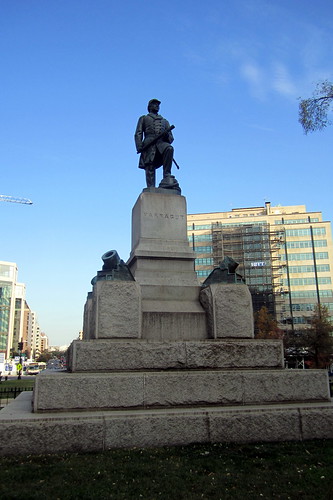
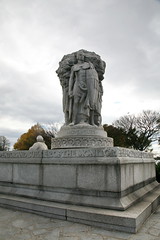
    Anyone who has visited or lived in Washington, DC knows that public art -- especially in the form of monuments and statuary -- is prevalent in nearly all of the city's green spaces. Four of these pieces are directly related to the Civil War Navy and are well worth noticing next time you are in the area.


    Admiral David G. Farragut appears in standing statue form in Farragut Square (17th and K St. NW). The piece was sculpted by Vinnie Ream Hoxie, cost $20,000, and was dedicated on 25 April 1881.


    The Naval Peace Monument also known as the Naval Monument or Peace Monument, was created by Franklin Simmons in 1877 to honor those who died honorably at sea during the Civil War. It is located at Pennsylvania Ave. and 1st St. NW. The cost of the piece was $20,000, paid for primarily by subscriptions from naval personnel.


    The DuPont Memorial, a monumental fountain located in Dupont Circle at the intersections of Massachusetts Ave., Connecticut Ave., 19th St. and P St. NW, was paid for by the family of Admiral Samuel DuPont and was dedicated on 17 April 1921. It was sculpted by Daniel Chester French (of Lincoln Memorial fame) and cost $77,521.33.


    John Ericsson, the inventor behind the famous Monitor, can be found in West Potomac Park sitting with an allegorical group representing his heritage and contributions. The monument was sculpted by J.E. Fraser at the price of $63,500 and was dedicated on 29 May 1926.


    Photographs courtesy of flickr.

    Andrew H. Foote wins week 4 poll! Poll five is up

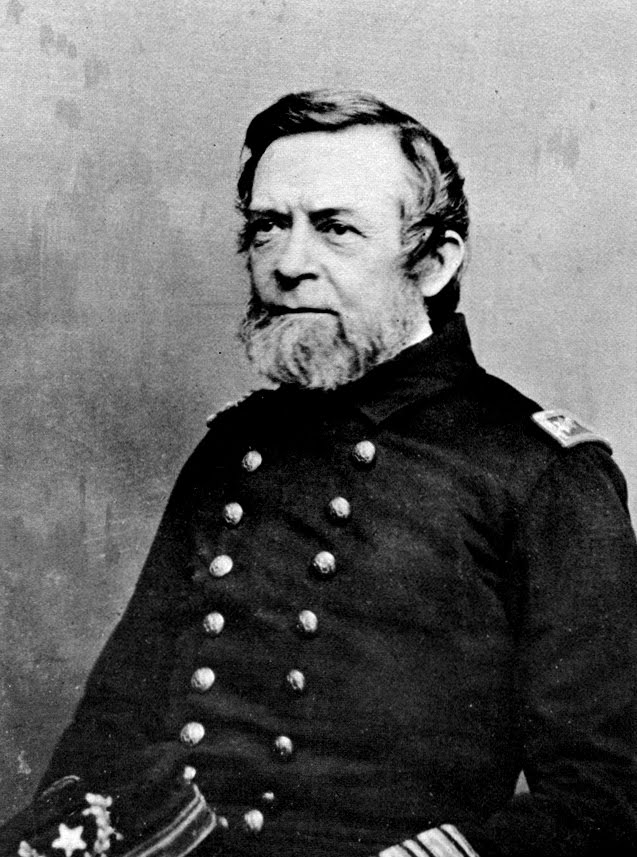
    Last month, the CWN 150 announced that it will begin a poll to decide who was the greatest naval officer of the Civil War. The polls will stretch over a few months, ultimately with a showdown between Union and Confederate officers. This past week, we highlighted our third poll with four Union officers: Andrew H. Foote, Silas Stringham, Winfield Scott (U.S. Army), and Richard W. Meade. After a week of voting, Andrew H. Foote won with 9 votes.We will be posting the third round of the poll today. Please vote, and encourage others to! We will be posting the fifth week of the poll today, finally introducing our first four Confederate naval officers. Reproduced again is Andrew H. Foote's brief biography from the Naval History and Heritage Command:

    Andrew H. Foote

    Andrew Hull Foote, born 12 September 1806 at New Haven, Conn., entered the Navy 4 December 1822 as a midshipman. Commanding Portsmouth in the East India Squadron on 20 and 21 November 1856, Foote led a landing party which seized the barrier forts at Canton, China, in reprisal for attacks on American ships. From 30 August 1861 to 9 May 1862, Foote commanded the Naval Forces on Western Rivers with distinction, organizing and leading the gunboat flotilla in the capture of Forts Henry and Donelson and Island No. 10. Wounded in action at Fort Donelson, Foote was commissioned Rear Admiral 16 July 1862, and was on his way to take command of the South Atlantic Blockading Squadron when he died at New York 26 June 1863.

    Captain Charles Wilkes Reports on the Trent Affair, 8 November 1861


    On November 8, 1861, USS San Jacinto Captain Charles Wilkes set out towards the Bahama Channel near Havana to intercept Confederate commissioners James M. Mason and John Slidell. The man who led the controversial U.S. Exploring Expedition two decades previous found himself leaving scientific endeavors for the new prospect of war. Mason and Slidell were heading to Europe to arbitrate agreements with nations for their support in the Confederate war effort, stopping for transport in Havana. During his search for the elusive CSS Sumter, Wilkes heard of the breakout of Mason and Slidell from Charleston and decided to take action. The USS San Jacinto intercepted the two on board the British mail steamer Trent under threat of cannon fire, taking Mason, Slidell, and their secretaries back to Boston. Although heroic, Captain Wilkes’ seizure of diplomats aboard a neutral ship almost fanned the flames of war between the United States and Great Britain, as they claimed that Wilkes clearly violated international law. After a swift apology for the event by Secretary of State William H. Seward, Mason and Slidell were released in January 1862, nearly two months after their capture.

    Reproduced below is Captain Charles Wilkes' report to Union Secretary of the Navy Gideon Welles seven days after the event unfolded. You can read more about Captain Wilkes and the Trent Affair at the Library of Congress website here or find out more about Charles Wilkes here from the Naval History and Heritage Command.


    Report of Captain Wilkes, U. S. Navy, of capture of Messrs. Mason and Slidell, Confederate commissioners on board the British mail steamer Trent, with enclosures.


    U. S. S. SAN JACINTO, November 15, 1861.


    SIR: I have written to you relative to the movements of this ship from Cienfuegos, on the south coast of Cuba.

    There I learned that Messrs. Slidell and Mason had landed on Cuba, and had reached the Havana from Charleston. I took in some 60 tons of coal and left with all dispatch on the 26th October to intercept the return of the Theodora, but on my arrival at The Havannah on the 31st I found she had departed on her return, and that Messrs. Slidell and Mason, with their secretaries and families, were there and would depart on the 7th of the month in the English steamer Trent for St. Thomas, on their way to England.

    I made up my mind to fill up with coal and leave the port as soon as possible, to await at a suitable position on the route of the steamer to St. Thomas to intercept her and take them out.

    On the afternoon of the 2d I left The Havannah, in continuation of my cruise after the Sumter on the north side of Cuba. The next day, when about to board a French brig, she ran into us on the starboard side at the main chains and carried away her bowsprit and foretopmast, and suffered other damages. I inclose you herewith the reports of the officers who witnessed the accident. I do not feel that any blame is due to the officer in charge of this ship at the time the ship was run into, and the brig was so close when it was seen probable she would do so that even with the power of steam, lying motionless as we were, we could not avoid it; it seemed as if designed.

    I at once took her in tow, and put an officer on board with a party to repair her damages. This was effected before night, but I kept her in tow till we were up with The Havannah and ran within about 8 miles of the light, the wind blowing directly fair for her to reach port.

    I then went over to Key West in hopes of finding the Powhatan or some other steamer to accompany me to the Bahama Channel, to make it impossible for the steamer in which Messrs. Slidell and Mason were to embark to escape either in the night or day. The Powhatan had left but the day before, and I was therefore disappointed and obliged to rely upon the vigilance of the officers and crew of this ship, and proceeded the next morning to the north side of the island of Cuba, communicated with Sagua la Grande on the 4th, hoping to receive a telegraphic communication from Mr. Shufeldt, our consul-general, giving me the time of the departure of the steamer.

    In this, also, I was disappointed, and ran to the eastward some 90 miles, where the old Bahama Channel contracts to the width of 15 miles, some 240 miles from The Havannah, and in sight of the Paredon Grande light-house. There we cruised until the morning of the 8th, awaiting the steamer, believing that if she left at the usual time she must pass us about noon of the 8th, and we could not possibly miss her. At 11:40 a.m., on the 8th, her smoke was first seen; at 12 m. our position was to the westward of the entrance into the narrowest part of the channel and about 9 miles northeast from the light-house of Paredon Grande, the nearest point of Cuba to us.

    We were all prepared for her, beat to quarters, and orders were given to Lieutenant D. M. Fairfax to have two boats manned and armed to board her and make Messrs. Slidell, Mason, Eustis, and Macfarland prisoners, and send them immediately on board. (A copy of this order to him is herewith enclosed.)

    The steamer approached and hoisted English colors. Our ensign was hoisted, and a shot was fired across her bow; she maintained her speed and showed no disposition to heave to; then a shell was fired across her bow, which brought her to. I hailed that I intended to send a boat on board, and Lieutenant Fairfax with the second cutter of this ship was dispatched. He met with some difficulty, and remaining on board the steamer with a part of the boat's crew, sent her back to request more assistance. The captain of the steamer having declined to show his papers and passenger list, a force became necessary to search her. Lieutenant James A. Greer was at once dispatched in the third cutter, also manned and armed.

    Messrs. Slidell, Mason, Eustis, and Macfarland were recognized and told they were required to go on board this ship; this they objected to, until an overpowering force compelled them. Much persuasion was used and a little force, and at about 2 o'clock they were brought on board this ship and received by me. Two other boats were then sent to expedite the removal of their baggage and some stores, when the steamer, which proved to be the Trent, was suffered to proceed on her route to the eastward, and at 3:30 p.m. we bore away to the northward and westward. The whole time employed was two hours thirteen minutes. I enclose you the statements of such officers who boarded the Trent relative to the facts, and also an extract from the log book of this ship.

    It was my determination to have taken possession of the Trent and sent her to Key West as a prize, for resisting the search and carrying these passengers, whose character and objects were well known to the captain, but the reduced number of my officers and crew, and the large number of passengers on board bound to Europe who would be put to great inconvenience, decided me to allow them to proceed.

    Finding the families of Messrs. Slidell and Eustis on board, I tendered them the offer of my cabin for their accommodation to accompany their husbands; this they declined, however, and proceeded in the Trent.

    Before closing this dispatch I would bring to your notice the notorious action of her Britannic Majesty's subjects, the consul-general of Cuba and those on board the Trent, in doing everything to aid and abet the escape of these four persons and endeavoring, to conceal their persons on board. No passports or papers or any description were in possession of them from the Federal Government, and for this and other reasons which will readily occur to you I made them my prisoners, and shall retain them on board here until I hear from you what disposition is to be made of them.

    I can not close this report without bearing testimony to the admirable manner in which all the officers and men of this ship 'performed their duties, and the cordial manner in which they carried out my orders. To Lieutenant Fairfax I beg leave to call your particular attention for the praiseworthy manner in which he executed the delicate duties with which he was intrusted; it met and has received my warmest thanks.

    After leaving the north side of Cuba I ran through the Santaren Passage and up the coast from off St. Augustine to Charleston, and regretted being too late to take a part in the expedition to Port Royal.

    I enclose herewith a communication I received from Messrs. Slidell, Mason, Eustis, and Mcfarland, with my answer.

    I have the honor to be, very respectfully, your obedient servant,
    CHARLES WILKES,Captain.


    Hon. GIDEON WELLES,
    Secretary of the Navy.


    AN AMERICAN ANSWER: In this "Harper's Weekly" cartoon after the United States had released Mason and Slidell to British custody, Uncle Sam is telling John Bull that he can have the two prisoners and that there are plenty more like them at Sing Sing prison, if he is interested. [Image: freerepublic.com]

    MISS SLIDELL ON THE RAM-PAGE.
    "I say, with my hand on my heart, that Miss SLIDELL, in her agony, did Strike Mr. FAIRFAX Three Times in the Face. I wish that her Knuckles had Struck me in the Face." [Image: Harpers Weekly, January 18, 1862]

    Week 4 Poll is now up!

    Last week, we unveiled the beginning of a contest to decide (by you the reader) who was the greatest naval officer, North and South. In the final week, we will square the Union and Confederate winner face to face to see who wins. Last week's winner was Admiral David D. Porter, who beat out Admiral David G. Farragut by a slim margin. For week four, we have several important Union officers to choose from. Although Winfield Scott's served in the United States Army, his "Anaconda Plan" was the guiding force for the Union Navy throughout the war. You can vote on the left panel of this blog. We have provided the following information about each officer courtesy of the Naval History and Heritage Command:

    Andrew H. Foote

    Andrew Hull Foote, born 12 September 1806 at New Haven, Conn., entered the Navy 4 December 1822 as a midshipman. Commanding Portsmouth in the East India Squadron on 20 and 21 November 1856, Foote led a landing party which seized the barrier forts at Canton, China, in reprisal for attacks on American ships. From 30 August 1861 to 9 May 1862, Foote commanded the Naval Forces on Western Rivers with distinction, organizing and leading the gunboat flotilla in the capture of Forts Henry and Donelson and Island No. 10. Wounded in action at Fort Donelson, Foote was commissioned Rear Admiral 16 July 1862, and was on his way to take command of the South Atlantic Blockading Squadron when he died at New York 26 June 1863.

    Silas Stringham

    Silas Horton Stringham, born in Middletown, N.Y., on 7 November 1798, served in the United States Navy from the War of 1812 through the Civil War. During the War of 1812, he served in the frigate President and took part in the engagements with the British ships Little Belt and Belyidere. He subsequently served in Spark in the campaign against Algerian corsairs and later, while attached to Hornet with the West India Squadron, participated in the capture of the slaver Moscow. During the Mexican War, he commanded the ship-of-the-line Ohio and took part in the attack on Vera Cruz. Commissioned Rear Admiral in July 1862, his Civil War service included command of the North Atlantic Blockading Squadron. Rear Admiral Stringham died in Brooklyn, N.Y., on 7 February 1876.

    Winfield Scott

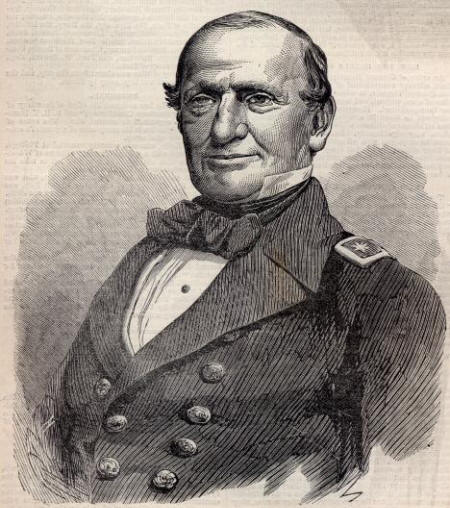
    Born June 13, 1786, Petersburg, Va., U.S. — died May 29, 1866, West Point, N.Y.) U.S. army officer. Creator of the "Anaconda Plan." He fought in the War of 1812 at the battles of Chippewa and Lundy's Lane (1814). Promoted to major general, he traveled to Europe to study military tactics. He advocated a well-trained and disciplined army, earning the nickname "Old Fuss and Feathers" for his emphasis on military formalities. In 1841 he became commanding general of the U.S. Army. He directed operations during the Mexican War and led the U.S. invasion at Veracruz and the victory at the Battle of Cerro Gordo. He was the Whig Party's nominee in the 1852 presidential election but lost to Franklin Pierce. In 1855 he was promoted to lieutenant general, becoming the first man since George Washington to hold that rank. Scott was still commander in chief of the U.S. Army when the American Civil War broke out in April 1861, but his proposed strategy of splitting the Confederacy — the plan eventually adopted — was ridiculed. Age forced his retirement the following November.

    Richard W. Meade

    Richard Worsam Meade III (also called Richard Worsam Meade, Jr., by many sources) was born in New York City on 9 October 1837. He was the son of Passed Midshipman Richard Worsam Meade II, USN, and followed his father into a Navy career when he entered the U.S. Naval Academy in 1850. Graduating in 1856, he served in the steam frigate Merrimack in 1856-1857 and off Africa in 1857-1859 on board the corvette Cumberland and the sloop of war Dale. Promoted to Lieutenant in 1858, Meade was an officer of the steamer Saranac and sailing sloop of war Cyane, both units of the Pacific Squadron, during 1859-1861.

    After returning to the East Coast from the Pacific in mid-1862, Lieutenant Meade was hospitalized for a few months for a tropical illness, then provided gunnery instruction to volunteer officers as the Navy expanded to meet the challenges of the Civil War. In January 1862 he became Executive Officer of the steam sloop Dacotah and later held the same position on the new gunboat Conemaugh. Lieutenant Commander Meade's subsequent Civil War service was distinguished, including participation in the supression of the July 1863 New York draft riots, plus active combat and blockade enforcement work while commanding the Mississippi River ironclad Louisville in the latter part of 1862 and the gunboats Marblehead in South Carolina waters in 1863-1864 and Chocura in the Gulf of Mexico during 1864-1865.

    William Cushing Wins Week 3 Contest

    A few weeks ago, the CWN 150 announced that it will begin a poll to decide who was the greatest naval officer of the Civil War. The polls will stretch over a few months, ultimately with a showdown between Union and Confederate officers. This past week, we highlighted our third poll with four Union officers: Samuel P. Lee, William Cushing. After a week of voting, William Cushing won with 9 votes.We will be posting the third round of the poll today. Please vote, and encourage others to! Reproduced again is Willaim Cushing's brief biography from the Naval History and Heritage Command:

    William Barker Cushing was born in Delafield, Wisconsin, on 4 November 1842, but spent most of his childhood in Fredonia, New York. He attended the U.S. Naval Academy from 1857 until March 1861, when his high-spirited behavior led to his resignation. The outbreak of the Civil War brought him back into the service, and he soon distinguished himself as an officer of extraordinary initiative and courage. Promoted to the rank of Lieutenant in mid-1862, Cushing served as Executive Officer of the gunboat Commodore Perry, then was given command of the tug Ellis, which was lost under heroic circumstances on 25 November 1862. He subsequently commanded the gunboats Commodore Barney, Shokokon and Monticello. During this time, he led several daring reconnaissance and raiding excursions into Confederate territories.On the night of 27-28 October 1864, Cushing and a small crew took the Navy steam launch Picket Boat Number One upriver to Plymouth, NC, where they attacked and sank the Confederate ironclad ram CSS Albemarle with a spar torpedo. This action made him a national celebrity, and he was quickly promoted to the rank of Lieutenant Commander. In January 1865, Cushing helped lead the Navy landing force in the conquest of Fort Fisher, NC, again distinguishing himself.Following the Civil War, LCdr. Cushing was executive officer of USS Lancaster and commanding officer of USS Maumee. Promoted to Commander in 1872, he was captain of USS Wyoming in 1873-74. In November 1873, he boldly confronted Spanish authorities in Cuba to save the lives of many passengers and crew of the steamer Virginius, which had been captured bringing men and supplies to Cuban revolutionaries. While serving as Executive Officer of the Washington Navy Yard, DC, Commander Cushing's always delicate health gave way and he died on 17 December 1874.

    Week Three Poll Up!

    Two weeks ago, we unveiled the beginning of a contest to decide (by you the reader) who was the greatest naval officer, North and South. In the final week, we will square the Union and Confederate winner face to face to see who wins. Last week's winner was Rear Admiral John Dahlgren. For week three, we have several important Union officers up for your vote. You can vote on the left panel of this blog. We have provided the following information about each officer courtesy of the Naval History and Heritage Command:

    Samuel P. Lee

    Samuel Phillips Lee was born in Fairfax County, Virginia, on 13 February 1812. He was appointed a Midshipman in the U.S. Navy in November 1825 and subsequently saw extensive service at sea, including combat action during the Mexican War and exploration, surveying and oceanographic duty. At the outbreak of the Civil War in 1861, he was captain of the sloop of war Vandalia in the East Indies, sailing her home on his own initiative to join the blockade of the Southern coast. Commander Lee commanded the new steam sloop USS Oneida during the New Orleans campaign and subsequent operations on the Mississippi River in the first half of 1862.
    In September 1862, S.P. Lee was placed in command of the North Atlantic Blockading Squadron with the rank of Acting Rear Admiral. He led this force for over two years, during which it was responsible for the blockade of the North Carolina coast and operations on North Carolina and Virginia inland waters, all areas of very active combat between Union and Confederate forces. Acting Rear Admiral Lee transferred to the command of the Mississippi Squadron in October 1864 and led it to the end of the Civil War in 1865.

    Reverting to his permanent rank of Captain after the Civil War, Lee had extensive service in the Washington, D.C., area. He was promoted to Rear Admiral in 1870 and retired from active service in February 1873. Rear Admiral Samuel Phillips Lee died at Silver Spring, Maryland, on 7 June 1897.

    William Cushing
    William Barker Cushing was born in Delafield, Wisconsin, on 4 November 1842, but spent most of his childhood in Fredonia, New York. He attended the U.S. Naval Academy from 1857 until March 1861, when his high-spirited behavior led to his resignation. The outbreak of the Civil War brought him back into the service, and he soon distinguished himself as an officer of extraordinary initiative and courage. Promoted to the rank of Lieutenant in mid-1862, Cushing served as Executive Officer of the gunboat Commodore Perry, then was given command of the tug Ellis, which was lost under heroic circumstances on 25 November 1862. He subsequently commanded the gunboats Commodore Barney, Shokokon and Monticello. During this time, he led several daring reconnaissance and raiding excursions into Confederate territories.
    On the night of 27-28 October 1864, Cushing and a small crew took the Navy steam launch Picket Boat Number One upriver to Plymouth, NC, where they attacked and sank the Confederate ironclad ram CSS Albemarle with a spar torpedo. This action made him a national celebrity, and he was quickly promoted to the rank of Lieutenant Commander. In January 1865, Cushing helped lead the Navy landing force in the conquest of Fort Fisher, NC, again distinguishing himself.

    Following the Civil War, LCdr. Cushing was executive officer of USS Lancaster and commanding officer of USS Maumee. Promoted to Commander in 1872, he was captain of USS Wyoming in 1873-74. In November 1873, he boldly confronted Spanish authorities in Cuba to save the lives of many passengers and crew of the steamer Virginius, which had been captured bringing men and supplies to Cuban revolutionaries. While serving as Executive Officer of the Washington Navy Yard, DC, Commander Cushing's always delicate health gave way and he died on 17 December 1874.


    Charles Wilkes
    [abbreviated biography from history.navy.mil]

    The outbreak of the Civil War, however, brought an interruption to his scientific work. On 19 April, he was detached from his duty with the expedition publication program in order to help destroy the Norfolk Navy Yard before Union forces abandoned it to the Confederacy. In May, Capt. Wilkes received orders to take command of the steam-powered frigate San Jacinto. He arrived on board his new command on 27 August, at Monrovia, Liberia, just before she set sail to return to the United States. During the voyage home, he took her to the West Indies in search of the Southern commerce raider, CSS Sumter, under the command of Capt. Raphael Semmes—later commanding officer of the famous Confederate cruiser CSS Alabama. During that mission, his ship stopped at Cienfuegos, Cuba, for coal, and Wilkes learned that the South's commissioners to England and France, James Mason and John Slidell, had escaped from Charleston on board the fast coastal packet Theodora and were then in Havana awaiting transportation to Europe. San Jacinto quickly headed for Havana, hoping to catch Theodora when she embarked upon her return trip but arrived a day late. He learned, however, that Mason and Slidell were still in Cuba and planned to board the British mail packet Trent at St. Thomas for the voyage to Europe.

    Thereupon, he concocted a plan to intercept Trent in Old Bahama Channel, some 230 miles east of Havana, and capture the two Confederate diplomats. On 8 November, the British ship steamed into sight, and Wilkes coerced her into stopping with two shots across her bow. A boarding party seized Mason and Slidell and their secretaries and then allowed the neutral ship to continue her voyage. San Jacinto then headed home with her prisoners. Upon his arrival in Boston, Wilkes was loudly acclaimed for his action, but soon the clouds of war with Great Britain over the incident began to darken the horizon. Ultimately, the dubious legality of Wilkes' action and the threat of war with Britain and France brought a complete disavowal of Wilkes' act by the Federal Government and the release of the prisoners.

    On 30 November, Capt. Wilkes was detached from San Jacinto and ordered to duty with the Board of Naval Examiners. That assignment lasted until the following summer. He commanded the James River Flotilla briefly in July and August of 1862 and received his promotion to commodore at that time. On 29 August, Wilkes left that post and took over the Potomac River Flotilla. That assignment proved to be of short duration. On 8 September, he received orders to command the West India Squadron. Promoted to acting rear admiral, Wilkes directed the West India Squandron— primarily concerned with hunting down Southern commerce raiders and blockade runners—until the summer of 1863. On 1 June, he was detached from the squadron and, on the 30th, set sail from Havana for the United States in Roanoke.

    Conflicts with the Navy Department, probably stemming from his treatment during the Trent affair negotiations, culminated in Wilkes' court-martial early in 1864 over the publication of a letter he wrote to Gideon Welles castigating the Secretary for statements made against Wilkes in his annual report. On 26 April 1864, Acting Rear Admiral Wilkes was found guilty by court-martial of disobediance of orders, insubordination, and other specifications and was sentenced to receive a public reprimand and suspension from the service for three years. President Lincoln reduced the term of suspension to one year, at the conclusion of which Wilkes retired from the Navy. On 6 August 1866, he was promoted to rear admiral on the retired list and, for the remainder of his life, worked for the completion of publication of the results of the Wilkes Exploring Expedition. He also took time out to do some writing, including an autobiography. On 8 February 1877, Rear Admiral Wilkes died at Washington, D.C. Initially interred at Oak Hill Cemetery in Washington, his body was moved to Arlington National Cemetery in August 1909.

    John Winslow

    John A. Winslow was born in Wilmington, North Carolina, in 1811. He entered the Navy as a Midshipman in 1827, was promoted to the rank of Lieutenant in 1839 and to Commander in 1855. During the Mexican War, he was commended to gallantry for his activities at Tobasco. Soon after the outbreak of the Civil War, Commander Winslow was assigned as Executive Officer of the Western Gunboat Flotilla. He was injured while commanding the incomplete ironclad river gunboat Benton in the Fall of 1861 and spent several months recovering.
    Promoted to Captain in July 1862, Winslow returned to the Mississippi area for further service, but was detached late in the year. He took command of USS Kearsarge in April 1863. Over the next year and a half, Captain Winslow patrolled European waters in search of Confederate raiders, keeping his ship and crew well-prepared for combat. On 19 June 1864, he led them to victory in one of the Civil War's most notable naval actions, the battle between USS Kearsarge and CSS Alabama.

    Winslow was promoted to the rank of Commodore as a result of this action. He became a Rear Admiral in 1870 and commanded the Pacific Squadron from then until 1872. Rear Admiral John A. Winslow died on 29 September 1873, soon after retiring from active naval service.

    John Dahlgren Wins Week 2 Contest!


    A few weeks ago, the CWN 150 announced that it will begin a poll to decide who was the greatest naval officer of the Civil War. The polls will stretch over a few months, ultimately with a showdown between Union and Confederate officers. This past week, we highlighted our second poll with four Union officers: John Dahlgren, Samuel F. Du Pont, John Rodgers, and Charles Henry Davis (See previous post). After a week of voting, John Dahlgren won with 11 votes.We will be posting the third round of the poll tomorrow. Please vote, and encourage others to! Reproduced again is Rear Admiral John Dahlgren's brief biography from the Naval History and Heritage Command:

    Rear Admiral John A. Dahlgren (1809-1870) was a naval ordnance innovator and commander of the South Atlantic Blockading Squadron during the Civil War. Dahlgren became a midshipman in 1826. Service on the U.S. Coast Survey (1834-37) distinguished his early career. In 1847, Lieutenant Dahlgren was assigned to ordnance duty at the Washington Navy Yard. Over the next fifteen years, he invented and developed bronze boat guns, heavy smoothbore shell guns, and rifled ordnance. He also created the first sustained weapons R&D program and organization in U.S. naval history. For these achievements, Dahlgren became known as the "father of American naval ordnance." His heavy smoothbores, characterized by their unusual bottle shape, were derived from scientific research in ballistics and metallurgy, manufactured and tested under the most comprehensive program of quality control in the Navy to that time, and were the Navy's standard shipboard armament during the Civil War. Promoted to commander in 1855, captain in 1862, and rear admiral in 1863, he became commandant of the Washington Navy Yard in 1861 and chief of the Bureau of Ordnance in 1862.

    With help from his friend Abraham Lincoln, Dahlgren took command of the South Atlantic Blockading Squadron in July 1863, and for the next two years led naval forces besieging Charleston in the Union navy's most frustrating campaign. Dahlgren cooperated magnificently with Army forces, but underhanded machinations by the ground force commander hindered the effort. Dahlgren's courage remained beyond question during naval attacks on enemy fortifications, but he never figured out how to counter the enemy's underwater defenses. As a leader, he took good care of his enlisted men, but failed to inspire his officers. After the war he commanded respectively the South Pacific Squadron, the Bureau of Ordnance, and the Washington Navy Yard.

    For more information about these officers and our efforts for the Civil War Navy Sesquicentennial, please visit the Naval History and Heritage Command homepage and stay posted on the blog and facebook.

    Week 2 Poll Up! Vote Now!

    Last week, we unveiled the beginning of a contest to decide (by you the reader) who was the greatest naval officer, North and South. In the final week, we will square the Union and Confederate winner face to face to see who wins. Last week's winner was Admiral David D. Porter, who beat out Admiral David G. Farragut by a slim margin.

    For week two, we have several important Union officers up on the voting block. You can vote on the left panel of this blog. We have provided the following information about each officer courtesy of the Naval History and Heritage Command:
    John Dahlgren

    Rear Admiral John A. Dahlgren (1809-1870) was a naval ordnance innovator and commander of the South Atlantic Blockading Squadron during the Civil War. Dahlgren became a midshipman in 1826. Service on the U.S. Coast Survey (1834-37) distinguished his early career. In 1847, Lieutenant Dahlgren was assigned to ordnance duty at the Washington Navy Yard. Over the next fifteen years, he invented and developed bronze boat guns, heavy smoothbore shell guns, and rifled ordnance. He also created the first sustained weapons R&D program and organization in U.S. naval history. For these achievements, Dahlgren became known as the "father of American naval ordnance." His heavy smoothbores, characterized by their unusual bottle shape, were derived from scientific research in ballistics and metallurgy, manufactured and tested under the most comprehensive program of quality control in the Navy to that time, and were the Navy's standard shipboard armament during the Civil War. Promoted to commander in 1855, captain in 1862, and rear admiral in 1863, he became commandant of the Washington Navy Yard in 1861 and chief of the Bureau of Ordnance in 1862.

    With help from his friend Abraham Lincoln, Dahlgren took command of the South Atlantic Blockading Squadron in July 1863, and for the next two years led naval forces besieging Charleston in the Union navy's most frustrating campaign. Dahlgren cooperated magnificently with Army forces, but underhanded machinations by the ground force commander hindered the effort. Dahlgren's courage remained beyond question during naval attacks on enemy fortifications, but he never figured out how to counter the enemy's underwater defenses. As a leader, he took good care of his enlisted men, but failed to inspire his officers. After the war he commanded respectively the South Pacific Squadron, the Bureau of Ordnance, and the Washington Navy Yard.

    Samuel F. Du Pont

    Samuel Francis Du Pont, born 27 September 1803 in Bergen Point, N.J., became a midshipman 19 December 1815. He commanded the sloop Cyane during the Mexican War and gave distinguished service at San Diego, Mazatlan, San Jose, and other ports. In command of the South Atlantic Blockading Squadron from 18 September 1861 to 3 June 1863, he directed many operations along the coast including the victorious campaign which resulted in the fall of Port Royal, S.C., 7 November 1861. For this accomplishment he received the thanks of Congress. Rear Admiral Du Pont died 23 June 1865 in Philadelphia, Pa.

    John Rodgers

    John Rodgers, son of Commodore John Rodgers, was born near Havre de Grace, Md., 8 August 1812. He entered the Navy as a midshipman 18 April 1828. Service in the Mediterranean on board Constellation and Concord opened his long career of distinguished service. In the mid-1850's he succeeded Comdr. Ringgold in command of the North Pacific Exploring and Surveying Expedition, which added greatly to our knowledge of far eastern and northern waters.

    In the early months of the Civil War, Rodgers organized the Mississippi Flotilla and supervised construction of the first ironclad gunboats on the western rivers. He took command of ironclad Galena in April 1862 and operated with distinction in the James River while supporting General McClellan's Peninsular Campaign. He was promoted to Captain 16 July 1862 and transferred to monitor Weehawken. In her he distinguished himself during the attack on Fort Sumter and in capturing Confederate ram Atlanta. The latter service won him the thanks of Congress and promotion to Commodore.

    After the war, Rodgers commanded the Boston Naval Station until 1869. He was elevated to Rear Admiral in December 1869 and given command of the Asiatic Squadron. In this post he ably handled diplomatic duties in addition to his naval responsibilities. Back in the United States he commanded Mare Island Naval Station and the Naval Observatory. He died in Washington 5 May 1882.

    Charles H. Davis

    American naval officer and scientist, b. Boston. Appointed a midshipman in 1823, Davis directed operations of the Coast Survey for a time along the New England coast. He established the American Ephemeris and Nautical Almanac in 1849 and published several hydrographic studies. In the Civil War he was fleet captain and chief of staff to S. F. Du Pont in the successful expedition (Nov., 1861) against Port Royal, S.C. On May 9, 1862, he replaced A. H. Foote in command of the Upper Mississippi flotilla of gunboats. The next day he repulsed the attack of a Confederate fleet near Fort Pillow, and on June 6 he annihilated the Confederate fleet before Memphis, taking the city the same day. He then joined Farragut in an unsuccessful attempt to take Vicksburg. Davis was chief (1862-65) of the Bureau of Navigation and superintendent (1865-67, 1874-77) of the Naval Observatory. For his victories at Fort Pillow and Memphis he was promoted to rear admiral in Feb., 1863.

    David Dixon Porter Wins Week 1 Contest

    Last week, the CWN 150 announced that it will begin a poll to decide who was the greatest naval officer of the Civil War. The polls will stretch over a few months, ultimately with a showdown between Union and Confederate officers. This past week, we highlighted the first of our poll with four Union officers: John Worden, David G. Farragut, David D. Porter, and Louis M. Goldsborough. After a week of voting, David D. Porter won with 10 votes.

    We will be posting the second round of the poll tomorrow. Please vote, and encourage others to!

    David Dixon Porter's brief biography from the Naval History and Heritage Command:

    David Dixon Porter was born at Chester, Pennsylvania, on 8 June 1813, the son of Commodore David Porter (1780-1843). His naval career began as a midshipman in 1829, and included service in the peacetime cruising Navy, the Mexican War and the U.S. Civil War.

    The latter conflict saw him rapidly rise from the rank of Lieutenant to Rear Admiral. In 1862, he was in charge of the Mortar Flotilla during the campaign to capture New Orleans and the lower Mississippi River. He took command of the Mississippi Squadron in October 1862 and led it through the active phase of the Western Rivers campaigns. Rear Admiral Porter spent the last several months of the Civil War in command of the North Atlantic Blockading Squadron.

    Following the War, Porter was promoted to Vice Admiral in 1866 and served as Superintendent of the Naval Academy. He became the Navy's senior officer, with the rank of Admiral in 1870, and remained an influential figure in naval affairs until his death on 13 February 1891.

    Five U.S. Navy ships have been named in honor of David Dixon Porter and his father, Commodore David Porter, including: Porter (TB-6), Porter (DD-59), Porter (DD-356), Porter (DD-800) and Porter (DDG-78).


    For more information about these officers, please visit the Naval History and Heritage Command homepage.

    New Poll Posted! (Part 1 of 4)

    In the spirit of the upcoming election season, there is a new poll posted on this blog: Who was the greatest Union Naval Officer during the Civil War?

    John Worden

    David G. Farragut

    David D. Porter

    Louis Goldsborough
    The poll is located on the left panel of the blog. Vote for your favorite! This will be part 1 of a 4 part series on Civil War leaders. In the upcoming weeks, we will also highlight your vote on the greatest Confederate Naval Officer.

    After both Union and Confederate leaders are announced, we will hold a contest for the best 500 word essay on why each officer exemplifies the characteristics of a leader. Winners will receive a special prize courtesy of the CWN 150 as well as their response posted on the blog.

    Stay posted in the upcoming weeks, and vote!
     
    Bloggers Team