Showing posts with label League of Nations. Show all posts

On April 8

On this day in ...
... 1946 (65 years ago today), the League of Nations held its last meeting, 25-1/2 years after its initial session in Geneva, Switzerland. The alliance had foundered with the onset and onslaught of World War II. The United Nations Organization, established by dint of the San Francisco Charter, would assume the intergovernmental security tasks that the League had been designed to discharge.

(Prior April 8 posts are here, here, here, and here.)

On January 10

On this day in ...
... 1946 (65 years ago today), in London, the U.N. General Assembly met for the 1st time ever. (credit for U.N. photo of British Prime Minister Clement Atlee giving an opening address) The lead of The New York Times' page 1 story, written by James B. Reston, captured the significance of this post-World War II event:

The fifty-one nations of the greatest war-time coalition in history, representing four-fifths of the people in the world, started today another chapter in man's melancholy search for peace and security.
One hundred and forty-seven days after the close of the war that cost more than 20,000,000 casualties and left countless millions homeless, and on the twenty-sixth
anniversary of the ratification of the ill-fated League of Nations Covenant, the nations met this afternoon in the blue and gold auditorium of the Central Hall of Westminster ....

(Prior January 10 posts are here, here, and here.)

On December 10

On this day in ...
... 1945 (65 years ago today), Gabriela Mistral addressed a banquet at City Hall in Stockholm, where earlier in the day she'd been awarded the Nobel Prize in Literature. She stressed the bonds between Sweden and her own country:

As a daughter of Chilean democracy, I am moved to have before me a representative of the Swedish democratic tradition, a tradition whose originality consists in perpetually renewing itself within the framework of the most valuable creations of society. ...
At this moment, by an undeserved stroke of fortune, I am the direct voice of the poets of my race and the indirect voice for the noble Spanish and Portuguese tongues. Both rejoice to have been invited to this festival of Nordic life with its tradition of centuries of folklore and poetry.
Mistral (prior posts), who'd been born Lucila Godoy y Alcayaga 56 years earlier, was not only a renowned poet, but also a diplomat, serving on League of Nations cultural committee and as a Chilean consul in Italy, Spain, and Portugal. (credit for photo of 5,000-peso note honoring her) She's the transnational foremother of IntLawGrrl Naomi Roht-Arriaza.

(Prior December 10 posts are here, here, and here.)

Treaties no treat?

What to make of Jamie Rubin's blithe Farewell to the Age of the Treaty?
In an op-ed yesterday Rubin, a State Department spokesperson back when Madeleine Albright was Secretary of State, posited that treaties aren't "even worth the trouble anymore."
The "trouble," it appears, is not with international agreements themselves. Troublesome, rather, is securing 2/3 consent of the Senate, a constitutional sine qua non for U.S. ratification of a treaty. The requirement's now bedeviling President Barack Obama's bid for ratification, detailed here, of the U.S.-Russia New Start disarmament treaty. (prior posts) (credit for White House photo of April 2010 signing)
"'Fortunately, there is an alternative,'" Rubin breezed. He argued that statutes, which pass upon simple majorities of both houses of Congress, usually "will work just fine."
Even putting aside the glib assertion that "the international system has most of the rules it needs," Rubin's argument falters on a number of points:
► History: The op-ed's ahistorical in its implication that this is a new problem. Presidential struggles to clear the 2/3 Senate hurdle are "nothing new," as our Opinio Juris colleague Duncan Hollis pointed out. Failure to secure approval dates at least to President Woodrow Wilson, and the Senate's rejections of the Versailles Treaty (right) and the League of Nations Covenant, in 1919 and again in 1920 -- years surely within the putative "Age of Treaties." Rubin himself no doubt recalls President Bill Clinton's CTBT debacle back in 1999.
► Politics: Also implicit is an assumption that congressional majorities easily may be obtained. Rubin points to legislative efforts on climate change as an example of his position "already being used." He pretermits, however, that these efforts have yet to bear statutory fruit. Given that the New Year will inaugurate a House of Representatives with a heavy GOP lean, getting Congress to okay internationally aimed reforms would seem far from simple.
► International Relations: Rubin's solution seems unlikely to give U.S. status abroad the hefty boost he suggests. Statutes and treaties are quite different legal animals. A statute may be altered, even repealed, at any time. Preferring the legislative path thus adds instability to the United States' foreign relations. What's more, a statute is the unilateral enactment of a single sovereign. In contrast, a treaty embodies that sovereign's consent not just to act, but to do so out of an international obligation. Treaties represent a deeper level of commitment, a promise to pursue global cooperation even if domestic political winds shift. Opting always for the U.S. statutory fix, at a time when other countries are urged to join treaty regimes, seems unlikely to ease what Rubin rightly calls "international frustration with American leadership."
Hard to see the op-ed's effort -- in essence, to put a brave face on an inferior option -- as much more than advance spin should New Start founder in the Senate.

On February 16

On this day in ...
... 1933, in Geneva, Switzerland, the foreign ministers of Romania, Czechoslovakia, and Yugoslavia signed the Pacte d'organisation de la Petite Entente, aimed at strengthening economic and political ties among the 3 Central European countries. The treatymakers pledged to act consistently with international instruments, chief among them the Covenant of the League of Nations.

(Prior February 16 posts are here, here, and here)

On February 6

On this day in ...
... 1946, the judges of the League 0f Nations-era Permanent Court of International Justice having resigned days earlier, election of the 1st members of the International Court of Justice took place at the 1st session of the United Nations' General Assembly and Security Council. Judge José Gustavo Guerrero (left) of El Salvador, the last President of the PCIJ, would be elected the ICJ's President in April; a month later, the new court would get its 1st case, Corfu Channel.

(Prior February 6 posts are here and here.)

On December 29

On this day in ...
... 1934 (75 years ago today), U.S. Secretary of State Cordell Hull expressed "genuine regret" at receiving Japan's formal notice of its renunciation of the Washington Naval Treaty of 1922, in which Britain, France, Italy, Japan, and the United States had agreed to limit armaments on their naval vessels. (credit for image of diplomats at 1922 Washington Naval Conference) The withdrawal came 21 months after Japan had quit the League of Nations (prior posts here and here).


(Prior December 29 posts are here and here.)

Toward a Definition of Terrorism

As we discussed in an earlier post, the ICC does not assert jurisdiction over terrorism, in part because drafters believed that the crime was not adequately defined under international law. Since the attacks of 9/11, this may be changing.
Terrorism is a concept with a colloquial meaning that lacks a formal consensus definition under international law. An omnibus treaty definition of the crime of terrorism has eluded the international community to date largely because of the now trite adage: “One man’s terrorist is another man’s freedom fighter.” As a result of this normative ambivalence, codification efforts have yielded a number of treaties that require states to criminalize only specific terrorist acts (such as aircraft hijacking or attacks against internationally protected persons), but no truly omnibus definition.

The League of Nations embarked on the first major attempt in the modern era to prohibit the crime of terrorism after the 1934 assassination by Croatian separatists of King Alexander of Yugoslavia and others. The treaty—the Convention for the Prevention and Punishment of Terrorism (1937)—defined terrorism as follows:

All criminal acts directed against a State and intended or calculated to create a state of terror in the minds of particular persons or a group of persons or the general public.
The treaty attracted 24 state signatories; only India ultimately ratified the Convention. The onset of World War II scuttled any further efforts to bring the treaty into effect. After the dissolution of the League of Nations, the treaty was never revived.

From this abortive start, the international community has proceeded in a piecemeal fashion by criminalizing various manifestations of terrorism (such as offenses committed on board aircraft, crimes against internationally protected persons, hostage taking, crimes involving maritime navigation, crimes involving nuclear material, and the financing of terrorism), often in response to particular terrorist incidents.
This proliferation of treaty instruments has led some courts and commentators to conclude that there is no established definition of terrorism under customary international law. Nonetheless, many definitions of terrorism share certain basic elements from which a more general prohibition may be identified:

► The perpetration of violence by enumerated or unenumerated means;
► The targeting of innocent civilians or elements of the civilian infrastructure;
► Conduct is undertaken:

  1. With the intent to cause violence or with wanton disregard for the act’s consequences;
  2. For the purpose of causing fear or terror, coercing a government, or intimidating an enemy; or
  3. To achieve some political, military, ideological, or religious goal.
Many instruments and penal codes thus contain one or more specific intent or motive elements requiring proof of the existence of some mental state over and above the general intent to commit acts of violence. In some cases, this mental element is aimed at the civilian population (the intent to cause terror) or a government (the intent to influence a government). This emphasis on the perpetrator’s motive markedly distinguishes crimes of terrorism from other domestic and international crimes. (The more specific the actus reus of the treaty, however, the less likely that such a surplus of intent is required).

In addition to sharing certain definitional elements, many treaties share structural components that obligate state parties to

► incorporate the relevant prohibitions into their domestic criminal codes,
► treat enumerated acts of terrorism as extraditable offenses,
► grant mutual legal assistance in the investigation and prosecution of the proscribed acts, and
► either extradite or prosecute offenders pursuant to broad principles of extraterritorial jurisdiction.

In this regard, the crimes of terrorism have been largely reponsible for the greater acceptance of passive personality jurisdiction in international law, as states increasingly assert jurisdiction over extraterritorial acts of terrorism committed against their nationals.

Many multilateral instruments also limit their application to terrorism committed by non-state actors, implicitly or explicitly failing to recognize any notion of state terrorism. Other treaties limit their application to acts of “international terrorism,” thus excluding jurisdiction over acts of terrorism committed by sub-state actors operating solely within a single state.

The 1999 International Convention for the Suppression of the Financing of Terrorism in certain respects unifies these various terrorism treaties and comes closest to an omnibus treaty definition of terrorism. Article 2(1) of that treaty incorporates a number of extant treaties in its annex by providing:

Any person commits an offence within the meaning of this Convention if that person by any means, directly or indirectly, unlawfully and wilfully, provides or collects funds with the intention that they should be used or in the knowledge that they are to be used, in full or in part, in order to carry out [any violation of an annexed treaty].
In addition, the treaty prohibits

[a]ny other act intended to cause death or serious bodily injury to a civilian, or to any other person not taking an active part in the hostilities in a situation of armed conflict, when the purpose of such act, by its nature or context, is to intimidate a population, or to compel a government or an international organization to do or to abstain from doing any act.
The Financing Convention is bolstered by a Chapter VII Security Council Resolution (1373) passed in the weeks following the attacks of September 11, 2001, requiring all states to, inter alia, suppress the financing of acts of terrorism and freeze financial assets of persons or entities involved in terrorism.

As noted in an earlier post, terrorism is not at present a crime within the jurisdiction of the International Criminal Court. Nonetheless, given the normative redundancy in international criminal law, the Court could adjudicate certain acts that one might also consider acts of terrorism within its existing subject matter jurisdiction when such acts of terrorism satisfy the elements of other international crimes:

► Violent acts (such as murder, torture, or kidnapping) that specifically target civilians in the context of an armed conflict—whether international or non-international—will likely constitute war crimes.
► Where such acts are committed within the context of a widespread or systematic attack against a civilian population, they may constitute crimes against humanity under Article 7 (whether or not they are committed within the context of an armed conflict). The definition of crimes against humanity in the ICC Statute requires proof that the attack was “pursuant to or in furtherance of a State or organizational policy to commit such attack” (Article 7(2)(a)). Presumably, many terrorist groups could be shown to possess such a policy to attack civilians.
► Terrorist attacks may also implicate the prohibition against genocide, where the acts target a protected group with the intent to destroy that group. Although there are many instances of acts of terrorism being directed against a protected group (such as those committed during “the troubles” in Northern Ireland (right) or even the attacks of September 11, 2001), it may be difficult to prove the specific intent to commit genocide as opposed to the intent to intimidate or coerce a government—the hallmark of terrorism.

It is worth considering what is left for a prohibition against terrorism to address if many violent acts already constitute either war crimes or crimes against humanity under international criminal law.

► For one, isolated or exceptional violent acts, committed in times of peace (or without any nexus to an armed conflict) and absent more systemic repression might not be considered a war crime or a crime against humanity. Prosecuting such acts at the international level or under international law would require the existence of a stand-alone crime of terrorism.

► Secondly, a prohibition against terrorism may aid in the prosecution of acts of violence committed against privileged combatants by unprivileged combatants (such as civilians directly participating in hostilities or peacetime attacks on members of the armed forces (Khobar Towers below)). Such acts do not constitute war crimes. If such acts are to implicate international criminal law, as opposed to the domestic law of either the territorial state or the state of the nationality of the victim (assuming this law applies extraterritorially), the international community will have to achieve consensus on an omnibus definition of terrorism.

In the past, a number of geo-political situations involving occupying, colonial, or racist regimes prevented this consensus from forming. Fortunately, many of these situations (such as South Africa) have been resolved in favor of the principle of self-determination. The situation in Israel and the Occupied Territories, however, remains one of the few obstacles to completing the remaining definitional work on the crime of terrorism. Many members of the international community are unwilling to unequivocally condemn all acts of violence committed by Palestinian and allied forces given the perceived justness of their cause. That said, a consensus is crystallizing around the judgment that acts of violence targeting civilians are never justified, regardless of the justness of the cause in question. By contrast, the legal categorization and consequences of attacks by unprivileged combatants against privileged combatants or military objectives remains an unsettled and highly contentious area of international law.

Resolving the situation in this part of the world would remove this distortion in the normative development of international criminal law—as if we needed another reason to accomplish this critical and elusive end.

(This discussion is drawn from my recent article on the cognizability of a tort of terrorism under the Alien Tort Statute, produced for a conference on civil litigation and terrorism at the University of Texas (Austin). The article appears in The Review of Litigation, a publication devoted to the theory and practice of litigation, and is available here).

On October 6

On this day in ...
... 1937, the League of Nations "adopted a resolution censuring Japan" for its aggression in China, "and inviting members to give China what aid they could -- recommending, however, 'further efforts to secure the restoration of peace by agreement.'" Sanctions would follow the next year; however, since Japan had withdrawn from the League long before, and so the resolution had no effect.

(Prior October 6 posts are here and here.)

On July 20

On this day in ...
... 1921, Alice Mary Robertson (near left) became the 1st woman to preside over the U.S. House of Representatives. Having been elected by Oklahoma voters, on March 4 of the same year she'd become the 2d woman ever to serve in Congress (the 1st was Jeannette Rankin, another Republican, about whom we've posted). Of Robertson's politics it's been written:

She opposed feminist groups like the League of Women Voters and the National Women's Party, and voted against bills funding maternity and childcare on the grounds that they were an unwarranted governmental intrusion on personal rights. This earned her the support of the Daughters of the American Revolution, of which she was a member.
(See also Louise Boyd James, “Alice Mary Robertson -- Anti-Feminist Congresswoman,” 55 Chronicles of Oklahoma 454 (Winter 1977-1978).) Robertson served only 1 term, losing her bid for re-election to the incumbent she'd ousted 2 years later. It would not be until the election of Republican Mary Fallin in 2006 that Oklahomans would send another woman to Congress. (credit for 1923 photo of Robertson with 2 later-arriving Representatives, Winnifred Huck (R-Ill.), far left, and Mae Ella Nolan (I-Calif.), center)
... 1940, having been occupied by Nazi Germany in April, Denmark withdrew from the League of Nations.

(Prior July 20 posts are here and here.)

On July 13

On this day in ...
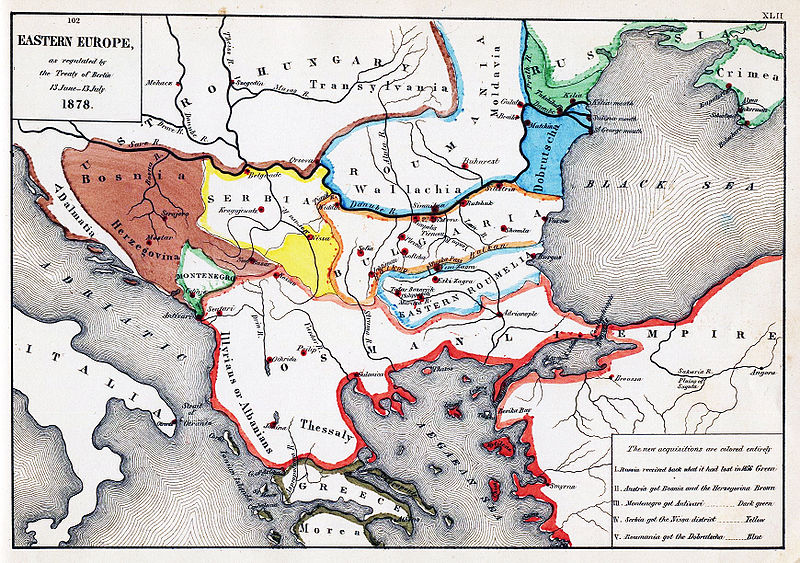
… 1878, the Treaty of Berlin, the final act of the Congress of Berlin, was signed by Britain, Austria-Hungary, France, Germany, Italy, Russia, and the Ottoman Empire. As a result, a Balkan crisis ended, and Serbia, Montenegro, and Romania became completely independent of the Ottoman Empire. Additionally, the treaty granted special legal status to some religious groups and served as a model for the minorities system that was subsequently established within the framework of the League of Nations. (credit for map of South-Eastern Europe after the Congress of Berlin)
… 1973, Alexander Butterfield, a deputy assistant to President Richard Nixon, revealed the existence of tapes to the special Senate committee investigating the Watergate break-in. Nixon had recorded almost every meeting in his White House offices since 1971 -- the tapes would prove vital in documenting that high-ranking officials had been involved in a cover up and other illegal activities. After a series of court battles, the Supreme Court unanimously ruled in United States v. Nixon (1974) that the President had to hand over the tapes; he ultimately complied. In recent weeks, many tapes have been made newly available to the public. (credit for July 30, 1973, cover of Newsweek)

(Prior July 13 posts are here and here.)

On June 19

On this day in ...
… 1961, Kuwait declared independence from the United Kingdom. Back in 1899, Britain had concluded a protectorate agreement with the ruler of Kuwait (flag at left). In it the ruler promised not to conclude treaties with other powers, to admit no foreign agents, and to cede no part of his territory without British consent. According to the independence agreement concluded on this day in 1961, relations between the 2 countries should continue to be governed by a spirit of close friendship, and, when appropriate, the 2 governments would consult on matters of concern to them both.
… 1939 (70 years ago today), Grace Abbott (below right), American social reformer, teacher, and writer, died in Chicago, Illinois. Concerned about the low pay and long hours required of children working in factories, Abbott became a leader in the fight for federal children's rights legislation. As associate of Jane Addams, Nobel Peace Prizewinner and IntLawGrrls transnational foremother, Abbott served as head of the Children's Bureau in the Department of Labor from 1921 to 1934. She was the official representative of the United States on the League of Nations' advisory committees on traffic in women and on child welfare from 1922 to 1934. Upon her resignation, President Franklin D. Roosevelt described her career as one of

inestimable value to the children, the mothers, and fathers of the country, as well as to the Federal and State governments.
From 1934 until her death, Abbott continued working for social welfare as a professor at the University of Chicago and as chair of international labor conferences and state committees dealing with child labor. (photo credit)

(Prior June 19 posts are here and here.)

On February 6

On this day in...
... 2000, Tarja Kaarina Halonen was elected Finland’s President. Halonen (left), who had served as the country's Minister of Foreign Affairs since 1995, holds the top post to this day. Just this past Sunday, another woman became leader of a nearby country: Johanna Sigurdardottir is Prime Minister of Iceland. In the words of the BBC, Sigurdardottir (below right) "is the first openly lesbian head of government in Europe, if not the world -- at least in modern times."
... 1946, the judges of the League-of-Nations-founded Permanent Court of International Justice all having resigned 6 days earlier, elections were held for the 1st members of the International Court of Justice, during the 1st session of the U.N. General Assembly and Security Council.


On January 25

On this day in ...
... 1919 (90 years ago today), meeting in plenary session, delegates of the Paris Peace Conference gave quick, unanimous approval of plan to set up a League of Nations. Coming in the wake of the devastation of World War II, the concept of an international organization designed to channel states' warlike impulses into processes of pacific dispute settlement was much praised: among those writing favorable commentaries that month were, in the New York Times, Charles Warren (op-ed here), who'd served as an Assistant U.S. Attorney General and would go on to become a Harvard law professor noted for his works of legal history, and, in The Atlantic, noted British author H.G. Wells (essay here). (credit for photo of hall in which conference took place)
... 2006, in what were " the first Palestinian legislative elections in a decade," the Islamist party Hamas "won a large share of votes," thus "depriving the more secular Fatah party of its longstanding monopoly on power," the New York Times reported. This last several weeks Hamas and Israel have been in armed struggle in Gaza -- a struggle on which IntLawGrrls have posted here, here, and here. (map credit)


Honoring Emily Greene Balch

A few words about Emily Greene Balch (left), whom today's guest blogger, Chimène Keitner, has chosen to honor:
Born in 1867, Balch was a member of the 1st class to graduate from Bryn Mawr College; thereafter she studied sociology and economics in Europe and, eventually, back in the United States. She started teaching at Wellesley College in 1896, and became a Professor there 15 years later. During this time she was active in movements for women's suffrage, racial justice, and fair treatment of immigrants.
When World War I broke out in 1914, she found her life's calling; that is, "furthering humanity's effort to rid the world of war." Among many other activities, Balch:
► took part in the 1915 International Congress of Women at The Hague;
► helped to found what's now known as the Women's International League for Peace and Freedom;
► collaborated with Jane Addams and others on Women at The Hague: The International Congress of Women and Its Results (1915); and
► participated in the work of the League of Nations that was formed in the wake of World War I.
(credit for photo below right of American delegation to the 1915 Hague Conference; Balch is standing at far left in the 3d row from the front, while Addams is sitting 2d from left in the front row)
By the time that Balch was named a Nobel Peace Prizewinner in 1946, she had altered "her strong pacifistic views" somewhat on account of the "the excesses of nazism." She came "to defend the 'fundamental human rights, sword in hand'" in World War II, even as she "concentrated on generating ideas for the peace, most of them characterized by the common denominator of internationalism." Today Balch, who died in 1961 at the age of 94 years + 1 day, joins Addams -- her friend and a 1931 Peace Prizewinner -- and other distinguished women on IntLawGrrls' transnational foremothers list at right, just below our "visiting from ..." map in our righthand column.

On October 7

On this day in ...

... 1935, 4 days after troops from Benito Mussolini-led Italy "swept into Ethiopia from Eritrea and Italian Somaliland and overwhelmed the Ethiopian army," the Council of the League of Nations "declared that Italy was the aggressor nation in the Ethiopian affair and made preparations to apply sanctions against the Italians." In fact League members did nothing, however, and within a year Ethiopia (known then as Abyssinia) accepted Italian rule. "This incident was not a minor one and has been regarded by history to be one of the thorns that led to the outbreak of World War II." (map credit)

... 1955, at the Six Gallery in San Francisco's Fillmore district, a 29-year-old "unknown poet from the East Coast," Allen Ginsberg, gave the 1st public reading of "Howl." He began:

I saw the best minds of my generation destroyed by madness

and then continued with a poetic rant (full text here) that, in the words of an NPR retrospective, "gave voice to an undercurrent of dissatisfaction and alienation in Eisenhower's America." Lawrence Ferlinghetti, whose City Lights press would publish the poem amid controversy, described the impact of this literary icon of the Beat Generation with more punch: "'Howl' knocked the sides out of things."


On October 2

On this day in ...
... 1883 (125 years ago today), Kingston Women’s Medical College, the 1st women's medical school in Ontario, was opened "to women students in a wing of City Hall" by Dr. Jennie Kidd Trout; in 1875 Trout, age 34, had become the 1st woman licensed physician in Canada. (credit for 1991 Trout stamp at left)
... 1924, in Geneva, Switzerland, delegates adopted the Protocol for the Pacific Settlement of International Disputes. This Geneva Protocol was intended, according to this League of Nations chronology,

to strengthen the international machinery of the League of Nations resulting from the absence of Germany, Russia, and the U.S. The protocol required compulsory arbitration of all disputes and defined the aggressor as a nation unwilling to submit its case to arbitration.

(credit for photo of League of Nations building in Geneva)


On September 30

On this day in ...
... 1938 (70 years ago today), in Germany, leaders of that country as well as Britain, France, and Italy concluded the Munich Pact, which took the Sudetenland (below right, in red) from Czechoslovakia and gave it to Germany. Though applauded by some at the time, the effort to avert further German aggression failed so miserably that critics' contemporary description of the Pact -- "appeasement" -- retains pejorative power to this day. (credit for German postcard above, which depicts Pact signers, left to right, Neville Chamberlain of Britain, Édouard Daladier of France, Benito Mussolini of Italy, and Adolf Hitler of Germany)
... 1938 (70 years ago today), the League of Nations unanimously approved a resolution on the Protection of Civilian Populations Against Bombing From the Air in Case of War, which maintained that:
► "The intentional bombing of civilian populations is illegal";
► "Objectives aimed at from the air must be legitimate military objectives and must be identifiable"; and
► "Any attack on legitimate military objectives must be carried out in such a way that civilian populations in the neighbourhood are not bombed through negligence".
As was the case with many other acts by the League, this did little to deter massive aerial bombardment of civilians, by both Allied and Axis Powers, in the World War II years that followed.

On July 28

On this day in ...
... 1945, in a move that New York Times reporter James B. Reston termed the payment of "a first installment on an old debt," the U.S. Senate voted 89-2 to ratify the Charter of the United Nations (right). The "debt" to which Reston referred: the Senate's 1920 rejection of a post-World War I precursor to the post-World War II Charter, the Covenant of the League of Nations. Debate in 1945 lasted "only six days," compared with the nine-month Senate debate over the League. Voting against the Charter were 2 Republicans, Henrik Shipstead of Minnesota and William Langer of North Dakota; the latter maintained that the Charter "would mean 'perpetual war' and the 'enslavement' of millions of poor people from Poland and India."
... 2003 (5 years ago today), Lady Valerie Goulding (below left) died in a nursing home in Shankill, County Dublin, Ireland. Born in England in 1918, she'd moved to Ireland following her marriage to "a fertiliser manufacturer and art collector, Sir Basil Goulding." In Dublin in 1951, she founded the Central Remedial Clinic for the care of 2 persons with physical disabilities; it now serves 4,000 patients. This launched her life's work on behalf of the disabled. She served by appointment to Seanad Éireann, Ireland's Senate, from 1977 to 1981; lost 2 bids for election to the Dail, Ireland's principal parliamentary chamber; and was considered as a candidate for Uachtarán na hÉireann, President of Ireland, in 1983. (photo credit)

On July 10

On this day in ...

... 1999, a Ceasefire Agreement respecting the armed conflict in the Democratic Republic of the Congo (map at left) was signed by that country as well as Namibia, Rwanda, Uganda, and Zimbabwe. Witnessing the signing were delegates from Zambia, the Organization for African Unity, the United Nations, and the Southern African Development Community. The Movement for the Liberation of the Congo signed the agreement on August 1; the Congolese Rally for Democracy on August 31.

... 1919, President Woodrow Wilson personally delivered to the U.S. Senate the Treaty of Versailles, which ended World War I and established the League of Nations. It was the 1st such personal delivery since the founding of the Republic in 1789. His presentation did not go well:


[H]e strained to read from typewritten notes on small index cards. Perhaps suffering from the effects of a small stroke, Wilson inadvertently omitted words as he proceeded. Realizing this, he stopped and repeated the garbled sentence, only to drop more words and repeat more sentences. Only near the end of his forty-minute address did Wilson approach eloquence. Setting aside his cards, the president turned to the Republican side of the chamber, where members sat in sullen hostility. He declared that treaty approval was their only option. "The stage is set, the destiny disclosed. It has come about by no plan of our conceiving, but by the hand of God. We cannot turn back. The light streams on the path ahead, and nowhere else." His conclusion evoked only scattered applause.


In November 1919 and again in March 1920, the Senate rejected the treaty. (credit for photo of "Big 4" -- from right, Wilson, France's Georges Clemenceau, Italy's Vittorio Orlando, and Britain's David Lloyd George -- during negotiation of treaty in Paris)

 
Bloggers Team