Showing posts with label Security Council. Show all posts

Responsibility to protect, Libya to Japan

(Thanks to IntLawGrrls for the opportunity to contribute this guest post)

On September 16, 2005, the General Assembly of the United Nations adopted by consensus a resolution recognizing the responsibility to protect. The core of the responsibility to protect (R2P) as adopted by the both the General Assembly and Security Council was first embodied in Paragraph 138 of the 2005 World Summit Outcome declaration:
'Each individual State has the responsibility to protect its populations from genocide, war crimes, ethnic cleansing and crimes against humanity. This responsibility entails the prevention of such crimes, including their incitement, through appropriate and necessary means. We accept that responsibility and will act in accordance with it.'

Paragraph 139 continues:
'The international community, through the United Nations, also has the responsibility to use appropriate diplomatic, humanitarian and other peaceful means, in accordance with Chapters VI and VIII of the Charter, to help to protect populations from genocide, war crimes, ethnic cleansing and crimes against humanity. In this context, we are prepared to take collective action, in a timely and decisive manner, through the Security Council, in accordance with the Charter, including Chapter VII, on a case-by-case basis and in cooperation with relevant regional organizations as appropriate, should peaceful means be inadequate and national authorities are manifestly failing to protect their populations from genocide, war crimes, ethnic cleansing and crimes against humanity. We stress the need for the General Assembly to continue consideration of the responsibility to protect populations from genocide, war crimes, ethnic cleansing and crimes against humanity and its implications, bearing in mind the principles of the Charter and international law. We also intend to commit ourselves, as necessary and appropriate, to helping States build capacity to protect their populations from genocide, war crimes, ethnic cleansing and crimes against humanity and to assisting those which are under stress before crises and conflicts break out.'

The original, and broader, formulation of the responsibility to protect was included in the December 2001 report, The Responsibility to Protect, from the International Commission on Intervention and State Sovereignty (ICISS). As a basic principle, this report concludes that
'where a population is suffering serious harm, as a result of internal war, insurgency, repression or state failure, and the state in question is unwilling or unable to halt or avert it, the principle of non-intervention yields to the international responsibility to protect.'

For military intervention to be justified for human protection purposes, there must be:
'serious and irreparable harm occurring to human beings, or imminently likely to occur, of the following kind:
'A. Large scale loss of life, actual or apprehended, with genocidal intent or not, which is the product either of deliberate state action, or state neglect or inability to act, or a failed state situation; or
'B. Large scale ‘ethnic cleansing’, actual or apprehended, whether carried out by killing, forced expulsion, acts of terror or rape.'

In dealing with what should occur if the Security Council fails to fulfill its responsibility or to do so “in a reasonable time,” “alternative options” are:
► Consideration of the matter by the General Assembly in Emergency Special Session under the “Uniting for Peace” procedure; and
► Action within area of jurisdiction by regional or sub-regional organizations under Chapter VIII of the Charter, subject to their seeking subsequent authorization from the Security Council.
The ICISS report cautions:
'The Security Council should take into account in all its deliberations that, if it fails to discharge its responsibility to protect in conscience-shocking situations crying out for action, concerned states may not rule out other means to meet the gravity and urgency of that situation –and that the stature and credibility of the United Nations may suffer thereby.'
Speaking from the perspective of September, 2001, the Commission concludes that it is impossible to find a legal consensus regarding humanitarian intervention without UN authorization but does not rule out the possibility of such intervention. It is for this reason that the Commission remarks that when a state or states intervene because the UN has failed to do so, and the states or state do so successfully, there may be “enduringly serious consequences for the stature and credibility of the UN itself.”
This R2P framework illuminates current events in Libya and Japan.

Libya
There are four basic sanctions against Libya in Security Council Resolution 1973 (prior IntLawGrrls post); specifically, the:
► Assets freeze;
► No-fly zone;
► Arms embargo; and
► Protection of civilians.
The assets freeze is left to individual states and does not involve force, so can be set aside for purposes of this discussion. (credit for March 2011 Goran Tomasevic/Reuters photo of airstrike in Libya)
The resolution authorizes states to “take all necessary means” to protect civilians. On March 24, 2011, NATO announced that it would be assuming responsibility for the arms embargo and the no-fly zone, and a few days later for protection of civilians as well.
Resort to the responsibility to protect, although cited by some commentators in reference to the resolution, is unnecessary to the legal authority of the resolution. The three-prong authorization of force falls easily within prior precedents predicated on a finding of a threat to peace or breach of peace under Chapter VII and authorization of collectively authorized humanitarian intervention within the term threat to peace.
Indeed, the crimes precedent to triggering the responsibility to protect may or may not have been sufficiently established to give rise to the responsibility. This responsibility is triggered only when a state has “manifestly” failed to protect its population from acts constituting genocide, war crimes, ethnic cleansing, or crimes against humanity.
The resolution refers to Libya’s responsibility to protect the Libyan population, the “widespread and systematic attacks in the Libyan Arab Jamahariya” which “may amount to crimes against humanity,” and the referral to the International Criminal Court of these possible crimes. It does not declare that Libya has committed any of these crimes. More importantly, a state’s failure to protect its own population from these crimes triggers a collective responsibility to protect using peaceful measures. With respect to force, the formulation says only that the international community is “prepared” to use force in such circumstances, not that it has an affirmative responsibility to do so. In short, resort to force remains as discretionary in terms of Security Council authorization as it was when predicated on a threat to peace.

Japan
Earthquakes, tsunamis, and climate disruption have focused international attention on environmental disasters, natural and anthropocentric, and the ability of the global community to respond adequately and immediately. Whatever the magnitude of the humanitarian violations in Libya, they are eclipsed by the sheer magnitude of the earthquake, tsunami, and nuclear disaster in Japan. (credit for NOAA animated model)


UN officials, including Secretary-General Ban Ki-moon, have been quick to deny that the responsibility to protect applies to environmental crises, including specifically climate change and its consequences. Nevertheless, the four specified crimes can encompass situations of abusive governments or non-state actors inflicting environmental damage.
In Iraq, for example, Saddam Hussein's destruction of the natural resources essential to living conditions of the Marsh Arabs could have been considered “deliberately inflicting conditions of life calculated” to bring about the physical destruction of the group in whole or in part.
The ICISS formulation calls for intervention even by force whenever there is large-scale loss of life, coupled with a state’s unwillingness or inability to act.
The reality of a deteriorating planet and multiple environmental disasters, which even the most well-prepared and well-intentioned state may find itself unable to address, highlights the shortsightedness in the UN position that the responsibility to protect should not be formulated to address environmental disasters.
Is there a humanitarian disaster which calls for global responsibility to respond and protect, with or without a state’s consent, more than a convergence of environmental disasters?
There is a pressing need for reconsideration of the responsibility in an environmental context, before the next disaster occurs in a state that is unable, and unwilling, to act.


On March 31

On this day in ...
... 1992, following the explosions of 2 passenger jets in which hundreds of persons perished -- that of Pan Am Flight 103 in December 1988 (right) (photo credit) and of Union de transports aériens Flight 772 in September 1989 -- U.N. Security Council Resolution 748 was adopted by a vote of 10 ayes, 0 nays, and 5 abstentions. The resolution banned flights and arms sales to Libya, and called upon the North African state to renounce support for terrorism.

(Prior March 31 posts are here, here, here, and here.)

Libya and the Codification of the Crime of Aggression

There has been a lot of attention in the press and blogosphere about the worrisome situation in Libya, the (in)adequacy of the United States' and United Nations' response thereto, and the Security Council's unanimous referral of the situation to the International Criminal Court via Resolution 1970 on February 26, 2011. (See our prior coverage here). On March 2, 2011, the ICC Prosecutor announced that he had opened his investigation into potential crimes committed in Libya (see his press conference here). The President of the ICC, Judge Sang-Hyun Song (S. Korea), thereafter assigned the situation to Pre-Trial Chamber I.

In undertaking his investigation into international crimes committed since February 15th, the ICC Prosecutor has already signaled that he will consider the commission of crimes against humanity—a constellation of acts made criminal under international law when they are committed within the context of a widespread or systematic attack against a civilian population with knowledge of that attack. Certainly the strafing of peaceful demonstrators with helicopter gunships, the indiscriminate bombing of residential neighborhoods by warplanes (left, photo credit), and the unleashing of mercenaries and snipers on the ground collectively rise to the level of such an attack. This is especially true given that at least a thousand people have been killed and thousands others have been injured and/or displaced. (Although, I should note that Judge Kaul, who does not sit on this PTC, will likely disagree here).

War crimes may also have been committed, depending on whether the situation in eastern Libya or elsewhere rises to the level of armed conflict. Common Article 3, whose prohibitions are listed as war crimes in Article 8(2)(c) of the ICC Statute, is applicable once there is an "armed conflict" occurring "on the territory of" a party to the Geneva Conventions. The determination of when violence rises to the level of an "armed conflict" depends on the level of violence and the degree of organization of the parties. Certainly, the formation of an increasingly hierarchized and united armed opposition—populated and led by courageous defectors from Libyan armed forces' officer corps—goes far toward finding the necessary degree of organization. In addition, there are indications that swaths of the country are under the control of opposition groups forging a transitional government (the Libyan National Council) after governmental authorities collapsed.

All this implies that the heightened threshold of Protocol II, which also governs non-international armed conflicts and whose prohibitions may be prosecuted as war crimes pursuant to Article 8(2)(e) of the ICC Statute, may also be satisfied. That treaty becomes applicable when there is a non-international armed conflict

which take place in the territory of a High Contracting Party between its armed forces and dissident armed forces or other organized armed groups which, under responsible command, exercise such control over a part of its territory as to enable them to carry out sustained and concerted military operations and to implement this Protocol.
It explicitly excludes situations

of internal disturbances and tensions, such as riots, isolated and sporadic acts of violence and other acts of a similar nature, as not being armed conflicts.
There thus may be reasonable grounds to conclude the existence of a full-scale civil war, albeit an unbalanced one according to comparative military assessments, which would lay the groundwork for war crimes charges.

The crime of aggression is not immediately implicated in the Libyan situation. For one, the aggression amendments will not come into force until 2017 at the earliest. Moreover, the definition of the crime does not envision the act of aggression being committed by or against non-state actors that are not linked to a state. Nonetheless, the crime of aggression may bear on responses by the international community to the crisis in Libya.

Indeed, military options are not off the table, according to recent comments by President Obama and other world leaders. In particular, it has been proposed that the international community—or some subset thereof—should impose a no-fly zone over the country in an effort to prevent Libya's increasingly erratic and vicious leader from committing further violence against his own people. The Gulf Cooperation Council and Arab League reportedly support such a measure as do several vocal members of Congress. France and Britain are working on a draft Security Council resolution that would authorize such a response, although it is unclear if Russia and China would support this measure, which sounds of military intervention. This raises the prospects that a group of states, such as NATO or some other coalition of the willing, might move forward without explicit Council approval. This is exactly the kind of scenario that worries detractors of the codification of the crime of aggression in the ICC Statute.

The imposition of a no-fly zone without prior Council approval might run afoul of the prohibition of aggression as it has been defined in the aggression amendments. Article 8bis(2) of the amendments defines “act of aggression” broadly as
the use of armed force by a State against the sovereignty, territorial integrity or political independence of another State...
The amendments go on to list the following as acts of aggression:

a) The invasion or attack by the armed forces of a State of the territory of another State ...;
b) Bombardment by the armed forces of a State against the territory of another State or the use of any weapons by a State against the territory of another State; ...
d) An attack by the armed forces of a State on the land, sea or air forces, or marine and air fleets of another State...
Simply policing the no-fly zone might constitute a breach of Libya's territorial integrity, and for a no-fly zone to be effective, it would likely be necessary to neutralize Libya's air defense capabilities, which would involve air strikes. To be sure, such acts would only be prosecutable as the crime of aggression if they are deemed to constitute a "manifest" violation of the U.N. Charter with reference to their character, gravity and scale as per Article 8bis(1). As we have discussed at length in our crime of aggression series, no explicit exception was carved out for bona fide humanitarian interventions or for considerations of a state's motives for engaging in military action. However, important understandings adopted in Kampala imply that a consideration of the "consequences" of military action might shield actions from being characterized as an act of aggression. This would depend, of course, on the views of
  • the prosecutor (exercising prosecutorial discretion),
  • the Pre-Trial Division (which would need to approve aggression charges), and
  • the Security Council (which also acts as a filter to aggression charges and can defer prosecutions for a renewable period of a year).
In any case, the ICC is poised to enter the debate about such humanitarian interventions in the event that they occur once the aggression amendments are operational. The situation in Libya offers yet another potential scenario in which a deployment of armed force might be warranted and beneficial, but may not—for whatever reason—be able to garner Security Council approval.

Terrorism said to be defined

Terrorism law is the central concern of the Netherlands-based Special Tribunal for Lebanon, an internationalized tribunal about which we've posted in the past. Established in 2007, it is charged with investigation and adjudication stemming from the 2005 assassination in Beirut of Prime Minister Rafik Hariri.
An ASIL Insight by our colleague Michael P. Scharf reports that last month the tribunal's "Appeals Chamber handed down a landmark ruling"; to be precise, it sets forth what its judges consider to be "the customary international law definition of terrorism." Entitled Interlocutory Decision on the Applicable Law: Terrorism, Conspiracy, Homicide, Perpetration, Cumulative Charging (available in Arabic, English, and French here), the 154-page decision was written by President Antonio Cassese (below right) (prior IntLawGrrls posts) on behalf of a five-man panel (men make up all the judges of this tribunal; a couple of the prosecution and defense officers listed are women).
Scharf quoted paragraph 85 of the decision -- issued in answer to request of the pre-trial chamber considering whether to confirm a pending indictment -- which sets forth the elements of the definition of terrorism at customary international law as follows:

► '[P]erpetration of a criminal act (such as murder, kidnapping, hostage-taking, arson, and so on), or threatening such an act';
► '[I]ntent to spread fear among the population (which would generally entail the creation of public danger) or directly or indirectly coerce a national or international authority to take some action, or to refrain from taking it'; and
► '[T]he act involves a transnational element.'

Scharf predicted that the definition will have ramifications that extend past the work of this tribunal -- into the work of the U.N. Security Council Counter-Terrorism Committee established pursuant to Resolution 1373 (2001), and even into national legal systems.
That is not an entirely comforting thought.
The definition, at least as stated above, would appear to know few bounds:
► The definition would seem to sweep in state as well as nonstate actors. That should make more than a few countries uncomfortable.
► What's more, the definition would seem potentially applicable to many transnational offenses not colloquially understood to be terrorism. To name one example, much violence committed in the course of cross-border smuggling enterprises would seem to fit the bill.
Those concerns are reflected in definitions set forth elsewhere on the subject.
► For instance, 22 U.S.C. § 2656f(d)(2), which requires annual country reports on terrorism, withdraws many state actors from the net by stating:

the term 'terrorism' means premeditated, politically motivated violence perpetrated against noncombatant targets by subnational groups or clandestine agents ...

► The catchall definition set forth in Article 2(1)(b) of the 1999 International Convention for Suppression of Financing of Terrorism also is narrower, for it applies only to acts
intended to cause death or serious bodily injury to a civilian, or to any other person not taking an active part in the hostilities in a situation of armed conflict.

Arson of a structure known to be unoccupied -- or of a building occupied by combatants -- would be excluded from the Convention's definition, but not, it would seem, from the definition advanced in the new judgment from the Special Tribunal for Lebanon.
These 2 counterexamples of state practice stand in tension with the tribunal's contention that its definition constitutes customary international law.
The tribunal's decision, Scharf reports, further endorsed at least some aspects of the encompassing accomplice-liability doctrine of "joint criminal enterprise," about which we've frequently posted. That embrace of expansive culpability, coupled with the breadth of the definition stated above, creates a risk that the stigma of "international terrorist" could be applied well beyond advisable limits.


Libya: Global Condemnations of Human Rights Violations


As the World Watches...
As posted here by IntLawGrrls Diane Marie Amann and Jaya Ramji-Nogales, human rights abuses against Libyan civilians include indiscriminate use of force, killings, forced disappearances, and violations of the rights to freedom of thought, conscience, opinion, peaceful assembly, and access to information. (Pictured, flag displayed by protesters and diplomats that have denounced the current government.) The reported violations have outraged observers around the world. This, despite a virtual communications blackout that has made monitoring events in Tripoli and other parts of the country difficult.
The United Nations Security Council meets today to discuss the potential imposition of sanctions under UN Charter Chapter VII authority.
Condemnations of Colonel Moammar Gaddafi's actions have included those from diplomats previously associated with his government.
A selected list of international statements and developments appears below.
The world is watching, but the people of the world must do more than watch. They must also insist that their leaders take appropriate joint actions to end the killings and other abuses.
UN Condemnations
►“Libya: Gaddafi in Spotlight at UN Security Council,” BBC News, 26 February 2011
“UN Resolution on Libya ‘possible’ on Saturday, Security Council President,” Xinhua, February 26, 2011
“Ban Calls on UN Security Council to Consider Immediate Steps to Stop Killings in Libya,” 25 February 2011
"UN Human Rights Council Recommends Suspension of Libya," UN Office of the High Commissioner for Human Rights, 25 February 2011
“15th Special Session on the situation of human rights in the Libyan Arab Jamahiriya” Human Rights Council, 25 February 2011 (links to statements by High Commissioner Navi Pillay, a statement on behalf of all “special procedures” mandate-holders, statements by member countries, and civil society, and Human Rights Council resolution calling for the suspension of Libya from membership on the Council)
Regional Condemnations
“AU Peace and Security Council on the Situation in Libya,” EuropAfrica.net, 24 February 2011
►Josh Rogin, “Over 200 Arab Groups Call for Libya No-fly Zone,” The Cable, Friday, February 25, 2011 (includes full texts of statements by prominent Arab intellectuals and by NGOs)
“Request for Provisional Measures to the African Commission on Human and Peoples’ Rights” INTERIGHTS, 24 February 2011
(joint request by Egyptian Initiative for Personal Rights, Human Rights Watch, and INTERIGHTS)
Condemnations by Libyan Diplomats
“UN Ambassador’s Tears for Libya,” BBC News, 26 February 2011 (UN Ambassador Mohamed Shalgham’s denunciation of the government’s use of force against civilians and request for Security Council action.)
“Libyan Arab League delegation renounces Gaddafi,” Reuters, 25 February 2011
Legal Standards
Libyan Arab Jamahiriya Homepage, UN Office of the High Commission for Human Rights
(listing Libya's international human rights obligations under treaty law and customary international law)
“Responsibility to Protect,” UN General Assembly Resolution A/RES/63/309, 4 September 2009 (International Coalition ofn the Responsibility to Protect webpage) (link to resolution and history of UN efforts to ennumerate the responsibilities of the international community when states fail to protect civilians within their borders or affirmatively harm them.)
News Updates
Live: Libya Revolt, BBC News (continuously updated page, visited 26 February 2011).

'Nuff said

(Taking context-optional note of thought-provoking quotes)


Looking for a way out of Afghanistan? Maybe it's time to try something totally different, like putting into action, for the first time in history, the most enlightened edict ever passed by the United Nations Security Council: Resolution 1325.

-- The provocative lead paragraph of a Los Angeles Times op-ed by Ann Jones, entitled "In Afghanistan, a woman's place is at the peace table." Jones, author of books on Afghanistan and women and armed conflict, stresses the promise of full implementation of Resolution 1325 on Women and Peace and Security, which (as detailed in IntLawGrrls posts available here) the Security Council adopted on October 31, 2000. The commentary derives from Jones' longer post at TomDispatch blog. (credit for photo by Jones of Afghan women) In similar vein, see this recent IntLawGrrls post by guests/alumnae Christine Bella and Catherine O'Rourke.

Women candidates for UN Secretary-General in 2006

Tradition has it that the post of Secretary-General should rotate so that each geographical region gets its "turn." Women have never had a "turn" . . .
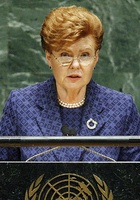
In her post today, Madame la Secrétaire générale?, Diane calls attention to this article and welcomes additional nominations for the position of UN Secretary-General. When the SG post last came open, states were strongly urged to consider nominating women (see, e.g., this action item from 2005, suggesting many accomplished women for the post). Only one female candidate emerged, Vaira Vike-Freiberga (photo), then President of Latvia, who ran at the joint invitation of Latvia, Estonia and Lithuania. In her statement announcing her candidacy she said:
With my formal decision to run for the post of UN Secretary General I wish to encourage women all over the world to continue their efforts to challenge prejudices and stereotypes. Half of humankind has never been represented at the helm of the UN. It is time to change this practice, which fails to reflect the structure of the world population. At the same time I wish to emphasize that the world cannot be divided into female and male, and we all must join together to defend human values and make the world a better place.
In a straw vote in the Security Council, Vike-Freiberga placed third among the six candidates, with two opposing votes from permanent members of the Council, no doubt Russia and China. Relations between Russia and Latvia were tense, and China was insistent that it was Asia's "turn" for the post of Secretary-General, a position strongly supported by Russia and many other UN member states. Until Ban Ki-moon's appointment in 2006, only one Asian had served as UN Secretary-General, U Thant of Burma (left), who served from 1961 to 1971. A number of Asian women were among those listed as potential candidates for the post of Secretary-General, including Singapore's ambassador to the US, Chan Heng Chee (right). Some of them supported other candidates, but most simply did not have the support of their governments to run for the post, a key factor in this highly political process.

Impact of Resolution 1325 on peace accords

(Our thanks to IntLawGrrls for the opportunity to contribute this guest post)

With last October's tenth anniversary of UN Security Council Resolution 1325 on Women, Peace and Security (2000), the resolution’s effectiveness is coming under intense scrutiny. (image credit) In our recent research on the impact of the resolution on the text of peace agreements, we make some significant findings about the impact of 1325 on peace agreement drafting.
(Our research dataset is available in full here. Our methodology, coding decisions, findings and our fuller analysis may be found in ‘Peace Agreements or ‘Pieces of Paper’? The Impact of UNSC Resolution 1325 on Peace Processes and their Agreements’, our article published in the October 2010 edition of International & Comparative Law Quarterly.)
Peace agreements can play a crucial role in setting post-conflict priorities and shaping the internal constitutional order. Women often attempt to influence agreement texts in pursuit of gender equality, in an effort to influence the key roadmap to the political and legal future that will shape their lives. For these reasons Resolution 1325 specifically targeted peace negotiations and agreements in paragraph 8, which calls on all actors involved, when negotiating and implementing peace agreements, to adopt a gender perspective, with particular reference to post-conflict needs. The aim of this perspective is to support local women’s peace initiatives as well as the human rights of women with relation to constitutional reform. (Prior IntLawGrrls posts on this resolution may be found here.)
In our research project, we were interested in whether the texts of peace agreements post-1325 showed evidence of the resolution’s impact. Did peace agreements signed after the resolution contain more references to women and gender equality than those signed before the resolution? If so, what was the nature of these provisions? What difference did involvement of the United Nations in the negotiation of the agreement make regarding, firstly, the number, and secondly, the nature, of peace agreement references to women and gender? Were peace agreements more likely to address the specific issues for women and girls identified in paragraph 8?
In summary we found:
► Only 16% of peace agreements contain references to women. But references to women have increased significantly since the passing of Resolution 1325, from 11% to 27% of agreements.
► This rise is more dramatic for agreements in which the UN had a third-party role (from 4% to 12%) than it is for agreements which did not involve the UN in such a role (from 7% to 14%).
► However, both before and after Resolution 1325 women are more likely to be referenced in agreements in which the UN is not named as a third party. The more marked increase in references to women in ‘UN’ agreements must therefore be understood in a context where such agreements were less likely to reference women prior to Resolution 1325.
► Peace agreement references to women are qualitatively often poor. They constitute scattered references to women, some of which contravene provisions of the Convention on the Elimination of All Forms of Discrimination against Women. Only on rare occasions do these references illustrate good practice.

Our data
Our study involved 585 peace agreements signed since between 1 January 1990 and 1 May 2010. We began by identifying provisions making explicit reference to ‘women’, ‘gender’, ‘widows’ or ‘girls’ and to ‘sexual violence’, or named forms of sexual violence such as ‘rape’.
We separately coded whether the UN was involved as some type of third party to the peace agreement. This enabled us to question the extent to which the UN has played a role in implementing its own normative standards. UN third party involvement was defined using the agreement text and documenting whether the UN, a UN agency, or a UN representative was party or signatory, mediator or facilitator, observer, witness or negotiator to the agreement.
In addition we undertook a qualitiative analysis of the reference to women.

Our Analysis
The overall finding that only 16% of peace agreements make any sort of reference to women is disappointing.
Even the higher figure for post-Resolution 1325 references to women of 27% (up from 11%) indicates a long way to go before peace agreements systematically include references to women. However, it does seem that the 2000 Security Council measure is having some effect, and particularly where the UN is involved.
Our qualitative review of the nature of the peace agreement references indicates that many of these references are unsubstantial.
There is little evidence of systematic inclusion of women in peace agreement texts, or systematic treatment of issues across peace agreements within conflicts. Moreover, some of the references in our database are, at best, ambiguous in terms of feminist gains, for example: the use of quotas which not only encourage but limit the participation of women (Bangladesh/Chittagong); references to ensuring women’s ‘moral integrity’ (Philippines); references to women as mothers to be targeted for early prisoner release (Nicaragua). Some strong textual provisions do however exist, often in countries that also have actions plans (see for example, Uganda).

Our conclusions
We suggest that further thought must be given to the strategies and barriers to effective implementation of Resolution 1325. Our findings regarding the resolution’s effectiveness with respect to peace negotiations and peace agreement texts suggest the need for further thinking on:
► What constitutes a ‘gender perspective’ in a peace agreement.
► How Resolution 1325 is being taken forward by organizations other than the UN is required, particularly as their role is increasing.
► Whether a ‘gender justice v peace’ dilemma exists where gender-specific concerns of women are left off the table, not due to oversight, lack of expertise, or lack of commitment, but because of concerns that inclusion would make it more difficult for the parties to reach agreement on other matters or destabilize any agreement reached.
► What constitutes good practice in terms of inserting ‘a gender perspective’ in peace agreement texts.
► How to retain space for women to re-envision peace processes in a transformative way, while influencing texts as they arise within the processes in which women are engaged.

We would encourage people to look at and use the research, and to contact us (c.bell@ulster.ac.uk, cf.orourke@ulster.ac.uk) with any response they may have.

Whither now the United States & the ICC?

(My thanks to IntLawGrrls for the opportunity to contribute this guest post)

The relationship between the United States and the International Criminal Court has recently come full circle. The United States has transitioned from being an ICC supporter to opponent, and back again, in little more than a decade. The current climate -- of “positive and principled” U.S. engagement with the Court -- represents a dramatic change from the United States’ formerly hostile position. (credit for June 2010 photo of U.S. State Department briefing on ICC) The new reality includes:
► Active involvement with the Court’s Assembly of States Parties;
► U.S. promises to assist with ICC prosecutions; and
► An ICC President who is now “very optimistic and hopeful” about the prospect of the United States ultimately joining the Court.
How likely is the possibility of U.S. accession to the ICC Statute?
This is the question that I address in my new article, "The United States and the International Criminal Court Post-Bush: A Beautiful Courtship, but an Unlikely Marriage," forthcoming in the Berkeley Journal of International Law. My conclusion, evidenced in the article’s title, is unlikely to surprise. What may prove unexpected, however, is the reasoning behind it.
The crux of my argument does not turn upon any of the concerns historically raised by U.S. opponents of the Court. To the contrary, I first illustrate why much of the early anti-ICC rhetoric has been neutralized by the Court’s work to date. For example:
The Prosecutor: The standard contention that the ICC Prosecutor is likely to target U.S. nationals is difficult to sustain when viewed through the lens of current practice. The reality is ICC investigations have thus far—and not coincidentally—aligned with U.S. foreign policy interests. ICC Prosecutor Luis Moreno-Ocampo (right) has likewise demonstrated a noticeable hesitancy to employ his power to trigger the Court’s jurisdiction, the would-be tool for those oft-anticipated “politicized prosecutions.”
Instead, the Prosecutor has embraced the sovereignty-friendly practice of self-referrals (referrals made by states of situations on their own territories). He has only once triggered the Court’s jurisdiction himself, and only then with the apparent support for this proprio motu exercise from both the territorial state (the Republic of Kenya) and the United States.
Aggression: Another source of U.S. anxiety—the Court’s subject matter jurisdiction over the crime of aggression—was put to rest during this year’s Review Conference of the Rome Statute, about which many IntLawGrrls have posted. Noting U.S. dissatisfaction with the recently adopted definition of the crime (prior IntLawGrrls post), I explain why these perceived flaws are ultimately of little significance to U.S. interests. The Court’s ability to exercise its jurisdiction over alleged acts of aggression is the crucial factor.
In this respect, the United States has found a friend in new Article 15 bis. The provision both insulates nationals of non-member states from the Court’s aggression prosecutions and allows state parties to opt out of the Court’s aggression jurisdiction (which, presumably, the United States would do, should it ultimately ratify the Rome Statute). As such, a U.S. national can be tried for aggression at the ICC only through a U.N. Security Council referral, an unlikely possibility that would require at least tacit U.S. approval.
These and other developments help to account for the present U.S. position and illustrate why, assuming status quo, U.S. support for the Court will likely continue.
What, then, is the barrier to the burgeoning U.S.-ICC relationship?
Simply put, it is that the ICC does not appear poised to fulfill its intended and self avowed role as a “court of last resort.”
Contrary to the United States’ longstanding and clear preference for justice at the national level, the Court’s jurisprudence makes clear that the ICC is in no way limited to acting only when there is no alternative forum for investigation or prosecution.
At the heart of the cases I consider is the principle of complementarity, a fundamental aspect of the Court’s Statute commonly thought to mean that the ICC can intervene only if a state with jurisdiction is unwilling or unable to carry out an investigation or prosecution. This definition of complementarity is so prevalent it appears in the latest edition of Black’s Law Dictionary.
A 2009 ICC Appeals Chamber decision, however, definitively rejects this interpretation. According to this Appeals Chamber decision in the case of Prosecutor v. Katanga and Chui, the Court’s ability to act is limited by the principle of complementarity only if national proceedings are being (or have been) conducted. In the absence of any domestic activity, there is, in the Chamber's view simply no impediment to case admissibility.
As I explain in the article, “inaction admissibility” has many sides. Among them:
The Good: Recalcitrant states cannot, by doing nothing, shield perpetrators of atrocities from ICC prosecutions.
The Bad: As applied thus far, inaction admissibility may discourage otherwise “willing and able” states from fulfilling their responsibility to investigate and prosecute international crimes. States that prefer for the Court to do the heavy lifting can make this happen by simply referring a situation and then doing nothing.
The Ugly: The Appeals Chamber in Katanga and Chui, a case arising out of the situation in the Democratic Republic of Congo, has given the ICC Prosecutor a veritable blank check to target individuals who are already the subject of relevant (perhaps even identical) national proceedings. Provided that the domestic proceedings are terminated in a timely fashion, and in favor of the ICC prosecution, a case is considered admissible due to “inaction.”
Quite obviously, the second and third points (combined with other factors discussed in the article) spell trouble for the prospect of U.S. ratification.
The absence of any limitations on inaction admissibility means that the Court may address, and perhaps is presently addressing, matters that could be prosecuted at the national level. As long as inaction admissibility remains ripe for abuse in this way, the United States will have a compelling reason not to assume the role of the Court’s leading funder.
Accordingly, the article concludes by isolating the factors that have brought this problem to the fore and discussing what can be done to remove this new impediment to U.S. accession.
The full paper is posted here. I welcome your comments!

On January 12

On this day in ...
... 1976 (35 years ago today), at the United Nations' headquarters in New York, the Security Council voted 11-1-3 to let the Palestine Liberation Organization take part in a debate on the Middle East. Abstaining were Britain, France, and Italy; the lone dissenter was the United States. The U.S. Permanent Representative to the United Nations, Daniel P. Moynihan, complained both that the PLO did not recognize Israel and that the PLO

is not a state, does not administer a defined territory, does not have the attributes of a state and does not claim to be a state.


(Prior January 12 posts are here, here, and here.)

Beyond the ICC: Addressing Sexual Violence in Kenya

(My thanks to IntLawGrrls for the opportunity to contribute this guest post)

Last week, two very interesting things happened in the world of accountability for sexual violence.
► First, Luis Moreno-Ocampo, the Prosecutor at the International Criminal Court, requested that six high-ranking Kenyans present themselves to The Hague. He charged three of the six with organizing and inciting political strife – including sexual violence – in the wake of Kenya’s 2007 general election.
► Second, the U.N. Security Council passed Resolution 1960 (2010), condemning sexual violence in zones of conflict and political unrest. This new resolution on women and peace and security calls for, among other things, commanders in armed conflict to explicitly prohibit sexual violence by their subordinates. It also requests support of civil society groups to coordinate resources, information, and efforts relating to widespread sexual harm.
This pair of events reminds me of Kenya, where I spent the month of October, speaking with government and civil society leaders about the problem of impunity for sexual violence.
Kenyan lawyers, parliamentarians, hospital staff, and grassroots advocates assured me that the problem is great – both for the politically motivated rapes of 2007-2008 and for cases of sexual violence in general. (above photo: mural on wall overlooking the Rift Valley, which suffered greatly during the post-election violence)
For example:
In early 2008, the Nairobi Women’s Hospital Gender Violence Recovery Centre alone handled nearly 700 cases of election-related sexual attack. Fully 90% of the rape cases reported involved multiple perpetrators. Several victims were children. A few cases of male victimization were also reported – mostly in the form of forced circumcision of men and boys from the Luo ethnic group, which does not practice circumcision. Depending on their ethnic loyalties, police had stood by and watched. Some police even participated.
Three years later, not one of these attackers has been convicted.
As one survivor was quoted in the report available here:

'[We] meet our perpetrators every other day, they are our neighbors. It’s tough knowing that they are still very safe from the arm of the law.'

Meanwhile, findings of the 2003 Kenya Demographic and Health Survey revealed that 44% of married, divorced, or separated women ages 15 to 49 reported had experienced physical or sexual abuse at least once by their husband or partner. Of these women, 29% had suffered such harm in the past calendar year.
The Nairobi Women's Hospital, which sees hundreds of survivors of sexual assault every year, estimates that one person is raped every thirty minutes in Kenya.
Perhaps surprisingly, Kenya has the legislation it needs to prosecute sexual violence in both scenarios.
Kenya has had a Sexual Offences Act in effect since 2006. In 2008, when the government commission inquiring into the post-election strife confirmed that politically motivated rapes had occurred, it specifically urged that the 2006 Act be fully implemented before the 2012 elections. Later that year, the Kenyan legislature passed the 2008 International Crimes Act, enabling domestic prosecution of international crimes like widespread, politically motivated rape.
There are signs of progress on the ground, as well.
For example, a few police stations have set up “gender desks” to provide specialized response, while Kenya’s health ministries drafted new guidelines for health professionals handling sex assault cases. Civil society groups have launched rights awareness campaigns about the Sexual Offences Act. A government task force was even created to oversee the Act's implementation.
Still, lack of political will, resources, and linkages cripples progress:
► Many police, doctors, even judges are still unfamiliar with the 2006 law.
► The few existing police “gender desks” are frequently unstaffed.
► Victims cannot access counseling or protection.
► Investigative procedures remain weak, and the government forensics lab is under-resourced to the point of being nonfunctional.
Civil society efforts have been valiant, but need coordination and government support. (photo at left: poster on wall at the Gender Violence Recovery Center at Kenyatta National Hospital)
A critical but missing step is dialogue and coordination among stakeholders – urban and rural, medical and legal, government and non-government. In response, the Sexual Violence & Accountability Project that I direct at the Human Rights Center, University of California, Berkeley, School of Law, has agreed to facilitate a workshop in Nairobi in 2011. Our aim is to bring key actors together to improve and coordinate response to sexual violence. We hope not only to create a space to troubleshoot implementation of the 2006 Sexual Offences Act, but also to brainstorm ways to increase capacity to handle widespread, politically motivated rape -- in time for the 2012 elections.
Of course, the question remains as to what to do about the mass rapes of 2008.Certainly, the ICC has kept sexual violence in its crosshairs as it pursues the architects of Kenya’s post-election violence. But the reach of the ICC is limited to persons with “greatest responsibility” for crimes within its jurisdiction.
How will Kenya sweep up lower-level perpetrators?
Kenya’s International Crimes Act, domesticating Rome Statute provisions regarding sexual violence, is not retrospective. Accordingly, it can’t be used to prosecute lower-level perpetrators of 2007-2008 crimes. Demands for a domestic tribunal received no traction. And as detailed in IntLawGrrls posts available here, Kenya’s Truth, Justice, and Reconciliation Commission is still struggling to legitimize itself after a birth marked by allegations of corruption and lack of confidence.
No one seems sure of what comes next.
For our part, we’re taking our cues from colleagues in Kenya and standing by to support in whatever ways they ask. In the meantime, the words of one Kenyan woman – recounting her country’s two most recent elections – is stuck in my head on replay:

'I was raped in 2002, again in 2008, and I will be raped again in 2012. Where is the justice in that?'

'Nuff said

(Taking context-optional note of thought-provoking quotes)

Leaders from Britain, the United States, France and China -- along with Russia, the permanent members of the U.N. Security Council -- have all visited India in the last six months, securing contracts worth a total of around $50 billion.

-- A Reuters report today from New Delhi, where Dmitry Medvedev, President of one of the P-5 countries listed in the snippet, declared Russia's support for giving India a permanent seat on the Security Council of the United Nations. (image credit) Medvedev's announcement follows the New Delhi statement earlier this month, when President Nicolas Sarkozy said France too now supports adding India as a "P-6" -- not to mention President Barack Obama's announcement in November, as we then posted, that "a reformed U.N. Security Council that includes India as a permanent member" is the United States' goal as well. The lining up of these ducks in a row makes for a fascinating study in politico-market emergence.

On December 8

On this day in ...
... 1970 (40 years ago today), the U.N. Security Council "strongly condemn[ed]" Portugal for its attack against Guinea 2 weeks earlier, mounted from the Portuguese colony of Guinea-Bissau. The attack caused "loss of life and extensive damage," according to Resolution 290. The Council insisted that Portugal compensate Guinea for these injuries, and urged U.N. member states not to provide Portugal with assistance in its military intervention. The vote on the resolution was 11 ayes and 0 nays. Abstaining were 4 countries: Britain, France, and the United States, all permanent Council members, plus Spain.

(Prior December 8 posts are here, here, and here.)

Need for new nuclear containment tools

(My thanks to IntLawGrrls for the opportunity to contribute a 2-part series of guest posts. Part 2 is below; Part 1, published yesterday, is here)

Just announced are the terms for the next round of talks on Iran's nuclear technology. They are set for next Monday and Tuesday in Geneva, Switzerland, between:
Catherine Ashton, the European Union's High Representative for Foreign Affairs and Security Policy, formerly an officer of the London-based Campaign for Nuclear Disarmament; and
► Dr. Saeed Jalili, secretary of Iran's Supreme National Security Council and its lead nuclear negotiator.
As demonstrated in my post yesterday, to date these negotations have been marked by lack of trust on all sides. Debate remains, however, to what extent the lack of trust can generate legal implications.
Some argue that without a ‘smoking gun’, there is no ground to act against Iran. They warn of the danger in relying on strategic assessment, which may prove to be misguided, as was the case of Iraq in 2003.
Others emphasise the severity of the risks, on the one hand, and the ability of proliferators to hide the evidence, on the other hand. They agree that comprehensive and logical assessments regarding nuclear proliferation need to include as much hard evidence as possible; nonetheless, they contend that in the interest of non-proliferation, such assessments should not be held hostage to the absence of such evidence. (credit for above logo from Iran's atomic energy site)
No less significant is the question of how to deal with a state once it is identified as a suspected proliferator.
Clearly the regime established by the 1968 Nuclear Non-Proliferation Treaty is ill-equipped to deal with cases such as Iran’s.
The provisions of the treaty are not geared to seeking out and stopping suspected defectors; moreover, these provisions lack precise criteria for dealing with such suspicions when they arise. Drafters devoted little attention to the prospect that a state might develop an interest in becoming a nuclear-weapon state without first withdrawing from the treaty.

(credit for map showing states with nuclear weapons in red, treaty-established Nuclear Free Zone in blue, and nuclear sharing states in orange, and states that are none of the above yet members of the treaty) In a world of new instabilities, where nuclear technology is increasingly accessible, the treaty is failing to achieve containment. The treaty's consensual regime was established during the Cold War, which encouraged adherence to the treaty and to the safeguards regime of the International Atomic Energy Agency. Some argue that this consensual regime is not only increasingly ill-fitted to address nuclear weapons proliferation risk, but actually enhances the incentive to proliferate.
Various initiatives and proposals attempt to escape this impasse.
Some proposals would try to strengthen the existing non-proliferation regime from the inside, both substantively and institutionally.
Other proposals move away from consensual mechanisms aimed at encouraging compliance, and towards effective enforcement. Even initiatives related directly to strengthening compliance with safeguard agreements invest in non-consensual mechanisms for strengthening the existing regime. Examples include:
Generic Security Council resolutions to address the case of a state that has been found by the Agency to be deliberately in non-compliance with its safeguards undertakings; or
► Declaration that nuclear weapons proliferation constitutes a ‘threat to the peace’, thereby engaging the sanctions regime of U.N. Charter Chapter VII in every case of non-compliance with the Atomic Energy Agency.
None of these proposals, however, addresses what is perhaps the greatest obstacle to success of the Non-Proliferation Treaty regime: its unique formal asymmetry and the legacy of international practice. Whatever the legal extent of the obligation to disarm, undoubtedly the political legitimacy of the regime is being undermined by what is perceived as abuse of status by the 5 treaty-recognized nuclear weapons states, Britain, China, France, Russia, and the United States.
It remains to be seen whether effective legal tools will be adopted in a timely manner to prevent Iran’s nuclear programme from maturing into a nuclear threat, or whether international law will continue to play a merely responsive role to that threat.

Negotiating Iran’s nuclear activities

(My thanks to IntLawGrrls for the opportunity to contribute a 2-part series of guest posts. Part 1 is below)

The recent announcement that Iran is willing to resume negotiations over its nuclear activities presents an opportunity to recap the development of the conflict over this issue, which erupted over eight years ago.
This conflict and its legal implications are considered in my book The Iran Nuclear Issue (Hart Publishing, 2010), on which this series of guest posts draws. In addition to a legal analysis, the book contains a detailed chronology and the texts of documents which underlie the evolution of the conflict.
In August 2002, an Iranian opposition group revealed the existence of two previously undisclosed nuclear facilities under construction in Iran.
In December 2002, the United States published satellite pictures of the two facilities, as proof of its long-held suspicions that Iran was pursuing both weapons of mass destruction and long-range missile capabilities.
Iran reacted by stating repeatedly that it was committed to the prevailing international legal regimes on weapons of mass destruction, including the 1968 Treaty on the Non-Proliferation of Nuclear Weapons. Iran contended that its commitment derived not merely from its contractual obligations but, more importantly, from its religious convictions and historical experience. Iran maintained that its programme, which was aimed at mastering the complete fuel cycle, was intended solely to support a civilian nuclear energy programme. It explained that it had operated clandestinely because of obstructions, by the United States and other countries, to its overt activities.
Suspicion nonetheless arose and increased among various states, and the matter was taken up by the International Atomic Energy Agency, which began an intensive inspection and verification operation in Iran. The Agency found that Iran had made substantial efforts over the previous two decades to master an independent nuclear fuel cycle, and was carrying out research and development activities related to the treatment, storage and disposal of radioactive waste.
In June 2003, and several times subsequently, the Atomic Energy Agency declared that Iran had failed to comply with obligations under its bilateral Non-Proliferation Treaty Safeguards Agreement.
Calls ensued, on the one hand, to take decisive measures against Iran, including referral to the U.N. Security Council, and on the other hand, to give Iran a chance to rectify its conduct.
Amid this debate, the United Kingdom, France, and Germany -- the EU3 -- undertook to negotiate directly with Iran. In October 2003, the two sides issued the Tehran Statement, in which Iran agreed to cooperate fully with the Atomic Energy Agency in order to settle all outstanding issues and to correct any failures to comply with its Safeguards Agreement. The EU3, meanwhile, informed Iran that if it complied with its commitments, the EU3 would not seek referral of Iran’s dossier to the Security Council.
In mid-2004, Iran resumed work on uranium conversion.
To defuse the crisis that followed, the EU3 engaged again in negotiations with Iran; overall, however, those negotiations did not result in any change of policy. Both sides expressed disappointment with what each deemed the other’s broken promises, procrastination, and bad faith.
The EU3 consequently aligned with the United States, which had already been pressing the International Atomic Energy Agency Board of Governors to refer the Iranian issue to the Security Council. This Board urged Iran to re-establish full, Agency-verified suspension of all enrichment-related and reprocessing activities, including research and development.
In January 2006, Iran began to enrich uranium in centrifuges at its Natanz plant. In reaction, the Agency's Board of Governors referred the Iran dossier to the Security Council, which has since adopted six resolutions under Chapter VII of the Charter of the United Nations. These resolutions imposed enforcement measures on Iran until it complied with the previous demands of the Security Council and the requests of the Board of Governors. The resolutions further added the suspension of work on all heavy-water-related projects, including the construction of the heavy-water research reactor in Arak (left). (photo credit) Enforcement measures include:
► A trade embargo on items and technologies which could contribute to the activities Iran was ordered to suspend; and
► A travel notification requirement and asset freeze with respect to designated individuals and entities involved in the activities Iran was ordered to suspend.
In August 2007, the Agency Secretariat and Iran negotiated a work plan to address a limited number of issues regarding Iran’s past nuclear programme. Outstanding issues have largely been addressed. But the Agency is still requesting that Iran:
► Account for and explain a series of documents found in its possession which point to nuclear weapons-related research; and
► Respond fully to queries on weapons studies that Iran had allegedly conducted. Iran denies the existence of any such studies.
These outstanding issues -- in addition to Iran’s continued refusal to suspend uranium enrichment and construction of the heavy-water reactor and adhere to the Additional Protocol -- form the basis upon which the Security Council maintains the Iran dossier and pursues sanctions against Iran.
Iran, however, argues that the work plan issues have been resolved satisfactorily. It further argues that even under the Security Council’s own terms, there is no basis for continuing the sanctions regime or for maintaining the Iran case before the Security Council. Iran claims that nothing short of its total capitulation will satisfy the Western powers, and regards this as extortion.
Others accuse Iran of being the one engaging in blackmail, in its demand for economic assistance permitted under Articles III and IV of the Non-Proliferation Treaty and for the release of sanctions as conditions for returning to the path of non-proliferation. Western states argue that, given Iran’s past record of concealment and its overall policy, Iran cannot benefit from the doubt as to its ultimate goal. It seems that any stance adopted by Iran which falls short of complete acquiescence is regarded not only as an act of defiance but also as an indication that Iran has something to hide.

(Tomorrow, Part 2: Implications of this negotiating history)

Breaking: Obama for India as P-6

At a speech before India's Parliament today, President Barack Obama said:

The just and sustainable international order that America seeks includes a United Nations that is efficient, effective, credible and legitimate. That is why I can say today — in the years ahead, I look forward to a reformed U.N. Security Council that includes India as a permanent member.

The Associated Press plays down the announcement, calling it a "diplomatic gesture," and The New York Times' Sheryl Gay Stolberg stresses the time and difficulties ahead.
Still, this is huge.
The announcement not only recognizes, as Obama said, that "India has emerged," but also signals a willingness to discuss in a realignment of the Council that inevitably would engage all the countries of the world -- the many other aspirants to a "P-" seat as well the other "-4" who've held that plum since 1945.

 
Bloggers Team