Showing posts with label Kenya. Show all posts

Expressive case selection at the ICC

(Delighted to welcome back alumna Margaret deGuzman, who contributes this guest post)

My draft article, Choosing to Prosecute: Expressive Selection at the International Criminal Court, tackles what I believe to be the most important challenge facing the ICC: how to allocate its extremely scarce resources.
The ICC has the mandate to “end impunity” for serious international crimes around the world but the resources to prosecute only a handful of cases each year. Unlike national courts, which are expected to prosecute most serious crimes in their jurisdictions, the ICC’s legitimacy is closely tied to perceptions of relevant audiences that it is choosing to prosecute the “right” crimes and the “right” defendants. Audiences who believe that the Court’s prosecutor, and to a lesser extent its judges, are focusing on the “wrong” cases tend therefore to challenge the legitimacy of the institution itself. Such challenges have been discouragingly common recently with African voices in particular speaking out against the ICC and one state – Kenya – threatening to withdraw from the regime.
The debate in academic and advocacy circles about how the ICC should select cases for prosecution currently centers on the role politics plays and should play in such decisions. Critics charge that the ICC operates as a tool of powerful states, while the Court’s Prosecutor, Luis Moreno-Ocampo (right), claims that his decisions are apolitical. Some scholars argue for greater recognition of the inevitable influence of politics on selection decisions, while others advocate selection procedures they believe will insulate the Court from such influence. Those who focus on process, including Moreno-Ocampo, suggest that selection decisions can enhance the Court’s legitimacy if they adhere to recognized principles of good process such as independence, impartiality, objectivity, and transparency. In particular, Moreno-Ocampo and others claim that cases can be selected according to an objective analysis of their relative gravity.
This focus on politics and process has obscured what I believe to be the chief threat to the ICC’s legitimacy: the absence of generally accepted goals and priorities for the institution’s work.
My article therefore seeks to reframe the debate about prosecutorial and judicial selection discretion at the ICC. The article demonstrates that the ICC’s selectivity threatens its legitimacy not merely because of the potential for improper political influence, but more centrally because the international community failed to endow the institution with clear objectives to guide its actions. To enhance the Court’s legitimacy, therefore, its supporters must engage in a constructive dialogue about the institution’s role in the global legal order.
In additional to highlighting the inadequate theoretical underpinnings of the Court’s work, the article proposes that the ICC adopt an expressive approach to selecting situations and cases to investigate and prosecute.
I do not dismiss the other dominant philosophies of international criminal law: retribution, deterrence, and restorative justice. Rather, I accept that each of these may help to justify particular prosecutions under particular circumstances.
At the same time, I argue that the primary basis for selecting one case or situation over another should not be the relative desert of perpetrators, which is extremely hard to measure, or the prospects for deterrence, which are virtually unknowable, or even the extent to which different individuals or communities are in need of restoration.
Rather, the best use of the ICC’s very limited resources is to focus on situations and cases that maximize the ICC’s expression of global norms. Such expression provides the best hope of contributing to crime prevention, not by deterring potential criminals, but by transforming the normative framework in which decision-makers operate.
My expressive prescription raises questions about what global norms the ICC should seek to express and in what order of priority – questions to which there are no clear answers, just as there is no international consensus about the goals of the Court more broadly. Nonetheless, I argue that by focusing explicitly on an expressive agenda, ICC selection decision makers can stimulate a dialogic process where norms are expressed, feedback received and, ideally, consensus builds over time.
To some extent this is already happening. When the ICC has pursued cases involving child soldiers or crimes against peacekeeper or election-related violence, it has sent a message that members of the international community – or at least the parties to the Rome Statute – feel strongly about condemning and preventing those types of crimes. In fact, as I posted, in a recent address at the American Society of International Law annual meeting, ICC Deputy Prosecutor Fatou Bensouda (left) highlighted this messaging function of the Court.
In my view, this focus on norm expression should be more explicitly adopted as a selection strategy, replacing the current pretense that selections are made based on objective assessments of relative gravity or the consistent application of other criteria.
An expressive agenda has at least the potential to enhance the ICC’s legitimacy by highlighting the value choices that undergird the Court’s selection decisions, inviting relevant audiences to react, and permitting the Court to adjust its choices to reflect the values of its constitutive communities.
The article is in draft form, and I welcome comments!

Bensouda on ICC prosecutions

(Delighted to welcome back alumna Margaret deGuzman, who contributes this guest post)

At last week’s annual meeting of the American Society of International Law, participants were treated to a luncheon presentation by Fatou Bensouda (right), Deputy Prosecutor of the International Criminal Court and candidate for the top job when Luis Moreno Ocampo’s term expires next year. Bensouda presented some opening remarks and then was ably questioned by our own Diane Marie Amann, as well as a few audience members.
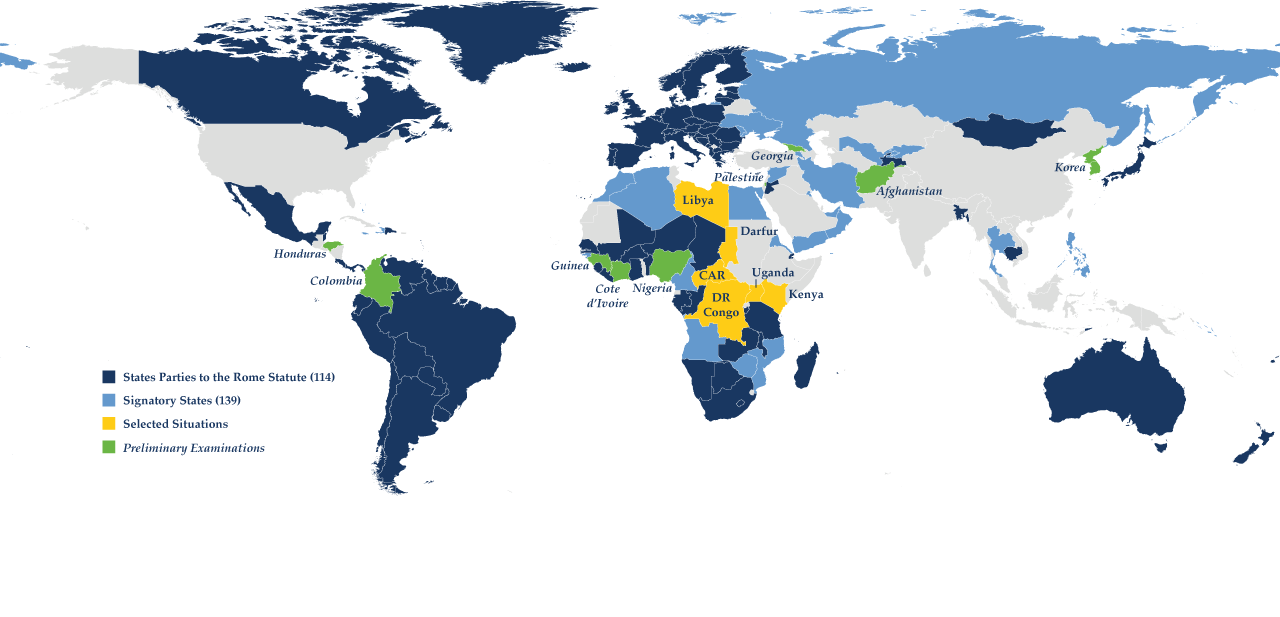
In her luncheon dialogue, which is available for web viewing here, Bensouda began by providing an overview of the work of the International Criminal Court Office of the Prosecutor (OTP) in the most active situations before the Court. Illustrating her talk was the map at bottom, which depicts the 114 states parties to the Rome Statute in dark blue, signatory states in light blue, selected situations in yellow, and preliminary examinations in green.
With regard to Libya, Bensouda stated that the OTP has notified those with formal and de facto authority, including Gaddafi, that their crimes will be investigated. The OTP has made clear that warning civilians to leave before attacking civilian areas does not relieve those involved of criminal responsibility. Bensouda emphasized that the OTP is seeking to be as transparent as possible in its dealings with the Libyan leadership.
In discussing the various situations, Bensouda revealed her vision of the ICC’s role in the global legal order: to prevent crimes through deterrence and by “sending messages” about the types of offenses the international community will not tolerate.
In discussing the OTP’s work with regard to the post-election violence in Kenya, for example, Bensouda asserted that the prosecutions will prevent crimes by “sending the message” that those who gain power by violence will be held accountable.
Similarly, she stated that the prosecution of those who killed peacekeepers in Sudan “sends an important message that the Court supports peacekeeping;” and the trial of Thomas Lubanga for recruiting child soldiers in the Democratic Republic of Congo “signals” the seriousness of that crime.
Bensouda also mentioned a situation in which the OTP is seeking to prevent crimes through incapacitation of key actors. She asserted that the arrest last fall of Callixte Mbarushimana, leader of the rebel group the Democratic Forces for the Liberation of Rwanda, was an effort to “destabilize” that organization and thus prevent crimes in Eastern Congo.
Bensouda also described the OTP’s approach to deciding which situations of alleged international crimes the ICC should investigate. The process of determining whether to pursue a formal investigation has become known as the “preliminary examination.”
Last October, the OTP issued a Draft Policy Paper on Preliminary Examinations. Bensouda promised that the final policy statement would be issued soon. Under Article 53 of the ICC Statute, the preliminary examination phase requires the OTP to determine whether a “reasonable basis” exists to proceed in a situation. This “reasonable basis” analysis has three components. It requires the OTP to assess whether:
► (1) crimes within the ICC’s jurisdiction appear to have been committed;
► (2) potential cases within the situation would be admissible (that is, they are sufficiently grave and meet the complementarity requirement that no State with jurisdiction is already acting in good faith); and
► (3) prosecution would not contravene the “interests of justice.”
The most interesting thing about the OTP’s draft policy on preliminary examinations is that it purports to disavow any role for prosecutorial discretion in deciding which situations to investigate. Whereas an earlier draft policy paper talked about the OTP “selecting” situations to investigate, the 2010 paper takes the position that the OTP must investigate if the statutory criteria are met.
Bensouda’s comments confirmed this approach. She noted that when the office began operations, Colombia and the Democratic Republic of Congo were the “gravest” situations within the Court’s jurisdiction; however, no investigation was opened in Colombia because that country was pursuing some national prosecutions. She also reiterated the OTP’s position that no investigation was undertaken with regard to the war crimes committed by British soldiers in Iraq because they were not sufficiently grave to be admissible.
As I have written elsewhere, this assessment seems mistaken – surely war crimes resulting in the deaths of even a small number of civilians are admissible before the ICC. The decision not to investigate the Iraq situation makes more sense if articulated as an exercise of the prosecutor’s discretion to focus on the most serious situations available. The OTP’s current policy, however, seems to preclude such an approach. Moreover, when questioned about the Court’s selection criteria, Bensouda seemed to admit that gravity is sometimes primarily a matter of numbers of victims – as in the Iraq situation – and at other times is conceived as relating more to the nature and impact of the crimes – in particular, what “signal” a particular prosecution is going to send.
Finally, Bensouda stated that there is no timeline for concluding preliminary examinations, and opined that the act of engaging in a preliminary examination itself has a deterrent impact. Echoing her current boss, Bensouda also emphasized that the OTP “has a legal mandate with no flexibility to adjust to political considerations,” a position that has been challenged recently by writers such as Bill Schabas and James Goldston.
Bensouda concluded that the ICC represents a “paradigm shift” from the Westphalian model of state sovereignty to one of international scrutiny and the rule of law.
In the questioning, Bensouda was pressed hardest on the problems associated with the ICC’s exclusive prosecution of African cases. She noted that such criticisms often overlook the victims of the African conflicts, and stated that she would “not apologize” for seeking to give victims a voice. She also sought to justify the emphasis on African situations by reference to the requirements of the ICC Statute, in particular the principle of complementarity. She noted that the OTP always encourages national proceedings but that unfortunately those are “not happening in Africa.” She reminded the audience that three of the African situations were referred by the affected governments themselves.
Nonetheless, when asked whether the ICC’s focus on Africa mitigates in favor of an African as the next prosecutor Bensouda, a native of the Gambia, was (unsurprisingly) supportive!


Breaking News from the ICC

The ICC recently released three important decisions in the last two days:

1. The first two are decisions by Pre-Trial Chamber II, by a majority, to issue summons to the six Kenyan suspects (about which we've blogged before) to appear before the ICC on April 4, 2011:

  • William Samoei Ruto (Ruto),
  • Henry Kiprono Kosgey (Kosgey),
  • Joshua Arap Sang (Sang),
  • Francis Kirimi Muthaura (Muthaura),
  • Uhuru Muigai Kenyatta (Kenyatta) and
  • Mohammed Hussein Ali (Ali).

The Chamber found reasonable grounds to believe that Ruto, Kosgey and Sang (the Odinga defendants) can be prosecute for specified crimes against humanity (murder, forcible transfer and persecution). (The Chamber rejected efforts to prosecute the three for torture). The cases against Ruto and Kosgey will proceed under a theory of indirect co-perpetration (i.e., committing crimes through another person(s)) in accordance with article 25(3)(a) of the Rome Statute. The case against Sang, by contrast, will proceed under a theory of complicity rather than co-perpetration, because the PTC determined that no reasonable grounds existed to believe that Sang's contribution to the commission of the crimes was essential.

Maintaining almost perfect symmetry, the PTC determined Muthaura and Kenyatta (the Kibaki defendants) will be prosecuted as co-perpetrators of the crimes against humanity of murder, forcible transfer, rape, persecution and other inhumane acts. Likewise, the case against Ali will proceed under a theory of complicity based on the finding that there were reasonable grounds to believe that Ali otherwise contributed to the commission of the crimes in accordance with article 25(3)(d) of the Rome Statute.

Unsurprisingly (see prior post), Judge Hans-Peter Kaul dissented (opinion as yet unavailable), arguing that the Prosecutor had failed to establish reasonable grounds to believe that the crimes were committed pursuant to or in furtherance of the policy of an organization as required by the definition of crimes against humanity in the ICC Statute.

2. In the Darfur situation, PTC I confirmed charges against two rebel leaders (Abdallah Banda Abakaer Nourain and Saleh Mohammed Jerbo Jamus) based upon alleged attacks on the compound of the African Union peacekeeping mission in Sudan on the evening of September 29, 2007. The two will be prosecuted for the war crimes of:

•violence to life and attempted violence to life;
•intentionally directing attacks against personnel, installations, material, units and vehicles involved in a peacekeeping mission; and
•pillaging.

Stay tuned...

The International Criminal Court and the Transformation of International Law? Maybe not quite yet . . .

(Delighted to welcome back alumna Leila Nadya Sadat, who contributes this guest post from Paris)

This week, unexpectedly, the Security Council voted unanimously to refer the situation in Libya to the International Criminal Court. That is cause for celebration; but celebration tempered with a strong dose of caution and even some real pessimism about the future.
On the plus side, the ICC is now becoming an international institution that is increasingly seen as a real partner in the maintenance of international peace and security.
Also, on the plus side, as Diane Marie Amann mentioned in an earlier IntLawGrrls post, the U.S. voted for the Resolution, rather than simply abstaining from vetoing it as the U.S. had done with Resolution 1593, referring to the Court the situation in Darfur.
Finally, I entitled this blog entry after my 2002 book of the same name, because one sees in the Resolution glimmers of change — that war is not the only answer to international conflict, that law is a relevant consideration in its resolution and that justice may be a possibility. That would be cause for celebration indeed.
At the same time, there are many worrisome elements in the Resolution which bode ill for the Court and for the referral. The Resolution itself retains two outrageous Bush-administration provisions (while admittedly discarding a third).
First, while deciding in paragraph 5 that the Libyan authorities “shall cooperate fully with and provide any necessary assistance to the Court and the Prosecutor” (even though Libya is not a State Party to the Court) the paragraph continues that “States not party to the Rome Statute have no obligation under the Statute. . . ” and, in paragraph 6, “decides, that national, current or former officials or personnel from a State outside [Libya] . . . shall be subject to the exclusive jurisdiction of that State” for any acts they may commit relating to UN operations in Libya. What an extraordinary display of double standards, given that several members of the Council who voted for the Resolution are not parties to the Rome Statute! Can a rule of law be a rule of law if it applies to some but not all?
The Resolution also provides that the ICC, not the United Nations, shall bear all the expenses relating to the referral, apparently as a way of appeasing the U.S. Congress, many of whose members continue to threaten the Court. So the United States and other non-Party States (China, India, Russia) are using — but not paying for — the ICC as a tool of coercive diplomacy. This is not good news.
Finally, the ICC is already struggling to convince African states that it is not a Court directed at them. The first four referrals all seemed quite sensible; but the fifth, the situation involving Kenya, was far more troublesome, given that the Prosecutor undertook the case on his own initiative, and at least some questioned whether it met the legal standards necessary in terms of subject matter jurisdiction, gravity and complementarity to be pursued at the ICC rather than in Kenya or otherwise. (Prior IntLawGrrls posts available here.) There were also serious questions raised at last summer's ICC Review Conference at Kampala as to whether it would not be preferable to see a proprio motu referral of the Colombia or Afghan situations. A sixth referral involving an African state — even in a case involving the clear commission of atrocities — may encourage the ICC’s detractors in Africa, and the double standards evinced by the Resolution’s text do not assist in this regard.
In the view of this writer, the Libya referral, in and of itself, is a good thing. The atrocities taking place as reported in the media seem clearly to warrant ICC intervention. But the failure of the great powers to fully support this Court, and to use it cynically when and as they please, rather than committing their money, time, energy and political support to helping it grow strong and endure, feeds the perception that this Court is not about justice, but about power, undermining its legitimacy. Thomas Friedman recently opined that President Barack Obama’s 2009 speech in Cairo (above) strengthened the case for democracy in the Arab world as he led others through the salutary example of his own life. Would that Obama will find the same courage to champion the International Criminal Court, and to show the world that Americans believe in accountability too.


(Cross-posted at Leila's An American in Paris blog)


Guest Blogger: Kim Thuy Seelinger

It's IntLawGrrls' great pleasure to welcome Kim Thuy Seelinger (left) as today's guest blogger.
Kim directs the Sexual Violence & Accountability Project at the Human Rights Center at the University of California, Berkeley, School of Law. The Project pursues interdisciplinary strategies to address impunity for sexual violence.
Prior to joining the Human Rights Center, Kim was a staff attorney and clinical instructor at the Center for Gender and Refugee Studies at the University of California Hastings College of the Law. There she co-taught the Refugee and Human Rights Clinic with our Hastings colleague Karen Musalo (prior IntLawGrrls posts). Kim also represented asylum seekers who were fleeing gender-based violence. She's also served as a Yale-China Association Legal Education Fellow in southwest China and as immigration staff attorney with Lutheran Family & Community Services in New York City. She earned her J.D. from New York University School of Law, and serves on the Board of Directors of the Southeast Asia Resource Action Center.
Kim's scholarship focuses on issues of gender-based violence, persecution based on sexual orientation, and developments in asylum jurisprudence. Most recently, this year she published "Violence Against Women and HIV Control in Uganda: A Paradox of Protection? ," in the Hastings International and Comparative Law Review. Her sample-based analysis of asylum claims involving forced marriage is forthcoming. Ki'ms current interests include the relationship of legal and medical sectors in the prosecution of sexual violence, as well as the intersection of women's rights and health status in general. In her guest post below, Kim discusses a range of efforts to address sexual violence in Kenya.
She writes the following dedication:

Kim dreams her international foremother to have been Trưng Trắc, a Vietnamese village woman born in the 1st century. Under the strain of Chinese Han control over North Vietnam, Trưng Trắc and her younger sister (atop elephants), led a predominantly female legion to temporarily expel Han dynasty forces from the northern prefectures.

Today Trưng (image credit) joins IntLawGrrls' other foremothers in the list just below the "visiting from..." map at right.

Heartfelt welcome!

Beyond the ICC: Addressing Sexual Violence in Kenya

(My thanks to IntLawGrrls for the opportunity to contribute this guest post)

Last week, two very interesting things happened in the world of accountability for sexual violence.
► First, Luis Moreno-Ocampo, the Prosecutor at the International Criminal Court, requested that six high-ranking Kenyans present themselves to The Hague. He charged three of the six with organizing and inciting political strife – including sexual violence – in the wake of Kenya’s 2007 general election.
► Second, the U.N. Security Council passed Resolution 1960 (2010), condemning sexual violence in zones of conflict and political unrest. This new resolution on women and peace and security calls for, among other things, commanders in armed conflict to explicitly prohibit sexual violence by their subordinates. It also requests support of civil society groups to coordinate resources, information, and efforts relating to widespread sexual harm.
This pair of events reminds me of Kenya, where I spent the month of October, speaking with government and civil society leaders about the problem of impunity for sexual violence.
Kenyan lawyers, parliamentarians, hospital staff, and grassroots advocates assured me that the problem is great – both for the politically motivated rapes of 2007-2008 and for cases of sexual violence in general. (above photo: mural on wall overlooking the Rift Valley, which suffered greatly during the post-election violence)
For example:
In early 2008, the Nairobi Women’s Hospital Gender Violence Recovery Centre alone handled nearly 700 cases of election-related sexual attack. Fully 90% of the rape cases reported involved multiple perpetrators. Several victims were children. A few cases of male victimization were also reported – mostly in the form of forced circumcision of men and boys from the Luo ethnic group, which does not practice circumcision. Depending on their ethnic loyalties, police had stood by and watched. Some police even participated.
Three years later, not one of these attackers has been convicted.
As one survivor was quoted in the report available here:

'[We] meet our perpetrators every other day, they are our neighbors. It’s tough knowing that they are still very safe from the arm of the law.'

Meanwhile, findings of the 2003 Kenya Demographic and Health Survey revealed that 44% of married, divorced, or separated women ages 15 to 49 reported had experienced physical or sexual abuse at least once by their husband or partner. Of these women, 29% had suffered such harm in the past calendar year.
The Nairobi Women's Hospital, which sees hundreds of survivors of sexual assault every year, estimates that one person is raped every thirty minutes in Kenya.
Perhaps surprisingly, Kenya has the legislation it needs to prosecute sexual violence in both scenarios.
Kenya has had a Sexual Offences Act in effect since 2006. In 2008, when the government commission inquiring into the post-election strife confirmed that politically motivated rapes had occurred, it specifically urged that the 2006 Act be fully implemented before the 2012 elections. Later that year, the Kenyan legislature passed the 2008 International Crimes Act, enabling domestic prosecution of international crimes like widespread, politically motivated rape.
There are signs of progress on the ground, as well.
For example, a few police stations have set up “gender desks” to provide specialized response, while Kenya’s health ministries drafted new guidelines for health professionals handling sex assault cases. Civil society groups have launched rights awareness campaigns about the Sexual Offences Act. A government task force was even created to oversee the Act's implementation.
Still, lack of political will, resources, and linkages cripples progress:
► Many police, doctors, even judges are still unfamiliar with the 2006 law.
► The few existing police “gender desks” are frequently unstaffed.
► Victims cannot access counseling or protection.
► Investigative procedures remain weak, and the government forensics lab is under-resourced to the point of being nonfunctional.
Civil society efforts have been valiant, but need coordination and government support. (photo at left: poster on wall at the Gender Violence Recovery Center at Kenyatta National Hospital)
A critical but missing step is dialogue and coordination among stakeholders – urban and rural, medical and legal, government and non-government. In response, the Sexual Violence & Accountability Project that I direct at the Human Rights Center, University of California, Berkeley, School of Law, has agreed to facilitate a workshop in Nairobi in 2011. Our aim is to bring key actors together to improve and coordinate response to sexual violence. We hope not only to create a space to troubleshoot implementation of the 2006 Sexual Offences Act, but also to brainstorm ways to increase capacity to handle widespread, politically motivated rape -- in time for the 2012 elections.
Of course, the question remains as to what to do about the mass rapes of 2008.Certainly, the ICC has kept sexual violence in its crosshairs as it pursues the architects of Kenya’s post-election violence. But the reach of the ICC is limited to persons with “greatest responsibility” for crimes within its jurisdiction.
How will Kenya sweep up lower-level perpetrators?
Kenya’s International Crimes Act, domesticating Rome Statute provisions regarding sexual violence, is not retrospective. Accordingly, it can’t be used to prosecute lower-level perpetrators of 2007-2008 crimes. Demands for a domestic tribunal received no traction. And as detailed in IntLawGrrls posts available here, Kenya’s Truth, Justice, and Reconciliation Commission is still struggling to legitimize itself after a birth marked by allegations of corruption and lack of confidence.
No one seems sure of what comes next.
For our part, we’re taking our cues from colleagues in Kenya and standing by to support in whatever ways they ask. In the meantime, the words of one Kenyan woman – recounting her country’s two most recent elections – is stuck in my head on replay:

'I was raped in 2002, again in 2008, and I will be raped again in 2012. Where is the justice in that?'

Breaking News: ICC Kenya Indictments Announced

As expected, Prosecutor Luis Moreno Ocampo today requested under Article 58 that the International Criminal Court issue summons to appear to six Kenyans in connection with his proprio motu investigation into post-election violence in Kenya. We've blogged about this and other issues involving transitional justice in Kenya here, here, here, and here. The six individuals to be prosecuted in two cases are:
1. William Samoei Ruto (left) who is the suspended Minister of Higher Education, Science and Technology and a member of Parliament for Eldoret, one of the places hardest hit by the violence. He was a supporter of Raila Odinga, Kenya's Prime Minister.
2. Henry Kiprono Kosgey is the Minister of Industrialization and a MP for Tinderet Constituency. He is former chair of the orange Democratic Movement (ODM), Odinga's party.
3. Joshua Arap Sang (right) is currently Head of Operations of and a commentator on a Kenyan radio station. He was accused of inciting violence after the elections.
The highly-redacted Article 58 Applications for the Odinga supporters is available here.
4. Francis Kirimi Muthaura (below right, addressing Kofi Annan) is Head of the Public Service and Secretary to the Cabinet and Chairman of the National Security Advisory Committee and a Kibaki supporter. He is accused of authorizing the police to use excessive force against ODM supporters.
5. Uhuru Muigai Kenyatta is currently the Deputy Prime Minister and Minister of Finance and Chair of the KANU party. He is the son of Jomo Kenyatta, Kenya's first president.
6. Mohamed Hussein Ali is Chief Executive of the Postal Corporation of Kenya and was Commissioner of the Kenya Police in the post-election period.
The equally-redacted Article 58 Application for the Party of National Unity supporters is available here. The crimes against humanity to be charged include murder, torture, persecution, and deportation.
The full Press Release is here and a video of the press conference is here. All suspects have apparently been on television stating they would cooperate with the ICC, although many of have publicly discredited the investigation.
In response to the Applications, President Obama issued the following statement:
Today, as the International Criminal Court announces the names of six suspects alleged to have participated in the post-election violence that threatened to tear Kenya apart three years ago, I encourage all Kenyans take a moment to reflect on the tremendous progress their country has made since those dark days. Together, you have been working to reconcile your communities, to reform your institutions to better serve the public good, and to put your country on a path to lasting peace and prosperity. Kenya is turning a page in its history, moving away from impunity and divisionism toward an era of accountability and equal opportunity. The path ahead is not easy, but I believe that the Kenyan people have the courage and resolve to reject those who would drag the country back into the past and rob Kenyans of the singular opportunity that is before them to realize the country's vast potential.

In pursuit of these goals, I urge all of Kenya's leaders, and the people whom they serve, to cooperate fully with the ICC investigation and remain focused on implementation of the reform agenda and the future of your nation. Those found responsible will be held accountable for their crimes as individuals. No community should be singled out for shame or held collectively responsible. Let the accused carry their own burdens - and let us keep in mind that under the ICC process they are innocent until proven guilty. As you move forward, Kenyans can count on the United States as a friend and partner.

Hear, hear.

Africa-based international law projects

(Delighted to welcome back alumna Bonita Meyersfeld, who contributes a 2-part series of guest posts on international law in Africa. Part 2 is below; Part 1, published yesterday, is here.)

Having described the overall work of the Southern and Eastern African Regional Centre for Women’s Law at the University of Zimbabwe, I continue in this post with descriptions of research in progress:
Makanatsa Makonese (left), a Doctor of Philosophy Candidate, is examining Zimbabwe’s Post-Independence Land Reform Laws and Policies and Their Impact on Women’s Right to Agricultural Land: A Critical Analysis of the Fast Track Land Reform Programme from 2000 and Beyond.
This research seeks to assess the availability or otherwise of a legal, policy, and institutional framework governing the Fast Track Land Reform Programme in Zimbabwe. The focus is on women and their right to access, own, and control agricultural land. The effect over the years of the country’s property laws in general, and land laws in particular, will be critically examined. The goal is to establish whether there have been any efforts during the implementation of the fast track land reform programme to break away -- away from a system that subjugates women in property ownership and toward one that recognises women as equal partners in national economic, social, and political development and transformation.
A primary focus of the research is the recognition that the fast track land reform programme was and is not just about parcelling out land but also about: creating social classes; developing jurisprudence around land ownership and reform in Zimbabwe; and setting up centres and sources of power that are critical in shaping the country in various ways. The position of women in the matrix and the country’s level of compliance with international human rights standards and best practices therefore have to be examined.
The nuance of the work is its engagement in a rights analysis in a context of rights violations; namely, the land grabs and concomitant displacement of landowners.
► Research by Renifa Madenga (left), also a Doctor of Philosophy Candidate, is entitled Using Women’s Voices/Experiences To Interrogate The Efficacy Of The International Criminal Justice System on Rape: The case of Rwanda 1994 Genocide. (credit for photo (c) Robert H. Jackson Center)
Her study explores the lived reality and experience of rape survivors of the 1994 Rwandan genocide. It is sited in the web of fears, needs, relationships, and anxieties that affect survivors of rapes committed during the Rwandan genocide, as well as their interactions with the international criminal justice system at the International Criminal Tribunal for Rwanda.
Using the voices and experiences of survivors and witnesses, the study interrogates the efficacy of the justice system. Its major questions: Does the system acknowledge and condemn the egregious abuses suffered by victim survivor witnesses? Does it recognize and addresse the needs, fears, and aspirations of those survivor witnesses?
The researcher, Madenga, works as an Appeals Counsel in the ICTR Office of the Prosecutor, and chairs that office's 3-year-old Sexual Violence Committee.
Annette Mudola Mbogoh, another Doctor of Philosophy Candidate, is researching The 2007 Post-Election Violence As A Spring Board For Peace, Reconciliation And Reparation: A Case For The Participation And Involvement Of Women In Mombasa, Kenya.
The study investigates the participation of women in Mombasa in peace, reconciliation, and reparation processes through Kenya's Truth, Justice and Reconciliation Commission. Women suffered gross human rights violations in recurrent electoral violence in Mombasa -- in 1992, in 1997, and in the unprecedented 2007 general elections. (Prior IntLawGrrls posts available here.) Women have been internally displaced, lost their loved ones, their property, and their businesses. They are survivors of physical violence and rape. However, their voices, needs, and concerns have been sidelined in the current transitional justice process in Kenya (flag at right). The Truth, Justice and Reconciliation Commission presents an opportunity for women’s voices, injustices, and stories to be heard, investigated, documented, and redressed in the ensuing reparation programmes.
Against this backdrop, this research investigates the level of participation of women in the unfolding truth commission process, as well as the factors hindering women’s active involvement. It seeks both to document injustices committed against women by virtue of their sex and to identify priority concerns and preferred reparations on the part of survivors. It interrogates the question of truth-telling versus justice. The study highlights the importance of reparations to achieve true reconciliation and the extent to which women’s multiple identities influences their choice between collective and individual reparations. The study explores the politics of representation amongst women in a very polarized and ethnicized community. It furthers the debate on the right to truth, which has been expounded by the institutions of the inter-American human rights system. These arguments are hinged on the new Constitution of Kenya, which enshrines women’s right to equality and representation in legislative bodies through reservation of special seats. Finally, the study recommends implementation of a gender perspective in peace and reconciliation efforts, as is espoused in international instruments such as U.N. Security Council Resolutions 1325 and 1820.
► Under examination by Catherine Makoni is The Impact of the Political Crisis in Zimbabwe on Women’s Right to Protection of the Law: An Investigation into the Handling of Cases of Politically Motivated Rape from 2000-2009.
Makoni's research investigates how cases of politically motivated rape have been dealt with, if at all, within the justice system of Zimbabwe (flag at right). The objective is to interrogate the duty of the state to protect women, and therefore its role to provide sufficient and meaningful redress. The research undertakes an empirical assessment of what assistance victim survivors of rape have received from both state and nonstate actors -- including officials of their own political party, who have undertaken to protect party members from acts of violence and intimidation by the ruling party. The study further seeks to influence responses by all these actors.
Rape was used as a tool for political coercion during the election periods in 2000, 2002, 2005 and 2008. The political crisis had an impact on how cases of politically motivated rape were dealt with at multiple levels. In brief, the State failed in its duty to protect women. The perceived inviolability of the perpetrators, as a result of their perceived political affiliation, determines whether allegations of rape are reported, investigated, prosecuted, and adjudicated. The law as presently formulated is not sufficient to cover the total scope of rape as it occurs when used as a tool for political coercion.
Rosalie Kumbirai Katsande, a Lecturer at the Centre, is Exploring the Potential of Laws and Procedures Governing Business Entities in Facilitating Women’s Entrepreneurial Development in the Horticultural Sector of Zimbabwe.
Inspiring this research is a passage in Peasants, Traders and Wives: Shona Women in the History of Zimbawe 1870 – 1939 (1996), in which Dr. Elizabeth Schmidt, Professor of History at Loyola University Maryland, writes:

When the Jesuit father A Hartmann visited the Shona Chief Chipanga in about 1891, he asked the chief how numerous the people where including women and children, the chief reportedly answered, 'women are not counted'. He then took a handful of dust from the ground and said, 'that is the woman. Hartman concluded that women were regarded as almost nonexistent.
In her own research project, Katsande explores women entrepreneurs in the horticulture sector of Mashonaland East Province of Zimbabwe. Her work interrogates the appropriateness for the development of business regimes by government authorities for women in rural areas. In an effort to determine the appropriateness of current such regimes, the study traces the economic history of Zimbabwe and shows how women’s economic initiatives have been marginalized by historical processes. Laws designed during colonial governance continue to inform and limit women’s entrepreneurial potential and development.
Historically, state officials discouraged Zimbabwean women from settling in the towns and at the mines. The officials opposed the growth of a permanent and potentially explosive African population in the urban areas, and encouraged women and children to subsidize male wages through agricultural production at rural homesteads. State officials expected rural-based women to bear the social costs of production -- caring for the sick, disabled, and retired workers -- while raising the next generation of labourers. Innovation by women was deeply affected by legislative and policy restrictions.
Against this backdrop, the study considers the current government’s people-centred development approach from an African feminist perspective, which, inter alia, focuses on empowering African women to improve their own lives.
The study reveals challenges to community income-generating projects initiated by the Zimbabwean Ministry of Women Affairs, Gender and Community Development. These are reported to have failed to address women’s economic needs; indeed, they present more of a burden, as they add work on already overworked women.
Women in the areas of study are running potentially viable horticultural ventures. The profitability of these ventures is dependent on agricultural support and training; however, this is not being received. Instead, women in these communities are presented with artificially constructed income-generating projects.

These are some of the impressive projects under way at the Centre. Perhaps of primary importance is the investigation of the realities of individual lives and how to link them into the international human rights agendas through national legal and policy frameworks.

Developments in Kenya: Truth Commission Process Back On

On the eve of the resignation of our colleague Ron Slye from the Kenyan Truth, Justice & Reconciliation Commission (TJRC) (see prior posts here, here, and here), the former Chair of the Commission, Ambassador Bethuel Kiplagat (left), has finally stepped down from the Commission to face allegations of potential conflicts of interest with the work of the TJRC. In addition, the Kenyan Chief Justice has finally established a five-person special tribunal in order to investigate these issues.

In light of these two developments, Professor Slye has withdrawn his resignation. In a statement, released today, he wrote:

The decision of the Chairman to step aside has restored some of my faith in the ability of the Commission to succeed. It is no means certain to me that it will. The lack of financial and other support to which I referred in my earlier statement still exists. I do believe, however, that with the Chairman’s decision to step aside, there is the possibility that the Government of Kenya and others will step up and provide the Commission with much of the support that it needs.

It is for these reasons that I announce that I am withdrawing my intention to resign from the Commission. In so doing I do not mean to imply that the Commission has overcome all of the hurdles facing it. I do believe, however, that with the hard work and dedication of the remaining Commissioners and staff, the Commission has a fighting chance to fulfill the important mandate entrusted to it by the people of Kenya.

As lingering concerns, Professor Slye noted that the Kenyan government has still not provided the Commission with the resources it needs to accomplish its mandate. As such, he urged the government as well as the donor community and civil society to support the work of the TJRC, because

For it is only by facing squarely the misdeeds of the past that a future of respect for the rights of all Kenyans can be ensured.
Well said.

ICC-Kenya-Bashir continued

The International Criminal Court is stepping up pressure on Kenya.
Last month Kenya permitted Sudan's President Omar al-Bashir to attend a Constitution Day celebration in Nairobi -- notwithstanding that Bashir's been indicted by the ICC, nor that Kenya, as an ICC state party, is obliged to cooperate with the court's efforts to secure personal jurisdiction over Bashir.
The safe passage Kenya allowed Bashir in September drew rebuke from U.S. President Barack Obama, as we then posted.
The ICC had made its own complaints a number of times earlier, among them an August bid before the U.N. Security Council.
This past Monday, the ICC sent a new message, this one directly to Kenya.
In its Decision requesting observations from the Republic of Kenya, ICC Pre-Trial Chamber I asked Kenya for information on

any problem which would impede or prevent the arrest and surrender of Omar Al Bashir in the event that he visits the country on 30 October, 2010.
Meanwhile, nearly 2 dozen nongovernmental organizations, representing Africa's civil society, also sent a letter urging Kenya to arrest Bashir.
Kenya's supposed to give its response to the ICC no later than this Friday, the day before the possible visit of the fugitive head of state, in connection with a summit session of IGAD (logo at left), the Djibouti-based Inter-Governmental Authority for Development. That group's expressed "dismay" regarding ICC charges against Bashir.
All this unfolds against the backdrop of Kenya's own problems with the ICC, which is investigating post-election violence in that country. Governmental resistance to inquiry (including that by the truth commission) is stiffening.
Stay tuned.

Breaking News: Ron Slye Resigns from Kenyan Truth Commission


Our friend and colleague Ron Slye (above) has just resigned from the Kenyan Truth, Justice & Reconciliation Commission effective November 1. In our prior coverage of the Commission (here and here), we noted the emergence of a controversy over the President of the Commission, who is implicated in events within the purview of the Commission but has refused to step aside. Eight Commissioners of the TJRC petitioned the Chief Justice to constitute a Tribunal to assess the allegations raised against Bethuel Kiplagat. Ron cited the lack of support from the government and the unresolved Kiplagat issue as grounds for his resignation:


I have lost my faith in the Commission’s ability to fulfill even a small part of its mandate. ... That loss of faith comes not from the work of the staff of the Commission – highly dedicated individuals who have worked under extremely trying circumstances to move the work of the Commission forward – but from the clear lack of support from the Government of Kenya and from the still-unresolved allegations against the Chairman of the Commission. ...

I have been willing to remain with the Commission so long as I felt that I could make a meaningful contribution to the work of the Commission and, more importantly, the general project of furthering truth, justice, and reconciliation in Kenya. I no longer feel that my continued stay at the Commission contributes effectively to either. ...

I fear that under the leadership of a person that has already prejudged the issue of Government involvement, the Commission will have a difficult time discovering the truth of this and the many other human rights violations that were allegedly committed either by the Government or with Government support, knowledge, or complicity.

Ron, who is a Professor of Law at the Seattle University School of Law and an Honorary Professor of the University of the Witwatersrand, is the second commissioner to leave the truth body after Betty Murungi (right) resigned in April.

A spokesperson indicated that the work of the TJRC would continue.

'Nuff said

(Taking context-optional note of thought-provoking quotes)

We have witnessed with shame the horrible events that occurred in Rwanda, Sierra Leone, Somalia and even here in Kenya. Thousands of Africans have been killed and displaced, women raped and forced to live as sex slaves, property destroyed and communities displaced.
As a Kenyan, and as an African woman, I can affirm that whether it is here in Kenya or in Darfur, in the Democratic Republic of Congo, in the Central African Republic or in Uganda, the need for justice is universal. The ICC is bringing us hope that we can finally see the fulfilment of the right of the victims to learn the truth, to see the perpetrators of these crimes tried, and to receive reparation. The only reason we might fear ICC is if we are guilty.

-- The 2004 Nobel Peace Prizewinner, Dr. Wangari Maathai (above left), in an op-ed, which she published yesterday in the Nairobi-based Daily Nation, reflecting on the work of the Kampala International Criminal Court Conference. (credit for photo by Martin Rowe)

Nexus of Film & Activism in Kampala

(Delighted to welcome back IntLawGrrls alumna and filmmaker Pamela Yates, who contributes this guest post to IntLawGrrls' series on the ICC Kampala Conference)

At Skylight Pictures we (Peter Kinoy, Paco de OnĂ­s, and I) spend a lot of time thinking about ways to heighten the impact of our films in order to increase awareness of human rights and justice issues. For over 25 years we’ve been committed to the art of storytelling through the language of cinema – lush cinematography, music woven in to enhance the narrative, thoughtful editing that seamlessly transports the viewer through time and space – in the belief that it will bring audiences to a deeper level of engagement.
In recent years, as social media tools have proliferated, we have adapted many of them to our mission. An example is the international justice Twitter feed on the IJCentral map, about which I blogged in this IntLawGrrls post.
But because much of our outreach work is in developing countries, we also produce lo-tech projects designed to engage audiences on the ground, for whom traveling through cyberspace is not an option.
And that’s the reason that Skylight's at the International Criminal Court Review Conference in Kampala, with 1,000 Screening Kits of our film The Reckoning: The Battle for the International Criminal Court (prior IntLawGrrls posts here and here) -- to give out free of charge to civil society organizations, to country delegations, and to the press. (Thanks to generous support from Humanity United and the John D. and Catherine T. MacArthur Foundation.) The Kits are in English and French, and include:
The Reckoning (60-minute version)
ICC and Africa (20-minute film)
Peace & Justice (20-minute film)
► Screening/Discussion Guide
► Audience Survey Form
► FAQs about the ICC
The impetus to make the Screening Kits came from 180 African civil society organizations that banded together and signed a petition to protest the 2009 declaration (available here) by the African Union (logo at right) of non-cooperation with the ICC with regard to the arrest warrant it issued for Sudanese President Omar al-Bashir. While the international press focused on the AU declaration and its critique of the ICC, the pushback against impunity coming from the civil society organizations wasn’t getting any attention. The latter organisations were saying that the AU wasn’t offering the victims any justice alternative to the ICC -- that it was effectively declaring Africa an “impunity zone”. They wanted to raise public awareness of how the ICC works and how it operates as a court of last resort.
So we reached out to these organisations to see if we could produce a media tool they could use to increase awareness of the role that the ICC can play in the battle against impunity. In coordination with Pivot Pictures, a media initiative of the International Center for Transitional Justice, we coordinated with the ICTJ country offices in Kenya, Uganda, Morocco, and South Africa to work out what materials and themes to include in the Kit. After a period of exchanging ideas and getting feedback from the civil society organizations on 2 short films that we produced for the project, we arrived at the menu listed above. Now those organisations will receive their Screening Kits and go forth to use them – we’ve created an online Screening Report form for the them to use, so that we may track the use of the Kits and the impact they are having.
The Kampala ICC Review Conference is an extraordinary opportunity to have massive impact with The Reckoning and a range of short films and microdocs we produced about international justice themes. We will be screening all this material non-stop at the RC Media Centre, and we also have several screenings planned at the People’s Space, where civil society organizations from around the world are gathered this 2 weeks in order to discuss the ICC. The Kampala theatrical Premiere of The Reckoning was at Watoto Church yesterday, and there will be a national broadcast on UBC, Ugandan national television, today.
And watch for our video blogs at the RC Media Centre. They'll be posted daily at IJCentral.

FGM: The American Academy of Pediatrics Weighs In

Recently, according to the New York Times, the American Academy of Pediatrics suggested a policy change that would allow American doctors to perform "a ceremonial pinprick or 'nick'" on girls "if it would keep their families from sending them overseas for the full circumcision." (See the new policy here). Female genital mutilation (FGM) is a complex, heart-wrenching issue that has occupied feminists both within and outside of Africa for many years. (For an excellent description of the issue, see IntLawGrrl Hope Lewis's article here) The health consequences for girls can be severe, even fatal. It is a deeply entrenched cultural practice in some places within Africa. The human rights community - at international and local levels - has agitated for recognition of FGM as a violation of women's human rights, and it is recognized as such in a number of international human rights documents. But still it continues. Some countries, such as Ghana, have passed legislative bans - although many of these have proven to be completely ineffective. More often than not, simply prohibiting the practice does not work. A few activist strategies, however, have enjoyed some success in curbing the practice in some areas. For example, a community in Kenya has popularized an alternative initiation rite, one that does not involve genital cutting. Some communities have successfully framed the issue as one involving significant health issues for girls rather than as one that violates the human rights of girls. I am a human rights activist/scholar, but I am also a pragmatist. Although I would love to see some recognition of the ways in which FGM violates women's rights, if an approach that emphasizes health resonates with local communities and works to combat the practice, then it makes sense to frame the issue in terms of health. So is it wise of the AAP to change its policy to one of tolerance? As with most things, the devil is in the details. As some feminists will legitimately argue, there is a serious risk of legitimizing the practice if it is medicalized and accepted within organizations such as the AAP. However, if we are truly talking about a "ceremonial pinprick" that will have cultural meaning within the community and take the place of more dramatic and dangerous cutting, then it might not be a bad solution in those limited circumstances. The bottom line, however, is that for any solution to work on a large scale, it will have to come from and have meaning within the communities that actually practice FGM.

Ocampo's Investigation in Kenya Underway

As we've blogged before, the ICC Prosecutor has received the green light to launch a proprio motu investigation into the post-election violence in Kenya. He's in Kenya May 7-12 for this purpose. The ICC has asked the Radio Netherlands Worldwide to accompany Ocampo on his investigation. Their reporting can be found here.
Gitobu Imanyara, a member of Parliament, introduced another bill recently to establish a special tribunal to investigate the violence (right) with Kenyan and international judges. Two prior efforts to create such a tribunal have failed in the past. This time, the debate was scuttled when it was realized that just 19 of 222 members in the house were present, lending further proof to the conjecture that there is no political will for such a tribunal despite protestations to the contrary from political leaders, including President Mwai Kibaki and once opposition leader, now Prime Minister Raila Odinga.
In other Kenya news, Bethuel Kiplagat--the Chair of the Truth, Justice & Reconciliation Commission (left)--still refuses to step down, even through the rest of the commissioners have asked him to do so, at least temporarily, so that they can continue their work with the confidence of the public. The commissioners have also asked the Chief Justice to establish a special tribunal to investigate the allegations against Kiplagat to determine if he is qualified to serve on the Commission, but so far such a tribunal has not materialized. As we blogged before, it turned out that the Chair may be personally implicated in events that are to be the subject of the Commission's work, although he took an oath to the contrary. In a statement, Kiplagat has argued that if he were to step down, it would amount to his condoning human rights abuses, including abuses against him personally. He has described calls for his recusal "a media-based lynch mob." Donors have refused to support the Commission while Kiplagat remains Chair. Sigh.

 
Bloggers Team