Showing posts with label NATO. Show all posts

Responsibility to protect, Libya to Japan

(Thanks to IntLawGrrls for the opportunity to contribute this guest post)

On September 16, 2005, the General Assembly of the United Nations adopted by consensus a resolution recognizing the responsibility to protect. The core of the responsibility to protect (R2P) as adopted by the both the General Assembly and Security Council was first embodied in Paragraph 138 of the 2005 World Summit Outcome declaration:
'Each individual State has the responsibility to protect its populations from genocide, war crimes, ethnic cleansing and crimes against humanity. This responsibility entails the prevention of such crimes, including their incitement, through appropriate and necessary means. We accept that responsibility and will act in accordance with it.'

Paragraph 139 continues:
'The international community, through the United Nations, also has the responsibility to use appropriate diplomatic, humanitarian and other peaceful means, in accordance with Chapters VI and VIII of the Charter, to help to protect populations from genocide, war crimes, ethnic cleansing and crimes against humanity. In this context, we are prepared to take collective action, in a timely and decisive manner, through the Security Council, in accordance with the Charter, including Chapter VII, on a case-by-case basis and in cooperation with relevant regional organizations as appropriate, should peaceful means be inadequate and national authorities are manifestly failing to protect their populations from genocide, war crimes, ethnic cleansing and crimes against humanity. We stress the need for the General Assembly to continue consideration of the responsibility to protect populations from genocide, war crimes, ethnic cleansing and crimes against humanity and its implications, bearing in mind the principles of the Charter and international law. We also intend to commit ourselves, as necessary and appropriate, to helping States build capacity to protect their populations from genocide, war crimes, ethnic cleansing and crimes against humanity and to assisting those which are under stress before crises and conflicts break out.'

The original, and broader, formulation of the responsibility to protect was included in the December 2001 report, The Responsibility to Protect, from the International Commission on Intervention and State Sovereignty (ICISS). As a basic principle, this report concludes that
'where a population is suffering serious harm, as a result of internal war, insurgency, repression or state failure, and the state in question is unwilling or unable to halt or avert it, the principle of non-intervention yields to the international responsibility to protect.'

For military intervention to be justified for human protection purposes, there must be:
'serious and irreparable harm occurring to human beings, or imminently likely to occur, of the following kind:
'A. Large scale loss of life, actual or apprehended, with genocidal intent or not, which is the product either of deliberate state action, or state neglect or inability to act, or a failed state situation; or
'B. Large scale ‘ethnic cleansing’, actual or apprehended, whether carried out by killing, forced expulsion, acts of terror or rape.'

In dealing with what should occur if the Security Council fails to fulfill its responsibility or to do so “in a reasonable time,” “alternative options” are:
► Consideration of the matter by the General Assembly in Emergency Special Session under the “Uniting for Peace” procedure; and
► Action within area of jurisdiction by regional or sub-regional organizations under Chapter VIII of the Charter, subject to their seeking subsequent authorization from the Security Council.
The ICISS report cautions:
'The Security Council should take into account in all its deliberations that, if it fails to discharge its responsibility to protect in conscience-shocking situations crying out for action, concerned states may not rule out other means to meet the gravity and urgency of that situation –and that the stature and credibility of the United Nations may suffer thereby.'
Speaking from the perspective of September, 2001, the Commission concludes that it is impossible to find a legal consensus regarding humanitarian intervention without UN authorization but does not rule out the possibility of such intervention. It is for this reason that the Commission remarks that when a state or states intervene because the UN has failed to do so, and the states or state do so successfully, there may be “enduringly serious consequences for the stature and credibility of the UN itself.”
This R2P framework illuminates current events in Libya and Japan.

Libya
There are four basic sanctions against Libya in Security Council Resolution 1973 (prior IntLawGrrls post); specifically, the:
► Assets freeze;
► No-fly zone;
► Arms embargo; and
► Protection of civilians.
The assets freeze is left to individual states and does not involve force, so can be set aside for purposes of this discussion. (credit for March 2011 Goran Tomasevic/Reuters photo of airstrike in Libya)
The resolution authorizes states to “take all necessary means” to protect civilians. On March 24, 2011, NATO announced that it would be assuming responsibility for the arms embargo and the no-fly zone, and a few days later for protection of civilians as well.
Resort to the responsibility to protect, although cited by some commentators in reference to the resolution, is unnecessary to the legal authority of the resolution. The three-prong authorization of force falls easily within prior precedents predicated on a finding of a threat to peace or breach of peace under Chapter VII and authorization of collectively authorized humanitarian intervention within the term threat to peace.
Indeed, the crimes precedent to triggering the responsibility to protect may or may not have been sufficiently established to give rise to the responsibility. This responsibility is triggered only when a state has “manifestly” failed to protect its population from acts constituting genocide, war crimes, ethnic cleansing, or crimes against humanity.
The resolution refers to Libya’s responsibility to protect the Libyan population, the “widespread and systematic attacks in the Libyan Arab Jamahariya” which “may amount to crimes against humanity,” and the referral to the International Criminal Court of these possible crimes. It does not declare that Libya has committed any of these crimes. More importantly, a state’s failure to protect its own population from these crimes triggers a collective responsibility to protect using peaceful measures. With respect to force, the formulation says only that the international community is “prepared” to use force in such circumstances, not that it has an affirmative responsibility to do so. In short, resort to force remains as discretionary in terms of Security Council authorization as it was when predicated on a threat to peace.

Japan
Earthquakes, tsunamis, and climate disruption have focused international attention on environmental disasters, natural and anthropocentric, and the ability of the global community to respond adequately and immediately. Whatever the magnitude of the humanitarian violations in Libya, they are eclipsed by the sheer magnitude of the earthquake, tsunami, and nuclear disaster in Japan. (credit for NOAA animated model)


UN officials, including Secretary-General Ban Ki-moon, have been quick to deny that the responsibility to protect applies to environmental crises, including specifically climate change and its consequences. Nevertheless, the four specified crimes can encompass situations of abusive governments or non-state actors inflicting environmental damage.
In Iraq, for example, Saddam Hussein's destruction of the natural resources essential to living conditions of the Marsh Arabs could have been considered “deliberately inflicting conditions of life calculated” to bring about the physical destruction of the group in whole or in part.
The ICISS formulation calls for intervention even by force whenever there is large-scale loss of life, coupled with a state’s unwillingness or inability to act.
The reality of a deteriorating planet and multiple environmental disasters, which even the most well-prepared and well-intentioned state may find itself unable to address, highlights the shortsightedness in the UN position that the responsibility to protect should not be formulated to address environmental disasters.
Is there a humanitarian disaster which calls for global responsibility to respond and protect, with or without a state’s consent, more than a convergence of environmental disasters?
There is a pressing need for reconsideration of the responsibility in an environmental context, before the next disaster occurs in a state that is unable, and unwilling, to act.


International Court of Justice Roundup

In connection with meetings at the Peace Palace (left) last week and the recent visit of Dame Rosalyn Higgins to Santa Clara, I had occasion to take a peek at the current docket of the International Court of Justice. The ICJ has entertained 150 cases since its inception in 1947. At the moment, 16 cases are pending on its docket—more than at any other point in history. I asked Judge Higgins about the more frequent resort to the Court and she credited several factors, including an increased faith in the ability of international law to resolve disputes, a recognition of the Court's ability to render just and efficient outcomes, and greater litigiousness generally.
Among the cases pending before the ICJ (another of whose judges, as we've posted here and here, will be in the Bay Area this week), we see:
► Frontier disputes:

► Cases invoking environmental law:

► Near and dear to my heart, are several cases involving international criminal law:

► Cases involving claims of violations of territorial integrity and the prohibition on uses of force:

► Human rights

► Civil jurisdiction


A final dispute that is hard to categorize (though I must admit that the word "petty" came instantly to mind) concerns the continuing fight over the use of the word “Macedonia” by the former Yugoslav Republic of Macedonia. Application of the Interim Accord of 13 September 1995 (Greece v. former Yugoslav Republic of Macedonia). Greece has jealously guarded the term, arguing that the former Yugoslav Republic of Macedonia, which declared its independence in 1991, harbors irredentist territorial ambitions toward Greece’s northern province of Macedonia.
In addition to these contentious cases, there is one matter invoking the Court's advisory jurisdiction. Judgment No.2867 of the Administrative Tribunal of the International Labour Organization upon a Complaint Filed against the International Fund for Agricultural Development relates to a complaint filed against IFAD on a terminated employment contract that went before the ILO.
Busy times at the ICJ indeed.


On February 1

On this day in ...
... 2006 (5 years ago today), asserting the freedom of the press was at stake, 6 newspapers in 4 European countries "reprinted controversial cartoons of the prophet Muhammad which have provoked outrage, trade boycotts and threats of violence towards Danes." The 12 cartoons had been published in several months earlier in "a right-of-centre Danish broadsheet." The controversy has resurfaced at times since; for example, in 2009, when Danish Prime Minister Anders Fogh Rasmussen was selected as NATO Secretary-General, and just last month, when trial began involving an alleged plot to attack the cartoonist.

(Prior February 1 posts are here, here, and here.)

On November 19

On this day in ...
... 1990 (20 years ago today), at a summit meeting in Paris, leaders of more than a score of countries signed an agreement billed as "the end of the cold war that divided East and West for more than four decades." The agreement between the member states of NATO, the North Atlantic Treaty Organization, and those of the Warsaw Pact promised to destroy "tens of thousands" of "nonnuclear weapons." Signing along with U.S. President George H.W. Bush was Soviet President Mikhail S. Gorbachev. (credit for photo of the 2 leaders at a 1989 Malta summit) At the signing in Paris, the latter proclaimed:
'What a long way the world has come!'
A thought worth pondering given the current, new uncertainties about the fate of New START, the disarmament pact we've been tracking (prior IntLawGrrls posts).

(Prior November 19 posts are here, here, and here.)

...and counting....

(Occasional sobering thoughts.) It's been fully 14 weeks since we last took account of the conflicts in Iraq, Afghanistan, and on the Afghanistan-Pakistan border.
The headline news this past week, of course, has been President Barack Obama's firing of U.S. Gen. Stanley A. McChrystal from command of forces in Afghanistan. The Oval Office dismissal came days after the online publication of spoken, and gestured, criticisms by McChrystal and his staff, the crudeness of which reads as a juvenile and downright dumb effort by military brass to out-Rolling Stone the Rolling Stone. (Perhaps if they'd seen the Gaga cover that would cloak the McChrystal story, they'd have known the futility of any such effort.)
Also seizing headlines was Obama's in-an-instant replacement of McChrystal with Gen. David H. Petraeus, commander of the U.S.-led coalition in Iraq from 2007 to 2008.
But neither seems the real story.
More likely, the real story is Obama's insistence that no change in war-waging policy would accompany the change in war-waging generals:
We are going to break the Taliban's momentum. We are going to build Afghan capacity. We are going to relentlessly apply pressure on al-Qaida and its leadership, strengthening the ability of both Afghanistan and Pakistan to do the same.
Whether that's in fact the last word on policy remains to be seen.
On her 1st day in office Friday, Julia Gillard, the new Prime Minister of Australia, assured Obama in a phone conversation that "supports the war in Afghanistan and he can rely on her to continue the commitment of troops." (credit for 2009 photo of Gillard, then Deputy Prime Minister, visiting Australian troops in Iraq shortly before their withdrawal from that country)
Yet in the country contributing the most troops after the United States to the NATO effort in Afghanistan, the news of the week was the 300th British servicemember death there. Not surprisingly, yesterday the new Prime Minister, David Cameron, sounded a rather more measured tone after meeting with Obama on the 1st day of this week's G-20 summit in Toronto. Cameron said:

Making progress this year, putting everything we have into getting it right this year is vitally important.
Criticism of the tactics of the AfPak war also persist, as was evident in the attention paid the public defense of targeted-killing-by-drones, delivered in March by State Department Legal Adviser Harold Hongju Koh. Four persons were killed in a drone raid yesterday, another 13 last week; "Pakistani officials have told the BBC that the US have carried out at least 70 such raids since January."
Also of concern, the continued spike in civilian deaths, a trend that Obama's promised to work to reverse:
Figures from the Pentagon show 90 civilians were killed by American or NATO forces in the first four months of this year, compared with 51 in the same period last year ...
As for Iraq?
Far less news. About a hundred persons killed by car bombs in May, on the "bloodiest day this year." More recently, reports of scattered violence "as," to quote The New York Times, "as the country’s political stalemate dragged on."
With these developments in mind, we revisit the casualty count since our last "...and counting..." post 6 weeks ago:
► The U.S. Department of Defense reports that coalition military casualties in Afghanistan stand at 1,141 Americans, 308 Britons, and 425 other coalition servicemembers. That's an increase of 117, 43, and 32 casualties, respectively, in the last 14 weeks. The total coalition casualty count in the Afghanistan conflict is 1,874 service women and men.
► Respecting the conflict in Iraq, Iraq Body Count reports that between 96,813 and 105,563 Iraqi women, children, and men have died in the conflict in Iraq since the U.S.-led invasion in March 2003, representing an increase of between 1,089 and 1,136 deaths in the last 14 weeks.
According to the U.S. Defense Department, 4,408 American servicemembers have been killed in Iraq, representing 23 servicemember deaths in the last 14 weeks. (As posted, U.S. troops are the only foreign forces remaining in Iraq.)

...and counting...

(Occasional sobering thoughts.) It's been nearly 11 weeks since our last "...and counting..." post reported on President Barack Obama's plan to send 30,000 more U.S. troops to Afghanistan. Deployment done, this Presidents' Day brings news of NATO's "biggest Afghan offensive yet" against Taliban forces, a description echoed in Canada, Britain, and the United States.
Days before the operation dubbed "Mushtarak," or "Together," began, London's Independent reported:
The offensive is expected to see heavy casualties on both sides, with civilian casualties "inevitable".
The truth of the prediction was evident in early headlines from the field of a battle that combat leaders say may last 30 days: "NATO says its rockets killed 12 Afghan civilians," and "Two Allied Deaths in Marjah Highlight Risks."
Though those numbers doubtless are not yet included in official records, it seems appropriate to revisit the casualty count since our last post:
► According to ¶ 19 of the January 4, 2010, Report of U.N. Secretary-General Ban Ki-moon to the Security Council, entitled "The situation in Afghanistan and its implications for international peace and security,"
UNAMA recorded 784 conflict-related civilian casualties between August and October 2009, up 12 per cent from the same period in 2008. Anti-Government elements remain responsible for the largest proportion of civilian casualties (78 per cent of the total), of whom 54 per cent were victims of suicide and improvised explosive device attacks. The increased reliance of anti-Government elements on improvised explosive device attacks has demonstrated an apparent disregard for the loss of civilian life. However, it is encouraging to see that certain positive steps have continued to be taken by the Government and its international military partners to reduce the impact of military operations on the civilian population.
Meanwhile, the U.S. Department of Defense reports that coalition military casualties in Afghanistan stand at 990 Americans, 258 Britons, and 391 other coalition servicemembers. That's an increase of 61, 22, and 24 casualties, respectively, in the last 11 weeks. The total coalition casualty count in the Afghanistan conflict is 1,639 service women and men.
► Respecting the conflict in Iraq, Iraq Body Count reports that between 95,315 and 103,997 Iraqi women, children, and men have died in the conflict in Iraq since the U.S.-led invasion in March 2003, representing an increase of between 983 and 1,065 deaths in the last 11 weeks. According to the U.S. Defense Department, 4,376 American servicemembers have been killed in Iraq, representing 9 servicemember deaths in the last 11 weeks. (As posted, U.S. troops are the only foreign forces remaining in Iraq.)

On January 27

On this day in ...

... 1950 (50 years ago today), by Executive Order 10099, U.S. President Harry S. Truman declared that the mutual defense plan of the North Atlantic Treaty Organization was in effect. (credit for photo of Truman signing NATO treaty in July 1949) The move that prompted diplomats from Belgium, Britain, Denmark, France, Italy, Luxembourg, and Netherlands, and Norway to meet at the international conference room of the State Department in Washington, D.C., in order to sign bilateral agreements with the United States that enabled them to receive U.S. military matériel. The total cost of this military aid was set at $1 billion.


(Prior January 27 posts are here and here.)

On December 22

On this day in ...
... 1989 (20 years ago today), the Brandenburg Gate opened so that all Berliners could join together for the 1st time in nearly 3 decades;
"[t]housands of people spilled on to the city's streets cheering in the pouring rain to watch the historic ceremony which effectively end[ed] the division of East and West Germany." Notable among the many items published this autumn to commemorate the 20th anniversary of Germany's reunification is this commentary, in which Dr. Mary Elise Sarotte (left), Professor of International Relations at the University of Southern California, Los Angeles, explained reasons for continuing tensions between Russia and other countries over the ensuant enlargement of the North Atlantic Treaty Organization.


(Prior December 22 posts are here and here.)

...and counting...

(Occasional sobering thoughts.) In last night's speech at the U.S. Military Academy at West Point, New York, President Barack Obama (below left) confirmed that he is deploying an additional 30,000 U.S. troops to Afghanistan, to bring the total complement of U.S. service women and men there to 100,000. (photo credit) (Transcript and video of the President's speech available here.) Though he said he would begin drawing down that force in 18 months, he set no timetable for full U.S. withdrawal from the region -- a deliberate word choice, given Obama's clear statement that the conflict extends to Pakistan as well as to Afghanistan.
Other new deployments to Afghanistan are likely soon to be announced in other countries, given the following immediate-reaction statement from Anders Fogh Rasmussen, former Prime Minister of Denmark and current Secretary-General of the North Atlantic Treaty Organization:

This is not a U.S. mission alone. There are 43 countries on the ground under NATO command and I am confident that other allies and partners will also make a substantial increase in their contributions.
It thus seems time to readjust IntLawGrrls' longstanding "...and counting..." feature.
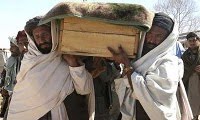
Afghanistan now will receive primary focus, a shift illustrated in today's introduction of the photo of an Afghan funeral above right (credit), which replaces the Iraqi photo we long have used. And though counts on Pakistan are not readily available, news from that theater of combat will be included as appropriate. In the absence of any Afghanistan-related site like Iraq Body Count, available civilian casualty figures from UNAMA, the U.N. Assistance Mission in Afghanistan, will be provided.
And so, here's the casualty count since our post 5 weeks ago:
► According to ¶ 54 of the September 22, 2009, Report of U.N. Secretary-General Ban Ki-moon to the Security Council, entitled "The situation in Afghanistan and its implications for international peace and security," UNAMA
recorded 1,500 civilian casualties between January and August, with August being the deadliest month since the beginning of 2009. These figures reflect an increasing trend in insecurity over recent months and in elections-related violence. Almost three times as many civilian deaths (68 per cent) were attributed to anti-Government elements activities than to pro-Government forces (23 per cent). As detailed in the UNAMA mid-year bulletin on the protection of civilians in armed conflict, the most deadly tactics used and which accounted for the largest number of
civilian casualties in the conflict to date were attributable to planted improvised explosive devices, and suicide attacks carried out by anti-Government elements accounted for 39.5 per cent of fatalities. Air strikes by pro-Government forces accounted for 20 per cent of fatalities.
Meanwhile, the U.S. Department of Defense reports that coalition military casualties in Afghanistan stand at 929 Americans, 236 Britons, and 367 other coalition servicemembers. That's an increase of 43, 14, and 6 casualties, respectively, in the last 5 weeks. The total coalition casualty count in the Afghanistan conflict is 1,532 service women and men.
► Respecting the conflict in Iraq, Iraq Body Count reports that between 94,332 and 102,932 Iraqi women, children, and men have died in the conflict in Iraq since the U.S.-led invasion in March 2003, representing an increase of between 760 and 836 deaths in the last 5 weeks. According to the U.S. Defense Department, 4,367 American servicemembers have been killed in Iraq, representing 16 servicemember deaths in the last 5 weeks. (As posted, U.S. troops are the only foreign forces remaining in Iraq.)

A strategy of gender fundamentalism in Afghanistan?

(It's our great pleasure to welcome IntLawGrrls alumna Penelope Andrews, who contributes this guest post on a critical issue also addressed in today's post just below it)

As President Barack Obama prepares to give a speech this Tuesday on his administration's strategy going forward in Afghanistan, it's time to ask what role the cause of women in Afghanistan should play in reaching this decision. It's not evident that any of President Obama's advisors are giving any weight to the cause of women as a relevant factor in determining future strategy in Afghanistan.
Eight years is a long time for the prosecution of a major international war. It is therefore appropriate to ask:
What has been achieved in the cause for women and their status in Afghanistan's life?
Undeniably, there have been a few notable gains, such as the increasing number of girls who now attend school, and the presence of some female parliamentarians. But for the most part the fundamental gains required for Afghan women to achieve full citizenship have not transpired. Women continue to remain hostage to President Hamid Karzai’s equivocation and compromises -- as well as to the authoritarian traditions of warlords who support, and are supported by, President Karzai.
► from U.S. and NATO forces who drop bombs on them or raid their homes and detain indefinitely family members;
► to an unrelenting reign of terror from the Taliban groups who persist in their strategy of denying women basic rights and who act to undo the few gains and rights that Afghan women have in the interim obtained or may gain;
► to violence committed by warlords inflicting harsh punishments on women and seeking to confine them to traditional roles.
When it comes to women, the war has been another disaster, and has obscured both the continuing denial of their civil and political rights and the deleterious impact of that denial. Women's hopes, raised during the early days of the invasion, have turned into a poignant despair. With the warlords and the Taliban controlling about ninety percent of Afghanistan, it's not surprising to hear, as one notable Afghan women activist put it, that the invasion has led to “no positive change” regarding the situation of women. (credit for Office of U.N. High Commissioner of Refugees photo of Afghan women)
Given these conditions, a key issue is to provide for the basic rights of women. Given past experience, there is no reason to believe that sending more troops will secure this goal. Can this aim be achieved through negotiations and reduction of violence? That is where the focus should be, not on adding more troops to wage war. Moreover, securing the rights of women is probably the best way to aid Afghanistan's indigenous democracy.
To be sure, the Taliban in the past has been chronically against women's rights, but could the United Nations broker an agreement whereby the war would be ended in exchange for a guarantee by the Taliban and the Karzai government to respect and promote women's rights?What exactly would this entail? First, the international community, through the United Nations, should adopt a policy akin to a zero tolerance approach to the pursuit of gender equality and the eradication of violence against women, a gender fundamentalism if you will. This means that women’s equality, along with the campaign to provide democracy, would be the raison d’être for international engagement.
This must be the commitment of the international community. The role and status of women would become an important measure of the achievement of democracy in Afghanistan, perhaps a harbinger of democracy.

(A longer version of this post appears at this month's issue of Asian Currents, the e-bulletin of the Asian Studies Association of Australia, the country where Penny's taken up a Chair in Law at La Trobe University)

... and counting ...

(Occasional sobering thoughts.) U.S. Senator Dianne Feinstein (D-Calif.) (below left) said this yesterday about the ongoing NATO role in Afghanistan:

'My view is that the mission has to be very clear. I believe it is not now. ... I don’t believe we can build a democratic state in Afghanistan. I believe it will remain a tribal entity.'
Not encouraging words from the Chair of the Senate Select Committee on Intelligence. But not much of a surprise, either, given recent news from that Central Asian country:
► An airstrike 10 days ago is said to have killed as many as 90 persons near Kunduz, and though it is hard to say how many were "militants," it is known that among the injured was a 10-year-old boy. NATO is investigating the decision to strike of German troops, who place the death toll closer to 50. In Berlin yesterday, Chancellor Angela Merkel (below right) promised "full clarification," "and expressed regret for possible civilian casualties, stating as parliament renewed debate regarding Germany's ongoing involvement:
'Every innocent person who is killed in Afghanistan is one too many.'
► The passage of 3 weeks since voting for President has yet to yield a winner, and tarnishing indications that incumbent, Hamid Karzai, will be the likely winner is a "chaotic count ... marred by allegations of widespread irregularities including phantom polling stations and stuffed ballot boxes."
As for Iraq, scattered violence persists even as the United States continues its plan to withdraw combat troops before next summer comes to an end.
With all this in mind, here's the casualty count since our post 6 weeks ago:
► Iraq Body Count reports that between 93,081 and 101,578 Iraqi women, children, and men have died in the conflict in Iraq since the U.S.-led invasion in March 2003, representing an increase of between 562 and 572 deaths in the last 6 weeks. According to the U.S. Defense Department, 4,343 American servicemembers have been killed in Iraq, representing 15 servicemember deaths in the last 6 weeks. (As posted, U.S. troops are the only foreign forces remaining in Iraq.)
► Respecting the conflict in Afghanistan, military casualties in Afghanistan stand at 830 Americans and 55 other coalition servicemembers. That's an increase of 67 and 37, respectively, in the last 6 weeks, and a total servicemember casualty count of 1,384.

On September 12

On this day in ...
... 2001, Article 5 of the North Atlantic Treaty of 1949 was invoked. It states:
The Parties agree that an armed attack against one or more of them in Europe or North America shall be considered an attack against them all and consequently they agree that, if such an armed attack occurs, each of them, in exercise of the right of individual or collective self-defence recognised by Article 51 of the Charter of the United Nations, will assist the Party or Parties so attacked by taking forthwith, individually and in concert with the other Parties, such action as it deems necessary, including the use of armed force, to restore and maintain the security of the North Atlantic area.
Any such armed attack and all measures taken as a result thereof shall immediately be reported to the Security Council. Such measures shall be terminated when the Security Council has taken the measures necessary to restore and maintain international peace and security.
Invocation meant that if the United States determined "foreign nationals" had committed the terrorist attacks of the previous day, "its 18 NATO partners" would support a military response, according to NATO Secretary-General George Robertson.

(Prior September 12 posts are here and here.)

2¢ on interrogation review

See the last item at The New York Times' "Room for Debate" for my thoughts on the news that, as foreseen by IntLawGrrl Beth Van Schaack, Attorney General Eric H. Holder, Jr. (left) has instructed Assistant U.S. Attorney John Durham to conduct a "preliminary review" of post-9/11 interrogations by the CIA to see whether U.S. law was violated. Prompting the order was release of a 2004 CIA report.
International criminal law point of comparison:
The 1999 "internal analysis," by the Office of the Prosecution at the International Criminal Tribunal for the former Yugoslavia, into whether NATO's air strikes against Serbia violated laws of war.


On June 30

On this day in ...
1984 (25 years ago today), Lillian Hellman (right) died in Tisbury, Massachusetts. The playwright's best-known works include The Children's Hour (1934), The Little Foxes (1941), and Toys in the Attic (1959). Throughout her career, Hellman openly held left-wing political views and was active in the campaign against the growth of fascism in Europe. As a result, she was subpoenaed to appear before the House Un-American Activities Committee in 1952. Pressured to reveal the names of associates in the theater who might have Communist associations, she refused:
'To hurt innocent people whom I knew many years ago in order to save myself is, to me, inhuman and indecent and dishonorable. I cannot and will not cut my conscience to fit this year's fashions, even though I long ago came to the conclusion that I was not a political person and could have no comfortable place in any political group.'
(credit for photo of paperback reissue of Hellman's 1969 memoir, An Unfinished Woman)
1992, Margaret Thatcher (below left) joined the House of Lords following the bestowal upon her of a life peerage. In 1959, Thatcher had been elected a Member of Parliament. She proceeded to become Britain's Prime Minister from 1979 to 1990 and a member of the House of Commons from 1990 to 1992. (photo credit) Thatcher used her appointment to the House of Lords to continue to make her views heard, particularly on European issues. In 1992, Thatcher called for the North Atlantic Treaty Organization to stop the Serbian assault on Goražde and Sarajevo as a means to end ethnic cleansing and to preserve the Bosnian state. She has also made a series of speeches criticizing the Maastricht Treaty.

(Prior June 30 posts are here and here.)

On June 9

On this day in ...
... 1909 (100 years ago today), 4 women rode out of New York City in a Maxwell touring car. "Forty-one driving days, 11 tires and 3,800 miles later they arrived in San Francisco, where they were met by a large fanfare celebration." Along the way the adventurers -- the driver, 22-year-old wife and mother Alice Huyler Ramsey, became the 1st woman ever to drive from coast-to-coast -- dealt with bad roads and weather, flat tires and car breakdowns, native Americans hunting jackrabbits and a posse of more recent settlers hunting an accused murderer. Ramsey described the trip in her book Veil, Duster, and Tire Iron (1961); she became the 1st woman to be inducted into the Automotive Hall of Fame in 2000. (credit for photo of Ramsey changing a tire during the 1909 sojourn)
... 1999 (10 years ago today), Serbia and NATO reached an agreement on Serb military withdrawal from Kosovo. Troops from the North Atlantic Treaty Organization had begun an intervention in the region in March of the same year. Today Kosovo is a nation-state recognized by some countries -- among them the United States, Christopher Dell just having been nominated as the 2d U.S. ambassador to Kosovo -- but not, by any means, by Serbia.

(Prior June 9 posts are here and here.)

On May 30

On this day ...
... 1967, Nigerian leader Yakubu Gowon, a military officer who'd taken control following a coup, decreed for the country as whole a new, federal administration. The announcement led 3 days later to the declaration of the independent state of Biafra (flag at right) in the southeast portion of Nigeria. Civil war raged for 30 months. At the end Biafra remained part of Nigeria, but at the cost of between 1 and 3 million lives.
... 1982, Spain became the 16th member of NATO, the North Atlantic Treaty Organization. The accession of post-Franco Spain (flag below left) marked the 1st addition to the NATO treaty regime since 1955, when the Federal Republic of Germany joined. Division within Spain continued even after accession, so that the question was put to a referendum in 1986. "With almost 60 percent of the electorate participating, 52.6 percent of the voters supported Spain's continued membership in NATO, while 39.8 percent opposed it"; thus Spain to this day remains a member of the alliance.

(Prior May 30 posts are here and here.)

On April 23

On this day in ...
... 1999 (10 years ago today), NATO defended the overnight bombing of Serbia's state television station, asserting that the building was a legitimate target and a "'ministry of lies.'" (photo credit) The Belgrade bombardment, reported to have caused 10 deaths and 18 injuries, was said to have been appropriate for the reason that the station gave propaganda support to the militaristic endeavors of Serbian President Slobodan Milosevic. Banković and Others v. Belgium and 16 Other Contracting States (1999), an application for relief filed by victims' survivors, was ruled inadmissible by the European Court of Human Rights. I've written about that decision in my article entitled Guantánamo.
... 2003, Cypriots were permitted to cross the "Green Line" that had separated the northern and southern portions of the island of Cyprus for nearly 3 decades. "The Turkish Cypriots announced ... that they were easing the restrictions to build confidence between the divided communities," the BBC reported. (map credit)

(Prior April 23 posts are here and here.)

On March 30

On this day in ...
... 1999 (10 years ago), reports were that Kosovo was in dire straits. Typical was a report for the U.S. Office of Foreign Disaster Assistance, which stated that: "All relief organizations have evacuated Kosovo at this time, including the International Committee of the Red Cross and Medecins Sans Frontieres (MSF), which had remained in Kosovo after the NATO bombing campaign" against Serbia began on March 24; that "[o]ver 100,000 people have been displaced from Kosovo since March 24"; and that surrounding areas, such as Albania and Macedonia, and even as far away as Bulgaria and Turkey, had swelled with Kosovar refugees.
... 2001, the administration of President George W. Bush "notified state Medicaid directors that Medicaid funds could not be used to cover RU-486, the so-called abortion pill, except in cases involving rape, incest, or when the life of the mother is in danger."

(Prior March 30 posts are here and here.)

On October 23

On this day in ...

... 1983 (25 years ago today), in the midst of civil war in Lebanon, bombs in Beirut devastated barracks of American and French armed forces, killing 241 American servicemembers, nearly all of them Marines, and 58 parachutistes. Although President Ronald Reagan "insist[ed] Marines will remain," the United States withdrew all troops from the country within months. (credit for photo of the President and 1st Lady Nancy Reagan reviewing caskets of U.S. troops who died in the bombing)

... 1989, in 1 country that had led movements in Eastern Europe away from the Warsaw Pact and toward market economies, Hungary became a republic by proclamation of interim President Mátyás Szűrös. The declaration came on the 33d anniversary of the unsuccessful uprising against Soviet control. Free elections would be held the following year. Hungary (flag at left) became a member of NATO in 1999 and of the European Union in 2004.

On August 11

On this day in ...
... 843 (1,165 years ago today), it is said (the exact date varies in various accounts), the Treaty of Verdun was concluded. With this treaty the 3 surviving sons of King Louis the Pious (778-840) settled a war among themselves by dividing the Holy Roman Empire once ruled by their grandfather, Charlemagne (circa 747-814). "[O]one of the most important treaties of Europe," the Verdun pact "laid the foundations for what would become the independent states of France and Germany."
... 2003 (5 years ago today), the North Atlantic Treaty Organization, better known as NATO, assumed "a leadership role in providing security in and around Kabul in Afghanistan, in what is the Alliance’s first mission beyond the Euro-Atlantic area." The conflict in that Central Asian country, begun in 2001 in response to terrorist attacks on New York and Washington on September 11 of that year, continues. IntLawGrrls tracks casualties and news about the conflict in our recurrent ...and counting... feature.
 
Bloggers Team