Showing posts with label same-sex marriage. Show all posts

On April 1

On this day in ...
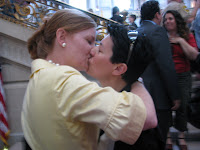
... 2001 (10 years ago today), Helene Faasen and Anne-Marie Thus (right), both notaries, were married at city hall in Amsterdam, the Netherlands. They became the world's 1st same-sex couple to be legally married. Both brides wore lacy gowns, one in white with veil, one in a creamier tone. (photo credit) Mothers of 10-year-old Nathan and 9-year-old Myrthle, the Maastricht couple celebrate their 10th wedding anniversary today.

(Prior April 1 posts are here, here, here, and here.)

Watch Prop 8 arguments live

From 10 a.m.-12:30 p.m. Pacific time today, a panel of the U.S. Court of Appeals for the Ninth Circuit will hear oral argument on a trial court's August ruling that California's ban on same-sex marriage violates the U.S. Constitution.
Attorneys will argue in San Francisco before Judges Michael Daly Hawkins, N. Randy Smith, and Stephen Reinhardt -- the last of the 3 having denied the motion to disqualify himself filed by proponents of the ban, contained in the state's Constitution as a result of voters' approval of a 2008 ballot initiative, Proposition 8 (prior IntLawGrrls posts available here).
The Ninth Circuit has decided to permit live dissemination of the arguments in the case, Perry v. Schwarzenegger. The court's decision gives rise to any number of ways to watch the arguments live:
► It'll be streamed into auditoriums at many law schools (including my home institution, the University of California, Davis, School of Law); and
► It'll be broadcast on C-SPAN.
The appeals court also has set up a web database on the case. Quick skimming of briefs available there indicates one good bet: whatever the panel should decide, it's unlikely to cite foreign law or practice, as no litigant appears to have mentioned any.

On October 1

On this day in ...
... 1989 (20 years ago today), Act No. 372 of June, 1989, to which the Danish monarch, Queen Margrethe II, had given royal assent, took effect. Thus was authorized the Denmark registered partnership, the world's 1st same sex civil union. It permits registration as long as 1 partner in the couple is a Danish national.

(Prior October 1 posts are here and here.)

D-Day: California's Proposition 8

In this case, D is for decision. And yesterday morning, the California Supreme Court made a big one: it ruled that Prop 8, the voter-approved initiative limiting marriage to a man and a woman, was a valid change to the California Constitution. (Prior IntLawGrrls posts available here.)(photo credit). While activists and disappointed LGBT people are taking to the streets in their hometowns and blowing up the social networking sites, it is worth pointing out that there is still hope after Strauss v. Horton.
Positively, the court held that:
► The fundamental constitutional rights of same-sex couples as previously announced by the court in In re Marriage Cases remained unchanged by Prop 8, which was narrow in that it only restricted the use of the term "marriage" to opposite sex couples.
► Prop 8 only applies prospectively; the 18,000 marriages that occurred prior to November 5, 2008, remain valid.
► The court did not decide whether same-sex couples that were lawfully married in other states would have their marriages recognized by the State of California.
In the aftermath of the otherwise disappointing decision, the key is to remember that this case was about "the scope of the right of the people, under the provisions of the California Constitution, to change or alter the state Constitution itself through the initiative process." The issue was not whether same-sex marriage should be legal in California. Of course, common sense says the two issues can hardly be separated, yet with our legal blinders, we can, and must separate such issues.
Ultimately, the decision is not fatal to same-sex marriage in California; it punts the issue back to the voters to decide whether to repeal Prop 8 in the same way it was passed, via ballot initiative, in the coming years. It also opens the door for a federal challenge, which is reportedly already underway. And for many Californians, it begs the question whether a clear revision to the state Constitution should be considered that would modify the state's initiative system.

On February 4

On this day in ...

... 2004 (5 years ago today), the state's highest tribunal, the Massachusetts Supreme Judicial Court, held that a bill that would have allowed same-sex civil unions did not meet the liberty and equality guarantees of the state's Constitution. In so doing the court reconfirmed its decision in Goodridge v. Department of Public Health (2003). The ruling paved the way for gay marriages. There'd been 10,000 as of mid-2008 -- among them the wedding at right of the original plaintiffs, Hillary and Julie Goodridge.
(image credit)

... 1985, on the 1st day it was opened for signature at U.N. headquarters in New York, 21 countries signed the Convention Against Torture and Other Cruel, Inhuman or Degrading Treatment or Punishment. The treaty, the scope and meaning of which have been hotly debated post-9/11, and entered into force on June 26, 1987. It now has 146 states parties -- among them, since 1994, the United States. (credit for 2008 map depicting all states parties in dark green, signatories in light green, and parties outside the CAT regime in grey)


International law @ AALS

Should International Law Professors Attend AALS?
That's the question posed in an Opinio Juris post last week. It continued:
I scan the program for the meager portions of international law that are served each year. This year is no different, and it is safe to say that one morning at the ASIL annual meeting is more fruitful for the international scholar than four days at AALS.*

Notwithstanding that note of pessimism, in the post our colleague Roger Alford proceeded to give some positive answers to his own question. On these latter he and I are in much agreement. Attending the annual meeting of the Association of American Law Schools last week at the San Diego Marriott (above right) offered a[n over]view -- in a literal as well as a figurative sense -- of the entire legal academy. That can be of use to all us international lawyers in this era of [over]specialization. And a look beyond labels, to the actual content of the program, showed there was much on offer.
Case in point:
I was lucky enough to attend a superb panel cosponsored by the Section on Constitutional Law and the Section on Africa. Entitled "Socio-Economic Rights: Comparative Perspectives and Criticisms," it featured a spirited discussion by Penelope Andrews (Valparaiso) (prior post), Richard A. Epstein (Chicago), Mark S. Kende (Drake), and Kim Lane Scheppele (Princeton), moderated by Miguel Schor (Suffolk). The exchange revealed that the once-deep division of opinion on such rights may be lessening -- that there may be a convergence to some middle ground, even as some judges in some national systems begin to implement modest enforcement of those rights. The overall effect of this development remains unclear. The discussion suggested, as Kende put it most provocatively:

Socioeconomic rights cases have not changed macroeconomic policies in the countries that have them. This debate might not much matter.

Neither of the sponsoring sections has the word "international" in its name. Nonetheless, as this précis makes evident, the panel offered much of interest for many an international lawyer. (Aside: The panel that the Section on Africa sponsored last year was equally pertinent and interesting.) Same too with a session at the same time on California's Proposition 8, a matter of great interest to IntLawGrrls (prior posts may be found here) and others concerned about human rights at home.
To talk only about programming, however, is to overlook AALS's key role in professional development. For many of us, presenting at an AALS meeting marked an early foray into public speaking about our scholarship. For many of us, AALS has offered an opportunity to network, to build a professional profile that extends beyond our home institution, to develop leadership skills applicable not only to AALS but to all our professional endeavors. Those offerings are important for internationalists no less than other law professors.
And so it gives great pleasure to announce, in sequential posts below, IntLawGrrls' contributions to last week's meeting and the new leadership of the AALS Section of International Law, for which yours truly has the honor to serve as Chair in 2009-2010.

Heartfelt kudos to all!

* This passage indicates there may be another source for Roger's discomfort. Might it be that the question to ponder is not whether a particular 4-day conference affords enough benefit to international law professors, but rather whether, in many instances in our 24/7 Century, there's enough benefit in conferences that span 4 days, or more (to which transcontinentals must add a day or 2 for travel)?


California marriage equality back in Court

'I think people are beginning to look at it differently, I know it’s happened for me. I started out not supporting it. The longer I’ve lived, the more I’ve seen the happiness of people, the stability that these commitments bring to a life. Many adopted children who would have ended up in foster care now have good solid homes and are brought up learning the difference between right and wrong. It’s a very positive thing.'

-- U.S. Sen. Dianne Feinstein (D-Cal.), quoted yesterday in Maureen Dowd's column. Feinstein (above right) was among the precious few high-ranking politicians who cut a television ad against Proposition 8, the ballot initiative that aimed to limit marriage in California to opposite-sex couples. (Prior posts here and here.)
Prop 8 passed by a margin of 52.1% to 47.9%. But it remains to be seen whether it will take effect. The California Supreme Court (below) has agreed by this order to hear petitions contending that the simple-majority-rules initiative process cannot be used to take a fundamental right like marriage away from a group that the Court has declared a suspect class -- as the Court did for same-sex couples in In re Marriage Cases (May 2008) (prior post). Invoking the Equal Protection Clause, petitioners argue that the only way to effect such a deprivation is by the state's more cumbersome, super-majority-needed "revision" process.
Throughout the course of this new round of litigation, filings by litigants and the many amici curiae may be found here.

I Voted!

This is the one I've been waiting for.
That phrase kept going through my head yesterday as I cast my ballot in the general election.
Yes, yesterday.
Though the media often refer to the November 4 election, in many states voting's been under way for a week or more.
And so my husband, son, and I traveled to the Oakland basement office of the Alameda County Registrar of Voters yesterday afternoon. It was near closing time on a quasi-holiday (Columbus Day, which morphed into Indigenous Peoples Day out here, before schools quelled the debate, about which IntLawGrrls just posted, by giving children off on account of a "teachers' in-service day"). Nonetheless, in the time we were there, more than half a dozen others showed up to cast their votes.
Most touching were the older folks. Eyes adance, their smiles said they could not wait another 22 days to try to make history. Nor could we.
Loyal blogreaders will know that I voted for Sen. Barack Obama for President, and No on Proposition 8. Oh, and No on Proposition 4, the parental-notification initiative about which I commented in yesterday's Sacramento Bee.
Now's your turn to register your preferences. For voting details -- registration deadlines, early and absentee voting, pollwatching (a public service that early voting frees you to do) -- contact your own county Registrar of Voters or Secretary of State. Or check out websites like these: the League of Women Voters. Rock the Vote. Vote for Change.

'Nuff said

(Occasional item taking context-optional note of thought-provoking quotes)

[T]he relatively modest political influence that gay persons possess is insufficient to rectify the invidious discrimination to which they have been subjected for so long. Like the political gains that women had made prior to their recognition as a quasi-suspect class, the political advances that gay persons have attained afford them inadequate protection, standing alone, in view of the deep-seated and pernicious nature of the prejudice and antipathy that they continue to face.

--Justice Richard N. Palmer, in Kerrigan v. Commissioner of Public Health, the judgment, released yesterday, in which the Connecticut Supreme Court ruled 4-3 that the equal protection guarantee of the state's Constitution requires that same-sex couples be granted equal marriage rights as opposite-sex couples.

(credit for photo of two plaintiffs)

Pope not gay over French proposal

Europe's witness these days to a fascinating diplomatic dance:
Pope Benedict XVI has rejected 2 consecutive nominees to be France's Ambassador to the Holy See. It's a most delicate matter -- the Paris daily Le Figaro will say only that the 2d nominee, long-time French diplomat Jean-Loup Kuhn-Delforge, was rebuffed "by reason of his 'personal profile.'"
What gives?
France's having trouble finding a suitable candidate who is neither divorced nor gay.
The former adjective describes the 1st nominee, a writer who is married to his 3d wife. The latter describes Kuhn-Delforge, who lives openly with his male partner.
In the late '80s a divorcé represented Spain at the Vatican, but apparently neither Pope John Paul II nor Spain itself knew the ambassador's status. In any event one suspects this Pope wouldn't listen to claims of precedent.
Listened to or not, France does seem to be signaling its view of 21st Century values -- a most interesting message from a country where the President just married for the 3d time; civil unions of same- as well as opposite-sex couples have been recognized for years; and more than 80 percent of the population "identify themselves as Catholic."


California Supreme Court makes human rights history

Yesterday, California joined the ranks of six other jurisdictions around the globe that permit same-sex couples to marry, including: Belgium, Canada, Massachusetts (USA), the Netherlands, South Africa, and Spain.
In so doing, the California Supreme Court took a leap in equal protection jurisprudence that few courts in the United States have been willing to make – that laws making distinctions based on sexual orientation deserve review under the strict scrutiny standard (generally reserved for "suspect classes" like race, sex, or religion). The California Supreme Court considered that gays and lesbians already had access to statutorily created domestic partnerships, which provided many of the same rights and obligations as marriage, but nonetheless decided (p. 9) that

the current California statutes . . . must be viewed as potentially impinging upon a same-sex couple’s constitutional right to marry under the California Constitution.

This fundamental right to marriage, the Court wrote (p. 7), is protected by the California Constitution, which

must be interpreted to guarantee this basic civil right to all Californians, whether gay or heterosexual, and to same-sex couples as well as to opposite-sex couples.

The ruling was met with great enthusiasm. Political leaders, activists, and ordinary citizens gathered at San Francisco City Hall to celebrate the news. Gay and lesbian organizations throughout the state celebrated. The gatherings were marked by laughter and tears of joy. In thirty days, the Court-required waiting period, many of the revelers will be joined in the first truly legal, state-sanctioned marriages between people of the same sex in California.
But gay rights opponents have been anticipating this decision, and the Secretary of State is currently reviewing signatures to determine whether a ballot measure to change the California Constitution to limit marriage to unions between one man and one woman will be voted upon in November. But in the meantime, gay couples are not deterred, and are already planning their weddings. This is one step in the global movement of gay rights as human rights. And marriage is just the tip of the iceberg. While marriage bills are also currently being debated in Norway and Sweden, the past year has brought big changes, including the European Court of Human Rights’ decision in E.B. v. France that Council of Europe States may not discriminate against gays and lesbians in adoption proceedings. But the struggle for gay rights is far from over, as in many countries around the world, gays and lesbians “face violence and inequality – and sometimes torture, even execution” because of their sexual orientation.
But each victory counts, and there can be no denying it, yesterday the California Supreme Court made human rights history!

(All photos © Kathleen Doty)

News flash: California statutes prohibiting same-sex marriages ruled unconstitutional

The California Supreme Court, by a vote of 4-3, today held that the state's same-sex marriage ban violates California's Constitution.
Judgment here; an IntLawGrrls prior post on California's history on the issue here.

Path to adoption eased in Europe

By a 10-7 margin the Grand Chamber of the European Court of Human Rights has ruled that France's refusal to permit a lesbian from adopting a child violated Europe's Convention on Human Rights.
E.B., a teacher in France's national nursery school system, had been in a longterm relationship with R, a psychologist. After the Conseil d'Etat refused to grant E.B. an authorization to adopt -- France reasoned that the child would suffer from lack of a "paternal referent," E.B. sought relief from the ECHR.
The Court ordered France to pay E.B. 10,000€ plus 14,528€ for court costs, finding violations of 2 provisions of the Convention, which is binding on all 47 member states of the Council of Europe:
► Article 8, freedom of interference with private and family life. On this, the Court wrote in ¶ 43 (citations omitted) that it had

previously held that the notion of “private life” ... is a broad concept which encompasses, inter alia, the right to establish and develop relationships with other human beings, the right to “personal development” or the right to self-determination as such. It encompasses elements such as names, gender identification, sexual orientation and sexual life, which fall within the personal sphere..., and the right to respect for both the decisions to have and not to have a child.

► Article 14, freedom from discrimination -- this was held to apply even though the provision does not explicitly protect individuals from discrimination on account of sexual orientation.
Voting with the majority in favor of E.B. were Judges: Nicolas Bratza, ECHR Vice President (Britain); Peer Lorenzen (Denmark); Françoise Tulkens (Belgium); Ireneu Cabral Barreto (Portugal); Elisabeth Steiner (Austria); Elisabet Fura-Sandström (Sweden); Egbert Myjer (Netherlands); Dragoljub Popović (Serbia); and Sverre Erik Jebens (Norway). Dissenting were Judges: Jean-Paul Costa, ECHR President (France); Boštjan Zupančič (Slovenia); Loukis Loucaides (Cyprus); Antonella Mularoni (San Marino); Riza Türmen (Turkey); Mindia Ugrekhelidze (Georgia); and Danutė Jočienė (Lithuania).
Even as a spokesman for France's Association of Gay and Lesbian Parents (logo on balloon in photo) rejoiced that "'homosexuals would no longer have to hide themselves in order to adopt,'" gays and lesbians in Belgium warned against premature celebration. Le Monde reported: "Their reservations can be explained by a stark observation: in their country, where homosexuals have not only the right to marry but also, since May 2006, to adopt, not one couple has managed to open a file for international adoption. Belgium's 2006 law, they said, is an "'empty vessel.'"

On December 15, ...

.... 2005, legislators of Latvia gave constitutional status to a statutory ban on same-sex marriage. Criticized by many of the country's leaders, the change came in the wake of altercations waged by opponents during the country's 1st gay pride march, which occurred in summer 2005.
... 2007 (today), the United States marks Bill of Rights Day, in recognition that on this date in 1791 the Bill (right) entered into force. In 1941, on the 150th anniversary of this date, Franklin D. Roosevelt proclaimed the day. The Bill of Rights is comprised of the 1st 10 amendments to the Constitution; its contents have served as a normative source for many subsequent national constitutions and international human rights instruments.

On November 15, ...

... 1941, Nazi leader Adolf Hitler issued a decree by which members of the security forces who engaged in homosexual conduct were subject to execution or imprisonment. The decree was extended to all males within months, part of a program of persecution, by death and consignment to concentration camps, during the Nazi regime.
... 1999, France enacted the law creating the Pacte civil de solidarité, or PACS, which permits civil unions between couples, of opposite sex and same sex alike.
... 1951, U.S. Rep. Ellen Tauscher (D-Cal.) was born in Newark, New Jersey.

On June 30, ...

... 2005, legislators enacted a law legalizing same-sex marriage in Spain. The move tracked similar developments in Belgium, the Netherlands, and Canada.
... 1868, Mabel Cratty was born in Bellaire, Ohio. A public school teacher for several years after her graduation from Ohio Wesleyan University, eventually she turned to social work. In 1906 Cratty became General Secretary (the title of the time for what now is called an Executive Director) of the Young Women's Christian Association. She would hold the YWCA post until her death from pneumonia 22 years later. By then, Cratty "directed the work of 110 women secretaries in thirteen foreign countries and the 1,300 associations in the United States, with a membership of more than 600,000." (YWCA illustration by Neysa Moran McMein courtesy of Library of Congress)
 
Bloggers Team