Showing posts with label Philip C. Jessup. Show all posts

Guest Blogger: Rebecca Young

It's IntLawGrrls' great pleasure to welcome Rebecca Young (left) as today's guest blogger.
Rebecca is currently an Associate Legal Adviser within the Presidency of the International Criminal Court. She has previously interned with South Africa’s Legal Resources Centre.
She completed her Honours Bachelor of Laws at the University of Adelaide in 2006, and was awarded the RBS Scots-Australian Council Postgraduate Council Scholarship to complete her Masters of International Law at the University of Edinburgh in 2009. At Edinburgh she was awarded both the T.B. Smith Prize for the most distinguished LL.M. Scholar and the W.A. Wilson Prize for the best dissertation in international law.
In her guest post below, Rebecca outlines her article, just published in the International Criminal Law Review, on victim groups and genocide (It's an issue on which IntLawGrrl Beth Van Schaack's also written, here, as well as yours truly, here.) Rebecca's work in international criminal law and international human rights law also has appeared in the Australian International Law Journal and the Edinburgh Student Law Review.
Rebecca reports that her passion for international law was inspired by her participation, while still an undergraduate, in the Philip C. Jessup International Law Moot Court Competition, about which another onetime participant, IntLawGrrl Kathleen A. Doty, also has posted.

Heartfelt welcome!

Guest Blogger: Amanda Sherwood

It's IntLawGrrls' great pleasure to welcome Amanda Sherwood (left) as a guest blogger.
Amanda recently received her J.D. degree from the University of California, Davis, School of Law, where it was this 'Grrl's privilege to have had her as a student, and where she was an active participant in the Jessup International Law Moot Court Competition and the Trial Practice Honors Board. Last summer, Amanda served as an intern at the Center for Justice & Accountability, the San Francisco-based nongovernmental organization of which IntLawGrrls guest/alumna Pamela Merchant is Executive Director. At CJA Amanda contributed to the litigation of Samantar v. Yousuf, then pending before the U.S. Supreme Court. In her guest post below, Amanda discusses the unanimous decision issued by the Court just last week.
After earning her B.A. degree in French from Whitman College in Walla Walla, Washington, Amanda worked as an English teacher in France. She reports that while she enjoyed the camembert and baguettes, she decided to return Stateside in order to pursue a career path that would allow her to seek justice for others. To that end, having completed her law studies, Amanda is preparing to take the California bar exam, and looking forward a career in international human rights and/or victim advocacy.
Heartfelt welcome!

Shocked, shocked

Casablanca's Captain Renault (below) would have put it this way*:

I'm shocked, shocked to find that an expert in transnational law might advise the State Department!

That in a nutshell is how 3 National Review Online bloggers attacked Harold Hongu Koh the day after his nomination to become State's Legal Adviser.
Koh, as we posted yesterday, is the Dean and Gerard C. & Bernice Latrobe Smith Professor of International Law at Yale Law School. His list of other achievements includes service as the Assistant Secretary of State for Democracy, Human Rights and Labor, as a member of the Secretary of State's Advisory Committee on Public International Law, and as an Attorney-Adviser in the Office of Legal Counsel at the Department of Justice.
Yet these 3 bloggers seem to see Dean Koh not as an accomplished and respected legal expert. He is, rather, a "transnationalist." And they mean that in a bad way.
One wrote:

Koh is a leading proponent of transnationalism, which would subordinate American national interests to perceived global interests. In his new post, Koh would be well positioned to turn his academic theories into reality—threatening severe damage to American sovereignty and subjecting American citizens to rule by a transnational elite of left-wing lawyers appointed to various international bodies.

In an apparent effort to signal a like-minded groundswell, that post then pointed the reader to posts by 2 others -- without mentioning that all 3 appear on the same NRO site.
One post stated that the Constitution by its own terms, and not a treaty, is the supreme law of the land. Given that this is a given for any international lawyer operating within the framework of U.S. law, the effort to use the principle as a trump card against transnationalism confounds the reader. So too the suggestion that a state's sovereignty is "sapped" simply because the state engages in consensual cooperation with other sovereign states.
As for these bloggers' "T" word (not "torture," which Koh has condemned in no uncertain terms, but rather "transnationalism"):
It is no novel idea, but rather a concept that traces to lectures published a half-century ago by Dr. Philip C. Jessup, himself an American diplomat, scholar, and judge. Jessup's 1956 insight was about reality, not theory. He observed that the categories of private and public law were blurring, and that law increasingly was crossing borders. "Transnational" law was worth study for the simple reason that it trained attorneys to spot these developments and thus to adapt their practice, to make choices of law. Koh's work -- including his co-authorship of a casebook containing judgments that illustrated these developments -- built upon this recognition of the world as it is.
In essence these 3 bloggers thus claim that expertise in the real world of law disqualifies someone from advising our government about the law.
Now that is shocking.


* Forgive the transnational cultural reference to the utterance of a French officer played by an English-born naturalized American in an American-made movie set in Morocco during a global war in which America won a leading role.

Notes from "The Jessup"

A few weeks ago, I had the opportunity to travel to Washington D.C. to compete in the Philip C. Jessup International Law Moot Court Competition. Joined by students on over 100 teams from 80 countries, it was truly an incredible experience shared by all.
The Jessup Competition originated at Harvard Law School in 1960, with American students arguing against foreign LLM students on the topic of Cuban Agrarian Reform. The Competition quickly internationalized, and now over 120 countries and special jurisdictions have sent teams to participate. It is currently administered by the International Law Students Association (ILSA).
Use of force in response to international terrorism was the subject of this year’s problem. Set around a series of attacks that spawned the victim nation to violate the territorial sovereignty of a neighboring state to apprehend the suspects, later subjecting them to detention and questionable treatment, and ultimately trial by military commission, the questions were challenging to say the least. Students considered the interplay between humanitarian and human rights law -- testing the bounds and applicability of the Geneva Conventions to terrorist activities, as well as the reach of the Convention Against Torture and the International Covenant on Civil and Political Rights.
I had the pleasure of facing off against teams from Iceland, India, Mexico, and the United States. I especially respect the international teams for arguing flawlessly in English, which for many of them is a second (or third or fourth) language. The two finalist teams in this year’s competition were Case Western Reserve University of the United States and the University of New South Wales of Australia. Both teams, each of which fielded one female oralist, argued beautifully. In a close decision, Case Western won the Jessup Cup.
The Jessup is more than a moot court competition, however. It is a wonderful way to meet students and practitioners from every corner of the globe interested in international law. To this end, the Jessup provides ample social events, including the “Go National Ball” to which attendees come dressed in their traditional national attire, parties in D.C. clubs, and a formal gala at the close of the event. By the end of the week, I think it’s safe to say we were all friends and colleagues, not competitors.
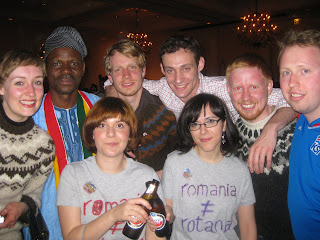
Participants were also invited to attend the ILSA and ASIL conferences that were held during the same week – a great way to learn about the hottest issues in international law.
Jessup participants tend to be a loyal, if not a fanatical bunch. “Friends of the Jessup” describe the experience as creating a “fraternity of legal professionals, new and old, converged to build bonds and share an invaluable cultural and academic exchange.” I have to say I agree. Groups are popping up all over Facebook with themes like “Free Samara Penza” (the fictional leader of the alleged terrorist organization in this year’s problem). I am online “friends” with hundreds of other Jessup participants.
But perhaps the most important take-away from this year’s competition is that there are now thousands of soon-to-be practicing attorneys all over the world well-versed in the legal issues surrounding the War on Terror. This new generation of lawyers, although from incredibly diverse backgrounds and with divergent political views, are competent to uphold the rule of international law, despite the threats each of their nations may face. Irrespective of competition results, that in itself is a huge achievement.

Northern California's own Fantastic 4

Kudos to Sumaira Arastu, Michael Djavakhyan, Kathleen Doty, and Jimmy McBirney, the advocacy team that dazzled judges in Santa Clara this weekend to win the Western Super-Regional round of the Philip C. Jessup International Law Moot Court Competition!
Am proud to have had the honor a couple weeks ago of mooting this Fantastic 4, all students at my home institution, the University of California, Davis, School of Law (Martin Luther King, Jr., Hall). They're now preparing for the "world championship Shearman & Sterling International Rounds" April 6-12, 2008, at the Fairmont Hotel in Washington, D.C. -- same time and place at this year's annual meeting of the American Society of International Law. ASIL's a cosponsor of this tournament, founded 49 years ago in honor of Philip Caryl Jessup (1897–1986), whose lifetime of work in international law included a decade of service as a judge on the International Court of Justice. It's a model ICJ, of course, before which Jessup competitors present their arguments. Other cosponsors include the International Law Students Association, the American Branch of the International Law Association, and the American Bar Association Section of International Law.
What propelled Sumaira, Michael, Kate, and Jimmy to victory? How did they master an incredibly complex problem of international and transnational criminal law? Sorry, dare not give away secrets mid-contest.
Heartfelt congratulations, and best of luck to all who'll compete in D.C. next month!
 
Bloggers Team