Showing posts with label extradition. Show all posts

International Law & WikiLeaks

(Delighted to welcome back alumna Mary Ellen O’Connell (below right), who contributes this guest post on release of classified documents by WikiLeaks, an issue on which alumna Patricia M. Wald posted yesterday)

I generally share Judge Wald’s critical view of WikiLeaks’ action.
In thinking about the matter from the perspective of international law, so far I see three areas of special interest:

1. Prosecution
State Department Legal Adviser Harold Koh, Attorney General Eric Holder, Secretary of State Hillary Clinton, and others have all discussed prosecuting “those responsible” for the document dump. The main figure associated with WikiLeaks is the Australian, Julian Assange. He is thought to be in hiding somewhere in Europe. Interpol has issued an international arrest warrant for Assange, to send him to Sweden to face questioning. I have seen no reports of a U.S. request for an international arrest warrant. (credit for logo of Interpol Red Notice)
My first thoughts in this episode have concerned on what basis Assange could be brought to the U.S. for prosecution. If he comes into Swedish custody, for example, and the United States then requests his extradition, NPR is reporting that the basis of criminal prosecution would likely be the Espionage Act. (See, e.g., 18 U.S.C. sec. 798 “Disclosure of Classified Information”.)
The Espionage Act seems to be narrowly drafted and to contain details that might well make it difficult to meet the requirements of U.S. extradition treaties.

2. Terrorism
Perhaps for the issues raised in Point 1, U.S. Rep. Peter King (R-N.Y.) is calling for WikiLeaks to be declared a terrorist organization? I wonder if Rep. King believes that declaring WikiLeaks a terrorist organization means that the U.S. will treat Assange as an “enemy combatant?” International law has no authority to support such assertions. We can hope that the administration will definitive reject them, and even reconsider other cases where criminal suspects are currently being treated as “enemy combatants.” (See my soon-to-be forthcoming article, “The Choice of Law Against Terrorism.”)

3. Diplomacy
We can further hope that this case will wake up governments around the world to greater vigilance on behalf of international law.
We should all be very concerned that certain Middle Eastern governments want to see military force used against Iran. There is no right to use military force against a state for the possession of even unlawful weapons. (See my “The Ban on the Bomb and Bombing, Iran, the U.S., and the International Law of Self-Defense”.) This is only one example. The documents are full of issues we in international law should be bringing to public awareness.
Ironically, in some cases involving the United States and non-compliance with international law, I wonder if governments are going to read the unflattering documents and either end cooperation or pressure the United States into ending non-compliant conduct? I have written about U.S. uses of military force in Yemen that conflict with international law. Is Yemeni President Ali Abdullah Saleh going to continue to cooperate in this after what has been said about him?
And, of course, all of us in international law need to be concerned about the attempt to steal private information concerning the Secretary-General of the United Nations.
The gratuitous gossip in some of the communications is also striking — it made me think of the Rolling Stone interview with General Stanley McChrystal. (prior IntLawGrrls post)
The WikiLeaks decision to release this material was reprehensible. Hopefully the right lessons will be learned from it with respect to the conduct of diplomacy and the goals of U.S. foreign policy.

Polanski Polemics

So there I was listening to the morning news in Paris when I heard that Roman Polanski (right), the director of Rosemary's Baby, Chinatown and The Pianist, had been arrested in Switzerland in response to a 30-year-old international warrant issued by the United States seeking to bring Polanski to trial for "having had sex" with a 13-year-old girl. The word "rape" was avoided; the focus was on the Swiss "treachery" of inviting Polanski to a film festival (to award him a prize) and then arresting him.
Then French politicos and "intellos" got into it, and got ugly when openly gay culture minister Fréderic Mitterand (nephew of former President François Mitterand) expressed his support for Polanski (as have many French intellectuals) and was attacked as a pedophile (based on his book La Mauvaise Vie, in which he tells of his encounters with young male Thai prostitutes). Various ministers and sub-ministers put in their 2 cents, then had to retract, and voilà! The "Polanski affair" became the "Mitterand affair." Meanwhile I'm thinking, "what about the girl?" Le Courrier International (a French Utne Reader), read my thoughts and rounded up some great articles from various papers around the world. In short, like several Italian terrorists of the 1970s, after fleeing the US, Polanski found refuge in France, where artistic geniuses may be indulged to the point of impunity. Thus the "Polanski affair" has renewed the Franco-American culture war: the French see the Americans as uptight Puritans overreacting to a man having sex with an adolescent girl, while the Americans see the French as a bunch of lascivious libertines (for a lighter take on the cross-cultural issue see this Doonesbury strip and keep clicking "next"). But as Brendan O'Neill points out in his "culture war" article, the case has also quite unfortunately become a war between victims: then 13-year-old Samantha Gailey, sedated, raped & sodomized by a 44-year-old man; and Polanski, a Holocaust victim--the holiest of victims, untouchable in guilt-ridden Europe because he has already suffered the unspeakable. Never mind that as one who has suffered, you'd think he be reticent to inflict suffering on others.
Missing from the polemic is any idea of justice: Polanski admitted his guilt back in '77, the issue now is how to repair the victim and punish the perpetrator more than 30 years after the crime. Ellen Snortland has a great suggestion: in her open letter to Polanski, she asks him to back her film on violence against girls and women, a sentence that would no doubt do more for society, and perhaps Polanski's rehabilitation, than locking him up. Meanwhile, as the intellectuals line up behind him, the Swiss are digging in their heels and refusing to release Polanski, who is fighting extradition.

On April 18

On this day in ...
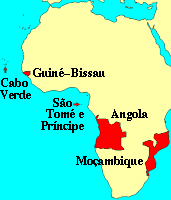
... 1961, in Casablanca, Morocco, national liberation groups in lusophone Africa (map credit) -- Angola, Cape Verde, Guinea-Bissau, Mozambique, and São Tomé and Príncipe -- joined together to form tThe Conference of Nationalist Organizations of the Portuguese Colonies, or CONCP. This a common front in opposition to Portuguese rule disbanded in the mid-1970s as the affected colonies won independence.
... 1988, a 3-judge Israeli court found John Demjanjuk guilty of war crimes that it ruled he had committed while a prison guard for the Nazis at the Treblinka death camp in Poland during World War II. (Prior IntLawGrrls post.) The capital case against the Ukraine-born man said once to have been known as "Ivan the Terrible" eventually was thrown out for lack of sufficient evidence, and the defendant then returned to the United States, where he'd worked in an Ohio car factory before retirement and before his 1986 extradition to Israel. Proceedings against him did not end, however; early in this month a U.S. immigration judge stayed a deportation order that if executed would result in the transport of Demjanjuk, now 89 years old, to Germany to face possible prosecution. Then, this Tuesday, the U.S. Court of Appeals for the Sixth Circuit issued an emergency stay pending review of Demjanjuk's challenge to transfer on grounds that he is too ill. (David Shankbone photo credit)

(Prior April 18 posts are here and here.)

Extradition silly season

For the 3d time in a month The New York Times has disserved readers interested in matters pertaining to international or transnational criminal law.
1st there was the uncritical puff piece on the unprecedented anonymity of the newly sworn-in bench of the Special Tribunal for Lebanon.
Then there was the uncritical call for unilateral air strikes against Sudan, without any consideration of whether international law might forbid the United States or any state from engaging in such use of force.
And now there is yesterday's uncritical story on Spain and 6 Bush Administration lawyers.
This IntLawGrrl had decided the day before the Times story appeared to write nothing on this at this time, for the reason that a close read of the Spanish media on which the story is based revealed little more than a leak of a trial balloon -- a tentative signal that a criminal investigation might be opened respecting these lawyers' involvement in U.S. interrogation abuses post-9/11. Unless things have changed radically in 2 days, Spain seems far from indicting anyone. The New York Times nonetheless chose to publish the names and photographs (perhaps better described as mugshots, given the nature of the photos chosen) of all 6.
But it's not that choice that galls. What galls is the 1st clause of paragraph 23 of the Times 25-paragraph story:

The United States, however, would be expected to ignore an extradition request for former officials, ....
This declaration, made without attribution -- without even the feint of an unnamed source -- is legal nonsense.
Extradition is a treaty-based process by which 2 nation-states promise to hand over fugitives upon request; this statement of promise in the U.S.-U.K. Extradition Treaty is typical:

ARTICLE 1
Obligation to Extradite
The Parties agree to extradite to each other, pursuant to the provisions of this Treaty, persons sought by the authorities in the Requesting State for trial or punishment for extraditable offenses.

Not every request will result in extradition, however. Such treaties often are quite detailed, and conditions for extradition vary from treaty to treaty. I have been unable to locate the text of the original and supplementary U.S.-Spain extradition treaties online. Still, certain common restrictions might well be part of the U.S.-Spain framework. For instance:
Double criminality: The offense for which the fugitive (called the "relator") is sought must have been, at the time it was allegedly committed, a felony under the laws of both countries.
Specialty: If extradited, the relator may be tried in the requesting country only for offenses properly named in the extradition request.
Political Offense: In some treaties, extradition will be blocked if the underlying offense is of a political nature.
Double Jeopardy/Ne Bis in Idem: There will be no extradition if the relator already has been tried for the same offense.
Hearing: The requested state typically will consider the relator's challenges to extradition, not only on factors like those above, but also on fundamental due process concerns, such as whether the person in custody is in fact the person sought for extradition, and whether the requesting state's statement of the bases for suspecting the relator of the stated offense is sufficient. In the United States such additional conditions are spelled out at Title 18, ch. 209 of the U.S. Code.
If the requesting state fails to meet all the requirements agreed upon in the extradition treaty and law, the requested state is fully justified in refusing the request.
Such a refusal, however, would fall far short of "ignoring" an extradition request, for it would have come after examination of the matter at hand; that is, only after the state had discharged its obligations under the extradition treaty to give due consideration both to its treaty partner's request for extradition and to the relator's challenges to same.
For the Times to suggest that the United States would do anything less evinces a lack of understanding about the law and casts innuendo where none is yet warranted.

Goodbye to "Get Out of Jail Free!" cards

There's much food for thought in the news of U.S. District Judge William M. Hoeveler's ruling that Gen. Manuel Antonio Noriega, due for release next week from U.S. federal prison, may be extradited to France, where he's been convicted in absentia of laundering proceeds from drug trafficking through French banks and the French real estate market.
There's the decision itself, of course:
Convicted of drug trafficking by a Miami-based jury in 1992, Noriega, de facto ruler of Panama at the time of his 1989 capture there by U.S. troops, enjoys, by judicial order, the status of a prisoner of war protected by the Third Geneva Convention. Hoeveler's decision hinged, therefore, on his conclusion that the Convention does not forbid transferring a POW to a 3d state for criminal trial. Noriega's attorney's said to be mulling "whether to challenge the ruling in the United States Court of Appeals for the 11th Circuit or with the United Nations." That last reference comes as a surprise. Can't think of any U.N. body that might be able to do anything enforceable in the matter except the Security Council, where, of course, the United States and France both have power to veto any such move.
And then there's the larger picture:
As more and more states reach outside their own territory to exercise criminal jurisdiction, it seems likely that the most notorious persons who suffer conviction and less-than-a-life-sentence in 1 sovereign state will look forward not to a final release date, but rather, on release, to a move to another jail in another sovereign state. Perhaps it's the ne bis in idem (that's double jeopardy, roughly speaking) overtones in this prospect that explain France's no-comment on the still-pending U.S. case -- as Reuters' Paris bureau put it, why France has made no official statement but instead "accepted the decision with prudence and discretion."
 
Bloggers Team