Showing posts with label civil party. Show all posts

On the Job! ECCC civil party lead lawyer

(On the Job! pays occasional notice to interesting intlaw job notices)

The United Nations Assistance to the Khmer Rouge Trials in Phnom Penh, Cambodia, is seeking a consultant to serve as International Civil Party Lead Co-Lawyer, a newly created position within the Civil Party Lead Co-Lawyers' Section of UNAKRT's Office of Administration.
The successful applicant will serve in tandem with a National Lead Co-Lawyer; they will have autonomy on substantive matters pertaining to civil parties. Specific Civil Party Lawyers will continue to represent specific civil parties before the Extraordinary Chambers in the Courts of Cambodia, and will support the Civil Party Lead Co-Lawyers. (As part of IntLawGrrls' ongoing Khmer Rouge accountability series, guest/alumna Sarah Thomas posted here about civil party participation at the ECCC).
As a general matter, the Lead Co-Lawyers will:
► Represent the interests of the consolidated group of Civil Parties, and
► Shoulder ultimate responsibility to the ECCC for the overall advocacy, strategy and in-court presentation of the interests of the consolidated group of civil parties, during the trial stage and beyond.
A detailed pdf account of expected duties and desired qualifications (among them, a minimum of 10 years' experience in the practice of criminal law and fluency in French or English) is available here.
The position is expected to be filled this year, before the beginning of the next ECCC trial, and to continue throughout appeals and conduct of any other proceedings. Deadline for applications is May 1, 2010.

Investigating criminal justice

Here's about all that many of us trained in the common law would have to say about our Continental counterpart:

Criminal procedure in civil law countries is inquisitorial. Dating back to the Code Napoléon of 1808, it features a juge d'instruction who both conducts police inquiries and issues judicial orders. The dominance of this investigating judge makes the inquisitorial system of the civil law entirely different from the accusatorial system of the common law.
But this comparative criminal law nutshell distorts reality.
That's in part because neither the inquisitorial nor the accusatorial method is any longer discrete. Rather,

aspects of each method now occur in the other to a degree that distinguishing the two 'is almost a "metaphysical question" which is now sterile and obsolete,'
as I wrote a while back (p. 833 n.144), quoting a chapter by Françoise Tulkens (left), then a law professor at Belgium's University of Louvain and since 1998 a Judge on the European Court of Human Rights, in The Criminal Process and Human Rights (1995).
The nutshell above is also distorted because even in France, the country that promulgated the Napoleonic Code, the investigating judge long ago lost considerable power. Our colleague Mireille Delmas-Marty (below left), Chair of Comparative Legal Studies & Internationalization of Law at the Collège de France and editor of the 1995 Criminal Process volume quoted above, traced this evolution in a recent Le Monde commentary. Her essay called into question aspects of a reform package put forward in March by a committee of jurists assembled last year by France's Minister of Justice, Rachida Dati (right).
Delmas-Marty noted that the juge d'instruction used to handle 40% of all criminal matters, "making him the most powerful man in France." No more. The juge's share dropped to 20% by 1960 and shrank to 8% by 1989. Today it's a measly 4% of all criminal matters.
Why the decrease?
Among the reasons, Delmas-Marty asserted, were reforms that increased the protections owed to persons under investigation. Even as those reforms were instituted, the prosecution gained more authority to act during the preliminary phases of a criminal case, and by means less cumbersome than those of the investigating judge. Examples of that new authority:
► Since 2007 victims seeking to pursue a criminal case via the partie civile mechanism were required first to address the prosecutor, not the juge. (Aside of note: Exercise of the power of investigating judges in Spain to pursue extraterritorial criminal investigations even in the face of opposition by the public prosecutor now faces resistance. As detailed here, here, and here, the Spanish government is working to require concrete jurisdictional links to Spain and "proof that no other national court system has taken up a given case" -- even as the most noted exerciser of extraterritorial criminal jurisdiction, Judge Baltasar Garzón, faces a misconduct inquiry related to an investigation into crimes during Spain's Franco era.)
► A bill that would effect domestic implementation of the Rome Statute of the International Criminal Court likewise gives the prosecution a "monopoly" over the pursuit of international crimes.
Thus did the French system shift toward an accusatorial method -- in Delmas-Marty's view, not in a good way. Prosecutorial power expanded even as fair-process safeguards retracted. The European human rights court wrote last summer in Medvedyev v. France that

the public prosecutor is not a 'competent legal authority' within the meaning the Court's case-law gives to that notion: as the applicants pointed out, he lacks the independence in respect of the executive to qualify as such.
In her commentary Delmas-Marty urged the following "re-equilibration of powers" as the current reform effort proceeds:
► Guarantees of independence and impartiality of the public prosecutor must be reinforced.
► Should the juge d'instruction be replaced with "a new 'judge of investigation and of liberties,'" as proposed, the granting to the latter judge of genuine power to supervise the public prosecutor throughout the course of investigation. Quoting Sorbonne Law Professor Geneviève Giudicelli-Delage, Delmas-Marty called for an "'optimum distance'" between the judge and the prosecution "because if the judge is placed too close he is blinded, but if he is too far away he is blind."
► Rights of the accused and the presumption of innocence must be strengthened by allowing for greater judicial oversight of prosecutorial action and for improvement of legal aid for the poor.
► Victims who wish to proceed as parties civiles should once again be permitted ask the judge directly to open a criminal investigation.
In words applicable to any system of criminal justice, Delmas-Marty concluded:
Whether it is a matter of the investigatory or the adjudicatory phase, it is not just technicalities, but also policy, that is at stake. The legitimate desire to simplify procedures and speed decisionmaking should not result in a power shift that works to the detriment of judges whose independence is guaranteed by the Constitution and to the benefit of a prosecutor who remains under the orders of the Minister of Justice.

Expanding Dialogue at the ECCC

The media is abuzz this week with news of the start of the trial of former Khmer Rouge leader Duch, which is the first trial to be held by the Extraordinary Chambers in the Courts of Cambodia. This is a momentous occasion, to be sure, and one to be celebrated as an opportunity for accountability and furtherance of the rule of law in Cambodia. Amidst the excitement, however, a smaller piece of news caught my eye: the Civil Parties' request that the Co-Prosecutors undertake further preliminary investigations into Duch's role in mandating forced marriages under the Khmer Rouge regime. (I received an electronic copy of the filing, but it's not yet been posted on the ECCC's website.) This seems to me potentially a great leap forward in expanding the dialogue about the shape of accountability in internationalized criminal courts in at least two directions.
First, the obvious -- the involvement of the Civil Parties in shaping the Co-Prosecutors' investigation, should it come to pass, would be an exciting turn of events. Rather than maintaining the Office of the Co-Prosecutors as the sole locus for selecting the direction of investigations, the voices of victims may actually have a role in determining the charges brought against defendants accused of mass atrocities. While a cynic might argue that it's the voices of the victims' lawyers, not the victims themselves, that are being heard, this potential inclusion of bottom-up input into the Khmer Rouge trials seems a step in the right direction.
Second, the transnational -- the Civil Parties grounded their request in a recent decision by the Appeals Chamber of the Special Court of Sierra Leone holding for the first time that forced marriage is a crime against humanity. While this precedent is obviously not binding on the ECCC, the Civil Parties' efforts to transport this new norm into the court's jurisprudence is an exciting horizontal development for internationalized criminal courts. As more courts accept new constructions of the definition of international crimes such as crimes against humanity from their peers, these new definitions will become an uncontroversial part of international criminal jurisprudence and even customary international law.
Third, the local -- the Civil Parties' submission is careful to distinguish between traditional Cambodian arranged marriages and forced marriage. Whatever one's view of arranged marriage, sensitivity to cultures that have traditionally embraced such unions seems appropriate, and may not have been present if the request for further investigations had been framed by individuals with less exposure to Cambodian society.
It is particularly striking to note that the vertical and horizontal expansion of dialogue in the ECCC could result in the cementing of a crime that's particularly gender-related. Though in Cambodia an estimated 400,000 men and women were victims of forced marriage, in most other instances (Sierra Leone, Rwanda, etc.), this is a crime perpetrated only against women. Adding it to the Co-Prosecutor's investigation would be a vital step in addressing the severe trauma inflicted by forced marriage and its resultant sexual crimes. Adding women's voices, and other voices that have too often been excluded, to international criminal prosecutions may just move the jurisprudence, from the bottom up, in a truly international direction.

Civil Party Participation at the ECCC

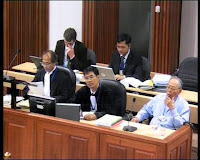
Drawing on French-inspired Cambodian criminal procedure, the Extraordinary Chambers in the Courts of Cambodia allows victims of the Khmer Rouge to participate directly in the proceedings as civil parties. Having worked with DC-Cam for nine months, I have had the opportunity to follow at first-hand the exciting developments in the area of victim participation. By and large, the Court has been very supportive of such participation. In a Decision of March 20th, for example, the Pre-Trial Chamber (pictured at right) adopted an expansive interpretation of the civil parties’ right to participate, stating that the Court’s Internal Rules are “clear in [their] wording that Civil Parties can participate in all criminal proceedings…” and that “Civil Parties have active rights to participate starting from the investigative stage…” (para. 36). Victims’ rights advocates welcomed this decision, hailing it a “landmark decision.”
Thus, it came as a surprise that, during the hearing on Ieng Sary’s appeal against provisional detention (pictured at left), the very same Pre-Trial Chamber recently established a worrying precedent for direct victim participation. On July 1st and 2nd, the Judges issued oral decisions prohibiting civil parties – whether represented or unrepresented – from speaking in person during pre-trial appeals. Based on a narrow provision failing to anticipate the participation of unrepresented civil parties, these decisions contradict the general principle that civil parties may participate without a lawyer. Internal Rule 23(7) provides that “[a]ny Victim participating in proceedings before the ECCC as a Civil Party has the right to be represented by a national lawyer, or a foreign lawyer in collaboration with a national lawyer…” Therefore, the Judges’ decisions were not in accordance with the Rules.
It appears that this sea change in the Chamber’s attitude can be attributed to multiple attempts by one civil party to speak during the proceedings. Worryingly, the Judges appear to have denied her requests based upon their disinclination to hear from her, rather than upon a correct reading of the Rules. The civil party in question (pictured at right) had already addressed the bench during an earlier hearing, using the opportunity to advertise a book! At the recent hearing, after the Judges denied her request to speak as a represented civil party, she promptly dismissed her lawyer and requested that she be heard as an unrepresented civil party. The Judges once again refused her request, seemingly irritated by her repeated attempts to speak. Eventually, she stormed out of the courtroom, vowing not to return until “[she has] a voice.”
Undoubtedly, the civil party raised an important issue regarding the direct participation of civil parties. Despite seeking to further victims’ rights, she has done victims a great disservice by demanding a robust scheme for civil party participation so early in the proceedings. Albeit limited to pre-trial appeals, unrepresented civil parties will now be precluded from speaking in person. The Judges had – until this time – adopted a very progressive approach. When, however, the civil party sought to force their hand, the Judges responded negatively, restricting opportunities for direct participation for all civil parties. As victim participation before internationalized tribunals remains in its nascent stage, civil parties and their lawyers should give greater consideration to the impact of their strategies so as to avoid exacerbating the Judges’ concerns about the disruption caused by the civil party procedure.

 
Bloggers Team