Showing posts with label Union Soldiers. Show all posts

New---Henry W. Slocum: The Now Not-So-Forgotten Union General

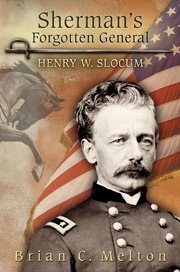
Sherman's Forgotten General: Henry W. Slocum, Brian C. Melton, Shades of Blue and Gray Series, Columbia: University of Missouri Press, 2007. xi + 292 pp. Illustrations, tables, notes, bibliography, index. $44.95 (cloth), ISBN 978-0-8262-1739-4.

Reviewed for H-CivWar by Gerald J. Prokopowicz, Department of History, East Carolina University

The Now Not-So-Forgotten Union General

In their quest to find something new to write about the battle of Gettysburg, Civil War authors have curiously overlooked the men commanding the seven infantry corps that comprised the bulk of the Army of the Potomac. Winfield Scott Hancock (II Corps) and Dan Sickles (III Corps) have been the subjects of excellent modern biographies, but John Reynolds (I Corps), George Sykes (V Corps), John Sedgwick (VI Corps), Oliver O. Howard (XI Corps), and until now Henry W. Slocum (XII Corps) have not received serious biographical treatment in the last forty or fifty years, if ever. With Brian Melton's solid biography of Henry Slocum now on the shelves, it's three down, four to go.

Civil War aficionados best remember Slocum, when he is remembered at all, for his role at Gettysburg, but Melton indicates in his title that there is more to the story. He begins by briefly tracing Slocum's prewar career, including graduation from West Point in 1852, resignation from the stagnant prewar army in 1856, and success as a businessman and investor in Syracuse. In 1858 Slocum was elected as an antislavery Republican to the state legislature, and was sufficiently prominent to receive a commission as colonel of the 27th N.Y. when war broke out in 1861. He received a wound at First Bull Run, was promoted to brigadier general, and subsequently led a brigade, division, corps, and wing of the Army of the Potomac. Two months after leading his troops on the field at Gettysburg, Slocum was transferred west with the XII Corps, to serve at Chattanooga under William T. Sherman and eventually in the march to the sea.

How could someone who participated at a high level of command in so many important campaigns be accurately described as a "forgotten general?" One reason is that Slocum left few documentary traces of his career. The author takes the reader into his confidence in a forthright introduction that reveals the difficulty of finding source material. There are no substantial collections of Slocum's papers, and historians have written little about him, with the exception of his role at Gettysburg.

A second reason Slocum has been forgotten is that he was something of a military chameleon, taking on the characteristics of whichever officer he happened to be serving under. In the Peninsula Campaign, he displayed a McClellan-like devotion to drill and pessimism about victory, as well as a tendency to overestimate the size of Confederate forces opposing him. He nonetheless did well enough in command of a division to earn a promotion to major general, and in the Antietam campaign his small but significant victory at Crampton's Gap brought him command of XII Corps. When McClellan was replaced by Ambrose Burnside, who was in turn replaced by Joe Hooker, Slocum tended to emulate his new leaders, in particular showing some of Hooker's battlefield aggressiveness as well as much of his penchant for army politics. Slocum considered Hooker a "worthless loafer" (p. 94) and a "braggadocio and drunkard," (p. 95) and after the battle of Chancellorsville he devoted himself to getting Hooker removed from command of the Army of the Potomac, just as Hooker had maneuvered to remove Burnside. Slocum's effort, like Hooker's, was successful; the army replaced Hooker with George Meade just before the battle of Gettysburg.

Slocum's performance at Gettysburg is the one moment in his career that has attracted substantial attention from historians, little of it favorable. In the late afternoon of July 1, 1863, he led the XII Corps onto the battlefield, too late to prevent the defeat of I and XI Corps. Melton argues that an acoustic shadow prevented Slocum from hearing the sounds of battle clearly, and that in any case he delayed his march at Two Taverns only for a few hours, not a whole day as some detractors of "General Slow-come" have written. Melton convincingly defends Slocum against charges of sloth or cowardice, but acknowledges that his cautious advance reflected the continuing influence of McClellan's command style. On July 2, Slocum executed Meade's ill-judged order to reinforce the Union left wing by moving almost all of XII Corps away from the army's right flank, leaving it dangerously exposed, another move for which historians have blamed Slocum. Melton's explanation of Slocum's performance verges on the kind of Monday morning quarterbacking that fills the pages of too many traditional Civil War military histories, but does effectively exonerate him by showing both that he was following Meade's orders, and that by the end of the day he had returned to Culp's Hill and stabilized the situation.

When the XI and XII Corps received orders to transfer to Tennessee in September 1863 under the command of Joe Hooker, the move put Slocum once again under his old enemy. Both generals complained to Lincoln, until Slocum was finally given a new assignment as the military administrator of Vicksburg, Mississippi. Not until Hooker resigned in a fit of pique at the height of the Atlanta campaign was Slocum recalled to his old corps. Serving under Sherman, Slocum again adapted to his environment and became a proponent of a hard war against Southern property. He led the left wing of Sherman's army on the March to the Sea, by far the largest force he had commanded.

After the war, Slocum again served as a military administrator in Mississippi, where he zealously enforced the rights of the recently freed former slaves, but his political sympathies were evolving toward his former foes. He resigned from the army in September 1865 and joined the Democratic Party, effectively committing what Melton describes as "political suicide." He spent the rest of his life in Brooklyn, where he was involved with the construction of the famous bridge named after the city, and served a term in Congress, but for the most part he simply faded away, overlooked by Republican historians and journalists who wrote him out of their accounts of the war because of his political defection afterward. Melton's sturdy biography may not be enough alone to rescue Henry Slocum from the fate of being "Sherman's forgotten general," but in taking the focus away from Slocum's moment at Gettysburg, it at least reminds the reader that there was much more to his career.
Source
: H-NET BOOK REVIEW, Published by H-CivWar@h-net.msu.edu (May 2008)
www.h-net.org/~civwar/

Copyright (c) 2008 by H-Net, all rights reserved. H-Net permits
the redistribution and reprinting of this work for nonprofit,
educational purposes, with full and accurate attribution to the
author, web location, date of publication, originating list, and
H-Net: Humanities & Social Sciences Online.

Photos: Top--Library of Congress, Bottom--University of Missouri Press

New---True Sons of the Republic: Europeans Fighting for the Union


True Sons of the Republic: European Immigrants in the Union Army, Martin W. Öfele, Praeger/Greenwood Publishing, 240 pp., photos, notes, bibliography, $49.95.

Up to 500,000 Union soldiers, or one fourth of the Union army, had been born in Europe. These immigrants had left their home countries for a multitude of reasons, mostly economic and political. In the United States, they envisioned a country of freedom that would allow them to pursue their goals of acquiring wealth and participating in politics. Soon immersed in the great debate over the expansion of slavery, many immigrants found themselves forced to take sides and eventually rallied around the Union flag. Ethnic Americans joined the Northern army out of the same motivations as their native-born comrades, with one notable difference. By defending the Union, immigrant volunteers hoped to tear down nativist obstruction against their assimilation into society and prove their worth as full citizens.

Declaring their unconditional loyalty, several groups entered into veritable competitions to raise separate regiments that would defend not only the Union but ethnic and national pride. Through their high visibility within the army, those units became synonymous with the ethnic war effort. The conduct of noticeable organizations such as the Irish Brigade or the partly German Eleventh Army Corps shaped public notions of immigrant participation in the war for decades to come, notwithstanding the fact that the large majority of foreign-born soldiers served in mixed and predominantly native American regiments. These new Americans contributed substantially to Union victory.

Martin W. Ofele has taught history at the Universities of Leipzig and Munich. He is the author of several publications on the Civil War Era in Germany.

Source: text from publisher

CWL: True Sons of the Republic: European Immigrants in the Union Army by Martin W. Öfele is the second in the series 'Reflections on the Civil War Era' from Praeger/Greenwood Publishing and was released in February. Decision in the Heartland: The Civil War in the West, the first in the series, was released in January and Weary of War: Life on the Confederate Home Front by Joe A. Mobley is the third and released in March.

Other Voices---Early Review of Noswothy's Roll-Call to Destiny

Roll Call to Destiny: The Soldier's Eye View of Civil War Battles , Brent Nosworthy, Basic Books, 336 pages, March 2008, $27.95.

Reviewed by Bruce Trinque, Amston, CT on Civil War Discussion Group, Yahoogroups.com

Although in some ways Brent Nosworthy’s new Roll-Call to Destiny: The Soldier’s Eye View of Civil War Battle can be viewed as a companion to his previous, ground-breaking The Bloody Crucible of Courage: Fighting Methods and Combat Experience of the Civil War, fundamentally Roll-Call to Destiny is independent of that earlier volume, written from a quite different perspective. Thoroughly grounded in firsthand accounts, Roll-Call to Destiny provides a vivid examination of combat during the American Civil War: infantry, cavalry, and artillery (and even naval, or at least riverine, action), from the beginning of the war until nearly its end, both Eastern and Western theaters, Union and Confederate.

The focus is not principally upon the experiences of individual soldiers, but rather upon the activities of “small units” (usually, regiments or batteries, but also brigades or larger organizations, where appropriate) at several different battles, including First Bull Run, Gettysburg, and Missionary Ridge, but also lesser-known actions such as Arkansas Post and Darbytown Road. The author does not attempt to provide detailed accounts of the whole battles, but rather focuses upon one or more selected small units at those actions to illustrate numerous facets of Civil War warfare. He is particularly careful to link the theory and practice of such American combat to European military history and technical developments, showing how the American experience fit into a broader picture and that it is impossible to really understand the battlefields of 1861-65 without taking that broader picture into account. In several cases, the author challenges conventional wisdom and provides convincing new answers to old questions.

Besides this innovative and insightful assessment of Civil War combat, Roll-Call to Destiny offers plenty of more traditional military history in the form of stirring narratives of dramatic episodes peopled by soldiers whose courage and skill rose to the occasion – or sometimes did not. This is a book that should be of great interest and value to anyone seriously interested in the real nature of fighting during the American Civil War. Even those who think that they have already read everything there is to be said on the subject will come away with new information and ideas. This is definitely a book that deserves a strong thumbs-up.

Source: cwdg@yahoogroups.com

CWL --- Far From Heaven: Compromises and Conflicts of Faith By Yankee Soldiers


No Nearer Heaven Now But Rather Farther Off: The Religious Compromises and Conflicts of Northern Soldiers, David W. Rolfs, in The View From the Ground: Experiences of Civil War Soldiers, Aaron Sheehan-Dean, editor, University of Kentucky Press, 2007, pp. 121-144.

Religion was the prism through which many Northern soldiers viewed and interpreted many their wartime experiences. Noted historians Stephen Woodworth, Reid Mitchell, Earl Hess, and Edward Ayers have emphasized that a large number of Civil War soldiers were intensely religious. Personal identity and worldview were firmly rooted in a commonsense reading of the Bible and when their understanding of their place in the world collided with warfare, soldiers turned to God for strength to endure the crisis. (p. 138)

Like any soldier today, the terrible emotional burden of combat placed soldiers in a position to consider the errors of their lives and to also be courageous in the face of death. Yet, beyond this surface viewing of the religious life of the soldier issue, David W. Rolfs adds the dimension of the severe psychological suffering which soldiers experienced.

Even as soldiers became acquainted with cognitive dissonance, that is when beliefs and behaviors are mismatched, they also experienced moral dissonance, that is attitudes and behaviors are mismatched. Moral tension and guilt are, at times, dealt with by the soldier changing his perception of his identity. The evaluation by historians of a soldier's self-perception is risky business. Rolfs admits that "it may not be possible to properly diagnose a soldier's psychological state on the basis of a few letters, but one can certainly make a reasonable hypothesis based upon the evidence." (pp. 134-135)

Depression among soldiers who held Christian beliefs was likely states Rolfs. in soldiers' letters he has found deeper emotions than the feelings of a guilty conscience. Stereotypical explanations such as the failures of simplistic faith, a focus on other-worldliness, and one dimensional understandings of sin, just does not match up with the religious content primary source documents. "The common soldiers' faith was actually far more realistic and complex that previously portrayed--realistic, in that it was a practical faith that seriously addressed the everyday problems believers encountered living in a fallen world, and complex because it was a comprehensive faith that encompassed a wide range of changing religious sentiments, from the steadfast certitude of the seasoned saint to the despair of a less mature believer suddenly confronted with doubts.' (p. 139)

For a copy of this essay, request it via inter-library loan or email The Civil War Libarian.

CWL --- Elephants at Shiloh


Seeing the Elephant: Raw Recruits at the Battle of Shiloh, Joseph Allan Frank and George A. Reaves, 215 pp., paperbound, bibliography, index, chapter notes, citations in text, University of Illinois Press, 2003. $14.95

The authors have created a marvelous study of the 90,000 soldiers who saw combat on April 6th and 7th, 1862 in western Tennessee, a few miles north of Corinth, Mississippi. Like First Manassas, Shiloh taught the citizens of the Union and Confederacy something unexpected. First Masassas taught that the war would not end in 90 days. Shiloh taught that the war would be extremely bloody. With 23,000 in two days fighting, Shiloh ranks with Antietam as one of the costliest battles in the briefest amount of time.

The authors' Introduction sets the tone by immediately presenting three soldiers' view of their experience of combat: drama, trauma, and matter-of-fact. They offer seven categories for how a raw recruit is prepared to preceive combat. A soldier's moral is conditional upon: tactical preparation, political attitudes, logistics, leadership, espirit de corps, comradeship and officier competence. Also, the authors present a bibliographic review of other writings on 'seeing the elephant.'
Studies of heroic romanticism, training and leadership, and combat morale are briefly discussed and the literature in the field is outlined succinctly.

The method of reseach is described and impresses the reader. The authors used 450 diaries and letter collections from 160 regiments and batteries that had not seen combat until Shiloh. Of the 450 soldiers' papers, Reaves and Frank retained 381 soldiers' works that contained enough information to be placed in a data set. Of course, the material was inchoate, spread among letters, diaries and reminiences.
The authors approached this material with 76 questions. If answers to 10 of these questions were found in the soldiers' material, then the source documents were admitted to the data set. The vast majority of the material in the data set was created during the first year of the war.

At the very beginning, the authors set aside "one-dimensional approaches emphasizing, for example, a Victorian heroic ethos or a single factors such as comradship." Reaves, a National Park Ranger serving at Shiloh National Battlefield Park, and Frank, a academic historian, offer an exemplary work of history.

CWL --- The Nature of Sacrifice: Charles Russell Lowell's Civil War


The Nature of Sacrifice: A Biography of Charles Rusell Lowell, Jr. 1835-1864, Carol Bundy, Farrer Strauss and Giroux, 560pp., endnotes, index, 2005, $35.00.

Within the first several chapters, this reader found Charlie Lowell a 'child of the(19)sixties living in the 1850s and not the Brahmin snob that he thought he would encounter.

Born in 1835, immediately before his family slipped from high social standing and wealth and into the 'poor cousins' category, Charlie the grew up in the 'high'culture' of Boston of close-knit kinship relations and opportunities.

With Transcendentalists and Abolitionists as neighbors and relatives, with books and debate as a part of family dinner discourse, and with newspapers and current bestsellers as a part of the table top literature of the household, Charlie grew into an apparently aimless but articulate Harvard student. Slight in build and height, surpassed all, after giving the commencement day address at Harvard in 1856, he took a manual laborers job on the Boston wharfs.

He approached manual labor and business in general with the soul of a philosopher and philanthropist. He was a subversive idealist in the workplace, a worker with a social conscience, and a son who wished to succeed where his father failed. Charlie chose the iron industry as his place in the world. By 1860, after an interlude in Europe recovering from tuberculosis, he was managing an iron foundry, west of Sharpsburg, Maryland. Voting Republican in the presidential election, he watched the secession crisis from western Maryland. The attack on Massachusetts troops by a Baltimore mob in the spring of 1861 brought him into the ranks of the Union army as a cavalry captain.

By 1863, after seeing action on the Peninsula and serving on McClellan's staff during the Sharpsburg campaign, Charlie Lowell commanded the 2nd Massachusetts cavalry in what he considered a 'backwater' assignment, Mosby's Confederacy. It was difficult and distastefull duty for him but one at which he excelled. Lowell collected near missed throughout the war; on the Peninsula he shook out his bedroll from behind his saddle and minie balls dropped out. At Antietam, he discovered his horse to be winded and removed the saddle and found the beast hit several times under it. As a colonel of a brigade during the 1864 Shenandoah campaign, he participated and rationalized the destruction of civilian farmsteads. He finally received a wound from a ball that clipped his elbow, traveled up his sleeve,crossed his shoulder, traveled down and cut a small portion of his spine. He died within 24 hours; he was survived by his wife whom he married in 1863 and was seven months pregnant.

The nature of Charles Russell Lowell's sacrifice was multi-faceted: the happy bachelor who left a wife and child, the workplace manager with a heart for the workers, sleight twenty-somenthing who had become a leader of cavalrymen, and the intellectual who became a anti-guerrilla fighter.

This biography surprises in many ways. Charlie Lowell is put in the context of a family on economic decline, of a social conscience within the environment of the empheral ideas of Transcendentalism, and of a top achieving Harvard student who condemns the college's curriculum of constant mind-numbing rote memorization. In 1861, few would have picked Charlie Lowell become a successful leader of cavalrymen. Appreciated by McClellan, Stanton, and Mosby, Lowell became a hero. The nature of Lowell's sacrifice was the loss of a future earned by a man who believed that there are no problems, only solutions and seized his duty to find a way to succeed.
 
Bloggers Team