Showing posts with label Union Generals. Show all posts

New And Noteworthy---Prussian Trained Yankee War Horse

Yankee Warhorse: A Biography of Major General Peter J. Osterhaus, Mary Bobbitt Townsend, 288 pages, University of Missouri; 8 illustrations, 7 maps, bibliography, index, $39.95

A German-born Union officer in the American Civil War, Major General Peter Osterhaus served from the first clash in the western theater until the final surrender of the war. Osterhaus made a name for himself within the army as an energetic and resourceful commander who led his men from the front. He was the last surviving Union major general and military governor of Mississippi in the early days of Reconstruction. This first full-length study of the officer documents how, despite his meteoric military career, his accomplishments were underreported even in his own day and often misrepresented in the historical record. Mary Bobbitt Townsend corrects previous errors about his life and offers new insights into his contributions to major turning points in the war at Vicksburg, Chattanooga, and Atlanta, as well as other battles.

Townsend draws on battle reports not found in the Official Records, on personal papers, and on other nonpublished material to examine Osterhaus' part in the major battles in the West as well as in minor engagements. She tells how he came into his own in the Vicksburg campaign and proved himself through skill with artillery, expertise in intelligence gathering, and taking the lead in hostile territory - blazing the trail down the west side of the river for the entire Union army and then covering Grant's back for a month during the siege. At Chattanooga, Osterhaus helped Joe Hooker strategize the rout at Lookout Mountain; at Atlanta, he led the Fifteenth Corps, the largest of the four corps making Sherman's March to the Sea.

Townsend also documents his contributions in the battles of Wilson's Creek, Pea Ridge, Arkansas Post, Port Gibson, Ringgold Gap, and Resaca and shows that he played a crucial role in Canby's Mobile Bay operations at the end of the war. In addition to reporting Osterhaus' wartime experiences, Townsend describes his experiences as a leader in the 1848-1849 Rebellion in his native Germany, his frustration during his term as Mississippi's governor, and his stint as U.S. consul to France during the Franco-Prussian War. Osterhaus stood out from other volunteer officers in his understanding of tactics and logistics, even though his careful field preparation led to criticism by historians that he was unduly cautious in battle. Yankee Warhorse sets the record straight on this important Civil War general as it opens a new window on the war in the West.

In addition to reporting Osterhaus’s wartime experiences, Townsend describes his experiences as a leader in the 1848–1849 Rebellion in his native Germany, his frustration during his term as Mississippi’s governor, and his stint as U.S. consul to France during the Franco-Prussian War. Osterhaus stood out from other volunteer officers in his understanding of tactics and logistics, even though his careful field preparation led to criticism by historians that he was unduly cautious in battle. Yankee Warhorse sets the record straight on this important Civil War general as it opens a new window on the war in the West.

Mary Bobbitt Townsend, great-great-granddaughter of Peter Joseph Osterhaus, is an independent scholar living in Southern California

Text and Image Source: University of Missouri Press

CWL---Sheridan's Lieutenants And The Birth Of The Modern Army

Sheridan's Lieutenants: Phil Sheridan, His Generals, and the Final Year of the Civil War, David Coffey, Rowman & Littlefield Publishers, Inc., 168 pages, maps, illustrations, notes, bibliographic essay, index, hardcover, $22.95.

In a clear and concise manner, David Coffey describes and explains the career of Phil Sheridan, who was brash, arrogant, connected to Grant, lucky and someone who could recognize talent. Best known of his victory at Cedar Creek, Virginia in October 1864 and for relieving Gouvernor Warren from command of the Fifth Corps at the Battle of Five Forks in March 1865, Sheridan is usually stereotyped as scrappy Irishman whom U.S. Grant pulled from staff service and put in command of troops.

Coffey details how Sheridan's division and brigade commanders created his luck. Custer, Crook, Merrit, Mackenzie, Devin, Miles, Wilson, Torbert and Lowell served Sheridan in 1864 and 1865. In twelve months, troops commanded by Sheridan wore out the Army of Northern Virginia's cavalry, killed J.E.B. Stuart, defeated Early at Winchester and Fisher's Hill, broke Lee's right flank at Five Forks and cornered him at Appomattox. Coffey also details the success of Wright and Getty at halting the retreating Union force and initiating an counter-attack Cedar Creek before Sheridan's ride makes it close to the battlefield. In detailing the Burning of the Shenandoah Valley, Coffey allows for some doubt regarding the actual amount of destruction reported by Custer and Sheridan.

In a footnote, Coffey suggests that the reader consult The Shenandoah Valley, 1861-1865: The Destruction of the Granary of the Confederacy by Michael G. Mahon. Though acknowledging the immense destruction in the valley during 1861-1865, Mahon refutes stereotypes regarding the volume of destruction in the fall of 1864 and its impact on the Army of Northern Virginia, which was drawing supplies more from the deep South than it was from the Shenandoah Valley. Also, CWL has found in
Virgina 1861, edited by Davis and Robertson, an essay that describes the amount of seizures of food stuffs and farm stock by Confederate authorities in the first summer, fall and winter of the war. These 1861 seizures limited the future production of crops and livestock later in the war.

The author finds the roots of Sheridan's success in his commanders, who time and again made Sheridan look better than he was. In the epilogue, Coffey describes the careers of Sheridan's lieutenants after the war and convincingly explains that the lessons they learned during the war made a significant impact on the next fifty years of U.S. army history. The Plains Wars, the Spanish-American War's Pacific Theatre, the administration of West Point, and the institutional growth of the army itself were heavily marked by officers under Sheridan during the last twelve months of the war.

Though sponsored by Grant, Sheridan on several occasions after the Battle of Cedar Creek refused to consent to Grant's pleas for a forward movement to Lynchburg in order to break the railroad before winter. Ironically, it is the railroad at Lynchburg to which the Army of Northern Virginia marches toward after its withdrawal from Petersburg and at which Sheridan's cavalry division corners Lee's army. Treading on his relationship with Grant, Sheridan dismissed Warren from command of the Fifth Corps at Five Forks. Grants allowed it and alienated Meade and the corps commanders of the Army of the Potomac, though payback came from Grant within two months.

Immediately after Lee's surrender, Grant ordered Sheridan to take the cavalry to North Carolina and aid Sherman. Sheridan had resisted that order twice before but he began to march toward North Carolina this time. Johnson surrendered before Sheridan's force arrived; Grant quickly removed Sheridan from command and sent him to Texas with orders to force the surrender of Confederates in that region and to intimidate Maximilian of Mexico who was France's puppet. Sheridan missed the Grand Review in Washington, D.C. Meade and his corps commanders rode at the head of the Army of the Potomac with out Sheridan, though his cavalry commanders were there in the parade. Later as a remembrance and for Plains War duty, President Grant advanced Sheridan to full general though Halleck and Meade had seniority. It was a tremendous slight, if not insult, to them.

Among the accolades given Sheridan at his death, Coffey offers this quote from Crook, who delivered victories at Winchester and Fisher's Hill to Sheridan: ". . . the adulations heaped upon him by a grateful Nation for his supposed genius turned his head, which added to his natural disposition, caused him to bloat his little carcass with debauchery and dissipation, which carried him off prematurely."

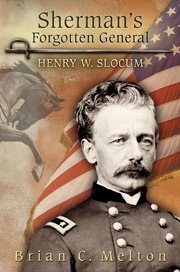
New---Henry W. Slocum: The Now Not-So-Forgotten Union General

Sherman's Forgotten General: Henry W. Slocum, Brian C. Melton, Shades of Blue and Gray Series, Columbia: University of Missouri Press, 2007. xi + 292 pp. Illustrations, tables, notes, bibliography, index. $44.95 (cloth), ISBN 978-0-8262-1739-4.

Reviewed for H-CivWar by Gerald J. Prokopowicz, Department of History, East Carolina University

The Now Not-So-Forgotten Union General

In their quest to find something new to write about the battle of Gettysburg, Civil War authors have curiously overlooked the men commanding the seven infantry corps that comprised the bulk of the Army of the Potomac. Winfield Scott Hancock (II Corps) and Dan Sickles (III Corps) have been the subjects of excellent modern biographies, but John Reynolds (I Corps), George Sykes (V Corps), John Sedgwick (VI Corps), Oliver O. Howard (XI Corps), and until now Henry W. Slocum (XII Corps) have not received serious biographical treatment in the last forty or fifty years, if ever. With Brian Melton's solid biography of Henry Slocum now on the shelves, it's three down, four to go.

Civil War aficionados best remember Slocum, when he is remembered at all, for his role at Gettysburg, but Melton indicates in his title that there is more to the story. He begins by briefly tracing Slocum's prewar career, including graduation from West Point in 1852, resignation from the stagnant prewar army in 1856, and success as a businessman and investor in Syracuse. In 1858 Slocum was elected as an antislavery Republican to the state legislature, and was sufficiently prominent to receive a commission as colonel of the 27th N.Y. when war broke out in 1861. He received a wound at First Bull Run, was promoted to brigadier general, and subsequently led a brigade, division, corps, and wing of the Army of the Potomac. Two months after leading his troops on the field at Gettysburg, Slocum was transferred west with the XII Corps, to serve at Chattanooga under William T. Sherman and eventually in the march to the sea.

How could someone who participated at a high level of command in so many important campaigns be accurately described as a "forgotten general?" One reason is that Slocum left few documentary traces of his career. The author takes the reader into his confidence in a forthright introduction that reveals the difficulty of finding source material. There are no substantial collections of Slocum's papers, and historians have written little about him, with the exception of his role at Gettysburg.

A second reason Slocum has been forgotten is that he was something of a military chameleon, taking on the characteristics of whichever officer he happened to be serving under. In the Peninsula Campaign, he displayed a McClellan-like devotion to drill and pessimism about victory, as well as a tendency to overestimate the size of Confederate forces opposing him. He nonetheless did well enough in command of a division to earn a promotion to major general, and in the Antietam campaign his small but significant victory at Crampton's Gap brought him command of XII Corps. When McClellan was replaced by Ambrose Burnside, who was in turn replaced by Joe Hooker, Slocum tended to emulate his new leaders, in particular showing some of Hooker's battlefield aggressiveness as well as much of his penchant for army politics. Slocum considered Hooker a "worthless loafer" (p. 94) and a "braggadocio and drunkard," (p. 95) and after the battle of Chancellorsville he devoted himself to getting Hooker removed from command of the Army of the Potomac, just as Hooker had maneuvered to remove Burnside. Slocum's effort, like Hooker's, was successful; the army replaced Hooker with George Meade just before the battle of Gettysburg.

Slocum's performance at Gettysburg is the one moment in his career that has attracted substantial attention from historians, little of it favorable. In the late afternoon of July 1, 1863, he led the XII Corps onto the battlefield, too late to prevent the defeat of I and XI Corps. Melton argues that an acoustic shadow prevented Slocum from hearing the sounds of battle clearly, and that in any case he delayed his march at Two Taverns only for a few hours, not a whole day as some detractors of "General Slow-come" have written. Melton convincingly defends Slocum against charges of sloth or cowardice, but acknowledges that his cautious advance reflected the continuing influence of McClellan's command style. On July 2, Slocum executed Meade's ill-judged order to reinforce the Union left wing by moving almost all of XII Corps away from the army's right flank, leaving it dangerously exposed, another move for which historians have blamed Slocum. Melton's explanation of Slocum's performance verges on the kind of Monday morning quarterbacking that fills the pages of too many traditional Civil War military histories, but does effectively exonerate him by showing both that he was following Meade's orders, and that by the end of the day he had returned to Culp's Hill and stabilized the situation.

When the XI and XII Corps received orders to transfer to Tennessee in September 1863 under the command of Joe Hooker, the move put Slocum once again under his old enemy. Both generals complained to Lincoln, until Slocum was finally given a new assignment as the military administrator of Vicksburg, Mississippi. Not until Hooker resigned in a fit of pique at the height of the Atlanta campaign was Slocum recalled to his old corps. Serving under Sherman, Slocum again adapted to his environment and became a proponent of a hard war against Southern property. He led the left wing of Sherman's army on the March to the Sea, by far the largest force he had commanded.

After the war, Slocum again served as a military administrator in Mississippi, where he zealously enforced the rights of the recently freed former slaves, but his political sympathies were evolving toward his former foes. He resigned from the army in September 1865 and joined the Democratic Party, effectively committing what Melton describes as "political suicide." He spent the rest of his life in Brooklyn, where he was involved with the construction of the famous bridge named after the city, and served a term in Congress, but for the most part he simply faded away, overlooked by Republican historians and journalists who wrote him out of their accounts of the war because of his political defection afterward. Melton's sturdy biography may not be enough alone to rescue Henry Slocum from the fate of being "Sherman's forgotten general," but in taking the focus away from Slocum's moment at Gettysburg, it at least reminds the reader that there was much more to his career.
Source
: H-NET BOOK REVIEW, Published by H-CivWar@h-net.msu.edu (May 2008)
www.h-net.org/~civwar/

Copyright (c) 2008 by H-Net, all rights reserved. H-Net permits
the redistribution and reprinting of this work for nonprofit,
educational purposes, with full and accurate attribution to the
author, web location, date of publication, originating list, and
H-Net: Humanities & Social Sciences Online.

Photos: Top--Library of Congress, Bottom--University of Missouri Press
 
Bloggers Team