Showing posts with label MF. Show all posts

Breaking News: "Baby Doc" in Haitian Court

Former self-appointed “president-for-life” Jean-Claude “Baby Doc” Duvalier was questioned by a Haitian prosecutor and a judge at his hotel outside Port-au-Prince and then “escorted” to court according to this BBC News report. At the time of posting, it is unclear whether he is being arrested or being subjected to further questioning. Reports indicate some unrest outside the courthouse.
International human rights NGOs and Haitian abuse survivors called for Duvalier’s immediate arrest after his mysterious return to the island on Sunday. Forced to leave Haiti during a popular uprising in 1986, “Baby Doc” Duvalier has been living in exile in France for more than two decades without arrest. His regime was characterized by widely and reliably documented human rights abuses.
Charges?
In addition to arguing Duvalier’s liability under Haitian law for alleged misappropriation of public funds and other violations, the Institute for Justice and Democracy in Haiti (IJDH) and the Bureau des Avocats Internationeaux (BAI) called for international human rights legal accountability (see press release here).
This legal documentation is supplemented by an extensive public record of Mr. Duvalier’s human rights violations, including the torture and disappearances of political dissidents at the Fort Dimanche prison and other crimes committed by organizations under his control including the Armed Forces of Haiti and the Volunteers for National Security (Tontons Macoutes).
Another Year...
For previous IntLawGrrls takes on Haiti, including by Marjorie Florestal, Jaya Ramji-Nogales, and yours truly, Hope Lewis, see here and here. One year after the 12 January 2010 earthquake, I wish I could suggest an accountable, effective, and sustainable pathway for rebuilding, recovery, and transformation. One thing is clear—the core of sustainability lies with the Haitian people and the Haitian Diaspora. Still, the rest of us must play our roles--even if that role is to remember the physician's oath "first, do no harm...."
As Dr. Martin Luther King said all human beings are “tied together in an inextricable web of mutuality.” Trade, humanitarian, human rights, migration, labor, tourism, and business laws and policies do have transnational implications. What "we" do has an impact in Haiti. What happens in Haiti matters wherever “we” are. Stay tuned.

The Great Race: Mexico, Trucks & Pigs

Despite global warming, the Gulf Oil spill, and the high price of gasoline, Americans remain obsessed with the idea of hitting the open road. But if you've ever driven off into the sunset with young ones, you know the call to adventure can quickly dissolve into a back seat screaming match or invoke the one question guaranteed to put any parent in a straight jacket: "Are we there yet?" Nowadays, the modern parent has all sorts of sophisticated distractions--from iPods to personal DVD players--to help keep the little tykes from suffering the dreaded, automobile-induced boredom blues. But in my day (you know, back when horse-drawn carriages shared the open road :) our pleasures were more modest. License plate bingo was a great way to wile away the time as we headed out to Bear Mountain or other wild places in New York state. For the uninitiated, here is a short but sweet explanation of the game.
Driving on the California road the other day, en route to my own driving adventure, I started to think about the way in which globalization might change that childhood game of license plate bingo -- if Mexico has its way.
When the North American Free Trade Agreement (NAFTA) came into existence in 1994, it contained a small provision allowing trucks loaded with goods from Canada and Mexico free access to U.S. highways, provided they followed all U.S. rules and regulations -- including safety regulations. For businesses, whether Canadian, Mexican or American, this represents a healthy cost savings. No longer would time be lost transferring goods from a Mexican truck onto a U.S.-owned truck at the border; breakage would be reduced, as would time to market; and it would be easier to keep track of inventory (less opportunity for goods to "fall off a truck," for example.) The measure seemed relatively uncontroversial on its face, and indeed for Canada it was. The U.S. has for years allowed Canadian trucks onto U.S. highways. Despite the Agreement to allow Mexican trucks onto highways in states near the Mexican border by December 1995, and throughout the United States by January 2000, however, Mexican trucks have been barred.
In 2001, Mexico filed a NAFTA Chapter 20 state-to-state dispute settlement claim against the United States arguing the ban treats U.S. truckers more favorably than Mexican truckers, which violates NAFTA’s national treatment provision (Article 1202); moreover, the ban favors Canadian truckers over Mexicans, violating NAFTA's most favored nation obligation (Article 1203). The panel in In the Matter of Cross-Border Trucking Services took issue with the United States' ban because such a complete restriction did not permit those Mexican trucking companies that did meet U.S. safety regulations access to U.S. highways. In other words, all Mexican trucks and truckers were banned even if they had exemplary health and safety records. The panel concluded:
It also is clear that the United States was well aware during NAFTA negotiations that the Mexican truck regulatory system was deficient in many respects in the U.S. view, and that many changes would be required to improve it significantly. The United States and Mexico have undertaken a cooperative program aimed at improving Mexico’s truck and driver regulatory system. While the United States contends that insufficient progress has been made to lift the moratorium, the U.S. obligations under [NAFTA] are not conditioned on a certain level of progress by Mexico in improving Mexico’s truck safety regulatory system. It is unclear when, if ever, the United States will be satisfied that the Mexican regulatory system is adequate to lift the moratorium with respect to all Mexican providers of trucking services.
Even after losing a NAFTA case, the United States refused to implement its obligation. As late as April 2010, a bipartisan coalition of 77 House members sent a letter to U.S. Trade Rep. Ron Kirk and Transportation Secretary Ray LaHood imploring them to renegotiate the NAFTA provision allowing Mexican trucks full access to U.S. roadways. But NAFTA authorizes a winning party to take retaliatory action where a losing party refuses to conform to the terms of the agreement. Thus, Mexico has for years raised tariffs against U.S. imports to the tune of millions of dollars hurting many American farmers in the process. Just last week, Mexico raised the stakes again by increasing tariffs on such politically sensitive products as U.S. pork. And like magic, pork producers have chimed in urging the U.S. to meet its NAFTA obligations to Mexico. A spokesperson for the National Pork Producers Council had this to say about the matter:
“Mexico’s retaliation against U.S. pork will have negative economic consequences for America’s pork producers,” said NPPC President Sam Carney, a producer from Adair, Iowa. “We are extremely disappointed that our top volume export market has taken this action, but we’re more disappointed that the United States is not living up to its trade obligations.”
What's so fascinating about this cat-and-mouse play between the U.S. and Mexico is the way in which it has changed the terms of the game. The United States may be considerably more wealthy and powerful than Mexico, but NAFTA offers up an opportunity to level the playing field in some way. Mexico is savvy enough to pit one group of U.S. stakeholders against another (on the other side of the controversy are The Teamsters who would lose out on well-paying jobs if their truckers were displaced by Mexicans). With mid-term elections fast approaching, the Mexican trucking crisis takes on political overtones. Given Obama's strong emphasis on export-led growth to leverage the United States out of the recession, taking a hit on a major export commodity will hurt. Or perhaps we'll begin to see some movement on this intractable issue.
And maybe even the venerable old game of license plate bingo will have to change to accommodate Mexican trucks.

Wyclef for President?

In 2004, Wyclef Jean--the noted Haitian activist, singer and former member of the Fugees-- released a song titled "If I were president," which served as a campaign promise of sorts. Here's a snippet:

If I were president
Instead of spending billions on the war,
I can use that money so I could feed the poor.
Cause I know some so poor,when it rains that's when they shower.
Screaming "Fight the power". That’s when the war should devour.
Jean might just get the chance to discover what he could. Last week, he announced his intention to run for the Haitian presidency (against his own uncle and several others) The incumbent and much maligned Rene Preval cannot run again, thus Haiti will have a new president. Is Wyclef Jean the right man for the job?

The Haitian presidential line is filled with despots and dictators, members of the elite class and former Roman Catholic priests, illiterates, medical doctors, the powerful and the powerless. We haven't yet had a singer. Certainly, Jean's status as a well-known singer should not preclude him from serious contention; if Schwarzenegger with his dubious acting skills can govern the most powerful state in the Union (as a California resident, I might take issue with whether he's actually done a decent job, but that's a point for another day) why not a singer for Haiti? But does Wyclef Jean have what it takes to bring Haiti out of the darkest moment in its 216 year history?

On the one hand, Jean has strong support from the Haitian poor who see him as a local boy made good who never abandoned them. Although he moved to Brooklyn as a teenager, Jean takes great pride in the fact that he never renounced his Haitian citizenship in favor of the more advantageous American one (if he had, the Haitian presidency would be closed to him as Haiti does not recognize dual citizenship). When Jean faced sharp criticism over Yele Haiti, an organization started by Jean to help Haitians, he pulled together a press conference and brandished his passport as both a sword and shield. Surely one who retained his Haitian nationality years after leaving the island could never be guilty of the terrible acts his organization was accused of? Acts such as not paying taxes and spending donors' money on lavish travel and on Jean himself, for example. While I might argue that many who have brandished the Haitian passport before him have done those things and much worse, Jean's tactics seemed to endear him more to the Haitian community at home and abroad--my own family included. Organizational irregularities aside, Jean has strong ties to the Haitian community and has served as Haiti's Minister of Culture and Ambassador at large. Moreover, unlike much of Haiti's elite, Jean's wealth was not created on the backs of Haiti's poor. He doesn't have ties to Haiti's strongly entrenched and regressive ruling class. He is an outsider who presumably could not be so easily co-opted.

On the other hand, Jean has little experience to guide Haiti through this delicate period in its history. Billions of dollars has been pledged in the Haitian rebuilding effort, although much of it has not yet materialized. Will Jean know how to pressure the international community to provide the funds it has promised? Will he put the proper mechanisms in place to police corruption and ensure the funds are well spent? Does he have a viable plan to create a new economy for Haiti? Haiti's administrative capacity was lamentable before the earthquake, now it is simply non-existence. Can Wyclef Jean create a professional cadre of civil servants that can get the functions of the state working again for Haiti's ordinary citizens? Jean gave an interview to Rolling Stone recently where he addressed many of these concerns (see it here).

Even if Wyclef Jean win's the Haitian presidency, all is not done. Haiti's elite has a long history of brutally doing away with leaders they cannot control. But Jean has a song to sing for all of them:
If I was president,
I'd get elected on Friday, assassinated on Saturday,
buried on Sunday. then go back to work on Monday.

The WTO wants YOU!

WTO-detractors have long accused the organization of being a "secret society" where deals are struck in dark, smoke-filled rooms far away from the public eye. Admittedly, the organization has not been very effective in addressing the complaint--at least not in the early years of its existence when a typical response would be that the World Trade Organization is a "government to government" institution. Translated from the bureaucratic-speak, it essentially meant there was no room for public participation. Civil society and the average citizen were expected to liaise with their home institutions rather than with the WTO. But times have changed.
After years of public protests, along with scholarly reflections on the institution's lack of legitimacy precisely because it operated in the shadows, the WTO had a public relations makeover of sorts. The membership changed the rules to allow for public access to some meetings--including dispute settlement meetings--for example, and the WTO began to hold an annual civil society conference meant to serve as a forum for public participation. This year, the organization has taken things one step further and sponsored a contest seeking . . . YOU! That's right, the WTO "invites you to participate in a video contest to tell us your views about the key forces shaping world trade."
So if you ever wondered just how you might give the institution a piece of your mind on their policies and practices, here is your chance. All you have to do is upload a YouTube video and send a link to mailto:%20publicforum2010@wto.org and you could be on your way (don't forget to check out the terms and conditions). I wonder if they'll have the world call in to choose the next WTO-Idol?

Hope for Haiti?

This past weekend, I got together with some Haitian friends to size up our experience with the Haitian reconstruction effort. I met these friends shortly after the devastating earthquake of January 12, and we have served as a Board of Advisers of sorts for each other; we've provided moral support and recruited each other into our various projects for Haiti. We've grown quite close over the last few months -- I suppose tragedy has a way of bringing people together. But I was still surprised when we all seemed to share the same sentiment: Haitians have become disillusioned with the reconstruction process. Turns out our experience is more that just anecdotal. Despite the record pledges for aid to Haiti--pledges that both Clintons had a hand in organizing-- the reality on the ground is not much different than it was a few months ago.
In a recent article summing up the relative failure of reconstruction, the author cites the following statistics:
  • Amount pledged for Haiti's reconstruction over the following 18 months at the March 31 UN conference: $5,300,000,000
  • Percentage of this amount that has been paid: 1.9
  • Amount of pledged U.S. bilateral search and rescue assistance to Haiti that was delivered in the wake of the earthquake: $0
  • Value of aid the French government has promised Haiti through pledged contributions to UN agencies, NGOS and the Red Cross: $180 million
  • Quantity of this aid that has been delivered: $0
  • Estimated number of Haitians who remain homeless after the earthquake: 1,500,000
  • Amount that has been collected for Haiti relief by U.S. charities: $1,300,000,000
  • Number of Haitians without even tents or tarps for shelter: 232,130
Less than 2 % of international funds pledged for Haiti has actually made its way to the island? None of the US bilateral aid or French support through the UN or NGOs has been disbursed? The international community made many promises for a "New Haiti" that would provide the institutions and resources the Haitian people so desperately need to succeed. But that is not possible without the pledged funding. There were also promises that the Haitian voice would not be lost; Haitians living on the island and throughout the diaspora were to play a central role in the rebuilding process. These promises are not materializing and Haitians are losing hope. Fast.

Developing Countries Confront Global Economic Crisis

The global economic meltdown was so yesterday. Seldom does the crisis make it on to the front pages of any of the major newspapers anymore, but the struggle for recovery continues in the shadows. Already, fissures are appearing in the once-unified front of the developed countries. European governments such as Germany are calling for a greater focus on controlling deficit spending, while President Obama has called for more spending to shore up flagging economies. But while the North struggles over the various modes of recovery, the developing world must deal with the fallout. This week, for the first time the World Trade Organization is set to discuss the impact of the financial crisis on those countries. A powerful coalition of developing countries, including India, South Africa, Argentina and Ecuador, had lobbied vigorously for such a discussion because in their view the North's massive bailouts amounted to illegal subsidies that have adversely impacted financial markets in the developing world. Can these bailouts prompt a WTO dispute brought on by developing countries?

Hamid Mamdouh, director of the WTO's services division, is reported to have said "There is a legal cover for situations where members might deviate from their legal commitments and obligations" but the situation is not so clear cut. The General Agreement on Trade in Services (GATS) does include what is known as a "prudential carve-out," which is meant to allow regulators the policy space to address financial crises. Article 2 of the GATS Annex on Financial Services states that a WTO member “shall not be prevented from taking measures for prudential reasons.” The prudential carve out is subject to WTO dispute settlement, however, if a member believes the provision is being abused, is discriminatory or is a disguised non-tariff barrier to trade. The matter has never been litigated before, and what standard of review the WTO would apply under the circumstances is an open question.

But would a developing country (or a group) actually raise a dispute settlement claim? Beyond the legal issues, there are both economic and political considerations for developing countries to deal with.
Countries like the United States have the political clout to fend off a potential case. Moreover, the economic recovery of the North is in everyone's interest -- developing countries rely on their markets, not to mention their technical and financial assistance. A dispute on this issue -- at least in the near future -- seems unlikely. But this makes the upcoming discussions at the WTO all the more important. The organization must provide a forum to at least acknowledge that developing countries are another in a long line of innocent victims of this economic crisis (photo credit).

Go, 'Grrls!

Proud to announce:
► Hari M. Osofsky (right), a charter member of IntLawGrrls, has accepted a tenured offer to join the faculty at the University of Minnesota Law School in Minneapolis. She looks forward to becoming a part of work there in environmental law and related fields.
► IntLawGrrls' international trade expert, Marjorie Florestal (left), likewise is enjoying her newly tenured-law-professor status at University of the Pacific McGeorge School of Law in Sacramento, California.
► IntLawGrrls guest/alumna Caroline Bettinger-López (right) will begin a tenure-track appointment as Associate Clinical Professor at the University of Miami School of Law on July 1, 2010, and will launch a new Human Rights Clinic there, for which she will serve as Director, at the beginning of next year. The clinic will focus on transnational/international human rights litigation and advocacy, including work before the Inter-American human rights system and the United Nations, and will also support social and economic justice campaigns and human rights advocacy in South Florida.
Heartfelt congratulations, 'Grrls!

Guatemala Battles Disaster on Two Fronts

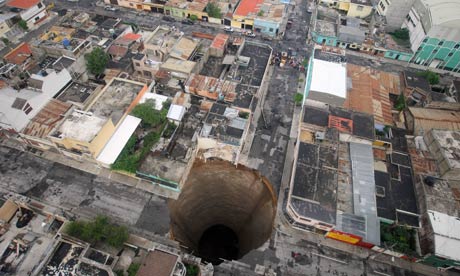
On Saturday, May 29 Tropical Storm Agatha--the first of the 2010 Pacific storm season--hit Guatemala. So far, Agatha has killed about 100 people and opened a sinkhole in Guatemala City large enough to swallow a three-story building (photo credit). As if that wasn't enough, the Pacaya volcano, situated just 15 miles south of Guatemala City, erupted on Thursday afternoon, spewing lava and rocks and flooding the capital with sand and ash. The airport closed, a television reporter was killed by a shower of burning rocks, and the President called for calm as thousands fled their homes in search of safety. I actually felt the tremor as I was teaching on Thursday afternoon, but having lived in Northern California for almost a decade, I thought nothing of it. I continued teaching with hardly a pause.

But now that we know the extent of the devastation, it is impossible not to weep with the Guatemalan people. The death toll on these twin disasters is still climbing, and no one yet knows the price tag on rebuilding the 800 or so homes destroyed and otherwise giving aid to the victims. A country that was already facing unbelievable odds now must face one more: recovering from the one-two punch of Agatha and Pacaya.

In a horrible twist, our students in the McGeorge InterAmerican Program found themselves in the midst of the crisis. They had been on a field trip with their professor--my colleague Raquel Aldana. With the rains came mudslides that closed the roadways and effectively trapped the McGeorge group where they were for a couple of days. Raquel courageously shepherded our students to safety and kept everyone calm. They are now safe and well having lived through an experience they will never forget.

Throughout the crisis McGeorge has been incredibly supportive, as have friends, colleagues and family. How lucky we are--those of us with money, a U.S. passport, and friends and loved ones. We have the luxury of knowing we always have an exit strategy. So many here in Guatemala are not quite so lucky.

I'll be teaching class again for the first time tomorrow. It is difficult to imagine discussing the finer points of GATT Article I's non-discrimination provision; but I also realize my work here is very relevant. I don't have to convince these students of the need for every country to have a basic level of wealth and development to care for their people in times of crisis. My students have faced the problem head on. And they have been changed by it.

Trade & Development in Guatemala

I am in Guatemala for the next few weeks teaching a course on trade and development in Latin America (no, not in Spanish). The students are both Guatemalan and American, and as I prepare for my first day, I'm struck by the different experiences they surely have encountered around trade. For centuries, Guatemalan trade was exploited by and for the Spanish outsiders. Even after independence, much of it continues to be exploited for the benefit of the few. Americans, however, have a history rich in the spoils of international trade. Free trade has served us bountifully and well. Those of you who have been reading my posts for awhile know that I am "pro" trade. I believe in the power of trade to bring not just economic benefits but true freedom to the masses. But it is impossible to be a student of economic history and ignore the uneven benefits trade has brought -- particularly in a country like Guatemala.

Guatemala is a country rich in many things. The Mayan culture is alive and thriving, providing a doorway into the language, history and religious practice of these early Americans. It is blessed with good weather, wonderful food and music, gorgeous vistas and a warm, welcoming population. But Guatemala is not rich in the economic sense of the word. It has the largest economy in Latin America, representing about one third of the population and one quarter of the GDP of the Central American Common Market. But the level of poverty in Guatemala -- and more specifically, the vast stratification in wealth between the haves and the have nots-- is among the highest in Latin America. Simply put, trade has not worked for Guatemala. Well, at least not the way it is supposed to work.

Free trade theory tells us that exchanging goods and services at the international level provides wealth. This wealth must then be effectively redistributed from the government down to the people. What happens when that mechanism fails? Well, free trade tells us that is a "distributional" problem not a trade problem. Trade policy is not the problem, thus it cannot provide a solution (sort of like the idea that "Guns don't kill people. People kill people." So why have gun control?) Of course this distributional problem de-legitimizes trade in the eyes of the vast majority who will never see its benefits. It is thus impossible to come to a place like Guatemala and simply content oneself with the same old answers. But does that mean trade is not good? Does that mean we all close our borders while we strive for the illusive but oh-so-seductive idea of self sufficiency? I think not.

Professor Frank Garcia in his piece Is Free Trade “free?” Is it Even “trade?” Oppression and Consent in Hemispheric Trade Agreements provides an excellent framework for understanding what free trade is -- and more importantly, what it is not.

[T]he essence of free trade ... is consent: trade consists of voluntary mutual bargained-for exchanges of roughly equal value. Three other types of transaction which, while they may look in some ways like free trade, do not in fact meet this definition: theft or predation, which may not be trade at all; coercion; and exploitation, which may be trade in some sense but also introduce other dynamics of concern for normative and pragmatic reasons. Participants in any of these three will see economic value exchange hands, and society may reap some economic benefit, but under conditions involving the absence of either basic consent, or the fullness of consent.

In short, a non-consensual exchange of value is not free trade even when it provides an economic benefit. Trade is inherently a consensual transaction. And though the Spanish conquerors of Guatemala might want to bestow the title of "free trade" on their actions, they cannot do so -- at least not in Garcia's (and my own) world. But I wonder whether in a postcolonial world the definition of free trade should be extended. Is it still free trade when a country's own bottleneck prevents the benefits of trade from accruing to the majority of its population?

In 2009, the World Trade Organization conducted a thorough review of Guatemala's trade policy regime. It gave Guatemala a relatively good bill of health: protection of domestic goods through high tariff walls has decreased -- the average tariff rate went from 7% in 2001 to 5.9 % in 2008, for example. The report has little to say about addressing the distributional problem, however.

My American students will not have had to confront these issues in quite the same way as my Guatemalan students have. For them, one question seems inevitable: Is this really what free trade is all about?

Rejecting the Comfort of the Familiar

I love this time of year. It's not only about the Great Awakening Springtime inevitably brings-- although I love that too! This is graduation season. It's a time when the students we have nurtured, prodded, exasperated and overwhelmed finally take what they've learned and set out on their own path. Last week, I was asked to keynote at a very special ceremony meant to honor and support students who were taking their first tentative steps in the international arena.
The ceremony took place at my home institution, The University of the Pacific, and was held to honor candidates for some of the most prestigious international fellowships--like the Fulbright and Rhodes.

I was asked to share my own experience of having completed a Fulbright and to reflect on how that experience impacted my career. After I got over the shock of recognizing I was one of "those" people -- one with a career long enough to reflect back on -- I began to consider what I would say. How did I get here? How did we get here? What possess those of us enthralled with international law to forge ahead in a world so vastly different from what we are used to?

I told those students that a successful internationalist must reject three things: the comfortable, the predictable and the familiar. There is nothing particularly comfortable or familiar about plopping yourself into a culture you hardly understand and attempting to make a worthy contribution. And when we undertake to do so, nothing is preordained; nothing is predictable. Every aspiring internationalist should have that experience. We should feel what it is like to barely speak the language, to not understand the inside jokes, to feel excluded and lonely and a stranger. We should experience getting lost and finding our way. We should feel the dawning sense of our connectedness despite language and other cultural barriers. There is something about following that path that breeds a certain openness to whatever may happen. Too many of us in the United States lack that openness.

A few weeks ago, Arizona adopted a draconian law targeting those who are different (we've posted about that here). Essentially, their difference is seen as proof of their criminality. They don't speak our language, so they must be illegal. Their hair and skin are different, so they must be aliens. The students at the Pacific ceremony will soon enough experience that sense of being foreign and alien. They are headed to such diverse countries as India and Fiji, and most of them will not blend in. But they of course will not be made into criminals by virtue of that difference.

I am so proud of these students. They are rejecting what is comfortable, predictable and familiar in favor of forging new paths to understanding. They will learn much, and they will hopefully bring back with them an increased sense of tolerance and empathy. We sorely need them.

The Vietnam War: Take II

The United States pulled out of an intractable, expensive and highly destructive war in Vietnam in 1975. For decades thereafter, relations between the two countries was nonexistent. But then ever so slowly came the thawing. Trade was a big part of The Great Thaw. Since time immemorial, whether the war involved companies or countries, real peace came only after the warring parties had established strong and deep trade ties between them. Trade has a way of creating new relationships and new memories.

Such has been the experience of Vietnam and the United States. Despite the bitter memories of mass bombings and torture cells deep in the jungle, the two countries forged a path to peace. In 2007, Vietnam joined the World Trade Organization with the aid and support of the United States. Vietnam's accession signaled the renewal of its ties with the international community. But just as important, it signaled a new relationship with the United States. The bonds of that new relationship are now being tested. Just a few weeks ago, Vietnam filed its first ever dispute in the WTO. Against whom? The United States.

In United States — Anti-dumping Measures on Certain Shrimp from Viet Nam (DS404), the two countries once again face off on some heated issues. The U.S. believes Vietnam is "dumping" large quantities of shrimp into the U.S. market. In trade law, dumping occurs when the exporting country sells its products into the domestic market either for less than the cost of production or less than the price sold at home. It is an unfair trade practice, and most countries have laws against such a practice. Vietnam, however, takes issue with the way the United States has calculated the so-called "dumping margin" -- an additional charge the U.S. imposes on Vietnamese shrimp to raise the price to more accurately reflect its normal value (i.e., it's "fair price"). The U.S. dumping methodology has long been under attack, indeed the WTO previously ruled the complicated "zeroing" method in dispute violated U.S. WTO obligations.

In this war, as in the last, Vietnam is likely to win an unexpected victory. What will this mean for relations between the two countries? Thankfully, in a sign of how far we have come since 1975, it is likely to have no effect. Trade = Peace

Times They Are A Changing: Developing Countries in the WTO

A few weeks ago, I strode into my law school classroom brimming with hope and optimism. "Brazil is about to retaliate against a U.S. trade measure!" I excitedly reported to my students. Luckily, this was a class on trade and development law, and so my students were equally struck by the news (it wouldn't have gone over so well in say . . . my contracts class!) Brazil poised to retaliate against the United States for an unfair trade action? Unheard of.

As Harvard Professor Robert Z. Lawrence notes, “Traditionally, retaliation in trade has been the preserve of the largest developed countries, which have market power.” To put it bluntly, there has always been an unspoken rule of trade law: Only rich countries get to retaliate against another's violation of trade rules. "Retaliation" in trade parlance simply means that one country receives approval from the WTO to take countermeasures against another for violation of the rules. The most common countermeasure is for the prevailing country to impose more duties on the exports of the losing country. But retaliation comes at some cost for poor countries--either economic or political.

For developing countries who desperately need the exports of more advanced countries, raising duties on these products simply punishes their own citizens who are forced to pay more for the goods (or risk not having them). Moreover, rich countries have an array of subtle and not-so-subtle means of coercion at their disposal to prevent developing countries from raising trade claims in the first place. Much of North-South trade is characterized by "voluntary" concessions--namely, rich countries provide poor ones preferential access to their markets on a non-reciprocal and voluntary basis. One example of this is the U.S.-created African Growth and Opportunity Act (AGOA), which allows duty-free and quota-free imports of some African goods into the U.S. market. But what would happen if Uganda, which is AGOA-certified, were to successfully raise a claim against the U.S. in the WTO? There goes its AGOA benefits. It is perhaps not surprising under the circumstances that no African country has raised a dispute in the WTO.

Developing countries have long faced the frustrating dilemma of a right without a remedy in trade disputes. But suddenly, things are changing. In 2002, Brazil successfully brought action in the WTO against U.S. subsidies to its cotton industry, which averaged $4.9 billion per year. After various appeals, Brazil was finally authorized by the WTO to retaliate against the United States to the tune of $830 million. Perhaps more importantly, Brazil threatened (with WTO support) to suspend intellectual property protection on things like U.S.-manufactured seeds and pharmaceuticals. Suddenly, Washington was taking note.

Just this week, Brazil and the United States announced a settlement of their now eight year old dispute. Brazil will postpone retaliation, and the United States in turn will modify its cotton subsidy program and establish a temporary assistance fund for the Brazilian cotton industry. Brazil's success has demonstrated that the trade rules are not exclusively the purview of the largest developed countries.

My students and I can only wonder what this will mean for the future of world trade.

Haiti: Rewired

The donor conference is over and the figures are in: Nearly 50 countries have pledged $9.9 billion to Haiti for the rebuilding effort. As Secretary Clinton has said, "that is an impressive sum by any standard." Indeed, this is an impressive sum, and it far exceeds the $3.9 billion the Haitian government had sought. Not all of it will be disbursed immediately, but nearly $5 billion will be made available to Haiti in the next 18 months. Problem solved?

Most experts in development circles recognize that such vast sums of money--if not properly managed--can create more problems than it solves for a country like Haiti. Corruption permeates much of Haitian society, and it would be a simple matter indeed for this money to get lost in the abyss. How are we to manage the process so that the money goes to its intended beneficiaries--Haiti's poor and neglected masses? There appears nearly uniform agreement that the Haitian government cannot manage the effort on its own. Based on its past track record, there is simply no reason to believe that it would properly manage the funds. But so far, the international community is not articulating a clear process for all stakeholders to have an input. In particular, the voices of Haitians themselves are absent. Without buy-in from Haitians who feel they have an ultimate stake in the outcome, there is no way for this process to be successful. It is time for us to learn from past mistakes. Haitians do not want to be passive observers in their own story. It is time for us to listen to their voices.


Can Exploitively Low-Pay Jobs Help Haiti?

You might think this a rhetorical question--surely the answer is obvious? Alas, it is not so obvious to the architects of the rebuilding plan for Haiti. Central to the Haitian recovery effort is a plan to revitalize the textiles and apparel sector, which has existed in Haiti since the time of the Duvaliers in the 1950s. UN Secretary General Ki-moon, President Clinton, President Obama and the U.S. Congress have all touted the plan, as has Haitian officials. In principle, it is not a bad idea: Factory owners in South Korea and elsewhere would relocate to Haiti to produce garments; their incentive would be cheap and abundant Haitian labor (unemployment even before the quake was somewhere around 80%), and duty free access to the U.S. market guaranteed through programs like HOPE II. The problem? At $3.09 a day, wages for garment workers are at 1984 levels and are not enough to sustain the worker, let alone her family.

All seem to agree that wages are simply too low. Indeed, the $3.09 was a significant increase brought about when lawmakers raised the minimum wage up from just $1.72 to $5 a day last year in response to protests. But factory owners complained, and President Rene Preval worked out a compromise allowing garment workers to be paid less. "It's not enough to make a decent living, but it's the first step," says the President of Haiti's Association of Industries. It is a refrain Haitian workers have heard for decades.

Relying on jobs that pay so low they cannot meet the basic needs of the worker is not a sustainable recovery plan for Haiti. It is a recipe for disaster.

photo credit

Haitians Speak Out: An Interview with Pierre Imbert

Two months after the Jan. 12 earthquake, Haiti struggles to find its footing in a world irrevocably changed. Plans for Haiti's future are being constructed, but the voices of Haitians are often missing from the discussion. In a series of one-on-one interviews, I attempt to reintegrate Haitians and Haitian Americans into the debate. These intereviews explore a side of Haiti foreigners too often miss, and it examines our hopes and fears for Haiti's future.


"What makes me angry is the degree to which we have failed the Haitian people." Pierre Imbert chokes back tears as he considers the plight of Haitians trying to survive the aftermath of January 12, 2010. "We allowed Haiti to descend into chaos. We allowed unscrupulous people to run Haiti into the ground." Although Imbert left Haiti decades before as a university student in search of a better life, he never truly lost his connection to his homeland. Just one month after the earthquake, he felt compelled to head back to Haiti to lend his support and bear witness to the devastation. What Imbert saw there moved him beyond words.

"It was an unbelievable scene," he said "and it hit you all of a sudden that you were entering a war zone." The images are ones Imbert is not likely to forget: children playing among the chaos of destroyed buildings, makeshift tents, and deep crevices in the land evidencing the enormous seismic shifts brought on by the earthquake; women with packs on their heads wandering aimlessly in the streets; and the long, endless and often dehumanizing queue of people standing beneath the harsh, unrelenting Caribbean sun in hopes of receiving a packet of rice from the aid trucks. Strangely, these sights gave Imbert hope. These people who had so long been mistreated by their own leaders, ignored by the international community, and forgotten by some of Haiti's more successful expats, were heading off in search of life. It mattered not that they did not know where they were going or how they were going to get there; it mattered even less that they did not know what they would do once they finally arrived. For Imbert, hope lay in the journey.

"What gives me hope," Imbert concludes "is that Haiti has sons and daughters that have labored through and survived . . . Haiti has sons and daughters all over the world that are finally focusing on it . . . with a renewed determination to build a new society."

You can find my full interview with Pierre Imbert here and here (video).


Will Aid be the Death of Haiti?

"We should be helping Haitian companies instead of companies in Florida"
-- Alex Zamor, owner of a drinking-water factory in Port-au-Prince, Haiti


Ilia Alsene is a Haitian merchant who supports herself by selling food, water and other tidbits on the side of the road near Champ des Mars Plaza in Port-au-Prince, Haiti. The life of a street merchant in Haiti is difficult by any measure.

Obtaining supplies can be a challenge, which is why the women's (and men's) rickety tables often will sport just a few items: a handful of bags of peanuts, three bottles of soda, some purified water encased in plastic bags. Getting pedestrians to stop and shop can be a challenge. The narrow streets of Port-au-Prince are packed with cars weaving around traffic and potholes and other obstructions, children walking to and from school, stray dogs, and the occasional chicken. Enticing a would-be shopper in the midst of all that frenetic energy is not easy. But the greatest challenge for a merchant by far is managing to come home with enough goud to feed the family and purchase the next day's supplies.

After the January 12 earthquake, Ilia and merchants just like her must face one additional challenge: How to compete with the food aid being distributed for free? No one denies the critical necessity of getting food, water and other basics to Haiti's devastated populace. But one of the foreseeable consequences of shipping in thousands of tons of foodstuffs purchased from abroad is that Haitian businesses are being squeezed out of their own market. "I have fewer customers now," says Ilia "because they are handing out free food down the street."

If this were the story of just one merchant or even a handful, the cost-benefit analysis would suggest we do nothing. But Ilia is a key player in the Haitian economy. Frederic Madsen, CEO of Haiti's largest beverage company, makes the case for helping women like Ilia: "When women like that don't make enough money, they stop buying my products," Madsen says. "They are the backbone of this economy." Alex Zamor, owner of a drinking-water factory, cannot afford to rehire 200 workers who were on his payroll before the quake because sales of his product are down ". . . nobody wants to buy water if there's free water on the streets," he says.
The challenge facing Ilia, Frederic Madsen and Alex Zamor is neither unforeseen nor maliciously created. The relief agencies that went into Haiti just days after the quake faced a difficult task; it would have been made insurmountable if the supplies they needed could only be sourced in Haiti. For one, Haiti did not have the capacity necessary even before the January 12th earthquake. Plus, Haitian businesses suffer from real or perceived problems of quality and ineptitude. In short, many are simply unwilling to deal with local suppliers.

Without a well-orchestrated campaign to place Haitian businesses at the center of the rebuilding effort, Haiti's post-quake revitalization will be an abject failure. No country can survive in the long term through the beneficence of others. Foreign aid, no matter how well intentioned, will not create a meaningful future for Haiti. Jobs are necessary; a robust middle class is necessary; a self-sufficient agricultural sector is necessary. None of that comes about through foreign aid. In her hard-hitting New York Times Bestseller Dead Aid, Zambian-born Dambisa Moyo makes the case that foreign aid creates learned dependency rather than prosperity. We have decades of empirical evidence suggesting she is right. Moreover, it separates a government from its constituency. What hope can Haitian voices have of influencing government policy when actors in Europe and America hold the purse strings?

So, what are we to do? Those in charge of the rebuilding effort make noises about understanding the problem, but the solutions are too complex and nuanced to rely on a handful of "experts". Organizations like Peace Dividend Trust, a Canadian NGO, is doing an invaluable job by making this issue more visible. PDT has started a "Haiti First" campaign urging aid agencies to buy goods and services from Haitian suppliers whenever possible. "A 'Haiti First' approach can help turn a tragedy into an opportunity by driving millions if not billions of new investment into the Haitian economy."

We too must do our part when we contribute to Haitian relief. Just last night, for example, I was invited to keynote at a benefit concert for Haiti. It was an inspiring event that moved me beyond description at the capacity of humans to join with each other in moments of crisis. But at the end of the concert, our host mentioned he had enlisted the help of a friend who owned an auto dealership to send trucks to Haiti.

But Haiti has auto dealerships. How much more effective would that money be if it were spent on Haitian soil? The Haitian auto dealer could pay her employees, and those employees in turn could feed their children with the food Ilia sells from her street corner in Port-au-Prince. That would have a real impact on the Haitian economy.

Dealing with Corruption in Haiti

Seconds after the Chile tremors subsided, the comparisons began: Haiti suffers a category 7.0 earthquake and well over 200,000 die (President Rene Preval recently has been predicting 300,000 as the final toll ). Chile experiences a category 8.8 quake--roughly 500 times stronger than Haiti's--and the death toll hovers at less than 200. In the last few days, I have read multiple variations on this theme, and you know what surprises me? That anyone is surprised.

The very idea that a middle income country like Chile, with its strong building codes, low level of perceived corruption, and responsive government could be compared with Haiti is just ludicrous. Chile is a Latin American "dream" poised to become the first OECD member from that region, and Haiti is widely regarded as the poorest country in the Hemisphere. Is it so surprising that their experience of any catastrophe would be vastly different? (Not to mention, of course, that Haiti's earthquake centered around its densely populated capital, while Chile's hit its more remote outer region.) It seems to me the more relevant question is this: How do we help prepare Haiti for the next inevitable crisis?

Experts credit Portugal's 1755 earthquake--which demolished the city of Lisbon, killed as many as 40,000 residents, and precipitated multiple fires and a devastating tsunami--as "the first modern disaster." Citizens demanded change in the way government prepared for and responded to natural disasters. As a result, Portugal reconstructed Lisbon with the zeal of the newly converted: a scientific inquiry into the mechanics of earthquakes was launched, strict zoning rules were passed, and Portugal became the first country in Europe to adopt building codes for seismic activity. In short, Portugal's 1755 catastrophe became the vehicle for change. Is that likely to happen to Haiti as well? Probably not.

The US Geological Survey recently predicted even more seismic activity in the region. There is no question that Haiti (and the island of Hispanola) is likely to experience further significant tremors. But rather than allowing the information to galvanize them into action, the Haitian government is engaged in more of its business-as-usual antics. The Washington Post reported President Rene Preval interrupted a high-level meeting with Admiral Mike Mullen, Chairman of the Joint Chiefs of Staff, to chide Post reporters for publishing stories of government corruption. "There is no corruption here," Preval reportedly declared. "We have a high sense of morality." Preval is either woefully uninformed or simply unwilling to tackle a serious problem that threatens Haiti's future.

Transparency International ranks Haiti 168 out of 180 countries in terms of the level of perceived corruption of the country's public sector (Chile is ranked 25). Preval might believe there is no corruption, but Haiti's international business partners would respectfully disagree. Indeed, even as Preval was adopting his "no corruption here" mantra, stories abounded of Haitian customs officials demanding humanitarian organizations pay exorbitant "taxes" on donated goods entering the country to aid the millions of displaced Haitians. It seems even in the midst of this epic crisis, the Ministry of Economy and Finance found the time to adopt a new set of procedure for getting supplies into the country: Organizations now were to sign over the goods to the Haitian Department of Civil Protection, which would review their request to get a tax exemption before releasing the goods. The rationale for this new, onerous procedure? To prevent businesses from sneaking in goods tax free under the banner of relief agencies. Ministry officials quickly denied they were taxing humanitarian goods. But for organizations who have volunteered a week or two of service to Haiti, the burdensome new procedures simply ensure the work they went to do would not get done.

There is no great mystery here. We know how to rebuild Haiti's infrastructure to avoid the kind of catastrophic outcome that occurred on January 12: Adopt strong building codes and land use planning procedures that avoid building in hazardous areas, and appoint government agents to ensure compliance. Chile (and Portugal) has shown us the way. But none of that is likely to happen until Haiti's pervasive corruption is resolved . . . or at least circumvented.

Why not appoint an authority responsible for overseeing Haiti's rebuilding effort (I admit here that I am building on a proposal offered up by another at a wonderful conference on Haiti hosted by California State University Sacramento last week)? The authority would be composed of Haitian government officials, to be sure, but also Haitian businesses and citizens, NGOs, and international donors, all of whom have an ultimate stake in the outcome. Who would demand that Haiti establish such an authority? Certainly the Haitian people should, but Haiti's government is not susceptible to the popular will. The international community, which is bringing in millions of dollars to sustain Haiti, does have the clout to demand the creation of such an authority. We should use it.

The Haitian earthquake is a catastrophe of unfathomable proportions. It should serve as a galvanizing force for change in the way Haiti has functioned. This cannot happen without a fundamental shift in the way Haiti does business. We need change.

Haiti Quake: Next Steps in a Sustainable Response


IntLawGrrls continue to follow developments in Haiti. Posts discussing the 12 January 2010 Haitian earthquake, humanitarian assistance, immigration status for Haitians located in the U.S. and France, human rights and disaster response, and participatory and sustainable recovery and development policies appear here.
Recent or Upcoming Developments
►Montreal Meeting. An international donors meeting on Haiti was held in Montreal, Canada in late January. Haiti was represented by its Prime Minister, Jean-Max Bellerive. The European Union and 14 other countries participated.
►CARICOM Response. CARICOM (the Caribbean Community) pledged its continued support to the Haitian recovery, initially in the area of health, to be followed by support for long-term sustainable development.
►UN New York International Donors’ Conference. The Montreal meeting will be followed by another international donors’ conference at UN headquarters in New York on 31 March 2010.
►Lawyers’ Earthquake Response Network (LERN). U.S.- and Haiti-based lawyers organized a network focused on human rights and other legal issues (sponsored by the Institute for Justice and Democracy in Haiti).
►ASIL Panel. The program committee has just added a late-breaking panel on Haiti at the American Society of International Law 104th Annual Meeting in Washington, DC. (I will chair the panel; also see post on “Women at ASIL” here). The panel is scheduled for Thursday, March 25, at 10:45 (web program will be updated shortly).
Current Priorities
All that Diane Marie Amann, Marjorie Florestal, Naomi Norberg, Jaya Ramji-Nogales, and I have said in earlier posts remains true. Emergency responses must continue as coordinated by the Haitian government and people and the international community under the mandate of the UN Office for Coordination of Humanitarian Affairs. The many NGOs on the ground themselves coordinate through umbrella organizations such as InterAction and use resource sites such as ReliefWeb.
Housing and Sanitation
More than 1 million people in Port-au-Prince and elsewhere in Haiti are living in tent cities or other make-shift shelters as the rainy season and hurricane season approach.
Although tents are an emergency quick fix for those with no other choice, they cannot be a long-term solution. The overcrowded tent cities do not have proper sanitation and potable water distribution facilities. This situation leads to the rapid spread of infectious disease (especially among those who’ve already been injured). Immediate attention must be given to the acquisition and distribution of more sturdy structures, along with the necessary temporary infrastructure for sanitation and water. Because so many things are interrelated, the overcrowding and lack of adequate shelter cannot be addressed without attention to rubble-removal and voluntary decentralization of the population.
The challenges are difficult and of unprecedented scale, but there are international guidelines and strategies for disaster response and recovery. Those guidelines should be implemented and supported by the Haitian government and by the international community.
Disability
As noted in a recent New York Times news story, crush injuries were common after the earthquake. Many amputations resulted from immediate trauma, while others became necessary because of the lack of proper medical facilities and antibiotics in the days and weeks following the quake. Other survivors were blinded, lost hearing, or suffered brain or spinal injuries. Even (especially) in the midst of disaster, the rights of persons with disabilities must be respected, protected, and fulfilled. (See Disability Rights series.)
Local disability resources were devastated by the quake. Haitians now need adaptive equipment (canes, crutches, walkers, rough-terrain wheelchairs, etc.) and trained physical therapists. These resources can help the newly-disabled recover and participate in the rebuilding of the nation. Unless you are a trained physical therapist or health professional, or a non-profit willing to donate appropriate equipment, the best way to help is through existing disability NGOs that already work closely with the people of Haiti.
The following governmental and private organizations provide links to a range of disability NGOs working in Haiti:
►United States International Council on Disability (USICD) (US government site coordinating NGO work).
►Mobility International USA (webpage on Haiti resources).
►PBS Newshour report on the non-profit Whirlwind Wheelchair International ( discusses the group's work to build rough-terrain wheelchairs). As was the case where a large number of amputees resulted from the use of landmines in armed conflicts, responses that are participatory, generate local jobs, training, and owenership, and focus on the empowerment of people with disabilities are to be applauded. Haitian people with disabilities can help build and fit prosthetic devices and wheelchairs, as well as train others in their use.
Those involved in large-scale rebuilding projects for housing, government buildings, or private sector buildings should ensure both accessibility under international standards and durability to withstand the risks of natural disasters.
Note: As this post was being written, news was coming in that an 8.8 earthquake has hit Chile. Our thoughts and solidarity are with all those affected.

Making Aid Work for Haiti

Even as the crisis in Haiti falls away from the front pages of our newspapers, the critical work of rebuilding has begun. This phase of the crisis does not have the high drama of watching someone being pulled out of the rubble alive after several days; it does not tug at the heartstrings as does the image of a dead little girl lying underneath a heap of rocks. But make no mistake: This is the moment when Haiti's future is being rewritten. The decisions being made today--many of which are not being made by Haitians themselves--will set the stage for Haiti's development well into the next century. My biggest fear is that as media and popular interest dies down, Haiti's redevelopment will be left in the hands of "the experts" who will proceed with business as usual.

I say this not to disparage experts in development; after many years focused on trade and development myself, I would have to admit I belong in that camp. Rather, I fear that if Haiti's redevelopment is left exclusively to donors, economists, lawyers, grant writers, consultants and other technocrats, we will construct a new Haiti that serves our own interests rather than the interests of the Haitian people. There is much in the field of development that needs to be changed. Too often, countries provide aid with so many strings attached that much of the money finds its way back to the donor country in the form of consultant fees or requirements that goods and services be sourced from the donor country. Money that would otherwise boost the economy of the beneficiary country evaporates into thin air only to reappear in Northern bank accounts. Donor countries then tout their "successes." This must change.

In recent days, the "nitty-gritty" of development politics has been the subject of some high level discussion. Both Ambassador and Mr. Clinton have spoken on the need to revamp aid agencies and funding mechanisms. It would be a good start. In addition, I think we need to reconsider the very projects we fund. One key requirement for a project should be its sustainability. In short, every project funded in Haiti (and elsewhere in the developing world) ought to have as its fundamental objective the obligation to train Haitians to take over once the foreign consultants have gone. If the goal is to train locals, then the very design of the project itself would have to change. The projects would have to be fully funded, multi-year measures; short term projects that merely contemplate flying in consultants to do the work should be disfavored. We need to identify talented Haitians and commit to training them over the course of a few years. There are so many Haitians just waiting for the opportunity to make a worthy contribution to their country. Our aid projects should be designed to allow them just such an opportunity.


Note:
I am speaking on the Haitian crisis at a forum hosted by California State University Sacramento today at 11 am. Please join us online if you can at http://tinyurl.com/yzdy358. Use real name as the Login name and leave the password field blank. Online participants are asked to test their computers by going to www.elluminate.com/support and are asked to login between 10:30am and 11am on February 22, 2010.

Ayiti Chéri: Creating a New Haiti Out of the Rubble

On Saturday, I found myself doing something I had not done in a long time: I sat in a living room full of Haitians eating du riz ak pwa, speaking Kreyol and plotting with others to help create real change in Haiti. I had known these Haitians (and Friends of Haiti) no more than a few minutes, but the formalities of the "getting to know you" dance seemed insignificant; we were family. Crisis has a way of bringing people together, ready or not.
(image of the Haitian National Palace 2006 credit)

On Tuesday, January 12, 2010, at 04:53:10 pm, a category 7 earthquake hit the Haitian capital of Port-au-Prince, changing the lives of millions of Haitians instantaneously. Countless thousands died, and hundreds of thousands more are homeless and displaced. Across the wall of the world, in every corner in which a Haitian could be found, time stopped. First came denial: It couldn't really be as bad as all that, could it? You know how the media loves to exaggerate and sensationalize things. When the reports became too horrific to minimize, the frantic phone calls to friends and family and the endless search for contact began. Where is Cousin Leon? Where is this sister? That brother? That child? Auntie Kettley, who had long become just a photo on the mantle you dusted from time to time, once again was a cherished member of the family who must be accounted for. (Image of Palace after the quake credit)

Those terrible first moments of confronting loss are gone. We have some idea of the extent of the devastation, even if we still cannot comprehend it. Now, the question becomes "What Next?" How does Haiti move out of the rubble? Like many other Haitian-Americans (and hyphenated Haitians the world over), I have been pondering that question for weeks. Is this truly the moment in which everything changes for Haiti? After all, life as we knew it has ceased to exist. Is it possible to create something anew? I hope so. The last thing Haiti needs is one more disaffected cynic mired in conventional, status quo thinking. But optimism untethered to reality and history is also is not helpful.

I have been listening with some interest--and much trepidation--to the international community's calls for change. The idea of a revival of the United Nation's mandate system has gotten some traction. Some call it a "takeover" of Haiti, while others frame it as a way to help Haiti "get back on her feet." However it is framed, I understand the sentiment. It has been frustrating to watch the singular lack of leadership displayed by Haiti's government officials. Sure, the institutions of government were lost in the quake, but a government is not its buildings. The Haitian people deserve a government that can give voice to their pain while visioning a new way forward and mobilizing resources to get us there. This government simply has not done any of those things effectively. But I do not hang my hopes on a UN mandate. History has taught me that Haiti has not fared well under the leadership of outsiders. Instead, I would like to see a focus on empowering Haitians to create their own future.

First and foremost, the Haitian economy must be revitalized. Long before the earthquake, Haiti had lost her economic footing. It had become a country that produces little and imports much. Haiti had become a land of mere consumers living off the fat of remittances sent from family living abroad and international loans. That must end. Haiti has a nascent textiles industry that must be revitalized, its agricultural capacity must be restored so that the land is once more capable of feeding her people. Ports and roads must be rebuilt to create the infrastructure for trade and commerce to flow. New industries suitable for the twenty-first century must be identified and cultivated. Do I have the answers? Of course not, but I understand that if the international community truly wants to help it must first learn to listen. The effort to rebuild Haiti must be led by the Haitian people themselves with the rest of us playing a supporting role. (photo credit)

When I was a kid growing up in Brooklyn, every expat Haitian family I knew listened with tears in their eyes to one song: "Memories of Haiti" by Dr. Othello Bayard. As I sat around that room full of Haitians on Saturday, I could remember the faint strain of lyrics that do a much better job explaining the responsibility we as Haitian Americans feel to truly contribute to Haiti's rebirth:

Ayiti cheri pi bon peyi pase ou nanpwen
Fòk mwen te kite w pou mwen te kap konprann valè w
Fòk mwen te manke w pou m te kap apresye w
Pou m santi vreman tout sa ou te ye pou mwen

(Haiti darling, there is no better country than you
I had to leave you in order to understand your value
I had to miss you to appreciate you
For me to really feel all that you were for me).
 
Bloggers Team