Showing posts with label washington dc. Show all posts

The Story of the DuPont Circle Fountain


Rear Admiral Samuel Francis DuPont is, of course, one of the most famous naval figures of the Civil War, so it makes sense that the fountain located in DuPont Circle and dedicated to his memory is one of the most famous landmarks in Washington, DC. This fountain, however, was not the first tribute to DuPont that stood in the park.

In 1882, Congress approved a monument to DuPont. The monument would be paid for by the DuPont family, and it was to be placed in what was then called Pacific Circle. Sculptor Launt Thompson took on the task of creating the DuPont statue. The completed bronze rendition of DuPont was dedicated on 20 December 1884.

Anyone who has ever visited DuPont Circle knows that this statue no longer exists in that location. Perhaps some who have visited Wilmington, Delaware have noticed it in that city instead. It was moved to Wilmington in 1920 by the DuPont family.

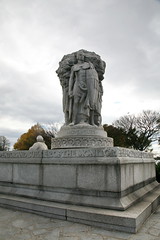
The fountain that now represents DuPont in Washington, DC is actually a product of the famous sculptor, Daniel Chester French, and architect, Henry Bacon. These men also collaborated on another well-known memorial - the Lincoln Memorial on the National Mall. The fountain includes three allegorical figures, each standing 8.5 feet tall. These figures represent the Wind, the Sea, and the Stars, which together symbolize the life at sea that DuPont and the rest of the Civil War Navy enjoyed.

But why was the statue moved and the fountain constructed in its place? Some credit monument reformers who had grown tired of heroic representations of figures in statue form and advocated for more abstract concepts in the forms of fountains and other non-statues. This is thought to be the only situation in which monument reformers managed to remove a statue from a location in Washington, DC and replace it with their version of a proper monument.

So if you ever find yourself in DuPont Circle, while contemplating DuPont the great naval figure, also contemplate the hubbub caused by the efforts to make him monumental.
The Civil War Navy As Seen In DC's Public Art

Anyone who has visited or lived in Washington, DC knows that public art -- especially in the form of monuments and statuary -- is prevalent in nearly all of the city's green spaces. Four of these pieces are directly related to the Civil War Navy and are well worth noticing next time you are in the area.


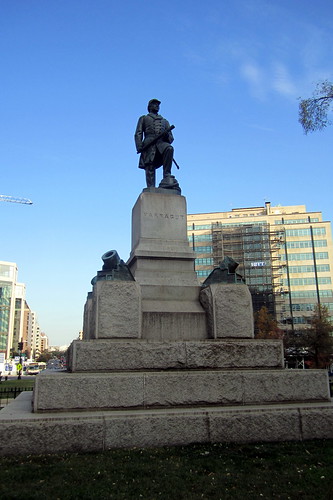
Admiral David G. Farragut appears in standing statue form in Farragut Square (17th and K St. NW). The piece was sculpted by Vinnie Ream Hoxie, cost $20,000, and was dedicated on 25 April 1881.


The Naval Peace Monument also known as the Naval Monument or Peace Monument, was created by Franklin Simmons in 1877 to honor those who died honorably at sea during the Civil War. It is located at Pennsylvania Ave. and 1st St. NW. The cost of the piece was $20,000, paid for primarily by subscriptions from naval personnel.


The DuPont Memorial, a monumental fountain located in Dupont Circle at the intersections of Massachusetts Ave., Connecticut Ave., 19th St. and P St. NW, was paid for by the family of Admiral Samuel DuPont and was dedicated on 17 April 1921. It was sculpted by Daniel Chester French (of Lincoln Memorial fame) and cost $77,521.33.


John Ericsson, the inventor behind the famous Monitor, can be found in West Potomac Park sitting with an allegorical group representing his heritage and contributions. The monument was sculpted by J.E. Fraser at the price of $63,500 and was dedicated on 29 May 1926.


Photographs courtesy of flickr.

Some Artistic Representations of John Ericsson in Washington, DC

John Ericsson’s design for the USS Monitor was crucial to the Union in the early years of the war and proved so important that it became the namesake of that style of ironclad warship. The United States Navy needed their own ironclad to go up against the CSS Virginia, and Swedish-born Ericsson—already a technological inventor and engineer of some renown—saved the day with his idea that seemed "the image of nothing in heaven above, or the earth beneath, or the water under the earth."

Ericsson has a rightful though often forgotten place in American history and one of the best ways to reconnect with slightly obscure figures is to experience artistic representations of their person. A quick search reveals that the Smithsonian’s National Portrait Gallery in Washington, DC has at least twelve pieces of Ericsson-related art ranging from a marble sculpture to traditional oil on canvas to albumen silver print. Most of these portraits are viewable online and this portrait of Ericcson as well as this 1862 group portrait entitled Men of Progress are viewable in person in the National Portrait Gallery’s American Origins exhibit.

After seeing Ericsson’s portraits, don’t forget to visit the John Ericsson National Memorial, located in West Potomac Park, south of the Lincoln Memorial. Here a six-foot-five figure of Ericsson sits surrounded by figures representing “adventure,” “labor,” and “vision”—three qualities that Ericsson and the Civil War Navies truly exemplified.
 
Bloggers Team