Showing posts with label William T. Sherman. Show all posts

New and Noteworthy: Bonfires in the Most Northern of Southern Cities

The Bonfire: The Siege and Burning of Atlanta, Marc Wortman, Public Affairs Press, 352 pages, $26.95, August 2009.

The capture of three great Southern cities were turning points in the American Civil War. The capture of New Orleans in April 1862, the most populated and prosperous city in the Confederacy put Europe on notice and plugged the Mississippi River's Gulf of Mexico and trans-Atlantic trade. The capture of Atlanta in September 1864 put the electorate on notice that the war was being won and that there was a light at the end of the tunnel. The capture of Richmond during the first days of April 1865 routed the Confederate civil government and put it flight.

Recently, Atlanta's Civil War history has received attention In particular, Secret Yankees has revealed that the Northerners that founded the city and lived there remained loyal to the Union and supplied a vast amount of intelligence on commissary stores and troop movements. Marc Wortman offers Bonfire: The Seige and Burning of Atlanta which provides the story of Atlanta from its founding in the 1830s to its burning in the fall of 1865. IN reviewing the index and the first several pages, Wortman's narrative appears to be character driven and accessibly written.

Noted historian, Debby Applegate reports that Wortman offers "extraordinary original research" and "vivid prose and old-fashioned suspense." Wortman is the author of The Millionaires’ Unit: The Aristocratic Flyboys Who Fought the Great War and Invented American Air Power, now in development as a feature film. An award-winning freelance writer, his work has appeared in numerous national magazines. He has taught literature and writing at Princeton University.

The destruction of Atlanta is one of the two epic moments in the film Gone with the Wind. A third epic moment occurred in 1970 when the film was released in major theatres and to my shock and dismay Nancy, my date, burst into tears at the scene where Scarlett is the most broken and then becomes the most resilient. Well, . . . it was an epic moment in my life.

Looking at the stack of soon to be read books on the floor next to my desk, Wortman's Bonfire is next; by the length its bibliography and the first several pages, it looks like one that I might wish to read a second time.

CWL---The Great March To The Sea

Southern Storm: Sherman's March To The Sea, Noah Trudeau, 35 maps, 42 black and white illustrations, order of battle, notes, bibliography, index, 671 pp., Harper Collins, 2008,$35.00.

Trudeau, former National Public Radio program producer and popular Civil War historian, addresses William T. Sherman's 1864 Atlanta to Savannah march through Georgia. Sherman's chief objective was to demonstrate to the Confederacy that there was no place in the South safe from Union troops. Industry and agriculture that supported the South's ability to make war was put to the torch as well as many civilian homes. Trudeau addresses the destruction and finds that it was similar to and did not exceed other campaigns by Northern and Southern armies. Nevertheless, the campaign shocked Georgians who had not experienced the war in any way other than sending soldiers, commissary goods, and armaments forth.

Confederate resistance was limited and what small defensive efforts were taken they were uncoordinated; there was not theatre commander to direct the Confederate resistance. The author does not go to great depths regarding Richmond's lack of leadership on this issue. Over and over again Trudeau shows that Sherman’s orders allowed his army have a great deal of latitude about what to burn and what to take. In a very thorough manner 60,000 Federal soldiers seized Georiga's food and forage. The destruction of Georgia railroads was one of the chief goals of the campaign and was thoroughly accomplished.

Trudeau concludes that Sherman's operational generalship was vastly superior to the Confederate resistance. Also Trudeau frequently shows that the Federal wing and corps commanders made significant tactical decisions. Both wing commanders, Howard Slocum as well as the cavalry corps commander, Kilpatrick, were Army of the Potomac veterans with mixed records in the east. The relationship between Sherman's operational decisions and the other commanders tactical decisions was founded upon the army's engineer officers who produced quickly superior maps for brigade, divisions and corps commanders. Trudeau offers abundant civilians' voices as well as those from enlisted Federal and Confederate ranks. His work is an enlisted men's, civilians' and generals' story.

The army's engineers also transported and installed pontoons and repaired and built bridges from materials on hand. Houses closest to the river nearly always were torn down to provide materials for bridge construction. It appears most destruction of family dwellings that occurred during the campaign was done in order to build bridges. At the operational level, Sherman kept the Confederate commanders guessing as to his destination. Was it Charleston or was it Columbia South Carolina? What it Mobile, Alabama? Was it Savannah, Georgia? This lack of knowing kept Confederate forces fractured.

Trudeau moderately approaches the campaign's myths and gently turns them over. Not necessarily brutal but similar to other armies' campaigns, Sherman's March was neither a lark nor complete desolation. Confederate soldiers fought bravely and against the odds but were often ill-led and themselves victims of meager central planning. Did Sherman abandon runaway slaves to following Rebel guerrillas? Yes. Sherman's policy allowed single families to join the march as employed servants but he refused to escort large bands of runaways through Georgia. As his army lived off the land, he would not allow it to forage for large numbers of blacks. He never put Andersonville prison on the list of the campaign's objectives due to the fact the the army could not absorb 24,000 diseased and starving prisoners and still march.

CWL notes that the maps were very handy and contained weather information; this is similar to Trudeau's maps in Gettysburg that had a clock and weather temperatures. CWL relied upon Earl McElfresh's watercolor campaign map to see the large operational picture and gain an understanding of the terrain and the numerous rivers that had to be crossed. McElfresh Maps are essential additions to CWL's library and are frequently consulted while on guided tours and reading books. The maps are printed on durable paper yet CWL has so frequently consulted the Gettysburg and the Antietam maps and that he has replaced them once.

New In August---Southern Storm, Sherman's March

Southern Storm: Sherman's March to the Sea, Noah Andre Trudeau, Harper Publishing, 688 pp., 36 maps, 16 pp., photographs, notes, bibliography, $35.00

From Publishers' Weekly
Trudeau, a prize-winning Civil War historian (Gettysburg), addresses William T. Sherman's march to the sea in the autumn of 1864. Sherman's inclusion of civilian and commercial property on the list of military objectives was not a harbinger of total war, says Trudeau. Rather, its purpose was to demonstrate to the Confederacy that there was no place in the South safe from Union troops. The actual levels of destruction and pillage were limited even by Civil War standards, Trudeau says; they only seemed shocking to Georgians previously spared a home invasion on a grand scale. Confederate resistance was limited as well. Trudeau praises Sherman's generalship, always better at operational than tactical levels. He presents the inner dynamics of one of the finest armies the U.S. has ever fielded: veteran troops from Massachusetts to Minnesota, under proven officers, consistently able to make the difficult seem routine. And Trudeau acknowledges the often-overlooked contributions of the slaves who provided their liberators invaluable information and labor. The march to the sea was in many ways the day of jubilo, and in Trudeau it has found its Xenophon.

From the publisher:
Award-winning Civil War historian Noah Andre Trudeau has written a gripping, definitive new account that will stand as the last word on General William Tecumseh Sherman's epic march—a targeted strategy aimed to break not only the Confederate army but an entire society as well. With Lincoln's hard-fought reelection victory in hand, Ulysses S. Grant, commander of the Union forces, allowed Sherman to lead the largest and riskiest operation of the war. In rich detail, Trudeau explains why General Sherman's name is still anathema below the Mason-Dixon Line, especially in Georgia, where he is remembered as "the one who marched to the sea with death and devastation in his wake."

Sherman's swath of destruction spanned more than sixty miles in width and virtually cut the South in two, badly disabling the flow of supplies to the Confederate army. He led more than 60,000 Union troops to blaze a path from Atlanta to Savannah, ordering his men to burn crops, kill livestock, and decimate everything that fed the Rebel war machine. Grant and Sherman's gamble worked, and the march managed to crush a critical part of the Confederacy and increase the pressure on General Lee, who was already under siege in Virginia. Told through the intimate and engrossing diaries and letters of Sherman's soldiers and the civilians who suffered in their path, Southern Storm paints a vivid picture of an event that would forever change the course of America.

CWL: Former National Public Radio producer Trudeau has successfully migrated to the print media. Satisfactory scholarship and a pleasant writing style that is accessible to most readers, Trudeau works regularly are featured on bookstores' front tables. The Last Citadel: Petersburg, Virginia, June 1864-April 1865, Bloody Roads South: The Wilderness to Cold Harbor, May-June 1864 and Like Men of War: Black Troops in the Civil War, 1862-1865 preceded his bestseller on the Battle of Gettysburg. Gettysburg is noted for its many maps that have the battle clock on them, closely follow the text which is broken into small parts and provide a strong chronological current to the narrative. For example in Gettysburg, Trudeau recounts each segment of the July 2nd fight for the Bliss Farm, from dawn and continuing through dusk. Each segment is provided about every two hours on the battle clock and is set in the context of the day's events. Buyers should expect a 20% and greater discounts on the retail price; also it is likely that it will be offered soon after publication at www.bomc2.com for $9.95 and free shipping.

News---Uncle Billy! Please Come Home!

After Decades Away, Restored General Sherman Marches Home, Alan Johnson, Columbus Dispatch, March 20, 2008.

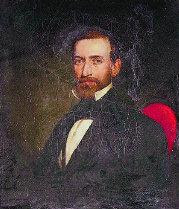
Grime and varnish marred the painting of Gen. William T. Sherman, left. The restored work will be returned to the Sherman museum in Lancaster. Were it not for the sharp eye of a member of the Fairfield Heritage Association, General William Tecumseh Sherman might still be lost after nearly 26 years away from home.

Instead, a rare original portrait of the Civil War general, known affectionately to his troops as "Uncle Billy," will return to the Sherman House Museum, the Sherman family home in Lancaster, in a March 29 ceremony.

The painting, which is about 150 years old, was among dozens of items, almost all of them connected to Sherman himself, that were stolen from the museum in 1982. The portrait was recovered last fall after a museum volunteer saw it in a Garth Auctions catalog. The Delaware, Ohio, art auctioneer and appraiser listed the selling price at $800 to $1,600, but turned it over to the Ohio Historical Society after learning it was stolen. Where was the painting from 1982 to 2007?

No one knows for sure. The woman who commissioned the painting to Garth Auctions for sale had it for only a short period of time and was unaware that it had been stolen, officials said. Barry Bauman, the Chicago art conservator who spent a month and a half repairing and restoring the painting, said he's pretty certain it was in storage. "The portrait was layered with a dirt and grime film, a slow buildup as if it was in long-term storage," he said. "It was so badly treated in the past. … There was a yellow varnish on it, and the background had been almost completely repainted."

Bauman, who formerly worked for the Art Institute of Chicago, did the work on the Sherman painting free. He figures it was a $10,000 job, although no official value has been placed on the restored work. "The conservator is invisible," he said, "but it's a lot of fun to be behind the scenes." The painting belongs to the Ohio Historical Society, which is giving it back to the Sherman museum. It is not signed and contains no date, but it apparently was painted just before the Civil War.

Laura Bullock, director of the museum, said whoever stole the painting and other items in 1982 did some homework. Only items personally connected with Sherman -- the painting and his chair, for example -- were taken from among hundreds of Civil War artifacts. The painting, although unsigned, is "precious to us," Bullock said. The museum has two other paintings of Sherman, one in military uniform and the other when he was 68, three years before his death.

Photographs: courtesy of Barry Bauman Restoration

Contact The Author: ajohnson@dispatch.com

Source: http://www.dispatch.com/live/content/local_news/stories/2008/03/20/SHERMAN_RETURNS.ART_ART_03-20-08_B1_GM9MR85.html?sid=101
 
Bloggers Team