-- Women's eNews, in an article citing correspondent Barnard (right) (credit for photo by Michael Priest). Barnard looked at 200 cables dispatched from 40 different countries, working "with a list of stories that Women's eNews had produced about women's rights in Afghanistan, Iraq, Iran, Saudi Arabia and other hot spots to determine whether U.S. diplomats were addressing these issues in any way." She found "nothing about poverty and women, reproductive rights, etc."
Women are off the U.S. diplomatic map. A look at 200 WikiLeaks cables finds no mention of our rights or struggles, says Corinna Barnard, and a recent check of the ... Council on Women and Girls site found a top story about romping reindeer.
Showing posts with label Saudi Arabia. Show all posts
Showing posts with label Saudi Arabia. Show all posts
'Nuff Said
(Taking context-optional note of thought-provoking quotes)

CEDAW brings advances in Saudi Arabia
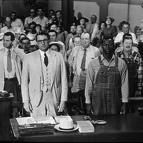 As a child, Tala Hejailan read To Kill a Mockingbird and other books and dreamed of becoming a lawyer. Today, she's a legal consultant waiting for a proposed law to become reality and allow her to become a "real lawyer," fulfilling that childhood dream. The only woman "lawyer" in the commercial law practice where she works, Hejailan cannot represent clients in court because no woman, lawyer or party to a suit, may appear in court unless accompanied by a mahram, a male guardian. A law proposed in February may change that to allow women lawyers to represent clients in family law matters. This would be a boon not only to women who want to be lawyers, but to women needing representation as well: since a woman's mahran is often her husband, she is at a clear disadvantage when seeking divorce or child custody.
The proposed law, which would be limited to family law despite the fact that women are obviously also parties to commercial disputes and subject to criminal conviction, has been under discussion for several years. It would continue efforts to bring Saudi Arabia in line with its obligations under the United Nations Convention on the Elimination of All Forms of Discrimination against Women (CEDAW), which it joined in 2000. Ratification was subjected to a reservation neutralizing provisions that conflict with Saudi law, however, and it wasn't until 2004 that King Abdullah (left, then crown prince) asked the (all male) Council of Ministers to
 modify laws to comply with CEDAW. Wisely, he appointed 9 women to advise the council on matters concerning women. He also suggested having women judges join the men on the bench in family courts, but so far, the only progress in this area, significant as it is, is that in 2007, women were given the right to counsel women and three law schools began accepting women students. May the wise King Abdullah and his advisors continue such reforms to that students like Asma Alamdar my realize their dreams of "being a successful law student and [having] a great career in law in Saudi Arabia," practicing "all that they ha[ve] learned, not just part of it."
(credit for still photo of courtroom scene from the movie To Kill a Mockingbird (prior post)
On November 21
On this day in ...
 ... 1979 (30 years ago today), in Islamabad, a "five-hour siege" that "began as an organised student protest" turned into a mob attack that resulted in the death of one Marine at the U.S. embassy in Pakistan, which was burned to the ground. The BBC attributed the attack to a radio broadcast in which Iran's Ayatollah Khomeini contended that "Americans were behind the occupation of Islam's holiest site, the Great Mosque in Mecca, Saudi Arabia" -- a broadcast that the U.S. State Department said contained "'irresponsible, outright, knowing lies.'" The Washington Post's 2004 retrospective on the attack is here.
(Prior November 21 posts are here and here.)
On March 3
 On this day in ...
... 1938, amid "an arid landscape marked only by the occasional palm-fringed oasis," an event occurred that Time rightly has called a world-changer: at well No. 7 (left), drillers "plumbed to a depth of 4,727 ft. and finally hit what would turn out to be the largest supply of crude oil in the world." (photo credit) Time wrote that the local ruler, Saudi Arabia's King Ibn Saud, who'd hoped the drillers from Standard Oil of California "would find water" with which "he could refresh his warriors' horses and camels,"
did not appear to appreciate the news fully at first. It was an entire year after the discovery when he and his retinue arrived in a caravan of 400 automobiles at the pumping station of Ras Tanura to witness the first tanker hauling away its cargo of Saudi crude. Henceforth the King would no longer rely for income on the pilgrims arriving in Mecca, Islam's holiest city. And his kingdom's petroleum wealth would emerge as a crucial factor in Middle East politics and the bargaining over global energy supplies.
 ... 1918, the newly installed Soviet regime in Russia ended its participation in World War I by signing the Treaty of Brest-Litovsk with Germany and Austria (right). The separate agreement was adopted without the consent of the Allied Powers, on whose side Russia had been fighting. By this treaty Russia gave up much: it
recognized the independence of Ukraine and Georgia; confirmed the independence of Finland; gave up Poland, the Baltic states, and part of what is now Belarus to Germany and Austria-Hungary; and ceded Kars, Ardahan, and Batum to the Ottomans.(Prior March 3 posts are here and here.)
On October 17
 On this day in ...
... 1968 (40 years ago today), with the U.S. national anthem playing at the Mexico City Olympics, 200-meter gold and bronze medalwinners, both African-Americans, "stood with their heads bowed and a black-gloved hand raised." Tommie Smith and John Carlos were members of the Olympic Project for Human Rights, whose badge the Australian silver medalist later wore to show his support for Smith and Carlos. Nevertheless, after U.S. media called them "'Nazi-like'" and "'storm troopers,'" "the two athletes were suspended from their national team, expelled from the Olympic village and sent home to America." (credit for photo (c) Associated Press)
 ... 1973 (35 years ago today), with approval from the world's largest producer, Saudi Arabia, the Organization of Petroleum Exporting Countries launched an oil embargo "meant to punish the West for its support of Israel in the Yom Kippur War." The withholding of oil, which lasted nearly 1/2 a year, "led to long lines at U.S. gas pumps" and "represented a major change in the political power of the OPEC nations." Oil-power-politics remains in the fore 3-1/2 decades later, as is evident in IntLawGrrl Christiana Ochoa's post above.
On women playing well
 To Jaya's excellent post yesterday on "Olympian Courage," I'd like to add a bit more recognition for women's plays during this Summer Games season.
Here's to:
► Hamchétou Maïga-Ba (left) and all the women hoopsters who represented Mali. These 2008 Beijing Games marked the 1st time a women's basketball team was sent by the country, which the New York Times described as "a predominantly Muslim country where women are subject to traditional subservience, genital mutilation, inequitable access to education and household violence." But the simple feat of fielding a team may have begun to change things. Maïga-Ba, who plays forward for the Women's National Basketball Association's Houston Comets, said of the land of her birth:
'Everybody is proud of us, even the guys.'
 ► Mona Eltahawy (right), an Egypt-born, New York-based commentator. She published in the Washington Post a stinging op-ed, which criticized Saudi Arabia for not including any women on its Olympic team. The Post then published its own editorial echoing Eltahawy's complaint.
Caveat:
No country deserves to claim too-high ground on the matter of women in the Olympics. The Times article reminds:
Women were not allowed to participate at the 1896 Summer Games in Athens, the first Olympics of themodern era.
They were expected to contribute applause, not athletic skill. Not until 1984 were women permitted to run the Olympic marathon, in reefer-madness fear that they might grow old too soon with such exertion; or worse, they might grow a mustache.
Or their uterus would fall out, as if it were a transmission.

Nineteen women competed in the 1900 Paris Olympics. The art student who took 1st place in the 9-hole golf tournament (above), Margaret Abbott, "is now recognized as the first female American Olympian winner."
Even today, when many women from many countries compete in many events, there's much room for improvement. More than 1 commentator's wondered if women's beach volleyball would get as much air time if its bikini-clad competitors covered up. (To which should be added this question: Would an activity so singly centered in 1 nation even be included in inter-national competition absent the costumes?)
 Then comes news, from Nayeli Rodriguez at Slate's XX Factor blog, on "the International Table Tennis Federation’s latest strategy for reversing low attendance to its matches": "draw attention to the sexier side of table tennis" by "urging lady players to adjust their competition outfits to flaunt more 'curves.'" (credit for 2007 photo at right of Chinese champion Wang Nan)
Here's hoping one day for an Olympics where attention's focused on how well women played, and not on how well they looked while playing.
"Saudi woman faces death for witchcraft"
The headline says it all. Human Rights Watch broke the story about condemned prisoner Fawza Falih Muhammad Ali earlier this week, when it published this letter to Saudi Arabia's King Abdullah bin Abd al-Aziz Al Saud. And Judith Weingarten, who's guest-blogged here at IntLawGrrls, has more here at her Zenobia blog.
Crime & punishment in Saudi Arabia
 After the cases of Nigerian women Safiya Husseini and Amina Lawal, both sentenced to death by stoning for violations of Sharia (Islamic religious) law (but later acquitted), comes that of "the Qatif girl”, as she is called. Violating the law against being in seclusion with a man not her husband or a relative, this 19-year-old joined a former boyfriend in his car. Soon to be married, she wanted to recover photos he had of her. The pair were dragged from the car by 7 men who then raped both of them. At trial, the victims each received a sentence of 90 lashes; the rapists were sentenced 80-1,000 lashes each and prison terms of 10 months to 5 years. The “Qatif girl” appealed and the decision has shocked even Saudis, which many feel to be motivated by spite against the girl’s human-rights-activist lawyer, Abdulrahman al-Lahem. The victim’s original sentence was already harsh – the standard Saudi punishment for adultery is only 60-80 lashes. Agreeing that the rapists’ punishments were insufficiently severe, the appellate court upped the prison terms to 2-9 years. But it also increased the girl’s sentence to 200 lashes and 6 months in jail. She has not yet been punished and her husband intends to appeal the judgment.
Stuck in Saudi Arabia
Don't miss "A View from Behind the Veil," Megan Stack's gripping account of 4 years reporting on Saudi Arabia for the Los Angeles Times. Her vignettes -- in the 1st, Stack is shunted out of the Men-Only section of Starbucks-Riyadh -- tell a story of a society where, she says, women and men alike are "stuck" between modernity and tradition.
Subscribe to:
Posts (Atom)


