The Civil War Did Not Take Place, William Pencak, Rethinking History Journal, 6:2 (2002), pp. 217-221.
Upon upon comparing and contrasting the media's accounts of the the 1991 Iraq War and eyewitness testimony of the war, Jean Baudrillard in in 1995 declared that the Gulf War did not take place. Pencak makes the same claim that the for the American Civil War is a verbal construction and hides testimony that American citizens would rather forget.
Pencak reviews the history of 'civil war' as a term that signifies the events of 1861-1865. Five stages gauge imperfectly how book titles used the term to describe the great conflict. He finds that the five stages correspond to the historical periods that marked the gradual reconciliation of the two regions. From 1865 to 1872, the term 'civil war' only appeared in the scholarly works of Benson Lossing (1866-1868), J. W. Draper (1867-1870) and Guernsey and Alden (1867). Otherwise, Northerners generally wrote of 'the rebellion' or 'the war for the Union' and Southerners wrote of 'the war for southern independence. At this time Reconstruction issues were at the fore.
During the 1870s, the moral picture became complicated by the continued presence of Federal troops in the South, and political corruption among the friends of U.S. Grant. Democratic Party leaders such as Samuel Tilden, Winfield Hancock, Grover Cleveland relied on Southerners turning out the vote. Pencak notes that from 1873 to 1889 the word/phrase 'rebellion' and 'war for the Union' stilled dominated in the North and 'War Between the States' became dominant in the South. He declares that state sovereignty had not been dismissed in the minds of Southerners and/or that the two regions were national states.
 By the late 1880s, the intersecting issues of European immigration, Populism, and urban disorders became more dramatic that inter-sectional antagonisms. In 1887 President Grover Cleveland returned captured Confederate flags and the 25th anniversary of the battle of Gettysburg was noted. Within 19 years the last Union veteran to be president, William McKinley, stated that North and South are not divided "upon the old lines, but upon principles and policies and the Spanish-American war saw the return of two Confederate generals to the ranks of the Federal army.
Memoirs began to pour forth and the term 'civil war' began to appear in the titles of the works in as many instances as the phrase 'the war of the rebellion' appeared.
For the first time the term 'civil war' was in the titles of books written by Confederate officers. From 1910 to 1920 the term 'civil war' was used in the majority of book titles. This trend continues to the present day. Pancak notes several popular culture references to the war; these anecdotes may indicate change away from the prevalence of the term 'civil war.'
 Granny Clampett of the Beverly Hillbillies became outraged at the use of the term 'civil war' which she defined at a time when the North invaded the United States. Nostalgia for the Confederacy among Southerners and the membership increases in of The League of the South, a relative new organization, are advocating a return to post-war terms. Now 'heritage violations' are committed by Northerners who are unaware of the Declaration of Southern Cultural Independence and the state of Mississippi's attempt to establish the Jefferson Davis Presidential Library. Pencak notes that 'while refutation of historical error can never shake the true believer' it may encourage some to keep an open mind about labels and hidden agendas. Distortions of the past are avoided when historians pay attentions to the historicity of the 'Civil War' as a proper noun. 'The Civil War' is a compromise term.
Special attention should be given to the term during this era of neo-Confederate interpretations. Foremost, Southerners before 1861 insisted that the cause of the war was a fear that the Federal government would interfere with the expansion of slavery or infringe on slavery's current domain. After the war slavery in the Southern mind was diminished as a cause of the war and states' rights elevated as a prime cause. " . . . the only states' right the South really cared about was the right to" keep their slaves. Southerners contested other states' legislation to inhibit the return of runaways by the Federal authorities.
 Pencak understands that the greatest myth regarding the war is the belief that the Confederacy laid down it arms and peacefully embraced reunion. Citing the 700 pages of Congressional testimony regarding incidents of violence committed before 1867, Pencak dismisses the notion that the South lost an essential tenet of the conflict.
From the 1865 to 1877, then from 1877 to the 1960s Civil Rights Movement, the South demonstrated a penchant for violence when ordering its race relations regarding land ownership, suffrage, labor contracts and social intercourse. Pencak's references his conclusions regarding the use of the terms 'civil war', 'rebellion' and others to a bibliography that is provided at the end of the article.
CWL feels that Pencak's essay is compatible with AP history courses and undergraduate students. His writing style is clear, concise and cogent. The essay is conducive to a classroom discussion on the nature of history and historical interpretations. The essay's length, with a list of bibliographic references, is five pages which is an amount that should not be intimidating to academic readers.
Image Source:
Top: Jefferson Davis Presidential Library
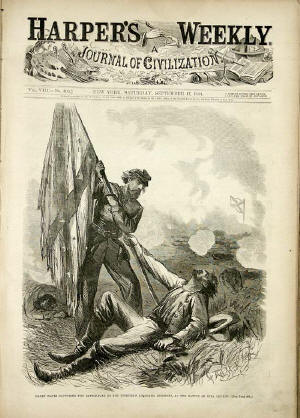
Second: Harpers Weekly Newspaper
Third: League of the South
Bottom: Penn State University