Showing posts with label John Brown; Harpers Ferry WV. Show all posts

News: John Brown Raider's Navy Colt Found By Private Collector; Used in Kansas and at Harpers Ferry, Virginia

Historian Reunites Abolitionist's Gun With Museum, Marylynne Pitz, Pittsburgh Post-Gazette, Wednesday, March 31, 2010.

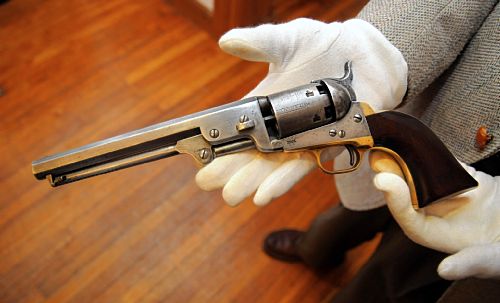
Robin Rombach/Post-GazetteAn 1851 Colt "Navy" revolver once owned by abolitionist Owen Brown.Robert Hassinger bid farewell on Tuesday to an old friend, a revolver whose craftsmanship, hallmarks and engraving led him on a fascinating quest and fed his lifelong passion for American history.

"I like to do research," said the retired insurance investigator, who returned an 1851 Colt "Navy" revolver to the Chicago museum from which it was stolen 62 years ago. Inside the third-floor board room of Soldiers & Sailors Memorial Hall & Museum in Oakland, he donned a pair of white gloves and carefully removed the gleaming revolver from a brown valise.

"There's no pitting, no rust," Mr. Hassinger, 83, said as he showed it to Libby Mahoney, chief curator of the Chicago History Museum, who was visibly impressed by its excellent condition. "I can't really believe that it's resurfaced. You're an extremely honest person," said Kathleen Plourd, the museum's collections director.

At a gun show here in 1991, Mr. Hassinger traded an 1860 Army revolver for the earlier 1851 Colt model because its low serial number piqued his interest. He began researching its history, accumulating information in a neat binder. While paging through Man at Arms magazine in 2001, the North Hills man read an article headlined "John Brown's Colt Navies."

John Brown, a zealous abolitionist, led an ill-conceived raid in 1859 on a U.S. military arsenal in Harpers Ferry, Va. Afterward, he was tried and hanged. Three of his sons also died in the anti-slavery movement. But Brown's third son, Owen, escaped from Harpers Ferry, fleeing to Canada and later returning to the United States. The article reported that Owen Brown's gun, stolen in 1948 from the Chicago History Museum, remained missing and had a serial number of 43156.

Mr. Hassinger knew his Colt revolver bore the initials O.B. on its backstrap. He figured the initials were those of the soldier who used the gun but was never able to match the letters to anyone, even after examining regiment rosters. On the day he got it, Mr. Hassinger showed the O.B. initials to his wife, joking, "This stands for 'Oh, boy, look at the neat gun I got.' " As he matched the serial number to his revolver, he was electrified by the realization that he held Owen Brown's gun in his hand. Now, he faced a dilemma. "I didn't know what to do," he said.

Mr. Hassinger consulted Ronald J. Erhart, a lawyer he knew from the Greater Pittsburgh Civil War Roundtable, who contacted the Chicago History Museum. He got no response. "Maybe they were afraid I was after some money. I wanted some proof that it was stolen," Mr. Hassinger said. "No claim was made to the insurance company because they thought the gun wasn't worth anything."

Mr. Hassinger then consulted Mike Kraus, curator of Soldiers & Sailors. A collector of Civil War artifacts since boyhood, Mr. Kraus believes the revolver is worth between $100,000 and $250,000. Through colleagues, Mr. Kraus reached Ms. Mahoney, Chicago History Museum's chief curator. "She was very interested in talking to me, especially when she heard the phrase, 'Owen Brown's pistol,' " Mr. Kraus recalled.

Ms. Mahoney sent documents showing the Chicago Historical Society accepted the revolver in the 1920s from Frank Logan, a collector of John Brown and Abraham Lincoln memorabilia. The packet included a newspaper account of the gun's theft. That proof satisfied Mr. Hassinger. "I realized that it belonged to them and that it had to go back," he said.

But that didn't make it any easier for him to let go of his crown jewel. "This is what makes me want to get up in the morning. I would love to own this, display it and give talks on it. It's a symbol of the development of this country," Mr. Hassinger said. Collectors, he said, don't really own their artifacts. "We are just custodians of them during our lifetime."

He's sad because Chicago History Museum officials "couldn't guarantee that it would go on display." They also declined to reimburse him for the costs he incurred in acquiring and insuring the gun. "That was never a condition of returning it, [but] why couldn't they just hand me $500 or even $100?" he said.

According to Mr. Hassinger's research, the Army adopted this gun in 1855. The 1st and 2nd U.S. Cavalry were the first regiments to carry it. An image of ships engraved on the gun's cylinder portray a fictional encounter between the Texan and Mexican navies, leading soldiers to call it a "Navy" revolver. Samuel Colt, who invented an innovative revolver, ordered this model to be engraved to honor the Republic of Texas because the first revolver he produced in 1836 was later used by Texas Rangers in fighting Comanches. It was called a "belt pistol" because at that time, soldiers stuck it in their belts.

Mr. Hassinger has a theory on how the revolver wound up in Owen Brown's hands. His father purchased a number of Navy revolvers while living in Lawrence, Kan., from 1856-58. Owen Brown joined his father there, participating in conflicts to prevent that state from becoming a slave state. Kansas joined the Union as a free state in 1861. "The soldier it was issued to may have lost it or may have deserted and sold it," Mr. Hassinger said, adding that the Army rarely recorded which guns were issued to specific soldiers.

Or, in 1856, Owen Brown may have fought with a member of the U.S. Army at a Kansas town called Black Jack, and taken the gun from a soldier there. Black Jack is about 20 miles south of Lawrence, the scene of bloody skirmishes over slavery. The right side of the gun's grip bears the initials of Robert Henry Kirkwood Whiteley, who headed the arsenal on Governor's Island in New York. His stamp meant that the gun had passed inspection and authorized payment for it.

Some time after 1859, Owen Brown returned from Canada to be near his sister, Ruth Brown Thompson, who lived in California. After he died in January 1889, his sister sold weapons that belonged to him and his father to Mr. Logan, who donated the weapons to the Chicago Historical Society. There's a strong market for Civil War memorabilia. "Stolen property remains stolen property," said Mr. Erhart. "He could have sold it to somebody in the black market. He understood that he had a duty to return it to the rightful owner."

Today, Mr. Erhart said, many museums emphasize World War II, and the Civil War's significance is missed by many Americans. "They wouldn't know Owen Brown from Charlie Brown." Mr. Erhart hoped this gun is displayed, for the sake of Mr. Hassinger and history buffs like him. "It may very well never see the light of day again and that hurts him. He has no say in what they do."

Text and Top Image Source: Pittsburgh Post-Gazette, March 31, 2010.

Second Image Source: Owen Brown

Third Image Source: Owen Brown's Grave in California

Fourth Image: Kennedy Farm, Maryland: location of Brown's Provisional Army encampment immediately before the raid on Harper's Ferry, Virginia

150th Anniversary---December 2, 1589: Freedom's Martyr?

Freedom’s Martyr, David S. Reynolds, New York Times, December 2, 2009

It's important for Americans to recognize our national heroes, even those who have been despised by history. Take John Brown.

Today is the 150th anniversary of Brown’s hanging — the grim punishment for his raid weeks earlier on Harpers Ferry, Va. With a small band of abolitionists, Brown had seized the federal arsenal there and freed slaves in the area. His plan was to flee with them to nearby mountains and provoke rebellions in the South. But he stalled too long in the arsenal and was captured. He was brought to trial in a Virginia court, convicted of treason, murder and inciting an insurrection, and hanged on Dec. 2, 1859. It’s a date we should hold in reverence. Yes, I know the response: Why remember a misguided fanatic and his absurd plan for destroying slavery?

There are compelling reasons. First, the plan was not absurd. Brown reasonably saw the Appalachians, which stretch deep into the South, as an ideal base for a guerrilla war. He had studied the Maroon rebels of the West Indies, black fugitives who had used mountain camps to battle colonial powers on their islands. His plan was to create panic by arousing fears of a slave rebellion, leading Southerners to view slavery as dangerous and impractical.

Second, he was held in high esteem by many great men of his day. Ralph Waldo Emerson compared him to Jesus, declaring that Brown would “make the gallows as glorious as the cross.” Henry David Thoreau placed Brown above the freedom fighters of the American Revolution. Frederick Douglass said that while he had lived for black people, John Brown had died for them. A later black reformer, W. E. B. Du Bois, called Brown the white American who had “come nearest to touching the real souls of black folk.”

Du Bois was right. Unlike nearly all other Americans of his era, John Brown did not have a shred of racism. He had long lived among African-Americans, trying to help them make a living, and he wanted blacks to be quickly integrated into American society. When Brown was told he could have a clergyman to accompany him to the gallows, he refused, saying he would be more honored to go with a slave woman and her children.

By the time of his hanging, John Brown was so respected in the North that bells tolled in many cities and towns in his honor. Within two years, the Union troops marched southward singing, “John Brown’s body lies a-mouldering in the grave, but his soul keeps marching on.” Brown remained a hero to the North right up through Reconstruction.

However, he fell from grace during the long, dark period of Jim Crow. The attitude was, who cares about his progressive racial views, except a few blacks? His reputation improved a bit with the civil rights movement, but he is still widely dismissed as a deranged cultist. This is an injustice to a forward-thinking man dedicated to the freedom and political participation of African-Americans.

O.K., some might say, but how about the blotches on his record, especially the murders and bloody skirmishes in Kansas in the 1850s? Brown considered himself a soldier at war. His attacks on pro-slavery forces were part of an escalating cycle of pre-emptive and retaliatory violence that most historians now agree were in essence the first engagements of the Civil War.

Besides, none of the heroes from that period is unblemished. Lincoln was the Great Emancipator, but he shared the era’s racial prejudices, and even after the war started thought that blacks should be shipped out of the country once they were freed. Andrew Jackson was the man of his age, but in addition to being a slaveholder, he has the extra infamy of his callous treatment of Native Americans, for which some hold him guilty of genocide. John Brown comes with “buts” — but in that he has plenty of company. He deserves to be honored today. For starters, he should be pardoned. Technically, Gov. Tim Kaine of Virginia would have to do this, since Brown was tried on state charges and executed there. Such a posthumous pardon by a state occurred just this October, when South Carolina pardoned two black men who were executed 94 years ago for murdering a Confederate veteran.

A presidential pardon, however, would be more meaningful. Posthumous pardons are by definition symbolic. They’re intended to remove stigma or correct injustice. While the president cannot grant pardons for state crimes, a strong argument can be made for a symbolic exception in Brown’s case.

By today’s standards, his crime was arguably of a federal nature, as his attack was on a federal arsenal in what is now West Virginia. His actions were prompted by federal slavery rulings he considered despicable, especially the Supreme Court’s Dred Scott decision. Brown was captured by federal troops under Robert E. Lee. And the Virginia court convicted him of treason against Virginia even though he was not a resident. (He was tried in Virginia at the orders of its governor, probably to avert Northern political pressure on the federal government.)

There is precedent for presidential pardons of the deceased; in 1999, Bill Clinton pardoned Henry O. Flipper, an African-American lieutenant who was court-martialed in 1881 for misconduct. Last year, George W. Bush gave a posthumous pardon to Charles Winters, an American punished for supplying B-17 bombers to Israel in the late 1940s. In October, Senator John McCain and Representative Peter King petitioned President Obama to pardon Jack Johnson, the black boxing champion, who was convicted a century ago of transporting a white woman across state lines for immoral purposes.

Justice would be served, belatedly, if President Obama and Governor Kaine found a way to pardon a man whose heroic effort to free four million enslaved blacks helped start the war that ended slavery. Once and for all, rescue John Brown from the loony bin of history.

David S. Reynolds, a professor at the CUNY Graduate Center, is the author of John Brown, Abolitionist and Waking Giant: America in the Age of Jackson.

Text Source: New York Times, December 2, 2009.

Image Sources:
First and Second Images: Kasama
Third Image: West Virginia Univeristy Library
Fourth Image: Virginia Military Institute

150th Anniversary--- December 2, 1859: The 9/11 of 1859?

The 9/11 of 1859, Tony Horwitz, New York Times, December 1, 2009

One hundred and fifty years ago today, the most successful terrorist in American history was hanged at the edge of this Shenandoah Valley town. Before climbing atop his coffin for the wagon ride to the gallows, he handed a note to one of his jailers: “I, John Brown, am now quite certain that the crimes of this guilty land will never be purged away but with blood.”

Eighteen months later, Americans went to war against each other, with soldiers marching into battle singing “John Brown’s Body.” More than 600,000 men died before the sin of slavery was purged. Few if any Americans today would question the justness of John Brown’s cause: the abolition of human bondage. But as the nation prepares to try Khalid Shaikh Mohammed, who calls himself the architect of the 9/11 attacks, it may be worth pondering the parallels between John Brown’s raid in 1859 and Al Qaeda’s assault in 2001.

Brown was a bearded fundamentalist who believed himself chosen by God to destroy the institution of slavery. He hoped to launch his holy war by seizing the United States armory at Harpers Ferry, Va., and arming blacks for a campaign of liberation. Brown also chose his target for shock value and symbolic impact. The only federal armory in the South, Harpers Ferry was just 60 miles from the capital, where “our president and other leeches,” Brown wrote, did the bidding of slave owners. The first slaves freed and armed by Brown belonged to George Washington’s great-grandnephew.

Brown’s strike force was similar in size and make-up to that of the 9/11 hijackers. He led 21 men, all but two in their 20s, and many of them radicalized by guerrilla fighting in Bleeding Kansas, the abolitionists’ Afghanistan. Brown also relied on covert backers — not oil-rich Saudis, but prominent Yankees known as the Secret Six. Brown used aliases and coded language and gathered his men at a mountain hideout. But, like the 9/11 bombers, Brown’s men were indiscreet, disclosing their plan to family and sweethearts. A letter warning of the plot even reached the secretary of war. It arrived in August, the scheme seemed outlandish, and the warning was ignored.

Brown and his men were prepared to die, and most did, in what quickly became a suicide mission. Trapped in Harpers Ferry, the raiders fought for 24 hours until Robert E. Lee ordered marines to storm the building where the survivors had holed up. Ten raiders were killed, including two of Brown’s sons, and seven more hanged. No slaves won their freedom. The first civilian casualty was a free black railroad worker, shot in the back while fleeing the raiders.

This fiasco might have been a footnote of history if Brown had died of his wounds or been immediately executed. Instead, he survived, and was tried under tight security in a civilian court in Charles Town, near Harpers Ferry. Rather than challenge the evidence, or let his lawyers plead insanity, Brown put the South on trial. Citing the biblical injunction to “remember them that are in bonds,” he declared his action “was not wrong, but right.”

“If it is deemed necessary that I should forfeit my life for the furtherance of the ends of justice,” he said, “and mingle my blood further with the blood of my children and with the blood of millions in this slave country whose rights are disregarded by wicked, cruel and unjust enactments — I submit; so let it be done!” He was hanged a month later, before a crowd that included John Wilkes Booth, who later wrote of the “terroriser” with a mix of contempt and awe.

Brown’s courage and eloquence made him a martyr-hero for many in the North. This canonization, in turn, deepened Southern rage and alarm over the raid. Though Brown occupied the far fringe of abolitionism — a “wild and absurd freak,” The New York Times called him — Southern firebrands painted his raid as part of a broad conspiracy. An already polarized nation lurched closer to violent divorce. “The time for compromise was gone,” Frederick Douglass later observed. “The armed hosts of freedom stood face to face over the chasm of a broken Union, and the clash of arms was at hand.” This was exactly what Brown had predicted in his final note.

Khalid Shaikh Mohammed is no John Brown. The 9/11 attack caused mass, indiscriminate slaughter, for inscrutable ends. Brown fed breakfast to his hostages; the hijackers slit throats with box cutters. Any words Mr. Mohammed may offer in his own defense will likely strike Americans as hateful and unpersuasive. In any event, the judge probably won’t grant him an ideological platform.

But perhaps he doesn’t need one. In 1859, John Brown sought not only to free slaves in Virginia but to terrorize the South and incite a broad conflict. In this he triumphed: panicked whites soon mobilized, militarized and marched double-quick toward secession. Brown’s raid didn’t cause the Civil War, but it was certainly a catalyst.

It may be too early to say if 9/11 bred a similar overreaction. But last night President Obama vowed to increase our efforts in Afghanistan — one of two wars that, eight years on, have killed nearly twice as many Americans as the hijacked planes. The nation, beset by the wars’ burden, will continue to find its domestic and foreign policy options hobbled.

Show trial or no trial, terrorists sometimes win.

Tony Horwitz is the author of Confederates in the Attic and A Voyage Long and Strange. He is working on a book about John Brown’s raid.

Text and Top Image Source: New York Times, December 1, 2009.

150th Anniversary---December 2, 1859: John Brown's Execution; "He Knew How To Die" On The Gallows

“He Knew How to Die”: John Brown on the Gallows, December 2, 1859, David W. Blight, History News Network, November 30, 2009.

One hundred fifty years ago this week, John Brown, the radical abolitionist, walked out of the Charlestown, Virginia jail to a wagon containing his simple wooden coffin. He sat on the box as the wagon conveyed him a half mile to the edge of town for his appointment with the gallows. U. S. troops and Virginia militia guarded this most famous execution in American history, fearing attempts to rescue the leader of the shocking Harpers Ferry Raid. As Brown’s 59-year old body dangled in the cold breeze that morning with the starkly beautiful mountains as a backdrop, Americans all across the land contemplated the meanings of violence, slavery, and martyrdom as never before. And we have never managed to get John Brown – his deeds and his death – out of our consciousness.

Every discussion of the history of revolutionary violence or terrorism (choose your label) in American history begins with John Brown’s efforts to destroy slavery. Today, many have folded Brown’s story into a pleasing sense of the inevitability of the Civil War; Harpers Ferry is viewed as the ordained “first shots” of the nation’s tragic, but worthwhile, struggle to end slavery in a society as Brown so famously put it, “purged with blood.” Some admire Brown as America’s own righteous, Bible-quoting Spartacus somehow advancing our history, a redemptive hero who justifies our self-perception as a nation devoted to freedom and equality. Or, then as now, Brown can be dismissed as the midnight terrorist, the bloody agent of fanatical rage in the name of God’s designs. These extremes can keep us comfortable with our prejudices and our desires, but blind to the authentic fated tragedy in Brown’s acts.

Saintly hero or evil monster, John Brown on the gallows has inspired and haunted American poetry, painting, fiction, and historical interpretation. A living ghost in the national psyche, he will not go away, especially in our post 9/11 world of ubiquitous political and religious violence. John Brown should and does still trouble us; his “soul” may “go marching on” in the song that bears his name, but we should never let him or his story rest too easily in the narratives we tell ourselves. History should never come so cheap as to simply make us feel good about murder in the name of vengeance for slaveholding. Yet, few at the time of his execution could resist the fact that vengeance (God’s or man’s) for more than two centuries of the destruction of the lives, the souls, the collective human future of millions of Africans and African Americans was a primal challenge in the struggle for the very existence of the experiment called the United States.

The raid on the federal arsenal in October and the famous trial that followed were sensational events. But the public hanging, conducted on southern soil by the state of Virginia, was far more important in the long run. If Brown had not been captured so readily, if a slave insurrection in Virginia had killed thousands and Brown himself had been merely shot on some country road and the body never found we would not be thinking about him today. It is all about the gallows. Brown said so himself in one of his many letters from jail while awaiting execution: “I am worth now infinitely more to die than to live.” And many of his admirers would say the same thing over the generations. Ralph Waldo Emerson gushed that Brown had “made the gallows as glorious as the cross.” By 1880, Frederick Douglass, to some extent a co-conspirator with the Old Hero, declared: “I could speak for the slave. John Brown could fight for the slave. I could live for the slave, John Brown could die for the slave.” In 1928, the poet Stephen Vincent Benet tellingly captured Brown’s lasting meaning: “He had no gift for life, no gift to bring/ Life but his body and a cutting edge, / But he knew how to die.” And in Jacob Lawrence’s haunting series of paintings of John Brown done in the 1930s, nearly every one of the 22 images contain some variation of a cross, formal or twisted, made of rifles and spears, or of Brown’s body itself. Lawrence’s Brown on the cross was America on the cross. And no use of this most powerful image of western culture – crucifixion – should ever make us comfortable in our stories.

John Brown should confound and trouble us. Martyrs are made by history; people choose their martyrs just as we choose to define good and evil. And we will be forever making and unmaking John Brown as Americans face not only their own racial past, but the ever changing reputation of violence in the present. Indeed, as Robert Penn Warren, a fierce critic of Brown, nonetheless once said, it is the job of historians to pick the “scabs from our fate.” Love old John Brown or not, if we can do that with this subject we will learn a great deal about ourselves.

Mr. Blight is professor of American History at Yale University, director of the Gilder Lehrman Center for the Study of Slavery and Abolition, and author of Race and Reunion: The Civil War in American Memory.

Text Source:History News Network, November 30, 2009.

Top and Middle Images: Jefferson County West Virginia Historical Society
Bottom Image: Yale University
 
Bloggers Team