Showing posts with label Command and Control of Troops. Show all posts

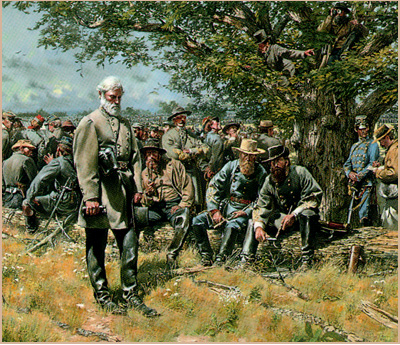
CWL---Lee In the Hands of God at Gettysburg

Did Lee Doom Himself At Gettysburg?, Military History Quarterly Online, August 7, 2009.

By blindly relying on meager intelligence and by being unspecific with his commanders, did Lee place himself in the hands of God at Gettysburg? Lee wrote three different reports explaining decisions he made during the 1863 Pennsylvania Campaign. He implied that his corps and division commanders had failed to move in coordination with each other and he speculated that he had asked to much of the men in the ranks. What is not in his report is an awareness that he believed intelligence that he may have realized, even during the campaign, was wrong and should have treated with caution.

Could Lee have done more to ensure that his commanders understood his intentions? With a thoroughly reorganized army after the battles at Chancellorsville and 2nd Fredericksburg, should Lee have done more to communicate with leaders working in new positions. Did misapprehension and miscommunication flourish in Lee's hands-off management style?

On July 2 though in physical proximity to Hill's headquarters, it appears that Lee did not facilitate Hill's communication with either Longstreet or Ewell. With both Ewell and Longstreet, Lee had one meeting before noon on July 2 with each. A foreign observer at Lee's headquarters reported that only one was sent and one report received at the headquarters. Lee did not have a meeting of all three corps commanders together at any time on July 1, 2, or 3.

"The result of this day's (July 20 operations induced the belief that with proper concert of action and the increased support that the positions gained on the right would enable the artillery to render the assaulting columns, we should ultimately succeed," Lee reported later. He was determined to continue the July 2 assault on July 3; the objective remained unchanged from July 2 through July 3.

In his second official report Lee admitted that he might have asked more of this men that they were able to perform. To his wife Mary, Lee wrote that his men ought not to have been expected to have performed impossibilities. Lee does not leave a statement that explains how he mispreceived impossibilities as possibilities. Lee does not blame his chief of artillery, Pendleton though later Porter Alexander, Second Corps artillery commander does. A decade later at Washington College Lee spoke to William Allen of Stuart's disappointing effort during the Pennsylvania Campaign. Stuart, Lee lamented had failed to give him information and this lack of information deceived him into pursuing a battle the first week in July 1863. Lee further stated that his plan would have routed the Federal army if all elements of the Army of Northern Virginia had moved simultaneously on July 2. At most it was a 'combination of circumstances' that brought about the defeat in Pennsylvania.

It is often noted that Lee explained his generalship as making and communicating plans then allowing his commanders find ways to implement them. How the commanders did that and how the Federals resisted those actions was in God's hands. At Gettysburg his commanders and their troops (in Longstreet's words) never fought harder than on the afternoon and evening of July 2. Was Lee a fatalist like Lincoln?

The article is found at Military History Quarterly

New This Month---Grant's Lieutenants: From Chattanooga to Appomattox

Grant's Lieutenants: From Chattanooga to Appomattox , Steven E. Woodworth, Editor, 256 pages, University Press of Kansas, notes, index, $34.95.
A companion to Grant’s Lieutenants: From Cairo to Vicksburg, this new volume assesses Union generalship during the final two years of the Civil War. Steven Woodworth, one of the war’s premier historians, is joined by a team of distinguished scholars—Mark Grimsley, John Marszalek, and Earl Hess, among others—who critique Ulysses S. Grant’s commanders in terms of both their working relationship with their general-in-chief and their actual performances.

The book covers well-known Union field generals like William T. Sherman, George Thomas, George Meade, and Philip Sheridan, as well as the less-prominent Franz Sigel, Horatio Wright, Edward Ord, and Benjamin Butler. In addition, it includes an iconoclastic look at Grant’s former superior and wartime chief of staff Henry W. Halleck, focusing on his wise counsel concerning Washington politics, the qualities of various subordinates, and the strategic environment. Each of these probing essays emphasizes the character and accomplishments of a particular general and shows how his relationship with Grant either helped or hindered the Union cause.

The contributors highlight the ways Grant’s lieutenants contributed to or challenged their commander’s own success and development as a general. In addition to revisiting Grant’s key collaboration with Sherman, the essays illuminate the hostile relationship between Grant and Thomas, commander of the Army of the Cumberland; Grant’s almost daily contact with “Old Snapping Turtle” Meade, whose expertise relieved Grant of the close tactical direction of the Army of the Potomac; and the development of a highly successful command partnership between Grant and Sheridan, his new commander of the Army of the Shenandoah. Readers will also learn how Grant handled the relative incompetence of his less sterling leaders—perhaps failing to give Butler adequate direction and overlooking Ord’s suspect political views in light of their long relationship.

Like its companion volume, Grant’s Lieutenants: From Chattanooga to Appomattox is an essential touchstone for Civil War scholars and aficionados. It offers new and profound insights into the command relationships that fundamentally shaped both the conduct of the war and its final outcome.

“These stimulating and insightful essays remind us of the collaborative nature of military command and help us appreciate how Grant persevered and ultimately prevailed in directing the Union armies to victory.”—Brooks D. Simpson, author of Ulysses S. Grant: Triumph over Adversity, 1822–1865

“A companion to Woodworth’s earlier collection of essays on top Union commanders that matches the high quality of the original. . . . Offers incisive analysis of the men Grant entrusted with execution of his strategic plans. Scholars and general readers will find much to ponder in this fine book.”—Gary W. Gallagher, author of The Confederate War

“A fascinating and thought-provoking book.”—Stephen D. Engle, author of Struggle for the Heartland: The Campaigns from Fort Henry to Corinth

STEVEN E. WOODWORTH is professor of history at Texas Christian University. He is the author and editor of more than a dozen books, including Nothing but Victory: The Army of the Tennessee, 1861–1865

Contents:
John Marszelak on William T. Sherman
Steven Woodworth on George Thomas
Ethan Rafuse on George Gordon Meade
Earl Hess on Franz Sigel
Mark Grimsley on Benjamin Butler
Benjamin F. Cooling on David Hunter, Lew Wallace and Horatio Wright
Steven Nash on Philip Sheridan
William B. Feis on E. O. C. Ord
Mark Grimsely on Henry W. Halleck.

Text and Image: University of Kansas Press
Table of Contents: Amazon.com

New--The Command and Control of Troops In Battle


America's Civil War: The Operational Battlefield, 1861-1863,Brian Holden Reid, Prometheus Books, 540 pages, $34.95. March 2007.

In 1861, when the Confederate States of America seceded from the Union and Civil War broke out between the North and the South, few people had much idea of the scale, intensity, and duration of the conflict they were about to enter. Politicians, generals, and common folk on both sides blithely assumed that the conflict would be over quickly and were naively convinced of the superiority of the leadership and the forces at their disposal. Three years later, after many horrendous battles and huge loss of life, the tragic realities of this war had begun to sink in. Stalemate had led to great frustration and suggested a protracted conflict with no end in sight.
In this successor volume to his acclaimed Origins of the American Civil War (1996), Civil War historian Brian Holden Reid examines in depth the operational military history during the first three years of America's Civil War. In particular, he focuses on generalship, command decisions, strategy, and tactics, as well as the experiences of ordinary soldiers.

Besides lack of experience among generals, Holden Reid reveals that for the first few years of the war there was considerable indecisiveness in the North, a hesitancy to punish the South, and a fruitless hope that the Confederacy would agree to some form of reconciliation. He highlights certain important political and social developments during the course of the war that had an effect on Union soldiers and shows how their views became a catalyst in hardening the attitudes in the North toward the South.

This important analysis makes a major contribution to Civil War military history within the larger context of a turbulent political and social climate. It will be followed by another work covering the final eighteen months of the conflict.

Brian Holden Reid (London, England) is professor of American history and military institutions and head of the Department of War Studies at King's College, London. Since 1993, he has been a member of the Council of the Society for Army Historical Research and from 1998 to 2004 served as chairman. In 2004-2005, he was the first non-American to serve as a member of the Lincoln Prize jury panel, which awards the most important literary prize in the field of Civil War history. His many books include The Origins of the American Civil War, The Civil War and the Wars of the Nineteenth Century, and Robert E. Lee: Icon for a Nation. (Text From Publisher)
 
Bloggers Team