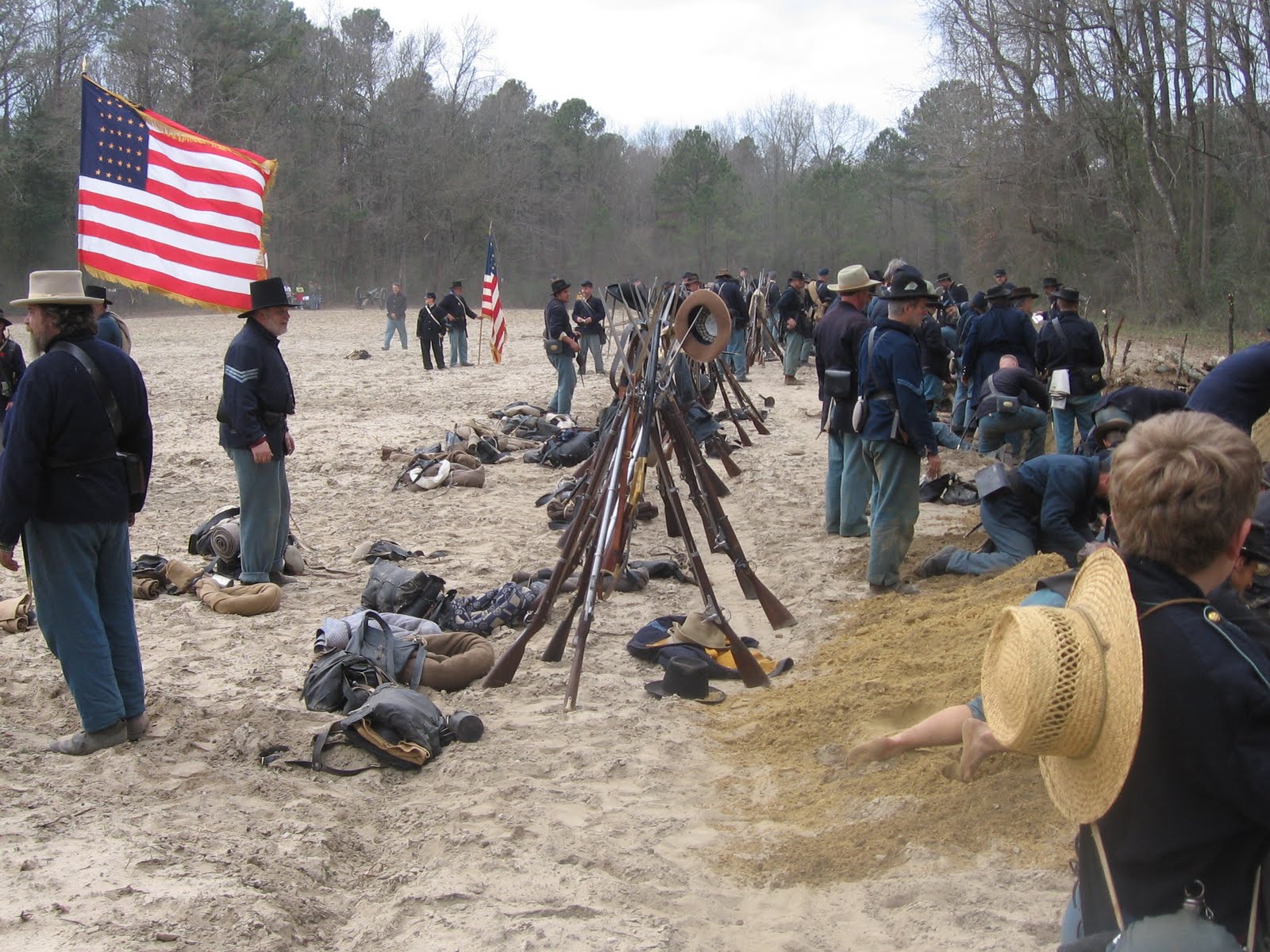
The Civil War Reenactors Rise Again, Erik Spitznagel, Business Week, February 25, 2011.
The 150th anniversary of the start of the American Civil War will make 2011 a banner year for the reenactment business
Tom Hunge knows he's living in the heyday of the modern sutling business. The 67-year-old from Winchester, Va., can't seem to keep enough of his authentic-looking 19th century military supplies—from vintage pencils (25 cents each) to Whitworth rifles ($1,000 and up)—on the shelves. "There have been days when I never put the phone down," he says. "I keep it next to my ear and write new orders for eight hours straight."
This April marks the 150th anniversary of the start of the American Civil War, which, among other things, promises to make 2011 the biggest year for the Civil War reenactment business in 146 years. Hunge estimates that, after a dip in popularity over the past decade, there are now 50,000 serious reenactors in the U.S., a number likely to grow during the sesquicentennial. With a Civil War wardrobe and accessory kit—sans rifle—costing roughly $1,000, 2011 also promises to be very kind to the sutling trade.
Hunge got into the business of sutling, or selling faux-military supplies, in 1961, during the war's centennial. Back then he hauled "six tons" of merchandise to a Gettysburg (Pa.) reenactment and "came home with an empty trailer and a cigar box full of cash," he says. Although his company, Winchester Sutler, now sells exclusively via mail order and the Internet, 2010 sales were up 50 percent from the previous year. In 2011, Hunge expects revenue to more than double. "It's not like we're General Motors," he laughs. "But people realize there's money to be made in this business now."
Hunge isn't the only giddy sutler. Civil War nostalgia has grown into a micro-industry, with specialty stores across the country looking to sell everything from muskets and haversacks to tents and bone toothbrushes. Haberdashers are stocking extra 19th century costumes for Civil War era soldiers, civilians, and even children. Outfitting reenactors is an essential part of a multifaceted Civil War industry that kicks into high gear a few times per century. Bradley Hoch, chairman of the Gettysburg 150th Anniversary Steering Committee, thinks the number of visitors to the area could increase by 33 percent this year, to a record high of 4 million. During the entire sesquicentennial, says Hoch, "We might be looking at total tourist dollars of $2.7 billion or more."
To lure these revelers, Hoch is planning "a rolling thunder of cannon fire." Beginning in April, when the first shots of the Civil War were fired at Fort Sumter, off the coast of Charleston, S.C., there will be demonstrations of events ranging from 19th century domestic life to the burning of Chambersburg, Pa., by Confederate troops. "We'll be using laser lights to simulate the burning," says Janet Pollard, director of Chambersburg's Visitors Bureau, "along with some smoke effects." Hoch and his team are already planning the reenactment of the Battle of Gettysburg, scheduled for July 2013. And the pressure is on: The last major Gettysburg reenactment—during the 135th anniversary in 1998—was considered the benchmark, with an estimated 30,000-plus players and 50,000 spectators.
 For Big Sutling, the sesquicentennial couldn't have come at a better time. During the '90s, "It wasn't unusual to have 20,000 reenactors on the field," says Rea Andrew Redd, a Civil War player and director of the Eberly Library at Waynesburg University in western Pennsylvania. "You sometimes had to pinch yourself." Over the past decade, though, the numbers have dropped significantly, Redd says. According to Tony Horwitz, author of Confederates in the Attic, a post-9/11 mentality is partly to blame. "It's harder to play-act war when we have two real ones," he says. Horwitz also points to a generational shift: "Younger people, addicted as they are to computers and other devices, aren't as keen on spending their weekends in the 19th century."
For veteran reenactors, however, there is nowhere they'd rather be. Scott Harris, director of Virginia's New Market Battlefield State Historical Park, recalls one role player who paid for inexpertly done dental care "so his bridgework and fillings would look more like they did in 1860." According to Horwitz, many reenactors "will starve themselves to achieve the gaunt, hollow-eyed look of underfed Confederates." Others, he notes, might "soak their uniform buttons in urine to oxidize the metal and give it the patina it would have had in the 1860s. They'll sleep in ditches and avoid modern words when in the field. They'll do everything short of firing live ammunition."
This enthusiasm is now spreading to parts of the U.S. not known for Civil War lust. Amateur historian Phil Williams is co-organizing an event called Freedom Fair in Colorado Springs, Colo. He hopes the festival, built around reenactments, will run for three weeks during each sesquicentennial summer, up to 2014. Williams doesn't mind that Colorado didn't join the Union until 1876, more than a decade after the war ended. "Colorado boasts 290 days of sunshine," he says. "We have a lot of green, lush area around us that can be used for reenactment battles. If we put up enough buildings that kinda look like Gettysburg, people will get the basic idea."
Yet historical accuracy can be divisive. Michael Givens, commander-in-chief of the reenactment outfit The Sons of Confederate Veterans, says his organization's goal is to "make sure that the true history of the South is represented." In December the SCV was involved in a $100-per-person "Secession Ball" in Charleston that featured a reenactment of the signing of South Carolina's Ordinance of Secession—as NAACP protesters picketed outside. The SCV's staging of Confederate President Jefferson Davis's swearing-in ceremony—held on Feb. 19 in Montgomery, Ala.—was also controversial.
Politics aside, many Union descendants are also heeding the call. Jeff Chandler, a real estate investor in Kissimmee, Fla., is the great-great-grandson of a member of the Fifth Regiment Maine Volunteer Infantry, which fought in Gettysburg. Last July Chandler visited a Gettysburg reenactment as a spectator and decided, "I want to feel their struggles, everything they went through." He's now ready to pay thousands of dollars for authentic-looking uniforms, accoutrements, and arms. "Whatever you put into this," he says proudly, "you're going to get back."
CWL: Yes, I said that.
Text Source: Business Week, February 25, 2011
Images' Source: Civil War Librarian---Top Image: Maryland Monument at Gettysburg, Second Image: CWL and CWLady at ball in Lynchburg Virginia, 2009.