Showing posts with label Army of the Potomac. Show all posts

New and Noteworthy: History of the Second Army Corps, Army of the Potomac

Defeating Lee: A History of the Second Army Corps, Army of the Potomac, Lawrence A. Kreiser, Jr., Indiana University Press, endnotes, bibliography, appendices, charts, illustrations. 387 pp. $34.95 [April 5, 2011]

CWL: Just received a review copy. Wow! 55 pages of notes, 31 pages of bibliography, 30 pages of appendices, 3 tables, 20 b/w illustrations, 1 map. Even the acknowledgments look good: Lawrence Kohl, George Rable, Richard Sommers, Donald Pfanz, Chris Calkins, and Ted Alexander. The Second Corps was created about 30 days before McClellan stepped off for the Peninsula Campaign. Kreiser carries the story to the end of the 19th century and the veterans' reunions. From a sample of the narrative the prose is clear and concise. Sources appear to be even between enlisted and commissioned soldiers. CWL will be starting this gem quite soon!

Indiana University Press: Fair Oaks, the Seven Days, Antietam, Fredericksburg, Gettysburg, Cold Harbor, Petersburg -- the list of significant battles fought by the Second Corps, Army of the Potomac, is a long and distinguished one. This absorbing history of the Second Corps follows the unit's creation and rise to prominence, the battles that earned it a reputation for hard fighting, and the legacy its veterans sought to maintain in the years after the Civil War. More than an account of battles, Defeating Lee gets to the heart of what motivated these men, why they fought so hard, and how they sustained a spirited defense of cause and country long after the guns had fallen silent.

David E. Long, author of The Jewel of Liberty: Abraham Lincoln's Re-election and the End of Slavery "Kreiser breathes new life into this most important of Union Army units.... A remarkably well-written and superbly researched account."

Forthcoming: The Army of the Potomac's 2nd Corps vs. Army of Northern Virginia

Defeating Lee: A History of the Second Corps, Army of the Potomac,Lawrence A. Kreiser Jr., Indiana University Press, 416 pages, 19 b&w illus., $34.95. Due May 1, 2011.

From the publisher: "Fair Oaks, the Seven Days, Antietam, Fredericksburg, Gettysburg, Cold Harbor, Petersburg -- the list of significant battles fought by the Second Corps, Army of the Potomac, is a long and distinguished one. This absorbing history of the Second Corps follows the unit's creation and rise to prominence, the battles that earned it a reputation for hard fighting, and the legacy its veterans sought to maintain in the years after the Civil War. More than an account of battles, Defeating Lee gets to the heart of what motivated these men, why they fought so hard, and how they sustained a spirited defense of cause and country long after the guns had fallen silent."

Blurb: "Kreiser breathes new life into this most important of Union Army units.... A remarkably well-written and superbly researched account." -- David E. Long, author of The Jewel of Liberty: Abraham Lincoln's Re-election and the End of Slavery

Lawrence A. Kreiser, Jr., is Associate Professor of History at Stillman College, a historically black college located in Tuscaloosa, Alabama. He is co-author of Voices of Civil War America: Contemporary Accounts of Daily Life.

CWL: CWL knows what he will be reading the first week in May.

New--Federal Second Corps at Antietam


Unfurl Those Colors: McClellan, Sumner, and the Second Army Corps in the Antietam Campaign, Marion V. Armstrong, University of Alabama Press, index, notes, bibliography, maps, illustrations, 424 pages.

Unfurl Those Colors! examines the operational fabric of leadership
and command in the Army of the Potomac during one of the most critical campaigns and battles of the Civil War. The Battle of Antietam remains “the bloodiest single day of combat in American history” with over 5,000 killed, 20,000 wounded, and 3,000 missing. Many eminent Civil War historians consider it the turning point of the war.

As a result of the perceived Federal success at Antietam, Abraham Lincoln was able to issue the Emancipation Proclamation to make the war about ending slavery and terminating any hope of European recognition for the South. This book constitutes an operational study of the Army of the Potomac during this campaign and battle, carefully documenting the command decisions of army commander George B. McClellan and following the execution of those decisions through the corps level of command and down to the ordinary soldier in the Second Army Corps.

It reappraises the leadership and decisions of Edwin V. Sumner during the battle of Antietam as the one federal corps commander who was steadfast in carrying out McClellan’s plan of battle and effectively directed the battle on the Federal right. It details as no previous account has the fighting of the Second Army Corps at Antietam to include Sedgwick’s division in the West Woods and French’s and Richardson’s divisions at Bloody Lane.

"Unfurl Those Colors! is a very important contribution to the field of Civil War and military history. While a number of significant books have been written on the Battle of Antietam and the Maryland Campaign, none have narrowed down a particular phase as this book does.” states Ted Alexander, Chief Historian at Antietam National Battlefield Park and a Smithsonian Associates tour guide specializing in Civil War sites.

Marion V. Armstrong Jr. is a retired U.S. Army reserve officer and teaches history at colleges in middle Tennessee.

Source: text from publisher

CWL: It seems Antietam/Sharpsburg is having a good year when it comes to publishers' attention. The Maryland Campaign of September 1862: Ezra A. Carman's Definitive Study of the Union and Confederate Armies at Antietam by Joseph Pierro arrived on the bookstore shelves in late March and now Unfurl Those Colors is upon us. The summer reading stack is getting tall!

News: Army of the Potomac's Winter Huts Location To Be Preserved

Park Proposed For Civil War's 'Valley Forge', Clint Schemmer, Free-Lance Star, March 26, 2008.

Central Stafford County needs a public park, historians and preservationists say, but not of the usual kind. This one, set atop ridges overlooking Accokeek Creek, would feature the most significant remaining set of unprotected Civil War forts and camps in the northern part of Virginia. That's what they recommended yesterday to area officials meeting at the University of Mary Washington's graduate-studies center in Hartwood.

County Administrator Anthony Romanello convened the ad-hoc group, which included Stafford supervisors, archaeologists, historians, planners, private citizens, and officials from the public utility that runs the regional landfill where the historic sites are located. To protect the sites as the landfill grows, the R-Board--or Rappahannock Regional Solid Waste Management Board--intends to preserve 14 to 20 acres of the 760-acre facility.

"The important thing is to convey this land unimpaired for our children--that's the first priority," said John Hennessy, chief historian of Fredericksburg and Spotsylvania National Military Park. "The R-Board has done a great thing by setting this property aside." In January, R-Board members voted unanimously to reshape an 80-acre landfill expansion, giving up 3 to 5 acres, to preserve one of the forts, R-Board Superintendent Andrew J. Mikel said. The other forts and winter camps sit on land nearer the creek, where environmental rules preclude landfill development.

Many participants in yesterday's meeting favored creating a park on the property so the public can see and appreciate the Civil War and 18th-century sites, which include four Union Army forts and two camps where soldiers spent the winter of 1862-63. Supervisor Paul Milde, whose Aquia District includes the tract, strongly supports the park concept.

The idea was first proposed two years ago by Friends of Stafford Civil War Sites, a private group that has worked with builders and county officials to protect and memorialize other Union sites in eastern Stafford. FSCWS made supervisors and planning commissioners aware of the Civil War sites in 2006, presenting a 100-page report on them and urging that they be preserved as a park with a one-lane, one-way road to provide access for visitors. Officials were asked to keep the information confidential to help save the sites, which are little known to the general public but have been dug by relic hunters since the 1950s.

Having waited two years for officials to act, FSCWS is now "impatient" to see the sites made into a park, said Glenn Trimmer, the group's director. Trimmer said the tract is the best surviving piece of the "Valley Forge of the Civil War," the winter camps where the Union Army recovered from its defeats at Fredericksburg and Chancellorsville and in the humiliating "Mud March," and gained the strength to fight again.

"You've got to remember," he said, "soldiers left these camps and went straight to Gettysburg. If they hadn't kept this army intact, and gotten it well trained and well drilled here, Gettysburg would have been a defeat." Author and University of Richmond instructor John W. Mountcastle and Stafford historian Al Conner urged Stafford, Fredericksburg and the R-Board officials to work quickly so the public can enjoy the sites during the Civil War's 150th anniversary, which begins in 2011. Mountcastle said the park could be a boon to regional tourism, much like two Civil War redoubts that Williamsburg saved and opened as a park last year during Jamestown's 400th anniversary.

Kerry K. Schamel-Gonzalez, research supervisor with Dovetail Cultural Resource Group, described two archaeological studies the Fredericksburg firm has done of the tract for the R-Board. Dovetail surveyed 12 sites, including four Civil War forts, two winter camps, a "corduroy" road built by Union troops, an 18th-century road trace and bridge site, two sandstone quarries, and 18th- and 19th-century home sites.

The forts were built to defend against a feared attack by Confederate cavalry, Schamel-Gonzalez said. A network of such earthworks protected the Union encampments in Stafford, home to at least 120,000 troops, and the army's bustling supply depot at Aquia Landing on the Potomac River. Hennessy and others urged that the sites be put on the National Register of Historic Places, to attest to their importance and help preserve them.

Romanello, county Historical Commission Chairwoman Anita Dodd and others said it's imperative to do more archaeology on the whole tract to make sure officials know what historic sites--including Indian and Colonial ones--might be there. At Romanello's suggestion, the principals agreed to form a small study group to hammer out the details of archaeology, preservation and park development. In the meantime, Mikel warned that the historic area, which is posted, is being patrolled by the county Sheriff's Office. Trespassers will be arrested, he said.
Segments from reports by Dovetail Cultural Resource Group and the Friends of Stafford Civil War Sites:

The proposed park tract in central Stafford features 12 archaeological sites, including: FORT 1: This two-faced, 248-foot-long Union Army battery has two gun platforms that may have held 3-inch ordnance rifles or 12-pound Napoleons. At its center is a square, 9-foot-deep supply pit or blockhouse. The fort area includes a zigzag trench and rifle pits.

FORT 2: This three-faced, 210-foot-long battery would have had four or five cannon.

FORT 3: This three-faced battery, which may have held six guns, included a heavily built blockhouse with below-ground storage for powder and shell.

FORT 4: Originally about 200 feet long, this earthwork has been damaged by logging.


WINTER CAMPS: A picket post and two dug-in winter camps, which had log shelters with fireplaces for the soldiers, neighbor the forts. One camp has what is believed to be an officers' quarters made of sandstone.

CORDUROY ROAD: Part of the area's wartime road network included a corduroy road built of logs so the Army of the Potomac could move wagons and heavy guns through boggy areas. Part of one such road, built of pine logs, is perfectly preserved in one swampy site.

BRIDGE ABUTMENTS: Sandstone abutments survive from a bridge that crossed a creek for a well-preserved 18th-century road that was a major route for the Union Army's 11th Corps.

QUARRIES: Two late 18th-century sandstone quarries, one of which appears to have later become a mill, speak to Stafford's role as a provider of building stone. Cut stone was put on skids and pulled by oxen or horse, or loaded onto shallow scows and taken downstream on Accokeek Creek. (The quarry at Government Island, on Aquia Creek, provided sandstone for the White House and the U.S. Capitol.)

Source: http://fredericksburg.com/News/FLS/2008/032008/03262008/366225
Contact: cschemmer@freelancestar.com

Photo: (Top) A Union blockhouse (left) like one found near Accokeek Creek defends Stafford's Potomac Creek railroad bridge. Library of Congres

Photo: (Bottom) Dale Galleon, artist.

CWL-- On Front and Flank: Henry Hunt's Artillery on July 3rd


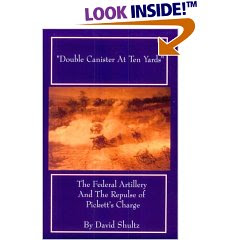
"Double Cannister At Ten Yards": The Federal Artillery and the Repulse of Pickett's Charge, David Schultze, Rank and File Publications, 1995, 77 pages, maps, order of battle, notes, and glossary.

David Shultz' slim but well packed volume opens up the sources regarding the issue of the role that the Federal artillery played in the repulse of Longstreet's second assault. General Pickett responded to a query concerning the Confederate defeat at Gettysburg with the statement "The Union army had something to do with it." After reading Shultz's book, I would say that the Union artillery definitely had something to do with it. I would guess that there may have been as many Rebel casualties from artillery shells as there were from infantry musket bullets.

Quickly, but thoroughly for the purpose of the book, Shultz covers the organization of the Cemetery Ridge artillery line: those pieces under the command of McGilvery, those under Hazard, and those under Osborn (with a nod to Wainwright). Stretching from Plum Run, to the Copse of Trees, to Zeigler's Woods and to the cemetery gatehouse, Henry Hunt brought the talent and the tubes together in the right spot at the right time.

Schultz convincingly describes the mortal effect which McGilvery's and Osborn's pieces had on the flanks of the Confederate assault. Also, the devastation of the pieces under Hazard, at the Union center from the Copse of Trees to Ziegler's Grove, is fully described. In detail, Shultz succintly describes the orders of Hunt and the orders of Hancock, their contradictions, and the effect of the contradictions had on the destruction on the Union center. Also, the decision to cease fire on McGilvery's line, withdraw of peices on Osborn's line and the Confederate belief that their artillery had swept the Union pieces off the ridge is presented.

The maps in the book are adequate but having Gettysburg Magazine at hand was helpful. "Double Canister at Ten Yards" also works well with the PCN dvd Gettysburg Battlewalks: Henry Hunt and Cemetery Ridge. As a taker of the Gettysburg LBG exam, I would put this book on the study list.

CWL --- Brave, Dutiful, Good: George Gordon Meade


George Gordon Meade and the War in the East, Ethan S. Rafuse, McWhiney Foundation Press, 2003, 192 pp., illustrations, maps, index, notes, $29.95.

Ethan Rafuse states his purpose frankly. To provide a chronicle of the life and career of George Gordon Meade and to delineate the forces that shaped the Union war effort in the East and the military and political problems that Meade and other generals encountered as they pursed victory are his goals.(p. 15) He splendidly achieves them.

As in A Single Grand Victory: The First Campaign and Battle of Manassas (2002) and McClellan's War: The Failure Of Moderation In The Struggle For The Union (2005), Rafuse deftly handles the primary sources to reveal the men and their mindsets on the battlefield. In each of his three works, the major dispute between the West Point trained generals, the political generals, and the administration of Lincoln is the line of operations to be pursued when the army advanced upon Richmond.

The West Pointer officers, even Hooker, believed the appropriate base to be the James River. The Lincoln administration, even Halleck, believed the appropriate base to be the railroads running north to south between Washington, DC and Richmond. The West Pointers in the Army of the Potomac were constantly frustrated by the Overland approach and were unable to convince the administration to adopt the James River approach. In the end, it is Grant who uses the Overland route to reach the appropriate base of operations, the James River.

Within the context of this struggle, Meade the commander of a brigade, a division, a corps and an army manages to excel. Citing Meade's extensive letters to his wife, Rafuse reveals a general who while it "was his job to offer suggestions, the final decision as to what policy he was to implement" rested with the Lincoln administration.(p. 169) Unlike McClellan and Hooker, Meade had a great contempt for history that had yet to be written. The statement of this attitude was in a letter to his wife written on April 10, 1865, the day after the surrender of the Army of Northern Virginia. The first draft of that yet to be final draft of history appeared in newspapers. He had a very low opinion of politicians and newspaper editors. He made a effort to shape policy with politicians but made no effort to shape perceptions of newspapermen. He did not attempt to work with politicians by cultivating his own lobby of congressmen and senators.

As a commander of a brigade in the Pennsylvania Reserve division, Meade suffered two wounds at the Battle of Glendale, June 30, 1862. He recovered and rejoined his brigade in time for the Battle of 2nd Manassas in which the Pennsylvania Reserves refused to retreat in the late afternoon of August 30 and, it can be argued, saved the Army of Virginia, from a truly ignominious defeat by capture. Meade ascended to division command before Antietam and to corps command during the battle. He returned to command of the Pennsylvania Reserve division for the Fredericksburg Campaign. He commanded a the Fifth Corps during the January 1863 'Mud March.' He became the last commander of the Army of the Potomac during the early morning hours of June 28, three days before the Battle of Gettysburg.

Meade confided to his wife many personal evaluations. McClellan 'errs on the side of prudence and caution, and that a little more rashness on his part would improve his generalship.' (p.47) Towards Burnside "I never felt so disappointed and sorry for any one in my life as I did" for him; "he really seems to have even the elements against him." (p. 57) "Hooker has disappointed the army and myself in failing to show the nerve. . . . I am sorry for Hooker, because I like him and my relations have been agreeable with him; but I cannot shut my eyes to the fact that he has on this occasion [Chancellorsville] missed a brilliant opportunity." (p. 66)

As for Meade's own generalship, Rafuse provides quotations from both Rebel and Union generals, particularly E.P. Alexander and U.S. Grant, that express an appreciation of his competence and perception of duty. In the course of less than 200 pages, Ethan Rafuse has provided readable, even suspenseful, biography that will be enjoyed by both the buff and the scholar.
 
Bloggers Team