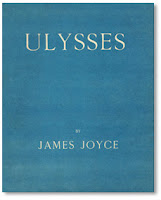
 ... 1922, on the 40th birthday of James Joyce, Irish expatriate, a crowd gathered outside Shakespeare & Company, the bookstore that the American expatriate publisher, Sylvia Beach, maintained in the shadow of Notre Dame, at 12, rue de l'Odéon, Paris. They awaited the arrival from Dijon, France, of the very 1st copies of Ulysses (right), the latest novel by Joyce. He and Beach are shown below left in the store, sitting in front of an edition of "the Sporting Times, also known as The Pink 'Un because it was printed on
  pink paper," which "contained a particularly vitriolic review of Ulysses," which claimed that the book "'appears to have been written by a perverted lunatic who has made a speciality of the literature of the latrine.'" Today Ulysses stands as a preeminent novel of the 20th century. Among its most memorable characters is Molly Bloom, modeled on Joyce's wife, Nora Barnacle (below right).
  (Dare we call Molly the original Desperate Housewife?) Molly's extended soliloquy -- a piece savored by actors like Fionnula Flanagan -- may be distilled into one oft-repeated word: "Yes."
... 1943 (65 years ago today), after 5 months of heavy fighting, the Soviet Union "announced the final defeat of the German 6th Army at the port of Stalingrad, in southern Russia." According to the BBC, "The battle has been described as among the most terrible of the war so far. " According to the New York Times, "more than 100,000 had been killed" in the last 20 days of the battle.


