Showing posts with label Northern Sentiment 1861. Show all posts

CWL--- Street Fighting in St. Louis, 1861

Civil Warfare In The Streets, Adam Goodheart, The American Scholar, Spring 2011, pp.20-32.

"In the early months of 1861--as the Confederate flag unfurled above Fort Sumter, as bands played and newly formed regiments paraded in town and cities throughout the North and the South--two civilians sat disconsolately at the sidelines of the Civil War. One had recently taken a desk job running a a horse-drawn trolley line. He spent most of his days pushing papers, trying his hardest to concentrate on the minutiae of fare revenues and fodder costs, in an office permeated with pungent aromas from the company''s adjacent stables. The other man was down-at-the-heels, small-town shop clerk who had come to the city in search of an officer's commission. He camped out at his in-laws' house, trudging around the city each day, fruitlessly trying to attract the attention of the local military authorities. The trolley-car executive was named William Tecumseh Sherman. The luckless clerk was Ulysses S. Grant. Both--as unknown to one other, probably, as each was to the nation--had found themselves in St. Louis." [20]

With this admirable beginning, Adam Goodheart describes the leading city in one of the nation's most populous and most slave holding states. At the crossroads of the North and the South, of agriculture and industry, of wage labor and slave labor, of native and immigrant Americans, St. Louis was crucial. Lincoln had said that he didn't know of God was on the side of the North but the states of Missouri, Kentucky and Maryland must remain in the Union. Davis' gambled that the bombardment of Fort Sumter would possibly bring into the Confederacy seven more states with slave labor. Without these seven, the Confederacy might be to small to be a republic but too large to be an insane asylum, to borrow a turn of phrase from James Henry Hammond, a South Carolinian.

Goodheart offers a cogent description of the German revolutionaries who migrated after the failed 1848 insurrection. St. Louis' sooty atmosphere lodged on window panes as Germans drilled at night in beer halls, factory warehouses and gymnasiums. Floors covered with sawdust muffled stomping boots and absorbed saliva tinged with tobacco. The Forty Eighters recognized in the slave holders a similar attitude that the landed German nobility held towards wealth, political power and manual laborers.

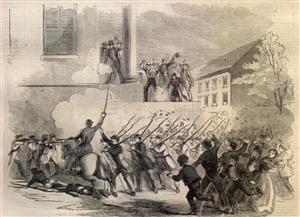
By May 9, Federal troops led by Nathaniel Lyon had the Confederates' Camp Jackson as a destination. With its capture things were going well for the Unionist. Gaurd by Germans, the parade of the prisoners through St.Louis' street lost what was gained that day. Secessionist bystanders spat, cursed, and threw clods of street mud. Bowie knives and revolvers began to appear. And then the war came. German newspaper buildings were burned and the city's wealthy loaded wagons with expensive furniture and fled across the river. For the next four years "Missouri would be the scene of atrocities unlike any seen elsewhere: ceasless guerrilla warfare that erased distinction between soldier and civilian almost entirely; violence with no greater strategic purpose than avenging the violence that had come before; in a few notorious instance, hundreds lined up and executed in cold blood. There would be many more shattered buildings, dead children and dead mothers, gutter awash in blood." [32]

Goodheart's use of primary sources with vivid details is a strength of this essay. Staying close to chronology and not digressing, his work is clear, crisp, and precise. If this article is representative of his coming book, 11861, then both casual readers and Civil War enthusiasts will be well served. CWL sees similarities between Bruce Catton's narrative style and Goodheart's. Catton's Army of the Potomac trilogy and his Centennial History of the Civil War, though 50 years old, are still appreciated by casual readers and history students.

Top Image: Civil War Muse

Middle and Bottom Image Source: Random House Publishing

Poetry---January 1861: Longfellow's Ride of Paul Revere Rallies Union Patriots

How Longfellow Woke the Dead, Jill Lepore, American Scholar, Spring 2011, 33-46.

Paul Revere's Ride, first published in The Atlantic's January 1861 issue, "is a poem about waking the dead." The dead are Northerners and black slaves. [46] Most readers above the age of 40 will recognize the phrases "Listen my children and you shall here/Of the midnight ride of Paul Revere. CWL doubts that most will under 40 years would readily place the author as Henry Wadsworth Longfellow.

Lepore notes that the poem is divided into two parts. The first and most familiar is the description of Boston during the night of April 18th, Revere, his horse and their journey together. The second part leaves Revere's fame behind and the muffled oars are not of British ships in the Boston harbor but those of phantom ships. The change hinges on the name of one of the British ships in the harbor. "The Somerset, British man-of-war; a phantom ship . . . ." To Longfellow and his 1861 audience 'Somerset' is the landmark 1772 legal decision which declared that slavery had never existed in England. [43]

The Somerset, British man-of-war;
A phantom ship, with each mast and spar
Across the moon like a prison bar,
And a huge black hulk, that was magnified
By its own reflection in the tide.

Lepore presents elements of Longfellow's The Witness to place light on the poet's intentions. In The Witnesses there are 'the bones of Slaves/They gleam from the abyss; They cry from yawing waves,"We are the Witnesses!" ' This theme of the dead giving testimony is is also in Revere's Ride.

Beneath, in the churchyard, lay the dead,
In their night encampment on the hill,
Wrapped in silence so deep and still
That he could hear, like a sentinel’s tread,
The watchful night-wind,

The poem finishes with Revere's very ride bearing witness both literally to the sleepers in the hamlets and metaphorically to the 1861 audience, when there 'is an hour of darkness and peril and need.' Longfellow wishes for the readers to act like patriots and 'waken and listen to hear a cry of alarm and 'the midnight message of Paul Revere.'

So through the night rode Paul Revere;
And so through the night went his cry of alarm
To every Middlesex village and farm,—
A cry of defiance, and not of fear,
A voice in the darkness, a knock at the door,
And a word that shall echo for evermore!
For, borne on the night-wind of the Past,
Through all our history, to the last,
In the hour of darkness and peril and need,
The people will waken and listen to hear
The hurrying hoof-beats of that steed,
And the midnight message of Paul Revere.

To put his work in a social context, Lepore uses Longfellow's other poems, his diaries, letters to and from his abolitionist friends including Senator Charles Sumner, a victim of a slaveholder's assault. In January 1861 Longfellow wrote in his diary, "The dissolution of the Union goes slowly on. Behind it all I hear the low murmur of the slaves, like the chorus in a Greek tragedy." Longfellow listened and heard the slaves humble chorus, a midnight message.

Source: Longfellow's Midnight Ride of Paul Revere and top image

Source: Longfellow Postage Stamp

Forthcoming in Paperback---Treason in 1775 and 1860

"Whom Can We Trust Now?": The Meaning of Treason in the United States, from the Revolution through the Civil War,Brian F. Carso, Jr., 262 pp., Rowan Littlefield Publishers, $50.00. (paperback expected in late 2008)

For several hours in August 1787, the delegates to the Philadelphia Convention debated the two sentences defining treason that would serve as the only criminal law in the U.S. Constitution. As storied and controversial as this ancient crime was, the meaning of treason for the new democratic republic was difficult to foresee. Historian and lawyer Brian Carso demonstrates that although treason law was conflicted and awkward, the broader idea of treason gave recognizable shape to abstract ideas of loyalty, betrayal, allegiance, and political obligation in the United States. Taking an interdisciplinary approach, Carso begins by exploring the nature of loyalty and betrayal in a democratic republic, using examples ranging from Socrates in Plato's Crito to the dilemma of Robert E. Lee in 1861 and the trial of Timothy McVeigh in 1997. Turning to legal history, the study considers the historical antecedents of the Treason Clause of the U.S. Constitution and examines the utility of American treason law as it was applied in a variety of cases, most notably in the 1807 trial of Aaron Burr, in which Supreme Court Justice John Marshall used twenty-five thousand words to explicate the Treason Clause. Finding that the antinomies of treason law in a democratic republic make successful prosecutions against treason nearly impossible, Carso turns to the political, intellectual, and cultural realms of civic life to identify and to explain the broader meaning of treason. The study investigates the perpetual condemnation of Benedict Arnold and the many ways treason animated civic discourse during the Civil war. By examining editorials, sermons, histories, orations, art, literature, and political cartoons, Carso identifies how the meaning of treason engaged the public imagination in a variety of compelling forms and instructed citizens on loyalty and betrayal outside the courtroom as much as within it.

Table of Contents
"What is a Traitor?" Loyalty, Betrayal and the State
"A Republic, if you can Keep It" The Evolution of Treason in America, 1620-1787
"Seasons of Insurrection" Early Rebellions and the Trial of Aaron Burr
"The Damnation of His Fame" Benedict Arnold and the Cultural Punishment of Betrayal
"With Malice Toward None" Treason, Amnesty, and the Language of Betrayal During the Civil War

About the Author
Brian F. Carso, Jr., holds graduate degrees from the University of Rochester, SUNY Buffalo School of Law, and Boston University, where he received his PhD in American Studies. A practicing attorney, he has held public office in both county and state government. He is currently an assistant professor of history at College Misericordia in Dallas, Pennsylvania.

Text: from publisher

CWL --- Words From The Well Known: Edward D. Baker, April 20, 1861


Edward Dickson Baker, died at the Battle of Ball's Bluff, VA on October 21, 1861, Major General and Senator from Oregon, Illinois Congressman, close personal friend of Lincoln who named his second son Edward (d. 1850) after him.

In a speech on April 20, 1861 in New York City:

"The hour of reconciliation has passed, the gathering for battle is at hand, the country requires that every man shall do his duty. . . . . I am not here to speak timorous words of peace, but to kindle the spirit of manly, determined war. . . . . Civil War, for the best of reasons upon the one side and the worst upon the other, is always dangerous to liberty, always fearful, always bloody; but, fellow-citizens, there are yet worse things than fear, than doubt and dread, and danger and blood. Dishonor is worse. Perpetual anarchy is worse. States forever commingling and forever severing are worse. Traitors and secessionists are worse."

From The Oxford Dictionary of Civil War Quotations, John D. Wright, ed. 2006.
 
Bloggers Team