Showing posts with label Fort Sumter. Show all posts

Happy 150th Anniversary

Civil War historians and enthusiasts have been waiting for this moment for the last 50 years.  Now a half century removed from the centennial celebration of the American Civil War, we have the rare and special opportunity to commemorate TODAY the opening of this country's most trying conflict.  Today marks the sesquicentennial anniversary of the opening of hostilities at Fort Sumter in Charleston, S.C.  You can see a full list of what they are doing by clicking on the link to the Fort Sumter National Monument HERE.   

The Washington Post came out with a great article outlining Fort Sumter and the making of "modern America."  Here is a direct link: Fort Sumter and Modern America.

The Post also has a great section asking its readers what they think the Civil War's greatest impact was.  HERE is the direct link to the site.

This also marks the birthday of the National Civil War Naval Museum at Port Columbus.  Happy Birthday, guys (Especially Mr. Bruce Smith- keep up the good work!).  We are all glad to hear that the symposium was a success.

So, instead of reproducing reports outlining the minute by minute  account of the battle (there are several sites out there that will be doing this), we would like to know your thoughts on this very special day in our history and collective memory.  Post your responses here, on our Facebook page, or tweet your thoughts @civilwarnavy.  Start the conversation.  Help keep the celebration alive and thriving these next few years. 

Welcome to the Civil War Sesquicentennial.

-CWN 150

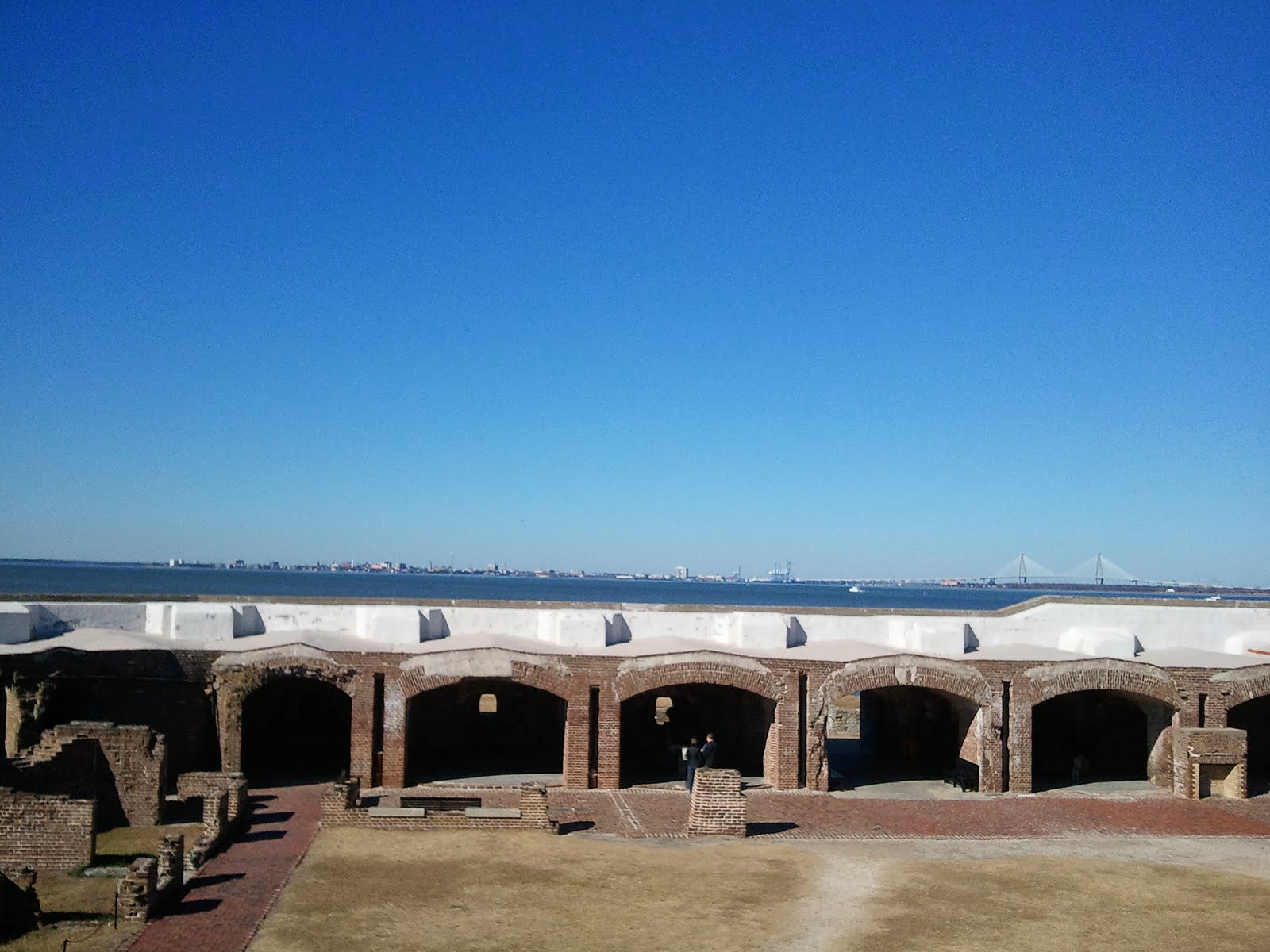
Today's Fort Sumter


Back in December, I was fortunate enough to visit Charleston, SC and - in particular - Fort Sumter. Today, Fort Sumter is owned and managed by the National Park Service, which provides rangers on the transporting boat and within the fort itself. As today is the anniversary of the firing upon the fort and the official beginning of the Sesquicentennial, I felt it was a good time to post just a few pictures.


On a quick personal note, I am excited to enter the Sesquicentennial as part of the CWN150 and I look forward to the next four years of commemorating and learning with all of our readers. -- SA

From the Charleston Mercury, 9 April 1861

"Our authorities yesterday evening received notice from Lincoln’s Government, through a special messenger from Washington, that an effort will be made to supply Fort Sumter with provisions and that if this were permitted, no attempt would be made to reinforce it with men! This message comes simultaneously with a fleet, which we understand is now off our bar, waiting for daylight and tide to make the effort threatened.

We have patiently submitted to the insolent military domination of a handful of men in our bay for over three months after the declaration of our independence of the United States. The object of that self humiliation has been to avoid the effusion of blood, while such preparation was made as to render it causeless and useless.

It seems we have been unable, by discretion, forbearance, and preparation, to effect the desired object, and that now the issue of battle is to be forced upon us. The gage is thrown down, and we accept the challenge. We will meet the invader, and the God of Battles must decide the issue between the hostile hirelings of Abolition hate and Northern tyranny, and the people of South Carolina defending their freedom and their homes. We hope such a blow will be struck in behalf of the South, that Sumter and Charleston harbor will be remembered at the North as long as they exist as a people.”

-------------------
At this time, the sloop of war USS Pawnee was dispatched from Hampton Roads to relieve Maj. Robert Anderson's garrison at Fort Sumter.  Leaving Hampton Roads, the ship would get caught in a storm, arriving too late to help the fledgling fort.  Time was running out, or had already run out for the Navy's assistance of the garrison. 

Reproduction of the Charleston Mercury article courtesy of the Daily Observations of the Civil War, a great site detailing the daily events during the sesquicentennial.  The link may be found at:  http://dotcw.com/events-diary-%E2%80%93-april-9-1861/

USS Brooklyn and Fort Sumter

In early January 1861, with a crisis growing at Charleston, South Carolina, the Secretary of the Navy dispatched the Sloop-of-War USS Brooklyn on a mission to deliver a message.


Commissioned in January 1859, the Brooklyn was among the US Navy's newest ships and reflected some of the cutting edge naval technology of the time. Her horizontal action steam engines turned a screw propeller which gave the ship an 11 knot top speed. She carried twenty-two IX-inch Dahlgren smoothbore guns. Such reflected naval ordnance trends towards all big gun batteries capable of firing both shell and solid shot.

In the first days of January, 1861, the Brooklyn lay at Hampton Roads, Virginia. On January 7, Secretary Isaac Toucey sent orders to Captain William S. Walker, commanding the Brooklyn, to sail toward Charleston.

Walker's orders were to proceed to the bar off Charleston harbor and deliver revised instructions to the army officer commanding a detachment of troops on the steamer Star of the West. The Star of the West had left New York several days earlier carrying reinforcements and supplies for Fort Sumter. According to the revised instructions the steamer would proceed to Hampton Roads, where the troops would disembark. If the troops were already unloaded at Fort Sumter, Walker was to return to Virginia. Although authorized to give "aid and succor" if the Star of the West was fired upon, Walker was not to take the Brooklyn past the bar outside Charleston.

Walker did not receive those orders until the morning of January 9. Even though he set sail by 11:45 a.m. that day, events had already overtaken his mission. That same morning, cadets from the Citadel, stationed on Morris Island outside Charleston, fired upon the Star of the West. The aggressive act caused the ship's captain to abandon the effort and turn back for New York.

Walker arrived off Charleston on January 12 to learn of the Star's repulse. He reported navigation lights dampened, passages blocked with obstructions, and batteries along the shorelines. Thus, one of the first missions of the war for the US Navy ended with a failed rendezvous and undelivered message.

Only following four years of war would US Navy warships venture again past the bar into Charleston Harbor.

----------------------
References:
Official Records of the Union and Confederate Navies in the War of the Rebellion; Series I - Volume 4, pages 220-221.

Official Records of the Union and Confederate Armies in the War of the Rebellion; Series 1 - Volume 1, page 134.
 
Bloggers Team