Showing posts with label Confederate Memoir. Show all posts

New---Faith, Valor, Devotion: Chaplain's Letters from Army of Northern Virginia's Kershaw's Brigade

Faith, Valor, and Devotion: The Civil War Letters of William Porcher DuBose by W. Eric Emerson and Karen Stokes, University of South Carolina Press, 392 pages, $49.95.

Brilliant and devout, William Porcher DuBose (1836-1918) considered himself a man of thought rather than of action. During the Civil War, he discovered that he was both, distinguishing himself as an able and courageous Confederate officer in the Holcombe Legion and later as a dedicated chaplain in Kershaw's Brigade. Published for the first time, these previously unknown letters of DuBose chronicle his Civil War actions with these two celebrated South Carolina units and make an important contribution to the literature and history of the war. They also advance our understanding of DuBose's burgeoning religious ideals as a Civil War combatant who would later become one of the foremost theologians of the Episcopal Church and a distinguished professor at the University of the South.

A native of Winnsboro, South Carolina, DuBose was studying to enter the Episcopal priesthood when the war began. After struggling with the question of secular and spiritual obligations, he decided to join in the defense of the Confederacy and began a long and varied career as a soldier. After service in the lowcountry during the first year of the war, he was thrust into the thick of combat in Virginia, where he was wounded twice and taken as a prisoner of war.

After being exchanged and returned to duty in 1862, DuBose was wounded again at the battle of Kinston in North Carolina, and a year later influential friends arranged for his appointment as chaplain in Kershaw's Brigade. He continued to share in the hazards of combat with the men to whom he ministered as they fought in the battles of Spotsylvania, Cold Harbor, Petersburg, and Cedar Creek in 1864.

Adroitly edited by W. Eric Emerson and Karen Stokes, the more than 150 letters collected here prove DuBose to be a man of uncompromising duty to his faith, fellows, and the Confederate cause. He references his interactions with prominent figures of the day, including General Nathan "Shanks" Evans, John L. Girardeau, John Johnson, Colonel Peter F. Stevens, General Joseph B. Kershaw, Louisa Cheves McCord, and General John Bratton. Also included here are DuBose's wartime courtship letters to his fiancée and later wife, Anne Peronneau DuBose. Collectively these extraordinary documents illustrate the workings of a mind and heart devoted to his religion and dedicated to service in the Confederate ranks.

W. Eric Emerson is director of the South Carolina Department of Archives and History in Columbia. The author of Sons of Privilege: The Charleston Light Dragoons in the Civil War, Emerson has also served as director of the Charleston Library Society and the South Carolina Historical Society. Karen Stokes is an archivist with the South Carolina Historical Society in Charleston. Her articles on South Carolina history have appeared in numerous newspapers and journals.

Text and Image Source: University of South Carolina Press

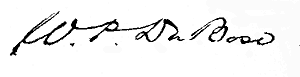
Image Source: Dubose signature

Forthcoming: Memoir of a Confederate Canoneer in General Lee's Army

Where Men Only Dare to Go Or the Story of a Boy Company, C.S.A., ,Royall W. Figg, Foreword by Robert K. Krick,Louisiana State University Press,272 pp, 1 photograph, $19.95, October 2008.

First published in 1885 and long out of print, Where Men Only Dare to Go by Royall W. Figg remains a classic memoir of Confederate service. This updated edition, with a new foreword by historian Robert K. Krick, brings Figg's captivating narrative back into print. Figg tells the story of Captain William W. Parker's Virginia battery, a significant Confederate unit that participated in every important engagement fought by the Army of Northern Virginia. Comprised mainly of young men, it became known as "Parker's Boy Battery." Figg joined the company at age twenty as a charter member at the battery's initial muster on March 14, 1862. He appears on each of the battery's fourteen bimonthly muster rolls from March 1862 to February 1865—an unusually devoted service record. His devotion is evident in the detailed accounting he provides of the battery's history, a vivid and engaging record of the experiences of a Confederate artillerist providing a rich blend of bravery, rascally behavior, and drollery.

J. Thompson Brown, the last commander of Parker's Virginia Battery, described Figg as "a fair representative of our Company, an intelligent fairly educated boy. . . . He was a truthful and Christian gentleman. . . . I believe what he says, as no man could doubt Royal W. Figg's statement." The reappearance of Where Men Only Dare to Go after so many years offers a new generation a chance to read the eyewitness report of this bright, observant young soldier who fought through the famous battles in the eastern theater. Royall W. Figg was a member of Parker's Virginia Battery in Robert E. Lee's Army of Northern Virginia.

Robert K. Krick is the author of numerous books on the American Civil War, including Stonewall Jackson at Cedar Mountain and Conquering the Valley: Stonewall Jackson at Port Republic.

Text: From Publisher

CWL---Simple Story of a Soldier Intrigues and Awaits Further Research


Simple Story Of A Soldier: Life And Service in the 2d Mississippi Infantry, Samuel W. Hankins, John F. Marszalek (Introduction), Fire Ant Books, an imprint of the University of Alabama Press, index, 96 pp. 2004, $12.95

In 1905, Samuel W. Hankins wrote and serialized his memoir in Confederate Veteran magazine. Living in a home for Confederate Veterans located in Gulfport, Mississippi, the 65-year later published his story as a pamphlet in 1912. From northeastern Mississippi, Hankins joined the Confederate army in 1861 when he had just turned 16. His father, not a supporter of secession, joined the Confederate army and ordered is son to stay with his mother. Samuel refused and father accepted him as a comrade in arms in the 2nd Mississippi regiment.

Drill was impossible for some in the 2nd Mississippi; they did not know their right from their left. Hankins describes his train ride to Virginia while riding atop the cars and his encounters with tunnels. Ordered to Jackson's small army, the 2nd Mississippi occupied Harpers Ferry, drilled, bought pieces of rope that had been used to hang John Brown and engaged in gambling. Nothing is mentioned of moving the locomotives down the Valley Pike but the soldiers' narrow eye view of the battle of Manassas is given.

Hankins neglects telling events from July 1861 to April 1862, at which point the 'war begins in earnest.' The soldiers are very soggy. One has a premonition of death. An artillery piece fires at a balloon; the ropes are cut and the balloonist falls to his death. In 1902, while in Corinth finds a former Union soldier who also witnessed the balloonist's fall. The 2nd Mississipi' place at Malvern Hill is in support of the artillery.

The battle of Sharpsburg comes and passes quickly. Hankins describes the Suffolk campaign as it was lived by the privates. Soaked uniforms, lousy clothes, rotting shoes, despicable food. Hankins relates that he was a half an hour from freezing to death while on picket duty; two of his comrades sling him between themselves and force him to walk. He recovers slightly. Readers will painfully accept the conditions of the winter of 1862-1863 and wonder how the 17-year old ever made it through.

Gettysburg comes quickly in the memoir; Hankins is wounded in the foot at the Railroad Cut and to captured. For the reader, the details of this event are very descriptive. Shipped to NYC, then to Fortress Monroe, then to City Point, Virginia, Hankins is exchanged and sent to Mississippi to recuperate. He does and joins other wounded veterans in forming a partisan band of cavalry who roam Mississippi and Alabama in search of a Confederate army to join. They are skilled in staying out of Yankee hands and avoiding combat altogether. The trek nearly destroys their horses and fortunately, a doctor locates a still and reinvigorated the flagging bodies and spirits of the troop.

The Mississippi cavalry battalion takes part in a portion of the Atlanta campaign and then is ordered to Mississippi, back to Alabama, and then back to Mississippi. Learning of the news of Lee's surrender, the unit disbands.

Though meager in the amount of detailed descriptions Harkins offers, those episodes he covers are expressive and from the privates point of view. The captain is the most important man in the memoir. Hankins never meets a general. His personal experience is at the center of this book and rewards the reader. Yet, Marszalek only introduces the pamphlet; there are no notes or annotations in the book. Hankins' memoir awaits a graduate student's efforts. An explanation of the 2nd Mississippi's role and conduct at Manassas and Glendale would be helpful. Hankins' reporting of the death of the balloonist is minimal. Medical care and the lack thereof is important in the memoir and needs to be expanded. The partisan cavalry battalions of Mississippi need to be explained. CWL enjoyed reading Hankins' memoir but wishes to have a fuller picture the privates, corporals, sergeants and captains of the 2nd Mississippi. Long Live Bell Irwin Wiley!
 
Bloggers Team