Showing posts with label 20th Massachusetts Volunteer Infantry. Show all posts

News: Battle of Ball's Bluff at Leesburg, Virginia Receives New and Additional Markers and Trails


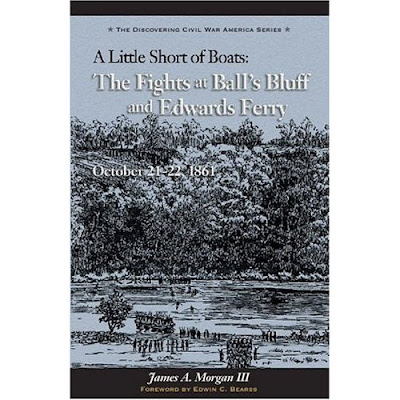
Jim Morgan, author of A Little Short of Boats: The Fights at Ball's Bluff and Edwards' Ferry, October 21-22, 1861 writes that on Saturday and Sunday, September 22 and 23, at 10:00a, the official unveiling and dedication of these new interpretive aids will occur at the Leesburg, Virginia site of the Battle of Ball's Bluff. Beginning at 9:00a and continuing to 4:00p on Saturday and 10:00a to 4:00p on Sunday, there will be a series of living history demonstrations by Union and Confederate reenactors.

"I'm delighted to announce that all the new, updated, and corrected historical markers are in. The original 16 which, even if correct, were weathered and not looking very good, have been replaced with new ones, plus four completely new signs help tell the story even better," states Morgan.
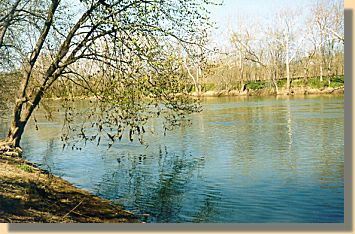

"Two new interpretive trails have been cut as well, and three of the original signs moved to new locations on them. These trails are somewhat more user friendly and on the new "Jenifer trail" the sign related to Lieutenant. Colonel Walter Jenifer, who commanded the small Confederate cavalry force, is closer to where his force actually was on the battlefield. The four completely new signs are at the Baker stone, the Hatcher stone, the bluff overlook, and in a spot roughly in the middle of the field approximately where an 1886 photo of a 15th Mass reunion was taken. It shows how the currently wooded area was actually an open meadow in 1886 and, by extension, in 1861."


"There also is a privately-funded monument to the 8th Virginia now in. Built on a square base of stone that closely resembles the stone in the cemetery wall, it has a slanted top on which sits a plaque listing the battles in which the 8th Virginia fought. It is located close to the Eppa Hunton historical marker. Because of the new sign and trail arrangement, the NVRPA is in the process of creating new trail maps and info brochures" states Morgan. It is hoped that the new signs will be added this autumn.

For those who live in the New York City area, Steve Basic reports that James Morgan will be the speaker at the December 12, 2007 meeting of the NYC Civil War Round Table. Contact Steve Basic through his email .

For additional reading: Harvard's Civil War: The History of the Twentieth Massachusetts Volunteer Infantry by Richard Miller. This regimental history is near the top of the "best of the best list" of new regimental histories read by the Civil War Librarian.

CWL --- And Then There Were None: The 20th Massachusetts at War


Harvard's Civil War: A History of the Twentieth Massachusetts Volunteer Infantry, Miller, Richard F.,University Press of New England, maps, photographs, end notes, selected bibliography and index, 530 pp, $35.00, 2005.

James McPherson tells a story of a commander of the 101st Airborne, who while taking a tour of Antietam and viewing the Sunken Road, stated that "You couldn't get American soldiers today to make an attack like that." 'Like that' meant the 50% casualties that Union regiments suffered at the center of the Confederate line.
Why not? Is it because neither the soldiers nor the public would tolerate casualties of that magnitude?

McPherson suggests that the wrong question is being asked. The 1st Texas at Antietam, the 1st Minnesota and the 26th North Carolina at Gettysburg suffered 80%+ casualties. What motivated these men and how did they endure the losses and return to battle? These are question McPherson has addressed in several books and articles.

Richard F. Miller in Harvard's Civil War offers a particular understanding of leadership as the answer to the question of motivation. The ideals of sacrifice, honor and duty, embodied in classical education of the era, were carried by the eight officers of the 20th Massachusetts Regiment who were killed in battle and the many who were wounded and the very few who were unscathed. Many of these men were descendants of the Revolutionary generation. Did the enlisted men, the non-commissioned officers and the commissioned officers disagree about slavery, about emancipation and about Lincoln's war aims and policies. Certainly. Yet the steadfastness and courage in battle of the 20th Massachusetts remained unaffected by the arguments over tactics, strategy and policy. The enlisted men did not select the commissioned officers; it was the prerogative of Massachusetts governor John Andrew to do so.

But these ideals were not limited to those with shoulder boards. John Kelliher, bootmaker in civilian life, first sergeant, lieutenant and captain in the 20th Massachusetts, was wounded at Spotsylvania in 1864; his lower jaw, an arm and shoulder blade, a portion of the clavicle, and two ribs were removed. In six months returned to the regiment as a major and finished the war in the active ranks.

Richard F. Miller's story of the 20th Massachusetts is among the best regimental histories that have been produced in the last 20 years but there are distractions between its covers. The book is not really about Harvard's Civil War. The institution is used as a frame for Miller's picture of the regiment. This book is not a history or biography of Harvard alumni. The ending of the story is rushed. In one paragraph, the 20th moves through 2nd Hatcher's Run in February 1865 to Farmville, Virginia, April 6th 1865. This paragraph is the fourth from the last paragraph of the book. Though the first chapter is entitled July 21 1865 and recounts the reception of Harvard's alumni who were now veterans of the war, it is not a fit as the end of the regiment's story.

Helpful for the reader would have been a chronology, a roster, and a brief section dealing what became of the significant surviving men and officers after the war. The maps are satisfactory as are the 34 photographic portraits of men of the regiment.
 
Bloggers Team